A Pragmatism Too Far?

It’s extremely hard to reconcile the events of the past month or so with the rationale of the Obama presidency. And that’s what makes this capitulation to hysteria so profoundly depressing. I can see the simple pragmatism behind it: the president under-estimated the strength and tenacity of these maniacs, and feared they could make further gains, plunging the region into a new turmoil. The media and the elites all jumped into full metal panic mode and created a powerful momentum for action. In fact, the elite consensus in favor of attacking ISIS was, until last night, at least, eerily reminiscent of the elite consensus in favor of going to war in Iraq in 2003 – without the year or so of debate. If US-ATTACKS-9/11-ANNIVERSARY-OBAMAyou’re Obama, you do not believe you can really solve this problem, but you need to do something, both to stave off possible disaster, to guard against potential ISIS expansion, and to try and rescue the Iraqi “state” one more time. So you rely on air-power, you corral the Saudis to help train and fund Sunni opposition to ISIS, you funnel some arms to the “moderate” Syrian rebels … and hope for the best.

What this misses in its flexibility is that it comes at the cost of profound incoherence. Presidencies need a grand narrative if they are to succeed. Obama’s was a simple one: to slowly rescue the US from the economic and foreign policy nadir that Bush-Cheney bequeathed us. We would slowly climb back out of the hole of fiscal recklessness and financial corruption into a saner, calmer period of slow but steady growth. We would slowly de-leverage from counter-productive over-reach in the war on Islamist terrorism. We would end two wars. We would begin nation-building at home – in the form of universal health insurance and badly needed infrastructure improvement. Above all, we would not be jerked back and forth by Islamist fanatics abroad, seeking to chart a course of steady strategic retrenchment.

Now, of course, this was never going to be a linear path. I feared back in 2009 that withdrawing from Iraq might look a lot like withdrawal from Vietnam. That it took place without a bloodbath or national humiliation was a triumph of optics and luck and bribery. But I was never under any illusion that the “surge” had succeeded in its own terms. We had no guarantee that Iraq would not return almost instantly to the sectarian distrust, hatred and violence that have been integral to its existence for decades. Kurdistan could work – but the rest remains ungovernable, except by tyranny and terror. And so yet another spasm of Shi’a-Sunni violence seemed inevitable to me. But at least, we would no longer be sitting in the middle.

I don’t buy for a second the lame idea that if the US had kept a residual force there – despite Baghdad’s express wishes – we would have avoided the current turmoil. We couldn’t control or end it with a hundred thousand of the best-trained troops in the world. What chance would 10,000 advisers have to counter the weight of history and the cycle of revenge? So there would come a point at which Iraq would implode again and the US might be tempted to intervene. I naïvely thought no sane American, after the Iraq War, would ever support that. I foolishly believed we would not be able to instantly erase – like an Etch-A-Sketch – all that we so painfully learned in that catastrophe.

What I under-estimated was the media’s ability to generate mass panic and hysteria and the Beltway elite’s instant recourse to the language of war. I believed that Obama was stronger than this, that he could actually resist this kind of emotional spasm and speak to us like grown-ups about what we can and cannot do about a long, religious war in the Middle East, that doesn’t threaten us directly. But he spoke to us like children last night, assuming the mantle of the protective daddy we had sought in Bush and Cheney, evoking the rhetoric he was elected to dispel.

What the president doesn’t seem to understand is that this dramatic U-turn isn’t just foolish on its own national security terms; it is devastating to him politically. He is now playing on Cheney’s turf, not his own. His core supporters, like yours truly, regarded our evolution from that Cheney mindset one of Obama’s key achievements – and he tossed it away last night almost casually. He committed himself and us to a victory we cannot achieve in two countries we cannot control with the aid of allies we cannot trust. And, worse, he has done so by evading the key Constitutional requirement that a declaration of war be made by the Congress. He is actually relying on the post-9/11 authorization of military force against al Qaeda in Afghanistan to wage war in Syria (in violation of international law) and in Iraq.

This is not just a betrayal of a core principle of his presidency – a restoration of normality – it is a rebuke to his own statements. This is what the president said last year:

We cannot use force everywhere that a radical ideology takes root; and in the absence of a strategy that reduces the wellspring of extremism, a perpetual war — through drones or Special Forces or troop deployments — will prove self-defeating, and alter our country in troubling ways.

His speech last night was an argument for doing exactly what he said we should not do a year ago. He has made no attempt to explain why he has completely changed his mind – except to react emotionally to a vile off-shoot of another Sunni insurgency in Iraq. This does not only mean his administration no longer has a coherent narrative, it also means he is utterly hostage to forces abroad he cannot control. His refusal to go to Congress for a prolonged open-ended campaign in Syria is also utterly inconsistent with his decision a year ago to go to Congress before even considering punitive air-strikes in response to Assad’s use of chemical weapons.

If he believed he needed to go to Congress for that limited engagement, how on earth can he argue with a straight face that he does not need to now? It makes no sense – and no one in the administration has been able to make a persuasive case for this walking contradiction.

That seems to me to leave us with a small chance to nip this in the bud. I believe that the administration needs to get direct authorization from the Congress to re-enter the Iraqi theater and enter the Syrian one by October 7 – 60 days since the first air-strike. Again, this is completely consistent with Obama’s previous positions. We have to break the war machine’s ability to do what it will without any constitutional checks upon it. We need to demand a full debate and a serious declaration of war. We are, after all, planning at least a three-year campaign in Syria, without the Syrian government’s approval, and in violation of international law. How can we do that without direct Congressional authority – especially when the administration has declared that ISIS is not a threat to the homeland?

Maybe there are enough Democratic and Republican skeptics in the Senate to force a vote. Even if they lose, such a vote would at least force these cowards to own a war they are acquiescing in, to share the full responsibility and face the voters, and to be subsequently accountable for its failures or modest success. And if an open-ended war against an entity that has not attacked the US or plans to do so is not something that the Congress should approve, then we really are an empire, and not a republic.  We are an empire with an executive branch that controls war and peace, that launches covert and overt wars, that keeps the US on permanent offense across the globe, creating as much terror as it prevents, and entangling us in one more sectarian vortex of fickle friends and mortal foes.

I refuse to cave into depressed acquiescence to this machine, even as it has now captured the one president who promised to restrain it. The only way to do this is to build a strong campaign – not least among Obama supporters – that no war be continued past October 7 without full Congressional debate and formal authorization.

Are we able to prevent the US from entering another nightmarish engagement in a part of the world that rewards no one?

Repeat after me: Yes. We. Can.

(Photo: US President Barack Obama stands at the Pentagon in Washington, DC, September 11, 2014, for a moment of silence marking the 13th anniversary of the 9/11 attacks on the United States. By Jim Watson/AFP/Getty Images.)
Congress Isn’t Doing Its Job

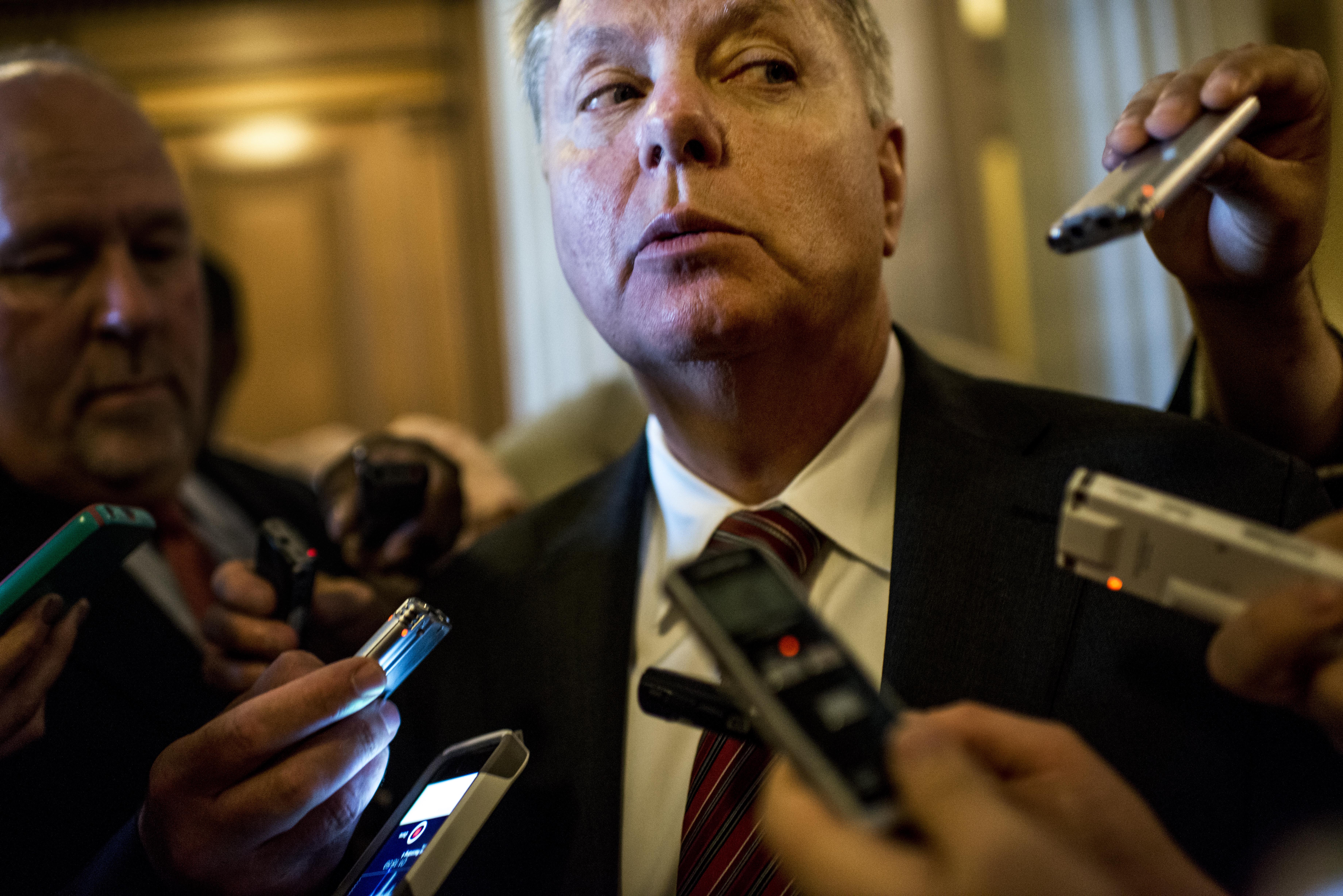
enator Lindsey Graham (R-SC)

Obama is claiming, dubiously, that he has the unilateral authority to fight ISIS. Even if that were true, Drum sees good reason to get Congressional approval:

If Obama is truly serious about not sending combat troops into ISIS-held areas in Iraq, then let’s get a congressional resolution that puts that in writing. Let’s get an authorization for war that spells out a geographical area; puts a limit on US troop deployments; and specifically defines what those troops can do. … It forces the president to explicitly request an escalation and it forces Congress to explicitly authorize his request. At the very least, that prevents a slow, stealthy escalation that flies under the radar of public opinion.

Why Andrew Napolitano wants Congress involved:

[W]ar often has surprise endings and unexpected human, geopolitical, and financial consequences. A debate in Congress will air them. It will assure that the government considers all rational alternatives to war and that the nation is not pushed into a costly and bloody venture with its eyes shut. A congressional debate will compel a written national objective tied to American freedom. A prudent debate will also assure that there will be an end to hostilities determined by congressional consensus and not presidential fiat.

Rand Paul, for one, is speaking up:

“It doesn’t in any way represent what our Constitution dictates nor what our founding fathers intended,” Paul, a likely 2016 presidential contender said on Fox News. “So it is unconstitutional what he’s doing.

“He should have come before a joint session of Congress, laid out his plan—as he did tonight—and then called for an up or down vote on whether or not to authorize to go to war,” Paul added. “I think the President would be more powerful [and] the country would have been more united.”

But Keating won’t be surprised if Obama chooses to go it alone:

It’s certainly valid to argue that just because ISIS have proven themselves to be more Kobe than jayvee, it doesn’t mean that airstrikes in Syria are a prudent policy. And there’s a good debate to be had about the role of Congress in authorizing military action in an age of asymmetrical threats and drone warfare. But let’s not kid ourselves: Shooting first and asking Congress later has become the rule, not the exception.

(Photo: by Melina Mara/The Washington Post via Getty Images)

The President’s Bullshit Legal Basis For War

Refugees Fleeing ISIS Offensive Pour Into Kurdistan

Eli Lake passes it along:

One Obama administration official said the argument that the new war is legal under the 2001 AUMF stems from the fact that ISIS began as a franchise of al Qaeda. Initially ISIS was known as al Qaeda in Iraq and at one point its leader, Abu-Bakr al-Baghdadi, pledged allegiance to al Qaeda in what’s known as an oath of Bayat.

But that argument would essentially ignore the fact that Baghdadi today has publicly broken with al Qaeda and declared himself the Caliph of the Muslim world.

Elias Groll hears a version of the same argument:

According to the senior administration official, that split does not matter for the purposes of targeting the Islamic State under the AUMF because of its “longstanding relationship with al Qaeda and Osama bin Laden” and “its long history of conducting, and continued desire to conduct, attacks against U.S. persons and interests.” In addition, the official said, there is “extensive history of U.S. combat operations against ISIL dating back to the time the group first affiliated with AQ in 2004.” ISIL is an alternate name for the group.

Describing the group as “supported by some individual members and factions” of groups aligned with al Qaeda, the official described the Islamic State as “the true inheritor of Osama bin Laden’s legacy.”

Robert Chesney, who is “cautiously supportive” of the Obama’s ISIS policy, rejects this legal rationale:

Until this evening the big AUMF interpretive boundary seemed to be the notion that it extended only to AQ’s associated forces actually engaged in hostilities against the United States (though the recent al Shabaab strike perhaps shows this line was not so important after all?). Now we are speaking not just of “associated forces,” but also “disassociated forces” that might, from a certain point of view, be seen as “successor forces.” Will we later hear of the AUMF applying to associated forces of this successor force? It is not hard to imagine many of them popping up the Iraqi-Syrian theater.

Benjamin Wittes is also throughly unimpressed by the administration’s logic:

This is not a stable or sustainable reading of the law, absent some dramatic, non-public intelligence about the ISIS-Al Qaeda relationship. Remember that this is a law that barely a year ago, President Obama was lecturing us needed to be narrowed and repealed. “This war like all wars must end,” he piously intoned. Apparently not, however, before we dramatically expand its interpretive scope and deploy it to support a new and open-ended military campaign that, in the president’s own words, “will take time.” All to avoid asking the girl, who might say no, to dance.

Jack Goldsmith joins the chorus:

The largest irony here is that President Obama has long hoped to leave a legacy of repealing the Bush-era authorization and declaring the “war” against al Qaeda over. “I look forward to engaging Congress and the American people in efforts to refine, and ultimately repeal” the 2001 law’s mandate” he said in a speech last May at the National Defense University. “I will not sign laws designed to expand this mandate further,” he added, before insisting that “history” and “democracy” demand that “this war, like all wars, must end.”

President Obama never did engage Congress to refine the 2001 law. The violent reality of the Islamic State has quickly belied the supposed demands of history and democracy. And the President, all by himself, has now dramatically expanded the 2001 mandate.

Ilya Somin counters those who contend that this isn’t a war:

Some defenders of the administration, such as legal scholar Peter Spiro, argue that the campaign against ISIS does not need congressional authorization because it is not a “real war,” primarily because the president assures us it will be limited to air strikes and probably won’t involve a risk of significant US casualties. The president himself said tonight that the campaign against ISIS “will not involve American combat troops fighting on foreign soil.” Such arguments are difficult to credit. Air attacks are among the most important instruments of modern warfare, and Air Force and Navy pilots surely qualify as combat troops; and it’s hard to see a meaningful distinction between “fighting on foreign soil” and bombing foreign soil. Repeated air strikes intended to – as the President put it – “degrade, and ultimately destroy” a potent enemy force that controls a great deal of territory, qualify as war by any reasonable definition. Claims that large-scale air attacks don’t count as warfare were specious when the administration trotted them out in defense of its intervention in Libya in 2011; and they have not improved with age. You don’t have to be a constitutional law professor, like the president, to see that.

Steve Vladeck doesn’t want to lose sight of the forest for the trees:

[A]ll of this focus on the legal rationales for military force shouldn’t obfuscate or excuse our continuing lack of understanding of the threshold questions: What, exactly, is the threat that ISIL poses to the United States, and why is that threat sufficient to justify uses of force beyond conventional self-defense? We heard a little bit on this front in the President’s speech last night–but, at least in my view, not nearly enough. And so for all the oxygen that will be consumed in the coming days and weeks over the meaning and scope of the 2001 AUMF, we shouldn’t let that drown out these critical (and necessarily antecedent) questions.

And Yishai Schwartz spells out the trouble with the administration claiming that “it is the ideology that matters, not the organization”:

The problem with the President’s legal theory is not just that it guts congressional war powers, but that it also seriously hampers our ability to achieve any kind of victory. Ideologies are notoriously difficult to stamp out. They evolve and spread and can go underground. States cannot. And while the Islamic State is most definitely a terrorist group, it is also a state. It has territory under its control and centralized bureaucracyall of which makes it more easily destroyed. As they draft and interpret their resolution, Congress, and the president, ought to remember that.

(Photo: By Spencer Platt/Getty Images)

Why Are We Going To War?

David Rothkopf suspects that, “what Obama began last night will be left to another president to finish”:

A strategy requires achievable goals and a plan to realize them. A good U.S. national security strategy also should be built around an outcome that enduringly advances national interests. This speech lacked several key components in both respects. It did not specify who was in the coalition that would help achieve our goals or what the division of labor would be among the participants. Most glaringly in this respect, it did not address the issue of who would be providing the critical “boots on the ground” component of the coalition, the ones our air power would support. There is no strategy without them. There is also no good strategy if, by default, they end up being bad guys who pose a different kind of threat – as would be the case if we end up being the air force for the Syrian regime in its battle with IS, or with Iranian troops, or with Iranian-led Iraqi troops (as has already been the case in Mosul and Amerli).

Christopher Dickey predicts ISIS will survive the onslaught:

The group originally known as al Qaeda in Mesopotamia, which evolved into ISIS and now Islamic State or the Caliphate, has proved especially resilient. During the American-led surge in Iraq in 2006 and 2007, the organization bore huge casualties. But detailed research into documents captured from the group shows it had a well-defined structure that enable it to survive despite enormous losses.

“It could not do much when it was in survival mode, but it did survive,” says Princeton Prof. Jacob Shapiro. “The implication for dealing with the Islamic State is that we should not expect it to be destroyed for a long time. Even if there is a successful coordinated effort against it, the group will likely remain capable of conducting terrorist acts in Iraq and Syria for the foreseeable future.”

Friedersdorf pinpoints the faulty logic in Obama’s speech:

[I]f America didn’t successfully eliminate violent extremists in Afghanistan or Iraq even with tens of thousands of boots on the ground, if extremists in those countries began to gain more power as soon as Americans left, if we didn’t manage to successfully train their armies even during a years long deployment of our best forces, why do we think that a foe Chuck Hagel characterizes as the most formidable we’ve seen in the War on Terror can be beat with airstrikes and a few hundred advisors? Or are they not as formidable as Team Obama has led us to believe? The White House may have an internally consistent logic that they’re not sharing. Evaluating it is difficult so long as they talk to us like we’re stupid.

But what if Obama’s goals are much more modest? Juan Cole asks, “What if he really does mean he has a Yemen-like situation in mind?”

What if Obama wants to prevent the fall of Baghdad, Erbil and even Riyadh? What if he is privately skeptical about Baghdad recovering Mosul any time soon? He has after all used drones in Waziristan in northwest Pakistan not to inflict military defeat but for tactical advantage. Iraq and Syria are the new Waziristan. ….

Don’t listen to his expansive four-stage program or his retooled, stage-managed John Wayne rhetoric. Look at his metaphors. He is telling those who have ears to hear that he is pulling a Yemen in Iraq and Syria. He knows very well what that implies. It is a sort of desultory, staccato containment from the air with a variety of grassroots and governmental forces joining in. Yemen is widely regarded as a failure, but perhaps it is only not a success. And perhaps that is all Obama can realistically hope for.

That is my one sliver of hope: that Obama knows this can only be a permanent mowing of a lawn, that he’s just trying to stop ISIS from further expansion, that what we eventually get will be minimalism. If so, this speaks to a much broader question: is it in any way prudent to declare a lofty, even unachievable, goal, when you have only a modest hope for getting there? It’s the expectations game all over again – and I would have thought this president would have figured out by now the costs of over-promising.

The Case For War: Your Thoughts

image001 (1)

Several readers respond to my initial reaction to Obama’s address. One simply sends the above image. Another writes:

You seem to touch upon but never explicitly articulate the inherent contradiction in the president’s ISIS strategy. On the one hand, the president appears to acknowledge that only Iraq’s Sunnis can defeat ISIS. While commendable, it’s frankly difficult to reach any other conclusion: not only was Iraq’s army absurdly ineffective in fighting ISIS, but 100,000 U.S. ground troops couldn’t defeat al-Qaeda in Iraq. Only the Sunnis could.

The president’s strategy however is tailor made to prevent another Sunni awakening. As demonstrated in Iraq and Syria, ISIS thrives in (and only in) environments where Sunnis perceive themselves to be under attack by hostile outsiders (the Alawites in Syria and Shi’a in Iraq). The president’s strategy is for the U.S. to serve as the air force for the the Kurdish and Shia Iraqi troops in hopes that this will help them retake the Sunni parts of Iraq. It was the Shia Iraqi government’s control over Sunni territory that facilitated ISIS’s reemergence in Iraq in the first place. Being bombed by the most capable military power in the world is also unlikely to persuade the Sunnis that they are not under attack by outside forces.

I fear our reader is correct. There is no real integration of the Sunnis into the Iraqi government – and no real guarantee that they ever will be. If the US is seen as an ally of the Iranians and the Iraqi Shiites, it will help ISIS, not hurt it. Another dissents:

Look, this is not a defense of Obama or of the wisdom of any policy he is pursuing here.  But everybody, including you, has to cut out the non-stop fiction that we are talking about a “war” here, much less a new, defining war decision.

Obama wasn’t asking for a war before and didn’t ask for a war tonight.  No one is asking for a draft, a tax increase, ground troops or anything remotely resembling what – for hundreds of years – would be a “war.”  That whole narrative framing is disingenuous, misleading, and hyperbolic.

Yes, Obama wants to expand air strikes against ISIS … and couple it with (no doubt futile) efforts to “fix” the broken Iraqi government.  Did anyone for a moment doubt that we were going to try expanded airstrikes against ISIS?  And, wake up – did anyone doubt that some military reaction would come when a group like ISIS threatened massive, untapped oil fields?  (Oh, is that rude to say? Please.)

I am not saying that there aren’t all sorts of good, valid questions … but the hysteria and ridiculous demands for some sort of specific strategy, “end-game” and plan to “destroy” ISIS?  C’mon.  Again, I think we can debate the wisdom of the entire U.S. “war on terror.”  But right now what I see are a bunch of journalists and bloggers who so egregiously fucked up the Iraq War under George W. Bush that they are now running around trying to overcompensate for past failures.  And it clouds the debate, not informs it.  Too many hyperventilating about a “war” include not only neocons, but also pundits desperate for some re-do of prior mistakes.

Zing! Look: the United States just announced it would begin airstrikes to back a ground campaign in Syria, a whole new theater of combat. It is only by the dangerous and corrupting process of the open-ended war on Islamist terrorism that we no longer think of that as a “war.” If another power started air-strikes on US soil, somehow, I think we’d think of it as a war. That this is now regarded as routine police work, which needs no Congressional authorization after 60 days, merely reveals the state of affairs we elected Obama to change. Another:

Try as I might, I just can’t see how you still maintain that this fight against the Islamic State is an inter-Islam fight.  I mean, check out this article, which I append only because it’s the most recent one I’ve read on the spread is IS. You’ve been gone, but articles like this have been coming out every day. IS has insinuated itself possibly as far as Egypt and Libya. And, of course, they made a grand attempt to exterminate the non-Islamic Yazidi last month, to say nothing of what they do to your fellow Christians.

These people are pure millenarians, Andrew, and they don’t give the slightest shit about the concept of “over here” and “over there”. I’m all for discussing the intelligence of an intervention, but we can’t have that discussion properly if we assume, from the outset, that they’re containable, or that anything we do would automatically make things worse by the very fact of our having done them.

And as for that singular success you mention, about the chemical weapons removal in Syria, two things: 1. That was a last-ditch success for the Obama administration; it was in no wise a success for anyone living in Syria because… 2. The direct consequence of that forced maneuver was to cripple the chances of the FSA in Syria and to cede the field of battle entirely to the Islamists. You can’t not have noticed this, but I don’t see you saying much about it. That “victory” came at a price that we’re still paying, and will go on paying for some time to come.

Try reading some of the Islamic State’s literature, like their irregular broadsheet Dabiq. It’s as clear as can be. The whole world will be brought face-to-face with Armageddon, not just moderate Muslims or the Shia. My view is: ignore this or laugh it off at your peril.  Welcome back, but don’t stretch the lessons of your break too far: the Islamic State is here, and it is spreading. If you don’t see that as a danger, then I think you need to take another look.

I would ask our reader to think of what our situation would be like if Assad’s WMDs were still at large – and within reach of ISIS. Then I’d favor intervention. But we avoided that true nightmare scenario only to enter into yet another one voluntarily. And the notion that the FSA was poised to win anything in Syria seems to me a fantasy. And another:

I hope you’re right about Obama’s true motives regarding our new intervention in Iraq.  I really wanted him to say that he was doing this reluctantly, that this is an exercise in containment, that this is an Iraqi fight and that our role would be absolutely minimal, that we’re doing this so that the Kurds – who seem to have their act together – don’t get overrun and so the rest of Iraq can get back to fighting amongst themselves rather than dealing with an unwanted invading force, that he was more interested in rebuilding America than waging Iraq War III.  I hope he has good reason to believe that ISIS in Iraq can be broken fairly easily and compelled to retire to Syria and that we won’t follow them there so that they become Assad and Putin’s problem rather than ours.

I suppose, however, that Obama had to act all commander-in-chiefy for a missile-happy American public and assure the people that we remain exceptional and tough.  Therefore, we can’t contain; we can only “destroy.”  With any luck, ISIS might roll back into Syria and a new story will arise to distract us so that Obama can scale this all back.  I hope that’s the game he’s playing with us.

One thing that has been overlooked in all this is the domestic politics in play: we’re two months away from a second-term mid-term election.  Obama’s popularity is as low as it’s ever been, dragged down it seems by the public’s sense that he is not a strong leader in foreign policy.  At the same time, a GOP wave has not yet fully formed; Senate races for Democratic-held seats in Alaska, Louisiana, Arkansas, Iowa, and North Carolina remain close.  Should Obama drop some bombs and ISIS ends up in retreat, the public could rally around the commander-in-chief, his poll numbers could rise, and some Republicans may even praise him for his foreign policy.  That might be enough to save the Senate for the Democrats.  It’s a gamble and a despicable way to play politics, but not out of the realm of possibility.

Last night’s speech also probably marks the demise of Rand Paul as a serious presidential contender.  The GOP will never embrace a non-interventionist, and if Paul morphs into an interventionist, his credibility as a man of principle (which is what his candidacy would be built around, and far more so in his case than others) is shot.  Count the votes his dad received in Iowa and New Hampshire in 2012; that’s how many Rand will receive in those states in 2016.  That other Paul – Paul Ryan – is the future of the Republican Party.

We’ll see, won’t we? If this feckless campaign does lead to the unintended consequences I fear, it could be one way for Paul to win the nomination. It’s a long way to 2016. Think of the changes between now and this time last year.

Will We Ally With Iran?

In his ISIS speech, the president stressed that the US would not enter a partnership with Bashar al-Assad to fight ISIS, but didn’t explicitly rule out working with Iran. Now the chairman of Iran’s Expediency Council, Hashemi Rafsanjani, says Tehran is ready to cooperate with the US. Obama might not be, but Murtaza Hussain suspects he won’t have much choice:

Thus far, U.S. hopes against ISIS have been pinned on the group’s most palatable enemies: The Iraqi Army, Kurdish Peshmerga, and more moderate Syrian rebels. While those groups have not been defeated, their position today is weaker than ever. As such, some cooperation with America’s ostensible enemies in the Iranian military will likely be necessary to any plan to defeat the Islamic State. Obama’s non-Iranian options look particularly bleak after [Tuesday’s] shocking assassination of one of Syria’s top anti-ISIS rebel commanders and dozens of his lieutenants. The commander, Hassan Abboud, was killed in an explosion during an underground meeting. So many members of his group, Ahrar al-Sham, were killed in the explosion that it’s now unclear whether it will continue to exist and provide a key counterweight to ISIS. Ahrar al-Sham was one of the best organized Syrian opposition factions aside from ISIS.

Brian Murphy believes that “Iran is likely to be drawn into any Western-led scenarios against the Islamic State militants and their networks.” One reason why:

The fight against the Islamic State must eventually cross the border to Syria, where the militants have important strongholds. Here’s where it gets really complicated. Obama had suggested that the ground game in Syria could be led by “moderate” rebels whose main goal – until now – has been trying to topple Syrian President Bashir al-Assad. Iran remains a critical ally of al-Assad. The West doesn’t want to deal directly with al-Assad to coordinate any strategies. But Iran could emerge as an intermediary.

Noah Smith argues that a reset with Iran would pay dividends both in the Middle East and in our dealings with Russia:

U.S. aerial firepower and Iranian troops could defeat ISIS, but more crucially, Iran is also in a position to stabilize the region. Assad is a monster, but if the U.S. and Iran were allied, he might be pressured into sharing power with the anti-ISIS rebels after ISIS goes down; as it is, our unrelenting commitment to get rid of Assad is assuring that Syria will remain in a state of anarchy, a vacuum that only an ISIS-type entity will ever fill. If anyone can pressure both Assad and the Iraqi Shiites into sharing power with local Sunnis, it’s an American-Iranian duo.

But there is another big, important reason for us to join with Iran: oil. The Iranian oil industry is currently restricted by U.S.-led sanctions that deprive it of Western technology and investment. With those sanctions removed, Iranian oil would begin to flow; if Iran helps stabilize Iraq, the effect will be multiplied. A flood of Iranian oil would give the U.S. the ability to level much heavier sanctions against Russia, and would ensure global oil supplies in the event that a broader conflict in Eastern Europe disrupts Russian oil supplies. In other words, becoming friendlier with Iran would strengthen our hand against the suddenly aggressive Russians.


The Case For War: Blog Reax

President Obama Addresses The Nation To Outline Strategy On ISIS

James Joyner didn’t hear anything terribly new in Obama’s address tonight:

The first thing I’d note is how much it sounded like any number of foreign policy speeches given by his predecessor. He declared again and again that, “As Commander-in-Chief, my highest priority is the security of the American people” and proudly enumerated all the was that “we have consistently taken the fight to terrorists who threaten our country.” He noted that, “We took out Osama bin Laden and much of al Qaeda’s leadership in Afghanistan and Pakistan. We’ve targeted al Qaeda’s affiliate in Yemen, and recently eliminated the top commander of its affiliate in Somalia.” …

The second observation is that it’s still not clear exactly what Obama’s strategy is. His stated political objective is to “degrade, and ultimately destroy, ISIL through a comprehensive and sustained counter-terrorism strategy” but he offered no plan that could plausibly do more than the former.

Andrew Sprung wasn’t impressed either:

Other than the execution of Foley and Sotloff,  ISIS’s direct threat to the U.S. is thus far hypothetical. That doesn’t mean it shouldn’t be countered. But does that threat justify unlimited executive action without express authorization by Congress? Obama glided right over that basic constitutional question. In short, the speech raised a lot more questions than it addressed — or than Obama has addressed elsewhere. It provided a thin sketch of a strategy and justification. Given broad popular support for action against ISIS, perhaps Obama calculated that less is more. But as a means of educating and preparing the nation, it was a cursory effort — an “I got this” from a president currently enjoying little public confidence.

Zack Beauchamp picks up on a cruel irony:

Bush argued that the United States needed to launch wars against regimes that might sponsor terrorist groups before they were imminent threats to the US. Obama is applying a version of that preventative war logic to ISIS.

Now, the comparison isn’t exact. There’s a compelling case that ISIS, an utterly brutal jihadi group that has already beheaded two Americans, will one day turn its eye towards the American homeland. It’s certainly more compelling than Bush’s case that Saddam might sponsor nuclear terrorism against the United States. What’s more, the military campaign Obama is proposing is extraordinarily more modest than Bush’s full-scale invasion of Iraq. But the irony here is unmistakable. Barack Obama, who won the presidency on the strength of his opposition to Bush’s war in Iraq, is now launching a new campaign in Iraq — on fairly similar reasons.

David Corn wonders what Obama will do when the war doesn’t go as planned:

Obama’s intentions are clear: he doesn’t want to return to full-scale US military involvement in Iraq. But now that he has committed the United States to renewed military action there, where’s the line? When US military intervention in Libya was debated in the White House, Obama, after careful deliberation, chose a calibrated course of action that included limited US military involvement as part of a multilateral campaign. That plan achieved its end: Libyan dictator Muammar Qaddafi was ousted. (The dust there, however, is far from settling.) Obama’s approach to ISIS is similar, but this problem is more vexing and the risks greater. His speech gave little indication of how he might confront the possible problems and hard choices that will likely come.

There’s an old cliché: no battle plan survives contact with the enemy. The same might be true for a case for war. Once a war is started, the narrative of that war, like the events themselves, can be hard to control.

Hayes Brown emphasizes that Obama’s “success stories” really don’t make much of a case for this type of counterterrorism strategy:

“This strategy of taking out terrorists who threaten us, while supporting partners on the front lines, is one that we have successfully pursued in Yemen and Somalia for years,” the excerpt reads. Except this is probably among the least encouraging thing that Obama could possibly say. Yemen and Somalia have been the target of hundreds of U.S. strikes, from not just armed drones, but also Special Forces raids and missiles launched from nearby ships. After nearly 13 years of using the authority granted to President George W. Bush to destroy al Qaeda in 2001, the United States is still trying to prevent the spread of terror in those countries, making the odds that the fight against ISIS will be a short one extremely low.

Jack Goldstone also focuses on those very bad examples:

I sure hope we get a DIFFERENT campaign than we had in Yemen and Somalia.  Those countries are still total wrecks, half-overrun by terrorists and rebels after years of air attacks.  The attack against ISIS needs to be more successful than our campaigns against the Houthis or al-Shabab; otherwise we will be fighting an endless war with little progress.  In those countries the problem is precisely that we have not had reliable allies on the ground (except when Ethiopia fought  with us in Somalia, and that did bring a major success).  So we need to find or create them in Iraq and Syria, and fast.

Paul Scharre argues that the air force is not well prepared to execute the strategy Obama outlined, primarily due to a shortage of drones:

Countering terrorist groups like Al Qaeda and ISIS requires more than simply dropping bombs. The key enabler is intelligence, much of which comes from unmanned aircraft, or “drones.” Contrary to the popular attention paid to “drone strikes,” the most valuable service that drones provide isn’t the ability to drop bombs—many manned aircraft can do that—but rather the ability to loiter overhead for 16-20 hours at a time, watching terrorists and gathering information. Several drones working together can provide 24/7 coverage, an unblinking eye watching a terrorist’s every move, and most importantly, every person he meets with, allowing intelligence analysts to unravel a network and find key leaders.

The Air Force refers to these 24/7 coverage areas as “orbits,” and in its most recent budget, it slashed them. In its Fiscal Year 2015 budget submission, the Department of Defense reduced the number of 24/7 Air Force Predator and Reaper orbits by 15 percent, from 65 to 55. This would make sense if there was too much capacity in the force or if the reduction of troops from Afghanistan meant that fewer surveillance orbits were needed. The reality is that demand for unmanned aircraft for high-priority missions like counterterrorism far exceeds supply.

Earlier today, Chris Woods reminded us of the limits of air power:

[T]here’s scant proof that airpower-only campaigns actually work. Much of Libya is now overrun by militant Islamists, while Yemen is actually less stable today after five years of secret U.S. drone strikes. Ground troops will eventually be needed to hold territory once IS is forced out of the areas of Syria and Iraq it now controls. Washington and its Western allies not only have little appetite for another ground war, they don’t have enough credibility to conduct one following the disastrous 2003 invasion of Iraq. Presumably that’s why Obama has promoted the idea of a regional solution to the problem. Yet with the Syrian and Iraqi armies barely capable of stepping up, it’s not clear who would fill that void.

And Frum practically begged Obama to not go back into Iraq:

Those of us associated with the Bush administration bear the burden of having launched a war on false premises that then yielded disappointing results. It’s a heavy responsibility, and one most of us have struggled with in our various ways. Not a day goes by that I don’t think of it. But it’s one thing to fail to achieve your aims. It’s another to start a war with no discernible aims at all. It’s not crass, not narrow, not unethical for the president of the United States to test any proposed foreign policy—and most especially the use of armed force—against the criterion: “How will this benefit my nation?” That test is not a narrow one. The protection of allies is an important U.S. interest. The honoring of international commitments is an important U.S. interest. And it could even be argued that humanitarian action can be justified when it will save many lives, at low cost in American blood and treasure, without creating even worse consequences inadvertently. This new campaign against ISIS does not even pretend to meet that test. It’s a reaction: an emotional reaction, without purpose, without strategy, and without any plausible—or even articulated—definition of success.

But Freddie deBoer doubted that things would ever change:

I can envision no plausible scenario in which this country stops its endless projection of military force. Not in my lifetime. I suppose I hope only that people in the media will someday be honest and say: we are bent on war, and our media is bent on war, and there is no such thing as an anti-war voice in our politics or media, and we will go to war again and again and again and again and again and again and again and again. We might “win,” this time. We will certainly destroy ISIS if we set our minds to it. And we will leave behind another failed state, whether after a year or ten, and then that failed state will do what failed states do, and we will go back again. But every time a little weaker, a little more vulnerable, until someday at last, the next war is the one that leads to our own destruction.

(Photo: U.S. President Barack Obama delivers a prime time address from the Cross Hall of the White House on September 10, 2014 in Washington, DC. By Saul Loeb-Pool/Getty Images)

The Case For War: Tweet Reax II

The first round of tweets here. Note the date on this tweet:

Live-Blogging The Case For War

9.51 pm. Here’s the best rationale I can think of for what the president has just announced. If we simply left ISIS alone, there’s a real danger that it could begin to organize in such a way as to threaten the US. That in itself reveals the craven dependency that the regional powers still have with respect to this kind of Salafist fanaticism – but it remains a fact. We can do a few things from the air to make ISIS’s life a lot harder, and hope to God that yet more American bombs in Iraq won’t go astray or provoke an even more intense reaction. Maybe the non-Salafist Syrian opposition can get its act together, but maybe it can’t. At best, the strategy is simply to try to contain ISIS with airpower. And that’s basically it. Another Sunni Awakening? That’s the hope. But at this point it’s surely just a hope.

So this is really a police action which does not end crime, cannot apprehend the criminals but can keep the criminals from getting a firmer footing for a while. As long as we are cognizant of that, we can judge its relative success or failure. But it contains no inkling of what the unintended consequences will be, leaves Obama open to even more pressure to send ground troops in if things go South, and allows the Congress to shirk any responsibility to declare war. Apart from all that, it’s brilliant.

9.42 pm. Notice a few salient things: the utter vagueness of the end-game; the refusal to go to Congress for a new war; not even a gesture toward telling us how we actually pay for this amorphous thing (with the Republicans suddenly losing any interest in the debt); no real sense of whether the Iraqi and Syrian forces can really fight ISIS, with or without US air support; and the grand coalition of Sunni Arab states … well, it looks like the Saudis may be rattled enough to help – but you don’t hear a peep from the Gulf states or Jordan.

This is an almost text-book case for not starting a war. I have come to the conclusion that the administration saw a kind of tipping point on the ground with ISIS, has no real solution, and improvised this strategy on the fly. And as far as the model in Yemen and Somalia, well …

And:

And the beat goes on …

9.37 pm. Hard to disagree:

Now, Obama has never denied he is prepared to wage a long war of attrition against Islamist terrorism. So it is not exactly a U-turn to target ISIS the way we targeted al Qaeda in Af-Pak. But if you do not buy the idea that mere force works against Islamist terror – because in a terror war, force can actually embitter and create as much terrorism as it prevents – then this is a grueling conclusion. It means a state of permanent warfare. It sets a precedent that the US can be baited into this kind of action by any two-bit Jihadist with a social media account and a few scary videos.

Do we think American bombs raining down on Iraq again will win us friends? Apparently we do.

9.36 pm. Tweet of the night:

9.30 pm. So here we are. The strategy is not to defeat a direct threat to the United States, because there is no such threat at present. The strategy is to contain ISIS through US airpower, the Kurds, the Iraqi “Army”, and by trying to get the Saudis to work the tribes to turn a critical mass of Iraqi and Syrian Sunnis against the Salafists and toward Baghdad. I presume air-strikes in Syria will be designed to cut off ISIS’ supply lines across the now non-existent border. I don’t doubt there will be special forces on the ground.

There will also be old-school American service-members on the ground in Iraq to help train the Kurds and the central government forces. Somehow, along (one presumes) with massive bribes as during the first “Awakening”, this will turn the tide.

That we have already spent enormous sums training the Iraqi army – and that they fled at the first sign of a black ISIS flag – goes unmentioned. But we should have no illusions about their ability to do anything meaningful to push back the Islamic State. The Kurds have had limited success in regaining territory. But the covert war in support of the non-Salafist Syrian opposition will become much more overt – with the Europeans taking the lead in funneling them arms. Where those arms end up we have no real control over. So in effect we’re pumping a whole bunch of weaponry into Iraq and hoping, once again, that it doesn’t come back at us.

I found the president to be calm and assured. But, to be honest, the final pep-talk about America was unnecessary, even tone-deaf. Who can believe America is a force for good in that part of the world when we have just blown the whole place up – and left a failed state in our wake? And the president still seems to convey an impression that those rescued from ISIS will somehow be grateful to the US for standing up for civilization and its values. They won’t be. They’ll hate us, whatever we do – but especially when we intervene. One obvious factor missing: the Iranians – many of whom apparently believe that ISIS is America’s creation. But the Iranians could scramble the sectarian balance here – but seeming to be a Shiite force of exactly the kind that spawned support for ISIS in the first place.

I don’t buy this as in any way guaranteeing the demise of ISIS; to analogize this war to Yemen and Somalia – where the president’s glib declaration of success doesn’t exactly evoke confidence – is to miss the obvious point that the US created the nightmare in Iraq from 2003 onward. This is a continuation of the same war, with the exact same tactics used by Petraeus to bribe, organize and arm Sunnis repelled by ISIS. But this time, we have no troops on the ground. And the Sunnis are even more pissed off now than they were then. And our credibility is in the toilet. And our levers are weaker. And the multi-sectarian government just barely formed has not even come close to proving its inclusive potential.

I wanted to be reassured. Alas, I’m not.


The Case For War: Tweet Reax