Threat Inflation And The Case For War

Fred Cole tries to apply the Powell Doctrine to the ISIS war, asking whether defending Iraq from the jihadist group is a vital American national security interest:

If we were talking about the fall of Iraq, as ISIS capturing Iraq’s land and resources, then I could see how that could threaten the vital interests of the United States, in time. But, frankly, a few months ago ISIS was an army of technicals, guys in pickups with guns on the back. Now they’ve captured some better gear, they’ve captured some money, but they’re a long way off from being able to threaten the United States. ISIS is far more likely to threaten the vital interests of Iran, Saudi Arabia, and Turkey than the United States. … They’re willing to massacre civilians. They’re willing to massacre prisoners. They’re willing to behead journalists. But hyperventilated claims of ISIS as an existential threat to the United States are nonsense. ISIS is unlikely to touch us here. They can’t capture Baghdad. They’re certainly not an existential threat to the United States.

Doug Mataconis draws the same conclusion:

Notwithstanding the hyperbole of the media, it seems rather apparent that IS is not an immediate threat to the United States despite the threats that they have made to bring the battle to America’s shores.

In no small part, this is because it seems clear that, leaving aside their military success against an Iraqi Army that doesn’t seem to want to fight and “moderate” Syrian rebels that are clearly weaker than IS forces, they don’t have the capability to strike in the same way that al Qaeda did (and even in  that regard it’s worth noting that that 9/11 attacks took several years of planning.) Additionally, though, it seems clear that IS’s ambitions lie elsewhere at the moment. If anyone should be concerned about the immediate threat from IS, it should be nations like Lebanon, Jordan, and Saudi Arabia, which bears at least some responsibility for all of this given their role in providing arms to the Syrian rebels regardless of whether they were “moderates” or jihadists. Given that, it seems fairly clear that describing IS as an immediate and grave threat as much of the current rhetoric has done is extremely hyperbolic to say that least.

But of course, the war cheerleaders are describing it just so. Nick Gillespie calls them out:

As with al Qaeda back in the day, our fears of ISIS suffer from massive threat inflation at every possible level. At the start of the summer, the number of ISIS fighters in Iraq was somewhere in the neighborhood of 7,000 to 10,000; those numbers have doubtless grown but they still face off against more than a quarter of a million Iraqi troops and somewhere between 80,000 and 240,000 peshmerga soldiers. Even the much-maligned Free Syrian Army numbers 70,000 to 90,000. And, it’s worth pointing out, ISIS is facing intense opposition (and some cooperation) from other jihadist groups, including and especially al Qaeda. If the Iraqi armed forces are in fact incapable of fighting successfully against ISIS after years of training and resources given them by the United States, there is in fact little we will be able to do to change things in Iraq[.]

Even among those who don’t overstate ISIS’s capabilities, however, some still favor going to war in order to preempt a future threat:

[I]n a thorough presentation on Sept. 3 at the Brookings Institution, outgoing director of the National Counterterrorism Center, Matthew Olsen, presented a less scary picture. ISIS has no cells in the U.S., Olsen said, “full stop.” Further, Olsen said, “we have no credible information” that the group “is planning to attack the U.S.” ISIS, Olsen said “is not al Qaeda pre-9/11.” …

[But] the potential threat of ISIS targeting the U.S. in the future is real, administration officials say. More conservative observers like Olsen agree that it is better to go on the offensive against ISIS now than to risk them becoming a bigger threat to Americans later. “ISIL poses a multi-faceted threat to the United States,” Olsen said at Brookings, and it “views the U.S. as a strategic enemy.” He says ISIS, “has the potential to use its safe haven to plan and coordinate attacks in Europe and the U.S.” Foreign fighters joining ISIS, “are likely to gain experience and training and eventually to return to their home countries battle-hardened and further radicalized,” Olsen says.

Weigel takes it all in and parts with this wry observation:

Does anybody remember the last time we were told that Iraq had produced an “imminent threat” to American lives? Better to just stain the sheets and hit the panic button, I guess. The long Democratic dream, from Kerry to Obama, of reducing terrorism from an existential threat to a managable nuisance, is just not an election-winner.

When Fighting Back Means Tweeting Back

Heads up that this video from the State Department contains some really graphic stuff:

Zenon Evans has details:

Playing catchup to ISIL’s spread throughout social media, the U.S. government is also posting daily on the Facebook and Twitter. The campaign is called “Think Again, [Turn] Away” and it’s geared at English-speakers who are tempted to join the terrorist organization. Britain recently raised an alarm because its defense department believe around 600 citizens have taken up arms for ISIL, though some estimate as many as 1,500 have. There are also an estimated 100 American citizens and a sum total of 3,000 Westerners who have joined the fight to establish a Caliphate throughout much of the Middle East. America’s information front focuses a lot on kids: ISIL isn’t letting kids go to school, ISIL is eating meat while children eat bread, ISIL is killing children and using them as suicide bombers. It also features on individuals who became jihadists but are now disillusioned with the fight, as well as Muslims who denounce ISIL as hypocritical and unfaithful to the religion’s teachings.

Alex Altman measures what the US is up against in this battle:

Much of the terrorist group’s work has taken place on Twitter. “2013 was the year of Twitter for Al-Qaeda and ISIS,” [Center for Strategic Counterterrorism Communications coordinator Alberto] Fernandez says. Since May, more than 60,000 Twitter accounts have been set up to herald the group, including 27,000 since the murder of Foley last month, according to an analysis conducted by Recorded Future, a web analytics firm, for the British media outlet Sky News. ISIS has used the platform both to spread grotesque photos of decapitated heads and bloodied bodies—”jihad porn,” as government officials call it—and to recruit potential conscripts. As Twitter cracked down on some of the gory imagery, an ISIS adherent even called for themurder of the site’s employees.

In the meantime, many of the group’s members have fled the site, terrorism analysts say, for more obscure social-media platforms like Friendica, Diaspora and VK (a Russian social-networking site used by the Boston bombers). The U.S. still finds itself outmatched as it tries to suss out and rebut all this activity.

Two Critical Passages

Here are two passages from a released preview of the president’s imminent speech (stay tuned for live coverage):

So tonight, with a new Iraqi government in place, and following consultations with allies abroad and Congress at home, I can announce that America will lead a broad coalition to roll back this terrorist threat. Our objective is clear: we will degrade, and ultimately destroy, ISIL through a comprehensive and sustained counter-terrorism strategy.

Ultimately destroy.” Softened but still clearly putting the US on the hook if ISIS endures, as it surely will. And notice the thin reed of a “new Iraqi government” – with still critical posts to be filled, no real unity among the various sects and factions, and an army that dissolves into sectarianism or total capitulation when ISIS attacks. Then this:

I want the American people to understand how this effort will be different from the wars in Iraq and Afghanistan. It will not involve American combat troops fighting on foreign soil. This counter-terrorism campaign will be waged through a steady, relentless effort to take out ISIL wherever they exist using our air power and our support for partner forces on the ground. This strategy of taking out terrorists who threaten us, while supporting partners on the front lines, is one that we have successfully pursued in Yemen and Somalia for years.

“Partner forces” on the ground? I sure hope he names them – and how many troops they will bring to bear. That’s a pretty important factor right there, isn’t it?

Here’s one thing the American people also need to understand. Anything we do over there will win us no friends and make us infinitely more enemies than we now have. Let’s have no illusions about that. We cannot “win” in Iraq; we cannot destroy sectarian or Salafist militias from the air; we can only lose to a greater or lesser extent. Before we jump into any new war, we should ask: Are we prepared to lose indefinitely – and keep creating as many terrorists as we kill? Are we really ready for a forever war across the world? Because we’re just re-starting one in earnest – in the vortex of what’s left of Iraq and Syria.

Quote For The Day II

“[It is] easy for us to provoke and bait this administration. All that we have to do is to send two mujahidin to the furthest point east to raise a piece of cloth on which is written al-Qaeda, in order to make the generals race there and cause America to suffer human, economic, and political losses. … This is in addition to our having experience in using guerrilla warfare and the war of attrition to fight tyrannical superpowers, as we, alongside the mujahidin, bled Russia for 10 years, until it went bankrupt and was forced to withdraw in defeat,” – Osama bin Laden, 2004.

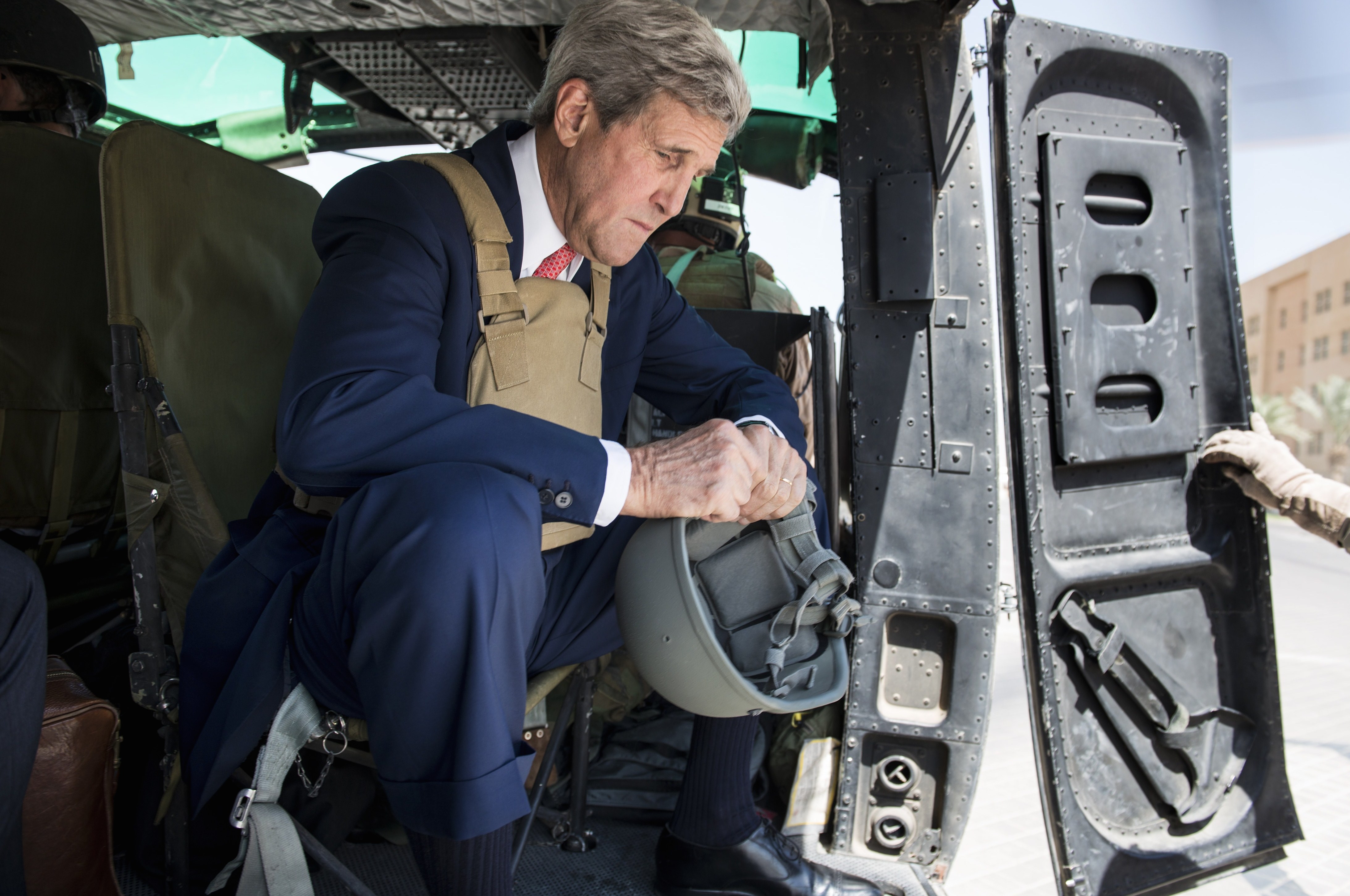
Face Of The Day

IRAQ-US-DIPLOMACY-KERRY

US Secretary of State John Kerry waits in a helicopter in Baghdad on September 10, 2014. Kerry flew into Iraq today for talks with its new leaders on their role in a long-awaited new strategy against Islamic State jihadists to be unveiled by President Barack Obama tonight. By Brendan Smialowski/AFP/Getty Images.

Inside The Mind Of A “Jihadi Tourist”

https://twitter.com/LifeofMujahid/statuses/485452312228675585

Michael Muhammad Knight almost became one in Chechnya. He describes what motivated him to go and what ultimately held him back:

For me, wanting to go to Chechnya wasn’t reducible to my “Muslim rage” or “hatred for the West.” This may be hard to believe, but I thought about the war in terms of compassion. Like so many Americans moved by their love of country to serve in the armed forces, I yearned to fight oppression and protect the safety and dignity of others. I believed that this world was in bad shape. I placed my faith in somewhat magical solutions claiming that the world could be fixed by a renewal of authentic Islam and a truly Islamic system of government. But I also believed that working toward justice was more valuable than my own life.

Eventually, I decided to stay in Islamabad. And the people who eventually convinced me not to fight weren’t the kinds of Muslims propped up in the media as liberal, West-friendly reformers. They were deeply conservative; some would call them “intolerant.” In the same learning environment in which I was told that my non-Muslim mother would burn in eternal hellfire, I was also told that I could achieve more good in the world as a scholar than as a soldier, and that I should strive to be more than a body in a ditch. These traditionalists reminded me of Muhammad’s statement that the ink of scholars was holier than the blood of martyrs.

In Rush To War, No Time For The Law, Ctd

Allahpundit despairs at how many members of Congress are eager to sidestep a vote on a war with ISIS. If they don’t exert some control over this process now, he warns, they’re not any more likely to do so if and when our military commitment starts to snowball:

What’s important is keeping Congress as politically comfortable as possible, and the less power they retain, the easier that becomes. Some members justify their deference to O in terms of the assets he plans to use: Bernie Sanders told the NYT he’s okay with letting Obama bomb who he wants as long as ground troops aren’t sent in, the key distinction being … I don’t know. I guess the president has inherent authority to put airmen’s lives at risk but not infantry’s? Does that make any sense? … They’re not going to cut the money off once men are in harm’s way. And they’re certainly not going to vote on an AUMF later, as Sanders’s airstrikes-yes-infantry-no formulation seems to imagine. Once they’ve allowed Obama to wage war unilaterally from the air, it’s the easiest thing in the world to let him wage war unilaterally on the ground too. If anything, Congress will be even more eager to have its fingerprints off of ground operations.

Cody Poplin compares the several proposed AUMFs currently being circulated on Capitol Hill. But their authors might just be wasting paper, as Obama is signaling that he already has all the permission he needs. Matt Welch cuts him no slack for flouting the Constitution:

In last year’s run-up to what once seemed like inevitable war against Syria, the president made what can be interpreted as an incoherent claim: that he had enough legal cover to start bombing Syria, but that he would nonetheless seek congressional approval. When that approval was not forthcoming, the president decided on a diplomatic solution instead. But note how he treated the congressional-authorization question one year ago today:

[E]ven though I possess the authority to order military strikes, I believed it was right, in the absence of a direct or imminent threat to our security, to take this debate to Congress. I believe our democracy is stronger when the President acts with the support of Congress. And I believe that America acts more effectively abroad when we stand together.

So either the president no longer believes these things, or he finds such beliefs to be an untenable hindrance in the waging of his latest war. At any rate, as in his more blatant nose-thumbing of Congress over U.S.-led regime change in Libya, Obama’s position on the constitutionality of war is essentially the opposite of what it was when he first sought the presidency.

But of course, as Steven Mihm points out, the American tradition of presidents going to war without explicit Congressional authorization goes all the way back to George Washington:

Washington sought “buy in” to go after the Indian tribes that began attacking white settlers on the western frontier in the late 1780s. Like the Islamic State today, they posed a threat that was at once amorphous, hard to reach, and even harder to combat. The Miami and Shawnee tribes of the Ohio River Valley had scalped and murdered settlers, stolen livestock and taken civilians captive. In 1789, Washington dutifully went to Congress, and warned lawmakers that it might be necessary to “punish aggressors” on the western frontier. Congress, preoccupied by other matters, declared that it wouldn’t “hesitate to concur in such further measures” that Washington had in mind. No formal vote authorizing war was held.

Meanwhile, Josh Rogin and Tim Mak note that the $5 billion Counterterrorism Partnership Fund Obama first proposed in May is back in play:

Several top Democratic and Republican senators told The Daily Beast on Friday that the administration has given Congress zero details about the proposed fund and consultations have been next to nonexistent. But Democrats said that was perfectly fine with them. “I support doing what we need to do to defeat ISIS,” Senate Foreign Relations Committee Chairman Robert Menendez told The Daily Beast when asked about the fund. Senate appropriators are already preparing to hand Obama the $5 billion. The draft of the defense appropriations bill would give the Pentagon $4 billion of the funds. The draft of the State Department and foreign operations appropriations bill contains the other $1 billion. All the money would be classified as war funding in the overseas contingency operations part of the defense budget.

Obama’s Open-Ended, Reckless, ISIS Gamble

President Obama Delivers Statement On Situation In Iraq

Ahead of the president’s major address tonight, word has leaked that Obama is considering airstrikes in Syria as part of the military operation against ISIS:

President Obama is prepared to use U.S. military airstrikes in Syria as part of an expanded campaign to defeat the Islamic State and does not believe he needs formal congressional approval to take that action, according to people who have spoken with the president in recent days.  Obama discussed his plans at a dinner with a bipartisan group of foreign policy experts this week at the White House and made clear his belief that he has the authority to attack the militant Islamist group on both sides of the Iraq-Syria border to protect U.S national security, multiple people who participated in the discussion said. The move to attack in Syria would represent a remarkable escalation in strategy for Obama, who has sought during his presidency to reduce the U.S. military engagement in the Middle East.

I guess entering one failed state’s civil war wasn’t challenging enough! Let’s enter two while we’re at it. Exit strategy? Pshaw. That’ll be up to Obama’s successor. In a more granular must-read analysis of this clusterfuck, Marc Lynch stresses that while a strategy of airstrikes and supporting local ground forces may be able to help restore stability and sovereignty to Iraq, in Syria these options “offer no plausible path to political or strategic success”:

A strategy predicated on the existence of an effective moderate Syrian rebel force is doomed to fail. Instead, the focus should be on shaping the environment in ways which will encourage the emergence of a politically legitimate and more effectively unified opposition. The destructive and radicalizing effects of uncoordinated flows of aid to competing rebel groups from outside states and private actors have long been obvious. The emerging regional strategy offers perhaps the first opportunity to unify these efforts to build rather than divide the Syrian opposition. The new coalition should expand on efforts to shut off funding and support not only for ISIS but also for the other powerful Islamist trends within the Syrian rebellion.

This will take time. The immediate goal in Syria should be the securing of a strategic pause between the rebel forces and the regime in order to focus military efforts on ISIS.  Crucially, this strategic pause does not mean cooperation or alignment with Asad, or a retreat from the Geneva Accord principles of a political transition. It should be understood instead as buying the time to shape an environment in which such a transition could become plausible. … The longer-term goal should be to translate this anti-ISIS tacit accord into an effective agreement by the external backers of both Asad and the rebels on a de-escalation of the conflict.  Rather than a military drive on Damascus, the international community should support the delivery of serious humanitarian relief, security and governance to rebel controlled areas and refugees.

I simply do not believe we are capable of pulling anything like this off. Robert Hunter also complicates the question of whether getting rid of Assad should be among our objectives there:

We continue to talk about “arming moderates,” but no US leader has ever articulated what would come after Assad. There is a basic assumption that, when Assad is gone, all will be rosy. The opposite is more likely true. Added to the ongoing carnage would be the slaughter of the minority Alawites. The risks of a spreading Sunni-Shia civil war would increase dramatically, even more than now. The irony is that many who now worry about ISIS argue that it would not have progressed this far if we had only “armed the moderates” in Syria. But given what would have likely happened if they had succeeded, this argument is nonsense. Yet even now the administration, along with academic and congressional critics, fails to address the consequences of its own rhetoric about getting rid of Assad; that statement has become a mantra, disconnected from any serious process of thought or analysis.

Juan Cole lays out some of the inherent risks in a US military campaign against ISIS:

Obama appears to envisage arming and training the “moderates” of the Free Syrian Army, who have consistently been pushed to the margins by al-Qaeda offshoots and affiliates. Private billionaires in the Gulf will continue to support ISIL or its rival, Jabhat al-Nusra (the Succor Front, which has pledged allegiance to al-Qaeda). Strengthening yet another guerrilla group will, again, likely prolong the fighting. Moreover, in the past two years, Free Syrian Army moderate groups have gone radical and joined Nusrah or ISIL at an alarming rate. Defectors or defeated groups from the FSA will take their skills and arms with them into the al-Qaeda offshoots.

In Iraq, while giving the Kurds and the Iraqi army close air support against ISIL has already borne fruit when the local forces were defending their ethnic enclaves, it hasn’t helped either largely Kurdish forces or the (largely Shiite) Iraqi army take Sunni Arab territory. Several campaigns against Tikrit have failed. The only thing worse than this failure might be success. Success would mean smart phone video making its way to YouTube showing US bombing urban residential buildings full of Sunni Arab families in support for a motley crew of Kurdish (non-Arab) fighters and Shiite troops and militiamen. Helping such forces take Tikrit, the birthplace of Saddam Hussein, would make for a very bad image in the Sunni world.

But we never learn, do we? Robin Wright’s comparison of the best- and worst-case scenarios illustrates how tremendous those risks are:

For the United States, the best possible outcome would be for the militants to withdraw from their illusory state in Iraq to bases in Syria, where they might wither in the face of strengthened Syrian rebels; ideally, the rebels would also bring an end to the Assad regime in Damascus. Iraq and Syria, with their multicultural societies, would then have breathing room to incubate inclusive governments. That’s the goal, anyway. The worst outcome would be another open-ended, treasury-sapping, coffin-producing, and increasingly unpopular war that fails to erase ISIS or resurrect Iraq. It might even, in time, become a symbolic graveyard of American greatness—as it was for the French and the British. The Middle East has a proven record of sucking us in and spitting us out.

Maybe it will take another humiliating, devastating defeat in an unwinnable war to finally get Americans to understand the limits of their military power – and the increasing toxicity of the American brand.

Jack Goldstone pens an explainer on ISIS, including some suggestions for how it might be defeated. He argues that while US or NATO military reprisals may be necessary to “blunt its success and undermine the feeling of invincibility it has given to its converts”, there are much more daunting challenges beyond that:

Second, the civil institutions that provide a power-base for moderate political organizations and their leaders must be rebuilt and given credibility. In Syria, this cannot happen until the Assad regime falls; in Iraq this cannot happen until a post-Maliki government establishes its credibility and effectiveness. … Third, the ongoing Sunni-Shia conflict in the Middle East is fueling every sort of violent group: Hezbollah, Hamas, ISIS, and others. At some point, the global community will have to lean on Iran, Saudi Arabia, and Turkey to cease their proxy wars and come to an agreement similar to that of 1648 in Europe, which ended the Thirty Years War that capped over a century of religious conflicts: every country can control its religious policy within its own borders, but agrees to stop meddling in religious conflicts in other countries and to respect other countries’ full sovereignty. This may be a distant goal (it took nearly a century in Europe) but is vital if the region is ever to know stable peace.

Shane Harris wants Obama to get straight whether he plans to “degrade”, “defeat”, or “destroy” ISIS, the last of which Harris considers an impossible goal:

Even if a combined military-political campaign were successful against the Islamic State, history shows that destroying fundamentalist organizations and terrorist networks is exceptionally difficult. Although Obama claims that the United States has “systematically dismantled” al Qaeda in the tribal regions of Pakistan, counterterrorism experts debate whether that’s true, pointing to the fact that Zawahiri is still alive and giving direction to fighters, as well as forming new al Qaeda affiliates, most recently in India. And nearly 13 years after the 9/11 attacks, a sustained military campaign against the Taliban in Pakistan and Afghanistan has failed to destroy the organization. Israel, for its part, has been unable to destroy Hamas and Hezbollah despite the country’s physical proximity to the decades-old militant groups and its ability to deploy one of the most formidable military and intelligence forces on the planet to the fight. The lesson is clear: Terrorist networks are persistent, and they return to their favored targets again and again.

Remarking on the internal illogic of the case for war, Justin Logan doesn’t see how even a successful military operation will solve any of the underlying problems:

The very same political forces that led to a Sunni insurgency during the aughts have contributed to the rise of ISIS. If those politics don’t change—and I see little reason to believe we can make that happen—then you may make gains against ISIS, but the underlying political disease that’s causing the problem remains untreated, and possibly untreatable. In other words, even if the Islamic State is destroyed, there will be an array of other spoilers endangering a thriving Kurdish minority and a stable, successful Iraqi government that integrates the country’s Sunni minority. In fact, these other problems preexisted and helped lead to the successes of the Islamic State. Are we just supposed to cross that bridge when we get to it?

Michael Brendan Dougherty serves up some sharp criticism, lamenting America’s inability to say “no” to lengthy, expensive experiments at fixing other countries’ security problems:

A three-year commitment is merely a hope that drones and bombs plus time equals a stability that is peaceful enough and liberal enough to make our quarter-century of involvement not look like a total waste. But it dumps all the responsibility for solving Iraq on the United States, and makes us yet again a convenient scapegoat for the whole region’s failure. …

This is all part of a broader pattern of the U.S. making too many promises. We’ve promised Japan and the entirety of Southeast Asia to manage China’s rise peacefully. Even as our NATO allies halved their share of military spending since the end of the Cold War, we’ve extended a security guarantee that a Russian advance on Estonia will be treated no differently from a land invasion of the United States. It’s a promise so risible it practically dares a Russian challenge. In fighting ISIS and propping up Iraq, the president is promising to finally make good on America’s constant failure to manage a millennia of hatreds and radical schools of thought, the politics of about six regional powers, and centuries of imperial hubris.

Lastly, George Packer compares Obama’s current situation to that of Gerald Ford after the fall of Saigon:

[Tonight] is a speech that Obama, even more than Ford, never wanted to give. He ran for reëlection, in part, on having fulfilled a promise to end the war in Iraq—always the previous Administration’s war. His eagerness to be rid of the albatross of Iraq played no small part in clearing the way for ISIS to take a third of the country, including Mosul, and to threaten Baghdad and Erbil.

All the more reason to give the President credit (though his political enemies never will) for his willingness, however reluctant, to turn around and face the catastrophe unfolding in Iraq and Syria. Wednesday’s speech will no doubt nod toward staying out (no boots on the ground, no new “American war”), even as it makes the case for going back in (air strikes, international coalitions, the moral and strategic imperative to defeat ISIS). This is the sort of balancing act that Obama speeches specialize in. But he also needs to tell the country bluntly that there will almost certainly be more American casualties, and that the struggle against ISIS—against radical Islam generally, but especially in this case—will be difficult, with no quick military solution and no end in sight. Otherwise, he’ll have brought the public and Congress on board without levelling with them, a pattern set in Vietnam and repeated in Iraq, with unhappy consequences.

The only way to air this debate properly is a full and robust vote in the Senate, preceding a formal declaration of war. That’s what the Constitution demands. And given the emotional rush to war in the country and Washington, you begin to see the wisdom of the Founders’ judgment.

(Photo: U.S. President Barack Obama speaks about Iraq in the Brady Briefing room of the White House on June 19, 2014 in Washington, DC. Obama spoke about the deteriorating situation as Islamic State in Iraq and Syria (ISIS) militants move toward Baghdad after taking control over northern Iraqi cities. By Chip Somodevilla/Getty Images)

No, Don’t Ally With Assad

The Syrian president isn’t as strong as he claims to be, Liz Sly remarks, and he needs us far more than we need him:

After three years of fighting, the army is depleted and tired. Assad is indebted to local militias trained and funded by Iran, and to Lebanon’s Hezbollah, for his government’s most important victories. Many of the Iraqi Shiite militias who also helped have gone home to fight the Sunni extremists on their own turf. The government sustains its efforts to repress the rebellion by bombing communities that oppose it from afar, further fueling the grievances that enabled extremism to thrive.

Even if the United States wanted to partner with Assad to defeat the extremists, “it’s not clear what he would bring to the table,” said Jeff White of the Washington Institute of Near East [Policy]. “What we’re seeing is the overall, uneven degradation of the regular military forces,” he said. “They’re becoming less and less capable over time.” That is partly why Syria is so eager to join forces with America in the international coalition President Obama is seeking to build against the Islamic State

He’s also been known to screw over his partners:

There has long been a clear pattern to Syrian statecraft: Syria’s leaders accommodate their opponents just enough to keep them at bay without ever surrendering the ability to do harm to the same said opponents.  It is smart and it has proven successful, which makes one wonder why anyone would ever believe that they could get something done with the Assads.

Examples of Syrian duplicity in which Damascus is discreetly helpful in one area, but causes trouble—most often death and destruction—in another abound.  Where to start?  How about the entire occupation of Lebanon?  Syrian forces put an end to the Lebanese civil war, but this was hardly a function of altruism.  Lebanon has paid a steep price and will continue to pay for Syria’s occupation for generations.  Then there is the way in which the Syrians have scrupulously maintained the armistice on the Golan Heights, but nevertheless enabled Hezbollah in southern Lebanon.  Of course, Hezbollah was a response to Israel’s invasion and occupation of Lebanon, but it was also through the group that the Syrians sought to inflict pain on the Israelis, spilling mostly Lebanese blood in the process.