“Not Mission Creep; Mission Gallop”

Greenwald is shocked but not surprised at how the notions that ISIS is a grave national security threat and “of course we’re going to war with them” have both become conventional wisdom:

If the goal of terrorist groups is to sow irrational terror, has anything since the 9/11 attack been more successful than those two journalist beheading videos? It’s almost certainly the case that as recently as six months ago, only a minute percentage of the American public (and probably the U.S. media) had even heard of ISIS. Now, two brutal beheadings later, they are convinced that they are lurking in their neighborhoods, that they are a Grave and Unprecedented Threat (worse than al Qaeda!), and that military action against them is needed. It’s as though ISIS and the U.S. media and political class worked in perfect unison to achieve the same goal here when it comes to American public opinion: fully terrorize them.

Larison fumes over the war’s rapidly expanding objectives:

It hasn’t taken very long for last month’s “limited” intervention in Iraq to expand far beyond anything that the administration originally described to the public.

Administration officials were denying that they planned for a “sustained” campaign just a few weeks ago, and now they’re saying the opposite. Obama said that he wouldn’t “allow” the U.S. to be dragged into a new war, and he is now setting out to take the U.S. into that war. What we’re seeing now is not so much mission creep as mission gallop, and it all seems to be happening without any serious consideration of the costs or the potential dangers of such an expansive campaign.

Even if the U.S. does not eventually commit large numbers of ground troops to this campaign, the U.S. will be at war in two countries where it does not need to be fighting. This is every bit as much a war of choice as the earlier wars in Iraq and Libya, and it hasn’t been thought through any better than those were.

Christopher Dickey thinks the ISIS threat is being overhyped, though he worries about lone ISIS-inspired nut-jobs like Mehdi Nemmouche, who killed four people in an attack on a Jewish museum in Brussels in May:

Veteran terrorism expert Brian Jenkins notes the alarmism in Washington has reached such proportions, there’s a kind of “shock and awe in reverse.” Thus, as Jenkins writes, Defense Secretary Chuck Hagel proclaims ISIS is an “imminent threat to every interest we have.”  A congressional staffer argues that it is “highly probable ISIS will…obtain nuclear, chemical, biological or other weapons of mass death…to use in attacks against New York [or] Washington.” Texas Governor Rick Perry claims there is a “very real possibility” that ISIS forces may have crossed the U.S.-Mexican border. Senator James Inhofe asserted, “We are in the most dangerous position we’ve ever been in as a nation,” and retired Marine four-star Gen. John Allen goes so far as to say, “World War III is at hand.”

All this plays to the advantage of the self-proclaimed Caliph Ibrahim, formerly known as Abu Bakr al-Baghdadi, whose ragtag army conquered a huge swathe of Iraq mainly by filling the vacuum left by incompetent Iraqi government military commanders. The conquest—and the reaction to it—have given him an aura of invincibility that holy-warrior wannabes find quite thrilling.

I actually hadn’t absorbed the sheer hysteria in Washington after the beheadings-bait. It’s truly shocking – and utterly insane. My earlier thoughts here.

In Rush To War, No Time For The Law

Josh Rogin observes that the president isn’t showing much interest in getting Congress’s permission to go to war with ISIS:

The president and his staff have made clear that they don’t feel they need congressional authorization to go after ISIS, but leaders in both parties disagree, and a long list of congressional figures believes the president must come to Congress for explicit authorization within 60 days of when he began striking ISIS in Iraq, on August 8.

But some of the hawks in Congress aren’t eager for a vote, Tim Mak finds:

Hawkish Sen. Lindsey Graham (R-SC) offered the frank assessment Monday that a congressional vote could hinder presidential power at a time when Obama most needs it to counter ISIS, putting him on the same page as senior Sens. Carl Levin (D-MI) and Dianne Feinstein (D-CA), both of whom indicated an interest in deferring to the president on war strategy. The Daily Beast asked Graham if the absence of a vote reflected congressional acquiescence to the president’s will on war strategy. A vote would be nice, he said, but bringing the issue to Congress could mean all sorts of measures that blunt the president’s response. “What if [Obama] comes here and [Congress] can’t pass it? That would be a disaster. And what if you put so many conditions on it that it makes any military operations ineffective? That’s what I worry about,” the senator said. “I think the president has an abundant amount of authority to conduct operations. It would be good to have Congress on board… if Congress doesn’t like what he’s doing, we can cut the money off.”

Still, some Senators are rightly insisting that the new war come to a vote:

On Monday, Sens. Bill Nelson (D-Fla.) and Jim Inhofe (R-Okla.) introduced resolutions to authorize military action in Syria, as did Rep. Frank Wolf (R-Va.). Speaking on the Senate floor, Nelson said he believes Obama already has authority to act, “but there are some who disagree, so rather than quibble about legalities, I have filed this legislation.” Inhofe said that an authorization vote would attract widespread, bipartisan support “because people realize — even [Defense Secretary Chuck] Hagel and others have made the statement — that the threat facing us is unprecedented.”

We Are Already Sort Of Allied With Iran

Flagging the above tweet, Jacob Siegel points to Iran’s deepening involvement in the ISIS conflict:

The photo reportedly shows the Iranian general Qasem Soleimani, commander of the Qods force, Tehran’s chief military strategist, and the man many American officials consider to be America’s most dangerous foe on the planet. His visit to the site underscores the convergence of U.S. and Iranian interests in Iraq, and Iran’s desire to be seen as orchestrating the efforts. Amerli was clearly a defeat for ISIS and a relief for the townspeople who had held off the group for six weeks. But it’s less clear what the alliance between U.S. airpower and Iranian-backed militias says about the vision guiding the mission in Iraq. Even leaving aside questions of a grand regional strategy for the Middle East—and how our track record suggests that U.S. led wars in Iraq can benefit Iran—its not clear how the precedent set in Amerli will serve the President’s more immediate goals for resolving the war in Iraq.

Juan Cole suspects Washington and Tehran are already coordinating their efforts to some extent:

US air strikes on ISIL in Iraq have alternated with Iranian air strikes on ISIL positions. It seems likely to me that the two air forces are coordinating in at least a minimal way, otherwise there would be a danger of them hitting each other rather than ISIL. … Ayatollah Ali Khamenei, Iran’s supreme leader, is alleged to have just authorized Iranian forces to coordinate with American ones. The denials from other Iranian politicians are likely merely camouflage for a policy that would dismay Iran hardliners.

But Keating doubts anyone will acknowledge that partnership:

There are obviously key points of conflict between Iran and the United States, not least of which is the country’s controversial nuclear program. A new round of talks about that issue are set to begin in New York this month. Any open acknowledgment of cooperation between the countries with regards to ISIS would likely make the U.S. Congress, hardliners in Tehran, and the Israeli government go absolutely berserk. But if the two nations continue to escalate the fight against a common enemy, it’s going to require some level of coordination. I don’t see Iran being formally invited into Obama’s “coalition of the willing.”

Nor is Russia likely to be a formal partner. But it too may become a de facto ally in the fight against ISIS. Ishaan Tharoor highlights how ISIS, which is believed to include some 200 Chechen fighters, is now lobbing threats at Putin as well:

Here’s a slightly new geopolitical wrinkle. Earlier this week, the Islamic State issued a video challenging a powerful global leader. But this time, it was not President Obama or one of his counterparts in Europe. It was Russian President Vladimir Putin. In the video, fighters pose atop Russian military equipment, including a fighter jet, captured from the forces of Syrian President Bashar al-Assad. This is Agence France-Presse‘s transcription of what follows:

“This is a message to you, oh Vladimir Putin, these are the jets that you have sent to Bashar, we will send them to you, God willing, remember that,” said one fighter in Arabic, according to Russian-language captions provided in the video. “And we will liberate Chechnya and the entire Caucasus, God willing,” said the militant. “The Islamic State is and will be and it is expanding God willing.”

Al-Qaeda’s Newest Franchise, Ctd

Tunku Varadarajan underlines the link between ISIS and al-Qaeda’s new South Asian branch:

What should we make of this call by Zawahiri, of this loveless jihad? Why has he made this declaration, and why now? After all, al Qaeda has been in Afghanistan for years; and therefore in Pakistan; and therefore available, already, for anti-India jihad. Counterterrorism experts I spoke to were as one in pointing to the rise of ISIS in the Syria-Iraq theater as the main propulsion. ISIS has not merely stolen al Qaeda’s thunder; it is siphoning recruits away from the older organization, which has yet to recover from the catastrophic loss (in terms of charisma, and as a species of jihadi Lord Kitchener) of bin Laden. “Zawahiri wants you” doesn’t have quite the same impact on potential recruits as “Osama wants you.”

Gen. Ata Hasnain, a former Kashmir Corps commander in the Indian army, told me that before ISIS emerged as a jihadi force, al Qaeda “never felt the need to expand its ambit into South Asia. The anti-India terrorist groups in Pakistan were considered adequately motivated and organized, and al Qaeda preferred to remain only an inspiration for them, instead of overextending itself. Its prime battle was with Saudi Arabia and the U.S.” With the rise of ISIS, he said, al Qaeda has effectively been dwarfed. The avowal of jihad against India is its attempt to aggrandize itself anew.

The dwindling numbers of the Pakistani Taliban, partly thanks to the Syrian jihad drawing them away, could be another factor in the announcement of Al-Qaeda in the Indian Subcontinent:

Just a few years ago, the Taliban was one of the two prime Islamist militant groups—the other being Al Qaida-aligned insurgents in Iraq—for foreign fighters around the world to enlist with. But with the self-proclaimed Islamic State on the warpath and new conflicts in North Africa, the Taliban has become less attractive. Specifically, the Pakistani Taliban. That’s the subject of a new report in CTC Sentinel, West Point’s counter-terrorism newsletter. As of July 2008, the Pakistani Taliban included around 8,000 foreign fighters, notes Raza Khan, a political analyst who authored the report. These fighters came from western Europe, the Middle East, China, Russia, India, and central Asian countries, particularly Uzbekistan. But today, only a few hundred remain.

But Arif Rafiq counsels against overstating the connection between ISIS and AQIS:

For the past few years, Al Qaeda has stepped up its outreach to Pakistanis. Its Urdu-language service is among its most active. Al-Zawahiri has also made a handful of statements addressing the plight of Muslims in Burma and India, and Islamic activists targeted by the state in Bangladesh. It’s been laying the groundwork for AQIS for some time. Indeed, more than beating out competition from IS, Al Qaeda is trying to fill a void in the South Asian jihadist communitythe absence of a grand patron. While Pakistan’s intelligence services continue to support militant groups in the region, such as Lashkar-e Taiba, its support for militants in Indian-controlled Kashmir has remained low for much of the past decade. That’s why Umar, the AQIS chief, in another video released this summer, asked Kashmiri Muslims to join Al Qaeda’s ranks and accused Pakistan of selling them out.

“The success or failure of Zawahiri’s new initiative,” Nisid Hajari writes, “may rest on one man: India’s Hindu nationalist Prime Minister Narendra Modi”:

The fastest way to increase Al Qaeda’s limited appeal in India would be for the authorities to overreact, as China has done with Uighurs in its restive Xinjiang province. This would not only alienate the best source of intelligence on homegrown radicals — the local Muslim community — it would rapidly burnish the appeal of radicals over more moderate voices. Any government scapegoating of Indian Muslims would be equally damaging. Modi’s association with the 2002 anti-Muslim riots in Gujarat and the Hindu nationalist Rashtriya Swayamsevak Sangh make him a lightning rod for many Muslims. He bears a special responsibility to endorse the loyalty of Indian Muslims and assure them they will not be targeted unfairly.

Probably the best way to ensure Zawahiri’s grand designs never come to fruition would be for Modi to push forward the stalled India-Pakistan peace process. As long as the wounds that divide the South Asian nations continue to fester, leaders on both sides will remain hostage to the actions of a few radicals: Any post-Mumbai terrorist plot in India that is traced back to Pakistan bears a high risk of setting off a wider conflagration.

Another Long War Begins?

According to some sources (NYT), the Obama administration’s plan to stamp out ISIS is likely to last at least three years:

The first phase, an air campaign with nearly 145 airstrikes in the past month, is already underway to protect ethnic and religious minorities and American diplomatic, intelligence and military personnel, and their facilities, as well as to begin rolling back ISIS gains in northern and western Iraq. The next phase, which would begin sometime after Iraq forms a more inclusive government, scheduled this week, is expected to involve an intensified effort to train, advise or equip the Iraqi military, Kurdish fighters and possibly members of Sunni tribes. The final, toughest and most politically controversial phase of the operation — destroying the terrorist army in its sanctuary inside Syria — might not be completed until the next administration. Indeed, some Pentagon planners envision a military campaign lasting at least 36 months.

The president went on Meet the Press yesterday, where he intimated that going into Syria to fight ISIS is still very much on the table. To Max Fisher, this translates into good news for Assad whether Obama wants it to or not:

At this point … all of the US-supplied kalashnikovs and mortar rounds in the world are probably not going to be enough to help Syria’s moderate rebels take on both the Assad regime and ISIS at the same time, much less seize all that ISIS-held territory in eastern Syria. The possibility of US airstrikes against ISIS territory in Syria would make a difference, but far from a decisive one. The calculus of the war has to change, and that appears to mean that the United States will now form its own unspoken and unacknowledged agreement with the Assad regime: let’s put aside our differences, for now, and cooperate against ISIS, a mutual enemy we both hate more than each other. In its basic contours, it is almost identical to the tacit deal that the Assad regime made with ISIS against the moderate rebels.

But Ed Morrissey argues that ruling out boots on the ground, as Obama did yesterday, “tips our hand to ISIS and probably made them breathe a sigh of relief”:

The US can’t dislodge ISIS from the ground they firmly hold through bombings, because it would result in high numbers of civilian casualties. If Obama and whatever coalition he brings together can’t sustain boots on the ground, they won’t sustain that kind of collateral damage either, which means that ISIS’ leaders will only need to worry about assassinations via drones. Without boots on the ground, the US won’t be able to get reliable intel for that to make enough of an impact to drive ISIS back into the desert.

But the issue is more strategic than tactical, too. We will likely hear on Wednesday that only a united Iraq can defeat ISIS, but the Sunnis are not going to trust the Iranian-backed Shi’ites to share power again, and aren’t going to respond to American guarantees unless we put boots back on the ground. Given the choice between ISIS and the subjugation of their tribes by Iran, most of those tribal leaders will choose ISIS, which is the direct result of us abandoning them by leaving Iraq despite our earlier assurances that we could force Nouri al-Maliki to share power.

Meanwhile, Mark Thompson updates us on the weekend’s air strikes, some of which targeted Anbar province, expanding the campaign from northern to western Iraq. Juan Cole lists some other salient developments. One item on his list:

The mufti or chief legal adviser of Saudi Arabia on Islamic law (Sheikh Abd al-Aziz Al Sheikh) gave a fatwa or ruling on Sunday that ISIL is just a band of rebels and murderers who have blood in their hands. Those Western pundits demanding evidence that Muslims have condemned ISIL should take note. The mufti of a Wahhabi country has done so, showing that the Saudi elite has had a scare thrown into it, even if some Saudis secretly support ISIL.

Another bit of news Cole highlights:

The Arab League declared its enmity with the so-called “Islamic State.” All the governments are afraid of ISIL. Although Arab League Secretary-General Nabil Alaraby met with US Secretary of State John Kerry, however, it is not clear what exactly the body can do in any practical way for the war effort. The state best poised to intervene against ISIL, Jordan (which borders Iraq and has a good little military and intelligence capabilities) is at least in public begging off, for fear of ISIL reprisals in Amman.

The Death Rattle Of Islamism?

by Jonah Shepp

Graeme Wood isn’t the first writer to touch on the significance of Abu Bakr al-Baghdadi’s declaration of a “caliphate”, but his substantial exploration of the meaning of the term gets to why it’s so weird that Baghdadi has chosen it to describe his so-called Islamic State when other radical Islamist groups have steered clear of such declarations:

Mostly … caliphate declarations have been rare because they are outrageously out of sync with history. The word conjures the majesty of bygone eras and of states that straddle continents. For a wandering group of hunted men like Al Qaeda to declare a caliphate would have been Pythonesque in its deluded grandeur, as if a few dozen Neo-Nazis or Italian fascists declared themselves the Holy Roman Empire or dressed up like Augustus Caesar. “Anybody who actively wishes to reestablish a caliphate must be deeply committed to a backward-looking view of Islam,” says [University of Chicago historian Fred] Donner. “The caliphate hasn’t been a functioning institution for over a thousand years.”

And it isn’t now, either. The designation of the ISIS “caliphate” still smacks of delusional grandiosity more than anything else. There is no downplaying its brutality or denying that it would do great violence to the West if given the chance, but the Islamic State is no superpower: more than anything else, its sudden rise owes mainly to the fact that Syria and Iraq are fragile states, and its savagery has alerted the sleepwalking states of the Arab world to the threat of jihadism like never before. The enemies it is making on all sides, especially among other Muslims, would seem to suggest that ISIS may burn out nearly as quickly as it caught fire. Could the madness of ISIS be the final fever of a dying ideology?

What seems most promising to me in the backlash against ISIS is the extent to which that backlash relies on the genuine principles of Islam itself. We know that some of the fighters traveling from the West to fight alongside ISIS know next to nothing about the religion. We have evidence that jihadist movements like Boko Haram and the Taliban are widely despised in their spheres of influence. Here, Dean Obeidallah takes a look at how leaders of Muslim countries and communities are more or less unanimously condemning the false Islam of the jihadists:

The religious and government leaders in Muslim-dominated countries have swiftly and unequivocally denounced ISIS as being un-Islamic. For example, in Malaysia, a nation with 20 million Muslims, the prime minister denounced ISIS as “appalling” and going against the teachings of Islam(only about 50 have joined ISIS from there). In Indonesia, Muslim leaders not only publicly condemned ISIS, the government criminalized support for the group. And while some allege that certain Saudi individuals are financially supporting ISIS, the Saudi government officially declared ISIS a terrorist group back in March and is arresting suspected  ISIS recruiters. This can be a helpful guide to other nations in deterring ISIS from recruiting.  A joint strategy of working with Muslim leaders in denouncing ISIS and criminalizing any support appears to be working. And to that end, on Monday, British Muslim leaders issued a fatwa (religious edict) condemning ISIS and announcing Muslims were religiously prohibited from joining ISIS.

This all has me wondering if ISIS, the reductio ad absurdum of radical Islamism, doesn’t herald the downfall of that ideology altogether. Bear in mind that political Islam hasn’t always been exclusively reactionary: the first avowedly Islamic politics of the modern era, first articulated before the Muslim Brotherhood’s founders were even born, was the Islamic Modernism of Muhammad Abduh, Rashid Rida, and Jamal al-Din al-Afghani. Here were pious Muslims arguing that Islam was fully compatible with rationalism and making arguments for universal literacy and women’s rights from the same Muslim revivalist standpoint from which Hassan al-Banna and Sayyid Qutb would later espouse a more conservative vision of Islamic politics in modernity.

The illiberal strain of Arab Islamism, its Iranian counterpart, and the more radical jihadist movements that grew out of these movements (or alongside them, depending on which historian you ask) have been the major representatives of political Islam in the late 20th and early 21st centuries. There’s no reason, however, to believe that this condition is permanent or that a less reactionary form of Islamic political thought, or even an Islamic liberalism after the model of the Modernists, could not take hold in the Muslim world given the right set of circumstances. Islamism, particularly in its more extreme varieties, has long articulated an Islamic state operating under a “pure” interpretation of Islamic law as a utopian vision. Now, here is an Islamic State, a “caliphate” no less, that claims to do just that, and the outcome is rather dystopian. Torture, gang rape, slave brides, beheadings, crucifixions, and child soldiers are not what most Muslims have in mind when they imagine the ideal Islamic society. I would wager that these horrors will turn more Muslims against radical Islamism than toward it.

This is all by way of saying, as a reminder, that “Caliph Ibrahim” (Baghdadi) represents Muslims about as thoroughly as Tony Alamo represents Christians. The fact that he has attracted enough funding and followers to run roughshod over northern Iraq and eastern Syria is nothing to brush off, but it’s not winning him any friends, and it doesn’t make his ideology any less ridiculous. It’s certainly not “Islam”, at least not as any Muslim I know practices it. That’s why I suspect it will fail, like most grandiose visions of world domination do. And by radicalizing the Islamic heartland against radicalism, as it were, perhaps ISIS will take the entire edifice of radical Islamism down with it.

The Road To Baghdad Is Paved With Good Intentions

Beinart recognizes the limits of American power to fix the Middle East but insists that our moral obligation to prevent a genocide in Iraq trumps all:

As I have learned myself very painfully, there is an enormous amount the United States cannot do. It cannot solve Iraq’s political problems. It may not even be able to hold Iraq together. It cannot solve the horror in Syria. It cannot defeat the Taliban. It cannot stop Libya from descending into anarchy. But it can save the people in the Sinjar Mountains, both by dropping supplies to keep them alive, and by bombing ISIS so Kurdish forces can retake the areas nearby. And in so doing, it can stop genocide. Thankfully, Obama is doing just that.

Is there a risk that the U.S. will find itself sucked back into a costly and futile effort to impose our will on Iraq? Perhaps, but everything we know about Barack Obama suggests he will resist that fiercely. And so will most Americans. It’s a risk worth taking, in part because in Iraq today, as in Southeast Asia four decades ago, we are culpable. Were it not for our war, and the anarchy it has bred, the Yazidis would likely not be facing imminent death. The reasons Americans want to turn away from Iraq are precisely the reasons we should not.

Greenwald, on the other hand, is pissed off that we’re intervening, stressing that “humanitarian airstrikes” are always and everywhere a contradiction in terms:

For those who ask “what should be done?,” has the hideous aftermath of the NATO intervention in Libya – hailed as a grand success for “humanitarian interventions” – not taught the crucial lessons that (a) bombing for ostensibly “humanitarian” ends virtually never fulfills the claimed goals but rather almost always makes the situation worse; (b) the U.S. military is not designed, and is not deployed, for “humanitarian” purposes?; and (c) the U.S. military is not always capable of “doing something” positive about every humanitarian crisis even if that were really the goal of U.S. officials?

The suffering in Iraq is real, as is the brutality of ISIS, and the desire to fix it is understandable. There may be some ideal world in which a superpower is both able and eager to bomb for humanitarian purposes. But that is not this world. Just note how completely the welfare of Libya was ignored by most intervention advocates the minute the fun, glorious exciting part – “We came, we saw, he died,” chuckled Hillary Clinton – was over.

Along the same lines, Walt argues that it’s time for us to get the hell out of the Middle East for good:

Some will argue that we have a moral responsibility to try to end the obvious suffering in different places, and a strategic imperative to eradicate terrorists and prevent the spread of WMD. These are laudable goals, but if the history of the past twenty years teaches us anything, it is that forceful American interference of this sort just makes these problems worse. The Islamic State wouldn’t exist if the neocons hadn’t led us blindly into Iraq, and Iran would have less reason to contemplate getting nuclear weapons if it hadn’t watched the United States throw its weight around in the region and threaten it directly with regime change.

So instead of acting like a hyperactive juggler dashing between a dozen spinning plates, maybe the best course is to step back even more than we have already. No, I don’t mean isolationism: What I mean is taking seriously the idea of strategic disengagement and putting the whole region further down on America’s list of foreign policy priorities.

But US interests are also at play here. Rather than genocide, Fisher observes that Obama’s real “red line” for ISIS appears to have been its incursion into Kurdistan:

Invading Iraq’s Kurdish region, it turned out, was Obama’s red line for ISIS. There are a few reasons why. The Kurdish region is far stabler, politically, than the rest of Iraq. (Kurds are ethnically distinct from the rest of Iraq, which is largely ethnic Arab; most Kurds are Sunni Muslims.) The Kurdish region, which has been semi-autonomous since the United States invaded in 2003 and has grown more autonomous from Baghdad ever since, also happens to be a much more reliable US ally than is the central Iraqi government. It has a reasonably competent government and military, unlike the central Iraqi government, which is volatile, unstable, deeply corrupt, and increasingly authoritarian.

It’s not hard to see how a cost-benefit calculation might lead the Obama administration to choose defending just Iraqi Kurdistan over defending all of Iraq from ISIS: the Kurdish region is smaller, it already has a competent military on the ground, it is reliably pro-US, and it can probably be protected at much lower risk to the US. With the rest of Iraq in chaos, the Kurdish region is also America’s last reliable base in the country, so if Erbil falls to ISIS then the US could effectively be out altogether.

And Kenneth Pollack doesn’t buy the arguments against humanitarian intervention:

At least according to the accounts we have received so far, the humanitarian need seems clear and pressing. The United States has the lift capacity to air drop humanitarian supplies and the military capacity to provide at least some degree of air support to the refugees against attack by ISIS fighters. That said, without a corresponding ground force, air power alone may not be enough to prevent a determined assault by ISIS. That is not an argument in favor of deploying ground troops, but neither should it be an argument against employing air power alone. Just because we are not certain to save them does not mean we should not try at all.

Any humanitarian intervention always begs the question, why intervene to help this group and not some other? There are vast numbers of people suffering in the world, so this is always going to be a question that some will ask. My response is that there are some situations where the suffering is acute, danger is imminent, and where there is something that the U.S. can do about it. Those are the cases where they U.S. should unquestionably act, and those criteria greatly diminish the number of eligible cases. I think the immediate situation of the Yazidi and other northern Iraqi minorities are clearly part of that set of cases. Moreover, I think it absurd to allow ourselves to be paralyzed by academic debates over which groups are most deserving of American assistance when there is a clear and pressing humanitarian need that we could be addressing.

Still, it’s not clear that Obama has a strategic plan here:

Retired Gen. Barry McCaffrey told MSNBC’s Chuck Todd he is “dismayed” by President Obama’s strategy in Iraq, and that it demonstrates “muddled thinking.”

“If you’re going to protect refugees, 50,000 people without water and food, you don’t do two F/A-18 strikes on an artillery unit somewhere in the vicinity,” McCaffrey insisted, criticizing Obama’s decision to authorize “pinprick strikes” against ISIL in the Sinjar Mountains, where tens of thousands of Yazidis are trapped as they flee from ISIL terrorists. “It looks to me as if a lot of this is internal U.S. politics to show we’re doing something,” McCaffrey said.
Who Are The Yazidis?

Raya Jalabi profiles the ancient faith community whose ongoing persecution at the hands of ISIS was a major factor driving Obama’s decision to authorize air strikes in Iraq:

The ancient religion is rumoured to have been founded by an 11th century Ummayyad sheikh, and is derived from Zoroastrianism (an ancient Persian faith founded by a philosopher), Christianity and Islam. The religion has taken elements from each, ranging from baptism (Christianity) to circumcision (Islam) to reverence of fire as a manifestation from God (derived from Zoroastrianism) and yet remains distinctly non-Abrahamic. This derivative quality has often led the Yazidis to be referred to as a sect.

At the core of the Yazidis’ marginalization is their worship of a fallen angel, Melek Tawwus, or Peacock Angel, one of the seven angels that take primacy in their beliefs.

Unlike the fall from grace of Satan, in the Judeo-Christian tradition, Melek Tawwus was forgiven and returned to heaven by God. The importance of Melek Tawwus to the Yazidis has given them an undeserved reputation for being devil-worshippers – a notoriety that, in the climate of extremism gripping Iraq, has turned life-threatening.

Under Ottoman rule in the 18th and 19th centuries alone, the Yazidis were subject to 72 genocidal massacres. More recently in 2007, hundreds of Yazidis were killed as a spate of car bombs ripped through their stronghold in northern Iraq. With numbers of dead as close to 800, according to the Iraqi Red Crescent, this was one of the single deadliest events to take place during the American-led invasion. The Yazidis had been denounced as infidels by Al-Qaida in Iraq, a predecessor of Isis, which sanctioned their indiscriminate killing.

A BBC feature explores the Yazidis’ beliefs and customs further:

Their own name for themselves is Daasin (plural Dawaaseen), which is taken from the name of an old Nestorian – the Ancient Church of the East – diocese, for many of their beliefs are derived from Christianity. They revere both the Bible and the Koran, but much of their own tradition is oral. Due in part to its secrecy, there have been misunderstandings that the complex Yazidi faith is linked to Zoroastrianism with a light/dark duality and even sun worship. Recent scholarship, however, has shown that although their shrines are often decorated with the sun and that graves point east towards the sunrise, they share many elements with Christianity and Islam.

Children are baptised with consecrated water by a pir (priest). At weddings he breaks bread and gives one half to the bride and the other to the groom. The bride, dressed in red, visits Christian churches. In December, Yazidis fast for three days, before drinking wine with the pir. On 15-20 September there is an annual pilgrimage to the tomb of Sheikh Adi at Lalesh north of Mosul, where they carry out ritual ablutions in the river. They also practise sacrifice of animals and circumcision.

Listening To The President

Amid the impending flurry of opinions, ideas, regrets, conclusions and arguments that you will greet today, it’s well worth eight minutes of our time simply to listen to what president Obama said last night about the US intervention in Kurdistan yesterday. Here’s what he obviously wants in descending order of importance: security for US personnel in Erbil; no genocide of the Yazidis; and a functional, multi-sectarian coalition government in Baghdad. The first two are achievable in the short term; the last is subject to the profound vicissitudes of the broken state of “Iraq”. Which is to say: we can see no long term clearly right now.

Like most decisions that come down to the president alone, this is a very, very tough one. The reasons to resist being pulled back into any conflict in Iraq are too obvious and manifold to state. But let me note one massive irony: one reason why ISIS appears to have made so much progress is because they are armed with American military equipment, abandoned by the Iraqi army. And the only reason ISIS exists at all in Iraq – and al Qaeda before them – is that the United States so thoroughly broke that country from 2003 on. So the proximate reasons for this American intervention are the unintended consequences of previous American interventions. You can see how global hegemony eventually provides endless reasons for its own perpetuation – and why some of us want to restrain and temper its ambitions.

Another obvious conclusion: the speech last night was very similar to the reasoning behind the ill-fated rescue of Misrata in the Libyan uprising. Again: an allegedly imminent slaughter of civilians. Again: the need to act expeditiously because of fast-moving events on the ground. And we saw how that intervention ended  – in chaos and disorder that has only enabled more slaughter and unrest. If we thought Libya had persuaded Obama that he should not act when he can to save thousands of innocent civilians threatened by murderous religious fanatics, then we misjudged his moral core.

Do I reject that moral core? Of course not. I would not want even the toughest realist in the White House to be unmoved by a possibly imminent mass execution of civilians. And this is not merely a possible mass execution. It’s attempted genocide. That distinction matters to me, and should matter to America. ISIS has now slaughtered countless innocents, as has the government of Assad in Syria. But the possible genocidal attempt to wipe out the entire, ancient Yazidi population makes this more than yet another grotesque incident in someone else’s civil war. Non-interventionism meets its toughest test when it comes to atrocities like these.

Then there is the issue of the Kurds, a feisty, stateless people whose sanity stands in stark contrast to some of their neighbors. They too have endured genocidal attacks in the past  – from Saddam Hussein. They have been staunch American allies for decades and critical to what’s left of any decent future in that part of the world. They are not active participants in the Sunni-Shiite Arab Iraq-Syria civil war. They have played a largely defensive game, with some opportunistic land grabs, while developing their own region in a manner Baghdad seems incapable of more broadly. If Erbil were to fall for lack of ammunition in the short term – because they are being targeted by US-made military equipment – then equalizing that imbalance in the short term seems to the least we can do.

Nonetheless, I remain troubled by this – as I think the president is as well.

The danger of getting sucked into the Iraqi vortex is great. What if air-strikes are not enough? What if ISIS manages to invade Kurdistan – or does unspeakable damage to the dam now under its control? We are talking about a Jihadist force born of a fanatical fusion of a depraved version of Islam with brutality and violence of unlimited scope. What we are now signaling, in other words, is that there are limits to what the United States will tolerate with respect to ISIS’ dominance and power projection. That means we could find ourselves forced to intervene again and again on these lines and for these reasons. Only the president’s fortitude and restraint – or willingness to retreat from the goals he has just set out – can save us. At that point, if the immediate need to save the Yazidis and Kurdistan is behind us, it is absolutely imperative that any further military action be authorized by the Congress. An expeditious act of executive authority is one thing. Another risk of war is something else entirely. And such a decision should not be a president’s anyway. It should be a decision by the American people, through their elected representatives.

My main fear of the intervention is that it might convey to Iraq’s terrible leadership that the US once again will do their hard work for them – and thereby relieve them of the task of constructing a new government, capable of rallying Sunnis, Shiites and Kurds to restrain ISIS. Perhaps the danger is now so great the dysfunction in Baghdad could break – and with indirect American support, a new and more widely legitimate Iraqi government can begin to roll back or at least cauterize the Jihadist onslaught. That’s the optimistic scenario.

But when has an optimistic scenario ever been borne out in Iraq? That is the question. As Barry Ritholtz put it today:

Each time I think I have finally put George W. Bush’s misadventures out of my mind, something comes about to remind us how utterly bereft of reason or intelligence the decision to invade Iraq was. It is likely to haunt the U.S. even longer than the disastrous Vietnam War.

Obama’s Iraq Strikes And Executive Power

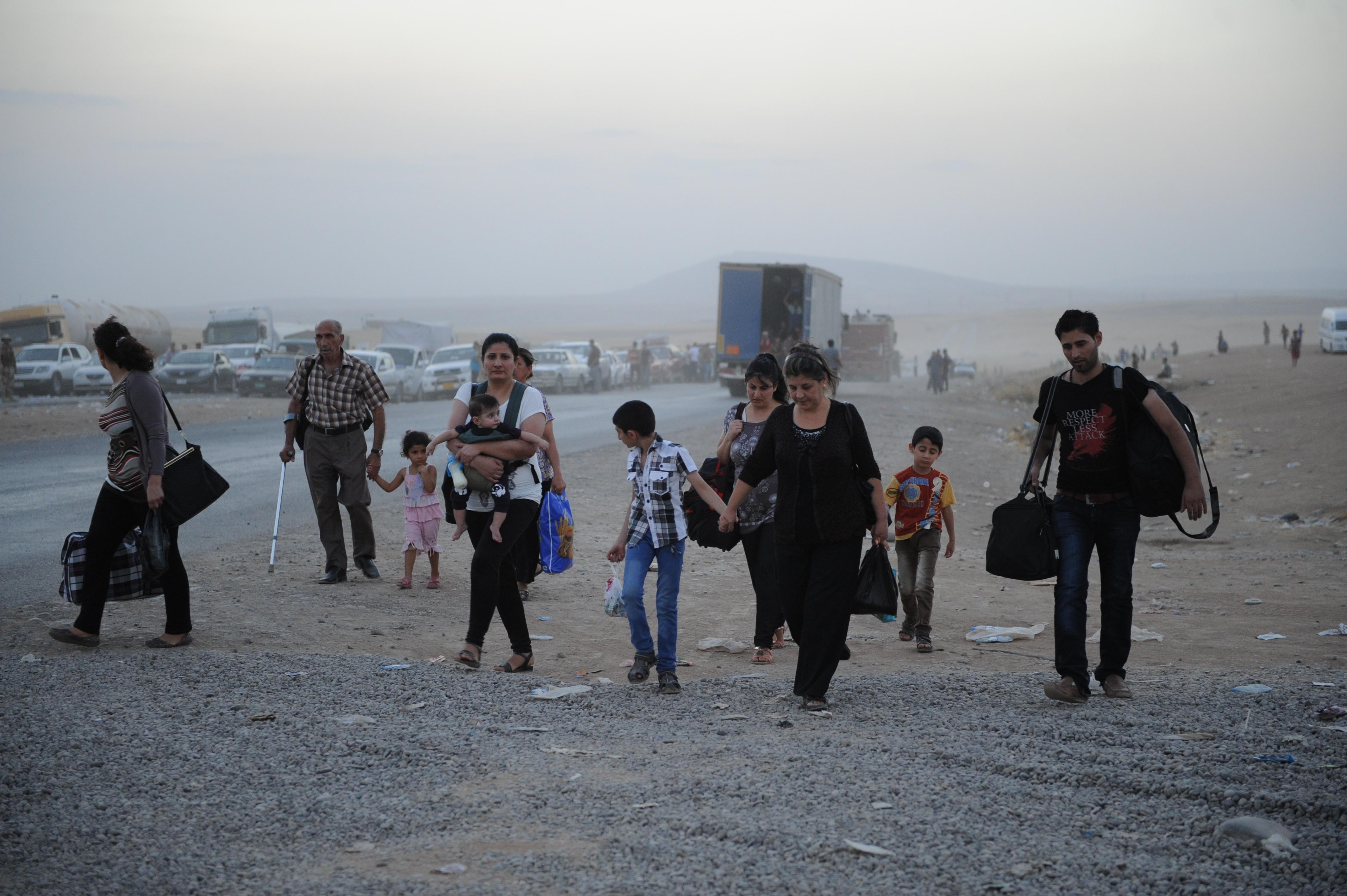
Thousands flee Iraq's Mosul

Ed Krayewski’s not so sure Obama’s decision to re-intervene in Iraq is a good idea, but he’s positive that intervening without Congress’s formal sanction is a bad idea:

As a murderous regime intent on dragging the Middle East back into the Dark Ages makes advances in the region, it’s worth remembering how governments there have encouraged virulent strains of extremist Islam as a way to maintain their own power. If the U.S. were to intervene to defeat ISIL, it would almost certainly cause more harm than good. Yet with ISIL hunting down minorities in Iraq and the Iraqi government powerless to do anything to stop them, the question of whether the U.S. ought to intervene to protect those civilians from ISIL and a situation U.S. policy helped create is a harder one to answer. President Obama’s decision to order limited air strikes in this situation may not be the wrong call. But, given the last half century of U.S. war policy, he will certainly bypass Congress despite claiming to “consult” it. Making the decision unilaterally, outside the constitutional framework, will be the wrong call.

Ilya Somin cautions Obama against escalating unilaterally:

It is possible that the military action envisioned will indeed be so small-scale that no congressional authorization is required. But what if it turns out that very limited strikes and stepped-up assistance for Kurdish and Iraqi government forces are not enough to impede ISIS’ advance? In that event, any significant increase in US military involvement would require congressional authorization.

In addition to meeting constitutional requirements, congressional support could also give military intervention valuable political legitimacy and staying power. If the president goes in on his own, political support could evaporate quickly if anything goes wrong. Since he alone would bear the blame, congressional leaders – especially those from the opposition Republicans – would have every reason to hang him out to dry. For that reason, among others, it is generally better to enter a war only if there is a broad political consensus in favor of doing so, including both the president and Congress.

But Jack Goldsmith expects that Obama’s views on his constitutional prerogatives to fight Islamist terrorism are becoming more expansive, by dint of necessity:

Wanting to declare the statutory war against Islamist terrorists over, the administration has long maintained that the residual use of Article II in this context will be exceptional and limited.  Given the large and growing nature of the Islamist threat, not just in Syria and Iraq, but elsewhere, I do not see how the President can protect U.S. national security interests with exceptional and limited uses of force under Article II.  Put more simply, the threat is not limited, and neither can (or will) be our response.  The current crisis in Iraq might be a test of this view, and of whether the Congress and the nation are comfortable with a President using force in its name under the broad, unilaterally determined parameters of self-defense, or whether it wants more formal and defined input and guidance and limitations from the legislature.

(Photo: Thousands of Yazidi and Christian people flee Hamdaniyah town of Mosul to Erbil after the latest wave of ISIL advances that began on Sunday has seen a number of towns near Iraq’s second largest city Mosul fall to the militants on August 6, 2014. By Mustafa Kerim/Anadolu Agency/Getty Images.)