Back To Iraq: Blog Reax

https://twitter.com/marieharf/status/497729146358099968

https://twitter.com/PentagonPresSec/status/497725099970031616

For Lawrence Kaplan, Obama’s decision to authorize airstrikes on ISIS targets in Iraq was a no-brainer:

The Yazidi, a tiny sect probably as old as the biblical province its members call home, have nearly been wiped out on dozens of occasions, by dozens of persecutors, and yet they survive. During the Iraq War, they turned to the Americans for protection, and the Americans turned to them for all manner of support. (The Yazidi supplied a disproportionate number of interpreters to the U.S. Army.) For this, the insurgents slaughtered the Yazidi, killing 500 on a single day in 2007. Whenever I would visit their ancestral home in the town of Sinjar, they would plead for stepped-up assistance from Washington.

The Yazidi need that assistance, and they need it today. For an administration that famously prefers to achieve its desired results abroad through suasion rather than brute force, this presents a conundrum. It should not.

Christine Allison argues that protecting Iraq’s religious minorities is a moral obligation:

If, through our own inactivity, we allow the Yazidis and Christians to suffer so much that they leave the country, what are we doing to Iraq, the cradle of civilisations? What about the smaller minorities, Shabaks and Mandaeans, who have found stability and shelter in the Kurdish region? Do we sit back and watch an extinction event in northern Iraq? As we commemorate the centenary of the first world war, we have only to look over Iraq’s border to see Turkey’s struggle to come to terms with its past in those years. Inaction in Iraq now will produce the same result: an ethnically “cleansed” landscape, a haunted population.

So now, in addition to our humanitarian efforts, we must turn to the Kurds, who, with their referendum on independence are apt to be perceived as causing “the break-up of Iraq”. But paradoxically, with their forces on the ground, they are the best protectors of northern Iraq’s diverse population. Air strikes and humanitarian drops are a beginning. But in the medium and longer term, London and Washington must find a way to maintain the balance of power between Baghdad and Kurdistan and still work closely with Kurdistan’s fighting forces to assure security.

Dreher also throws his full support behind the intervention:

It is my devout hope that the US kills as many ISIS berserkers as we possible can. I saw today video of a Christian child who had been decapitated by these monsters, and heads of Christians on pikes. There was news today that they were slaughtering Yazidi men and taking their wives as plunder. They are worse than Waffen SS. I’m pretty strongly noninterventionist, but that is not an absolute position, especially not when we can fairly be blamed for setting off this crisis. As they say in Texas, some people just need killin’.

Morrissey calls Obama’s announcement “the right and … only possible steps”, though he doubts airstrikes alone will do the job:

The Kurds have spent the last 23 years living in peace and freedom, relying on the US to protect their interests while being caught between the Turks, Iranians, and Iraqis. Walking away from the Kurds after their long support of our efforts to stabilize Iraq even at the expense of their own dreams of independence would be a betrayal that would send shock waves around the world to other groups working with the US — especially in Afghanistan. The Kurds will be the canary in the coal mine of American credibility for decades to come.

In the meantime, it will take more than a couple of airstrikes to stop the genocides of ISIS to come. The so-called Islamic State and its leadership is perhaps the most explicitly bloodthirsty regime to arise in generations or perhaps centuries, and nothing short of utter defeat will stop them from continuing to annihilate all those who do not bow down to them. The US and the West will have come to grips with this reality sooner or later, and in terms of lives lost and the effort necessary to stop ISIS, sooner would be much more preferable.

To Dan Hogdes, the events in Iraq prove that the US has to be the world’s policeman:

When people say “We don’t want America to be the world’s policeman,” I don’t think most of them actually mean it. What they really mean is “We don’t want America to be the world’s policeman, and the world’s prosecutor, judge and jury as well.”

And that’s a fair argument. But at the moment, with the implosion of the authority of the UN, there is no effective prosecutor, judge or jury. Earlier this week the UN patted itself on the back for the successful conviction of Khmer Rouge leaders Nuon Chea and Khieu Samphan. They are 88 and 83 respectively. Their victims – an estimated two million of them – died 40 years before. Pol Pot himself never faced justice. If we want a world based on laws then someone ultimately has to enforce them. And there is only one state on the planet with the means and inclination to do so. That state is the United States.

But the limits of the mission are very much in doubt. Ryan Goodman questions them:

[I]s this mission really just to protect US personnel or also to aid the Kurds? The New York Times reported that “aides said [the President’s] hand was not forced until ISIS won a series of swift and stunning victories last weekend and Wednesday night against the Kurds in the north, who have been a loyal and reliable American ally.” Similarly, Rep. Adam Smith, the ranking Democrat on the House Armed Services Committee, said “he supported intervening on behalf of the Kurds, as opposed to the unpopular Baghdad government. ‘The Kurds are worth helping and defending.’”

On the second mission (protecting religious minorities on Mount Sinjar), the President outlined three criteria for such humanitarian actions: “[1] innocent people facing the prospect of violence on a horrific scale, [2] when we have a mandate to help — in this case, a request from the Iraqi government — and [3] when we have the unique capabilities to help avert a massacre.” It is unclear, in my mind, why those three criteria won’t also apply to ISIS’s genocidal efforts elsewhere in the country, and the US ability “to help avert” those massacres.

Zack Beauchamp believes that the “key cause of all of this is ISIS’ somewhat surprising advance into territory held by Iraq’s Kurds”:

“This is a big deal,” Phillip Smyth, a researcher at the University of Maryland who follows this situation closely, said. “First, they push the Christians out of Mosul [Iraq’s second-largest city], and now they’re doing that.”

Smyth sees at least two basic motivations for the ISIS advance. One is simple opportunism: not every Kurdish unit is equally strong, and ISIS will take any territory it thinks it can, given the chance. The second is more strategy: they likely want to cut off Iraq’s Kurds from Kurdish communities in Syria, where ISIS is fighting a second front against the Syrian government. “They’re trying to cut off geographic links between those two territories,” he said.

John Cassidy asks, “Once the U.S. bombing starts, when will it stop?”:

That is one of the many tough questions that Obama and his colleagues will have to answer. Are the sole goals of the mission to help out the Yazidis and prevent Erbil from falling? Or is this the beginning of a U.S.-led effort not merely to halt the advance of ISIS on its eastern front, in the Kurdish region, but to roll it back everywhere in the country? On these questions, Obama was studiously ambiguous. … Already, though, one Rubicon has been crossed. A President who came into office on a promise to pull the United States out of Iraq, and who followed through on his pledge, has just ordered more combat operations in, or over, Iraq.

Josh Marshall wants to know what changed on the ground to tip Obama towards intervention, and why our understanding of ISIS’s and the peshmerga’s capabilities has been so wrong:

[W]hat’s happened to ISIS, which was supposed to be a fairly small, rag tag force, highly spirited perhaps but not a force capable of making gains against a disciplined regular army? Quite a bit of American weaponry did fall into ISIS hands when the Iraqi Army fled. But advanced weaponry usually requires significant training to use effectively or at all and additional time to integrate its use into a fighting force. It seems highly questionable that all that weaponry could have transformed ISIS’s capabilities so quickly.

And if ISIS hasn’t changed, is it possible that the Peshmerga were never really the vaunted force they were made out to be? That’s the question asked by this editorial in a Saudi paper. Whether it’s one of these misapprehensions or the other or both, either would seriously change the situation in Iraq from what we’d been led to believe as recently as a few days ago.

Indeed, if the Kurds can’t finish ISIS on the ground, even with American air support, what happens then? That’s where Jacob Siegel spots a major flaw in Obama’s plan:

The consensus among ex-CIA analysts, former military officers, and Iraq veterans who spoke with The Daily Beast is that the Peshmerga’s abilities were overrated. No one questions the Kurds’ willingness to fight, but their military prowess appears to have degraded in the years since the U.S. military stopped training them and withdrew from Iraq. … Air strikes against ISIS targets can weaken the group, buy time, and prevent it from massing on Kurdish forces, but according to military and CIA veterans, air power alone will not be decisive.

“The advisors need to be pushed out, if they haven’t been already,” said Nada Bakos, a CIA veteran who led the team analyzing the terrorist network that was ISIS’s predecessor in Iraq. The advisors she referred to are the special operations troops who have so far stayed away from the battlefield, offering intelligence and advice from headquarters in areas remote from the fighting.

Juan Cole is having flashbacks to 1991:

The Neocons who wanted to go to war against Iraq in the early zeroes always said that one reason a war would be good was that the US was spending a lot of money on the no-fly zone over Kurdistan– as if a whole war wouldn’t be much more expensive (it was, by about $1 trillion). Apparently not only has the Iraqi federal army almost completely collapsed, finding itself unable to take back Tikrit, but now the so-called Islamic State was making a move on Iraqi Kurdistan’s capital of Irbil. Obama’s hope that the so-called “Islamic State” can be stopped by US air power is likely forlorn. The IS is a guerrilla force, not a conventional army. But one thing is certain. A US-policed no fly zone or no go zone over Iraqi Kurdistan is a commitment that cannot easily be withdrawn and could last decades, embroiling the US in further conflict.

Lastly, Michael Crowley remarks on Obama’s evolution when it comes to genocide and US intervention:

In his 2007 comments about genocide, Obama at least seemed to imply that, because the U.S. can’t prevent slaughter everywhere, it shouldn’t take humanitarian action anywhere. But as President he has adopted a different point, first in Libya and now in Iraq: Just because we intervene in some places doesn’t mean we have to intervene everywhere. That doesn’t make for a very tidy doctrine. Nor will it console the miserable people of Syria. But it will bring jubilation to the terrified thousands on Mount Sinjar, for whom salvation is now coming.
Did We Just Bomb Iraq?

https://twitter.com/PentagonPresSec/statuses/497488631599464448

Kurdish and Iraqi officials are attributing airstrikes on ISIS targets in northern Iraq to the US, but the Pentagon is denying everything:

The New York Times, citing Kurdish officials, reported that U.S. forces bombed at least two targets in northern Iraq. The McClatchy news agency also reported aerial bombings outside the town of Kalak in the Kurdish region of northern Iraq, stating that Kurdish media had described jets as American bombers. But the Pentagon press secretary, Rear Adm. John Kirby, said on Twitter that the press reports were “completely false.” The Pentagon also denied a report, by ABC News, that the U.S. had begun humanitarian air drops to people in need in northern Iraq.

Earlier on Thursday, a defense official told TIME that the Iraqi government had begun airdrops in northern Iraq and that it was considering providing “direct assistance wherever possible.” Multiple news outlets, including CBS News and the New York Times, reported Thursday that airdrops or airstrikes were among the options under consideration.

But even if they haven’t gone ahead with them yet, the Obama administration is definitely thinking about both as the situation rapidly deteriorates:

For months, hundreds of US military advisers sent to Iraq have compiled assessments of Iraqi military strength against Isis, a process that the Obama administration has portrayed as a prerequisite for any airstrikes. But with no offensive action taken, the Pentagon has faced criticism for dragging its feet on a deepening crisis.

Now Kurdish peshmerga irregulars have fallen back to positions closer to the regional capitol of the autonomous region, Irbil, following days of Isis gains in nearby towns in and near Iraqi Kurdistan. Tens of thousands of civilians are said to be crossing into Kurdistan for shelter. As much as the dire persecution of Iraqi religious minorities has prompted Obama administration discussions of food, water and medicinal air drops, the threat to the pro-US Kurds has contributed to the reengaged debate over air strikes.

Robert Farley explains why flying aid to the Yazidi refugees is easier said than done:

Unless the drops are very careful, militants might end up with the food and water. That’s not such a disaster, except that groups searching for aid packages can come into contact with armed militants searching for the same thing. The Pentagon has worked hard over the past decade to develop a system that allows precision delivery of large amounts of material, but the system remains geared toward getting supplies to experienced soldiers, not to groups of untrained civilians.

Moreover, airdrops of food, and especially water, are time- and resource-intensive. One off-the-cuff analysis suggested that 24 C-130 transport aircraft flying round trips every day would be necessary to keep the Yazidi supplied with water. Iraqi capacity is limited by the lack of available aircraft and by the need to devote resources to areas in direct combat. Iraq has a handful of C-130s, and a handful of smaller Antonov An-32s, but these aren’t nearly enough to meet the needs of such a large population, even under the best of circumstances. Thus, any operation would require the deployment of American, Turkish, or NATO transport aircraft to the area.

Gordon Lubold sums up the desperation in Iraq right now:

The situation has quickly grown dire. Humanitarian groups said earlier this week that as many as 40,000 civilians, many of whom are Yazidi, were trapped as vaunted Kurdish peshmerga forces defending the area lost ground to the Islamic State. Although the United States has supported Iraqi forces, including providing hundreds of Hellfire missiles, the peshmerga say they are poorly equipped to counter the Islamic State, previously known as ISIS. [White House spokesman Josh] Earnest on Thursday called the situation a humanitarian catastrophe. He also said the administration is deeply concerned about reports that several hundred girls had been abducted from the area.

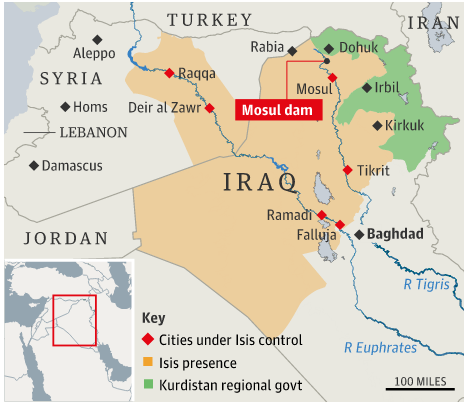
Compounding the deteriorating situation is the Islamic State’s capture of Iraq’s largest dam, the Mosul. What that spells for civilians if, say, the militants blow it up, sending a 65-foot wall of water downriver, has been a concern since the Islamic State began its offensive across northern Iraq in the spring.

So Allahpundit figures if there’s a time to act, it’s the present:

The Yazidis starving on Mount Sinjar is bad, ISIS seizing the Mosul Dam is worse, and ISIS overrunning the one solid ally America has in the region is probably worst of all. Maybe the threat to Irbil finally convinced Obama to act. I’m honestly shocked that the jihadis could have the peshmerga so far back on their heels that the capital of Kurdistan could be under threat, but maybe that’s my own ignorance showing. If the Kurds aren’t going to push ISIS back, though, who is? Turkey? The Saudis?

A Genocide Is Being Committed In The Middle East

http://youtu.be/JNoP-tQ5mCw

Some 40,000 Iraqi Yazidis, whose hometown of Sinjar was overwhelmed by ISIS militants on Saturday, are stranded on a mountain with little food or water after fleeing the city and being trapped there by the jihadists below, who consider them heretics:

UN groups say at least 40,000 members of the Yazidi sect, many of them women and children, have taken refuge in nine locations on Mount Sinjar, a craggy, mile-high ridge identified in local legend as the final resting place of Noah’s ark. At least 130,000 more people, many from the Yazidi stronghold of Sinjar, have fled to Dohuk, in the Kurdish north, or to Irbil, where regional authorities have been struggling since June to deal with one of the biggest and most rapid refugee movements in decades.

Sinjar itself has been all but emptied of its 300,000 residents since jihadists stormed the city late on Saturday, but an estimated 25,000 people remain. “We are being told to convert or to lose our heads,” said Khuldoon Atyas, who has stayed behind to guard his family’s crops. “There is no one coming to help.”

The Yazidis, Bobby Ghosh explains, are one of several Iraqi minority groups in danger of persecution and genocide by the murderous “caliphate”:

Many Shi’ites can flee—some already have—southward, and find refuge among family and those of their own sect; many of my Shi’ite friends in Baghdad are currently sheltering northerners sent to them by religious organizations. Kurds, likewise, have been streaming into the Kurdish-dominated areas to the north and west of ISIL-controlled territory. Yet another minority, the Assyrians, most whom are Christians, have also fled south, and now await succor from the West, especially from groups of well-established Iraqi Christians in the US, who themselves fled previous spasms of persecution. But other minorities, just as vulnerable to the wrath of ISIL, have neither international support nor nearby refuge. And ISIL seems to have identified them for special persecution.

ISIS has also captured the largest Christian town in Iraq. Razib Khan argues that these minorities’ days are numbered. To him, “the rise of the Islamic State, and the past 10 years of chaos and violence, suggest that this is the end of the persistence of ethno-religious sects such as the Yezidi across most of the Fertile Crescent”:

The Jacobites Christians, Assyrians, and Yezidi, lack powerful patrons and protectors. Though most Sunni and Shia would not countenance genocide, they are focused more on the exigencies of their own internecine conflicts. Many minorities already have large Diaspora populations Europe. Tens of thousands of Yezidi live in Germany, and tens of thousands of Assyrians live in Sweden. The most practical short term solution would be extend refugee status selectively to ethno-religious minorities to prevent them from being eliminated by genocide. …

Of course a final irony is that the migration of the ancient Middle Eastern minorities to the West will likely result in their diminishing over the generations. The corporatist straight-jacket of the Middle Eastern milieu was constricting, but it allowed for a communal identity to maintain itself. In the individualist West these small communities are unlikely to be able to self segregate in large enough ghettos where their cultural norms are dominant. This means that identity will become a choice, and over time intermarriage will likely result in a decrease in numbers. Though the Yezidi are rightly objects of sympathy, their cultural norms are quite retrograde in many ways. These folkways were adaptive in the circumstances of Kurdistan, a persecuted minority which had to maintain a high level of group cohesion. But in the West they are often impediments to full flourishing, and produce inter-generational conflicts.

Jacob Seigel notes that “Kurdish forces from Syria and Turkey have crossed the border, forming a rare alliance with the Peshmerga inside Iraq that has already begun clashing with ISIS to recapture the ground lost over the weekend”:

Tens of thousands of Iraqis now stranded in the mountains are awaiting the outcome of those battles. As for the United States, it is “working urgently and directly with officials in Baghdad and Erbil to coordinate Iraqi airdrops to people in need,” the Defense Department said. On Wednesday, it was 106 degrees in Mosul. There may be 25,000 children trapped in the mountains, according to the United Nations’ children’s relief agency. Forty of them have died already.

George Packer discusses what we might do to help the Yazidis:

Yesterday, a senior U.S. official told me that the Obama Administration is contemplating an airlift, coördinated with the United Nations, of humanitarian supplies by C-130 transport planes to the Yazidis hiding in the Sinjar mountains. There are at least twenty thousand and perhaps as many as a hundred thousand of them, including some peshmerga militiamen providing a thin cover of protection.  The U.N. has reported that dozens of children have died of thirst in the heat. ISIS controls the entrance to the mountains. Iraqi helicopters have dropped some supplies, including food and water, but the refugees are hard to find and hard to reach.

It was encouraging to learn that humanitarian supplies might be on the way, but we always seem to be at least a step behind as ISIS rolls over local forces and consolidates power. ISIS is not Al Qaeda. It operates like an army, taking territory, creating a state. The aim of the Sinjar operation seems to be control of the Mosul Dam, the largest dam in Iraq, which provides electricity to Mosul, Baghdad, and much of the country. According to one expert, if ISIS takes the dam, which is located on the Tigris River, it would have the means to put Mosul under thirty metres of water, and Baghdad under five.

But Morrissey wants more than that:

ISIS has purged Christians from their ancient communities in Mosul and the Nineveh province over the last several months. The war in Gaza has distracted the West for the last few weeks, but with that war now paused at the very least, perhaps it’s time to start shifting our gaze back to the much more dangerous situation in Iraq and Syria, where the death tolls already dwarf what has been seen in Gaza. We’ve spent a lot of time intervening in the Gaza war. What has the US done about ISIS, which poses much more of a threat to the US and the West, in a country where our presence might have made a difference?


Abducted By ISIS

A harrowing account from a 14-year-old Kurd in northern Syria:

They would be taken to the torture room downstairs, one by one. When it was Lawand’s turn, he was first put in a car tire and beaten. Then he was hung from the ceiling by his hands, and beaten again. He could take this punishment for only half an hour before admitting that the list of his YPG relatives was accurate. He was taken back to the cell upstairs, where his time in detention would span 20 days. The kids were allowed to spend an hour each day in the yard; older prisoners got only five minutes. …

When the Muslim holy month of Ramadan began, in late June, Lawand was allowed to leave the prison. He rejoined the other students at a nearby school. The kids were forced to observe the holiday’s daily fast in the July heat. When one was caught taking a sip of water, the militants tied him to the goalposts of a soccer field, making his body into a cross. Then they scalded him with hot water and beat him with sticks.

Some kids tried to escape. One was successful. When the rest were caught, they were put through mock executions, and more torture. Some had knives pressed against their throats for what seemed like an hour.

ISIS Gains Ground In Northern Iraq

Screen Shot 2014-08-04 at 2.26.16 PM

The Islamic State has taken over the town of Sinjar in the country’s northwest, near the Syrian border. Sinjar is the homeland of the Yazidis, a religious minority that Joshua Landis warns is now in grave danger of persecution:

One of the few remaining non-Abrahamic religions of the Middle-East, the Yazidis are a particularly vulnerable group lacking advocacy in the region. Not belonging to the small set of religions carrying the Islamic label “People of the Book,” Yazidis are branded mushrikiin (polytheists) by Salafis/jihadists and became targets of high levels of terrorist attacks and mass killing orchestrated by al-Qaida-affiliated jihadists, following the instability brought about by the War in Iraq.

Today’s IS assault is already bringing about devastating consequences for Yazidis, who make up about 340,000 of Sinjar’s 400,000 inhabitants (this is a high estimate). Many have fled on foot through the desert, without food or water. Others fleeing in cars for Dohuk have been unable to make a clean escape, due to the inability of the roads to accommodate such a large flux of people. Thousands of cars are currently stranded west of the Tigris River.

Andrew Slater also fears for Sinjar’s religious minorities:

By the afternoon of Sunday, August 4, with ISIS in full control of Sinjar, terrified families from the area began their dangerous exodus. The speed with which ISIS engulfed the entire mountain range attests to the large numbers of fighters they brought to bear for this major offensive. Villagers in the Sinjar area gave accounts of girls and young women from their families being abducted by ISIS fighters and carried away. Countless families fled to the mountains above their villages where they are currently surrounded by ISIS controlled areas and are desperately calling friends and family members who escaped, pleading for help. Pictures of families hiding in the mountains have circulated widely on Iraqi social media.

Besides the Sayyida Zainab mosque, ISIS forces were reported to have blown up the Sharif Al-Deen shrine on the Sinjar mountainside, a holy place for Yezidis. The ISIS flag was also raised over the only remaining church in the Sinjar area. Within 24 hours, Sinjar has been transformed from a bustling community into a string of ghost towns.

In its rampage through northern Iraq, ISIS may also have captured Iraq’s largest dam:

Capture of the electricity-generating Mosul Dam, which was reported by Iraqi state television, could give the forces of the Islamic State (Isis) the ability to flood Iraqi cities or withhold water from farms, raising the stakes in their bid to topple prime minister Nuri al-Maliki’s Shia-led government. “The terrorist gangs of the Islamic State have taken control of Mosul dam after the withdrawal of Kurdish forces without a fight,” said Iraqi state television of the claimed 24 hour offensive. Kurdish officials conceded losses to Isis but denied the dam had been surrendered. A Kurdish official in Washington told Reuters the dam was still under the control of Kurdish “peshmerga” troops, although he said towns around the dam had fallen to Isis.

Meanwhile, jihadists affiliated with ISIS and the Syrian jihadist rebel group Jabhat al-Nusra have taken over the Lebanese border town of Arsal, but Zack Beauchamp assures us that this isn’t as scary as it seems:

ISIS’s actions in Arsal aren’t part of a deliberate expansion of the caliphate into Lebanon. Rather, Lebanese forces picked a fight with ISIS fighters who’d been pushed out of Syria. In purely geographic terms, this interpretation of the fighting makes more sense. … Lebanon, down near Damascus in the west, is really far from ISIS’ bases in north-central Iraq and northern Syria. It would be very, very hard for ISIS control territory far away in Lebanon in the same way it controls the caliphate proper.

That said, ISIS’ presence in Lebanon really could be destabilizing all the same. The Arsal fighting alone has already displaced 3,000 people and killed at least 11 Lebanese soldiers. And while ISIS is not trying to seize territory in Lebanon outright (not yet, anyway), the group is ramping up terrorist attacks there. “They’ve been bombing things, trying to get cells in Tripoli [and] Damascus,” Smyth says. “They’ve tried to use these different cells to bomb Iranian and Hezbollah targets there.”

In any case, Keating remarks that these developments are changing the calculus regarding ISIS’s staying power:

A few weeks ago, it seemed unlikely that ISIS could hold out for that long given the sheer number of regional actors it had picked fights with. But it seems like it’s not only holding out, it’s expanding its activities into new areas and taking on new rivals. It’s hard to imagine how it will be contained unless the various forces fighting it can somehow find a way to coordinate. For now, the center of the conflict seems to be the Mosul Dam. Will the prospect of power cuts or catastrophic flooding be enough to get Maliki’s government to work with his Kurdish rivals?

Siddhartha Mahanta notices that ISIS’s recent gains have prompted the Baghdad government to start cooperating with the Kurds:

That massive setback — which the peshmerga claim is a strategic retreat — reportedly led Maliki to back up the peshmerga with air support, as Reuters reported on Monday. “We will attack them until they are completely destroyed; we will never show any mercy,” a Kurdish colonel told the news agency. “We have given them enough chances and we will even take Mosul back. I believe within the next 48-72 hours it will be over.” So while Maliki is making good on his threat to use legal power to seize Kurd-claimed oil, he’s also sending in the planes to back the Kurds just as the myth of their apparent invincibility takes a potentially serious hit. It’s either a shrewd political move or a truly desperate cry for help. Baghdad and Erbil. These days, theirs is a tale of two frenemies.

And Dexter Filkins argues that we should be helping the peshmerga, too:

The militants in ISIS have swept across much of northern and western Iraq, and there is no sign that they have any intention of slowing down. In a surprising—and encouraging—turn, Maliki has apparently ordered the Iraqi Air Force to carry out air strikes to help the Kurds. That said, the Iraqi Army has proved itself utterly ineffectual in combating ISIS. If the U.S. decided to help the Kurds, there would be no guarantee that the Kurds wouldn’t later use those weapons to further their own interests. But what other choice is there? If anyone is likely to slow down ISIS, it’s going to be the Kurds—regardless of whatever they’re planning to do later on.

Meanwhile, Back In Syria …

Hassan Hassan suspects that Assad is poised to recapture Aleppo, which would be a potentially fatal blow to the rebels:

The regime’s recent gains mean that it may be able to strangle the opposition’s strongholds in Aleppo, and threaten its support networks outside the city. Sheikh Najjar is a strategic gateway for the regime into Aleppo’s northern countryside, and if it can capture the still rebel-held Infantry School and Handarat camp, it can secure northeastern Aleppo and encircle the rebels. It can also disrupt the rebels’ supply lines to Turkey, which represent their main source for arms and supplies.

Thus, the rebels in Aleppo find themselves squeezed from all sides:

They are facing pressure from much of the city’s surrounding countryside, the loss of strategic territory on the outskirts of Aleppo, and now regime incursions into the city’s internal districts. The regime has also successfully opened a supply route into Aleppo from the southern countryside, which activists say was one of the key reasons for the regime’s latest advances in the city. To make matters even worse, the Islamic State (IS), previously known as ISIS, is advancing toward Aleppo from the east, from its strongholds in the cities of Raqqa and al-Bab.

Aleppo’s recapture by the regime would be catastrophic for the opposition. From the opposition’s point of view, the city is too big to fall: The takeover of the country’s northern economic hub in 2012 helped the opposition to establish itself as a viable challenge for the regime. If it now falls to the regime, the opposition would have lost four main provinces — after Raqqa, Deir Ezzor, and Homs — to its rivals in the regime and the Islamic State.

A Well-Oiled Caliphate

In Charlie Cooper’s estimation, ISIS is handling governance surprisingly well. Part of that is down to its control of strategic resources:

Currently, it controls many of Iraq’s northern oilfields and is in a strong position to take its largest refinery at Baiji. On top of this, three weeks ago, IS took over Syria’s largest oilfield in al-Omar. Once a field is secured, IS has been quick to make a profit, reportedly earning millions of dollars selling oil to the Assad regime and, allegedly, to Iraqi businessmen.

In terms of water, IS has long controlled the Tabqa Dam and, hence, Lake Assad, in Syria, as well as the Fallujah and Mosul dams in Iraq. It thus falls to IS to provide drinking water and irrigation to massive areas of farmland. In a sense, IS has become a de facto state provider that enjoys a complex economic and infrastructural interdependence with the populations that live within its territories, something that further insulates it from outside attack.

But Keith Johnson finds reason to believe that the shady oil deals that fund the group’s activities aren’t sustainable:

With the Islamic State at the helm, that oil boom certainly won’t last forever.

The old oil fields in Syria and Iraq need lots of care, such as injections to keep the pressure up and output reliable; the lack of trained technicians and the frequent turnover have been a nightmare for proper reservoir management and will ultimately lower future output at those fields, [Chatham House oil expert Valérie] Marcel said. Still, all else being equal, that kind of control over oil fields, oil revenues, and petroleum products would be a financial shot in the arm for any terrorist outfit. Control of oil products, from gas canisters needed for cooking to fuel needed for transport, gives the group additional local leverage. And the revenue bolsters the Islamic State’s ability to recruit and pay fighters and to buy weapons.

However, that money is also desperately needed to cover the salaries of public workers in places the militants now occupy. Providing basic public services to show that they can do more than conquer and crucify, but can govern to a limited extent, also costs money. Serving as an unelected proxy for ousted or absent governments has long been a way for Islamist groups, from Hezbollah to Hamas, to broaden popular support.

The latest Dish on ISIS’s oil here, and on the water issue here.

The Lady Cops Of The Islamic State

As ISIS commands all women in its domains to veil their faces or face unspecified punishment, Kathy Gilsinan explores the role Iraqi Syrian women themselves are playing in enforcing the group’s fanatical dictates:

The al-Khansaa Brigade is ISIS’s all-female moral police, established in Raqqa soon after ISIS took over the city a few months ago. “We have established the brigade to raise awareness of our religion among women, and to punish women who do not abide by the law,” Abu Ahmad, an ISIS official in Raqqa, told Syria Deeply’s Ahmad al-Bahri. Ahmad emphasized that the brigade has its own facilities to avoid mingling among men and women. “Jihad,” he told al-Bahri, “is not a man-only duty. Women must do their part as well.”

The institution of female enforcers for female morality makes a certain kind of sense if you take the prohibition against sexes mingling to its logical extreme. Still, ISIS in Raqqa may be the only jihadi group employing this kind of logic. In other jihadi groups, “it is men who enforce modesty in public,” explains Thomas Hegghammer, an expert on Islamist militancy affiliated with the Norwegian Defence Research Establishment, via email. Nor has the practice spread elsewhere in the Islamic State’s self-declared caliphate. The al-Khansaa Brigade may be what Hegghammer calls a “short-lived stunt in a single city.”

Indeed, regional news sources suggest the brigade was designed to solve a specific problem: male anti-ISIS fighters disguising themselves in all-concealing feminine garb to pass through checkpoints. With male ISIS members reluctant to inspect under garments to verify the womanhood of the wearers, they got some women to do it.

You Can’t Believe Everything You Read About Iraq

A UN official who claimed that ISIS had ordered genital mutilation for all women and girls in Mosul appears to have been the victim of a hoax:

The story quickly began to go viral, racking up hundreds of shares on social media. Soon thereafter, however, journalists with contacts in Iraq began reporting that the story didn’t hold up. “My contacts in #Mosul have NOT heard that ‘Islamic State’ ordered FGM for all females in their city,” Jenan Moussa, a reporter with Al Anan TV tweet out. “Iraqi contacts say #Mosul story is fake,” echoed freelance writer Shaista Aziz, adding: “Iraqi contact on #FGM story: “ISIS are responsible for many horrors, this story is fake and plays to western audience emotions.’”

NPR’s Cairo bureau chief also claimed that the story was false, tweeting “#UN statement that #ISIS issued fatwa calling 4 FGM 4 girls is false residents of Mosul say including a doctor, journalist and tribal leader.” Not long after a version of a document in Arabic, bearing the black logo that ISIS has adopted, began circulating on Twitter. The document, those who shared it said, is a hoax and the basis for the United Nations’ claim.

That wasn’t the only inaccurate story to come out of the Islamic State. David Kenner highlights some others:

Last week — as the jihadist group’s very real campaign to force Christians to pay a tax levied on non-Muslims, convert to Islam, or face death reached fever pitch — multiple news outlets reported that the Islamic State had burned down the St. Ephrem’s Cathedral. There was just one problem:

The pictures published by news outlets and shared on social media of the supposed burning of the Syriac Catholic cathedral were from church burnings in Egypt or Syria. To this day, there has been no confirmation from anyone in Mosul that a cathedral was burned.

But the most spectacular story about the Islamic State relates to what would have been one of history’s most spectacular bank heists. Shortly after the group stormed Mosul, the provincial governor in the region told reporters that it had raided the city’s central bank, making off with more than $400 million, in addition to a “large quantity of gold bullion.” … There’s only one problem: The heist doesn’t appear to have happened.

The news that ISIS militants destroyed the tomb of the prophet Jonah, on the other hand, appears depressingly credible:

Residents said on Thursday that the militants first ordered everyone out of the Mosque of the Prophet Younis, or Jonah, then blew it up. … Several nearby houses were also damaged by the blast, said the residents, speaking on condition of anonymity because they feared for their own safety. The residents told AP that the militants claimed the mosque had become a place for apostasy, not prayer. The extremists also blew up another place of worship nearby on Thursday, the Imam Aoun Bin al-Hassan mosque, they said.

Violence Triumphs Over Pluralism

That’s the essence of Shadi Hamid’s take on the aftermath of the Arab uprisings and the rise of armed Islamist groups throughout the Middle East:

The July 3, 2013 coup in Egypt has had a chilling effect beyond the country’s borders, strengthening one particular narrative among both regimes and their opposition: that the only currency worth caring about is force. With the relative decline (for now) of the Muslim Brotherhood and other mainstream Islamist groups that had made their peace with parliamentary politics, radicals and extremists have quickly moved to fill the vacuum. They do not counsel patience. They tell followers and fence-sitters that there is little need to wait 20, 30, or 80 years for the Islamic State, or something like it. The Islamic State can be realized now through brute, unyielding violence. Within the varied, often fractious world of political Islam, the radicals remain a minority, but their numbers belie an outsized influence.

We might not like to admit it, but violence can, and often does, “work” in today’s Middle East. This is not just a reference to the Islamic State of Iraq and Syria (ISIS), but also to less extreme militant groups that control territory throughout Syria, providing security and social services to local populations. From Libya to Palestine to parts of the Egyptian Sinai, armed—and increasingly hard-line—Islamist groups are making significant inroads.

William Dalrymple argues that the rise of ISIS and its persecution of Christians bode ill for secularism in the Arab world:

Certainly since the 19th century Christian Arabs have played a vital role in defining a secular Arab cultural identity. It is no coincidence that most of the founders of secular Arab nationalism were men like Michel Aflaq – the Greek Orthodox Christian from Damascus who, with other Syrian students freshly returned from the Sorbonne, founded the Ba’ath party in the 1940s – or Faris al-Khoury, Syria’s only Christian prime minister. Then there were intellectuals like the Palestinian George Antonius, who in 1938 wrote in The Arab Awakening of the crucial role Christians played in reviving Arab literature and the arts after their long slumber under Ottoman rule.

If the Islamic state proclaimed by Isis turns into a permanent, Christian-free zone, it could signal the demise not just of an important part of the Arab Christian realm but also of the secular Arab nationalism Christians helped create.

Relatedly, noting the unusually cold shoulder Hamas has gotten from some Arab states during the Gaza war, Juan Cole attributes this to the region’s recent political realignment around the struggle between states and Islamist non-state actors:

[Y]ou have a bloc of nationalist states– Egypt, Jordan, and Syria — facing off against movements of political Islam, and Hamas has to be counted among the latter. (Iraq, ruled by parties of Shiite political Islam, is trying to join the nationalists in the region in alliance against the “Islamic State”). It is therefore difficult for these states to intervene on behalf of Hamas, since they want the organization, and the whole tendency to political Islam, to drop dead. …

Even the so-called “Islamic State” turns out to be useless to Hamas. Its leadership says that it has to tackle the “hypocrites” among the Muslims before turning to “the Jews.” This is a reference to early Islam. When the Prophet Muhammad emigrated from Mecca to Medina, most people in the latter city came to embrace Islam, even if only pro forma. City notables who outwardly had become Muslims but inwardly resented and tried to undermine the Prophet, were termed “hypocrites” or “those in whose hearts there is a sickness”. The so-called Islamic State views all other Muslims this way. So the struggle between nationalism and political Islam has neutralized most of the Middle East if it hasn’t made them de facto allies of Israel.