The Islamic State In Iraq And Only Iraq

Jacob Siegel casts doubt on ISIS’s ability to extend the reach of its “caliphate” beyond Iraq, given that its Sunni rebel allies there don’t share its objective of world conquest:

There is a paradox to ISIS’s power. The caliphate has grown to rival al Qaeda for prestige in the global jihad movement but it becomes clearer with every day that, within Iraq, the Islamic State doesn’t extend very far outside of Mosul. As an attacking force, ISIS might be the most powerful army in Iraq, able to ambush the army in lightning assaults that have either scattered or slaughtered government and militia soldiers. But the skills and composition that have led to ISIS successes on the battlefield haven’t set them up to rule in any more than a handful of cities. They are too small to impose their authority over extended territory. For that they rely on their allies, using them until the day they are no longer needed, just as they, in turn, are being used.

ISIS’s victories and social media theatrics have won it a flock of Internet supporters and death-seeking recruits, but most of its potential followers in Iraq aren’t looking online to choose a cause, they take orders from tribal leaders or other local authorities.

Likewise, Yezid Sayigh contends that “in fact ISIS is following a well-worn path for taking power and consolidating it in the limited geographical space of a single nation-state where its true social base lies”:

To legitimize itself ideologically and acquire leverage over its partners and competitors, ISIS calls Muslims to jihad, labels western governments “crusaders,” and pledges to free Palestine. This again mimics Saddam, who appealed to pan-Arabism and the Gulf monarchies to support his war against revolutionary Islamist Iran in 1980, and in 1990 linked his invasion of Kuwait to the liberation of Palestine and evoked Islamic solidarity by having “Allahu Akbar” inscribed on the national flag.

But Saddam remained an Iraqi leader in the Iraqi setting, benefitting from the country’s oil wealth to cement his rule internally but remaining bound by its limitations, especially its deep social cleavages and weak national identity. ISIS is even more dependent than he was on its societal balances and alliances within the narrower domestic demographic base of the Arab Sunnis of Iraq, a vulnerability that is not seriously compensated by its partial extension into Syria.

Strategic Countertrolling

The State Department is hip to the fact that jihadists are using social media to propagandize and recruit supporters, and its $5 million Center for Strategic Counterterrorism Communications is devoted to fighting back. The trouble, as Jacob Silverman reveals, is that they’re not very good at it:

The way the program works is fairly simple: The State Department’s analysts follow online chatter about the latest ISIL victory or news of a recent al-Shabaab massacre in Kenya, and then they try to insert themselves into the conversation. The idea is less to sway committed terrorists than to persuade fence-sitters not to join up or provide material support.

But State’s messages usually arrive with all the grace of someone’s dad showing up at a college party. The posts tend to be blunt, adversarial, and plagued by poor Photoshop work.

Typically, “Think Again Turn Away,” as the CSCC’s English-language Twitter account calls itself, delivers hectoring messages written in the schoolmarmish tone of Reagan-era “Just Say No” commercials – only this time it is terrorism, not drugs, they’re trying to scare everyone away from. And because the government’s tweeting is so flat and self-serious, few people—even those most sympathetic to its messaging—are motivated to share the CSCC’s posts. As anyone bidding for attention on social media knows, that’s a serious problem.

ISIL supporters, by contrast, can be playful and droll, though sometimes the humor is exceedingly macabre and only appeals to a certain sensibility. Many of the photos being circulated — such as one of a dead Shiite man floating in a body of water, alongside a joke about him being taught to scuba dive — are horrific, but they also make for popular jihadist memes. (That particular picture was retweeted nine times and favorited 15.) The plain fact is that, for now, groups like ISIL are far more sophisticated than the State Department in their messaging.

Previous Dish on ISIS’s social media campaigns here, here, and here.

Convert, Submit, Or Die, Ctd

In light of the persecution of Iraqi Christians by ISIS, Dougherty argues that the US has a serious moral obligation to help:

[T]he U.S. should look for ways to provide direct monetary and diplomatic assistance to neighboring states in the region where persecuted Iraqis are seeking refuge, perhaps even going so far as to directly assist in the emerging centers of authority in Kurdistan, where some refugees have sought protection from ISIS, and which continues to prove itself capable of maintaining some order and security. Although I’m generally inclined toward a more restrictive position on immigration, the U.S. should, as a matter of practice, be especially generous in granting refugee status to the collateral victims of the war we started in Iraq. It should even offer some refugees of ISIS persecution the material resources to emigrate to America if they so desire.

The dream of transforming Iraq into an incubator of Arab liberalism has turned into a nightmare for religious minorities. America’s intervention in Iraq, and its support of Syrian and Libyan rebels, have created a disastrous disorder in which Islamist threats thrive. Mosul was a home for Christians for as long as Christianity existed. Not anymore. Now, the U.S. cannot restore these people to their homes, nor reverse the desecration of Christian shrines. But our diplomatic, financial, and moral energies should be used to protect them from any further harm.

Meanwhile, a few readers consider why Americans are relatively quiet over the plight of Iraqi Christians:

Why the silence? It could be, as Tim Stanley said, that the West is embarrassed about the idea of Christians being a persecuted minority. Or fear of another invasion. Personally, I think it’s because large numbers of Christians in the West, primarily of the Evangelical variety, harbor bigoted attitudes towards Arabs in general and Catholics (Roman, Orthodox, Anglican, Coptic, etc.) in particular. Having spent time in Israel and the West Bank, I continually find people at home surprised to hear of the plight of Palestinian Christians there. They are surprised to hear that one could be an Arab, a Palestinian, and a Christian. Most people are simply ignorant of the fact that there is a Christian Arab presence in the Middle East at all. It should seem obvious, but it’s not. The assumption is that all Palestinians are Muslims, and all Muslims are jihadists. (I live in the South; what can I say).

Another takes a different approach:

I do not think, as Stanley does, that it has anything to do with feeling embarrassed about Christians as a persecuted minority.  Rather it has to do with stories like this one:

In a joint statement, the chairmen of the United States Conference of Catholic Bishops’ Ad Hoc Committee for Religious Liberty and Committee on Laity, Marriage, Family Life and Youth decried the decision [by Obama banning discrimination against transgender employees]. “Today’s executive order is unprecedented and extreme and should be opposed,” said Archbishop William Lori of Baltimore and Bishop Richard Malone of Buffalo. “In the name of forbidding discrimination, this order implements discrimination.” “With the stroke of a pen, it lends the economic power of the federal government to a deeply flawed understanding of human sexuality, to which faithful Catholics and many other people of faith will not assent,” they continued. “As a result, the order will exclude federal contractors precisely on the basis of their religious beliefs.”

American Christians have cried wolf too many times over superfluous issues like this one and the HHS mandate positioning both not as misguided government overreach, but as persecution.  After repeated self-indulgence, will anyone listen to them when there is real and life-threatening persecution of Christians in other parts of the world?  This case illustrates the real harm that many American Christians have committed focusing on their first world problems rather than on the worldwide body of Christ.

Baghdad’s Bullies Back In Business

Jacob Siegel is in the Iraqi capital, monitoring the revival of hardline Shiite militias whose ideologies aren’t much friendlier than that of ISIS. In his latest dispatch, he reports on the threats faced by a local NGO that protects abused women and gay Iraqis:

It was the police who phoned the organization Sunday morning, [Dalal] Jumaa [who heads the office of the Organization of Women’s Freedom in Iraq] said. They told her they had heard she harbored gay men and runaway girls. But the threat, which the police were relaying, came from Asaib Ahl al Haq, a powerful and notoriously brutal Shia militia in Baghdad. “I cannot stop Asaib Ahl al Haq,” the policeman told her, “they received this information and will kill you if you don’t leave.”

The Organization, as everyone calls it, stood accused of pimping out the young women in its shelters, which Jumaa said is a lie commonly used to slander Iraqi groups advocating for women’s rights. She convinced the policeman of her innocence but the militia wouldn’t be waiting to hear her out. Asaib Ahl al Haq is the group believed to have slaughtered 29 women alleged to be prostitutes last week in the upscale neighborhood of Zayouna.

No Quiet On The ISIS Front

Hanna Kozlowska provides an update on Syria, where as many as 700 people were killed last Thursday and Friday in fighting between ISIS and regime forces – the highest death toll in 48 hours since the start of the war in 2011:

The Shaar gas field in central Syria saw some of the heaviest fighting. It is a crucial gas supply facility for the country’s central region and among the largest in Syria. Islamic State fighters attacked the field Wednesday night — just hours after Bashar al-Assad was sworn in for a third, seven-year term as president —  and seized it Thursday, killing 270 government soldiers, guards, and staff. According to the Syrian Observatory for Human Rights, a Britain-based NGO, at least 40 militants from the group formerly known as ISIS were killed. Over the weekend the body count grew by 100. More than 170,000 people have died since began in March 2011. And the war created an unprecedented refugee crisis displacing 2.8 million people, including many women and children.

On Monday, Islamic State fighters clashed in Damascus with other anti-Assad rebels who initially embraced the group but now are trying to expel it from the city. They’ve successfully ousted the organization from sections of the capital and its outskirts but the Islamic State’s influence has recently expanded, encompassing an oil-rich area in the eastern Deir Az Zor province. The organization controls much of Syria’s east.

The conflict also continues to have a severe impact on its neighbors. Alice Su takes stock of the ever-heavier burden the Syrian refugee crisis is imposing on Jordan, which is also host to thousands of refugees from Iraq and other war-torn countries:

A year passes, then two, then three. Rents rise—up to 300 percent in some areas—along with gas, electricity, and water bills. The Jordanian economy, already destabilized by disrupted trade and transit routes across the region, wobbles. GDP growth declines. Foreign direct investment shrivels. Budget deficits and public debt grow.

Jordan’s government has drafted a National Resilience Plan to mitigate this kind of damage for its citizens, 14 percent of whom live below the national poverty line. But the plan, along with all the humanitarian work in the country, depends on international funding, which is dwindling. To date, UNHCR has received 33 percent of its 2014 regional appeal for the Syrian crisis, leaving a gap of nearly $2.5 billion.

Jordan is not meant to be a host country indefinitely. Refugees are supposed to stop here for relief until they reach a “durable solution”—meaning returning home or resettling somewhere with permanent residence. So far, 22 countrieshave pledged to receive almost 35,000 Syrians, with UNHCR calling for a further 100,000 pledged spots by 2016. But there are more than 2.6 million Syrian refugees total, and only some of the pledges— just 121 resettled in America and 24 in the U.K., for example—have been fulfilled. The remaining refugees are stuck here, lives frozen, told to wait for a resolution that may not come.

Convert, Submit, Or Die

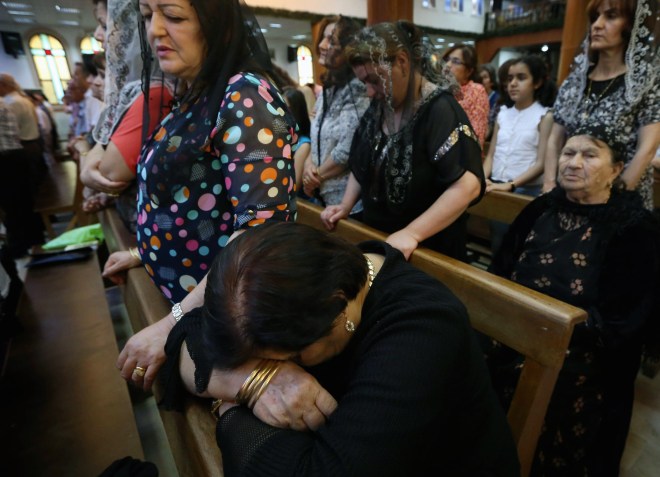
IRAQ-UNREST-RELIGION-CHRISTIANS

Meanwhile, back in the hellhole of Iraq, the “Islamic State” has issued an ultimatum to Christians in the areas it controls:

In the statement, Isis said Christians who wanted to remain in the “caliphate” declared earlier this month in parts of Iraq and Syria must agree to abide by terms of a “dhimma” contract – a historic practice under which non-Muslims were protected in Muslim lands in return for a special levy known as “jizya”. “We offer them three choices: Islam; the dhimma contract – involving payment of jizya; if they refuse this they will have nothing but the sword,” the announcement said.

A resident of Mosul said the statement, issued in the name of the Islamic State in Iraq’s northern province of Nineveh, had been distributed on Thursday and read out in mosques. It said that Islamic State leader Abu Bakr al-Baghdadi, which the group has now named Caliph Ibrahim, had set a Saturday deadline for Christians who did not want to stay and live under those terms to “leave the borders of the Islamic Caliphate”. “After this date, there is nothing between us and them but the sword,” it said.

Juan Cole comments on the flight of Christians from Mosul, which leaves the city without a Christian community for the first time since the dawn of the faith itself:

Mosul’s fleeing Christians have largely gone to Dohuk or Irbil in Kurdistan, and Kurdish officials have urged Kurds to give them refuge. Shiite shrines and institutions in the holy cities of Najaf and Karbala have also offered to shelter the displaced Christians. Tens of thousands of Iraqi Christians had earlier gone to Syria and Lebanon, though it seems likely that they will try to get to Europe.

Christians are not the only group at risk. There are many small unorthodox Shiite communities in northern Iraq, and they are recipients of the same threats being directed against the Christians. There are also Mandaean Gnostics. In the period of the American occupation, the predecessors of IS such as al-Qaeda in Mesopotamia, had routinely target Christians and heterodox Shiites for bombings and attacks.

Tim Stanley wonders why that persecution of Iraqi Christians continues to inspire little outrage in the West:

It could be that no Westerner wants to return to Iraq, that politicians fear that even discussing the country will lead voters to fear yet another invasion and yet another bloody occupation. Or it could be that we feel embarrassed about the very idea of Christians as a persecuted minority. The reporter John Allen argues that Westerners have been trained to think of Christians as “an agent of aggression, not its victim” – so we’re deaf to pleas for help. That opinion is supported by Ed West in an excellent e-book, and its consequences have been condemned by religious leaders here in the UK. Rabbi Jonathan Sacks has compared the suffering of Middle East Christians with Jewish pogroms in Europe and reminded everyone of the words of Martin Luther King: “In the End, we will remember not the words of our enemies, but the silence of our friends.”

It would indeed be awful to think that the West might remain silent as violence rages purely out of a failure to recognise that Christians can be victimised, or out of a reluctance to cast aspersions on certain brands of Islam. It would make this the first genocide in history to be tolerated out of social awkwardness.

Daveed Gartenstein-Ross and Amichai Magen take a broader look at some of the governance problems jihadists face in their fanatical attempts to impose Islamic law:

Jihadist groups’ rigid religious outlook drives their belief that sharia must be imposed and also the shape that sharia takes for them. Washington Institute for Near East Policy scholar Aaron Y. Zelin notes that the Islamic State’s city charter after the group captured Mosul on June 10 provided for amputation of thieves’ hands, required timely performance of all required prayers, and forbade drugs and alcohol. Further, “all shrines and graves will be destroyed, since they are considered polytheistic.”

This charter has much in common with previous jihadist governance efforts: They tend to have a legalistic and all-encompassing interpretation of sharia, insisting upon even obscure rules. In a previous period of jihadist rule over Mosul – when the Islamic State’s predecessor, Al-Qaeda in Iraq (AQI), controlled the city until May 2008 – citizens were required to follow intricate and bizarre rules. AQI banned the side-by-side display of tomatoes and cucumbers by food vendors because the group viewed the arrangement as sexually provocative, in addition to banning a local bread known assammoun, the use of ice, and barbers’ use of electric razors. These restrictions might be Monty Python-esque, but the punch line was grim: Iraqis were killed for violating them.

Previous Dish on the plight of Iraqi Christians under ISIS here.

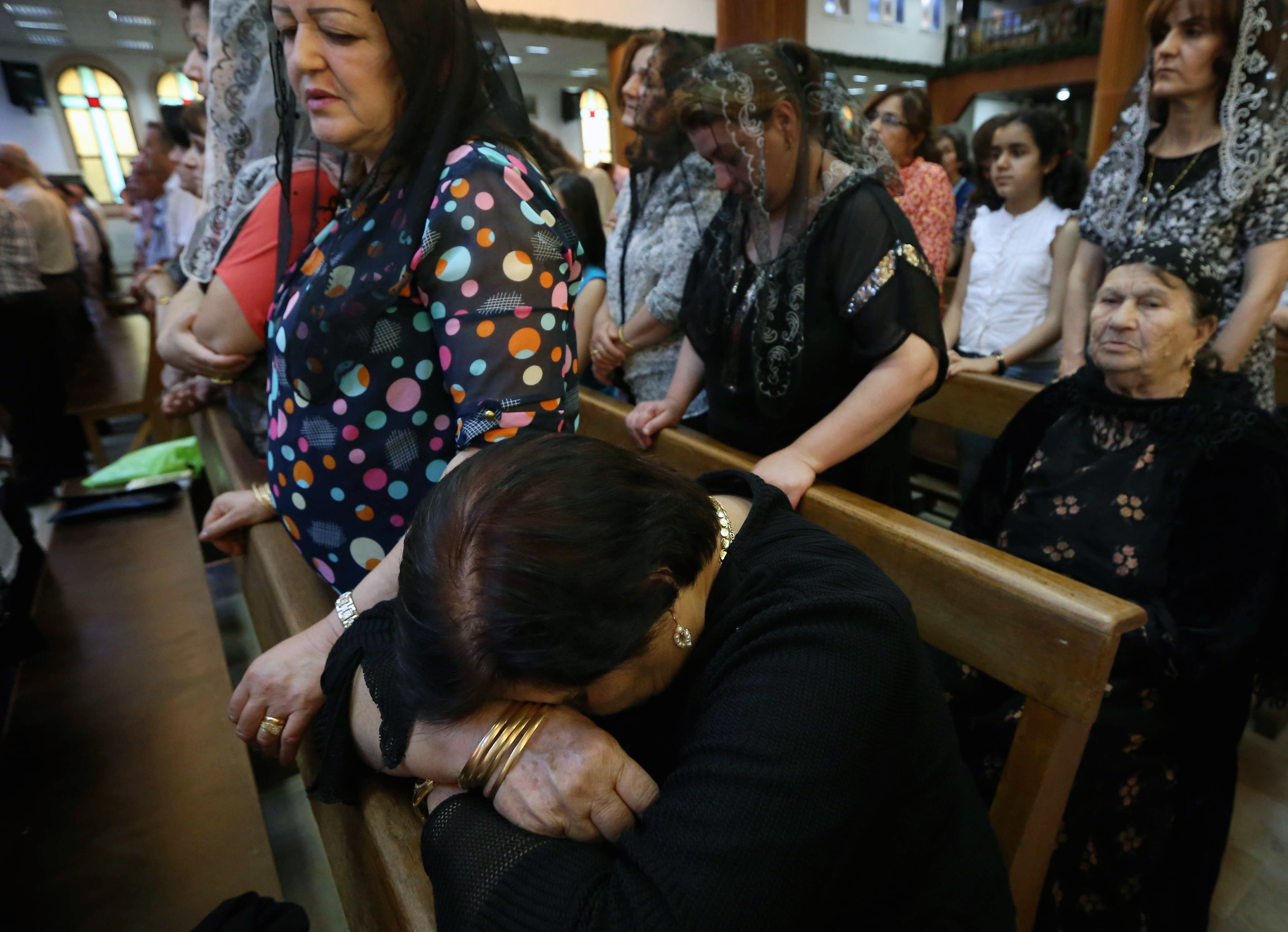
(Photo: Iraqi Christians attend a mass at the Saint-Joseph church in Arbil, the capital of the autonomous Kurdish region of northern Iraq, on July 20, 2014. Hundreds of Christian families fled their homes in Mosul on July 20 as a jihadist ultimatum threatening their community’s centuries-old presence in the northern Iraqi city expired. By Safin Hamed/AFP/Getty Images)
Kurdistan’s Moment? Ctd

Juan Cole’s list of recent “disturbing” news items from Iraq begins with some major developments regarding the Kurds:

1. Last Wednesday Prime Minister Nouri al-Maliki angrily lashed out at the Kurds, accusing them of harboring the terrorists of the so-called ‘Islamic State.’ Since the Kurds have in fact fought the IS radicals, al-Maliki’s charge is hard to take seriously. Rather, it appears to be a sign of how angry he is that Kurdistan president Massoud Barzani is pressuring him to step down. I don’t think al-Maliki can get a third term without Kurdish support.

2. Barzani responded that al-Maliki is “hysterical.” The Kurds then withdrew from al-Maliki’s cabinet, in which they had been his coalition partners. The ministries will likely go on running all right, but the move is symbolic of the break between al-Maliki and his erstwhile backers. Foreign Minister Hoshyar Zebari, one of those who suspended participation, says it will be hard for the Kurds to work with al-Maliki unless he apologizes.

3. On Friday, the Kurds seized two important oil fields in the Kirkuk region. Since their willingness to supply Turkey with petroleum seems to be one of the reasons Ankara has increasingly made its peace with Iraqi Kurdistan becoming independent, the Kurds are now in a position to remunerate Turkey even more generously for acquiescing in their national aspirations.

By seizing these oil fields, Keith Johnson fears, the Kurds risk antagonizing the Iraqi government and further escalating tensions between Baghdad and Erbil:

The big questions now are:

How much more will the move strain the unity of an Iraqi government still struggling to push back against a spring offensive by Islamist insurgents? And how will the Kurds actually sell the additional oil they now control? As a solely regional government, the KRG has hit major obstacles in finding international buyers for its crude since it began trying to sell abroad earlier this year — largely because of Baghdad’s threats and diplomatic pressure.

The Kurdish seizure will aggravate U.S. goals of getting Iraq’s Sunni, Shiite, and Kurdish populations to work together to fight the Islamic State, formerly known as ISIS. Coupled with strident talk of an independent Kurdish state, it further complicates efforts to broker a truce between Baghdad and Erbil, especially regarding international oil sales. “

Luke Harding provides a glimpse of what life is like in Kirkuk these days:

Iraq’s disintegration has affected the city in multifarious ways. It has, for example, touched on the fortunes of Kirkuk’s football club. Nowzad Qader, the head of Kirkuk’s FA, said Iraq wasn’t able to complete its league this year, with players unable to travel to Baghdad. It was too dangerous, he said, since Isis controlled the road. “Isis doesn’t like humanity much, let alone football,” he observed. “If Iraq still exists next season we’ll resume.” Nearby, youths kicked a ball around in the early evening heat.

Qadar said the local FA reflected Kirkuk’s tradition of coexistence, at odds with the sectarian mayhem in the rest of the country. He was a Kurd, his deputy a Turkman and the secretary an Arab. “It’s like a microcosm of Iraq. We work together in brotherhood,” he declared. Maureen Nikola, a volleyball coach, said girls who played on her team came from all of Kirkuk’s ethnic groups. Some of her Christian players had emigrated with their families after 2003, she said. Nikola, a Christian herself, added: “If the peshmerga weren’t here, we would have had to flee, like Mosul.”

Previous Dish on the prospect of an independent Kurdistan here.

A Sunni Revolution In Iraq

That’s how Osama al-Nujaifi, the most recent speaker of Iraq’s parliament and one of the country’s leading Sunni lawmakers, understands the insurgency from which ISIS emerged as the lead actor:

Yes, it is a revolution. But at the same time, the terrorists are taking advantage of it. It’s a revolution that started a year and a half ago, as peaceful demonstrations. [The government] didn’t deal with it according to the constitution. Instead, they faced it with force. So it turned into a military movement. But it wasn’t as broad as we see now. The Islamic State in Iraq and Syria (ISIS) [which now calls itself the Islamic State] took advantage of the gap between the government and the people, and they invaded and occupied Iraqi cities.

ISIS controls important military areas, but the wider geographical area is in the hands of tribes and armed groups who are rebelling against the government, and who before that were fighting the Americans. We need to differentiate between these groups and the terrorists. We need to face ISIS militarily. But these other groups should be dealt with politically.

For this reason, Owen Bennett-Jones suggests that the Islamic State will eventually fall apart, but he argues it’s likely to take Iraq, and maybe even Syria, along with it:

The disintegration of Iraq fits into larger trends challenging the established order in the Middle East and it isn’t only jihadis who are driving the changes. In a development that would have been unimaginable a few years ago, Western companies are now buying oil from the Kurds despite the opposition of the central government in Baghdad. In Syria, Isis controls some oilfields but the output still gets to market. As for borders, it is no longer outlandish to consider the possibility of an Alawite redoubt in western Syria and of Kurdish self-rule: a de facto independence that would change not only Iraq but also Turkey, Syria and Iran.

Meanwhile, Patrick Cockburn considers the prospects for an ISIS assault on Baghdad:

Iraq’s acting national security adviser, Safa Hussein, told me that ‘many people think’ Isis will ‘synchronise attacks from inside and outside Baghdad’. He believed such an assault was possible though he thought it would lead to defeat for Isis and the Sunni rebels who joined them. The Sunni are in a minority but it wouldn’t take much for an attacking force coming from the Sunni heartlands in Anbar province to link up with districts in the city such as Amariya, Khadra and Dora. Much depends on how far Isis is overextended, surprised by its own victories and lacking the resources to strike at the capital. …

A rational calculation of the balance of forces in any prospective battle for Baghdad shows that Isis has shot its bolt for the moment and can’t advance out of Sunni-dominated provinces. But Baghdadis are wary of assuming that they’re safe because they know they have to take into account the gross incompetence of the ruling elite around Maliki, which clings to power as if it had not just lost half the country. Even the generals who openly abandoned their troops in Mosul, Ali Ghaidan Majid and Abboud Qanbar, still hold their old jobs, two of the three most important in the army. ‘I still see them turning up to military meetings in Baghdad and they often sit in the front row as if nothing had happened,’ a senior official said despairingly. ‘It is beyond a joke.’

The Battle Over Iraq’s Oil, Ctd

Ariel Ahram argues that the oil and water resources ISIS has captured are forcing it to behave more like a state and less like an insurgency:

Oil and water, unlike diamonds or drugs, contribute to the coherence to the Islamic State and the discipline of its governance. While both the United States and (even more significantly) Iran have dispatched military advisers to Iraq, full-blown outside intervention is difficult to imagine. Other forms of non-violent interventions, such as placing sanctions or embargoing IS’s oil production, are unlikely to be effective. Alternatively, coming to agreements on the disposition and distribution of water and oil resources could form the basis for some modes of negotiation. IS has already cooperated with the Assad regime in the distribution of electricity. While arrangements for sharing water and oil will not bridge the profound ethno-sectarian and ideological gap separating IS from the KRG, Iraq, Syria and the myriad of other belligerents, it could provide a basis for conflict management that mitigate the worst violence and spares civilians further harm.

In the meantime, ISIS’s control over Iraq’s central oil fields is becoming a major revenue stream for the jihadist operation. Steve LeVine highlights its million-dollar-a-day oil smuggling business:

According to an investigation by Iraq Oil Report (paywall), ISIL rapidly captured one and possibly two oilfields south of Kirkuk soon after storming Iraq a month ago. The fields, in the Hamrin mountains, produce relatively small volumes—just 16,000-20,000 barrels a day. But that earns a tidy income even at the knock-down local black market rate of about $55 a barrel, according to the report.

The description of ISIL’s smuggling route into Kurdistan continues the narrative of a ruthlessly managed, financially savvy rebel group that has emerged over the last year first in Syria and now Iraq. That includes control over Syria’s oilfields—on July 3, ISIL captured al-Omar, the country’s largest oilfield—plus some $420 million in Iraqi dinars snatched up in the June capture of Mosul. In all, ISIL may have a cache of some $1.3 billion. If you look at the capture of Iraqi territory as a business expansion, the prudent thing for ISIL to do is to establish new lines of revenue to support its added expenses. This is what the Hamrin mountain oil-smuggling network looks like.

Overall, however, Douglas Ollivant stresses that much less of Iraq’s oil is at risk in this conflict than many assume:

The bulk of Iraq’s oil production, now at about three million barrels per day, occurs in the far south of the country, in and around Basra province. A few smaller but still significant fields in the far northeast of Iraqi Kurdistan contribute another few hundred thousand barrels a day. Neither of these regions are anywhere near the current fighting. Further, each is buffered—by the mountains that rise in the KRG to the northeast, and by hundreds of kilometers of almost exclusively Shia Iraqi geography in the south. The Baiji refinery, a facility that has become a battleground in recent weeks, is focused exclusively on internal oil refinement and distribution and is not a part of Iraq’s export infrastructure. So Iraq is still on a path to be producing four million barrels a day by the end of this calendar year, or shortly thereafter.

The fighting will doubtless slow the further expansion of Iraq’s oil production. Baghdad’s inability to process hydrocarbon contracts, combined with increased security and insurance costs for international oil companies means, that we should now be less optimistic about predictions that Iraq will be producing 6 million barrels a day by the end of the decade. But the idea that Sunni jihadists will be overrunning Iraq’s southern oil fields is extremely far fetched.

Previous Dish on the Iraq conflict’s oil dimension here and here, and on the water dimension here and here.

ISIS’s “Mission Accomplished” Moment, Ctd

Keating notices that their declaration of a caliphate isn’t rallying many other jihadists around its flag:

So far, there hasn’t exactly been a rush of other jihadi groups pledging allegiance to [Abu Bakr al-] Baghdadi. A number of Islamist groups in Syria, including al-Qaida’s official branch there, al-Nusra, have denounced the announcement. The caliphate has gotten a few pledges of support from groups in Egypt and Libya as well as a factions of the Pakistani Taliban and al-Qaida in the Arabian Peninsula. But we’ve yet to hear from senior leaders like AQAP’s Nasir al-Wuhayshi or al-Qaida in the Islamic Maghreb under Abu Musab Abdel Wadoud. All in all, considering the power-play ISIS just mounted, it hasn’t gotten a particularly impressive show of support from the international movement it purports to now lead. As terrorism analyst J.M. Berger put it, “it’s starting to look like that time ISIS threw a caliphate party and nobody came.”

Richard Bulliet doesn’t expect the title of “caliph” to do much for Baghdadi either:

[T]he success or failure of an ISIL caliphate will have little to do with the history of either the title or the office. None of the OIC states will recognize Baghdadi’s grandiose proclamation, and without such recognition, it will remain meaningless.

ISIL may well continue to enjoy military success against the feeble and embattled Syrian and Iraqi regimes, and that success may well draw in recruits. But the benefit to ISIL of a claim to the medieval caliphate of Baghdad is nil. In fact, it already draws more ridicule than support. Yusef al-Qaradawi, a spiritual guide to the Muslim Brotherhood in Egypt, declared that ISIL’s declaration is void under sharia and has dangerous consequences for the Sunnis in Iraq and for the revolt in Syria.”

There is an outside chance that ISIL’s Islamic State could become a regional polity with some degree of staying power, like the Sokoto Caliphate. But if that does happen, it will be due almost entirely to the fortunes of war rather than the fallacious founding of a caliphate.

Meanwhile, Robert Ford sees potential to peel other Sunni groups away from the Islamic State’s coalition:

In a reversal of their thinking after 2003, many Sunni Arabs also now call for a Sunni Arab region modeled off the Kurdistan Regional Government that they so bitterly opposed 10 years ago, during the drafting of the present Iraqi constitution. The present constitution would allow a Sunni Arab regional government with its own security forces and a wide margin of self-rule. They are surely also thinking about the share of Iraq’s big oil revenues from southern and northeastern Iraq that would go to their region, which would be centered in western Iraq. This suggests that there is space to negotiate with at least some of the Sunni Arabs. These figures would likely be willing to stop the fight against Baghdad in return for a reformed central government and an agreed path to decide if and where to establish another regional government in Iraq.

Nevertheless, Paul Miller contends that “the Middle East is now a more favorable operating environment for jihadist groups than ever before”:

Today there is no serious ideological rival left to Islamist politics in most Middle Eastern countries. Nationalist and Marxist politicians discredited themselves with decades of corruption, mismanagement, and autocracy that left the region nearly worst in the world for human development. The groups gaining ground in the political ferment of the last few years tend to espouse variations of Islamism — of the peaceful sort, where possible, as in Tunisia (the Ennahda Party) and Egypt (the Muslim Brotherhood has publicly foresworn violence since the 1960s), but of the violent sort elsewhere.

[T]here is now a wide swath of territory across Iraq and Syria that is essentially safe haven for jihadist militants. This is probably the greatest strategic setback to the United States in its long war against jihadists since al Qaeda declared war on the United States in 1996. That a menagerie of like-minded jihadist militant groups are alive and well and capturing territory suggests the irrelevance of former Defense Secretary Leon Panetta’s claim in 2011 that al Qaeda was nearing “strategic defeat.” The fate of al Qaeda is simply one small piece of a much larger problem. The situation is all the worse today because jihadist groups can now exploit the international border between Iraq and Syria to their advantage. In a move familiar to anyone watching the Afghan and Pakistani Taliban, terrorists plan, train, and hide on one side of the border, unmolested by the local government because they only carry out operations on the other side.