The Syrian-Turkish-Kurdish Clusterfuck, Ctd

Senate Armed Services Chairman Carl Levin has come out in favor of establishing a buffer zone along the Turkish-Syrian border, along with a no-fly zone, to protect civilians against both ISIS and the Assad regime:

“We should seek to establish a delineated buffer zone along the Turkish border in order to protect civilians, a zone which would be secured by Turkish boots on the ground, if Turkey is willing, protected by a coalition no-fly zone,” Levin said Wednesday morning at the United States Institute of Peace. “Both things will be necessary, for Turkey to consider Turkish boots on the ground inside Syria along that border, there must be a no-fly zone to protect that buffer zone… and we should seek to do that.”

This is not the first time Levin has called for a no-fly zone in Syria. In March of 2013, Levin endorsed the idea of a no-fly zone and airstrikes against the Assad regime. But that was before the Obama administration made a deal with Assad promising no airstrikes against his forces in exchange for Syria turning over its chemical weapons stockpiles.

Levin’s proposal would fulfill some of Turkey’s conditions for participating in the fight against ISIS in Syria. However, Kate Brannen points out, it would also be an expensive, risky undertaking that could draw us much deeper into the Syrian civil war than we’d like to get (which, in turn, would sort of fulfill Turkey’s other main condition):

Creating a no-fly zone along the Syrian-Turkish border that could serve as a refuge for civilians fleeing the Islamic State and a training ground for members of the Syrian opposition would most likely mean taking out Syrian air defense systems and possibly taking on its air force. That could result in significant numbers of Syrian military fatalities — and potentially American ones.

That type of fight would also run the risk of setting back the fight against the Islamic State, as the United States and its coalition members would essentially be fighting a war on two fronts. The Syrian military has not interfered with U.S. airstrikes against terrorist targets in eastern and northern Syria, but that could change if U.S. airplanes also start bombing Syrian targets.

As for Ankara’s surprising behavior of late, Totten stresses that it shouldn’t be surprising at all:

When [Turkish President Recep Tayyip Erdogan] looks at the map he sees dominoes. Kurdish independence in Iraq could lead to Kurdish independence in Syria which could lead to Kurdish independence in Iran which could lead to Kurdish independence in Turkey. Every time a new independent Kurdish entity pops up in the Middle East, the liklihood that Turkey will lose an enormous swath of its territory increases. His analysis is correct. So he’ll bomb the Kurds but not the Islamic State. He’d be against Kurdish independence in Syria even if the PKK didn’t exist.

Turkish animosity against Kurds is hardly a secret, so I’m not sure why so many in Washington can’t understand this guy. Maybe it’s because he lets girls go to school and doesn’t stone anybody to death.

Derek Davison seconds that:

The fact that Turkey would apparently rather let Daesh slaughter and enslave the Kurdish defenders of Kobani than do anything that might benefit long-term Kurdish political aims may be immoral, unconscionable, even indefensible on a humanitarian level, and it’s fine to condemn Turkey on those grounds, but as a pure calculation of national interest, what Turkey is doing shouldn’t surprise anybody. It’s not as though America hasn’t greatly wronged the Kurds in the past, when it was in US interests to do so. It’s also worth noting that the UK and Germany have also opted out of direct military involvement in Syria, but nobody seems to be talking about expelling them from NATO or moving American military hardware to other countries in Europe.

It may be that Turkey will still come around to America’s position on Daesh, or at least closer to it; recent Kurdish protests aside, Ankara’s Syria policy has been consistently unpopular within Turkey, and PKK threats to break-off peace talks with the government over its inaction in Kobani may yet force Erdogan’s hand. But if Erdogan is swayed, it will be because of domestic politics, not American pressure or threats.
The Plight Of The Yazidis Still Isn’t Over

George Packer checks in with his Yazidi contact “Karim” in northern Iraq, who reports that his community remains on the brink of a humanitarian disaster two months after a much-heralded rescue effort:

Yesterday, I spoke on the phone with Karim. He’s still at the top of Mt. Sinjar, living in a military camp with around a hundred fighters, the majority of them Kurdish, the rest Yazidis. They sleep in United Nations tents and eat canned food brought in by humanitarian airdrops. There is no real way out except by airlift—in the past ten or twelve days, according to Karim, ISIS has pushed Yazidi fighters out of villages north and west of Mt. Sinjar, and they now surround the mountain. Karim told me that there are still about a thousand civilians around the mountain, also living in tents. The humanitarian airdrops are not enough, food is running low, and the past few nights have been cold with the approach of winter. The Yazidi resistance fighters want an international ground force to liberate Sinjar—something that they are unlikely to get.

A few hours before we spoke, Karim said, five Yazidi girls arrived at the mountaintop camp. The youngest was nine, the oldest twenty. They had walked several dozen miles from their town to the south of the mountain. They carried nothing with them and were barefoot. The girls said that they had been held prisoner for weeks by ISIS fighters, and were badly beaten, according to Karim. Other Yazidi girls and women have been distributed in slave markets to ISIS fighters, and when I asked Karim if the girls had also been raped, he told me, “I couldn’t bear to ask that question, to be honest.”

Ralf Hoppe interviews a Yazidi woman who was kidnapped by ISIS but managed to escape after nine days in captivity:

Their captors beat them, sometimes several times in a single day, for no apparent reason. There was a man with a beard who used an electric cable, while two others preferred wooden switches. Sometimes they were also punched and kicked, and they were repeatedly sexually abused.

Nadia doesn’t give a literal account of these rapes. It is virtually impossible for her to talk about them, and it contravenes the conventions of her culture. She merely says: “We were taken individually to another room, to one of the men.” Then she lowers her head, in silence, awash with shame. “What else could we do?” she says after a while, now speaking very quietly. She says the men were merciless. Some women threw themselves at their tormentors’ feet, kissed their knees and hands, and — eyes filled with tears — pleaded for mercy. It was no use. The men remained unmoved. It only entertained them.

The jihadists are claiming a theological justification for enslaving the Yazidis in their English-language propaganda newsletter Dabiq:

The Islamic State newsletter, released online at the weekend, also contains an article by John Cantlie, a British journalist being held hostage, in which he says he fears he will soon be killed like his four fellow hostages, James Foley, Steven Sotloff, David Haines and Alan Henning. But most of it is devoted to theological justifications for Islamic State behaviour, citing early clerics and the practices of the Prophet Mohammed and his Companions during the early years of Islamic expansion.

“The enslaved Yazidi families are now sold by the Islamic State soldiers as the mushrikin were sold by the Companions before them,” the article, entitled “The Revival of Slavery before the Hour”, says. It says that “well-known” rules are observed, including not separating mothers from their children – something which may account for the number of teenage girls being used in this way, according to their families. It says that 20 per cent of women are being taken in this way, in accordance with rules demanding a fifth of property captured in war to be handed over as tax.

Will ISIS March On Baghdad?

iKdqgfdYrWhI

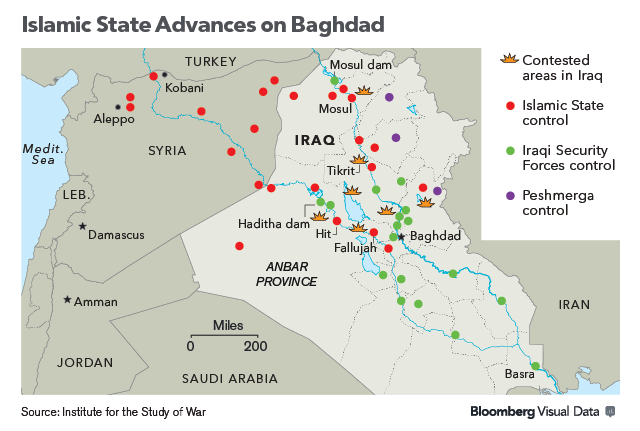
Recent gains by ISIS in western Iraq’s Anbar province, including the capture of a military base on Monday, are raising fears that the militants might soon attempt to move on Baghdad:

Militants seized the base, located near the town of Hit and a major highway from Baghdad to the Syrian border, after heavy fighting with soldiers, according to Ahmed al-Dulaimi, a Sunni tribal leader. Its capture increases the threat to Ramadi, Anbar’s capital, and to Iraq’s second-largest dam at Haditha. …

Islamic State captured the Anbar towns of Hit and Kubaisa last week, and its fighters are battling Iraqi forces in Abu Ghraib, 18 miles (29 kilometers) from Baghdad’s fortified Green Zone that houses embassies and government offices. The town of Haditha is “completely besieged” by Islamic State militants and will fall within days without U.S. action to prevent it, Faleh al-Issawi, the deputy head of Anbar provincial council, said by phone late yesterday. He said the jihadists control 80 percent of Anbar province.

Joel Wing attributes these advances primarily to the weakness of the Iraqi Security Forces:

The fact that the ISF still appear hapless in most areas does not bode well for the future. They have broken again and again in just a few days. Both Baghdad and the American led coalition need to intervene in a much more determined fashion to reverse the situation, because even if places like Ramadi and Haditha are able to hold on they are cut off from their supply lines and need to be supplied by air something the government forces are not good at. If not there could be more bad news coming out of western Iraq very soon.

In Walter Russell Mead’s view, there is “a lot to be nervous about”:

CBS News cites a figure of 60,000 Iraqi troops assigned to defend Baghdad, but given the rampant corruption in the Iraqi armed forces, the official numbers on paper are one of the least important facts about the defending forces. As Haaretz noted in June, a large portion of the Iraqi army is made up of “ghost soldiers” who appear in the official troop count but pay their commanders a portion of their salary in return for being excused from duty. Graft has always been rampant in the post-Ba’athi Iraqi military, with officers stealing not only money and equipment, but even reportedly food and water from their soldiers during ISIS’ June blitz. These factors, while perhaps attenuated, are still very much at play today. And the chances for turning things around look ever-more remote.

Even if the jihadists can’t take and hold the capital, Paul Shinkman argues that they can still do enough damage to seriously undermine the government’s authority:

Defense officials and analysts agree the Islamic State group likely could not seize and maintain control of Iraq’s capital city. Chiefly, militias within the Shiite Muslim neighborhoods in the east would resist the Sunni extremists’ onslaught and reject their attempts to recruit moderate citizens to their cause. There are, however, measures of extremist success other than all-out capture. It’s no coincidence that the Islamic State group has approached Baghdad from the west, taking control of most of Anbar province, including territory near the capital city that flows into western neighborhoods mostly populated by fellow Sunnis.

Any doubts among locals that their government would not be able to protect them feeds directly into the formula the Islamic State group has used with great success to seize control of large cities like Fallujah in Iraq or parts of towns like Kobani near the Turkish border in Syria. “For them, nothing succeeds like success. They’re on a roll and they’re not really being impeded,” says Bruce Hoffman, a former adviser to coalition forces during the Iraq War and counterterrorism scholar at the CIA. He now teaches at Georgetown University. “At this stage, it’s whoever can provide security.”

But Michael Knights interprets the push toward Baghdad as a Hail Mary pass of sorts:

In truth, the threat posed to Baghdad this autumn is emerging less because ISIL is winning the war in Iraq and more because it might be slowly but steadily losing it. All across north-central Iraq, ISIL is being challenged by joint forces comprised of Sunni tribes, Shia militias, Iraqi soldiers, Iranian advisors and U.S. airpower. ISIL is struggling to maintain its grip on this battlefield of strange bedfellows, and it could be moving on Baghdad now out of a desperate need for a big victory more than anything else. Even as ISIL appears to be making progress in marginal places like Kobane, the Syrian Kurdish border town, inside Iraq the group has been faltering and needs a new front to rejuvenate its campaign.

Among the less-noted victories against ISIL recently: In early October, Kurdish peshmerga forces and local Sunni tribesmen of the Shammar confederation – usually bitter rivals – cooperated in a three-day blitzkrieg that recaptured the vital Rabiya border crossing that links the ISIL territories in Iraq and Syria. In Dhuluiya, 45 miles north of Baghdad, Sunni tribesmen of the Jabouri confederation are pushing ISIL back from their lands in collaboration with both Iraqi Army forces and, stunningly, Iranian-backed Shia militiamen from the Kataib Hezbollah movement.

Don’t get too excited about any victories by the Shia militias, however. Justine Drennan flags an Amnesty International report that accuses these militias of carrying out revenge attacks on Sunni civilians:

The report, released on Tuesday, alleges that since the self-proclaimed Islamic State started grabbing territory in Iraq, Shiite militias supported by the Iraqi government have abducted and shot dozens of Sunni civilians, apparently in retaliation for the Sunni extremist group’s attacks on Shiites. Many of the Sunnis being killed have no apparent connection to the Islamic State, and just seem to have been in the wrong place at the wrong time, the report says.

“Scores of unidentified bodies have been discovered across the country handcuffed and with gunshot wounds to the head, indicating a pattern of deliberate execution-style killings,” the international human rights group stated on Tuesday. The group’s report is based on six weeks of interviews with victims, observers, and government officials in central and northern Iraq between August and September.

The Syrian-Turkish-Kurdish Clusterfuck

https://twitter.com/DavidKenner/status/521981053368418305

Turkey launched airstrikes yesterday – not against ISIS, but against Kurdish insurgents in southeast Turkey:

Turkish news reports said the strikes had been aimed at fighters of the Kurdistan Worker’s Party, known as the P.K.K., and were in retaliation for the shelling of a Turkish military base. Such airstrikes were once common, as Turkey fought a Kurdish insurgency in a conflict that claimed almost 40,000 lives over nearly three decades. But hostilities essentially ceased two years ago when the peace process began, and both the Turkish newspaper Daily Sabah and an online statement from the P.K.K. said the airstrikes on Monday were the first since then. The Turkish military also released a statement, but it did not mention airstrikes specifically, only an exchange of fire with “terrorists.”

Authorities in Iraqi Kurdistan are now pressing Ankara to let their fellow Kurds cross the border to help defend the Syrian town of Kobani, which remains under siege from ISIS:

Speaking on a visit to RFE/RL in Prague on October 13, Falah Mustafa, the foreign minister of the Kurdish regional government (KRG), said Ankara should heed calls from the international community to help the city, which has been under siege for almost four weeks.

“It’s a moral responsibility for all of us to move in order to help the besieged [city of] Kobani,” Mustafa said. “We hope that there would be an understanding by Turkey to the calls from the international community and to the needs of these people who have proven to be bravely fighting the terrorists throughout this period, from the day they have been besieged.” He said Ankara should establish a corridor between its border checkpoint of Mursitpinar and Kobani, whose northern edge is less than a kilometer from the Turkish frontier.

Today and yesterday, ISIS positions in Kobani and elsewhere in Syria came under heavy attack from US planes:

Centcom said the 21 strikes in and around Kobani destroyed two of the group’s staging locations and damaged another, destroyed one an ISIS-held building and damaged two others, damaged three ISIS-held compounds, destroyed one ISIS truck, and destroyed one ISIS armed vehicle and another ISIS vehicle. The US military also struck an additional seven ISIS staging areas, two ISIS mortar positions, three ISIS occupied buildings, and an ISIS artillery storage facility. Centcom said early indications were that these strikes were “successful.” Separately, the US military conducted an additional strike on an ISIS-held oil refinery near Dayr az Zawr. Centcom said this strike was also successful.

But the jihadists are apparently making gains in Iraq:

“The militants, they now control 80% of Anbar province,” said Faleh al-Issawi, a local politician from Anbar, detailing weeks of miserable performance on behalf of the Iraqi military. Government forces, he says, are constantly on the back foot, rarely launching offensives to regain territory. Outgunned and beleaguered, he says, Iraqi army units in Anbar are beginning to collapse. “We are renewing our call for American or International troops to come to Anbar province and begin ground operations,” he said, expressing a policy desire completely at odds with that of the central government.

Meanwhile, the Obama administration is claiming that Turkey has agreed to allow US warplanes carry out strikes from its bases, but Turkish officials won’t confirm that:

[National Security Advisor Susan] Rice said Ankara had joined Saudi Arabia in agreeing to allow its bases for training moderate Syrian opposition forces and had agreed that “facilities inside Turkey can be used by the coalition forces, American and otherwise, to engage in activities inside of Iraq and Syria.” Incirlik Air Base, located about 50 kilometers inland from the Mediterranean Sea in southern Turkey, is home to the U.S. Air Force’s 39th Air Base Wing and about 1,500 American military personnel and is key to protecting NATO’s southern flank.

On Monday, Turkish Foreign Minister Mevlut Cavusoglu denied there was such an agreement on bases, according to state-run Anadolu Agency. “There is no decision at the moment concerning Incirlik or any other issue,” the agency quoted Cavusoglu as saying[.]

Meanwhile, Jamie Dettmer is dismayed at the anti-Western rhetoric Turkish President Erdogan whipped out in a speech yesterday:

About T.E. Lawrence—who is still viewed as a hero in the West and by many Arabs—the Turkish President showed nothing but disdain, then used Lawrence as a vehicle to heap opprobrium on others. Erdoğan dismissed the British officer as “an English spy disguised as an Arab.” And he told the university audience—the speech was televised—that Westerners are “making Sykes-Picot agreements hiding behind freedom of press, a war of independence or jihad.”

Erdoğan argued there are modern-day Lawrences in Turkey right now “disguised as journalists, religious men, writers and terrorists.” And the remark was especially ominous on the day five foreign journalists—three of them German—were hauled before a court for a preliminary hearing in the southeastern Turkey of Diyarbakır, following their arrests at the weekend by anti-terrorist police.

Marc Champion believes Erdogan has miscalculated:

Erdogan appears to believe he can squeeze the PKK and its affiliate in Syria, while negotiating a settlement with Turkey’s Kurdish community. If so, he would be underestimating how quickly a massacre in Kobani could push events beyond his control. Erdogan is a formidable politician and never to be underestimated, yet I suspect he is making a big mistake for Turkey.

That’s because only one of the two very risky paths for Erdogan has a chance of a positive outcome. The Turkish leader has a real prospect of building a long-term alliance with the Kurds and creating a stable buffer against the chaos of the Middle East, partly because he has already done a lot to repair relations with Kurds in Iraq and Turkey in recent years. Islamic State, however, can offer nothing but instability and fear.

Michael Crowley returns to our other big problem in Syria – Assad, with whom Erdogan and the Syrian rebels would like us to go to war as well:

Obama may find it increasingly difficult to battle ISIS without coming into conflict with Assad’s forces. “Sooner or later the linkage is going to be forced,” said Paul Salem, vice president of the Middle East Institute. Salem wonders how Obama would react if American-trained rebels come under aerial bombardment by Assad’s air force: Would U.S. forces pounding ISIS targets elsewhere in the country refuse to intervene? (That would hardly inspire goodwill among the rebels.) How should the U.S. respond [if] Assad’s forces move to claim territory cleared by ISIS after coalition attacks? And will Obama tolerate Assad’s infamously brutal attacks on civilian populations now that U.S. fighter-bombers are mere minutes away from the scene of such crimes?

Larison sure hopes we don’t take the bait:

It is unreasonable to expect anti-regime forces to do Washington’s bidding against other enemies of the regime when their overriding concern is to fight regime forces. However, that isn’t an argument for doing what the rebels want. It draws our attention back to why the war has been misguided and unlikely to succeed from the start, especially once it expanded into Syria. If both Turkey and the “moderate” opposition refuse to cooperate unless the U.S. attacks the Syrian government, that tells us that the war against ISIS cannot be fought effectively at an acceptable cost. That should be a clear warning to the administration to stop now before it gets in any deeper. Warring against both sides in the same civil war not only appears absurd, but it greatly increases the chances of costly failure.

Max Fisher, on the other hand, asserts that an alliance with Assad is the only logical outcome of Obama’s Syria policy:

Obama doesn’t want to build up the rebels enough to defeat ISIS, he doesn’t want to invade and occupy Syria (rightly), and he doesn’t trust Turkey enough to sponsor a Turkish invasion. With those options off the table, only Assad is left as someone who is able to re-conquer ISIS-held territory and occupy it for many years, which is what it would take to end the ISIS threat. So it looks increasingly likely that Obama will come to view Assad as his only real option if he wants to defeat ISIS.

Go To Congress, Mr. President, Ctd

Screen Shot 2014-10-10 at 11.39.43 AM

Aaron Blake passes along the results of a new CBS News poll showing that 62 percent of Americans think the ongoing campaign against ISIS in Syria requires congressional authorization. But that doesn’t mean it will happen:

Similarly, 80 percent think member of Congress should desert the campaign trail, come back to Washington, and debate the use of force against the Islamic State. Those are pretty strong numbers. But it’s highly unlikely they’ll force any kind of action.

That’s because, however many Americans feel Congress should approve military action, very few of them are speaking out against the decision to go into Iraq and Syria without congressional approval. To be sure, Americans would like for their duly elected representatives to sign off, but they’re not exactly incensed that Congress hasn’t been asked. And people largely approve of what they’ve seen so far, as far as the airstrikes go.

The latest Reason-Rupe poll turns up a similar result, with 78 percent saying Congress should return to Washington to vote on this war:

Fully 63 percent of Americans say members of Congress haven’t voted on the authorization of military force because they don’t want to put their vote on the official record. Only 15 percent of Americans think Congress hasn’t voted because it believes President Obama does not need their authorization for military action, and 8 percent felt Congress simply hasn’t had enough time yet to hold the vote. This is a rare non-partisan issue in which overwhelming majorities of Democrats (77%), Independents (78%), and Republicans (83%) feel Congress should weigh in on this important decision.

Noting that Obama’s 60 days are up, Jack Goldsmith infers that the White House’s shifting legal basis for the operation is meant to avoid a Congressional vote:

Section 5(b) of the [War Powers Resolution (WPR)] requires the President to “terminate any use of United States Armed Forces” 60 days after he introduces such forces into “hostilities” unless Congress “has enacted a specific authorization for such use of United States Armed Forces.”  Senator Cruz is thus right that the WPR requires the President to seek new congressional authorization from Congress unless the 2001 and 2002 [Authorizations For Use of Military Force (AUMFs)] are specific authorization” for the airstrikes against the Islamic State. Recall that the President originally (in August and September) relied on Article II alone as a basis for the strikes against IS.  He then switched about a month ago to say that the strikes are also based on the 2001 and 2002 AUMFs.  The switch in legal rationales has enormous significance for – and in my judgment was likely motivated by – compliance with the WPR.  For if the AUMFs are a proper basis for the strikes against the Islamic State, then there is no issue under the WPR because Congress has authorized the conflict.  Only if the President is wrong about the applicability of the AUMFs to the Islamic State is there a problem under the WPR.

The Business Of War

Justine Drennan counts the costs of the campaign against ISIS so far:

[E]ach U.S. “strike” against the self-proclaimed Islamic State can involve several aircraft and munitions and cost up to $500,000, according to Todd Harrison, an expert with the Center for Strategic and Budgetary Assessments, a Washington-based defense think tank. Harrison said the cheapest possible strike could cost roughly $50,000 — assuming a single plane dropping one of the cheaper types of bombs. … But using his $500,000 upper estimate, Saturday’s strike missions alone cost as much as $4.5 million. And those figures don’t even include the intelligence, surveillance, and reconnaissance flights necessary to scope out targets ahead of strikes, which have helped make even the low-level campaign against the Islamic State hugely expensive. The Pentagon revealed on Monday that it has spent as much as $1.1 billion on military operations against the Islamic State since June.

But this war, among others, is great news for the companies that make those planes and bombs:

Led by Lockheed Martin Corp. (LMT), the biggest U.S. defense companies are trading at record prices as shareholders reap rewards from escalating military conflicts around the world.

Investors see rising sales for makers of missiles, drones and other weapons as the U.S. hits Islamic State fighters in Syria and Iraq, said Jack Ablin, chief investment officer at Chicago-based BMO Private Bank. President Barack Obama approved open-ended airstrikes this month while ruling out ground combat.

“As we ramp up our military muscle in the Mideast, there’s a sense that demand for military equipment and weaponry will likely rise,” said Ablin, who oversees $66 billion including Northrop Grumman Corp. (NOC) and Boeing Co. (BA) shares. “To the extent we can shift away from relying on troops and rely more heavily on equipment — that could present an opportunity.”

Meanwhile, Julia Harte and R. Jeffrey Smith flag a report by Conflict Armament Research, which “indicates that the Islamic State’s relatively newly-formed force has had little difficulty tapping into the huge pool of armaments fueling the conflicts in Iraq and Syria.” The group, the report shows, has gotten its hands on arms and munitions manufactured in 21 different countries, including, of course, the American equipment taken from the retreating Iraqi army. Now that the Pentagon is preparing to send more arms to the Iraqis and Syrian rebels, the jihadists are licking their chops:

On Sept. 18, Congress passed a law authorizing the Defense Department not only to re-equip Iraqi forces that lost territory and abandoned their weaponry to IS, but also to provide arms to “appropriately vetted elements of the Syrian opposition.” …

The Islamic State, meanwhile, has said it welcomes fresh opportunities to get its hands on additional Western-supplied munitions. “Look how much money America spends to fight Islam, and it ends up just being in our pockets,” says Abu Safiyya, the narrator of an Islamic State propaganda video uploaded to YouTube on June 29. Gesturing at a Ford F-350 truck parked in an Iraqi police base captured by the extremist militants over the summer, Safiyya said, “They will lose in Syria also, God willing, when they come. We will be waiting for them, God willing, to take more money from them.”

WTF, Turkey?

Jonathan Schanzer wonders if it isn’t time to review Turkey’s NATO membership in light of its lackluster support for the coalition war against ISIS:

Turkey’s stock as a Western ally is plummeting. Ankara stubbornly resists joining the coalition unless it broadens its fight to topple Syria’s Bashar al-Assad. Turkey’s 200 or more F-16 fighter jets sit idle as the Islamic State makes alarming gains across Syria and Iraq. This stands in sharp contrast to other Muslim world allies – including Saudi Arabia, Bahrain, the United Arab Emirates, Qatar and even Jordan – that have taken part in the aerial campaign against the Islamic State. Turkey’s absence is conspicuous. It’s the only NATO ally among these Muslim world partners. To be clear, the fight against the Islamic State is not a NATO mission, but it serves as a reminder of how little Erdogan’s regime has done to help preserve order in the Middle East.

Larison rejects Turkey’s conditions for participation, particularly its demand that the war’s objectives expand to include regime change:

If Turkish support comes at the price of having to fight both sides in Syria, the price is far too high.

It is understandable that the Turkish government doesn’t want to bear the brunt of a ground war in Syria, since there has long been strong opposition in Turkey to the government’s Syria policy and even greater opposition to Turkish involvement in the war, so the administration would be wise not to expect a large Turkish commitment to the war in any case. Turkey is trying to use the war against ISIS to keep pursuing the misguided goal of regime change in Syria that it has pursued for the last three years without success, and the U.S. would be irresponsible to indulge them in this any more than it already has.

Max Fisher explains why Ankara’s demand for a buffer zone won’t fly:

Here is what makes buffer zones, or safe zones, or humanitarian corridors so dangerous: once you have American/British/French/Turkish troops occupying a little sliver of Syria that’s surrounded by ISIS or by Assad forces, it’s all but inevitable that those troops will come under attack. The war in Syria is deeply chaotic and the factions disorganized; it would only be a matter of time. Open fighting between the foreign occupation forces and ISIS or Assad forces could spiral out of control all-too-easily, possibly leading to all-out war. The odds are just very low that we could put American (or British or French or Turkish) troops in the middle of the Syrian civil war and somehow keep the mission contained to protecting a tiny buffer zone.

This may well be why the Pentagon is saying that the buffer zone option is not “on the table.” The exposure to risk and to mission creep is likely just too high.

One of the reasons why the Turks have been reluctant to rescue the Syrian border town of Kobani is that they are loath to help out fighters affiliated with the Kurdistan Workers’ Party (PKK), an independence movement in Turkey. But Nick Danforth and Daphne McCurdy argue that Ankara’s goals and the PKK’s aren’t as incompatible as they seem, especially since the PKK has significantly moderated its separatist aims:

The real opportunity for the Kurds today is not, as many pundits excitedly predict, that they finally have a shot at complete independence. Instead, they finally have the good sense and intellectual foundation to pursue much more modest but pragmatic goals. While the heroic defense of Kobani has won the PKK and PYD a new wave of Western support, Kurdish leaders would do well to remember that their evolution from Stalinism to liberalism has also been crucial to this newfound legitimacy. …

The real question now is whether the AKP and PKK can find common ground. Here is where the nightmare of the Islamic State is instructive. Much has been made about how the AKP wants to replace an old-fashioned version of Turkish nationalism with that of a religious community built around the Muslim idea of the Ummah. So does IS. But when you compare the vision of post-nationalism the AKP spent the last decade promotingbreaking down regional borders through free transit, low tariffs, and trade promotionit sounds a lot more compatible with the PKK’s newly endorsed secular post-nationalism than the savagery of IS.

Berivan Orucoglu points to another reason why Turkey remains more concerned about Assad than ISIS:

Another factor that distinguishes Turkish attitudes toward the Islamic State from those of the West is the refugee crisis. Two years ago, then-Foreign Minister Ahmet Davutoglu famously predicted that Assad would lose power within weeks. He also said that Turkey would be able to accept no more than 100,000 refugees before it would have to take drastic action. Today Assad is still in power, and Turkey is hosting 2 million refugees. The U.S.-led airstrikes have triggered a new influx of people fleeing the war: Almost 100,000 Syrians have fled to Turkey as of Sept. 23. The refugees are not only a huge burden on the Turkish economy, but are also tearing at the country’s social fabric. In many towns the influx of Syrian refugees has brought serious demographic changes, triggering conflicts between the locals and the refugees.

But in Sinan Ülgen’s view, Erdogan’s approach to the Syrian conflict isn’t helping to solve that problem:

By prioritizing the removal of Mr. Assad and expending a huge amount of political capital to convince its partners of the necessity of regime change, Ankara is also losing an opportunity to mobilize international support for its ballooning refugee crisis. Turkey is now host to more than 1.4 million Syrian refugees, with government spending reaching $3.5 billion. Just a week ago, 138,000 Syrian Kurds sought refuge in Turkey, a number surpassing the total number of Syrian refugees accepted by the 28 European Union member states since the beginning of the conflict in 2011.

Yet despite the growing social and material cost of hosting the refugees, Turkey has been unable to mobilize international support for a more equitable sharing of the refugee crisis burden.

Obama’s Syrian Quagmire

Clashes between ISIL and Kurdish armed groups

Fred Kaplan gets real:

The Syrian part of Obama’s anti-ISIS strategy was always a deferral. He seems not to have thought it through, perhaps because he didn’t think he’d have to. It would be hard, and take long, enough to “degrade and destroy” ISIS before he’d have to deal once more with Assad. He didn’t count on two factors. First, ISIS-in-Iraq and ISIS-in-Syria turn out to be inseparable; it’s hard to fight one without contending with the other. Second, America’s allies in the region—on whom Obama’s strategy depends—have interests that are at times at odds with American interests. This becomes a problem in coalition warfare. ISIS, in fact, gains much of its strength from the fact that the countries arrayed against it—which, together, could win in short order—can’t get their act together; they have too many conflicting interests tearing them apart.

He zooms out to conclude:

The international system in which we all grew up, the system of the Cold War, has shattered, and nothing has taken its place. There are no real power centers. Nations, even small and medium-sized ones, are freer to pursue their own interests, which often collide with ours. Large nations have less leverage than they once did, and it’s harder to coerce or persuade other nations to put our interests above their own. Obama is in a tight position (and future presidents should take note, because they will be, too): He may have to succumb to mission creep—or slowly, carefully, creep away.

I hope it’s the latter. There’s no way this clusterfuck can do anything coherent over the longer term. The Turks’ ambivalence – even with ISIS controlling a hefty chunk of their border with Syria – tells you everything you need to know. I agree with this reader:

1) In 1983, antecedents of Hezbollah bombed the shit out of military barracks in Lebanon, murdering over 200 US Marines. US officials made a bunch of noise about how they won’t be deterred. Less than 6 months later, Reagan had us get the fuck out of Lebanon. The Lebanese proceeded to murder each other for another 7 years before they got tired of it and stopped.

2) In 2014, two American journalists are murdered by a bunch of guys in the desert. Obama responds by having us get the fuck inside Iraq and Syria, two countries mired in slow burning civil wars.

And by publicly engaging with these idiots on the battlefield, Obama and every other US politician raises ISIS’s profile, drawing more recruits and terrorist funding to their cause.

I despair at how few Americans understand the psychology of power and lose their collective shit and demand engagement when a group — that is so self-destructive it would otherwise burn out on its own — cuts off a couple American heads. I also despair at the American politicians who understand the psychology of power intimately well, but (a) are too ignorant to understand it applies to foreigners as well, or (b) are too singleminded in their power games against Obama to care.

And finally, I despair at Obama, who I assume knows better.

I know it would have been tough to counter the politics of hysteria and fear this summer. But Obama should have been tougher in pushing back an unreconstructed neocon narrative that has now taken hold. God knows the Democrats are useless in articulating a policy of minimalism in confronting this kind of terror – but without a president leading with the case, actually proudly defending his reluctance to get mired in quag again, there’s no hope at all. He was just too weak.

Fredrik Logevall and Gordon Goldstein fear that Syria will become for Obama what Vietnam was for Lyndon Johnson:

War has a forward motion of its own. Most of Johnson’s major steps in the escalation in Vietnam were in response to unforeseen obstacles, setbacks and shortcomings. There’s no reason the same dynamic couldn’t repeat itself in 2014.

And there is a political logic, too: Then as now, the president faced unrelenting pressure from various quarters to do more, to fight the fight, to intensify the battle. Then as now, the alarmist rhetoric by the president and senior officials served to reduce their perceived maneuverability, not least in domestic political terms. Johnson was no warmonger, and he feared, rightly, that Vietnam would be his undoing. Nonetheless, he took his nation into a protracted struggle that ended in bitter defeat.

Larison holds the president responsible for setting the self-fulfilling logic of escalation on its course:

Presidents trap themselves into pursuing unwise escalation in foreign wars because their earlier decisions and past rhetorical overkill seem to compel it. Unfortunately, the administration has repeatedly combined careless rhetoric with a tendency to yield sooner or later to hawkish pressure. By indulging in the former (e.g., talk of “destroying” ISIS or claiming it is an “imminent threat to every interest we have”), Obama and his officials give hawks the opening they need to demand more aggressive measures. Having already endorsed most of the hawks’ assumptions about the conflict, the administration makes it very difficult for itself politically not to give in to those demands. At best, Obama has created an open-ended conflict that his successor will be forced to continue. Given Washington’s bias in favor of throwing more resources at a problem when a policy hasn’t succeeded, it is quite likely that the next administration will conclude that Obama’s policy didn’t “work” because it was insufficiently aggressive.

Waldman throws up his hands at the lessons America clearly hasn’t learned from our experience in the Middle East over the past 13 years:

It would be wonderful if the current campaign renders ISIS impotent. It would also be wonderful if the Syrian civil war wrapped up soon, with the Assad regime replaced by an inclusive democracy in which everyone’s human and civil rights are honored. But realistically, chances are that in two years time Barack Obama will bequeath to his successor a situation that is still unresolved and still bad (though perhaps in ways we haven’t even yet imagined). And no matter who that successor is, the answer he or she offers to the question of Syria and Iraq — and whatever questions follow — is likely to be more military actions. That president will either be Hillary Clinton, who throughout her career has been one of the most hawkish Democrats around, or it will be a Republican who is even more hawkish.

(Photo: Smoke rises from the clashes between Islamic State of Iraq and Levant (ISIL) and Kurdish armed troops in Kobane (Ayn al-arab), Syria, on October 9, 2014. By Ibrahim Erikan/Anadolu Agency/Getty Images.)

The Battle For Kobani, Ctd

Air strikes on ISIS in and around the besieged Syrian border town continued to escalate today. Local Kurdish forces are still holding out against the militants, though there are conflicting reports of how much of the town ISIS currently controls:

The U.S. Central Command said five airstrikes south of Kobani since Wednesday had destroyed an Islamic State group support building and two vehicles, and damaged a training camp. The strikes also struck two groups of Islamic State fighters, it said in a statement. “Indications are that Kurdish militia there continue to control most of the city and are holding out against ISIL,” it said, using an acronym for the Islamic State group, which controls large swaths of territory in Syria and Iraq. …

The [Syrian Observatory for Human Rights] said the militants had seized more than third of Kobani, but Kurdish officials disputed that, saying their forces had recaptured several parts of the town. “I can confirm that they don’t control a third of the city. There is only a small part of Kobani under the control of Daesh,” said local Kurdish official Idriss Nassan, using an Arabic acronym to refer to the Islamic State group.

Turkey’s foreign minister stressed in a press conference that Ankara would not launch a unilateral ground operation to rescue Kobani. The government’s refusal to act has sparked protests among Turkey’s Kurdish community, leading in many cases to violence. Piotr Zalewski provides an update on the clashes, which by his count have left at least 21 dead:

In Diyarbakir, about 60 miles north of the border with Syria, members of Hizbullah, a local Islamist group allegedly sympathetic to ISIS, traded gunfire with Kurdish protesters, including PKK militants. Ten people were found dead by the morning. More clashes have been reported in a number of other cities across the southeast, as well as in Kurdish neighborhoods in Ankara, Izmir and Istanbul, with security forces firing tear gas and rubber bullets against protesters armed with rocks and Molotov cocktails. A curfew was imposed in six provinces, with soldiers patrolling the streets of several cities on Wednesday.

Tulin Daloglu analyzes the situation from the perspective of Turkish politics:

Turkey is going through a decade of polarization to an extent never seen before in its republican history. Turkish President Recep Tayyip Erdogan’s policies have divided the public and his decision to put imprisoned PKK leader Abdullah Ocalan at the center of the peace process created serious controversy. Kemal Kilicdaroglu, the main opposition Republican People’s Party (CHP) leader, blamed Erdogan again Oct. 8 for having wrong-headed policies. …

Despite such serious disagreements about the country’s direction between Turkey’s ruling and opposition parties, all the legislators seem to agree that Turkey should use caution before ordering its ground forces to intervene in Kobani. Moreover, all agree that pro-PKK voices exaggerate linking the fall of Kobani to the fall of Ankara. Yet, they all believe that if IS captures Kobani, its jihadists will control a long stretch of the Syrian-Turkish border and that would pose a threat to the country’s national security. In sum, the situation is in a dire mess.

At yesterday’s Pentagon briefing, Rear Adm. John Kirby acknowledged that Kobani might still fall to the jihadists:

“We all need to prepare ourselves for the reality that other towns and villages, and perhaps Kobani, will be taken by ISIL.” Kirby reiterated a point he has emphasized before, which is that the U.S. military is fully aware that airstrikes alone will not be sufficient to roll back the Islamic State’s gains in Iraq and Syria. To do that, the United States, along with its partners, is going to have to retrain the Iraqi security forces, bolster the Kurdish Peshmerga, and build a ground force in Syria out of vetted and trained members of the Syrian opposition.

Kobani, in Ben Wallace-Wells’ view, “suggests one risk of the plan: that in the interim there may be atrocities on the ground that these forces are helpless to stop”:

The smart line in Washington ever since Obama took office, both from the administration and from foreign-policy thinkers, has been that the Bush adventures revealed some of the limits of what the United States could accomplish overseas, that we could no longer be everywhere at once. That is a sensible posture to take; it may be the only possible posture. But the cost of that posture is that there will be some very grim events that the United States allows to unfold, because they are not taking place at strategically important spots like “command and control centers,” because our allies aren’t ready, because we can’t be there and everywhere else, too. There will be some things that are unpleasant to stomach. Right now, it looks like Kobani may be one.

Morrissey doesn’t see how this ends well without someone sending in ground forces:

Air strikes may have bought a little more time for Kobani, but without any troops to bolster its defenses, those airstrikes are only delaying the inevitable. If Obama really wants to “degrade and destroy” ISIS, he’ll need to convince the Turks and other regional players to get on the ground, or he’ll have to send American troops to do it.

To Drum, the renewed calls for us to do something are fairly predictable:

Some of this will just be partisan opportunism, but most will be perfectly sincere protests from people with the memory span of a gnat. What they want is a magic wand: some way for Obama to inspire all our allies to want exactly what the United States wants and then to sweep ISIS aside without the loss of a single American life. Anything less is unacceptable.

But guess what? The Iraqi army is still incompetent. America’s allies still have their own agendas and don’t care about ours. Air campaigns still aren’t enough on their own to stop a concerted ground attack. This is the way things are. There are no magic wands. If you want quick results against ISIS, then speak up and tell us you want to send in 100,000 troops. If you’re not willing to do that, then you have to accept that lots of innocent people are going to die without the United States being able to offer much help. Make your choice now.

Panetta’s Plaint

Panetta Gives Speech On  Leadership and Public Service

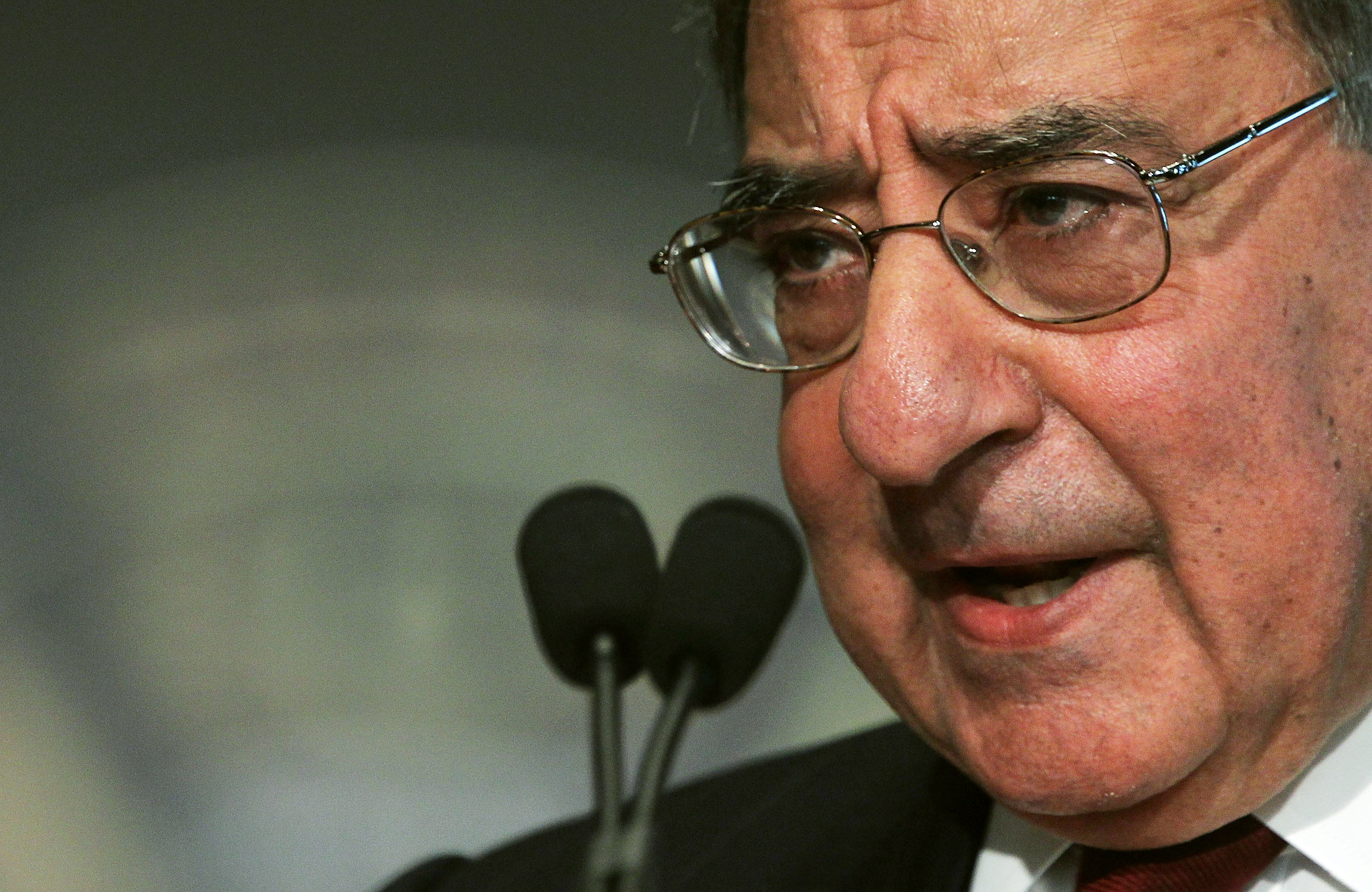
In his new book Worthy Fights: A Memoir of Leadership in War and Peace, the former defense secretary harshly criticizes Obama’s handling of Iraq and Syria:

Mr. Panetta, who was C.I.A. director before taking over the Pentagon, recounted decisions that he disagreed with, including the withdrawal of all troops from Iraq in 2011, the failure to intervene in Syria’s civil war by arming rebels and the abrupt reversal of Mr. Obama’s decision to strike Syria in retaliation for using chemical weapons on civilians. Mr. Obama “vacillated” over the Syria strike and “by failing to respond, it sent the wrong message to the world,” he wrote. Had the president followed different courses, Mr. Panetta said in the interview, the United States would be in a stronger position as it now tries to counter the rise of the extremist Islamic State in Iraq and Syria. He added that he believed the president has turned a corner and “is going a long way in terms of repairing some of the damage I think took place as a result of the credibility issue that was raised on Syria.”

Beinart finds the “credibility” argument about Syria silly:

Since he declared war on ISIS, the Obama administration has been recruiting other countries to join the United States. And whatever you think of the war itself, that diplomatic effort has been remarkably successful. Ten different Arab countries have agreed to participate in the anti-ISIS campaign. Even John McCain and Lindsey Graham have praised the administration’s coalition-building skills. All this illustrates the silliness of Panetta’s claim.

It was one thing to speculate a few months ago that Obama’s chemical-weapons about-face would make it harder for the U.S. to convince allies to join a military coalition the next time. But the next time is now here. Roughly a year after supposedly squandering America’s credibility by standing down on chemical weapons, Obama has mustered enough credibility to convince a bevy of Arab countries to help us bomb fellow Arab Muslims in the heart of the Middle East.

And Drum responds to Panetta’s assertion about working in the Obama admin, that “for the first four years, and the time I spent there, I thought he was a strong leader on security issues. … But these last two years I think he kind of lost his way”:

Think about this. Panetta isn’t even a super hawkish Democrat. Just moderately hawkish. But his basic worldview is simple: as long as Obama is launching lots of drone attacks and surging lots of troops and bombing plenty of Middle Eastern countries—then he’s a “strong leader on security issues.” But when Obama starts to think that maybe reflexive military action hasn’t acquitted itself too well over the past few years—in that case he’s “kind of lost his way.”

That’s the default view of practically everyone in Washington: Using military force shows strong leadership. Declining to use military force shows weakness. But most folks inside the Beltway don’t even seem to realize they feel this way. It’s just part of the air they breathe: never really noticed, always taken for granted, and invariably the difficult but sadly necessary answer for whichever new and supposedly unique problem we’re addressing right now. This is what Obama is up against.

Panetta also believes that the fight against ISIS could turn into a “30-year war” and will likely require the deployment of ground forces. That statement understandably upsets Greenwald:

Only in America are new 30-year wars spoken of so casually, the way other countries speak of weather changes. He added that the war “will have to extend beyond Islamic State to include emerging threats in Nigeria, Somalia, Yemen, Libya and elsewhere.” And elsewhere: not just a new decades-long war with no temporal limits, but no geographic ones either. … At this point, it is literally inconceivable to imagine the U.S. not at war. It would be shocking if that happened in our lifetime. U.S. officials are now all but openly saying this. “Endless War” is not dramatic rhetorical license but a precise description of America’s foreign policy.

Panetta is, of course, not the first former cabinet member to come out with a book critical of the president’s leadership. Dana Millbank wonders why this is:

The lack of message discipline is puzzling, because Obama rewards and promotes loyalists. But he’s a cerebral leader, and he may lack the personal attachments that make aides want to charge the hill for him. Also, as MSNBC reporter Alex Seitz-Wald tweeted in response to a question I posed, Panetta, Gates and Clinton didn’t owe their careers to Obama. Clinton was a rival, Gates was a Bush holdover, and Panetta is a Democratic eminence grise. Loyalty didn’t trump book sales — or Clinton’s need to distance herself from Obama before a presidential run.

(Photo: Leon Panetta delivers remarks at Gaston Hall of Georgetown University February 6, 2013 in Washington, DC. By Alex Wong/Getty Images)