The Politics Of Fear And Hysteria

Republicans are rolling out a new line of attack for the midterms, conflating the issues of immigration and national security to make Democrats look like surrender monkeys on both. Zeke Miller flags the above ad from the National Republican Congressional Committee, which claims that ISIS militants are coming to America “through Arizona’s backyard” – with help from Dem Congresswoman Ann Kirkpatrick, of course:

[T]he ad relies on a Sept. 10 writeup of a congressional hearing by the conservative Washington Free Beacon in which a Department of Homeland Security official was understood as telling lawmakers that ISIS “supporters are known to be plotting ways to infiltrate the United States through the border.” But a review of the testimony by DHS Under Secretary for Intelligence and Analysis Francis Taylor tells another story. Instead, he said, “there have been Twitter, social media exchanges among [ISIS] adherents across the globe speaking about that as a possibility.” But that is a far cry from a direct threat, and light years away from a direct plot against the homeland.

Greg Sargent looks at a similar claim from Arkansas Senate candidate Tom Cotton:

Congressman Cotton’s version seems to go a step further, envisioning an active, ongoing collaborative effort between the Islamic State, and Mexican drug cartels who are looking to diversify by branching out into terrorism, whose end goal is to kill Americans on U.S. soil.

New York Times columnist Charles Blow has performed an anatomy of this developing story on the right. Blow concluded that it originated on a conservative website, which suggested that ISIS may be “working to infiltrate the U.S. with the aid of transnational drug cartels.” A Republican Congressman from Texas similarly said ISIS and Mexican drug cartels have been “talking to each other.” And from there, it was onward to Fox News. Some of the sources Blow found overlap with the Cotton campaign’s back-up materials from conservative media.

GOP politicians aren’t the only people wilding exaggerating the ISIS threat. As Zack Beauchamp notes, the jihadists themselves are only too happy to do the same. Zack offers up “a by-no-means complete list of some of the crazier threats”:

• Take over the White House. Abu Mosa, an ISIS spokesman, told Vice that “we will raise the flag of Allah in the White House.”

• Conquer most of Syria, Jordan, Israel, Lebanon, Kuwait, and Iraq. An ISIS map shows the group controlling an implausibly large chunk of the Middle East.

• Ally with Russia to get Iranian nuclear secrets. A plan allegedly written by Abdullah Ahmed al-Meshedani, an ISIS leader with responsibility for foreign fighters, involves ISIS giving Russia access to Syrian natural gas to persuade Moscow to turn against Iran and Syria, as well as to help ISIS get nuclear weapons.

• Conquer Rome and then the world. In an address, ISIS chief Omar al-Baghdadi told his followers that “you will conquer Rome and own the world.” Rome.

• Destroy Iran using cheap Afghan carpets to undercut the Persian market. Also from the Meshedani document, this plan involves waging economic war on Iran by lowering prices in the rug market. The document also lays out designs on the Iranian caviar industry.

The Battle For Kobani, Ctd

US-led coalition strikes ISIL in Kobane

Stepped-up air strikes have apparently begun to drive back ISIS fighters from the Syrian Kurdish border town, which they had all but captured as of yesterday, though it’s not clear whether this will be enough to turn the tide in the battle:

“They are now outside the entrances of the city of Kobani. The shelling and bombardment was very effective and as a result of it, IS have been pushed from many positions,” Idris Nassan, deputy foreign minister of Kobani district, told Reuters by phone. “This is their biggest retreat since their entry into the city and we can consider this as the beginning of the countdown of their retreat from the area.” Islamic State had been advancing on the strategically important town from three sides and pounding it with artillery despite fierce resistance from heavily outgunned Kurdish forces. Defense experts said it was unlikely that the advance could be halted by air power alone.

The Obama administration, meanwhile, is getting fed up with Turkey:

“There’s growing angst about Turkey dragging its feet to act to prevent a massacre less than a mile from its border,” a senior administration official said. “After all the fulminating about Syria’s humanitarian catastrophe, they’re inventing reasons not to act to avoid another catastrophe. “This isn’t how a NATO ally acts while hell is unfolding a stone’s throw from their border,” said the official, who spoke anonymously to avoid publicly criticizing an ally.

Steven Cook turns a critical eye on Ankara’s reasoning here:

The Turkish analysis of the situation is different from that of the United States and the Europeans. Ankara believes that IS emerged as a result of the Syrian civil war, which in turn is the result of Syrian President Bashar al-Assad’s intransigence and brutality. The Turks thus insist that getting rid of Assad is the only way to get rid of IS. This is both simplistic and self-serving: Given that Ankara has been vocal in its support for regime change in Syria, anything less would be a profound embarrassment to Erdogan and Davutoglu. Inasmuch as Erdogan does not believe that the United States is going to do in Assad and may even sometime down the road tacitly agree to some sort of deal that leaves the Syrian dictator in place, the Turks remain cool to taking part in the anti-IS coalition.

Finally, though it may be hard to believe, there are elements of the AKP’s constituency that regard IS as a legitimate group seeking to protect Sunni interests in Syria and Iraq amid ongoing sectarian bloodshed.

Semih Idiz solicits some expert views, which all coalesce around the notion that Erdogan wants the coalition war to be against Assad rather than ISIS:

“Davutoglu is saying in effect that IS is the product of rage and if the source of that rage, namely the Syrian regime, goes, then such groups will also go. I don’t know if he believes this himself, though,” [lecturer on international politics at Istanbul’s Kadir Has University, Soli] Ozel told Al-Monitor. Ozel also wonders if there is an ulterior motive to Ankara’s insistence on a no-fly zone and buffer zone in Syria even though there is no international support for them. “If IS engages in a massacre in northern Syria this will provide an excuse for Ankara doing little to prevent it. It can say, ‘I warned the international community, but it refused to act.'”

Nihat Ali Ozcan, a security expert at the Ankara-based Economic Policy Research Foundation of Turkey and a columnist for Milliyet, believes the real problem for the Turkish military in Syria is that it cannot decide who the enemy is. “If the target is Assad, the answer to this question is simple,” Ozcan argued in his Oct. 7 column. “Otherwise it is not clear who and where the enemy is. It wears no uniform and is a part of the civilian population.”

Larison reminds us, again, of how dangerous it would be for the US to start a two-front war in Syria:

If “destroying” ISIS is already an unrealistic goal, and it is, setting out to defeat both ISIS and the Assad regime at the same time is even more fanciful. Destroying the latter would probably be relatively easier, and we know that the U.S. is capable of overthrowing established foreign governments by force, but in doing so the U.S. would plunge all of Syria into even greater chaos. If the war against ISIS also requires the U.S. to go to war with the Syrian government now or later, there is no way that the outcome will be worth the costs to the U.S., and those costs continue to grow with each new goal that hawks want to tack on to the ever-expanding war.

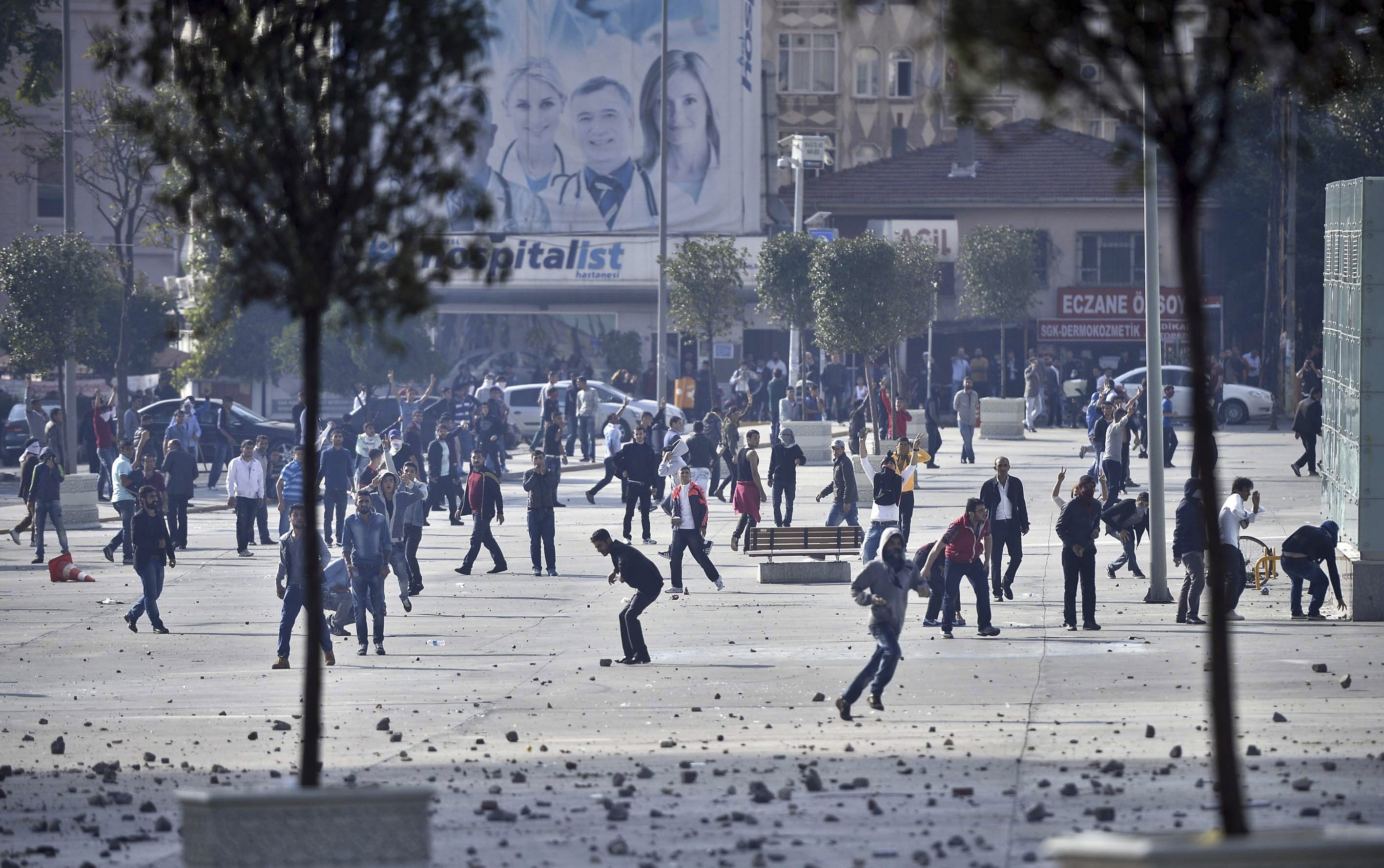
Kurds in southeast Turkey are protesting the government’s inaction. Some of the protests have turned violent:

Nineteen people have been killed in fighting between supporters of the Kurdish PKK party and police and local Islamist groups, according to media reports. Turkey’s Agriculture Minister Mehdi Eker said ten were killed and 45 injured in Diyarbakir, the main city in Turkey’s mostly Kurdish southeast. The city of Diyarbakir is “calm” as citizens “generally abide by the curfew,” imposed last night, Eker said today at a televised press conference.

Jamie Dettmer channels more outrage from the Kurdish refugees and fighters amassed on the Turkish side of the border:

“There will be consequences for this,” an activist with Turkey’s outlawed Kurdistan Workers’ Party, or PKK, tells me. “We aren’t going to forget,” the curly-haired woman, who declines to give a name, says sitting cross-legged on a blanket pulled up under Pistachio trees. PKK activists and defenders in Kobani claim the course of battle could have been changed with just some modest assistance: if they could have gotten anti-tank missiles the Americans have been handing out to rebel battalions in Aleppo and Idlib provinces, and if Turkey had allowed Kurdish reinforcements to cross the border.

Cale Salih examines how the US has dealt with the Kurds differently in Syria and Iraq, which she argues “is reflective of Washington’s general mistaken tendency to presume distinctions between the two countries that do not actually exist”:

In Iraq, the US not only carried out air strikes but also armed the Iraqi Kurdish peshmerga and sent military “advisors”. As a result, the peshmerga were able to provide ground intelligence to guide US air strikes, and, in conjunction with Kurdish fighters from Turkey and Syria, they followed up on the ground to retake important territories lost to Isis.

In Syria, the US has been more hesitant to develop such a bold Kurdish partnership. At first glance, the Kurdish fighting force in Syria – the People’s Defence Units (YPG), linked to the Kurdistan Worker’s Party (PKK), which the US designates as a terrorist group due to its decades-long war with Turkey – is a less natural partner than the widely recognized Kurdistan Regional Government (KRG) in Iraq. Yet it was YPG and PKK forces that provided the decisive support on the ground to the Iraqi Kurds, allowing KRG peshmerga to regain territory lost to Isis in Iraq. The US in great part owes the limited success of its airstrikes in north Iraq to the PKK and YPG.

But Jake Hess reveals that Washington has held back-channel talks with the Syrian Kurds:

The United States has rejected formal relations with the Democratic Union Party (PYD), the party that is essentially the political wing of the YPG. The PYD, which has ruled Kobani and other Kurdish enclaves inside Syria since President Bashar al-Assad’s forces withdrew in July 2012, is affiliated with the Kurdistan Workers Party (PKK), a militant organization that has fought Turkey since 1984 — and has consequently been listed as a terrorist organization by both Turkey and the United States. But interviews with American and Kurdish diplomats show that Washington opened indirect talks with the PYD years ago, even as it tried to empower the group’s Kurdish rivals and reconcile them with the Free Syrian Army (FSA).

Though Washington has declined PYD requests for formal talks, the United States opened indirect talks with the group in 2012, former U.S. Ambassador to Syria Robert Ford told Foreign Policy.

Meanwhile, Canada will be launching its own airstrikes soon, and another report suggests coalition ground troops are being discussed:

Military chiefs from more than 20 countries — many already involved in the fight against the Islamic State and some who are considering joining the group — will meet in Washington early next week to discuss progress on airstrikes in Iraq and Syria as well as plans to create a ground force to consolidate gains against the group.

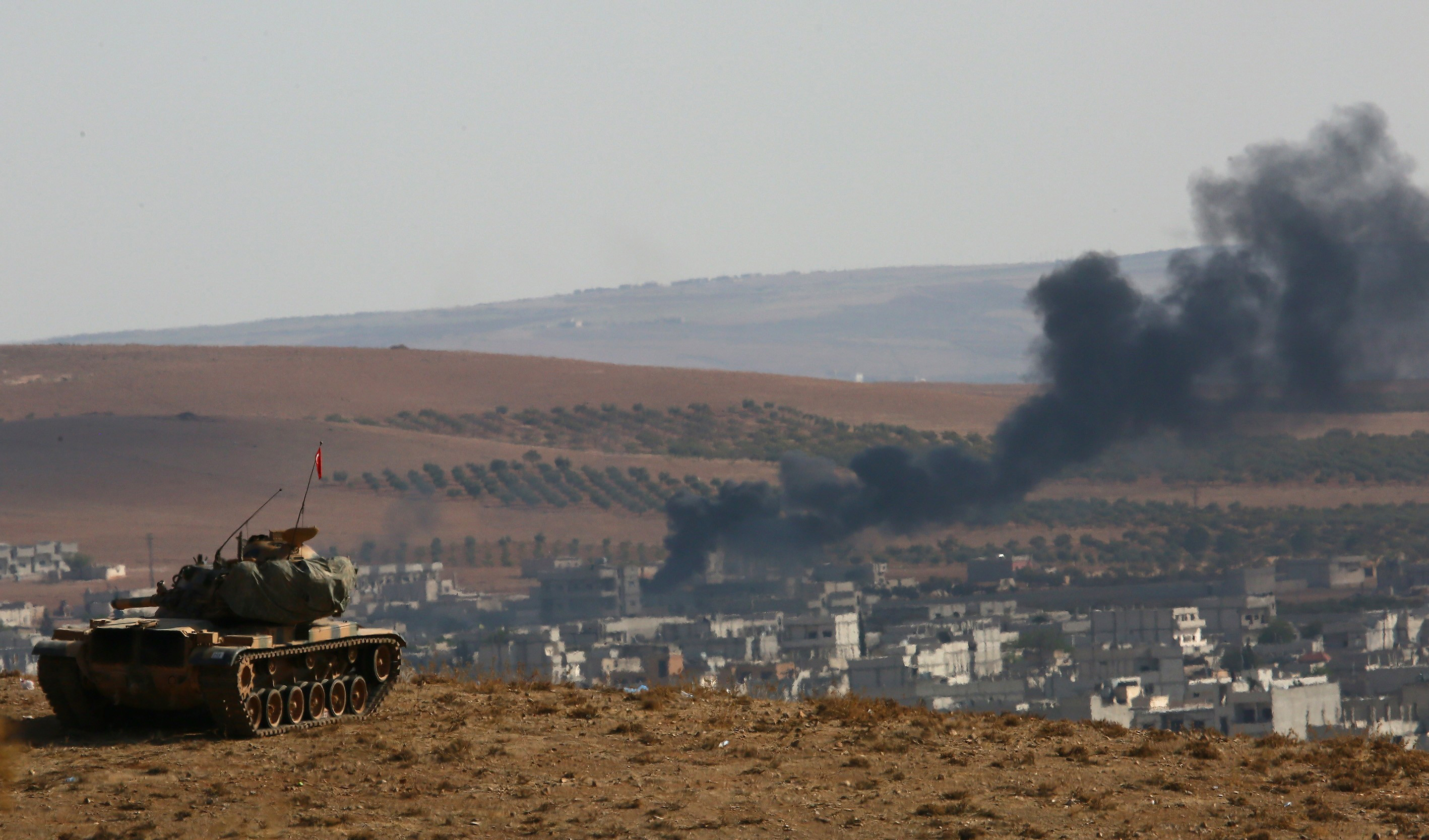
(Photo: A photograph taken from Suruc district of Sanliurfa, Turkey, shows that Turkish army forces patrol while smoke rising from the Syrian border town of Kobani (Ayn al-Arab) after US-led coalition airstrikes against the Islamic State of Iraq and the Levant (ISIL) on October 8, 2014. By Emin Menguarslan/Anadolu Agency/Getty Images)

How To “Contain” A Problem Like Jihadism?

Unauthorized demonstrations against the advance of ISIL in Turkey

A reader quotes me:

Except, of course, it was Kennan’s careful and conservative case for containment that ultimately won the Cold War without the near-Armageddon that the predecessors of today’s chronic interventionists (Kennedy especially) nearly brought us to.

As someone who advocated a continuation of the containment policy towards Saddam Hussein rather than an invasion as you did, I think it needs reminding that “containment” during the Cold War did not mean isolationism, or doing nothing, but instead involved a very complex series of actions and alliances, including using force as an option. Keenan’s containment policy, as actually put into action, was a very active form of engagement with the entire world. It’s during that time that our entire “military-industrial complex” rose to prominence and influence.

So invoking Kennan and Cold War containment makes the opposite case in terms of our foreign policy in the Middle East, or against ISIL or Syria or whomever. Containment is a way of actively engaging these military threats, while being under no illusion that full-scale invasions and occupations are the solution.

I see Obama’s strategy in relation to ISIS and the Iraq to be one, essentially, of the same kind of active containment that our country used during the Cold War. Engagement, not isolationism, is the key. And that includes some use of force, and the arming ofiraq2 various groups, realistically understanding that we are not going to “win” by these means, but that we can at least prevent anyone else from winning either, and by drawing out the conflict over decades, we can ensure that the natural superiority in the underlying cultural and economic conflicts will resolve themselves in our favor.

It’s clear that preventing ISIS or any other radical Islamist group from taking power over a country such as Iraq is in America’s interests. That doesn’t mean that we should re-invade the country, but it does mean that we should remain militarily engaged to make sure it doesn’t happen, without of course going overboard on the idealism and machismo.

It’s of course debatable as to which containment strategies will work best in any given set of circumstances, but I don’t think one of the options is just walking away from the Middle East and assuming all will work out best without our involvement. That’s the first kind of isolationism Keenan described and criticized. The second kind, isn’t even one that Keenan himself advocated, given his endorsement of large US military bases in Europe and around the world, and military engagements in local clashes as Cold War proxies. So don’t go hiding behind Keenan as some sort of shield for advocating that the US should just disengage from these sorts of wars and conflicts.

My reader makes some excellent points, so let me explain why I still do not agree. There is a core difference between the threat we face today and the threat we confronted during the Cold War. The threat today is asymmetrical, whereas the face-off between the US and the USSR was eerily symmetrical. This means that the use of force against our current enemy is much more easily turned back against us – and the zero-sum assumptions of the Cold War can easily splinter into a myriad complications and unintended consequences when confronting global Jihad.

We did not have to worry in the battle against communism that we would somehow create many more spontaneous support for communism by resisting it; and we were confronting a huge multi-nation state, with a unitary command structure and global allies and puppets.

With Jihadism, we are beset by countless more complexities. The entities we are fighting change, melt away, re-group, and are capable of coming back from the near-dead in any anarchic place on earth they can find (and there are many). We are dealing with a world of disorder, not of frozen order. We are not confronting an advanced nation-state seeking to control large swathes of territory by conventional means. We’re dealing with asymmetrical terrorism which cannot be deterred the way the Soviets were, and which can even gain strength by our opposition. This requires a much nimbler, subtler touch – one few statesmen or women can muster for long.

The Jihadists are not suppressing large previously democratic populations with totalitarianism like the Soviets either; they are exploiting deep conflicts within the Muslim world – the Sunni-Shi’a divide pre-eminent among them – which refuels them in a way the bankrupt doctrines of Soviet Communism couldn’t, and in a culture where Western democracy is deeply alien. They are able to exploit all the resentments of those who see the West as a looming tower of decadence and wickedness – a huge f0rce in our modern world.

And they harness (even as they pervert) the immense power of fundamentalist religion, which, unlike communism, has roots deep in many cultures, and is resurgent in part because of the perceived threat of modernity (something that is not going to go away soon). The kind of raw military power that could deter the Soviets – as in the nuclear stand-off – simply does not work against the kinds of insurgencies we have been tackling.

We know this. The Sunni insurgency in Iraq – which I fear may be a permanent feature of that region unless the Sunnis retake control of what’s left of the central government – was bribed and charmed into quiescence for a brief period – while we had tens of thousands of troops in country. Once we left – and even if we had stayed with a residual force – we had no leverage to keep it at bay, as the deeper contradictions of the imperial construct of Iraq unfold. Our allies, unlike in the Cold War, also have many different agendas. Take Turkey, a NATO stalwart against the Soviets. Today, Turkey is beset with a much more complex set of problems – a Rubik’s Cube of how to control Kurdish separatism and depose Assad while resisting ISIS. And we expect an alliance as in the olden days? In the Cold War, moreover, we had no major NATO allies actually funding communist ideology and secretly arming the Soviet Union – while many of our so-called allies in the Middle East, like Saudi Arabia, are both the cause and purported solution to our dilemma.

In my opinion, we have learned these past few years that a conventional attempt to defeat Jihadism – by invasion and occupation – will fail, unless we construct a permanent imperial presence, which we neither want nor can afford. We have learned that drones and air-power can help at times – but also over time hurt, by incurring civilian casualties which emboldens our enemies, or splintering insurgencies into ever-more extreme and fringe groups; we have learned that funneling arms to our supposed allies can easily backfire – as ISIS’ plentiful supply of purloined US hardware attests to; and we have learned – and are fast re-learning – that when local governments lack legitimacy – like Baghdad’s or Kabul’s – the use of air-power against an insurgency is even less effective. In those circumstances, I believe we simply have to accept that, whatever our motives and power, there are some problems we cannot solve. And my concern with the president’s ISIS policy is that he has led Americans to believe that we can “ultimately destroy” something that we simply cannot.

Until Iraq’s Sunnis really believe Baghdad can represent them, there will be no progress against ISIS. The one sliver of hope I see is the current desperation of some Sunni tribes in the face of ISIS’ brutality. There’s a report in the NYT today on those lines. Money quote:

After enduring weeks of abuse by insurgents of the group called Islamic State, members of the Aza tribe struck a secret deal last month with local police and military officials: The authorities would supply weapons to two tribal regiments totaling about 1,150 fighters, and in return the tribe would help government security forces fight Islamic State.

Several days later, the tribal regiments, in collaboration with Iraqi government troops and Shiite militia fighters, liberated 13 villages in Diyala Province from Islamic State, which is also known as ISIS, officials said. “ISIS has humiliated the top sheikhs of Diyala and has done horrible and unforgivable crimes against people here,” said Abu Othman al-Azawi, an Aza sheikh and a member of the provincial council. “They tried to vandalize the tribal system and break its ties.”

But even this is a very tricky business:

The geometry of tribes and tribal loyalties in Iraq is byzantine. Allegiances — even within tribes — can vary from province to province, district to district, village to village. Iraqi officials have also been concerned that arming Sunni tribes could enable the formation of paramilitary organizations that could turn quickly against the Shiite-led government.

But note one essential thing about this potentially good sign. It happened not because we made it happen; it emerged out of a convergence of interest among the relevant parties. That’s the only way this will find some kind of resolution – and our neo-imperial meddling can actually impede it as easily as help it. Less is sometime more; more is sometimes less. But at some point, amid these dizzying complexities in regions the locals know far far better than we do, we have to ask ourselves if this kind of challenge is simply too hard for us to overcome, and whether less intervention can do more to undermine our enemies than more. We may well be better off keeping our heads down, bolstering our defenses (which is why I am not a huge critic of the NSA), and occasionally pivoting to exploit an opening on the ground.

I cannot prove this, no more than the interventionists can prove that more meddling will help. But I cannot look at the past decade and draw the conclusion that more intervention is the real solution to our woes. In fact, I think it is close to madness to believe so.

(Photo: Protesters take streets across Turkey to hold unauthorized demonstrations against the advance of Islamic State of Iraq and the Levant (ISIL) militants toward central Kobani, in Istanbul, Turkey on October 7, 2014.  By Sebnem Coskun/Anadolu Agency/Getty Images.)
The Battle For Kobani, Ctd

Since yesterday, ISIS militants in northern Syria have penetrated farther into the town of Kobani (also known as Ain al-Arab) on the Turkish border, driving back the Kurdish militias defending it and sending thousands of civilians fleeing for their lives to safe havens in Turkey:

Mustafa Bali, a spokesman for Kurds in Kobane, told Agence France-Presse that 2,000 civilians were evacuated on Monday and that all civilians were ordered to leave. More than 180,000 refugees from around Kobane have already poured over the border into Turkey since the siege on the city started three weeks ago, the Wall Street Journal reports. IS fighters have already captured more than 300 Kurdish villages around Kobane, but the street-to-street fighting on Monday put them within a mile of the city center. They now surround the city on three sides.

New coalition air strikes reportedly launched today may not be enough to turn the battle against the jihadists, but there are signs that Turkey is preparing to act:

President Recep Tayyip Erdogan of Turkey suggested Tuesday afternoon that the strikes may have come too late, telling Syrian refugees at a camp in Gaziantep Province, near the border, that Kobani was about to fall, The Associated Press reported. “There has to be cooperation with those who are fighting on the ground,” he was quoted as saying, while adding that airstrikes might not be enough. The latest fighting is taking place in full view of Turkish forces who have massed tanks with their cannons pointing toward Syria but who have not opened fire or otherwise intervened.

Marc Champion urges more support and arms for the Syrian Kurds:

Kobani is the main town in the Westernmost of three areas that make up the self-proclaimed Kurdish-run autonomous region of Rojava. Kobani sits across the main road that runs along the Turkish-Syria border, and if Islamic State can take it, the group can pass through it to get directly from Aleppo in the West to other territories it holds in the east. Plus, the area controls a border crossing. So Islamic State wants to take Kobani, followed by the other parts of Rojava, to make their safe haven safer. Denying Islamic State this victory should therefore be important to the coalition’s goals.

But an effective defense would require assistance from Ankara, and “Erdogan appears to be holding the town, and the coalition, hostage to his broader fights with the PKK and with Syrian President Bashar al-Assad”:

I’m not sure what the answer is for the Kurds of Kobani. They deserve sympathy for their plight, but their leaders are making a choice, too: To fight and die rather than give up their dream of Kurdish self-rule in a pocket of Syria. It seems clear that without Turkish support, the coalition can’t or won’t unleash its full air power to save Kobani, and that this support won’t materialize until the Kurds agree to a buffer zone. That, surely, is by now Rojava’s least bad option.

Goldblog fears a massacre in Kobani if ISIS is not beaten back:

I just got off the phone with a desperate-sounding Kurdish intelligence official, Rooz Bahjat, who said he fears that Kobani could fall to ISIS within the next 24 hours. If it does, he predicts that ISIS will murder thousands in the city, which is crammed with refugees—Kurdish, Turkmen, Christian, and Arab—from other parts of the Syrian charnel house. As many as 50,000 civilians remain in the town, Bahjat said.

“A terrible slaughter is coming. If they take the city, we should expect to have 5,000 dead within 24 or 36 hours,” he told me. “It will be worse than Sinjar,” the site of a recent ISIS massacre that helped prompt President Obama to fight ISIS. There have been reports of airstrikes on ISIS vehicles, but so far, Bahjat said that these strikes have been modest in scope and notably ineffective.

Zack Beauchamp explains how the jihadists advanced on the town so rapidly:

Why did things change? Most analysts say it’s about Iraq. When ISIS swept northern Iraq beginning June 10, its militants captured enormous amounts of advanced, American-made military equipment that had been dropped by the Iraqi army, including mortars and frontline battle tanks, which they’ve brought to the fight in Syria. The Kurdish forces are now outgunned. And because they’re surrounded, they can’t resupply.

But William Gourlay believes that “the brave fight of the PYD has demonstrated the military shortcomings of ISIS”:

That local militias – with only light arms and little outside support – can hold off a major ISIS offensive, including a great deal of heavy weaponry of US and Russian origin, indicates that ISIS’s military prowess is vastly overstated. The PYD militias are tenacious and are fighting to hold their homeland, to be sure, but one can only wonder how easily ISIS may have been defeated in this arena if the might of the US-led coalition had been effectively brought to bear.

The Battle For Kobani

Kurdish fighters in northern Syria, who are desperately trying to hold off an ISIS advance on the border town of Kobani, are pleading for heavy weapons, saying US air strikes are not really helping:

The jihadis, who this weekend generated further outrage with the murder of the British hostage Alan Henning, are simply too numerous to be cowed by the air assault by US fighter jets, the Kurds say. “Air strikes alone are really not enough to defeat Isis in Kobani,” said Idris Nassan, a senior spokesman for the Kurdish fighters desperately trying to defend the important strategic redoubt from the advancing militants. “They are besieging the city on three sides, and fighter jets simply cannot hit each and every Isis fighter on the ground.”

He said Isis had adapted its tactics to military strikes from the air. “Each time a jet approaches, they leave their open positions, they scatter and hide. What we really need is ground support. We need heavy weapons and ammunition in order to fend them off and defeat them.”

Jamie Dettmer reviews the weekend’s events from his vantage point on the Turkish side of the border:

Although the weekend air raids were hardly intense, the effect of even limited U.S. bombing runs was telling. The missiles launched on Friday and Saturday night interrupted what had been salvo after salvo of tank and mortar fire from the jihadists during daylight hours and forced Islamic State militants to move half-a-mile back from the besieged town. They also emboldened the Kurdish defenders, who are lightly armed and fending off heavy armor. On both nights the Kurds counter-attacked and had some successes, destroying at least one ISIS tank.

Despite the airstrikes, the town’s fate hangs in the balance, says Ismat Sheik Hasan, a commander in the YPG Kurdish self-defense forces, whose vanguard is formed by an offshoot of Turkey’s outlawed Kurdistan Workers Party (PKK). Even so, the point of American airpower was made, adding further poignancy to the Kurds’ questioning about why the U.S. is not being more forthright in assisting them to defend the town from an enemy President Barack Obama says he wants to “degrade and defeat.”

Jeremy Bender attributes the ineffectiveness of US airstrikes in Syria to a lack of intel and coordination on the ground:

The US simply doesn’t have the same kind of on-the-ground intelligence presence and capabilities in Syria that it has in neighboring Iraq, where coordination with the Kurds and the Iraqi government allowed American airstrikes to help dial back a major ISIS assault. The US lacks those kinds of partnerships in Syria, and the resulting shortage of intelligence is a major strategic shortcoming — something that may plague the coalition’s overall goal of disrupting and destroying ISIS’ network within Syria.

Liz Sly explains why Turkey hasn’t rushed to save the city:

Turkey remains ambivalent about joining the coalition against the Islamic State, despite a vote in parliament Thursday authorizing military intervention. Turkey is anxious not to take any action that would embolden its Kurdish foes on either side of the border, and the resolution named the Kurdish Workers’ Party, or PKK — the parent organization of the Kurdish militia fighting in Kobane — as one of the targets of any future military intervention, along with the Islamic State and Syria’s President Bashar al-Assad.

Turkish Prime Minister Ahmet Davutoglu signaled late Thursday that Turkey might be prepared to act. “We wouldn’t want Kobane to fall. We’ll do whatever we can to prevent this from happening,” Davutoglu told Turkish journalists. But it remains unclear what Turkey is prepared to do.

Michael Stephens worries:

https://twitter.com/MStephensGulf/statuses/519174472872787968

Adam Chandler presents the battle over Kobani as a sign of how ISIS is adapting to the presence of American air power:

The advance of the Islamic State fighters into a strategically important Syrian city is a development that U.S.-led airstrikes were supposed to preclude. But as many are suggesting, the coalition efforts to stem the Islamic State onslaught have been ineffective. This is, at least in part, because ISIS has changed its tactics.

“In Syria and Iraq, they took down many of their trademark black flags, and camouflaged armed pickup trucks,” The Wall Street Journal wrote of ISIS. “They also took cover among civilians.” The group is also said to have decentralized some of its command structure, adjusted its movements to nighttime, and eschewed the frequent use of cellphone and radio communications.

Australian Defense Minister David Johnston also sees ISIS adapting rapidly:

Johnston acknowledged the potential for Isis extremists to adapt to the expanded air strike campaign by presenting fewer targets to the air forces. “I think that’s pretty certain that they will adapt very quickly not to be out in the open where the Iraqi security forces can call in an air strike.” The embedding of Isis militants in towns was “a much more difficult proposition and I think we’ve started to see adaptation already”, Johnston said. “It was always going to be that the Iraqi security forces would have to step up and go into these towns and clean them out,” he said. In a separate interview on Sunday, Johnston said Isis could be “extremely adaptive” and Iraq could be “quite a long campaign”.

Another ISIS Snuff Film

The jihadists released another video on Friday, showing the beheading of British aid worker Alan Henning:

As in the other videos, a masked militant speaking with a British accent appears against a desert background with the hostage. The militant is dressed in all black with his face covered, while Henning kneels in the same orange outfit worn by ISIS’s other prisoners. … ISIS’s threats against Henning came under widespread criticism, especially after reports that he had been cleared of espionage charges by an ISIS-founded sharia court. A British Imam known for being a supporter of ISIS, Abdullah el-Faisal was among those who spoke up for Henning, saying that the 44-year-old was a“sympathizer to Muslims.”

The next threatened victim is Peter Kassig, a 26-year-old American aid worker. On Saturday, Kassig’s parents issued a videotaped statement pleading for their son’s life:

In the three-minute video, Ed and Paula Kassig address ISIS directly, highlighting his humanitarian work and his conversion to Islam, which took place while he was in captivity. (A family spokesman said Kassig’s name has been changed to Abdul Rahman.) Kassig, who spent a couple of years in the Army, is the founder of Special Emergency Response and Assistance, a small group that provided food, medical supplies, and other help to Syrian refugees. He was abducted near the Syrian city of Deir Ezzor in October of last year.

Saletan believes ISIS is signing its own death warrant with these beheadings, which appear to be driving up support for war in the US, Britain, and France:

[I]t’s noteworthy how much of the surge in enthusiasm for military action occurred during the period in which the videos were released, as opposed to the period in which Obama declared ISIS a threat to U.S. interests and launched strikes against it. In the June ABC/Post poll, only 45 percent of Americans endorsed “U.S. air strikes against the Sunni insurgents in Iraq.” Fewer than half of these supporters (20 percent of the total sample) said they supported such airstrikes strongly. By Aug. 13–17, a week after Obama’s announcement, support had increased by about 10 points: 54 percent supported air strikes, and 31 percent supported them strongly. But by Sept. 4–7, after the Sotloff video, support had climbed much higher. Seventy-one percent of Americans supported air strikes, and 52 percent supported them strongly. From these numbers, one could argue that the ISIS videos were twice as effective as Obama in rallying American support for war.

An Actual War On Women, Ctd

Colum Lynch relays the nauseating findings of a new report on ISIS:

By the end of August, the U.N. documented the abduction of up to 2,500 civilians, mostly women and children, from the northern Iraqi towns and regions of Sinjar, Tal Afar, the Nineveh Plains, and Shirkhan. Once they were in captivity, fighters from the Islamic State sexually assaulted the teenage boys and girls, witnesses told the United Nations. Those who refused to convert to the groups ran the risk of execution. “[W]omen and children who refused to convert were being allotted to ISIL fighters or were being trafficked … in markets in Mosul and to Raqqa in Syria,” according to the report. “Married women who converted were told by ISIL that their previous marriages were not recognised in Islamic law and that they, as well as unmarried women who converted, would be given to ISIL fighters as wives.”

A market for the sale of abducted women was set up in the al-Quds neighborhood of Mosul. “Women and girls are brought with price tags for the buyers to choose and negotiate the sale,” according to the report. “The buyers were said to be mostly youth from the local communities. Apparently ISIL was ‘selling’ these Yezidi women to the youth as a means of inducing them to join their ranks.”

Previous Dish on ISIS’s use of rape and sexual slavery here.

ISIS And Israel

Yishai Schwartz argues that the Islamic State has killed off chances for an Israeli-Palestinian peace:

Israel sees a region in flames and a proliferation of terrorist groups. As governments fall and brutal militants seize territory all around them, the guarantee of a paper treaty seems scant protection. Who knows what government will even be there tomorrow? What good is a treaty when terrorists with rocket launchers control territory mere miles from your cities?

In his speech at the United Nations just a few days ago, this was Israeli Prime Minister Benjamin Netanyahu’s central theme:

“States are disintegrating. Militant Islamists are filling the void. Israel cannot have territories from which it withdraws taken over by Islamic militants yet again, as happened in Gaza and Lebanon. That would place the likes of ISIS within mortar range – a few miles – or 80 percent of our population.”

These are not the words of a man prepared for imminent and far-reaching territorial concessions. Netanyahu has long had something of a pre-Egyptian treaty strategic mindset. Now, with al-Nusra and Hezbollah sitting on Israel’s northern border, Hamas in Gaza and most frighteningly, an unstable Jordan threatened by ISIS to the East, who really can blame him?

But Nathan J. Brown disputes the Israeli PM’s facile views on ISIS, particularly his “Hamas=ISIS” propaganda:

The rise of ISIS and its rivalry with other groups does pose a challenge but in a less direct way than Netanyahu suggests. In a visit earlier this month to Jordan, I found Da’ash (as ISIS is known according to its Arabic acronym) on everybody’s lips regardless of an individual’s political affiliation. Those of an Islamist bent regarded the upstart as a challenge and a rival, not an ally. …

But that places the leadership of some of the groups Netanyahu identifies in a very awkward position. On the one hand, they reject Da’ash’s ideas, methods, textual interpretations and agenda. On the other hand, they note that Da’ash defiance strikes some chords among the youth and that its actions grab agenda-setting attention. Their response is therefore somewhat guarded — to criticize Da’ash’s deeds and doctrines but in tones that fall far short of the horrified revulsion expressed elsewhere. The result sounds cagey and calculated — because it is.

Our Allies Have Their Own Ideas

SYRIA-UNREST-IDLIB

Mohammed Ghanem urges the US to coordinate more closely with Syrian rebels in the fight against ISIS, arguing that doing so would help defeat the group in Iraq as well:

Airstrikes alone will not defeat the Islamic State. Despite nearly two months of strikes in Iraq, Islamic State fighters attacked Iraqi army checkpoints close to Baghdad last weekend, and reports this week indicate a strong Islamic State presence just a mile west of the city. Although Obama administration officials are correct that the anti-Islamic State campaign will take time, they need to accelerate and significantly modify the effort to prevent further advances toward Baghdad. Close coordination with Syrian rebels would accomplish this. By enabling rebels to escalate ground attacks on the Islamic State’s western front, coordination would force the group to divert resources from Baghdad. And unlike the Iraqi army, moderate Syrian rebels have a proven record of rolling back Islamic State forces. But no coordination of any significance is occurring.

But Shane Harris questions Ghanem’s premise that Baghdad is at risk:

But if Baghdad were to fall, it would effectively put the Islamic State in control of Iraq and spell political disaster for the White House. That the Syrian rebels are connecting the fate of Iraq with their fight next door underscores how desperately they want help from the United States, and how unsuccessful they’ve been in securing it.

Dettmer attributes the Free Syrian Army’s growing disillusionment with the US to a clash of priorities:

While the Kurds see the American intervention as one that can be parlayed into their independence, the Sunni Muslims of northern Syria express deep anger towards America. They see themselves being set up as a sacrifice for a U.S. policy meant to prop up Iraq. They are furious with what they view as the cynical U.S. decision to enter this war not with President Bashar Assad as the target—not to help topple a dictator whose refusal to permit reforms triggered a conflict that has left nearly 200,000 dead—but to focus instead on ISIS alone. Across the dizzying, fragmented spectrum of rebel factions—from moderates to Islamists—commanders insist that since the start of the U.S.-led coalition’s air offensive on September 23 Assad has increased the tempo of his own airstrikes on rebel positions, reassured that he is not the butt of American rage and is now free to let the U.S. deal with ISIS.

The rebels aren’t the only ones quibbling with our choice of targets. In Sinan Ülgen’s view, Turkey’s hesitation in joining the anti-ISIS coalition owes partly to a belief that Syria’s problems can’t be solved without getting rid of Assad:

Turkey’s leaders believe that the international community’s response to the Islamic State should be far more ambitious, seeking to redress the underlying causes of the current disorder. Such a strategy would have to include efforts to compel Iraq’s new government to break with the sectarianism of former Prime Minister Nouri al-Maliki, while supporting the new leadership’s efforts to provide basic health, educational, and municipal services to all of Iraq’s citizens. As for Syria, the only plausible route to normalcy begins with forcing President Bashar al-Assad to cede power. To this end, the US and its allies should consider striking Assad’s strongholds in Syria, while establishing safe havens for the moderate opposition under the protective cloak of a no-fly zone.

Juan Cole sees Ankara’s recent moves in a similar light:

Turkey has gotten enormous pressure from President Obama, French president Francois Hollande and UK PM David Cameron to join. For their part, they need the region’s largest Sunni Arab country on their side to avoid having the campaign against ISIL look like a Christian-Shiite Jihad against Sunnis. Turkey values its NATO membership and will want to fulfill obligations to other NATO members. President Tayyip Erdogan also very much wants Turkey to be accepted into the European Union, and may figure that proving Turkey’s worth in fighting a Muslim extremism that seems threatening to Europe may gain him some good will in the EU. Also, Turkey fears that if the West does manage to inflict attrition on ISIL, the Baathist regime of Bashar al-Assad might benefit, but Turkey wants to see it overthrown. Being in the coalition allows Turkey to demand that pressure be kept on al-Assad to step down.

Discussing the potential pitfalls of military coalitions, Micah Zenko identifies such conflicting agendas as a major concern and concludes with an important question:

In the months after 9/11, Defense Secretary Donald Rumsfeld often pointed out how 90 countries were participating in “the largest coalition in human history” in the global war on terrorism. That initial level of commitment dissipated as time passed and as the United States pursued its war on terrorism in a manner that many former coalition members fundamentally opposed. Rumsfeld also liked to say, “The mission determines the coalition; the coalition must not determine the mission.”

An easy prediction is that at some point, some members of this coalition will want to redirect their airstrikes against Bashar al-Assad’s regime. When that becomes the mission, what becomes of the coalition?

(Photo: Fighters loyal to the Free Syrian Army (FSA) pose with their weapons in a location on the outskirts of Idlib in northwestern Syria on June 18, 2012. By D. Leal Olivas/AFP/Getty Images)