Did Vice “Support” Terrorism?

Andrew March suggests that the gutsy journalist Medyan Dairieh, who embedded with ISIS militants in Syria to get an inside look at the group’s operations and produced this stunning documentary (trailer above), may have violated the law against providing material support to terrorists, given how nebulously that support is defined:

In the test case that came before the Supreme Court in 2010, Holder v. Humanitarian Law Project, the Court held that it was constitutional to prohibit a group of humanitarian legal professionals (including a retired U.S. judge) “from engaging in certain specified activities, including training PKK members to use international law to resolve disputes peacefully; teaching PKK members to petition the United Nations and other representative bodies for relief; and engaging in political advocacy on behalf of Kurds living in Turkey and Tamils living in Sri Lanka.” The Court rejected the claim that the statute “should be interpreted to require proof that a defendant intended to further a foreign terrorist organization’s illegal activities.” Instead it affirmed that the statute prohibits “‘knowingly’ providing material support” and that Congress was within its rights to choose “knowledge about the organization’s connection to terrorism, not specific intent to further its terrorist activities, as the necessary mental state for a violation.” In short, according to the Court: expert advice + coordination with a terrorist group = federal crime.

That decision means, for example, that Jimmy Carter and his Carter Center could be in violation of federal law for giving peacemaking advice to groups on the State Department’s FTO list. Any private individual who coordinates with a group on that list, or a group that the individual ought to know engages in terrorism, with the purposes of providing it advice or assistance—even on how to pursue an end to its campaign of violence—is guilty of a crime by the logic of the Roberts Court.

Turkey’s Stake In The ISIS War

TURKEY-SYRIA-KURDS

As expected, Turkey’s parliament today authorized the government to take military action against jihadists in both Syria and Iraq, but Ankara has yet to say what, if anything, that action will be. With ISIS on its border, though, we might find out soon:

Kurdish fighters backed by US-led air strikes were locked in fierce fighting Wednesday to prevent the besieged border town of Ain al-Arab from falling to the Islamic State group fighters. “There are real fears that the IS may be able to advance into the town… very soon,” the Syrian Observatory for Human Rights warned, with the jihadists within three kilometres (two miles) of the strategic town.

Or an attack on the tomb of Suleiman Shah, a Turkish enclave in northern Syria, might be what finally draws Ankara into the war:

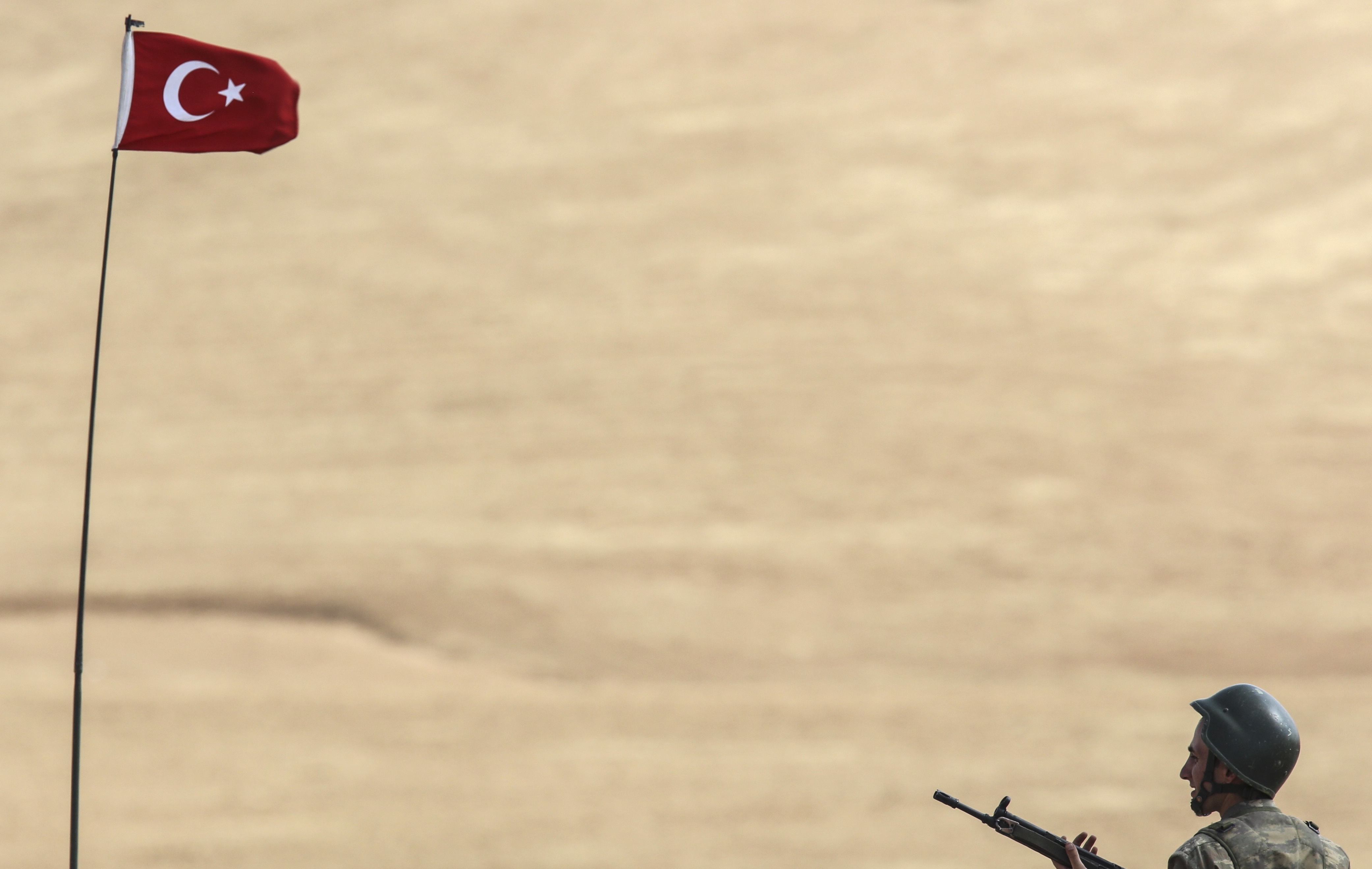
Deputy Prime Minister Bulent Arinc said Tuesday that the militants were advancing on the white stone mausoleum, guarded by several dozen Turkish soldiers and perched on a manicured lawn under a Turkish flag on the banks of the Euphrates. The tomb was made Turkish under a treaty signed with France in 1921, when France ruled Syria. Ankara regards it as sovereign territory and has made clear that it will defend the mausoleum if it is attacked.

Jamie Dettmer relays the suspicions of diplomats in Ankara that “Turkey will limit its military role—doing a bare minimum as a NATO member to avoid embarrassing the Western alliance but not enough to undermine the anti-Western narrative that thrills Erdogan’s Islamist supporters and other religious conservatives in the country”:

“As much as Turkey enjoys the protection of NATO’s Patriot missiles against the Syrian regime, Ankara is perhaps not willing to appear an active member of a war operation against what was initially a Sunni insurgency movement in Syria,” according to Marc Pierini, a former ambassador of the European Union in Ankara. “Turkey under the Justice and Development Party (AKP) has never wanted to appear to be aligning itself with Western policies.”

Erdogan’s domestic critics say he has to some degree helped the rise of ISIS, as well as other Islamic militants. At the very least Turkey has turned a blind eye to them as they emerged in the Syrian civil war and increasingly formed the vanguard in the fight to topple Syrian President Bashar Assad. Some critics argue that Turkey’s intelligence agencies have gone farther and actively channeled arms supplies to the jihadists.

Koplow also explores how the spillover effects of the conflict in Syria stand to influence Turkey’s domestic politics. For one thing, the government’s non-response is alienating the country’s Kurdish population, threatening to undo what had been a fairly successful rapprochement:

Many Kurds blame Ankara for allowing ISIS to fester and even for empowering the group through its previous see-no-evil-hear-no-evil border policy. The more half-hearted the Turkish government has been about getting rid of ISIS, the harder it is to successfully conclude the Kurdish peace process. In southeastern Turkey, funerals for Kurdish fighters who have been killed fighting ISIS across the border are a regular occurrence, and they contribute to growing discord between a naturally restive population and the Turkish government. The ongoing battle between ISIS and Kurdish fighters for the town of Kobane on the Syria-Turkey border — and Turkey’s apparent reluctance to get involved for fear of empowering Kurdish militants in Turkey — is inflaming passions and contributing to antigovernment rhetoric in ways that will reverberate well beyond this particular fight. …

An economy burdened by refugees, renewed unrest among Turkish Kurds, resurgent nationalism, and policy run by unaccountable intelligence services makes for an unstable brew. ISIS has presented the United States and the entire Middle East with a new set of problems, but its immediate legacy may be an end to what has been a remarkable period of Turkish domestic stability.

(Photo: A Turkish soldier stands on a hill in Suruc, Turkey on October 2, 2014, facing the Islamic State (IS) fighters’ new position, 10km west of the Syrian city of Ain al-Arab (Kobani). By Bulent Kilic/AFP/Getty Images)

Whom Exactly Are We Bombing In Syria? Ctd

SYRIA-CONFLICT

David Kenner has more on our Syrian allies, who for some reason aren’t all that grateful for the bombs we’re dropping on their country:

Foreign Policy interviewed six FSA commanders from [Deir Ezzor] who are currently exiled by the Islamic State and hiding out in southeastern Turkey. All of them were arrested at some point by the jihadist group; some were tortured. They all agree that the U.S. airstrikes in their home country are a bad idea. FSA fighters and commanders complained to Foreign Policy that they have received no increase in support since the international effort to combat the Islamic State began, despite promises from the Obama administration that the United States would begin supplying arms to the rebels. The FSA fighters also disparaged the airstrikes, saying they would mainly kill civilians and give the Assad regime a chance to gain ground.

Anti-Assad Syrian civilians have echoed this opposition. While Islamists have seized on the attacks to brand U.S. President Barack Obama as an “enemy of God,” even the traditionally secular protesters in the town of Kafr Anbel held a poster blasting the coalition for killing civilians.

Zack Beauchamp calls these civilian deaths “not an inevitable feature of any sort American involvement in Iraq and Syria” but rather “a direct product of the maximalist goals the Obama administration has set for its war on ISIS”:

By choosing only to provide limited help to Iraq in critical situations, the United States had enormous control over targeting. It could focus only on ISIS targets where airpower was likely to be effective, such as disrupting supply convoys between Iraq, that also were unlikely to kill a lot of civilians.

But now, the United States has committed itself to helping both Iraqi and Syrian rebel soldiers take back all of ISIS-held territory. That’s a more ambitious strategy that takes on a lot more risk, including toward civilians. If and when Iraqi military and Syrian rebel forces move on ISIS positions in heavily populated areas, they will expect and may very well depend on American close air support. The US will be forced to rely on sketchy Syrian intelligence and strike dangerously close to civilian population centers. It’s this simple: the more aggressive the American objectives are in the war against ISIS, the more likely American forces are to kill civilians.

Erika Solomon and Geoff Dyer back up previous reports that our targeting of the Nusra Front is alienating our friends and encouraging the al-Qaeda franchise to seek out Western targets:

[M]oderate rebels on the ground fear Washington’s decision to widen its attacks could not only weaken them, but create a larger pool of fighters who believe the west – and its partners on the ground – are their enemy as much as Mr Assad. Nusra fighters insist they had no interest in foreign attacks before the coalition strikes. But since then the group appears to have shifted its position: Jabhat al-Nusra’s leader, known as Abu Mohammed al-Golani, recently put out a statement warning western civilians to demand an end to strikes to avoid becoming victims of attacks in their own countries. Nusra fighters have been a critical partner to other rebels fighting to end four decades of Assad family rule. Their targeting by the US outraged some opposition forces.

And Joshua Hersh observes that most of the pro-democracy activists who launched the 2011 revolution are no longer there, having been killed, silenced, or driven into exile either by the regime or by ISIS:

Not all revolutionary civil activity has ceased inside Syria. In the town of Kafranbel, in Idlib province, a clever and merry band of activists continue to create humorous banners that comment on recent events, and seek to bring attention to their ongoing plight. (Recent banners have quoted Robin Williams, honored the murdered journalist James Foley, and mocked the world’s obsession with the World Cup.) And in Aleppo, there are revolutionary councils and civilian activists networks, not to mention a noble brigade of volunteer rescuers who risk their lives daily to pull survivors from the rubble of regime airstrikes. But for so many other would-be do-gooders, the rebel-held countryside, not to mention the major cities still under government control, has long proven unwelcome terrain. Going home remains a distant illusion.

“The sense of despair and the sense of loss is so powerful,” one longtime Syrian activist and humanitarian worker told me by Skype last week from his asylum in London. “For the people still inside, even if they are activists, they are under so much pressure—the pressure of the war, the militarization, the abuse.” He added, “At this point, if you want to be an activist, it’s basically to call for the fighting to stop, the bloodshed to stop.”

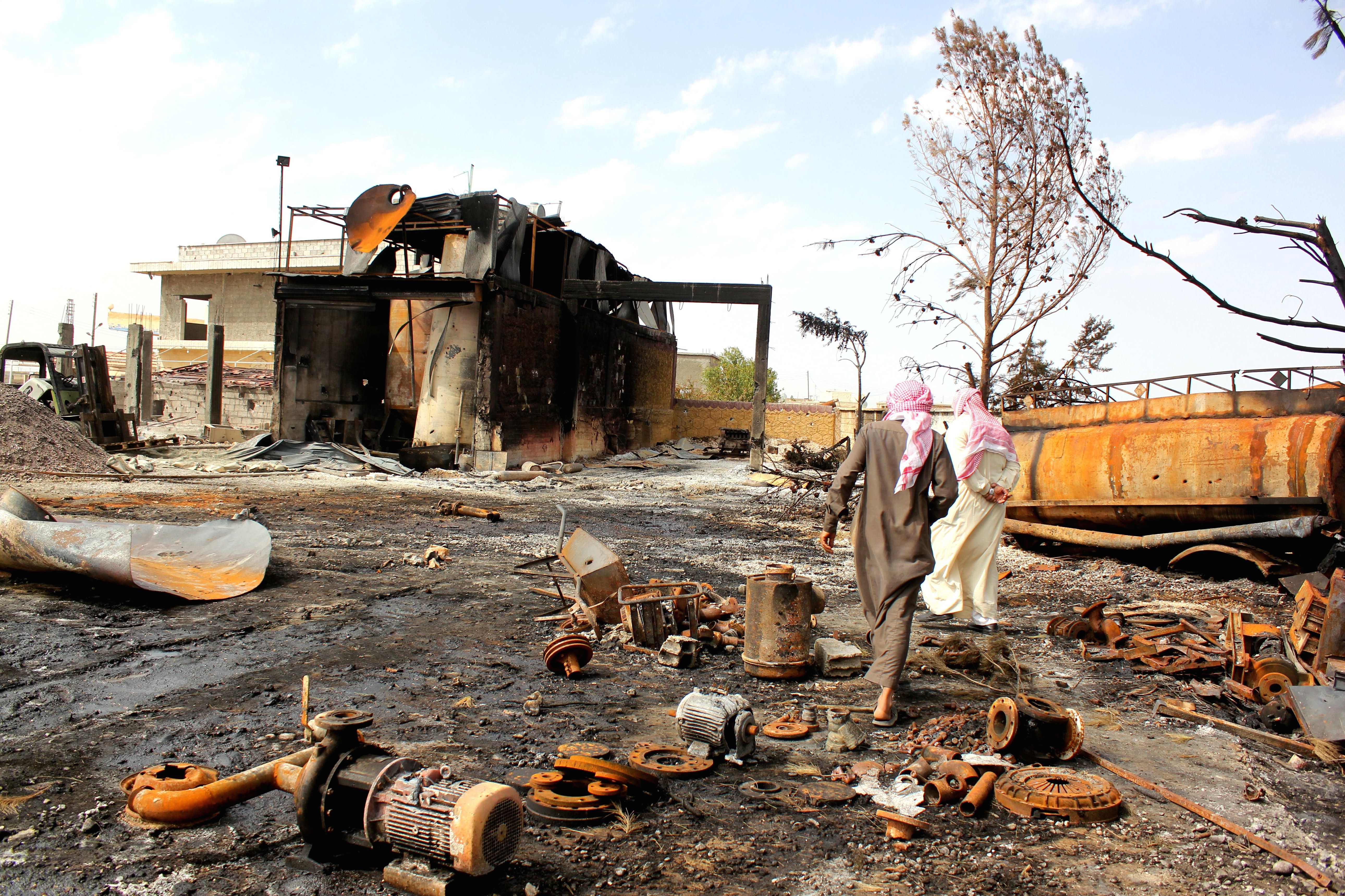
(Photo: On October 2, 2014, men walk through the rubble of an oil refinery that was reportedly targeted by the US-led coalition on September 28, in the northern Syrian town of Tal Abyad near the border with Turkey. By AFP/Getty Images)

Obama’s War Budget

Jessica Schulberg reads a new report that attempts to tally the cost of the ISIS war so far:

Due to the vaguely defined scope of the conflictPresident Barack Obama has vowed not to deploy U.S. combat troopsit has been hard to put a dollar amount on the operation. But a Center for Strategic and Budgetary Assessments (CSBA) report released Monday estimates that the U.S. has already spent between $780-$930 million in Iraq and Syria. In just the past month, the cost was $250-$400 million, or $9-$14 million per day. …

Because Obama has yet outline any long-term plan for U.S. efforts in Iraq and Syria, CSBA’s long-term cost estimates are based on likely hypothetical levels of warfare. If the U.S. draws down airstrikes to approximately 100 targets a month (there have been 200 targets this month, but air campaigns usually peak early because targets learn to hide) and caps U.S. personnel at 2,000, the cost is estimated to be between $2.4 and $3.8 billion a year. But if the administration follows recommendations to deploy 25,000 ground forces and raises the number of air strikes to 200 a month, it will be closer to $13-$22 billion annually.

“To put this in perspective,” she adds, “the U.S. spent approximately $1.1 billion in total direct expenditures in the 2011 NATO-led intervention in Libya.” But  notes that these estimates are “far less than the roughly $150 billion the U.S. spent during the peak years of the Afghan (2011) and Iraq (2008) wars.” Business Insider looks at where the money to fight ISIS is coming from:

The Pentagon has said that financing for the ISIS fight will come from the Overseas Contingency Operation fund, an account exempt from budget caps that was created for the wars in both Afghanistan and Iraq last decade.

Earlier this year, Obama sought to dwindle the budget for that account down to about $59 billion from $85 billion, reflecting the decline of operations in Afghanistan. But the spending bill passed by Congress last month continues to fund the OCO at the $85 billion level.

Meanwhile, Kate Brannen tries to see through the fog over the $5 billion counterterrorism fund the White House proposed in June, including the $500 million Congress has already approved to arm the Syrian rebels:

According to multiple sources — both inside the military and on Capitol Hill — the fund’s purpose is murky because it was mostly conceived by National Security Council staff within the White House with little input from budget or policy experts at either the Pentagon or Foggy Bottom. A few days after the West Point speech, while visiting Poland, Obama announced another new fund. This one was $1 billion for a European Reassurance Initiative, again taking Pentagon officials by surprise, Defense Department and congressional sources told Foreign Policy.

In both instances, the Pentagon was given pots of money and was basically told to figure out how to spend the money, rather than asked what it really needed, one Pentagon official said. If the Pentagon had proposed the counterterrorism fund, it would have been “dead on arrival” at the White House, a former senior Defense Department official said.

Whom Exactly Are We Bombing In Syria?

Last week, a US air strike meant to hit a base held by the al-Qaeda affiliated Nusra Front almost hit a Free Syrian Army facility instead:

Since U.S. airstrikes against ISIS in Syria began on Sept. 22, there has been no coordination between the U.S. military and its alleged partners on the ground, according to FSA leaders, civilian opposition leaders, and intelligence sources who have been briefed on the U.S. and allied military operation. It’s this lack of communication that led to an airstrike that hit only 200 meters from an FSA facility in the suburbs of Idlib. One source briefed on the incident said multiple FSA fighters were killed in the attack.

“Unfortunately, there is zero coordination with the Free Syrian Army. Because there is no coordination, we are seeing civilian casualties. Because there is no coordination, they are hitting empty buildings for ISIS,” Hussam Al Marie, the spokesman for the FSA in northern Syria, told The Daily Beast.

Shocking that things can go awry like this during a war “effort”. Allahpundit rightly sees downsides to targeting both ISIS and other jihadist groups at the same time:

What’s at risk of happening here, as ISIS and the Nusra Front congeal, is our allies in the Free Syrian Army suddenly getting it on all sides. Assad has every reason to keep killing the “moderates”; the west has always eyed them as a potential governing regime in Syria once Assad is gone, so by eliminating them Assad makes himself the only anti-ISIS game in town. And now both ISIS and the Nusra Front have a strong reason to target the FSA.

Notwithstanding this week’s mishap, Nusra will suspect that the “moderates” are either already [feeding] intelligence to the Pentagon about their locations or will be soon. The smarter strategic play here, surreal though it may seem, might have been to leave Al Qaeda alone at first and concentrate on ISIS, so as to better isolate the latter group.

But then, maybe that was impossible. Once ISIS is gone, who’s likely to replace them in control of Sunni areas? Right — Al Qaeda. We’re holding the weakest hand on the field with the FSA. To clear a path for them to rule, we’ll have to eliminate … everyone, basically.

And the quicksand will get deeper and deeper. As if that’s not enough, Fred Hof insists that the US treat Assad as our enemy as well:

The salient fact governing today’s situation in Syria is that there would be no Islamic State were it not for the criminally sectarian manner in which the Assad regime chose to respond to peaceful political protest. This would be true even if the Assad regime had had nothing to do with sustaining Al Qaeda in Iraq during the years of American occupation. This would be true even if regime-IS collaboration on the ground in western Syria were merely happenstance: an accident produced by the existence of a common enemy.

Aaron David Miller illustrates why all of this is nuts:

So, here’s my latest worry. Looking at our Syria policy, it has begun to dawn on me that we really face a two-part conundrum that we will have difficulty unpacking. First, there’s the obvious: hitting the Islamic State (IS) strengthens Syria’s President Bashar al-Assad. Second: If we choose to hit him, we’ll buck up IS, al-Nusra, and the rest of the swell groups who are in the Syrian opposition, not to mention alienating our new friends, Iraq’s prime minister, and of course, Iran, and a few of our old acquaintances like Putin.

That two-part conundrum only reinforces my real concern: the new and potentially slippery slope that is at the heart of our approach. And it’s not boots on the ground. Instead, it’s the reality that we’re being pulled inexorably like a moth to a flame not just toward a military conflict with Assad, but toward bearing the responsibility for fixing — or worse for creating — the new Syria. Indeed, under the realist’s rubric of striking IS to keep America safe, we may well end up in the very place U.S. President Barack Obama has willfully tried to avoid: nation-building.

And the beat goes on, and on, and on …

Roger Cohen Sees Hitler In The Desert

Well, we all see mirages, I guess. But it says something about the hysteria about the latest incarnation of the Sunni insurgency in Iraq that we’re suddenly comparing them to Nazis and to non-humans. Even as Cohen himself acknowledges that “the Nazi death machine was unique. Facile invocation of it is too frequent, belittling the phenomenon and its victims.”

So why break Godwin’s Law so egregiously? Cohen wants us to believe, channeling Martin Amis and Primo Levi, that there was no “why” in the unconscionable unique act of the Holocaust. And yet, mountains of evidence explain exactly why: it was a function of a vile racism that regarded the Jewish people as vermin that needed to be exterminated in order to allow the master race to flourish. It was not some random act of mass murder; it had a grotesque but clear and constantly trumpeted rationale. Then Cohen seems to endorse the idea that the Nazis were somehow unhumans or “counter-humans”, in Levi’s words. But that too, it seems to me, lets them off the hook. The Holocaust was a deeply human act  – a function of humankind’s capacity, revealed throughout history, of extraordinary levels of hatred and violence, brought to new and unfathomable evil in the age of the industrialized state.

And equally, it is absurd to argue that “there is no why to the barbarism of ISIS.”

This is after Cohen actually produces a long litany of reasons for ISIS’s brutality and evil, mind you, none of which he deems sufficient to explain the ISIS propaganda beheadings he watched on video. But why should we not take the Islamists’ word for it? They are committing slaughter and rape and attempted genocide for one core reason: because God demands that they slaughter infidels. Their mandate is beyond any human one but results in so-very-human evil.

Again, you’d think, reading Cohen, that this has never happened before. You’d think that genocide was invented by the Nazis. You’d think that religious slaughter was invented in the last couple of months. And all of this is designed to hype even further the propaganda behind this war without end, without providing any actual strategy for doing anything that could possibly alter the onslaught, or in some way win it.

And so we have the final cry of the liberal interventionist:

“Leave it to the Arabs, it’s their mess, they can clean it up,” is an inadequate (if understandable) response to ISIS. It would have been the wrong one. President Obama’s coalition in the war to eradicate ISIS may be flimsy but passivity was not an option.

And then he equates them with the Nazis yet again. The point of this facile invocation is simply to scream: Something Must Be Done. No war based on that vague slogan has ever ended in anything but disaster. But here we go again …

We War-Loving Americans

Aaron Blake highlights a new poll showing rising public support for Obama’s ISIS strategy:

The newest WaPo-ABC poll shows 50 percent approve of Obama’s handling of the Islamic State, as compared to 44 percent who disapprove. That’s an improvement from August, when the question referenced only Iraq and not Syria, and 42 percent of Americans gave Obama a vote of confidence. Obama’s new polling heights come as Americans overwhelmingly approve of the airstrikes he ordered in Syria. Seven in 10 Americans (70 percent) support the airstrikes — up from 65 percent in early September. His decision to send American forces to train Iraqi troops and coordinate airstrikes against the Islamic State in that country is less popular, but still gets positive marks: 53 percent support and 44 percent opposition.

Drum is dismayed at how comfortable we are with going to war yet again:

According to polls, nearly two-thirds of Americans are on board with the fight against ISIS and nearly half think we ought to be sending in ground troops. That’s despite the fact that practically every opinion leader in the country says in public that they oppose ground troops. At this point it would take only a tiny shove—a bomb scare, an atrocity of some kind, pretty much anything—and 70 percent of the country would be in full-bore war frenzy mode.

It’s like we’ve learned nothing from the past decade. Our politicians are in love with war. The public is in love with war. And the press is really in love with war. It just never ends.

Larison rejects at least one of Drum’s conclusions:

I don’t see much evidence that the public is “in love” with war. Yes, there is currently majority support for the administration’s decision to attack ISIS from the air, but there is reason to believe that this support is shallow and likely to evaporate as the war drags on. According to at least one survey, most Americans also consider ISIS to be a “very serious” or “fairly serious” threat to the U.S., and that simply isn’t true. This false belief has inflated public support for action against ISIS, and that is going to wear off over time. Far from being “in love” with war, a better way to think of the public’s reaction is that they have been whipped into a panic about a vastly exaggerated threat by irresponsible fear-mongers. Most Americans support the current intervention because they wrongly think it is necessary for U.S. security, and they have been encouraged in that wrong view by their sorry excuse for political leaders.

Linker sees the entire 2016 field subscribing to war love:

From the president and Hillary Clinton on through a long line of possible Republican candidates, no one likely to be involved in the 2016 race for the White House seems inclined to diverge from the militaristic consensus that dominates official Washington and plays so well in the American heartland. It’s war-lovers everywhere you look. Very much including when the American people look at themselves in the mirror.

An Anti-Jihadist Dilemma

Colum Lynch and Elias Groll point out an inherent danger in Obama’s effort to cut off ISIS’s supply of foreign fighters, warning that illiberal regimes will likely use it as an excuse to further stifle dissent:

[At last week’s UN Security Council session], the Obama administration pushed through a measure that requires member states to prevent their citizens from traveling abroad to participate in or finance acts of terrorism. It was unanimously approved by the assembled world powers, but the vote wasn’t the clear-cut win for American diplomacy that it may appear to be.

Instead, the measure, in a textbook example of the dangers of unintended consequences, could end up giving China and similarly repressive states such as Russia and Middle Eastern monarchies powerful new tools for cracking down on separatist groups branded as terrorists. The resolution, which is legally binding, is so sweeping and vague that it effectively leaves it to each country to decide who to target, and how, because there is no internationally agreed upon definition of terrorism. For instance, the resolution requires that law enforcement agents prevent people from traveling if they have “credible information that provides reasonable grounds” for suspecting they might commit terrorist attacks during their travels. The standard of proof required to ban travel is likely to vary sharply in democratic and autocratic countries, opening the door to potential abuse of, for example, political opposition groups and ethnic minorities.

Akil Awan asks how countries whose citizens travel to Syria and Iraq to join ISIS should best deal with them when they return home. Every option, he finds, has limitations and downsides:

The third and final option being mooted by some governments, is to seek a punitive, rather than rehabilitative, response by criminalizing all those who return from fighting in Syria. And whilst we certainly should hold those who have committed crimes accountable, in the absence of clear evidence of criminality, this is simply not feasible for the rest. Not only is it impracticable and cost-prohibitive, but also morally indefensible, considering that some of the young men and women who traveled there to fight did so for largely altruistic reasons, moved by the plight of Syrians suffering under Assad’s brutal regime. Of course, others had far less idealistic motives, stirred by the thrill of adventure, or escapism from the ennui of their lives back home, or simply swept up in the raw euphoria of being part of the Jihadist zeitgeist. Many of these young people will no doubt have made mistakes in their youthful exuberance that they will surely come to regret later. How many of us are now proud of every life decision we made at the age of nineteen?

An Actual War On Women, Ctd

The victims of ISIS are often raped, as we’ve detailed. But take issue with much of the reporting on these rapes:

Press reports and punditry about sexual violence in Iraq and Syria continually employ the phrases “weapon of war” and “tool of terror.” Without a doubt, some wartime rape is a weapon of war: Some commanders use rape or the threat of rape strategically to punish enemy communities, induce compliance, or demoralize opponents. But the “weapon of war” narrative is disastrously incomplete.

Research suggests that rape has multiple causes, and is more closely associated with fighting forces’ internal practices (like forced recruitment, training practices, or the strength of the military hierarchy) than with strategic imperatives, ethnic hatred, or other “conventional wisdom” causes. In short, to assume that wartime rape is always “rape as a weapon of war” is to ignore the majority of cases.

Moreover, to the extent that wartime rape is a weapon of war, policymakers who invoke the “weapon of war” narrative may actually strengthen belligerents’ strategic positions. Commentary about the Islamic State’s sexual “brutality” ­– exemplified in a recent policy recommendation aimed at “shaming” the organization – risks reinforcing the Islamic State’s intimidating reputation (which is already well-known on the ground and in the refugee camps). Reputations and rumors matter in conflict; recent research in Lebanon has suggested that fear of rape has become an important reason for refugees to leave Syria. Playing into combatants’ rhetorical strategies could result in increased refugee flows, contribute to efforts to diminish women’s involvement in public life, or even increase the incidence of wartime rape.

Dissents Of The Day III

US Secretary of State Colin Powell holds

The fisking from readers over my Bush-Obama comparison continues:

“But we are going to war despite the fact that ISIS is no more a direct threat to the United States than Saddam was – arguably much less, in fact.”

Really? And exactly how did Saddam threaten the U.S.? I’ll give you the reported attempt to kill George H.W. Bush in 1993, though that was never proven true. But there was no serious threat after that. Saddam did not conduct any public executions of U.S. citizens, and he did not threaten terrorist attacks against the U.S. There was no threat beyond the hysteria promoted by you and the neocons.

If you dismiss ISIS as a threat, you are surely hiding your head in the sand. That does not necessarily mean our incursion is the proper course, but your decision to equate Obama with Bush is more than a little depressing.

Another quote of mine:

“And it’s much smaller than George W Bush’s coalition in 2003.”  

Size matters?  You might want to revisit that Coalition of the Willing list; not a single Arab or Middle Eastern country signed on.  Most of the countries enlisted contributed nothing (if you discount that infantry division from Micronesia).  And most of the rest made a token contribution.  GW Bush‘s coalition was pure PR.  And how many American chits got pushed across the felt to obtain that “coalition”?

Whatever contributions the Gulf States, the Saudis, and Jordanians make, they made their commitment public, and that’s not nothing in this region.  Truth is, Saudi, Egyptian, Syrian, and Jordanian forces did very little in Gulf War I.  But the public alliance was deemed necessary for legitimacy in the region.

And another:

“I can’t imagine [Obama supporters] downplaying the folly of this if a Republican president were in charge.”

Umm … seriously?

Do you not recall that Congressional Democrats did in fact acquiesce like little lambs when Bush was president, and they also did the same when any Republican launched military action in the past, be it Papa Bush and Panama, Reagan in Lebanon, Grenada, etc?

Another, from our Facebook page:

“This comes perilously close to proving that our democracy doesn’t really have much of a say.”

Not really, does it? I mean, sure, Obama was America’s choice (twice!). But the elected Congressfolk were their constituencies’ choices, too. And in both cases, most people share some of their president’s priorities, but not all, and share some of their congressfolks’ priorities, but not all. This is simply the result of a mixed government, which democracy, flawed as our version may be, has brought us. The democracy does have a say, and it seems to be saying that we elect these people for the promises *we* want them to keep, not the ones *they* want to keep.

Another:

“This is an illegal war …”

I’m not in favor of the bombing in Syria, but not for legal reasons.  The Authorization for Use of Military Force (S.J.Res.23) specifically states:

the President is authorized to use all necessary and appropriate force against those nations, organizations, or persons he determines planned, authorized, committed, or aided the terrorist attacks that occurred on September 11, 2001, or harbored such organizations or persons, in order to prevent any future acts of international terrorism against the United States by such nations, organizations or persons.

Note the specific words “he determines”.  These words delegate to the president all of the power to decide to whom the resolution applies.  No one else needs to agree with his determination, because under the law passed by Congress, the determination is his alone to make.  President Obama has decided it applies to the organizations the US is currently bombing.  Therefore, the action is authorized by Congress, and no further authorization is required.

If Congress wants to rescind or amend the AUMF it has the power to do so, but until then, Congress delegated authority to President Obama, and he is The Decider.

Another piles on further:

“This is an illegal war, chosen by an unaccountable executive branch, based on pure panic about a non-existent threat to the United States, with no achievable end-point.”

I must disagree on almost all counts.

First, Congress has willingly abdicated its war-making responsibilities in this instance, largely for political reasons. For Republicans in Congress, the calculation is particularly crass. By refusing to accept the responsibility of taking the reins on this action, they are free from any responsibility for outcomes – except, of course, for their certain continuing ability to criticize Obama no matter what he does. If he takes no action, he is aiding and abetting our enemies; if he acts strongly, then he was too slow and too timid to act in the first instance.

So, please, spare us the “illegal war” hyperbole – it would be illegal only insofar as Congress wanted to exert its authority, but to the contrary, Congress has willingly waived it.

Second, there has been no rush to war here, no fear-mongering, and most notably, no lying about the cause and purpose of this action – in other words, the antithesis of the snake-oil sales-pitch of the Bush Administration.  You call that a small matter.  I think most rational people would find Obama being honest, forthright, and direct to be a sea-change from the fabrications and evasions of the previous administration.

As for the claim that the threat is “non-existent,” well, I suppose that depends on whether one is willing to abandon any and all responsibility for the mess caused by the Bush invasion of Iraq and walk away entirely.  The problem, of course, is that walking away and doing nothing has consequences – for the Kurds, for Iraqi moderates, and for Iraq’s new government.  Do we turn our back and close our eyes to the slaughter?  Do we abandon the Kurds yet again?  There are no easy solutions, nor any certain outcomes. But doing nothing is neither helpful nor moral.

To paraphrase Colin Powell, we broke it, we bought it.  Obama didn’t choose this mess. He is merely struggling to try to clean up a nearly intractable mess.  So, yeah, targeted air strikes are the worst option … except for everything else.

The rest of the reader dissents here and here.

(Photo: US Secretary of State Colin Powell holds up a vial that he said was the size that could be used to hold anthrax as he addresses the United Nations Security Council on February 5, 2003. Powell urged the UN Security Council to say “enough” to what he said was Iraq’s 12 years of defiance of international attempts to destroy its chemical and biological weapons. By Timothy A. Clary/AFP/Getty Images)