The Best Of The Dish Today

I needed that.

I read two essays today from Israel that deepened my understanding of the current darkness. One by Gershom Gorenberg is unsparing in its criticism of Netanyahu – a tough, and honorable, position to take in wartime. The other by David Horovitz conveys the acute sense of beleaguerment and bitterness with which Israel is confronting the latest evidence that it has yet to overcome the profound resistance of those whose country and land were taken from them decades ago now. Together, the two pieces are bookends of despair. There is much more carnage ahead – paid for, in part, by you and me.

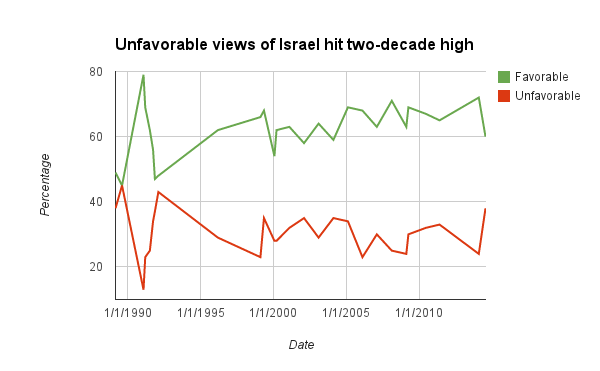
You can see some of the effects in the latest CNN poll on the subject. Among Democrats, 49 percent say they have mostly or very favorable views of the Jewish state; but 48 percent have mostly or very unfavorable views – it’s split down the middle. On the question of whether Israel was justified “in taking military action against Hamas and the Palestinians in the area known as Gaza”, Democrats are also split 45 to 42 percent. There’s also a generation gap: among those over 50, an overwhelming majority – 65 – 26 – believe the Gaza campaign is justified; among the under 35, it’s an even split: 47 – 45. I’d say this is a problem for the Greater Israel lobby. The differential between their lock-step Democratic support in the Congress and the real divisions in the party at large may soon become much harder to disguise.

Today, we rounded up the facts, data and opinions on the latest threat to the ACA; we pondered the long-term futility of endlessly bombing Gazans to smithereens; I wondered not for the first time why the Democrats are unable to make an aggressive, positive case for their policies; and remembered a time when a Republican president could tell Israel (and Britain and France) to go take a hike. To puncture some of the humid summer gloom, we also launched a contest for the best cover song of an original hit. Speaking of which:

The most popular post of the day was For Israel, There Is No Such Thing As An Innocent Gazan; next up: Some Clarity On Russia and Ukraine.

Many of today’s posts were updated with your emails – read them all here.  You can always leave your unfiltered comments at our Facebook page and @sullydish. 27 32 more readers became subscribers today to bring us to 29,690. You can help us get to 30,000 here – and get access to all the readons and Deep Dish – for a little as $1.99 month. Gift subscriptions are available here.

See you in the morning.

Paying For Israel’s Permanent War

fy2015foreignaid

Reminding us that the US subsidizes Israel to the tune of over $3 billion a year, Jesse Walker scrutinizes the case for this assistance and finds it lacking:

You hear two sets of arguments for the aid packages. The first is the one you’d expect: With some exceptions, which we’ll note in a moment, people who back Israeli policy tend to want America to fund it. The second comes from the folks who feel the aid gives Washington leverage that it can use to work for peace. America’s checks do give D.C. a greater ability to insert itself into the conflict, a fact that has led a number of Israel’s supporters as well as its critics to call for ending American aid. (Needless to say, that doesn’t mean they’d want the money to stop while the war is in progress.) Despite that power, Washington’s ability to tamp down the tensions has been, shall we say, rather limited. As my colleague Shikha Dalmia wrote a few years ago, “If money could buy peace, Israelis and Palestinians would now be holding hands and singing kumbaya.” Instead we’ve been subsidizing war.

We also pay for the clean-up afterward, David Corn adds, pointing to the $47 million humanitarian aid package the State Department announced on Monday:

According to the UNRWA, 75 of its facilities in Gaza, including schools and warehouses, have been damaged in the fighting. Presumably, some of the $15 million being sent to the agency by the United States—which covers a quarter of an emergency appeal for $60 million issued by the UNRWA—will be used to repair or replace UNRWA installations destroyed by the US-funded Israeli military.

The new package of US assistance includes $3.5 million in funding for Mercy Corps, Catholic Relief Services, and other nongovernmental organizations. According to the State Department, Mercy Corps will use some of this money to supply non-food items to displaced Palestinians and extend a short-term employment program for 3,000 people in Gaza and a “psycho-social support program” assisting about 2000 families. Catholic Relief Services will provide medical supplies and fuel for medical facilities.

(Chart via Yglesias)

How The Peace Process Collapsed … Again

In a lengthy narrative piece, Ben Birnbaum and Amir Tibon chronicle John Kerry’s efforts to broker an Israeli-Palestinian peace deal, and how the talks finally broke down. (Believe it or not, TNR decided to publish an account of the entire thing that blames everything on the Palestinians.) In their account, everything fell apart when Abbas made good on his threat to seek membership in 15 UN conventions, and went ahead with a reconciliation agreement with Hamas, after Netanyahu was unable or unwilling to meet Palestinian conditions for resuming negotiations. Toward the end of the piece, the authors wonder what comes next:

The Palestinians may resume their quest for full-fledged U.N. membership this fall. In Israel, there are almost as many plans as people: Lieberman, the foreign minister, wants his country to make peace directly with the Arab League; Bennett, whose party is JORDAN-US-PALESTINIAN-ISRAEL-DIPLOMACYnow polling just behind Likud, is advocating partial Israeli annexation of the West Bank. Livni has spoken about unilateral steps that would forfeit Israeli claims to West Bank territory outside the settlement blocs and freeze building in those areas. In the United States, top Middle East voices are urging Kerry to bypass Abbas and Netanyahu and put forward his own detailed peace plan. …

There’s no shortage of ideas, in other words. And some of themparticularly that lastmay bring Israelis and Palestinians closer to a deal than Kerry got this time. But few of the people we spoke to expected progress any time soon. With Netanyahu entrenched, Abbas on his way out, settlements and rocket ranges expanding, and the populations increasingly hardline, we seem to have reached the end of an era in the peace process. And no one harbors much hope for what comes next. “I see it from a mathematical point of view,” said Avi Dichter, the former chief of Israel’s Shin Bet intelligence agency. “The American effort will always be multiplied by the amount of trust between the two leaders. So if Kerry’s pressure represents the number five, and then Obama’s help brings the American effort to ten, it really doesn’t matter. You’re still multiplying it by zero. The final result will always be zero.”

Martin Longman quibbles with how the piece blames the failure of the talks solely on the Palestinians:

The way this reporting is constructed, it makes it look like there is all this flurry of activity on the American and Israeli sides which is just cut off at the knees by an impatient Abbas. I don’t doubt the basic reporting here, but I think it doesn’t take into enough account the degree to which Netanyahu was either delaying with a purpose or simply incapable of delivering.

Do the reporters actually believe that Netanyahu was on the verge of rounding up the votes he needed to release the fourth tranche of prisoners? If they do believe this, they didn’t bother to say that they believed it. Yet, the way they reported it implies that they actually believe it. It appears that Livni and the Americans thought it was possible. So, maybe it was. A successful vote wouldn’t have been any magic elixir anyway, but it would have kept the process alive. And that would have been a much better place to be than where we are now, wouldn’t it?

Frum, of course, finds the narrative of Palestinian intransigence more plausible, but his other takeaway is a great deal of respect for the work Kerry put in. “It’s amazing how much more gets done,” he writes, “when the secretary of state isn’t running for president”:

John Kerry’s initiative failed. But the risk of failure attends every political initiative. It’s fine to calculate how much political risk to accept. But when a secretary of state in pursuit of his or her own political future decides that no risk is acceptable, then nothing much is ever tried. Which is why Hillary Clinton’s record as secretary of state is so blank. By 2012, Obama had apparently given up on hopes of negotiating an Abbas-Netanyahu deal. Kerry’s hopes had dwindled, but not yet died. “I think we have some period of time—in one to one-and-a-half to two years—or it’s over,” Kerry said in 2013. So he tried. He failed. But in other places where is he trying, he seems to be succeeding: smoothing the post-Karzai political transition in Afghanistan, reaching U.S.-Europe consensus on how to respond to Russia in Ukraine. It seems you get a lot more done by doing your job than by positioning and planning for your next one.

(Photo: US Secretary of State John Kerry gestures as leaves the Jordanian city of Amman on March 27, 2014, en route to Rome. Kerry and Palestinian president Mahmud Abbas held “constructive” talks on the Middle East peace process, a US official said Thursday, as crunch decisions loom in the coming days. By Jacquelyn Martin/AFP/Getty Images.)

For Israel, There’s No Such Thing As An Innocent Gazan, Ctd

Noam Sheizaf engages Israeli incredulity at why Gazans support Hamas, and explains why it’s not beyond the pale for them to do so:

The people of Gaza support Hamas in its war against Israel because they perceive it to be part of their war of independence. … Israelis, both left and right, are wrong to assume that Hamas is a dictatorship fighting Israel against its people’s will. Hamas is Shujaya neighborhood of Gaza full of dead bodiesindeed a dictatorship, and there are many Palestinians who would gladly see it fall, but not at this moment in time. Right now I have no doubt that most Palestinians support the attacks on IDF soldiers entering Gaza; they support kidnapping as means to release their prisoners (whom they see as prisoners of war) and the unpleasant fact is that most of them, I believe, support firing rockets at Israel.

“If we had planes and tanks to fight the IDF, we wouldn’t need to fire rockets,” is a sentence I have heard more than once. As an Israeli, it is unpleasant for me to hear, but one needs to at least try and understand what lies behind such a position. What is certain is that bombing Gaza will not change their minds. On the contrary.

Meanwhile, Francesca Albanese wonders why the Hamas 10-year peace proposal has been greeted with deafening international silence. And Jamelle Bouie demolishes Thane Rosenbaum’s WSJ op-ed, which rehashes the argument that Gazan civilians are legitimate targets because they voted for Hamas and harbor militants in their homes and neighborhoods:

For comparison’s sake, here’s Osama Bin Laden attempt to justify the Sept. 11 attacks:

[T]he American people are the ones who choose their government by way of their own free will; a choice which stems from their agreement to its policies. Thus the American people have chosen, consented to, and affirmed their support for the Israeli oppression of the Palestinians, the occupation and usurpation of their land, and its continuous killing, torture, punishment and expulsion of the Palestinians. The American people have the ability and choice to refuse the policies of their Government and even to change it if they want.

For both Rosenbaum and Bin Laden, the situation is straightforward: Because a majority of Gazans/Americans voted for leaders who used violence or waged war against Israelis/Muslims, both have forfeited their claim to noncombatant status. After all, if they wanted to avoid conflict, they wouldn’t have elected those people in the first place. If you recoil from this logic, your head is in the right place.

(Photo: People frantically attempted to to pick up the dead and the wounded in the blood strewn area while plumes of smoke from the recent Israeli shelling lingered in the air on July 20. By Mahmood Bassam/Anadolu Agency/Getty Images.)

Israel’s Self-Defense Plea

Amos Guiora defends the bombing of Gaza on traditional lines, stressing that “Israel has an obligation to protect its citizens harmed by Hamas’s decision to endanger its own population”:

While the number of Palestinian casualties suggests both a disproportionate operational response and an exaggerated application of self-defense, the reality is simultaneously nuanced and obvious. Nuanced because limits must be imposed; otherwise, the nation state violates the essence of international law. Obvious, because the nation-state’s primary obligation is to protect its civilian population. Israel has the right to self-defense in accordance with commonly accepted principles of international law. Application of that right, in the context of Hamas’s actions, requires recognizing two realities: the price paid by innocent Palestinians as a result of human shielding and the clearly foreseeable deaths of numerous Israelis if tunnels are not destroyed. While the loss of innocent life is always tragic, aggressive self-defense is the essence of operational counterterrorism.

Spot the euphemism: “aggressive self-defense.” Just war theory allows for no such thing. Defense is defensive, not aggressive. Pre-emptive slaughter as a means to deter future attacks doesn’t hack it. And defense should be proportionate to the actual threat to Israel not the potential one. Or as George Bisharat puts it: “All nations have a right of self-defense, including Israel. But that right may be exercised lawfully only in limited circumstances. Israel cannot validly claim self-defense in its recent onslaught against Gaza for two main reasons”:

First, despite its 2005 withdrawal of ground forces and settlers from Gaza, Israel still exercises effective control over the region by controlling its airspace, coast and territorial waters, land borders (with Egypt), electromagnetic fields, electricity and fuel supply. Accordingly, Israel remains an occupying power under international law, bound to protect the occupied civilian population. Israel can use force to defend itself, but no more than is necessary to quell disturbances. Hence this is not a war – rather, it is a top military power unleashing massive firepower against a penned and occupied Palestinian population.

Second, self-defense cannot be claimed by a state that initiates violence, as Israel did in its crackdown on Hamas in the West Bank, arresting more than 400, searching 2,200 homes and other sites, and killing at least nine Palestinians. There is no evidence that the terrible murders of three Israeli youths that Israel claimed as justification for the crackdown were anything other than private criminal acts that do not trigger a nation’s right of self-defense (were an American citizen, or even a Drug Enforcement Administration agent killed by drug traffickers on our border with Mexico, that would not entitle us to bomb Mexico City).

And that, in a nutshell, is Waldman’s answer for why Israel is losing the PR war:

If Israel is losing the propaganda war, it’s because propaganda can only take you so far when the facts are telling a story you’d rather people didn’t hear. Social media has something to do with it, but it’s still traditional media that show the largest numbers of people what’s going on. And when you have a Palestinian death toll that now exceeds 500 and is going nowhere but up while the numbers of Israeli civilians who have died is still in the single digits, you just aren’t going to be able to spin a story of equal suffering and blame.

It’s as though Hamas said, “I dare you to kill those people,” and Israel replied, “You got it,” then turned to the rest of the world and said, “Hey, what do you want — he dared me!”

It’s impossible to be a moral human being and not be horrified by what is happening to the civilians in Gaza. If that is the price for quiet, it is too high. And what this toll is doing to Israel’s broader global legitimacy far outweighs its short term security goals.

When The Right Wasn’t Always Reflexively Behind Israel

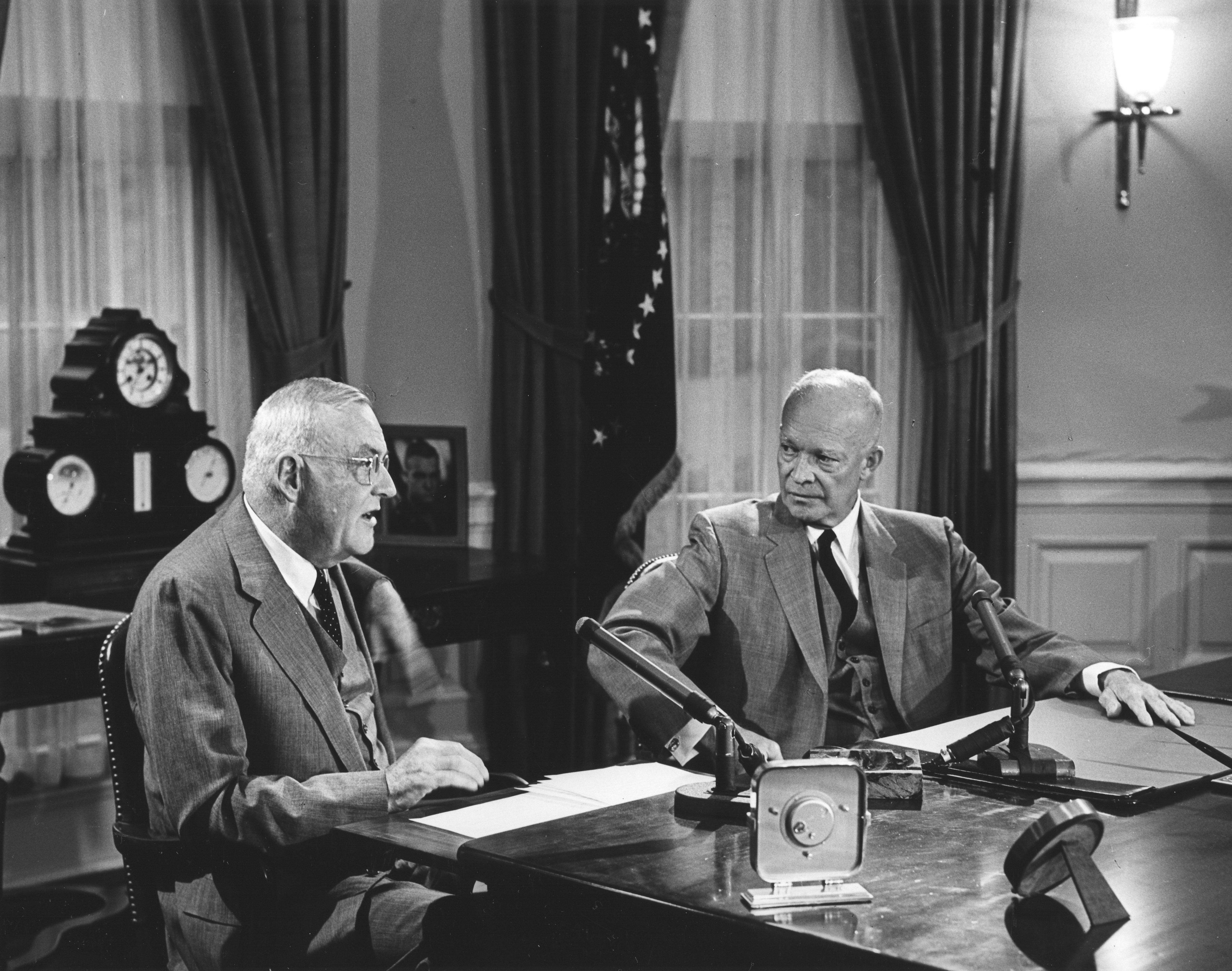
Ike & Dulles From The White House

Scott McConnell has an interesting trip down memory lane at The American Conservative. He remembers a time when the first thing Republicans would consider with respect to Israel was the national interest of the United States. Remember Suez? Money quote:

During the Cold War 1950s, Israel was not especially favored by the right. It was perceived as vulnerable and somewhat socialist, and even conservative publishing houses like Regnery produced books sympathetic to the Palestinians. But the 1967 war transformed Israel’s image for conservatives—as it did for other groups, American Jews especially. By 1970, the Nixon administration and many on the right had begun think of Israel as a useful Cold War asset. The Jewish state had demonstrated it could fight well against Soviet allies. The idea of Israel as a strategic asset was always somewhat problematic—it would be called into question when America suffered the Arab oil embargo of the 1970s, and there were sharp disagreements over Israel’s invasion of Lebanon in the 1980s. But one could safely generalize that most conservatives considered Israel an asset—a proposition that the neoconservatives, valued newcomers to the conservative movement, pushed enthusiastically.

When the Cold War ended, this became more complicated.

Israel proved useless when Iraq invaded Kuwait: American diplomacy had to devote much time and energy to ensuring that Israel did not enter the conflict, as Israeli involvement would have blown up the anti-Saddam coalition President George H.W. Bush had painstakingly constructed. What good was a regional ally that must be kept under wraps when a regional crisis erupts? More generally, once Americans began to see their Mideast problems as originating from within the region, rather than from Soviet meddling, issues such as Israel’s treatment of the Palestinians became salient. For a brief time, the place of Israel in the conservative mind was in flux.

McConnell makes the argument that it was at this point that the neoconservatives made their move – by ending the careers of Joe Sobran and Pat Buchanan at National Review, both of whose criticism of US-Israel relations sailed very close to the wind of anti-Semitism. It’s been a while since those controversies, and it’s impossible to defend Sobran, especially given the hate-filled rants he would go on to pen. Buchanan is a trickier case because, whatever else you can say about him, he has a first class mind and a real, if often noxious, worldview. But the threat of having your career ended by saying the wrong thing about Israel lingered in the atmosphere, as it was always intended to do:

Buckley’s depiction of the power of the Israel lobby to break people’s reputations is perceptive and unequivocal. Describing his first private dinner with Joe Sobran where they discussed the Decter/Podhoretz charges, Buckley relates that he told the story of William Scranton, a governor of Pennsylvania who was considered presidential timber in the 1960s. Nixon sent him on a fact-finding mission to the Mideast and he came back with a recommendation that the United States be a little more evenhanded, and… no one ever heard from him again. Buckley writes: “We both laughed. One does laugh when acknowledging inordinate power, even as one deplores it.”

Would Buckley now be considered an anti-Semite because if his description of AIPAC as having “inordinate power”? Maybe five years ago. But one senses a little more nuance and a little more circumspection about the consequences of always backing Greater Israel for ever. Even, perhaps, on the right, however much money Adelson and his buddies pour into the process.

(Photo: During a radio and television broadcast, US Secretary of State White House John Foster Dulles (1888 – 1959) (left) speaks with US President Dwight Eisenhower (1890 – 1965) in the Oval Office at the White House, Washington DC, August 3, 1956. The men were discussing the recent nationalization of the Suez Canal by the Egyptian government. By Abbie Rowe/PhotoQuest/Getty Images)

Quote For The Day

Tensions Remain High At Israeli Gaza Border

“It’s maddening to think that the tremendous military power Israel has amassed is not giving it the courage to overcome its fears and existential despair and take a decisive step that will bring peace. The great idea of the founding of the State of Israel is that the Jewish people has returned home, and that here, we will never be victims again. Never shall we be paralyzed and submissive in the face of forces mightier than us.

Look at us: The strongest nation in the region, a regional superpower that enjoys the support of the United States on an almost inconceivable scale, along with the sympathy and commitment of Germany, England and France – and still, deep inside, it sees itself as a helpless victim. And still it behaves like a victim – of its anxieties, its real and imagined fears, its tragic history, of the mistakes of its neighbors and enemies.

This worldview is pushing the Jewish public of Israel to our most vulnerable and wounded places as a people. The very essence of “Israeliness,” which always had a forward-looking gaze and held constant ferment and constant promise, has been steadily dwindling in recent years, and is being absorbed back into the channels of trauma and pain of Jewish history and memory. You can feel it now, in 2014, within very many of us “new” Israelis, an anxiety over the fate of the Jewish people, that sense of persecution, of victimhood, of feeling the existential foreignness of the Jews among all the other nations.

What hope can there be when such is the terrible state of things? The hope of nevertheless. A hope that does not disregard the many dangers and obstacles, but refuses to see only them and nothing else,” – David Grossman.

(Hat tip: Jeff Weintraub)

(Photo: Israeli soldiers weep at the grave of Israeli Sergeant Adar Barsano during his funeral on July 20, 2014 in Nahariya, Israel. Sergeant Barsano was killed along with another IDF soldier on the twelfth day of operation Protective Edge, when Hamas militants infiltrated Israel from a tunnel dug from Gaza and engaged Israeli soldiers. By Andrew Burton/Getty Images.)

“Telegenically Dead” Ctd

Israel

As the hasbara machine fails to stymie international outrage over the Gaza campaign, Aaron Blake highlights some polling that suggests American public support for the Jewish state is on the decline:

A new CNN/Opinion Research poll shows 38 percent of Americans now have an unfavorable view of Israel, which in recent days has launched a ground operation in Gaza that has resulted in more casualties than its allies would prefer (witness John Kerry’s reaction). The death toll in the current conflict includes more than 500 Palestinians. If you combine CNN and Gallup polling, that’s the most Americans who view Israel in a negative light since 1992. Israel is hardly a pariah on the scale of Russia, and 60 percent of Americans still have a positive view of Israel. But the increase in negative views reinforces an emerging trend in the American electorate: It wants nothing to do with overseas conflict, and would prefer that such conflict didn’t exist.

Keating remarks on the role Twitter has played in leveling the propaganda playing field:

Twitter was not even three years old when Israel launched Operation Cast Lead, its last, and far bloodier, incursion into Gaza, and Twitter was certainly not the indispensible tool for gathering and disseminating news that it has since become. … Despite the Israeli government’s large social media campaign—in constrast to that of Hamas, whose accounts are routinely blocked—it has undoubtedly been losing the online information war. As the New York Times notes the “hashtag #GazaUnderAttack has been used in nearly 4 million Twitter posts, compared with 170,000 for #IsraelUnderFire.”

“On the other hand,” he adds, “it’s not clear how much difference this will make”:

Support for Israel remains extremely high in the United States and is increasingly defined by party affiliation. The coverage may be becoming more balanced, but the audience may not have much interest in nuance.

Emily Shire scans the social media vitriol and wonders if Twitter hasn’t actually made the situation worse for everyone:

Since the recent violence has broken out between Israelis and Palestinians, Twitter and Facebook have become a parallel battleground. Inane and disturbing hashtags have been lobbed by those often far removed from the rocket fire. And it’s not just from random, anonymous civilians. A social media manager for the African National Congress, South Africa’s ruling political party, posted a message on Facebook that featured an image of Adolph Hitler with the text “Yes man, you were right …I could have killed all the Jews, but I left some of them to let you know why I was killing them.”

The conflation of anti-Semitism and anti-Israel sentiments is nothing new. The hate behind both have long bled into each other. But the flippant use of extremist hashtags only helps to validate the worst fears that anti-Semitism is alive and well in too many parts of the world (in case the firebombing of a Paris synagogue didn’t already do that). This, in turn, feeds into an outpouring of anti-Arab vitriol on social mediaDavid Sheen reportedly translated tweets by Israeli teens calling for death sentences to Arabs. And just prior to the most recent outbreak of all-out violence, Facebook groups like “The People of Israel Demand Revenge” grew by the tens of thousand in response to the abduction and murder of the three Israeli teenagers.

Can Kerry Fix The Gaza Mess?

John Kerry rushed off to Cairo last night to try and broker a ceasefire between Israel and Hamas, but it’s not at all clear that he can get the deal he wants:

Kerry reiterated Sunday what Obama told Netanyahu on Friday: that the US supports a return to the 2012 cease-fire that halted rocket fire into Israel from Gaza. Hamas says Israel did not hold up its side of that agreement. And the militant group that governs Gaza is also deeply suspicious of the Egyptian government, which – since the 2012 cease-fire – has banned the Muslim Brotherhood. Hamas is affiliated with the Muslim Brotherhood. But just returning to the 2012 agreement is unlikely to happen, says WINEP’s [Eric] Trager. “Egypt today is not going to accede to anything that would allow Hamas to come out of this strengthened,” he says. Egypt is also not likely to accept opening the Gaza-Egypt border at Rafah, another Hamas demand.

As of this writing, the Cairo visit has produced no breakthroughs. Steven Cook argues that Egypt is a terrible interlocutor, given that Sisi’s regime actually benefits from the conflict:

The Egyptians seem to believe that a continuation of the fighting — for now — best serves their interests.

Given the intense anti-Muslim Brotherhood and anti-Hamas propaganda to which Egyptians have been subjected and upon which Sisi’s legitimacy in part rests, the violence in Gaza serves both his political interests and his overall goals. In an entirely cynical way, what could be better from where Sisi sits? The Israelis are battering Hamas at little or no cost to Egypt. In the midst of the maelstrom, the new president, statesman-like, proposed a cease-fire. If the combatants accept it, he wins. If they reject it, as Hamas did — it offered them very little — Sisi also wins.

Pointing to signs that Israel is reluctant to escalate the conflict further, John Cassidy raises hopes for a ceasefire soon:

Reports from Israel suggest the I.D.F. has been surprised (and even impressed) by the ferocity and effectiveness of the Hamas fighters, and that there is a mounting feeling that, with seven more Israeli soldiers having been killed in the past twenty-four hours, Benjamin Netanyahu’s government will soon be faced with the choice of escalating the military campaign or declaring victory and withdrawing. “In view of the stiff resistance put up by Hamas, the level of destruction, if fighting continues, may reach that of Beirut in 2006,” Amos Harel wrote in Haaretz.

Is Netanyahu prepared for that? Is Israel? Since the Prime Minister of Israel has insisted all along that the aims of Operation Protective Edge are limited—degrading Hamas’s infrastructure and reducing its ability to launch rocket attacks—he seems to have some wiggle room. On Tuesday, the I.D.F. announced that it had already uncovered fourteen tunnels in the Gaza Strip, some of which were twenty-five metres deep and reinforced with concrete. Having destroyed these tunnels and foiled, or so he claims, several terrorist attacks on Israeli communities close to the border, Netanyahu may be able to claim that the military escapade has accomplished its aims, and he may be able to bring it to an end. That, at least, is what Kerry and the embattled residents of Gaza will be hoping for.

Michael Totten suspects that Hamas is also ready to declare “victory” and agree to a truce, but is pessimistic that this war will bring the parties any closer to a permanent peace than the last war, or the one before that:

By the time the Israelis finish their work, Hamas may have killed enough Israelis and fired enough of its rockets that it can save face with an empty “victory” boast despite losing so many people, despite emptying its vast arsenal with little to show for it, and despite having [its] tunnels collapsed. Then its leaders will agree to a cease-fire. It doesn’t matter that no one will believe Hamas won. Hamas just needs to be able to say it. The Israelis and Palestinians won’t be an inch closer to peace after that happens, but at least the conflict will go back into the refrigerator. It will start up again at some point, though, and we’ll take another ride on the deadly and stupid merry-go-round, so savor the calm while it lasts.

For Israel, There’s No Such Thing As An Innocent Gazan

Neve Gordon and Nicola Perugini scrutinize the logic by which Israel treats virtually any building in Gaza as a legitimate target and any civilian killed as a “human shield”:

All civilians in Gaza are being held hostage by Hamas, which is considered a war crime and a gross violation of international law governing armed conflict. This, then, provides legal and moral justification against the accusation that Israel is the one killing civilians. Presumed human rights violations carried out by Palestinians against Palestinians – taking hostages and human shielding – thus become the legitimization of lethal and indiscriminate violence on the part of the occupying force. Hence, the use of human shields is not only a violation. In contemporary asymmetric urban wars, accusing the enemy of using human shields helps validate the claim that the death of “untargeted civilians” is merely collateral damage. When all civilians are potential human shields, when each and every civilian can become a hostage of the enemy, then all enemy civilians become killable.

And, critically, Israel is absolved of any moral responsibility for any of it. That’s what worries me. When military might is expended on crowded civilian areas and all civilian casualties are presumed the responsibilities of others … you get well over 500 dead, including countless women and children, including attacks on hospitals and families breaking the Ramadan fast in their own home. You get this:

Monday morning, the Abu Jameh family pulled 26 bodies, 19 of them children, from the rubble of their home near the southern Gaza town of Khan Younis, the largest toll from a single strike since the battle began July 8. Four people were killed at Al Aqsa Martyrs Hospital, the main one serving the center of the crowded coastal enclave. An airstrike Monday night destroyed the top five floors of an apartment building called Al-Salam — the Peace — in central Gaza City, an area that had been seen as a safe haven, killing 11.

And yet some even argue that this horrifying spectacle is actually a moral necessity:

The deaths of innocents are not simply outweighed by Israelis’ right to live without daily rockets and terrorists tunneling into a kibbutz playground; but by the defense of a world in which terrorists cannot use morality to achieve victory over those who try to fight morally. It is the protection of that world, one in which moral soldiers still have a fighting chance, that justifies Israel’s operations against Hamas today. And it is that greater cause that decisively outweighs the terrible toll in innocent life.

When you are killing scores of children, it is not enough to argue self-defense (even though the Iron Dome has given Israel about as robust a defense against home-made rockets as you can get). You have to argue for something grander to nullify the corpses of children. And the dehumanization of those living in Gaza – to the point at which spectators with popcorn cheer their deaths – has led to Israeli indifference to the deaths of human beings that, if they were Jews, would be regarded as the harbinger of calamity. Can you imagine the response in Israel if over 200 Israeli children were killed by a rocket attack by Hamas? Can you imagine anyone saying that the Israelis did this to themselves? That tells you everything about how deep the moral rot has gone, how this kind of zero-sum war and brutalizing occupation over decades cannot but destroy a country’s soul.

Larison, meanwhile, tackles the trope that Gazans forfeited their right to be treated as innocent civilians by voting for Hamas and allowing the group to operate in their communities:

Non-combatant status can be forfeited only by becoming a combatant, and that doesn’t happen by having voted for the current rulers or simply by living under their rule. Forfeiting non-combatant status requires taking up arms or directly lending aid to those that are fighting, and that doesn’t appear to apply to the civilian victims killed during the current operation at all. It may please Hamas to make use of these victims’ deaths for their own purposes, but that doesn’t absolve the Israeli government of its responsibility for causing those deaths. If Hamas benefits politically from these civilian deaths, and it seems likely that they do, it would seem obvious that Israel should not want to cause any more, and yet at each step over the last few weeks Israel’s government has responded with tactics that are guaranteed to continue killing many more non-combatants for as long as this operation continues.

And this is the truth about the state of Israel today. To endure it must crush. The more it crushes the deeper the resistance will run; the deeper the resistance the more unthinkable the carnage will have to go. This is an abyss of revenge and hatred, the dreadful consequence of every utopian scheme in human history.