Anti-Zionism And Anti-Semitism

Pro Palestinian Demonstrations Are Held Throughout Europe

Some of the protests against the Israeli assault on Gaza have veered definitively into the realm of rank Jew-hatred. The NYT has a decent round-up of the worst today, and it’s especially troubling in France. As the world responds to Israel’s latest incursion in Gaza, Brendan O’Neill remarks on what he sees as the ever-thinning line between anti-Zionism and anti-Semitism:

[I]n the latest rage against Israel, it isn’t only the Israeli state or military that have come in for some loud flak from so-called radicals – so have the Israeli people, and even the Jews. In Paris on Sunday, what started as a protest against Israel ended with violent assaults on two synagogues. In one, worshippers had to barricade themselves inside as anti-Israel activists tried to break their way in using bats and planks of wood, some of them chanting ‘Death to Jews!’. Some have tried to depict such racist behaviour as a one-off, a case of immigrants in France losing control. But on that big demo at the Israeli Embassy in London last week some attendees held placards saying ‘Zionist Media Cover Up Palestinian Holocaust’, a clear reference to the familiar anti-Semitic trope about Jews controlling the media. On an anti-Israel protest in the Netherlands some Muslim participants waved the black ISIS flag and chanted: ‘Jews, the army of Muhammad is returning.’

His theory as to why this happens:

Why does being opposed to Israel so often and so casually tip over into expressions of disgust with the Israeli people and with the Jews more broadly? It’s because, today, rage with Israel is not actually a considered political position.

It is not a thought-through take on a conflict zone in the Middle East and how that conflict zone might relate to realpolitik or global shifts in power. Rather, it has become an outlet for the expression of a general feeling of fury and exhaustion with everything – with Western society, modernity, nationalism, militarism, humanity. Israel has been turned into a conduit for the expression of Western self-loathing, Western colonial guilt, Western self-doubt. It has been elevated into the most explicit expression of what are now considered to be the outdated Western values of militaristic self-preservation and progressive nationhood, and it is railed against and beaten down for embodying those values.

Koplow, meanwhile, flags some nasty Jew-bashing in Turkey:

Ankara’s mayor Melih Gökçek, fresh off the heels of tweeting out pro-Hitler sentiments, urged his government yesterday to shut down the Israeli embassy in Ankara, referring to it as “the despicable murderers’ consulate” and stating that “they are 100 times more murderous than Hitler.” Not to be outdone, Bülent Yıldırım, the odious head of the “humanitarian relief NGO” IHH – the same NGO that organized the Mavi Marmara flotilla – warned Jewish tourists (yes, he said Jewish rather than Israeli, and yes, that was deliberate on his part) not to show their faces in Turkey and threatened Turkish Jews that they would pay dearly for Israel’s actions in Gaza. …

I get the anger and frustration, and I see it personally from Turkish friends on my Facebook feed and my Twitter stream, who are furious with Israel not because they are Jew-hating anti-Semites but because they deplore the mounting civilian death toll in Gaza, which they see as disproportionate and excessive. … But there is a world of difference between criticizing Israel out of a deeply held difference of opinion versus comparing Israelis to Hitler, equating Israel with Nazi Germany, throwing around the term genocide, openly advocating violence against Israeli nationals and property, and threatening Jews over Israel’s behavior. It is completely beyond the pale, and anyone who cares a lick about liberal values should be denouncing it loud and clear without qualification.

Amen.

Update from a reader:

The Dish cites the incident outside the Synagogue de la Roquette, which has been basically debunked/seriously disputed – the President of the synagouge himself confirming the details of this alternative report, on video.

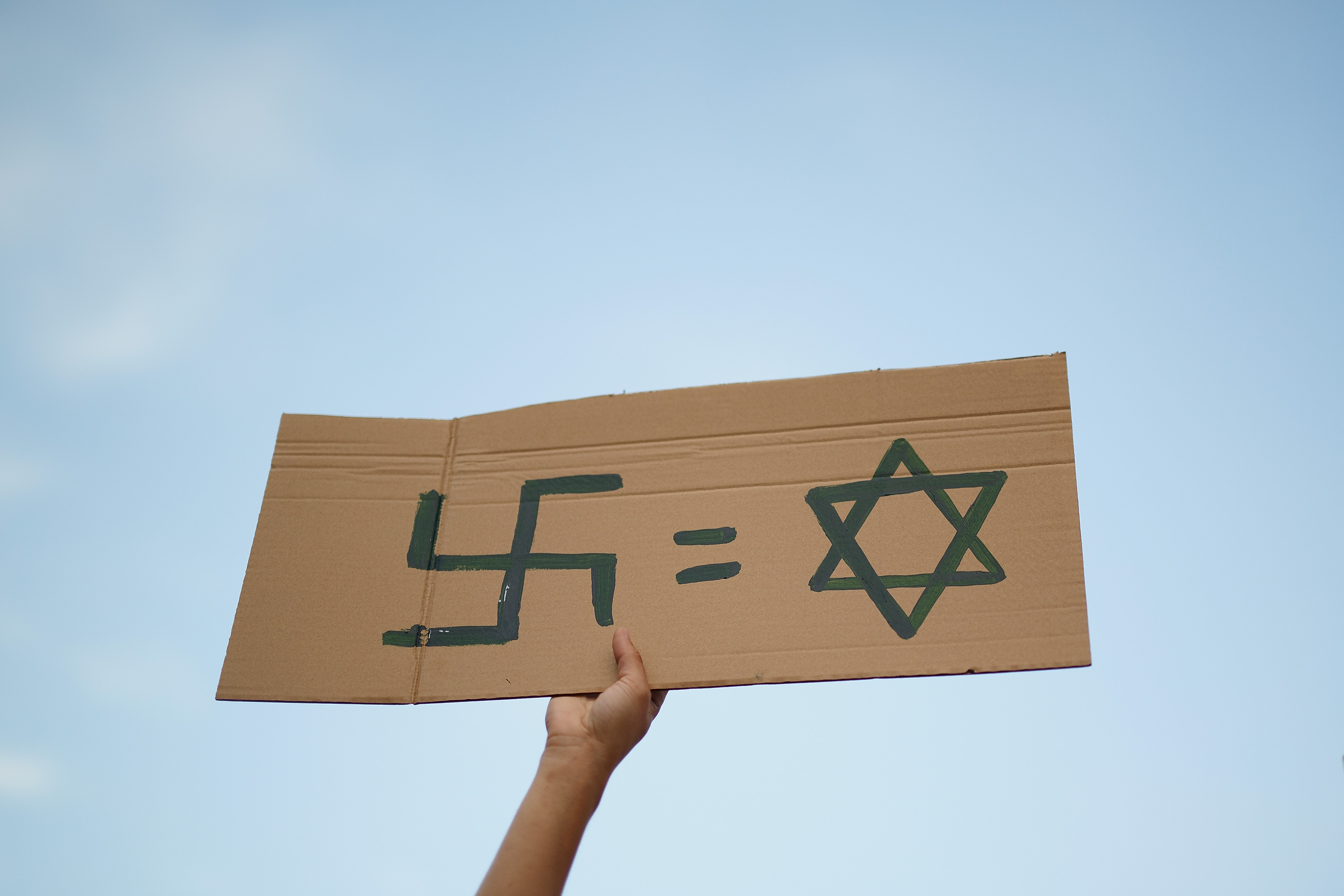
(Photo: A Pro-Palestinian demonstrator holds a placard with the symbols ‘Swastika equal to Star of David’ during a demonstration on July 17, 2014 in Madrid, Spain. By Pablo Blazquez Dominguez/Getty Images.)
Your Home Will Be Destroyed In One Minute, Ctd

Martin Longman isn’t buying Israel’s claim that its warning shots are a humane gesture:

What’s clear is that these operations have a different purpose than killing individuals who belong to Hamas. The purpose is to make it clear that belonging to Hamas will cause your family to lose their home and quite possibly their lives. Even living in the same building as a Hamas member or maybe even in the house next door or across the street is a threat to your whole family.

This policy, then, is designed to turn the Palestinian population against Hamas.

It’s designed to make families disown children who fraternize with Hamas. It’s designed to cause apartment dwellers to purge their buildings of tenants who work with Hamas. The Israelis have a term for people who don’t leave their dwellings once they have been warned that a Hamas member is living among them. They are “human shields.” And, as human shields, they have made a decision that denies them any further human rights. …

Perhaps this policy can force Palestinian patriarchs (or matriarchs) to forbid their sons and daughters from associating with Hamas, but if Hamas goes away will their replacements be better? More compliant? Easier to negotiate with? This is a policy of beating people into terrified submission, but similar policies in the recent past have only seemed to bring short stints of calm. The Israelis call this “mowing the lawn.” The grass always grows back, and quicker if it is nourished with rain.

Watch an example of the other terrifying euphemism – a “knock on the roof” – here.

Understanding The Permanence Of Greater Israel, Ctd

A small but telling story in the Baltimore Sun reveals how an American couple and their kids, after losing their jobs, have decided to relocate to Israel. Except they’re not relocating to Israel – but to a settler outpost near Jerusalem in the occupied territories. But neither the couple nor the reporter notice this rather pertinent fact:

The Brenners acknowledge the controversy surrounding moves such as theirs, part of a larger movement that many view as a stumbling block to peace in the region. But they say peace is also part of their dream. “We understand that there are other people living in Israel. … We want to live in peace,” David Brenner said. “My wife and I pray for a time when the Jewish people and Arabs and Christians will be able to live peacefully side by side.”

Notice “other people living in Israel” means others living in the occupied territories. Greater Israel already exists. And always will.

The Biggest Loser In The Gaza War

Hussein Ibish nominates the Palestinian Authority for the dubious distinction:

There is no question that Abbas and the PA were suffering a crisis of legitimacy in recent months, at the same time that Hamas was enduring an even greater crisis at virtually every register. But now, at least, Hamas has seized the initiative, albeit at a hideous cost. It alone appears to wave the Palestinian flag, however speciously. It alone claims to have a strategy for national liberation — armed struggle and “resistance” — no matter how implausible.

The danger is that the bloody and reckless hostilities between Israel and Hamas at least constitute something, which a PA armed with nothing may find difficult to counter politically. With each successive flare-up of violence between Israel and Hamas, the Islamist group has taken more blame from both Palestinian and broader Arab public opinion for the deaths and destruction. Hamas’s political “bounce” from nationalist sentiment against Israel has been more fleeting. But if the PA still appears ineffective, marginal, and irrelevant, even the heaping of public blame on Hamas might not stop it from gaining significant ground in the Palestinian political landscape.

But the PA has taken some action – namely, appealing to the UN Security Council and attempting to leverage its longstanding threat to seek an ICC investigation of Israel:

“We call on the Security Council to adopt a resolution that condemns the Israeli military aggression against the Palestinian civilian population in the Gaza Strip, calls for its immediate cessation, calls for the lifting of the Israeli blockade on Gaza Strip, and calls for protection of the Palestinian people,” Palestine’s U.N. envoy, Riyad Mansour, told the Security Council in an emergency session on Gaza.

Mansour said that if the Security Council failed to respond to his government’s appeals, the Palestinian Authority would “have no recourse but to turn to the judicial bodies of the United Nations and the international system.” The remark appeared to be a veiled warning that the Palestinians were prepared to ask the Hague-based International Criminal Court (ICC) to probe Israel’s military conduct. The Palestinians had previously agreed to hold off on asking for an ICC investigation into Israeli conduct as long as U.S.-brokered peace talks showed signs of progress.

Hamas now says it has captured an Israeli soldier, which Ishaan Tharoor says could further strengthen the group’s position relative to the PA:

[F]or militant groups like Hamas, one captured Israeli soldier is vital currency. Israel rebukes Hamas for not accepting the offer of ceasefires brokered by outside parties, but the ceasefires on offer did nothing to satisfy Hamas’s longstanding demands regarding the release of Palestinian prisoners (including some who were re-arrested after being freed in the exchange for Shalit), the loosening of border controls in heavily blockaded Gaza and the payment of salaries to some 40,000 public employees in Gaza. …

Hamas was not in a particularly strong position to win any of its demands — that is, until it claimed to have captured another Israeli soldier. If that proves true, then it could be a game changer. Still, the biggest loser in the wake of the Shalit release was neither Israel nor Hamas, but the Palestinian government of President Mahmoud Abbas, who has long been at odds with the Islamists. In one fell swoop, Hamas won a real victory — the release of over 1,000 Palestinians — when years of Abbas’s diplomatic wrangling and quixotic missions for U.N. recognition have achieved little to improve the lot of Palestinians.

Growing Up Gazan

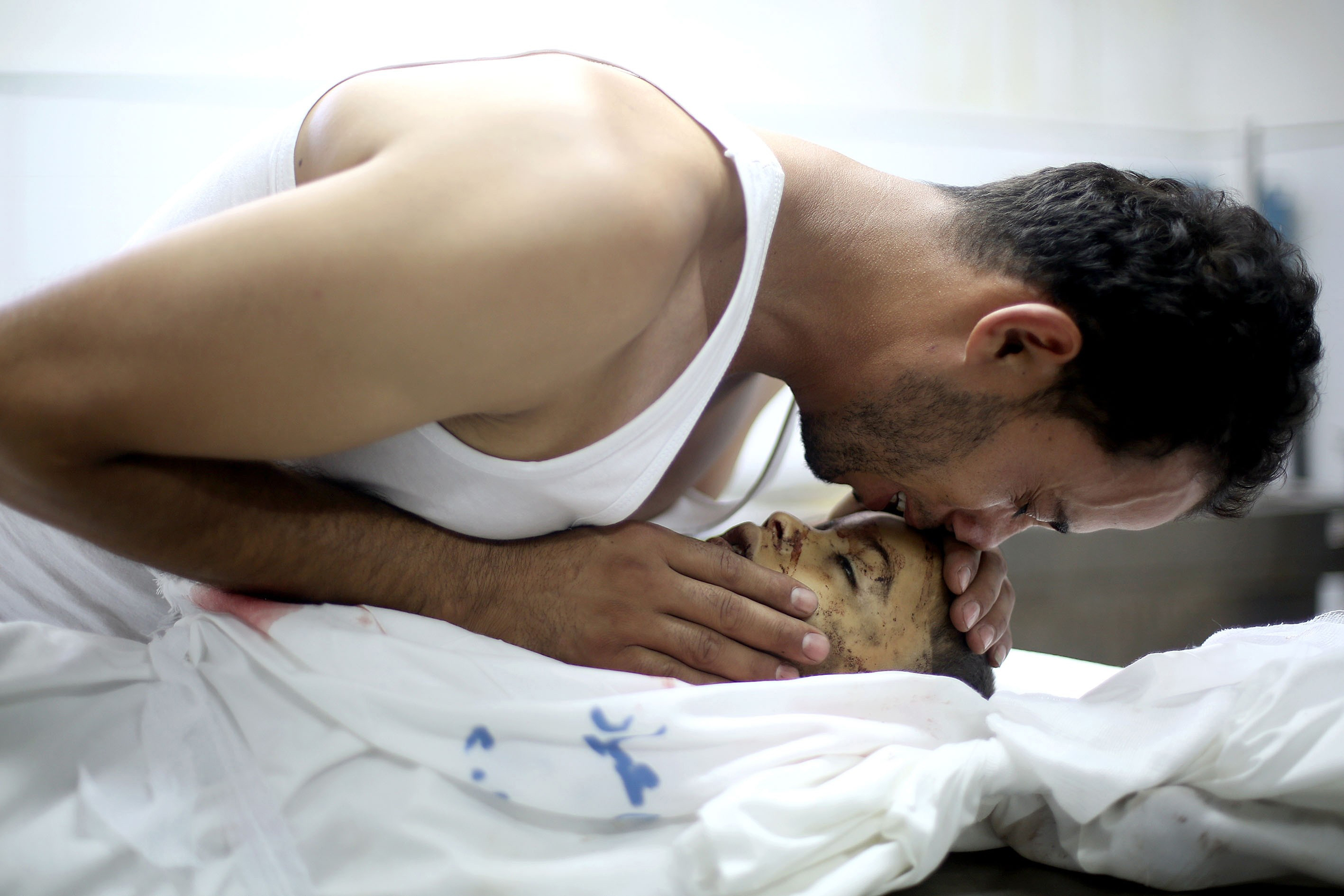
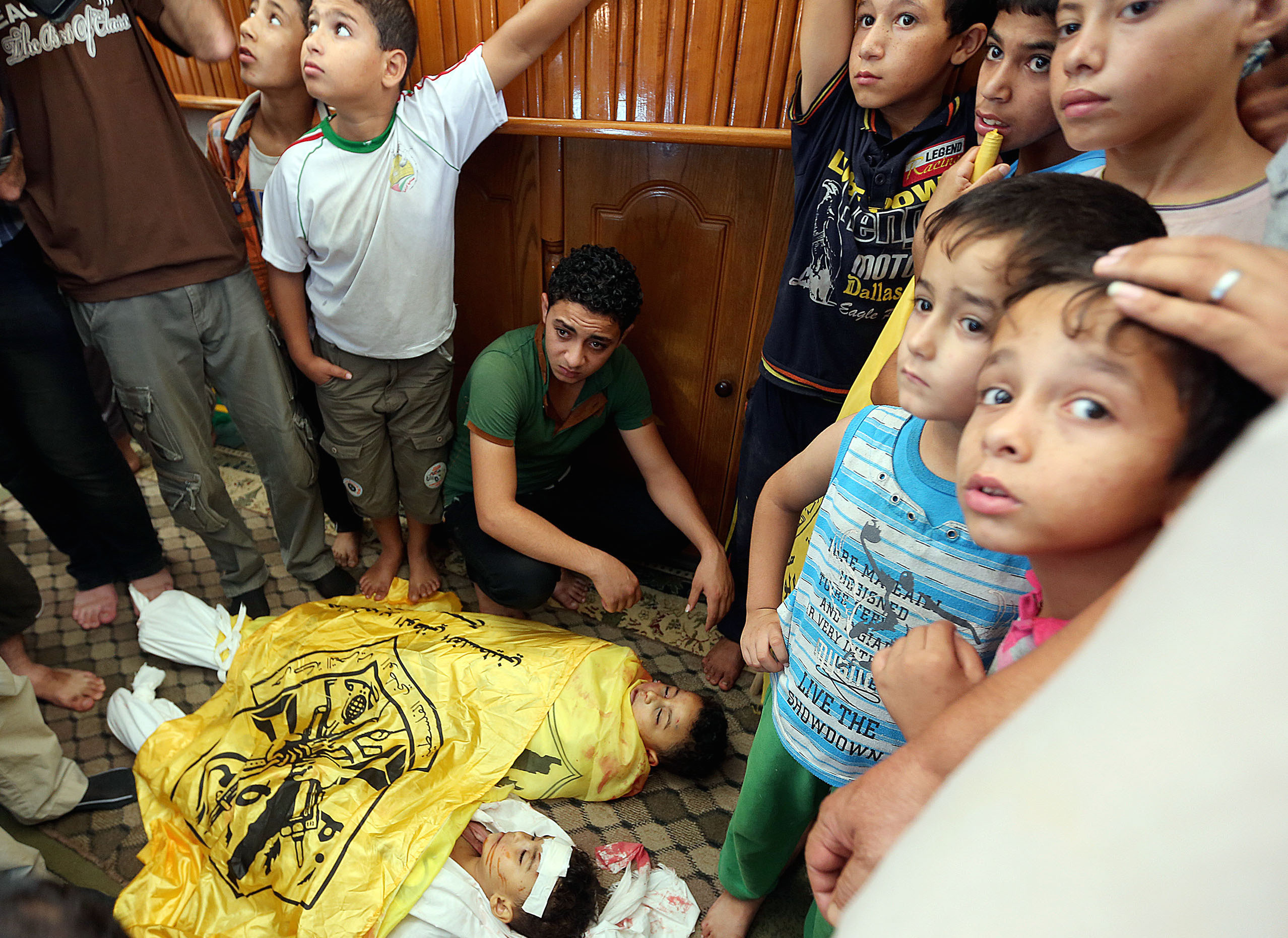
Mourning for 3 children killed by Israeli airstrikes

First, a reminder of why there are so many images of wounded and dead children coming out of Gaza (and thus appearing on the Dish, to the dismay of many readers):

UNICEF says about half the children who’ve died in Gaza during Operation Defensive Edge have been under age 12. (That’s one sixth of civilian casualties, for those keeping count.) In contrast, more than 40 percent of the population is age 14 and younger. Shoot a rocket blindly into the Strip and your chances of hitting a prepubescent child are almost 50-50.

With that in mind, Shlomi Eldar argues that isolation has fed the radicalism of the young men of Hamas’ military wing, along with their delusion that a war with Israel is winnable:

The Qassam Brigades’ militants of today are children of the second intifada. Even before they were recruited or enlisted in the Qassam Brigades, they drank the jihadist messages that the movement spreads among all the needy of Gaza who knock on the gates of its institutions (the dawa — Hamas’ welfare institutions). The great neglect of Gaza in the years Israel controlled it helped Hamas to grow.

In the past, hundreds of thousands of Palestinians worked in Israel, learned its language, got to know its culture and even formed ties of friendship with their Israeli employers. In the course of the second intifada and Hamas’ rise to power, these ties have all been severed. The older generation found itself unemployed and without income and the youth found work with the militant wing of Hamas and the other organizations (Islamic Jihad as well as the popular resistance committees).

These young men, who have not once in their lives left the borders of the Gaza Strip and have never seen Israel, have been fed the stories of the wonders of the Palestinian rocket, which was developed in Gaza’s workshops and can shake Israel. The stories of the glory of Hamas have been impressed well in the young recruits and the doctrine that has been so deeply etched in them has given them the feeling, or the delusion, that salvation could be gained through the rockets that have been developed in Gaza.

And the children who make up a majority of Gazans today don’t necessarily have anything better to look forward to:

A normal life … is nearly impossible in Gaza. It is one of the most densely populated areas in the world — home to about 1.3 million Palestinians, roughly one-third of whom live in U.N.-funded refugee camps. The territory is riddled with poverty, its local economy completely stifled by the blockade. According to UNRWA, about 80 percent of the population receives aid. Official Palestinian statistics put Gaza’s unemployment rate at nearly 40 percent, while youth unemployment hovers around 57 percent.

“We have a whole generation who have grown up under occupation,” says Dr. Mona El-Farra, health chair of the Palestinian Red Crescent Society. “We have a whole society traumatized, living with extensive psychological damage.”

More than half of Gaza’s population is under the age of 18. They have grown up intimately familiar with war: This is the third Israeli bombardment Gaza has faced in just the past five years. “Even if the fighting ends tomorrow,” Farra says, “The poverty won’t end. All of us, especially the youth, will still be trapped.”

(Photo: Relatives of three children killed during the airstrikes of Israel mourn near the death bodies of children in Gaza city on July 19, 2014. By Mustafa Hassona/Anadolu Agency/Getty Images)

Bibi’s Strategy

Tensions Remain High At Israeli Gaza Border

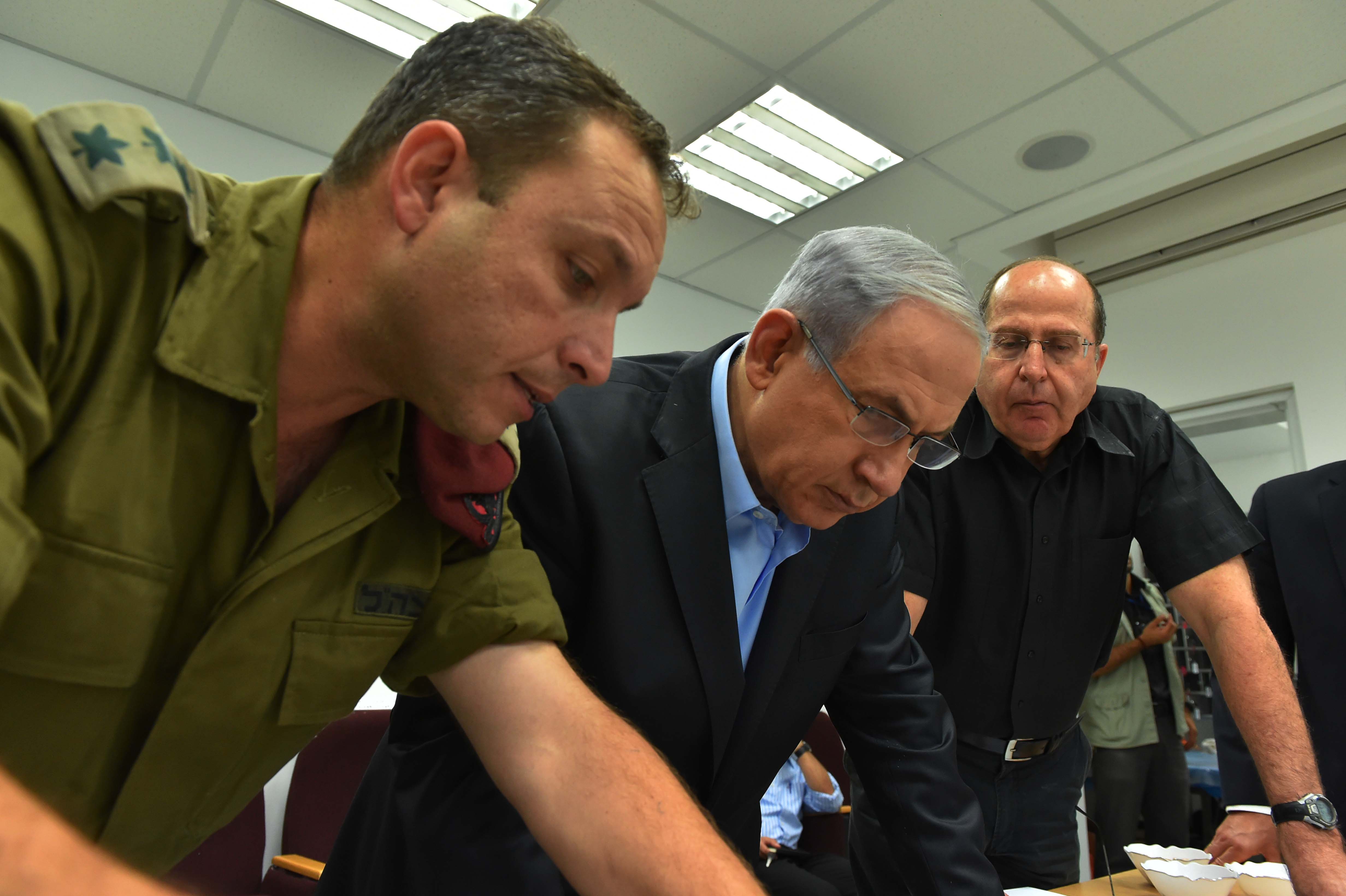
With the next Israeli election expected to take place about a year from now, Brent Sasley observes how Netanyahu is responding to domestic politics during the Gaza incursion:

Netanyahu is managing the war carefully and effectively, from the standpoint of Israeli casualties and Israeli security. And Israelis recognize this. While rightist rivals were demanding a full-scale invasion and occupation of Gaza, Netanyahu authorized only airstrikes, testing Hamas’ interest in a cease-fire. He did not suffer any significant backlash in the media or in public debate, even while millions of Israelis were forced into bomb shelters. But pressure to do more was growing: on July 13, about four days before the actual incursion began, about 67 percent of Israelis supported a ground operation. By authorizing one, Netanyahu has given the public what it has demanded.

According to the latest poll, Netanyahu’s caution – restraint, then a limited operation only, backed by large-scale force – has paid off. His Likud party has gained four seats, from 20 to 24, while his former ally Avigdor Lieberman has dropped from 11 to eight seats.

Efraim Halevy weighs the invasion’s benefits and risks for Israel:

Israel must achieve resounding success in this new phase of combatboth to change the present mindset of Hamas and, of course, to maintain national support for the government’s policies. This will entail a campaign lasting several daysthough it is conceivable that it could extend beyond that. Israel has a good chance to achieve its aims: a more restrained Hamas and the reintroduction of the Palestinian Authority in Gaza, at least policing and controlling the southern gateway to Egypt.

But there’s also some risk that this phase of the operationan incursion into a small agricultural swath of Gazafails. And if it does fail, then a more treacherous scenario looms:

an operation that will entail urban warfare in Gazan steets. That mission would have a much more robust agenda. Its proponents talk about the demilitarization of Hamas. What they mean by this is unclear. But any attempt to forcefully strip Hamas of its weaponry would entail untold risks and consequences.

But Martin Shaw argues that the risks of Netanyahu’s war-as-politics mentality and the military adventurism it encourages may be much greater than the prime minister realizes:

Netanyahu’s blowback problem is not just Hamas: its political reinforcement is a predictable consequence of what he is doing, just as the continuing dominance of the aggressive Israeli right is a predictable consequence of Hamas’s rocket campaigns. The real problem is the extreme instability of the wider Middle East, with long-term wars raging in Syria and Iraq, in which the stability of Jordan – absolutely crucial to Israel’s own – is increasingly at risk. The gain to Israel of the brutal new, anti-Hamas Egyptian government is small in comparison.

Israel could find itself, not too far ahead, facing an opposition far worse than Hamas, which cannot be contained by the quick-fix punitive expeditions that Israel has practised in Gaza and Lebanon in the last decade, and which are easily sold to a domestic public and tolerated by western governments. Indeed these assaults, which Israelis now think of as routine, could contribute to a radicalisation beyond Gaza, and beyond as well as within Israel-Palestine, which will genuinely threaten their security in a way in which Hamas can never do.

Seeing an opportunity in Hamas’s declining public support (and assuming, of course, that the war doesn’t reverse that trend), Goldblog urges Israel to pursue a peace settlement by unilateral means, if necessary:

Netanyahu and his ministers are notably inexpert at helping the more moderate Palestinian factions strengthen their hold on the West Bank, and they specialize in putting their collective thumb in the eye of Mahmoud Abbas, the president of the Palestinian Authority. A clever post-conflict Israeli strategy would be to help the Palestinian Authority extend its mandate more deeply into Gaza (I’ll have more about the troubled P.A.-Hamas unity government later), because there is no permanent military solution to Israel’s rocket problem, only a political one.

Some commentators, like the excellent Shlomo Avineri, believe that even Palestinian moderates such as Abbas are incapable of making final-status compromises, because they are “genuinely uninterested in a solution of two states for two peoples because they’re unwilling to grant legitimacy to the Jewish right of self-determination.” I don’t disagree that many, many Palestinians fall into this category. But I’m not giving up yet. Where Avineri is right is in his argument that Israel must take the interim steps, regardless of Palestinian participation, to protect its democratic character.

He isn’t optimistic that the rightist government will heed such calls, though. Neither is Rula Jebreal, who believes what we are seeing in Gaza today is Netanyahu’s idea of a peace strategy:

The ongoing game theory behind the Israeli air strikes and ground invasion is, in effect, “The Netanyahu Peace Plan.” It is just far easier to attack Gaza—in the name of fighting Hamas—than it is to sign a peace agreement with moderates such as Palestinian Authority President Mahmoud Abbas. And the latter has never been Netanyahu’s goal. Quite the contrary: By bombarding Gaza, Netanyahu can dismiss all Palestinian claims to sovereignty and self-determination—in the name of security. In turn, a perverse and cyclical game has emerged in which Israeli occupation and “security campaigns” serve only to engender further retaliatory violence and at the same time further embolden Palestinian extremists.

The moderate Palestinian leadership had already accepted all the conditions Netanyahu demanded. They renounced violence, recognized the state of Israel, and embraced a demilitarized Palestinian state. But in response, the Israeli government made no concessions, the result of which was to effectively destroy the moderate leadership within Palestinian society. Conversely, when Israel negotiated with Hamas and released more than 1,000 Palestinian prisoners in exchange for one Israeli soldier, Israel sent the perverse message that it only negotiates with those who engage in violence, while moderates such as Abbas, who attempt to negotiate in good faith, are humiliated and ignored. The recently reported “secret negotiations” between Hamas and Israel are in keeping with this policy.

(Photo: In this Israel Ministry of Defense handout, Israel Defense Minister Moshe Ya’alon (R) and Israel Prime Minister Benjamin Netanyahu meet with IDF forices as they visit the Southern Command July 9, 2014 in Beersheba, Israel. By Ariel Harmoni/Israel Ministry of Defense via Getty Images.)

“Telegenically Dead”

The dead body of Palestinians carried to Al-Shifa Hospital's morgue

Benjamin Wallace-Wells identifies why Israel is losing the PR battle in the American media:

“I’ve seen some truly shocking scenes this morning,” tweeted the Guardian’s man in Gaza, Peter Beaumont, on Saturday. “A man putting the remains of his two year old son into a garbage bag.” 3,000 people retweeted that. Earlier this month, the IDF’s twitter feed had been full of images of besieged Israelis. But by this weekend Israel was so clearly losing the public relations war that Prime Minister Benjamin Netanyahu complained to reporters, tersely, that Hamas uses “telegenically dead Palestinians for their cause.”

If Netanyahu is so bothered by how dead Palestinians look on television then he should stop killing so many of them. But his complaint is in itself a concession.

The story of the conflict between Israel and Palestine looks a little bit different this time around. Social media have helped allow us to see more deeply inside war zones–in this case, inside Gaza, and allowed viewers much fuller access to the terror that grips a population under military attack. America’s changing demographics (the country’s Muslim population has skyrocketed in the past decade and is now as much as 50 percent larger than the US Jewish population) have meant both a more receptive audience for sympathetic stories about Palestinians and more Americans like Abu Khdeir, with connections back to Palestine. The sheer imbalance in the human toll, in the numbers of dead, has been impossible to elide or ignore.

That’s despite the best efforts of media outfits like CNN, which reassigned the reporter who had dared to comment on how the Israeli spectators watching the war from the hilltops outside Sderot had threatened her and her crew:

CNN has removed correspondent Diana Magnay from covering the Israeli-Palestinian conflict after she tweeted that Israelis who were cheering the bombing of Gaza, and who had allegedly threatened her, were “scum.”

“After being threatened and harassed before and during a liveshot, Diana reacted angrily on Twitter,” a CNN spokeswoman said in a statement to The Huffington Post. “She deeply regrets the language used, which was aimed directly at those who had been targeting our crew,” the spokeswoman continued. “She certainly meant no offense to anyone beyond that group, and she and CNN apologize for any offense that may have been taken.” The spokeswoman said Magnay has been assigned to Moscow.

(Photo: A relative mourns over the dead body of a child killed due to Israeli attacks at Al-Shifa Hospital’s morgue in Gaza City, on July 20, 2014. At least 40 Palestinians were killed and 400 others injured in Israeli shelling of residential areas, including al-Shujaya, in eastern Gaza City. By Mustafa Hassona/Anadolu Agency/Getty Images.)

Where Are They Supposed To Go?

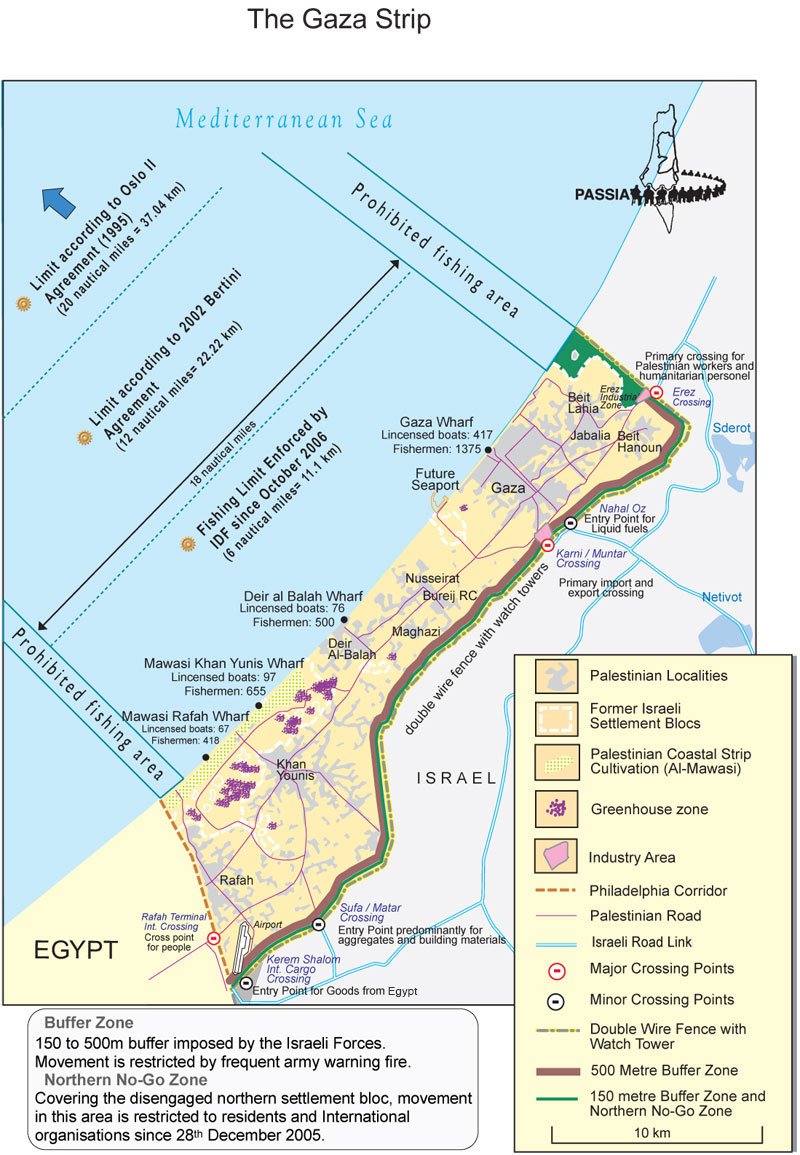
gaza_2007_map_correct_PASSIA

Jesse Rosenfeld reports from Shejaiya, the Gaza City neighborhood that bore the brunt of yesterday’s shelling. Residents tried to evacuate but didn’t have many options:

Magdin Ayad, 26, standing with her seven children in front of a shuttered store on the edge of Al Shejaiya, doesn’t know where she can go. “We will just sit and wait,” she said amid the routine boom of exploding tank shells. With all her family also fleeing from the district, her only option is to join the hundreds seeking safety at Gaza City’s Al Shifa hospital.

Although strained and running out of supplies, the hospitals are the sole sign of any functioning civil institutions. There is a constant flow of ambulances bringing in wounded while doctors scurry to save them. Hamas spokesmen stand by the hospital gates and denounce the attack on Al Shejaiya as a massacre and vow to fight on. It’s the only place to get official government comment in Gaza and a handful of guards are the only security forces to be seen.

But there’s no seeking shelter at the Wafa hospital, which has been repeatedly bombed:

Since the beginning of the war, Israel had been calling the al-Wafa rehabilitation hospital in eastern Gaza telling them to evacuate ahead of a scheduled bombing, according to the hospital’s executive director Basman al-Ashi. The Israeli military says it was attacking military targets nearby. Many of the patients at al-Wafa are severely disabled or paralyzed, unable to move. The staff refuses to leave.

The fourth floor of the hospital was first shelled on Tuesday, and several times after that. Doctors moved the patients to the first floor to withstand the assault. Around 8:30 p.m. on Thursday, they received another call from an Israeli officer telling them to evacuate. Again, they refused. Minutes later, the attack began with artillery shells crashing into the fourth, third, and second floors.

“The electricity went out, all the windows shattered, the hospital was full of dust, we couldn’t see anything,” says Aya Abdan, a 16-year-old patient at the hospital who is paraplegic and has cancer in her spinal cord. She is one of the few who can speak. Many of the other patients are comatose.

Telling a hospital to evacuate or be bombed is what Israel has descended to. That the Israelis need to harden themselves in the face of such slaughter from the skies does not remove the stain. In some ways, it intensifies it. The rhetoric of Israel and its reliable supporters reflect this fact. They have to assign responsibility to Hamas for every child they kill. The alternative – the truth – is too painful for them to absorb. And so the dehumanization intensifies.

Zack Beauchamp captions the map above, which illustrates how trapped the Gazans are:

There’s a serious Israeli blockade of Gaza. You’ll notice Israeli fences, boundaries, and supervised crossings all around Gaza. Israel heavily controls the flow of goods through these channels, including food, medicine, construction materials, and the like. The [stated] reason it does that is to limit Hamas’ ability to resupply itself militarily; for instance, Hamas and other militant groups often home-build rockets that get fired into Israeli towns and cities. These restrictions also severely affect civilians. To deal with the military and civilian effects of the blockade, Hamas built well over a thousand tunnels out of Gaza — mostly into Egypt. Israel’s stated reason for the ground incursion into Gaza is shutting down tunnels into Israel built for attacks, but it also may want to shut down Hamas supply tunnels into Egypt.

The Best Of The Dish This Weekend

Tensions Remain High At Israeli Gaza Border

There are times, I suppose, when our weekend reflections might seem out of place in a busy, bruising, secular world. And that might have seemed all the more true these past two summer days, thick as they have been with the hubris of Putin, the nihilism of Hamas, and the collateral massacre of the innocent that is happening in Gaza, as I write these words.

But I would offer a mild disagreement. When there is nothing you or I can actually do about the disgusting criminality of the Russian separatists and goons in Eastern Ukraine, or the cynical, smug Hamas theocrats lobbing useless rockets, or the persistence of the Israeli military past the corpses of dozens of children, we can nonetheless find ways to live among it. It says so much more about the civilizing skepticism of Montaigne, for example, that he was making the case for doubt as the religious wars of absolute certainty were getting underway in his own country and beyond. It speaks to me, at least, that a Muslim cleric could also make the case, during Ramadan, that

oppression attempts to strip the oppressed of their rights and dignity; whereas oppressing strips the oppressor of their very own humanity.

He wasn’t referring to Israel’s endless mowing of the human lawn, but he surely might have. It helps too, I’d argue, to counter the more high-minded counterpoints to the horror to remember that war-makers are seeking peace as well, in their own way:

People who choose to participate in military action are more likely to be altruists than egotists: they are prepared to sacrifice their own lives for the sake of something that transcends them, such as their country or their religion, or socialism, secularism or democracy, or a world where peace and tolerance will reign in perpetuity.

What is Zionism if not a utopian desire for a peaceful, promised land – a desire now etched for ever in the blood and bitterness of so many – and that you see today in the bloodied tears of the Israeli soldier above?

This weekend, we further explored what makes life worth living – in the acerbically honest poems of Deborah “working girl” Garrison; in sex after sixty (I think); of sex between races – perhaps the best rebuke one can make to war between Jews and Muslims; in an escape from reality like Burning Man, seen here from a drone above – or in a post-acocalyptic Eden in Vanuatu. It was fitting too as children were blown apart by bombs, that I spent hours today reading a terrific book about Montaigne (the book club discussion is imminent – buy the book here), whose sanity and spirit reaches us across the centuries, and helps keep me sane, and even happy, although I am simultaneously distracted and distraught.

The most popular post of the weekend was A Game-Changer For Ukraine; followed by The Oldest Depiction Of Sex On Record.

This last week was the most trafficked since February; and brought in the most new subscribers in the same period. Join the 29,616 subscribers here. Or if a friend has a birthday coming up, buy a gift subscription here.

And see you in the morning.

(Photo: An Israeli soldier weeps at the grave of Israeli Sergeant Adar Barsano during his funeral on July 20, 2014 in Nahariya, Israel. Sergeant Barsano was killed along with another IDF soldier on the twelfth day of operation “Protective Edge,” when Hamas militants infiltrated Israel from a tunnel dug from Gaza and engaged Israeli soldiers. By Andrew Burton/Getty Images)

Quote For The Day II

Tensions Remain High At Israeli Gaza Border

“Gaza is part of our Land and we will remain there forever. Liberation of parts of our land forever is the only thing that justifies endangering our soldiers in battle to capture land. Subsequent to the elimination of terror from Gaza, it will become part of sovereign Israel and will be populated by Jews. This will also serve to ease the housing crisis in Israel. The coastal train line will be extended, as soon as possible, to reach the entire length of Gaza.

According to polls, most of the Arabs in Gaza wish to leave. Those who were not involved in anti-Israel activity will be offered a generous international emigration package. Those who choose to remain will receive permanent resident status. After a number of years of living in Israel and becoming accustomed to it, contingent on appropriate legislation in the Knesset and the authorization of the Minister of Interior, those who personally accept upon themselves Israel’s rule, substance and way of life of the Jewish State in its Land, will be offered Israeli citizenship,” – MK Moshe Feiglin, outlining a future for Gaza that will also surely, eventually, after another provocation, be applied to the West Bank.

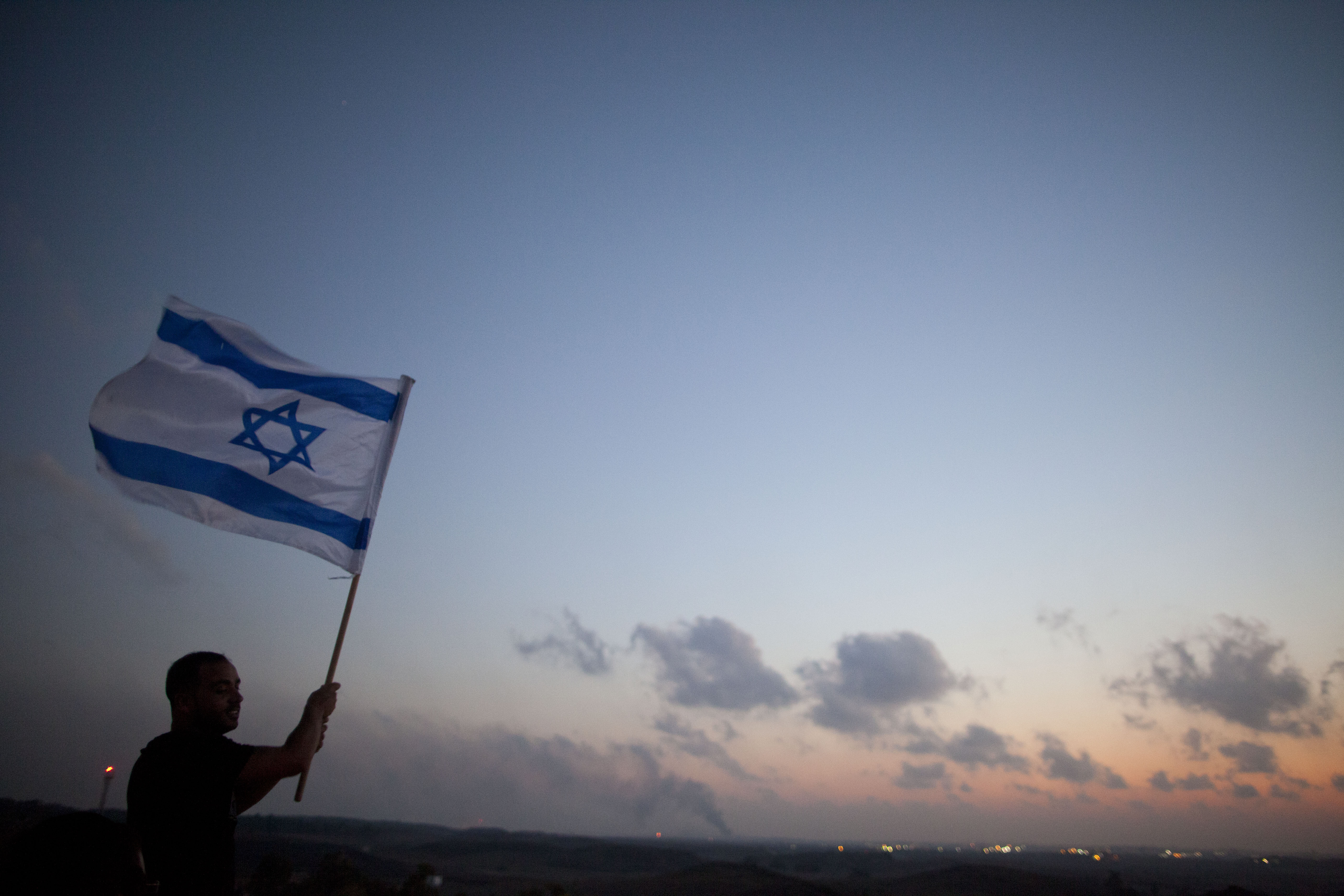
(Photo: A man stands with an Israeli flag on a hill overlooking the Gaza Strip on July 20, 2014 near Sderot, Israel. By Lior Mizrahi/Getty Images.)