The Deadliest Day Yet

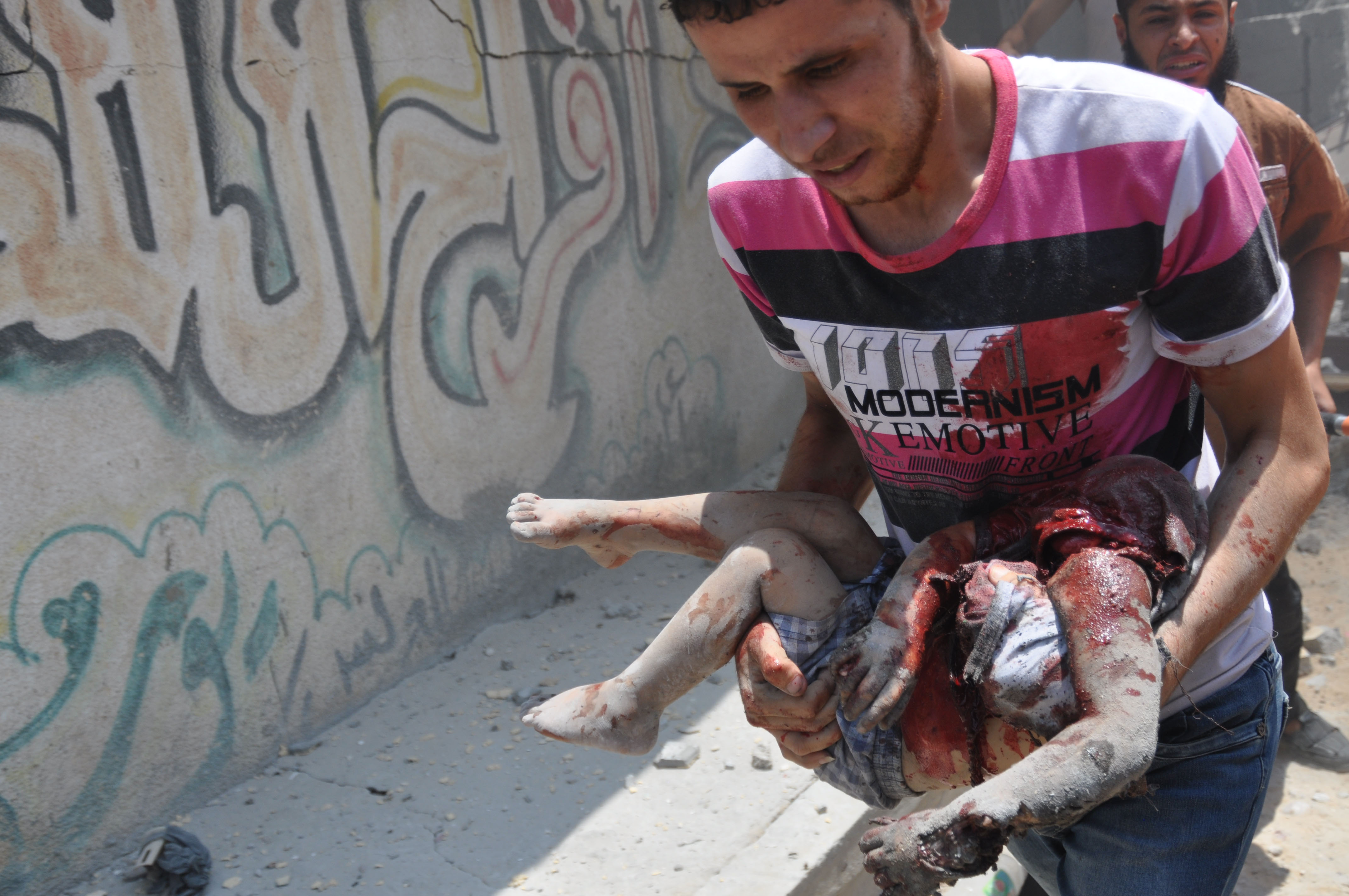
Shujaya neighborhood of Gaza full of dead bodies

(Photo: Paramedic team and few journalists access the Shujaya neighborhood of Gaza during the two-hour humanitarian ceasefire proposal from the International Committee of the Red Cross which was accepted by Israel on July 20, 2014. People frantically attempted to to pick up the dead and the wounded in the blood strewn area while plumes of smoke from the recent Israeli shelling lingered in the air. By Mahmood Bassam/Anadolu Agency/Getty Images)

Who Is Putting Gazan Lives At Risk?

PALESTINIAN-ISRAEL-CONFLICT

Philip Klein flags an UNRWA statement about rockets its relief workers found stored in a vacant Gaza school, offering it as proof of Hamas’s disregard for the lives of Gazans:

UNRWA said it had taken steps to have the weapons removed. As I noted on Wednesday, the fact that Palestinian terrorists store and fire rockets from schools, hospitals and residential areas increases the likelihood of civilian casualties.

But does that justify bombing the school? Max Fisher thinks not:

Israel has overwhelming military superiority in the conflict, and while that does not make Hamas rockets disappear or obviate their very real effects on Israeli civilians, Israel is strong enough to choose not to bomb a mosque and a center for the disabled in Gaza, as it did on July 12. It can choose not to bomb Gaza beaches frequented by civilians, as it did on Wednesday, killing four boys between the ages of 9 and 11. …

This is the one thing that both Hamas and Israel seem to share: a willingness to adopt military tactics that will put Palestinian civilians at direct risk and that contribute, however unintentionally, to the deaths of Palestinian civilians. Partisans in the Israel-Palestine conflict want to make that an argument over which “side” has greater moral culpability in the continued killings of Palestinian civilians. And there is validity to asking whether Hamas should so ensconce itself among civilians in a way that will invite attacks, just as there is validity to asking why Israel seems to show so little restraint in dropping bombs over Gaza neighborhoods. But even that argument over moral superiority ultimately treats those dying Palestinian families as pawns in the conflict, tokens to be counted for or against, their humanity and suffering so easily disregarded

Both sides are putting innocent Gazan lives at risk. And Israel cannot grotesquely pin the deaths of, say, those four boys, or countless others, on Hamas. Omar Baddar adds that the question of who is using “human shields” is also not as clear as Israel would like it to be:

While human rights organizations haven’t yet addressed “human shields” allegations in the ongoing round of Israel-Gaza violence, they did after the 2009 round when Israel killed at least 773 Palestinian civilians, compared to three Israeli civilian casualties (a ratio of 257:1), and used the same “human shields” argument to deflect responsibility for those deaths. When the dust settled, Amnesty International investigated the matter and concluded that there was “no evidence that [Palestinian] rockets were launched from residential houses or buildings while civilians were in these buildings.” …

By contrast, the same report found that “in several cases Israeli soldiers also used [Palestinian] civilians, including children, as ‘human shields’.” Going back in time just a little further to put this into context is important: when the Israeli Supreme Court ruled in 2005 that the Israeli military had to stop using Palestinian civilians as human shields, the Israeli “defense” establishment objected to the ruling. The appeal against the ruling failed, and the practice remains technically illegal, but Israel implicitly encourages it to continue by offering an “inadequate … slap on the wrist,” as Human Rights Watch put it, to Israeli soldiers caught using this reprehensible tactic.

Christa Case Bryant and Ahmed Aldabba examine why Gaza doesn’t have bomb shelters like Israel does:

If Gaza’s leadership were able to replicate [Israel’s] civilian infrastructure, would it be able to achieve similar protection in the face of Israel’s military superiority? “If there is a direct [Israeli] hit … the shelter will not stand,” says Lt. Col. Avi Bitzur (res.), former head of the Israeli military’s fortifications branch. “If [the munitions] will fall next to the shelter, it can stand against it.”

From an urban planning perspective, it would be feasible to build an extensive network of civilian shelters in Gaza despite the outdated infrastructure, says Bitzur, who now serves as deputy head of Homefront Defense Studies at Beit Berl College.  But financially it is unworkable, he says. “It’s too much expense, too much to do it now. You cannot give now a shelter for 1.5 million people,” he says, estimating that it would require billions of shekels and at least five to six years.

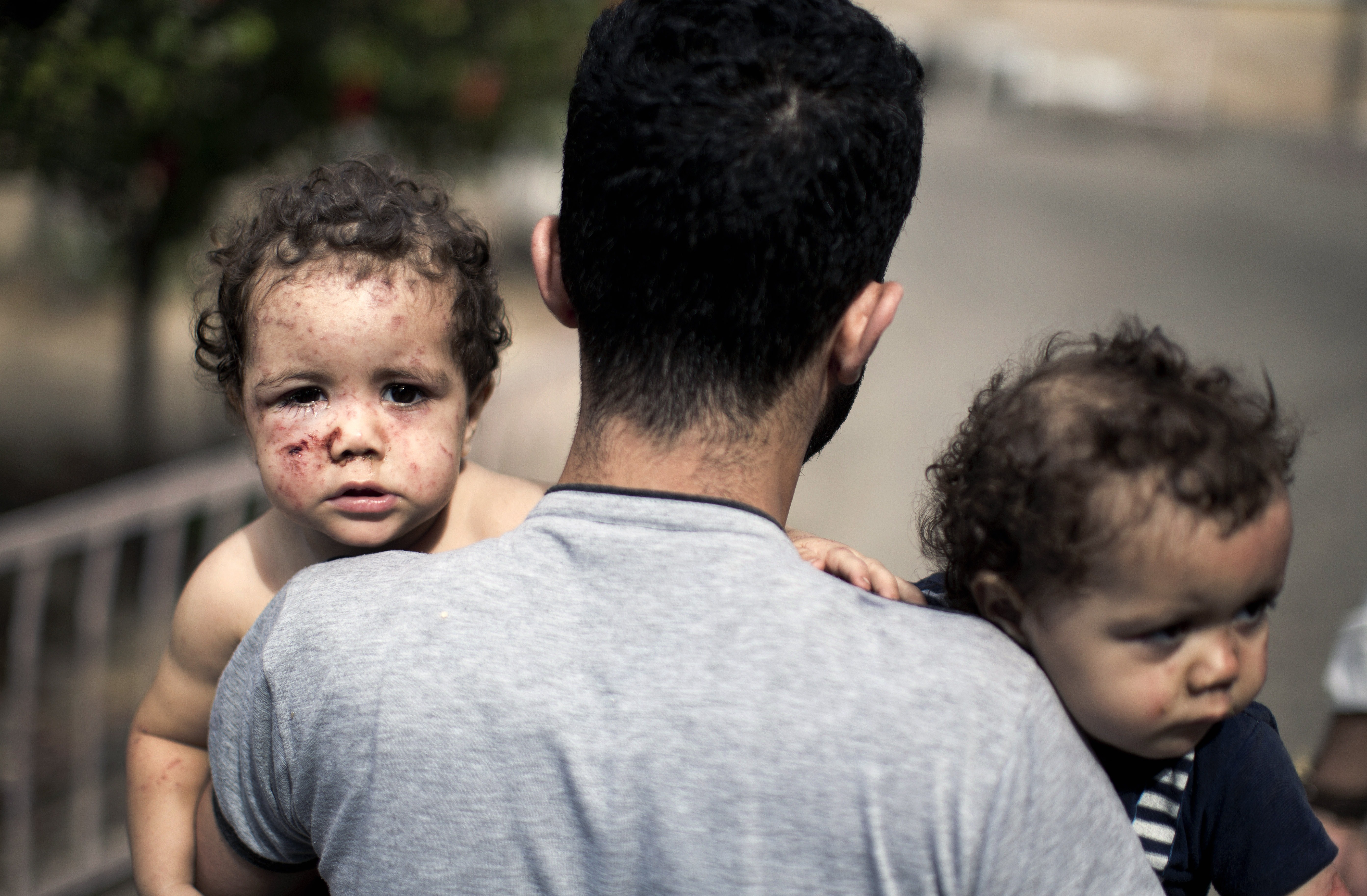
(Photo: A Palestinian man holds his daughters, Shada and Lama al-Ejla, who were injured in an Israeli tank attack, as he leaves al-Shifa hospital on July 18, 2014 in Gaza City. Israel warned it could broaden a Gaza ground assault aimed at smashing Hamas’s network of cross-border tunnels, as it stepped up attacks that have killed more than 260 Palestinians. By Mahmud Hams/AFP/Getty Images.)

Culpability And Morality In Gaza

PALESTINIAN-ISRAEL-CONFLICT-FUNERAL

Emily Hauser reflects on these thorny questions:

Targeting enemy civilians is a war crime. Let’s not entertain any doubt about that. Hamas and other Palestinian militants have targeted Israeli civilians with rockets for years; the fact that these rockets are crude and their aim poor doesn’t mitigate the simple fact: Targeting civilians is a war crime. Trying to determine who “started” our current state of conflict is not quite so simple, though, unless we accept ideology as fact. For some Jews, the Palestinians started it by refusing to accept our nationalism as ascendant to theirs; for some Palestinians, the Jews started it, in precisely the same way.

If, however, we’re trying to uncover a chain of discrete events leading to the seemingly permanent state of war between Israel and Gaza, the waters are muddy. Did the latest round of rockets come in response to an IDF incursion, or the other way around? Did it start when Israel neutralized a terrorist infiltrator, or was that terrorist a farmer trying to gather crops? Both sides play into the provocation-response cycle, each conveniently forgetting that actions have consequences, often beyond those we first imagined.

Her bottom line:

I have lived under missile attack, and I have family under attack in the south right now. I do not for one moment doubt Israel’s right to self-defense. But even if we set aside the damage and forget the dead, if we remain incurious about the impact both might have on our enemy’s will to compromise – even if all we consider is sheer efficacy – how can we look at this history and believe that repeating past failures will keep the Jewish State safe? Are you safe now?

For Gobry, it is crystal clear that Israel has the moral high ground:

What I have not forgotten is the following: the State of Israel is a democracy with the rule of law and respect for human rights (yes, imperfect, unlike the United States and Europe, which, as we all know, are perfect); demonic hatred of Jews is a real and persistent fact of history and when left unchecked it always leads to atrocities; this demonic hatred is absolutely clearly distilled into the enemies of Israel; and most, most importantly this: if tomorrow Hamas, Hizbullah and other enemies of Israel dropped their weapons, peace would break out; if tomorrow Israel dropped its weapons, a genocide would break out.

There is, there can be, no moral equivalency. Sometimes there really are Good Guys and Bad Guys.

But not to Seumas Milne, who stresses the centrality of the occupation in driving the conflict:

The idea that Israel is defending itself against unprovoked attacks from outside its borders is an absurdity. Despite Israel’s withdrawal of settlements and bases in 2005, Gaza remains occupied both in reality and international law, its border, coastal waters, resources, airspace and power supply controlled by Israel.

So the Palestinians of Gaza are an occupied people, like those in the West Bank, who have the right to resist, by force if they choose – though not deliberately to target civilians. But Israel does not have a right of self-defence over territories it illegally occupies – it has an obligation to withdraw. That occupation, underpinned by the US and its allies, is now entering its 48th year. Most of the 1.8 million Palestinians enduring continuous bombardment in Gaza are themselves refugees or their descendants, who were driven out or fled from cities such as Jaffa 66 years ago when Israel was established.

Waldman argues that justifying Israel’s assault by referring to Hamas’s criminality is “no justification at all”:

It’s been said many times that no government would tolerate rockets being fired into its territory without a response, which is true. But those rockets do not grant Israel a pass from moral responsibility for what it does and the deaths it causes, any more than prior acts of terrorism have. In this as in so many conflicts, both sides—and those who defend each—try to justify their own abdication of human morality with a plea that what the other side has done or is doing is worse. We’ve heard that argument made before, and we’ll continue to hear it. But when we do, we should acknowledge it for what it is: no justification at all.

Actions are either defensible on their own terms or they aren’t. The brutality of your enemy makes no difference in that judgment. It wasn’t acceptable for the Bush administration’s defenders to say (as many did) that torturing prisoners was justified because Al Qaeda beheads prisoners, which is worse. And our judgment of Hamas’s lobbing of hundreds of rockets toward civilian areas tells us nothing about whether Israel’s actions in Gaza are right or wrong.

(Photo: A relative mourns during the funeral of Rani Abu Tawila, a Palestinian who was killed in an Israeli attack, on July 18, 2014 in Gaza city. Israel warned it could broaden a Gaza ground assault aimed at smashing Hamas’s network of cross-border tunnels, as it stepped up attacks that have killed more than 260 Palestinians. By Mahmud Hams/AFP/Getty.)

And The Beat Goes On

https://twitter.com/jetpack/status/490124421567635456

As Netanyahu vows a “significant expansion” of the ground offensive in Gaza, the WaPo’s live blog updates the body count so far:

Israeli forces launched a ground operation in Gaza Thursday night. Since then: 28 Palestinians and one Israeli soldier have died. This brings the Palestinian death toll to more than 260, with more than 2,000 injured. The Israeli death toll is at 2.

Emma Green digs deeper into how the toll of the conflict is measured and how that contributes to the media narrative:

Even the tallies of rockets fired and shelling exchanged aren’t simple: The numbers themselves are imbued with meaning. The New York Times has a running count of “the toll in Gaza and Israel, day by day“; aggression from Hamas is measured in “X rockets launched from Gaza,” while aggression from Israel is measured in “X targets struck by Israel.” The unit of measurement is the important part: Palestinian firepower is measured as discrete weapons, rockets that Hamas is intentionally hurling at Israeli civilians. Israeli firepower is measured in hits, which are called “targets” (not people, or houses, or “militants”). And yet the two numbers are placed side by side for comparison, implying clarity of fault, or even clarity of what’s happening on the ground in Gaza and southern Israel.

Gregg Carlstrom expects no breakthroughs anytime soon, partly because Hamas’s conditions for a ceasefire are unacceptable to Israel and Egypt:

Hamas has been clear about its demands since the conflict began: It wants Israel to lift the siege of Gaza, and to release the dozens of prisoners freed in the 2011 deal for captured Israeli soldier Gilad Shalit, who were rearrested this summer in the wake of the killing of three kidnapped Israeli teens. Neither of these demands, however, are politically viable. Members of Netanyahu’s government, including the hawkish Economy Minister Naftali Bennett, have demanded an end to prisoner swaps. And the military-backed government in Egypt, which labeled Hamas a terrorist organization and spent a year demonizing the Muslim Brotherhood, is unlikely to agree to open the Rafah crossing with Gaza.

Comparing the situation in Gaza to the US military’s experience in Fallujah, Iraq, in 2004, Juan Cole expands on his longstanding argument that Israel can’t achieve permanent “quiet” with force:

The Israelis cannot actually destroy Hamas or its capabilities as long as significant numbers of Palestinians in Gaza support it. That support is political, having to do with the organization’s role in at least trying to stand up to Israeli oppression, occupation and blockade. Just as the enemies of the US ultimately prevailed in Falluja, so the enemies of Israel will prevail in Gaza.

Oppression and occupation produce resistance. Until the oppression and the occupation are addressed, the mere inflicting of attrition on the military capabilities of the resistance will not snuff it out. Other leaders will take the place of those killed. If Israel really wanted peace or relief from Hamas rockets, its leaders would pursue peace negotiations in good faith with Hamas (which has on more than one occasion reliably honored truces). Otherwise, invading Gaza will have all the same effects, good and bad (but mostly bad) that the US invasion of Falluja had on Iraq.

The Best Of The Dish Today

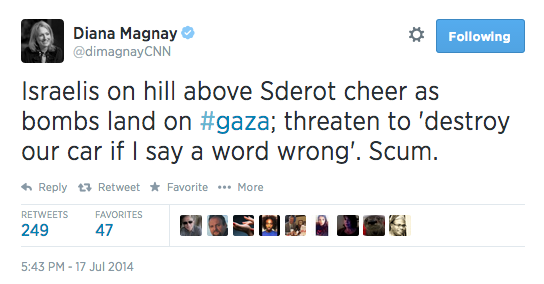
Dorsey Shaw flags the above video and notes that “a few minutes later, the reporter, CNN’s Diana Magnay, tweeted this and then deleted it about 20 minutes later:”

enhanced-31646-1405634778-17

She was right the first time. As if on cue, the US Senate passed a resolution backing Israel’s new invasion of Gaza:

Sens. Bob Menendez (D-N.J.) and Lindsey Graham (R-S.C.) authored S.Res. 498, which reaffirms Senate support for Israel, condemns unprovoked rocket fire and calls on Hamas to stop all rocket attacks on Israel. “The United States Senate is in Israel’s camp,” Graham said on the Senate floor Thursday.

We knew that already, Butters. Only too well.

I have only two thoughts about the horrifying events in Ukraine. First, a prayer for the souls lost and their loved ones. Second, a provisional inference: If the plane was downed by the Russian separatists – as seems pretty obvious from the smoking gun audio – then Putin has just found out how reckless grandstanding can come back and bite you back in the posterior. It will change a huge amount in the fraught politics between Putin’s neo-fascist Russia and Europe. The new Tsar will soon have a choice: to keep lying and become an international pariah, or to back down and get a grip. I suspect he’ll keep lying … and quietly back down. But these are Thursday night conjectures. They may evaporate with more information by the morning.

You can read all our Ukraine coverage of today in one place here. And you can read all our coverage of the Gaza war in one place here.

We’re now at 29,550 subscribers. You can join them and help get us to 30,000 here – and get access to all the readons and Deep Dish – for a little as $1.99 month. Gift subscriptions are available here. A new Dishhead writes:

Just wanted to say I subscribed this evening for the first time. I discovered your blog a few months ago when that horrendous gay discrimination bill in Kansas blew over and was really impressed with the quality of the discussion, so I’ve stuck around since then, religiously reading the posts as they come in. After today’s one-two punch of the Israeli invasion of Gaza and the shooting down of the plane over Ukraine, coming here for the news is like night and day compared with the sensationalism of traditional media. Looking forward to scouring the Deep Dish in the weeks to come. Keep it up.

See you in the morning.

Will Israel Crush Hamas?

That appears to be the objective as IDF ground troops continue to infiltrate Gaza:

This morning’s reports that a cease-fire could occur by Friday morning are now looking much less likely. “The IDF’s objective as defined by the Israeli government is to establish a reality in which Israeli residents can live in safety and security without continues indiscriminate terror, while striking a significant blow to Hamas’ terror infrastructure,” the Israel Defense Forces said in a statement late Thursday, confirming it had begun a ground operation in Gaza.

“The prime minister and defense minister have instructed the IDF to begin a ground operation tonight in order to hit the terror tunnels from Gaza into Israel,” Benjamin Netanyahu’s office confirmed. “In light of Hamas’ continuous criminal aggression, and the dangerous infiltration into Israeli territory, Israel is obligated to act in defense of its citizens.” Casualties have already been reported.

Josh Marshall interprets this as a sign that Netanyahu has capitulated to his coalition’s right flank:

The backstory on the Israeli side has been a tug of war between the military chain of command and the government over whether to intensify the campaign in Gaza and whether to launch a ground invasion. The military, cognizant of 2009, has generally been trying to avoid an intensification of the campaign. And Netanyahu himself seems to have been generally siding with the generals, but with intensifying demands from members of his own government for a full out ground assault. As the rocket fire out of the strip has continued, the pressure to launch a ground invasion has escalated. That question now seems to have been answered.

While that may be the case, Yishai Schwartz argues, “the more likely explanation is that Israel just didn’t have any other options”:

Israel could have continued its aerial and artillery exchanges with Hamas, but this campaign did not appear to be damaging either the will or the capability of Hamas. It could have loosened its rules of engagement and struck Hamas more effectivelybut doing so would have inflicted unconscionably disproportionate civilian damage. It could have capitulated to Hamas’s ultimatums to release hundreds of security prisoners and reopened Gaza to shipments of arms- and tunnel-making materials. Apart from the moral implications of such a concession, doing so would simply have strengthened Hamas and ensured additional fighting. An extended cease-fire would be ideal. But so far, Egyptian attempts to broker such a cease-fire seem to have fallen on deaf ears. So Netanyahu was left with a choice that wasn’t really much of a choice.

Fred Kaplan believes Israel is no longer thinking strategically:

[L]et’s say an invasion crushes Hamas, a feasible outcome if the Israeli army were let loose. Then what? Either the Israelis have to re-occupy Gaza, with all the burdens and dangers that entails—the cost of cleaning up and providing services, the constant danger of gunfire and worse from local rebels (whose ranks will now include the fathers, brothers, and cousins of those killed), and the everyday demoralization afflicting the oppressed and the oppressors. Or the Israelis move in, then get out, leaving a hellhole fertile for plowing by militias, including ISIS-style Islamists, far more dangerous than Hamas.

Either way, what’s the point?

Mataconis speculates:

This could simply be a relatively small operation on Israel’s part designed to maximize the gains it has made against Hamas in the current conflict before a cease fire takes hold. That is not an uncommon tactic in war, of course, so it would make sense if that’s what’s going on here. For the moment at least, though, there doesn’t seem to be any indication that the military is limiting its objectives in this operation, and Hamas seems to be fighting back as vigorously as they can. Given all that, I’d put the odds of a cease fire at any time in the [near] future as being pretty slim if not non-existent.

Indeed, ceasefire talks are going nowhere fast:

Earlier in the day, Palestinian Authority President Mahmoud Abbas and Arab League Secretary-General Nabil Al-Arabi conducted cease-fire talks in Cairo. The session was also attended by an Israeli delegation but it left after several hours of discussions. For the time being, Arab diplomats in New York were waiting to see whether talks in Egypt on a cease-fire progress before deciding whether to turn to the U.N. Security Council for help in stopping the fighting. “There is intense effort being made by President Abbas in Cairo in trying to finalize what would be a cease-fire,” said one Arab diplomat. “That’s where all the efforts are for the moment.”

Even if a ceasefire does takes hold, Ibrahim Sharqieh stresses, nothing will be resolved:

It is delusional to assume that when the current battle ends, both parties will return to their communities to resume normal lives. The Israeli-Palestinian conflict has created two meanings of normality. The 40,000 Israeli reservists who were called up this time will, for the most part, go back to their jobs and homes when the fighting ends. But Gazans, 39% of whom are unemployed, will go back to their “normal” lives under the brutal conditions of the Gaza blockade and be at the mercy of Israel’s rules about what type and quantity of food and other basics are allowed into Gaza. The Palestinians in the West Bank will go back to their daily humiliation of roadblocks and expanding Israeli settlements at the expense of their livelihoods. …

To prevent another tragic war in the future, things must change. Palestinians mainly need two things: dignity and bread. Israel must end the occupation in general and the Gaza blockade in particular. The mistake of the 2008 and 2012 mediation efforts was that they produced cease-fires that allowed the Israelis to go back to business as usual — but left the Gaza blockade intact and perpetuated untenable conditions, which led to further and bloodier fighting.

On The Ground In Gaza: Tweet Reax

https://twitter.com/jetpack/status/489863843749707777

https://twitter.com/SullyR_/status/489867655776845825

Western Values

Larison makes the case that Israel doesn’t really have such values anymore:

[Douglas] Murray … says that Israel “takes western values seriously and fights for the survival of those values,” but that seems to be almost exactly the opposite of what has been happening in Israeli politics over the last ten or fifteen years. Some of this may depend on what Murray wants to include as “Western values” and what he thinks it means to “fight” for them, but it would be fair to say that Israel under its last two governments has become increasingly illiberal domestically and even more heavy-handed in its dealings with its immediate neighbors. The occupation has become more entrenched than it was at the turn of the century, and support for a negotiated settlement with the Palestinians has dwindled significantly. If Murray is right that this is what being a “Western country” involves, then I suspect most people in the West would rather be something else.

And it’s not getting any better anytime soon. Recent research by Anna Getmansky and Thomas Zeitzoff forecasts that the political upshot of the current conflict will be to move Israel even further to the right:

In research that is forthcoming in the American Political Science Review, we use variation in the range of rockets from Gaza to Israel to estimate the effect of terrorism on voting in the Israeli elections from 2003 through 2009. During this period, the rockets’ range has continuously increased, allowing us to examine what happens to voters who come into the range of rockets from Gaza compared to similar voters who live outside that range. We find that the vote-shares of right-wing parties that typically oppose concessions to Palestinians increase by 2-7 percentage points among voters within range of rockets. We further argue that voters “reward” right-wing incumbents electorally even if rocket range increases while they are in office, because right-wing parties are perceived to be more competent in dealing with security threats. …

So what does the current round of violence mean for the future of the Israeli-Palestinian conflict following the recent round of violence? Our research as well as other studies would suggest a pessimistic outcome. Given the increase in the number of Israelis who are within the range of rockets, and the high number of Palestinian casualties, the recent round of fighting is likely to cause individuals on both sides to harden their attitudes towards each other, making a peaceful resolution of the conflict less likely.

And as Keating points out, Netanyahu is actually to the left of the most vocal members of his cabinet:

One aspect of the situation that’s gotten comparatively little attention is that hardline members of Prime Minister Benjamin Netanyahu’s Cabinet seem to be pushing the Israeli government toward a more aggressive campaign. Netanyahu is hardly pushing for accommodation, but the most aggressive political pushback he’s gotten during this campaign is from the right, not the left. Yesterday, Netanyahu fired his deputy defense minister, Danny Danon, a member of his own Likud party, for saying that the short-lived cease-fire yesterday had humiliated Israel. Netanyahu had faced heavy criticism in the Cabinet for accepting the Egyptian-proposed cease-fire, particularly from Danon, Foreign Minister Avigdor Liberman, and Economy Minister Naftali Bennett of the right-wing Jewish Home party.

Meanwhile, Yglesias flags a recent poll suggesting that neither the Israelis nor the Palestinians really want two states:

Strikingly, this conclusion that 27 percent of Palestinians and 35 percent of Israelis favor a two-state solution is likely an overstatement of the actual level of popular support. …

[T]he international community’s comforting image of a tragic conflict being driven by misguided extremists on both sides is somewhat obsolete. Mainstream opinion on both sides now shows a decided lack of enthusiasm for foreigners’ favored solution. Which by no means makes a Two-State Solution impossible — public opinion is somewhat malleable, a real peace treaty in the hand might seem more appealing than a hypothetical one, and even in democracies unpopular measures are enacted all the time. But it’s wrong to simply assume that if the current wave of violence dies down, the larger conflict will naturally proceed to resolution.

Perhaps that’s why Bernard Avishai hopes for a major American intervention in the peace talks:

What the Obama Administration seems unable to grasp, or finds inconvenient to admit, is that the peace process cannot just be paused; to say that the parties to the conflict must want peace more than Americans is to condemn them to leaders who, in the short run, benefit from conflict, and hand Americans, and everyone else, an insufferable future. Obama reiterated, this week, that the status quo is unsustainable. But what is he prepared to do about it, other than offer Kerry as a mediator? Kerry must persist in demanding a ceasefire, of course—but, if he gets one, he must seize the moment to finally publish an American plan for a larger peace.

Such a plan, endorsed by all world powers, can at least temporarily redeem Abbas’s leadership by giving hope—what Obama has called a “horizon”—to young Palestinians who, watching Gaza but not only Gaza, are thinking apocalyptically. Netanyahu says he will stop the operation when he can be assured of “quiet,” which sounds reasonable enough. But it is morally reckless to think that peace is the same thing as quiet, which can be purchased, if only temporarily, with intimidation.

Good luck. Read my take on the permanence of the Greater Israel project here.

(Update: A tweet that was briefly live on the post contained an image that was from Lebanon in 2006, not current day Gaza: “Israeli girls write messages such as “to (Hezbollah leader Sheikh Hassan) Nasrallah with love from Israel and Daniele” on shells destined for targets in southern Lebanon. Photo: Afp Ap”)