Understanding The Permanence Of Greater Israel, Ctd

fertility-620

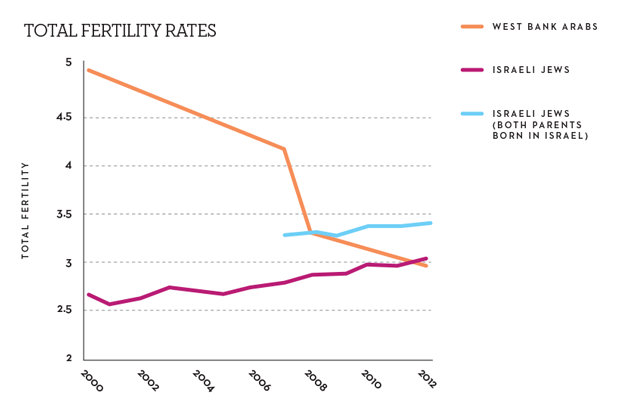
The great hope of many Israelis on the far right (which these days means the center) is that demography – far from forcing them to come to terms with the occupation – is actually the major impetus behind the de jure annexation of the entire West Bank. A recent piece in Tablet By David Goldman brings that into focus. Money quote:

Israel is the great exception to the decline in fertility from North Africa to Iran, as I argued in a 2011 essay for Tablet magazine. The evidence is now overwhelming that a Jewish majority between the Jordan River and the sea is baked in the cake. The CIA World Factbook estimates total fertility of Arabs in Judea, Samaria, and Gaza at just 2.83 in 2014, versus 3.05 in 2011. The total fertility of Israeli Jews, meanwhile, has risen above three children per female … Jewish immigration is consistently positive and accelerating, while Palestinian emigration, at an estimated 10,000 per year since 1967, is reducing the total Arab population west of the Jordan River.

Palestine Authority data exaggerated Arab numbers in Judea and Samaria by about 30 percent, or 648,000 people, as of the 1997 census. As Caroline Glick observes in her 2014 book The Israeli Solution, Jews will constitute a 60 percent majority between the river and the sea, and “some anticipate that due almost entirely to Jewish immigration, Jews could comprise an 80 percent majority within the 1949 armistice lines and Judea and Samaria by 2035.” Israel therefore has little fear demographically from annexation.

I’m not an expert so I cannot judge these demographic predictions. They seem somewhat dubious to me. But in some respects, that’s not the point. The point is that many Israelis, especially those in its current government, believe this scenario and at the same time see the vast upheaval in the Arab and Muslim world as a golden opportunity to achieve the radical Zionist goal from the very beginning: control of all the land between the river and the sea.

You saw this in Netanyahu’s brusque dismissal of the two-state solution as impossible because of the renewed threat of Jihadism unleashed by the Arab Spring and the Iraqi and Syrian civil wars. And that, on top of alleged demographics, is what fuels Israel’s otherwise baffling desire to settle the West Bank and East Jerusalem at the expense of any other objective. (Netanyahu was prepared to release scores of convicted murderers of Jews than remove one brick from Greater Israel’s foundations in Judea and Samaria.)

Far from encouraging the Israelis to make peace as soon as possible, the spiraling chaos in the Arab world has emboldened many to intensify and accelerate the settlements and the colonization, and to press the war against the desperate and isolated Hamas with cold-blooded dominance. Here’s how David Goldman sees it:

The inability of the Palestine Authority to govern, the inability of Hamas to distance itself from its patron in Tehran, and the collapse of the surrounding states eventually will require Israel to assume control over the West Bank. This time the Israelis will stay. Israel can’t rely on the PA to conduct counterterrorism operations against Hamas, its coalition partner. Israel’s border with the Hashemite Kingdom in the Jordan Valley, meanwhile, has become a strategic pivot. ISIS is now operating in strength at the common border of Israel, Syria, Jordan, and occupied Iraqi-Syrian border towns close to the common frontier with Jordan. Jordan’s own security requires a strong IDF presence on its western border.

When Israel absorbs Judea and Samaria—and it is a when, not an if—the chancelleries of the West will wag their fingers, and the Gulf States will breathe a sigh of relief.

The two-state solution is dead. Greater Israel is here to stay. And it’s just a matter of time before an American administration embraces it.

The Rank, Pathetic Failure Of Hamas

Gaza hospital strike by Israeli missiles

William Saletan argues that life under the Islamist militant group has been “disastrous” for Gaza:

Critics accused Israel of violating the laws of war in practice. But Hamas flouted those laws explicitly. It fired rockets on every city within reach, declaring, “All Israelis have now become legitimate targets.” Weapons launched by Hamas and its allies have hit citizens in Gaza. They’ve hit Palestinian homes and buildings in the West Bank. They’ve hit Gaza’s power lines twice, knocking out 20 percent of the strip’s electricity. All this while managing, with more than 1,200 rockets, to kill only one Israeli.

The vast majority of the damage in Gaza has been inflicted by Israel. Yet Hamas has contrived to make the carnage worse. It has encouraged Gazans to stand in the way of Israeli missiles. When Israel advised 100,000 Gazans to evacuate an area targeted for invasion, Hamas instructed them to ignore the warnings. It added: “To all of our people who have evacuated their homes—return to them immediately and do not leave the house.”

And these nihilist tactics aren’t getting them anywhere either. As Michael Totten remarks, “Hamas is losing and everyone knows it”:

That’s almost certainly the reason Hamas rejected the Egypt-proposed cease-fire agreement. So far it has accomplished practically nothing. A small band of serial killers on the West Bank managed to murder more Israelis a couple of weeks ago than Hamas can manage with its entire missile arsenal now. It’s pathetic, really, and must be extraordinarily humiliating.

The Middle Eastern habit of declaring victory after getting your ass kicked has a long pedigree. Egypt did it after losing the 1973 Yom Kippur War. North Korea built a hysterical propaganda museum in Cairo commemorating that make-believe victory, but at least that particular fantasy is based on something. The Egyptian army did well against Israel for the first couple of days even though it lost in the end. Hezbollah declared victory in the 2006 war despite the fact that entire swaths of its infrastructure were obliterated, but Hezbollah did inflict some serious damage and triggered a refugee crisis. Hamas couldn’t possibly base a victory boast on anything now.

Michael Koplow adds that Hamas’s leadership structure, such as it is, makes it hard for the group to negotiate an end to the crisis:

Hamas is an organization fractured between the Gaza leadership and the international leadership based in Qatar, and so it is unclear what it actually wants and who has the authority to make a deal. Signs point to Khaled Meshal following the military leaders right now than the other way around, and the military guys in Gaza appear to be averse to ending the fighting anytime soon. The atmosphere is very different now than it was in 2012, and while I will for the second time in a week emphasize that internal Palestinian politics are not my expertise, I have the sense that Meshal will be subject to the Gaza leadership’s veto on any deal he is involved in brokering. There is also the complicating factor of Gazans wanting a ceasefire and whether this will create any pressure on Hamas’s Gaza wing to at some point acquiesce.

They’re also likely to run out of rockets pretty soon:

Simply extrapolating the current tempo of operations on both sides would suggest that missile stocks in Gaza will be getting very low within a fortnight. However, that assumes that Israel is not running out of targets, as it did after only a week of Operation Pillar of Defence in 2012. The IDF says that it still has plenty of targets to work on, but the pressure to find more if the missiles keep on coming could yet lead to a limited ground assault. That is something Israel still wants to avoid. But the problems for Hamas and Islamic Jihad are more acute. They need to find a way of quitting while they retain some firepower, particularly as building a new arsenal of rockets will be much harder than before given the close security co-operation between the new al-Sisi government in Egypt and Israel. The military logic on both sides suggests that the end of this bout of fighting is not far off.

Previous Dish on Hamas’s objectives in the current conflict here.

(Photo:  Israeli air missiles hit al-Wafa Hospital, the rehabilitation center, which currently serves patients in Gaza city, Gaza on July 16, 2014. Following the strike, Hospital administrators moved all patients from the top floor. By Mohammed Talatene/Anadolu Agency/Getty Images.)

Inside The Mind Of Hamas

In an interview with Zack Beauchamp, Hussein Ibish offers his take on what the Gaza crisis means for the militant group’s strategic position:

Hamas has been desperately trying to get out of this morass that it’s found itself in; it really feels trapped and desperate. And they tried to foment trouble in the West Bank, and it didn’t succeed. They didn’t get anything out of the unity agreement, so it’s falling back on what it knows sometimes gets results — which is rocket attacks. What they are hoping for, this time, is concessions not from Ramallah or from Tel Aviv, but from Cairo, Egypt. I don’t think that most people understand that — it’s all about Egypt.

What Hamas can get can only come from Egypt. From Israel, they’re demanding the release of prisoners that were part of the shahid squad [a Hamas military group] that was arrested when Israel was pretending they didn’t know the teenagers were dead. Israel tracked them down and dealt Hamas a serious blow. Which is why Netanyahu isn’t so interested in getting into an artillery/aerial exchange with Hamas — the Israelis frontloaded their retribution. It was all done in the West Bank, before the bodies were found.

Allison Beth Hodgkins also views Hamas as having been backed “into a corner where it had to chose between the Russian roulette of escalation and irrelevance”:

It chose the former — a high stakes gamble to reclaim the mantle of resistor in chief on behalf of the struggle and shore up its tenuous stake in the Palestinian marketplace.

To a large degree, Shlomi Eldar gets it mostly right here when he says that Hamas’ main objective is to avoid looking like a defeated movement. What it really can’t afford to look like is a religiously conservative version of Fatah: weak, ineffective and seen as trading a continued hold on power for continued occupation. While the business of governing the fractious Gaza Strip has forced Hamas to make compromises in order to pay the bills and keep the sewage from overflowing, these compromises have required enforcing the November 2012 ceasefire on all the resistance factions in the strip. This is no easy task in good times (or not so bad times), but with the popular mood turning from generally irritated to downright irate, groups like Islamic Jihad, the PFLP and other new challengers smell blood in the water.

In light of this weakened position, Mitchell Plitnick advises the militants to cut their losses:

There simply isn’t an endgame that represents progress for Hamas. In 2012, when then-Egyptian President Morsi brokered an agreement, Hamas could claim a few minor concessions from Israel (which never really materialized once there was no pressure on Israel to follow through with them). There will be nothing of that sort here, but Hamas seems to be desperately clinging to the hope that it can extract something to base a claim of victory on.

That’s a terrible gamble. It is much more likely that the refusal to agree to a ceasefire is giving Netanyahu exactly what he wants: the chance to deliver a blow to a weakened Hamas regime in Gaza. Hamas has given Netanyahu the means to do this without having to overcome the global opposition that was apparent at the beginning of the current fighting.

The Growing Partisan Gap On Israel

partisan-mideast

Although Americans’ sympathies remain broadly on the side of the Jewish state, our views on the conflict are becoming more politically polarized:

73 percent of Republicans favor the Israeli side, compared to 44 percent of Democrats, and 45 percent of Independents. Moreover, this partisan gap has widened considerably since 1978, when the gap between Republicans and Democrats was only 5 percentage points.

Flagging the same poll, Ed Morrissey remarks that the dramatic increase in Republican support “may end up being worrisome to Israel in the long run”:

The US has a long history of bipartisanship when it comes to our alliance with Israel, even though some members of both parties have criticized it for various reasons. If this becomes another issue of partisanship testing, that will not benefit Israel, nor would it benefit our own politics.

On the other hand, every demographic in the survey has a plurality sympathizing with Israel by a wide margin. Even among the lowest levels of sympathy for Israel — liberal Democrats and religiously unaffiliated — the margins are double-digit at 39/21 and 36/20. There are substantial differences about the level of sympathy in the age demos, but not the balance of sympathy. The youngest demo, 18-29YOs, favor Israel 2:1 at 44/22, while among seniors it rises to 60/9.

Philip Klein adds:

Some political reporters like to talk about the “Sheldon Adelson primary” — of Republican candidates seeking the approval of the pro-Israel casino magnate. As the Pew poll shows, however, the whole idea of of an “Adelson primary” is a sloppy description of what’s happening within the GOP. In reality, support for Israel among Republican primary voters is broad and deep. A 77-percent to 4-percent issue among predominantly Christian conservatives is not representative of the party platform being overtaken by a small cabal of Jews. No Republican has a chance at the nomination if he or she is perceived as anything but a staunch supporter of Israel, and this goes far beyond Adelson.

But that means, of course, further enabling of Greater Israel’s maximal goals, and an ever-spiraling antagonism with much of the Muslim world. And you wonder why I’m resigned to an endless war.

Quote For The Day

“Gaza … is a maximum-security facility. It is difficult to visit and impossible to leave. We allow in essential food, water, and electricity so that the prisoners don’t die. Apart from that, we don’t really care about them—that is unless they approach the prison fence, or the “forbidden” perimeter, where anyone who wanders too close is shot, or if they try to throw something over the fence. Indeed, they occasionally throw some homemade bombs made of things they’ve managed to smuggle into prison, and when they fall on our heads, it is really unpleasant. So we send our snipers to the watchtowers built around the prison and shoot them like fish in a barrel until they calm down. And when they finally do calm down, we cease firing because we are not the kind of bastards who shoot people for fun,” – Noam Sheizaf.

Arabs Care About Gaza This Week

GazaTweets

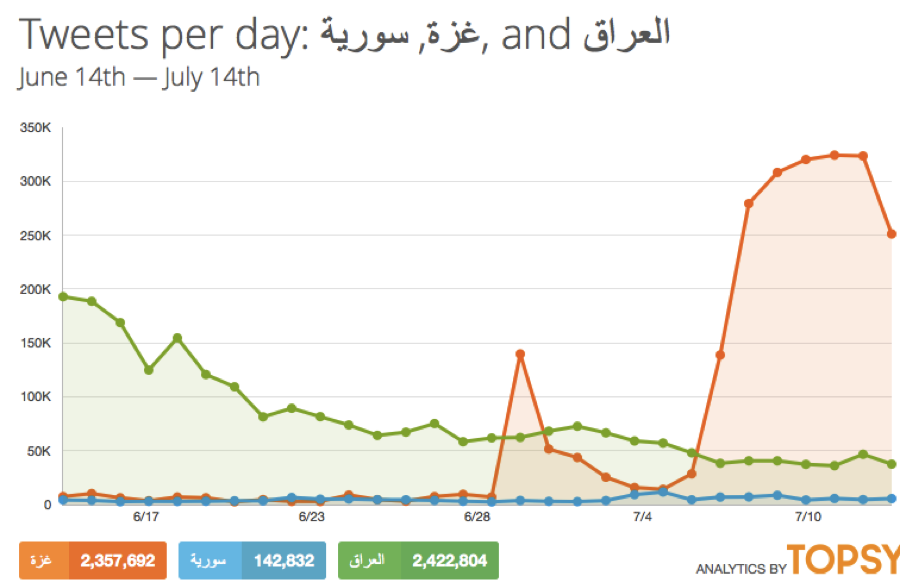
“Has the Palestinian issue really lost its centrality to Arab identity or did it retain the latent power to galvanize Arab attention?” Marc Lynch asks. To try and answer that question, he took a look at Twitter trends:

Syria (in blue), which in 2012 and early 2013 consistently generated millions of tweets per month in Arabic, shows a relatively low level flat line. The shocking developments in Iraq (in green) galvanized attention in mid-June, and Iraq continues to attract more attention now than does Syria. But Gaza, after being virtually ignored for a long time, surges to dominate everything else once the conflict begins. Score one for the “latent relevance” hypothesis.

That doesn’t mean that nothing has changed, of course. Arab publics remain intensely divided and frustrated, while Arab regimes remain intensely repressive and more fearful than ever of popular mobilization. Sectarianism remains rampantly virulent, and the regional campaign against the Muslim Brotherhood can’t help but affect public sentiment toward Hamas (especially in Egypt). The Gulf states and their media seem to be replaying 2006, when they tried to buy Israel time to finish off Hezbollah.

But one of the lessons of 2006 was the limitations of such efforts: Hezbollah garnered widespread, intense Arab support for its struggle against Israel despite the Arab media’s coverage and the sectarianism generated by Iraq’s civil war. The solidarity generated by the killing of innocent fellow Arabs by Israel tends to overwhelm political divisions, even among those who blamed Hezbollah then or blame Hamas today for the war.

23 – 1

Tensions Remain High At Israeli Gaza Border

As we enter yet another phase in yet another bombardment of Gaza, I find myself nodding my head to much of Roger Cohen’s latest column (he’s been on a splendid roll lately). Part of me doesn’t want to look or write about it, because there is little point. There is even less of a point in actually trying to defend the Palestinians or to express grief that so many are being killed by Western armaments.

Hamas has indeed made itself again a pariah – for its refusal of any cease-fire, for its desperate aggression with its hundreds of largely useless but still traumatizing rockets, and for its cynical preparedness to allow civilians to die in the rubble made by the Israelis, as they “mow the lawn” yet again. On this subject, the world is full of passionate certainty, and it is a fool’s errand to care.

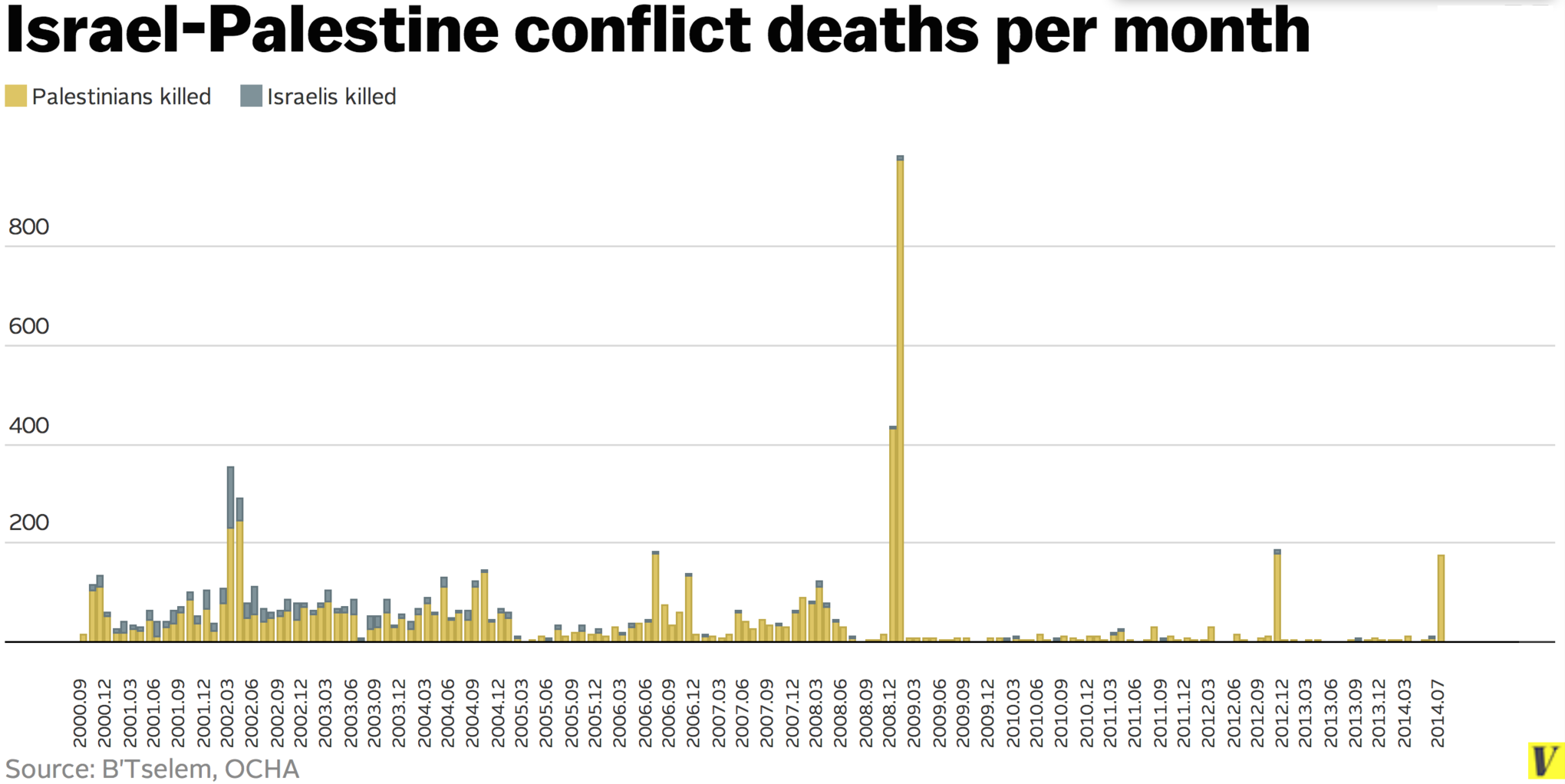
But I cannot help myself, because I do care. And, yes, I’m aware of the now-exhausted arguments about proportionality. We have gone over this once before in the 2009 Gaza war. But my view remains a relatively simple one: when one side has overwhelming military, economic and diplomatic superiority, it is not now and never has been a fair fight or a just war. And the fatalities on both sides prove that in staggering ways:

IP_conflict_deaths_total

Max Fisher notes that since January 2005,

when the conflict began to change dramatically, it has killed 4,006 people, of whom 168 have been Israeli and 3,838 Palestinian. That means that, since January 2005, only four percent of those killed have been Israeli, and 96 percent Palestinian. Since January 2005, in other words, the conflict has killed 23 Palestinians for every one Israeli it claims.

That is why when I hear Israeli outrage at the devastation of Israel’s security and peace by the latest Hamas offensive, it sounds to me like over-compensation. Yes, many are indeed traumatized by sirens and drills and rockets. I do not mean to minimize that or the Israeli deaths and injuries – but it is objectively infinitesimal compared with the living terror under which Gazans now live.

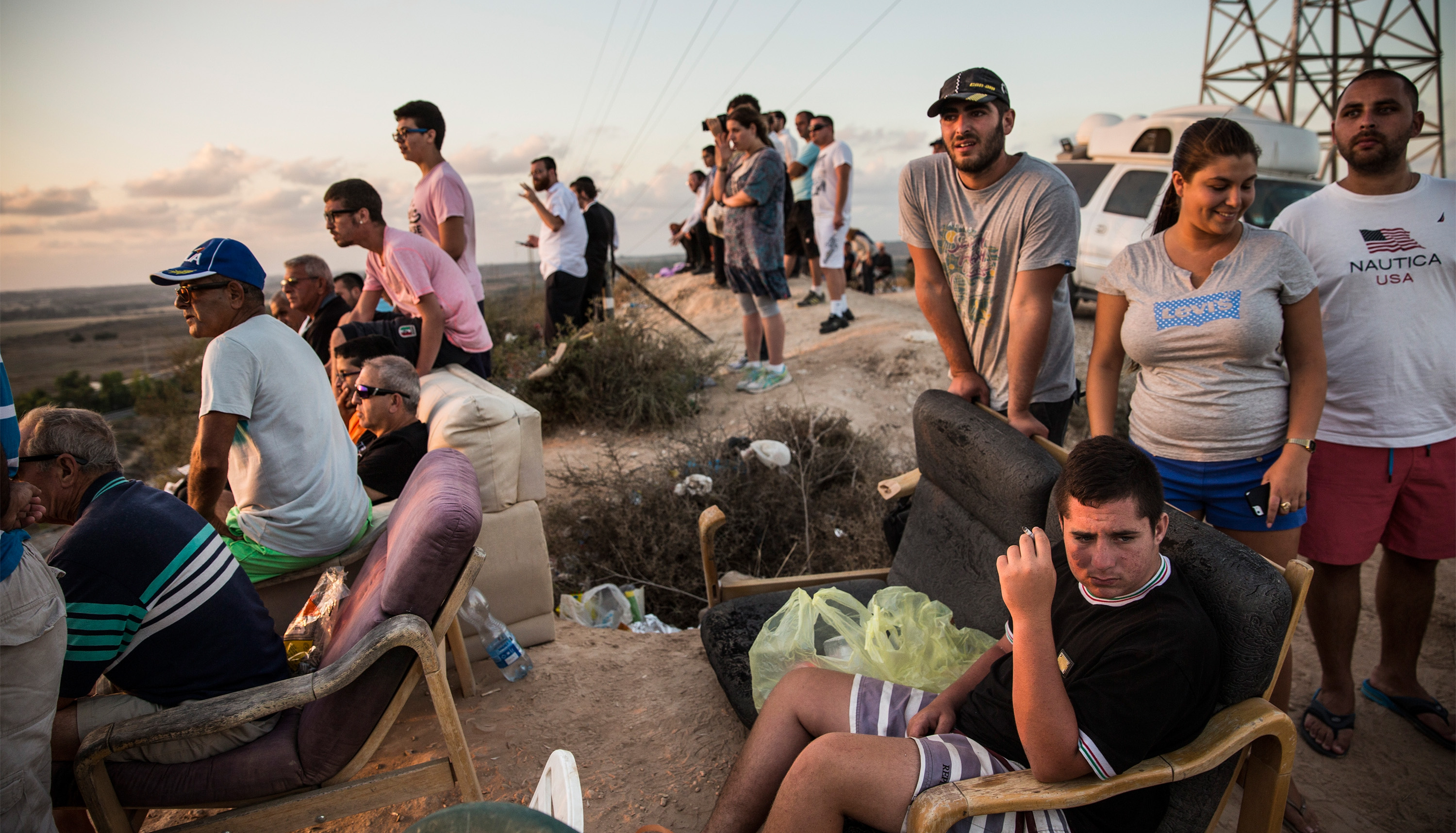
And look at the photograph above. Do these Israelis look terrified? They are watching Gaza get pounded into dust from a Sderot mountain. They’re within the rocket range, but they sure don’t look worried. They’ve brought chairs and beer and, yes, popcorn! Mackey has an excellent and devastating report on the atmosphere. When the sound of blasts occur, there is applause. And the same viewing parties happened in 2009, as children were being dragged out of rubble. Yes, Palestinians cheer Israeli deaths. But they have no power. To cheer even as you have overwhelming force and superiority tells you a lot about what has happened to the moral compass in Israel today.

There is also the question of rank ahistoricity in the coverage. Without an understanding of how Israel and Gaza got to this point, it is hard to put it in perspective. A reader puts it well:

Why is it that these seemingly now-routine flare ups of violence are treated as though they were unique situations? It’s always “they did this, so we responded” and an endless tit-for-tat follows until Hamas finally gives up. Rarely does there seem to be an appreciation of the consequences of having created an open-air prison on the West Bank with similar levels of control in Gaza.

I ask Goldblog and your dissenting readers, if not for these rocket attacks, are the Palestinians even relevant to the Israelis in any meaningful sense? The West Bank, in comparison to Gaza, has stayed relatively peaceful, but what does Fatah have to show for it? Ignorance of Palestinian suffering by the Israeli people, endless expansions of settlements, and lives utterly dictated by Israeli policy over which they have no influence. The Arab shopkeepers in Jerusalem staged a very visible protest and nobody cared. And now that Netanyahu has ruled out the possibility of a sovereign Palestine, they also have no future of their own. They are doomed to imprisonment forever, “state” or no “state.”

I keep returning to this article you posted by Max Fisher that early on remarks, “the occupation is wrong, it is the problem, and Israel is responsible.” I think this applies to Hamas’ futile rocket campaigns. I don’t believe that Hamas fires the rockets simply to raise the death toll, although that is probably part of the thinking there. Instead, I view this through the lens of street culture: they are firing these rockets for respect. The occupation is an endless line of indignities that Palestinians are subjected to every day, a fact that barely seems to register among Israelis, and Hamas is demanding they at least look them in the eye as they do it.

Returning to my earlier point, violence is the only case in which they are relevant to their captors, so they fire these rockets as a release, much as an ostracized kid will act out just to be noticed by someone else. They might be dominated in every sense by Israel, but they won’t be reduced to human livestock or a dehumanized “lawn” that must periodically be “mowed” to maintain an illusion of peace. Their lives may be completely dictated by Israel, but at least in this one case, they can defy that rule and be noticed for it – even getting the other side to admit their own powerlessness to truly stop it. Can Fatah claim to have ever gotten the Israeli government to admit defeat in any sense whatsoever? Hamas can.

And so the beat goes on …

Your Home Will Be Destroyed In One Minute

https://www.youtube.com/watch?v=waSPsI9-ge8

Adam Taylor passes along the above video of an Israeli “roof knock”:

“Knocking the roof” is the Israeli military practice of warning the residents of a building they are targeting that they should get out. Warnings can come via a phone call or a warning missile: In this case, the occupant of the house, Samir Nofal, received both, Watania reports. The practice has become one of the most controversial aspects of the current conflict. … When a specific building is due to be targeted, Israel may call an occupant, or fire a small missile at the building. That’s the final warning: Get out now, or you will die.

The Israel Defense Force (IDF) is open about this tactic. It recently released this video which includes a transcript of a phone call and a video of a “knock on the roof.” Despite the IDF’s apparent confidence in the tactic, critics see flaws. The phone calls show how much of Gaza’s communication networks are in Israeli control, for example, while others say that the “warnings” are not always followed up with an attack: A worrying tactic that might be considered psychological warfare.

Eyal Weizman calls the IDF’s warning shots an abuse of international law:

Israeli military lawyers argue that if residents are warned, and do not evacuate, then they can be considered legitimate collateral damage. Under this interpretation of the law, the civilian victims become human shields. This is a gross misuse of international law.  It is illegal to fire at civilians, even if the intention is to warn them. It is ridiculous to ask them to understand, in the commotion and chaos of war, that being shot at is a warning – and it is outrageous to claim that this is undertaken to save their lives.

International law should protect civilians. In Gaza, it is being abused in order to enable attacks where attacks should not be undertaken at all.

Update from a reader:

Quick note regarding the video about IDF “roof knocks” that you posted this afternoon; I am not invested in either side of the tragic conflict in any way, but it is worth mentioning that the video you posted has been edited. Watch the tree and the smoke at the 1:14 mark. I thought it worth pointing out.

Another is more skeptical:

That video is likely pure propaganda.  Watch the smoke start to billow out of the side window around the 1:11 mark.  Notice the bush gently swaying? Then a complete reset at the 1:16 mark.  Smoke is gone.  The lighting has even changed.  By the time the building goes, I’m not even sure any more that the entire thing wasn’t staged.

Dissents Of The Day

Many readers are upset over this post and our Gaza coverage in general:

Over the last few days I noticed you keep saying Netanyahu called for revenge. I assume that is based on this NYT editorial. I refer you to this rebuttal in TNR. If you have any other sources for that claim, could you please post them? I would also like to note that you have repeatedly stated as fact that the Israeli authorities knew the teenagers were dead, but that’s pure speculation. All they could know for sure is that they were shot. You also state as fact that the kidnappers weren’t Hamas, which is again speculation (not to mention that Hamas both encouraged kidnapping beforehand and approved of this one, publicly).

I’ve been reading your blog for years and generally enjoy it, but I have to say you seem quite emotional when talking about Israel. Now I have to go take a shower because you made me defend Bibi.

No, I’m not. I’m referring to Netanyahu’s out-of-context quote from Israel’s national poet, Haim Nahman Bialik, in the wake of the discovery of the bodies of the three Israeli teens:

The passage he chose came from a poem that Bialik penned shortly after the 1903 Kishinev pogrom, in which dozens of Jews were murdered in what today is Moldova. The line Netanyahu quoted — “Such vengeance for blood of babe and maiden hath yet to be wrought by Satan…” — is often interpreted today as promoting or heralding a fierce revenge for murder.”

The full poem undermines that feeling – but Netanyahu quoted only the inflammatory phrase. Another reader:

I’m starting to worry about you when I read things like this:

But what alternative do they have exactly, if they [Hamas] wish to have any military capacity at all? Should they build clearly demarcated camps and barracks and munitions stores, where the IDF could just destroy them at will?

Seriously?  Let’s back up a step. Why should Hamas have a military capacity and for what purpose? If they were responsibly governing their territory, they would have a military set up for defense of their borders and their people.  Quiet would be met with quiet, and the IDF would have no cause to attack Gaza. That’s not what’s happening.  Hamas takes every opportunity to smuggle in explosives, weapons, and rockets with the sole intent of attacking Israeli soldiers and civilians.  I’m no lawyer, so I can’t say whether Hamas’ attacks from civilian areas and it’s situating of military facilities around and under civilian buildings is a war crime, but it shows a shocking indifference to the welfare of the people it claims to represent.

I’m just arguing that, given Israel’s designation of the whole area as a terror state, no military capacity, defensive or offensive, would be permitted by Israel and so concealment in urban areas makes a horrible kind of sense. I don’t defend it, with its awful consequences for civilians. But I can see why it’s there – and it’s  too crude to say it’s there solely to get civilian casualties to put international pressure on Israel. That may be part of a horrifyingly cynical calculus, but it isn’t all of it. Another reader:

I am not a fan of Bibi, and I know that you don’t much like his government, as your current coverage of the conflict with Hamas clearly indicates. But you fail to cover some news items from the area that you willfully ignore.

Since the war with Gaza began – and that’s what it is, a war – Israel has permitted humanitarian aid to cross the border from Israel to Gaza. This includes medical supplies (including blood products), food, and fuel. Israel WARNS Gazans to get out of harm’s way before they strike. They have called off air strikes because of the apparent presence of non-combatants. You don’t mention any of this that I can see. Who ever heard of such a thing?! Can you imagine any other nation doing this?! Does the US drop leaflets on Afghanistan or Pakistan before going after Taliban fighters with drones? I doubt they ever even considered it.

Is it tragic that civilians are dying in Gaza? Of course. I may be naive, but I truly believe that if Hamas stopped firing rockets, Israel would stop the bombing raids. Why is it that in your eyes only Israel is not permitted to defend itself?! When I was in Israel last month, before the boys were kidnapped, rockets were falling on Southern Israel and Israel did nothing. I met some folks from Nitzan, a community in Southern Israel, who said that the rockets were landing almost daily, just south of their town and that they were very ticked at the government for doing nothing about it.

These folks were not your “Greater Israel” types. They just want to live in peace. But having rockets rain down on your neighborhood is unacceptable. I wouldn’t accept it and neither would you.

Unfiltered feedback from readers on our Facebook page.