A Short-Lived Ceasefire

A ceasefire in the Gaza war, proposed by Egypt, failed to take hold this morning after Hamas rejected it:

Israel’s security cabinet agreed to the terms of the deal after meeting early on Tuesday. … Palestinian President Mahmoud Abbas also welcomed the terms Egypt had set forward. However, Hamas, which recently formed a temporary unity government with its rivals in Abbas’ more moderate Fatah political party, said that it wasn’t consulted in the drawing up of the terms of the ceasefire. In a statement on the website of its armed wing, the Qassam Brigades, Hamas said the Egyptian initiative was one of “bowing and submission” and “was not worth the ink it was written with.” With that statement lodged, rockets continued to fire from Gaza into Israel.

Hayes Brown interprets this development:

The rejection of the deal places a new burden on Hamas to maintain public support among Palestinians for its actions. Hamas’ approval ratings have jumped wildly since it first came to power in 2006, with an April poll from the Arab World for Research and Development showing that only 20 percent of Palestinians hold a positive view of the group’s governance efforts. In the face of international condemnation for rejecting a possible ceasefire, and the Israeli government sure to capitalize on its own willingness to hold fire, Hamas will have even further to go to reach what it sees as an acceptable outcome for an escalation it arguably didn’t want at this moment.

But Avi Issacharoff insinuates that the ceasefire was meant to be rejected:

Soon after the Egyptian proposal was published, one Hamas spokesman, Fawzi Barhoum, announced “there will be no truce unless the demands of the military wing, and of the Palestinian people, are met.” Did that represent Hamas’s rejection of the proposal? That’s not clear — and won’t be until the spokesmen of the military wing, who are leading this conflict with Israel, have stated their position. But sources in the Strip told this reporter late Monday that the military wing has decided not even to discuss the Egyptian proposal. These sources said that Hamas is fuming over the process by which the Egyptian terms were brought to its attention — via the media.

Indeed, the leaking of the proposal to the Egyptian media, the fact that it ignores Hamas’s demands, and the further fact that it includes a nod to Israel via its similarities to the 2012 terms, must seem suspicious indeed to Hamas. Could it be that Jerusalem and Cairo hatched this move together, in order to corner Hamas?

And Mya Guarnieri stresses that a ceasefire means something very different for Israelis and for Gazans:

Israel is willing to return to the status quo, a status quo that serves Israeli interests. Sure there is occasional rocket fire from Gaza but Israel has the Iron Dome and, in the sparsely populated south of the country, the rockets usually fall in open spaces. The occasional rocket from Gaza actually helps Israeli hawks strengthen their case for continuing the “occupation” of the West Bank (an “occupation” that, in the wake of Netanyahu’s recent remarks, should be understood as a de facto annexation). The Israeli right points to the rockets from Gaza and says, “Look, we withdrew from Gaza in 2005 and all we got is rocket fire!”

Returning to the status quo also means that Israel strikes Gaza from time to time and kills Palestinian civilians there and in the West Bank without garnering much scrutiny from the international media and, by extension, the international community. Returning to the status quo would also mean an end to the immediate damage to Israel’s image caused by the horrific photos and footage coming out of Gaza, and global protests against what Israel calls “Operation Protective Edge.”

An outraged Ali Abunimah argues that as long as Israel maintains its crippling siege on the strip, it is Israel, not Hamas, that is rejecting an end to the violence:

Already, Prime Minister Benjamin Netanyahu stated that “If Hamas rejects the ceasefire, we will have international legitimization to restore the needed quiet.” That is a euphemism to kill more people, on top of the almost 200 Israel has already killed, the vast majority of whom civilians, including dozens of children. This systematic targeting of civilians and civilian objects, in intense bombardments of Gaza has continued since 7 July. Media are likely to follow the Israeli spin instead of asking Israel why it is maintaining the collective punishment of 1.8 million Palestinians in Gaza and why it constantly violates ceasefire agreements. But the fact remains: it is Israel that has rejected reasonable ceasefire conditions that have always been on the table.

But whether or not the Israeli spin is justifiable, it will probably work. Mkhaimar Abusada expects Hamas to do a deal eventually, if only to save face:

“Hamas feels that that if it agrees to this, it hasn’t achieved anything more that it achieved in 2012. They feel they’ve done much better in this round of fighting…and so we should get a much better deal in order to end the fighting,” says Abusada, who studies the Islamic movement. At the same time, he notes, the price that Hamas will pay for continuing to refuse a cease-fire is high: It will annoy the Egyptians, lose points with war-weary Gazans, and could eat away at the international sympathy that has built up for Gaza amid the horrifying footage of a death and destruction. “Hamas has not made its final decision, and is engaging in its own internal dialogue now,” Abusada adds. “My hunch is that Hamas is going to accept the cease-fire, eventually, because to say no to the Egyptians will cost them too much.”

Understanding The Permanence Of Greater Israel

Israeli air strikes on Gaza

My old sparring partner, Jeffrey Goldberg, has been busy pondering why Hamas has sent hundreds of rockets – with no fatalities – into Israel. He argues that it does this in order to kill Palestinians. It’s an arresting idea, and it helps perpetuate the notion that there are no depths to which these Islamist fanatics and war criminals will not sink.

It also helps distract from the fact that Hamas itself did not kill the three Israeli teens which was the casus belli for the latest Israeli swoop through the West Bank; that Netanyahu had called for generalized revenge in the wake of the killings, while concealing the fact that the teens had been murdered almost as soon as they had been captured; and that Israeli public hysteria, tapping into the Gilad-like trauma of captivity, then began to spawn increasingly ugly, sectarian and racist acts of revenge and brutality. It also side-steps the rather awful fact that this nihilist and futile war crime is all that Hamas has really got left.

Yes, they conceal armaments and rockets and weapons in civilian areas – and that undoubtedly increases civilian deaths. But what alternative do they have exactly, if they wish to have any military capacity at all? Should they build clearly demarcated camps and barracks and munitions stores, where the IDF could just destroy them at will? As for the argument that no democratic society could tolerate terrorist attacks without responding with this kind of disproportionate force, what about the country I grew up in, where pubs and department stores in the mainland were blown up, where the prime minister and her entire cabinet were bombed and some killed in a hotel? I don’t recall aerial bombing of Catholic areas in Belfast, do you? Or fatality numbers approaching 200 – 0? Democratic countries are marked by this kind of restraint – not by calls for revenge and bombardment of a densely populated urban area, where civilian casualties, even with the best precision targeting and warnings, are inevitable.

And there is, for all the talk of aggression on both sides, no serious equivalence in capabilities between Hamas and the IDF. The IDF has the firepower to level Gaza to the ground if it really wants to. Hamas, if it’s lucky, might get a rocket near a town or city. I suppose Israel’s reluctance just to raze Gaza for good and all is why John McCain marveled that in a war where one side has had more than 170 fatalities, 1,200 casualties, 80 percent of whom are civilians, and the other side has no fatalities and a handful of injuries, Israel has somehow practiced restraint. One wonders what no restraint would mean.

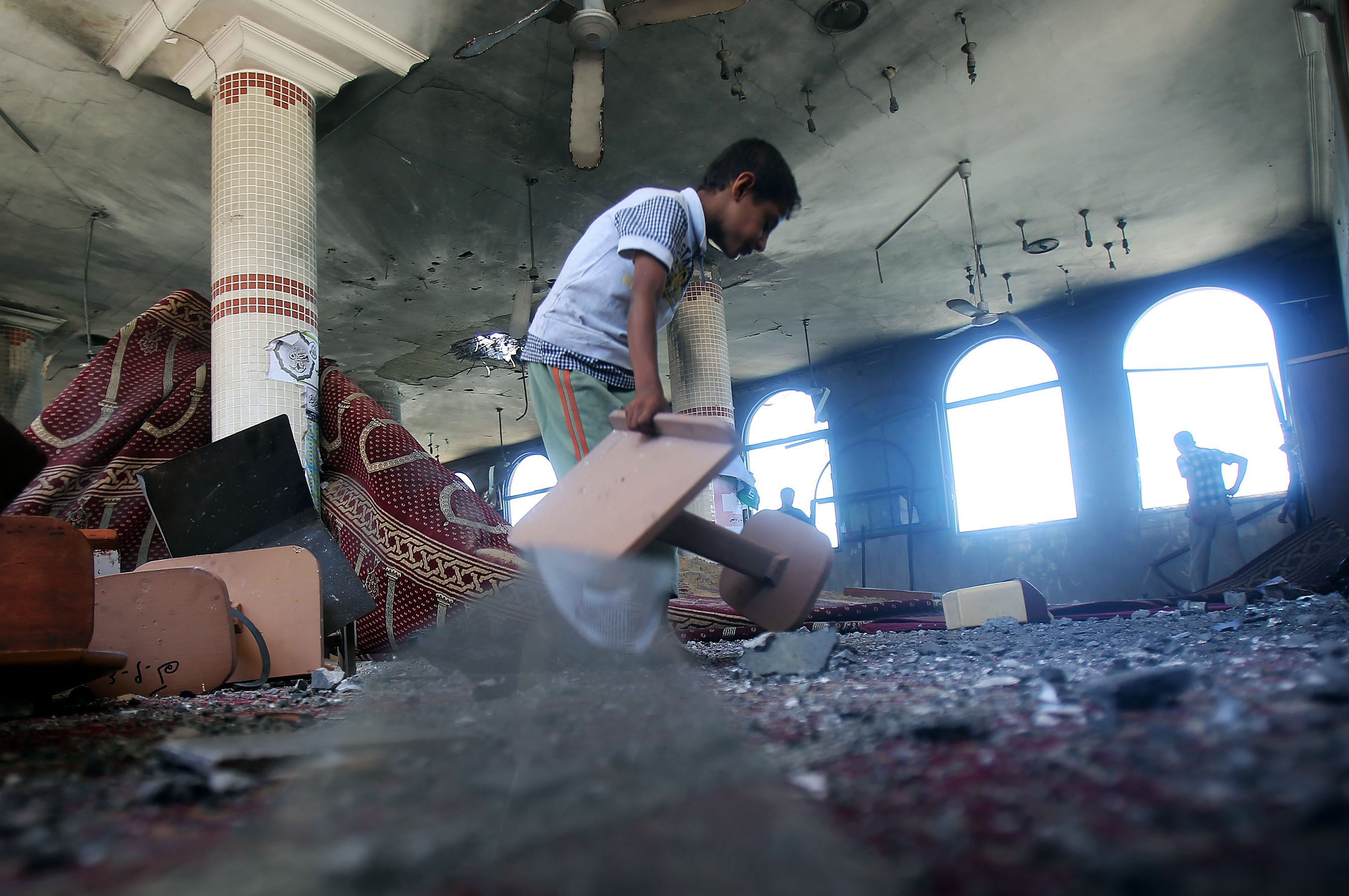
And look at the image above. Part of our skewed perspective is revealed by it. Imagine for a second that Hamas had leveled a synagogue. Can you imagine what Israel would feel justified in doing as a response? Or imagine if a Jewish extended family of 18 had been massacred by Hamas, including children? Would we not be in a major international crisis? At some point the lightness with which we treat Palestinian suffering compared with Jewish suffering needs to be addressed as an urgent moral matter. The United States is committed to human rights, not rights scaled to one’s religious heritage or race.

But this morning, as if to balance Hamas’s blame for every single death in the conflict, Goldblog feels the need to chide the Israeli prime minister for his “mistake” in having utter contempt for any two-state solution. “Mistake” is an interesting word to use.

It implies a relatively minor slip-up, a miscalculation, a foolish divergence from sanity. But it is perfectly clear to anyone not always finding excuses for the Israeli government that Netanyahu wasn’t making a mistake. He was simply reiterating his longstanding view that Israel will never, ever allow a sovereign Palestinian state to co-exist as a neighbor. And unless you understand that, nothing he has done since taking office makes any sense at all. Everything he has said and done presupposes permanent Greater Israel. And he is not some outlier. Israel’s entire political center of gravity is now firmly where Netanyahu is. The rank failure of the peace process simply underlines this fact. As do half a million Jewish settlers and religious fanatics on the West Bank. Which means that US policy is completely incoherent. Since the whole idea of a two-state solution is as dead as the infamous parrot, why on earth are Americans still pursuing it?

I think because many want Israel to be other than what it plainly is. They understand that this project of a bi-national state with Jim Crow segregation and disenfranchisement is a horrible fate. Jeffrey is as eloquent on this today as he has ever been:

If Netanyahu has convinced himself that a Palestinian state is an impossibility, then he has no choice but to accept the idea that the status quo eventually brings him to binationalism, either in its Jim Crow form—Palestinians absorbed into Israel, except without full voting rights—or its end-of-Israel-as-a-Jewish-state form, in which the two warring populations, Jewish and Arab, are combined into a single political entity, with chaos to predictably ensue.

But this is clearly the reality. The Obama administration was the last hope for some kind of agreement, and the Israelis have told the president to go fuck himself on so many occasions the very thought of accommodation is preposterous. With the acceleration of the settlements, and the ever-rising racism and religious fundamentalism in Israel itself, this is what Israel now is. And what it will always be. Anyone still assuming that a two-state solution is actually in the minds of the leaders of Israel is therefore whistling in the wind. One wonders simply how many Palestinians have to die and how much largess we must keep sending to Israel before that whistling eventually stops.

A reader adds:

This is what really put Israel’s occupation and settlement of the West Bank in perspective for me: Israel has possessed the West Bank for almost precisely the same proportion of its national existence as the United States has possessed Texas and California. About seven-tenths.  That is, Israel has occupied the West Bank for 71 percent of the time since national independence in 1948; the United States has possessed Texas and California for 69 percent of the time since national independence in 1776.

Imagine an American claiming that possession of Texas and California was not in some way fundamental to the character of the nation. Imagine if American border politics was predicated on the claim that possession of Texas and California was temporary and both would someday be returned to Mexican sovereignty. Preposterous! A United States without Texas and California would not be the United States anymore. Though it might keep its name, it would be a fundamentally different nation. Even more, the United States would first have to become an existentially different nation before it would even consider peaceably permitting California and Texas to leave the union.

Just so with Israel. Despite protestations otherwise, possession of the West Bank has become a fundamental and existential part of the character of Israeli nationhood. Possession of the West Bank is not temporary, it is not contingent, and it is not an exception to the general rule of the character of Israeli nationhood. Occupation and settlement are as central to the Israeli nation, its politics and culture, as burritos, Hollywood, and Sunbelt conservatism are to American politics, culture, and national identity.

And this was the vision of many of the Jewish state’s founders. To see what is in front of one’s nose …


For more of our ongoing coverage of this latest Israel/Gaza conflict, go here.

(Photo:  A Palestinian boy inspects the Al-Noor Mosque destroyed in air attacks staged by Israel army within the scope of “Operation Protective Edge” on July 14, 2014 in Deir Al-Balah district of Gaza City, Gaza. By Belal Khaled/Anadolu Agency/Getty Images.)

Gaza Gets Worse

The conflict continues to escalate, with Israel launching a ground offensive and warning tens of thousands of northern Gazans to flee in advance of a major assault:

An estimated quarter of the 70,000 residents of the town of Beit Lahiya in northern Gaza fled their homes early Sunday after Israel dropped fliers and made phone calls warning residents of upcoming attacks. The United Nations reported 17,000 Palestinians have registered in shelters. The warnings came after Israeli special forces briefly raided Gaza to destroy a suspected long-range rocket launch site. Meanwhile, rockets were fired from Syria and Lebanon into northern Israel. The rocket attack from Lebanon was the third such incident since Friday. No one has claimed responsibility for the rocket fire Monday morning, and no injuries were reported.

The death toll in Gaza, according to Hamas officials, stands at 172, with over 1,100 injured. Gregg Carlstrom believes the Israelis when they say they are out to destroy Hamas for good:

The Palestinian militant group is, in the estimation of Israeli officials, weaker than it has been in memory, and Israel senses the best opportunity it has had in a long time to permanently degrade or even eliminate Hamas as a political factor.

It’s not just that the Israelis are pounding Hamas from the air and rounding up senior Hamas officials; with help from their de facto ally across the border—Egyptian general-cum-dictator-cum-president Abdel Fattah el-Sisi—they have managed to keep Hamas’ supply tunnels to Gaza virtually shut down. Analysts estimate that the roughly $20 million per month that Hamas collected in tax revenues from the tunnels has been reduced almost to zero.

Based on their public statements, it’s clear that at least some Israeli hawks would like to do to Hamas what Sisi has done to the Muslim Brotherhood group from which Hamas once sprung: batter it into submission. Officials in Israeli Prime Minister Benjamin Netanyahu’s cabinet have gone further, talking openly of a campaign to eradicate the group. Even Hamas officials admit they are worried. “I would say that, yes, the situation is not ideal,” Osama Hamdan, the head of Hamas’ foreign relations bureau, told me. “It’s certainly not as it was a few years ago.”

But as Juan Cole is quick to point out, it won’t work:

With leaders killed and rockets depleted, the Israeli hard liners probably believe, Hamas may be fatally weakened. At the very least, it will be less able to resist future episodes of lawn mowing in Gaza. The theory behind this campaign, however, is incorrect. Hamas is perfectly capable of building more rockets, even if they are smaller and have less range than the imported ones. And killed leaders can be replaced by their cousins.

Natan Sachs, however, doubts Israel actually wants to eradicate Hamas:

Even if Israel were to enter Gaza with ground forces, it’s unlikely to try and topple the Hamas regime, for fear of the immense cost of such an operation to the local population and to Israeli troops. Instead, Israel prefers a weakened, deterred, but effective Hamas. With the tunnels from Sinai now closed, a hit to the Hamas stockpile stands some chance of lasting longer than previous attempts, since it would be harder for Islamists to replace the lost weaponry.

But even if its weaponry were degraded, Hamas’s motivation to prove “resistance” to Israel will remain. Most acutely, this round of violence has the potential to reinforce the unrest — which had subsided — in the West Bank and in Jerusalem. A full blown Intifada, possibly coupled with attacks from Lebanon or elsewhere, could make this round of violence seem tame by comparison.

Previous Dish on the crisis in Israel and Palestine here, here, and here.

The Best Of The Dish This Weekend

Germany Fans Watch 2014 FIFA World Cup Final

What Netanyahu really thinks:

“I think the Israeli people understand now what I always say: that there cannot be a situation, under any agreement, in which we relinquish security control of the territory west of the River Jordan.”

David Horovitz spells out what this means:

Not relinquishing security control west of the Jordan, it should be emphasized, means not giving a Palestinian entity full sovereignty there. It means not acceding to Mahmoud Abbas’s demands, to Barack Obama’s demands, to the international community’s demands. This is not merely demanding a demilitarized Palestine; it is insisting upon ongoing Israeli security oversight inside and at the borders of the West Bank. That sentence, quite simply, spells the end to the notion of Netanyahu consenting to the establishment of a Palestinian state. A less-than-sovereign entity? Maybe, though this will never satisfy the Palestinians or the international community. A fully sovereign Palestine? Out of the question.

The “peace-process” is and always was a sham. Greater Israel, if Netanyahu and his supporters have their way, will exist for ever. It seems to me that this is a fact that American policy should not have to absorb.

It was a shockingly beautiful weekend up here on Cape Cod – and I spent much of it playing with my dogs. The Dish was in a very upbeat mood as well: from Linklater’s remarkable new meditation on time and life to the truly promising possibilities of cognitive behavioral therapy; from Oliver Sacks’s LSD joys to Christopher Isherwood’s epiphany of awareness; from a celebration of the beauty and depth of the Latin Mass to two poems in awe of the English countryside in the summer.

Two more: the Christian-Buddhist meditations of Rowan Williams; and the deeper atheism of Friedrich Nietzsche.

The most popular post of the weekend was The Revenge Doctrine, Ctd, followed by Psyched About CBT.

See you in the morning.

(Photo: German fans celebrate as they watch the 2014 FIFA World Cup Finals at a nightclub on July 13, 2014 in Palma de Mallorca, Spain. By David Ramos/Getty Images.)

The Revenge Doctrine, Ctd

Funeral of a five-year-old child in Gaza

J.J. Goldberg reveals that the official story of what happened after those three Israeli yeshiva students were kidnapped is more hasbara than fact:

Once the boys’ disappearance was known, troops began a massive, 18-day search-and-rescue operation, entering thousands of homes, arresting and interrogating hundreds of individuals, racing against the clock. Only on July 1, after the boys’ bodies were found, did the truth come out: The government had known almost from the beginning that the boys were dead. It maintained the fiction that it hoped to find them alive as a pretext to dismantle Hamas’ West Bank operations.

What more do you need to know about the bigotry, callousness and hubris of Netanyahu? Well, this, maybe:

It was clear from the beginning that the kidnappers weren’t acting on orders from Hamas leadership in Gaza or Damascus. Hamas’ Hebron branch — more a crime family than a clandestine organization — had a history of acting without the leaders’ knowledge, sometimes against their interests. Yet Netanyahu repeatedly insisted Hamas was responsible for the crime and would pay for it.

So Netanyahu knew that the kidnapping wasn’t by Hamas proper, insisted that it was anyway, withheld the truth about the boys’ deaths in order to sustain a massive process of collective punishment of Palestinians in the West Bank, and then unleashed yet another brutal, lop-sided pulverization of Gaza. This is not a rational regime; and it is not a civilized government. J.J. Goldberg notes the Israeli military’s profound ambivalence about where Netanyahu is taking the country, along with the religious fanatics and racist haters who propel him forward.

And yes, yes, and yes again to the notion that Hamas should not be firing rockets into Israel at all, let alone at civilians directly, even though they have incurred no casualties and have bounced off the Iron Dome when they encroached too far into Israel proper. But in this instance, there is no equivalence. One side deliberately and deceptively instigated absolutely unjustified collective punishment of an entire population, and pre-meditatedly whipped up nationalistic and racist elements to back them up. They then went on to bombard Gaza – and many civilians – into another submission – after a period of relative calm and peace. The result is another disproportionate slaughter: around 100 Palestinians dead so far, and no Israelis. If you see nothing wrong with this, your moral compass is out of whack.

Meanwhile,  Obama and other world leaders have offered to broker a ceasefire, but Netanyahu has made it clear he’s not interested. An unnamed Israeli official tells Raphael Ahren that the goal of the bombardment this time is to permanently dismantle Hamas’s ability to strike Israel (didn’t they say the same thing last time?):

“It is quite possible that Hamas would agree to an immediate ceasefire — we’re hitting them hard, they want the situation to cool down,” the senior official told The Times of Israel, speaking on condition of anonymity. Brokering a ceasefire with Hamas would have been possible a week or a two ago, but an agreement that would leave in place the group’s offensive capacities not what Israel wants, the official said.

“Today, we’re not interested in a Band-Aid. We don’t want to give Hamas just a timeout to rest, regroup and recharge batteries, and then next week or in two weeks they start again to shoot rockets at Israel. Such a quick-fix solution is not something we’re interested in.” While refusing to discuss concrete steps the Israel Defense Forces plan to take in the coming hours and days, the official said that the government is discussing a ground invasion of Gaza “very seriously.”

Robert Naiman wants more US pressure on Israel to end the escalation:

The United States government has many levers on Netanyahu. Of course the U.S. gives Netanyahu billions of U.S. taxpayers’ dollars a year, but while it would be politically difficult (to put it mildly) to cut off U.S. military aid – the Obama Administration could not bring itself to cut off military aid to the Egyptian military coup, even when clearly required to do so by U.S. law – the Administration has many other, more subtle levers on Netanyahu that it could deploy without giving AIPAC, the ADL and their allies a convenient target for counterattack. The Administration could raise the volume of its public criticism of Netanyahu. The Administration could let it be known that it might refrain from vetoing a U.N. resolution that condemned Netanyahu. The Administration could “leak” that it is deepening efforts to engage Hamas politically, then issue a non-denial denial when these efforts are criticized. The Administration knows full well that it has all these levers and more. All it lacks is sufficient public political pressure to use them to force an end to the killing.

Au contraire. Most of the political pressure will come from those defending this latest slaughter built on a knowingly false pretext. Know despair.

Update from a reader:

I’m an American currently spending the month in West Jerusalem with my family.  Look: I’m no fan of Netanyahu or the current right-wing coalition here. I’m still trying to understand the implications of the government’s withholding of the information that the three teenagers were likely killed immediately after abduction. But when you say that the rocket fire from Gaza has caused “no casualties” in Israel, this is untrue. For example:

Following a barrage of rocket fire targeting southern Israeli cities, a rocket launched from Gaza hit a fuel tank near a gas station in Ashdod, causing severe damage and a fire. One person was critically injured by the strike, while seven other Israelis were lightly injured, according to Magen David Adom.

Granted the level of casualties is far lower than what we’re seeing on the Palestinian side, but it’s not “no casualties” on the Israeli side.

And when you say that rockets “bounced off the Iron Dome”, you are wrong both figuratively and literally.  Iron Dome only intercepts rockets bound for populated areas; all the rest it lets go. It has an astonishing 90% success rate at interceptions, but even so that means 10% are getting through to cause damage.

Even when the rockets fall harmlessly, they trigger sirens and send thousands of civilians running for cover.  We see relatively few rockets launched toward Jerusalem, but I’ve had to drop everything and run with my family to shelter several times in the past week.  It’s nerve-wracking.  I can’t imagine how bad life is for civilians in Gaza right now.

(Photo: A Palestinian man sits next to the body of five-year-old Abdallah Abu Ghazal killed in an Israeli air strike, during his funeral at a mosque in Beit Lahiya, in the northern Gaza Strip, on July 10, 2014. By Ashraf Amra/Anadolu Agency/Getty Images.)

The Post-Peace Process Era

Considering the political situation in Israel/Palestine and the total collapse of the negotiations into self-parody, Greg Djerejian believes we are beyond any chance of a peace process, unless the Obama administration is willing to finally stand up to our client:

The ‘peace process’ has become a phrase now almost of ribald derision in many quarters, a moniker for seemingly endless cycles of aimless discussion mired in its own rituals, positions, talking points, coteries of drafters and scriveners that come and go, like the seasons. And beyond this, the conventional wisdom has developed into a burgeoning sense that—with everything else afoot in MENA—does Israeli-Palestinian peace really even matter all that much? Deep down, however, true friends of Israel realize it very much does. … What is needed is a convincing leader of a great power (hello, Barack) to tell his client—politely but firmly—that its many untold billions upon billions of aid come with a small price, meaning, a modicum of respect for its patron.

Here instead, we are being played for fools, negotiating with ourselves for the privilege of trying to help a client who pays us too little heed back. Even the hapless Palestinians ‘waiting for Godot’ in Ramallah could not tolerate this theater of transparent chicanery this go around. A ‘process’ like this is indeed a mockery. What is required is an end to the tyranny of such incremental process obsession, instead tabling firmly before the counterparties what everyone knows are the broad parameters of a deal, and exerting real pressure (including suspension of material components of financial and military aid) until people get serious about inking the real deal[.]

Judis is even more pessimistic, doubting that even mighty Washington can salvage the situation at this point:

The United States can influence Israeli politics. It can threaten to withhold economic or military assistance. The Eisenhower and George H.W. Bush administrations were able to use these kind of threats to force concessions. But the Obama administration appears completely unwilling to undertake this kind of diplomacy toward Israel. Obama and Kerry know that if they tried to withhold aid, they would face an immense uproar on Capitol Hill. J Street has acquired some clout among liberal Democrats, but what support AIPAC and the other groups that back Netanyahu have lost among Democrats, they have more than made up among Republicans.

And if Obama and Kerry wanted to restart negotiations, they would also have a problem with the Palestinian side. Abbas has been a receptive negotiating partner – he made significant concessions during the talks with the Israelis, including agreeing to an Israeli army presence in the Jordan Valley for up to five years – but he is increasingly hampered by old age and illness. As a result of the negotiation’s failure, and the cooperation of the Palestinian Authority’s security force with the Israelis, Abbas has also become increasingly unpopular. One Fatah official estimated his support among Palestinians as ten percent. But he has no replacement in sight.

After the current wave of violence dies down, Keating predicts a return to the unsustainable, but not yet critical, status quo:

Both the withdrawal plans pushed by the international community and the annexation moves favored by the Israeli hard right seem fairly unattractive compared with muddling through with the current state of affairs, which again, for most Israelis, hasn’t been all that bad. Of course, the events of the last few days have been demonstrations that this status quo was extremely fragile and, in the long run, probably not sustainable. But when Israel winds down its strikes on Gaza and the rockets stop flying, as they likely will soon, it may once again become very easy to forget the knife’s edge the country is sitting on. Meanwhile, the settlements will continue to grow, even more radical groups in Gaza may eclipse Hamas if it’s decimated in the ongoing assault, the influence of moderates on both sides will diminish, and the prospects for any sort of workable resolution to the conflict will likely continue to recede.

Shmuel Rosen outlines what Israel hopes to achieve in the ongoing bombardment of Gaza. He sees history repeating itself:

Israel’s goals are not at all mysterious. Israel is long past its era of hopeful thinking about its neighbors. It is well aware that Gaza isn’t going anywhere, and neither is Hamas. So what does it hope to achieve? It wants Hamas to be militarily weaker. It definitely wants Hamas to have a smaller number of rockets, and if a ground operation is launched in the coming days, the mission of many of the forces will be to target the piles of ammunition that are stored, well hidden among Gaza’s crowded civilian population.

Israel wants Hamas to be less cocky. But Israel isn’t likely to set the bar higher than that. It isn’t likely to want Hamas completely gone. Not even if the price for it to stay is having a round of mild violence every now and then. Because Hamas, illogical and violent as it is, is the only force that even wants to rule that miserable area. It is currently the only force preventing Gaza from turning totally chaotic. And chaos, as recent Middle East developments keep teaching us, is worse than even despotism.

So I’ll see you in approximately two years for this same column again.

The Revenge Doctrine, Ctd

The graphic video seen above illustrates some of the devastation caused by Israel’s new bombing campaign in Gaza. At least 22 people have been killed and 90 injured. Meanwhile, militants in the strip are firing rockets with longer ranges than ever before, reaching Tel Aviv and beyond. Those that landed in and around the coastal city forced the evacuation of a peace conference organized by Ha’aretz. Max Fisher comments on the sad irony of that development:

Observers of the Israel-Palestine conflict often say that the violence committed by both sides is self-defeating, but rarely is this so demonstrably and immediately true as with today’s evacuation of the Ha’aretz peace conference. The conference itself is part of a larger effort by the Israeli political left to overcome Israeli apathy toward the conflict and build political momentum for peace; that movement is squeezed between Israel’s political right and militant Palestinian groups, both of which in action and rhetoric tend to polarize Israelis and Palestinians against one another and against even the idea of compromise. It’s often said that there is not enough “political space” for the Israeli pro-peace left, and while typically that is meant metaphorically today it was true physically as well.

While Hamas and other Palestinian groups have launched a number of rockets from the Gaza Strip into Israel over the past week, they almost never reach all the way to Tel Aviv, Israel’s largest city and a cosmopolitan haven rarely touched by the conflict. The rocket siren sounded over the city for the first time since 2012, when Gaza groups fired hundreds of rockets into Israel as Israeli forces bombarded the Palestinian territory. The rockets appear to have landed harmlessly and the conference attendees eventually returned to the hall. The incident ended bloodlessly, but it was a perfect symbol of the conflict’s tragic absurdity and endless cycle of self-perpetuation.

Meanwhile, Goldblog weighs in on the killing of Muhammad Abu Khdeir and the brutal beating of his cousin Tariq:

I think that while the murder of 16-year-old Muhammad Abu Khdeir is a terrible crime, the non-fatal beating of his cousin, the Palestinian-American teenager Tariq Khdeir, by Israel’s Border Police, is, in one way, more consequential. Obviously, murder is the ultimate crime, but this murder was committed, we believe, by thugs operating independent of state authority. The beating of Tariq Khdeir was conducted by agents of the state. We judge countries not on the behavior of their criminal elements, but on 1) how they police their criminal elements; and 2) how they police their police. Those of you who have seen images of the beating of Tariq Khdeir know that this assault represents a state failure.

Unfortunately, this is not a one-off failure. On too many occasions, Israeli police officers and soldiers have meted out excessive punishment to Palestinians in custody. I’ve witnessed some of these incidents myself, both as a reporter and as a soldier. More than two decades ago, I served in the Israeli military police at the Ketziot prison camp, by Israel’s border with Egypt. This was during the first Palestinian uprising (which is remembered now, of course, as the “good” uprising, of stone-throwing and Molotov cocktails, rather than suicide bombers) and the prison held roughly 6,000 Palestinians, many of them street fighters, but many from the leadership of the uprising as well. It was at the prison that I witnessed—and broke up—one of the more vicious beatings I have ever seen. I wrote about this incident, and others, in my book about my time in Ketziot, Prisoners: A Story of Friendship and Terror.

Fisher provides a depressing reminder that getting roughed up at the hands of Israeli police is an all too common experience for Palestinian boys:

According to a February 2013 report by UNICEF, the United Nation’s Children’s Fund, about 700 Palestinian minors are arrested, interrogated, and detained by Israeli security forces every year. That has been sustained for the last ten years, bringing the total to 7,000 under-age Palestinians detained by Israel, or about two per day, every day, for a decade. Almost all are boys, and according to the report many are released with substantial bruising and cuts.

According to the UNICEF report, “The common experience of many children is being aggressively awakened in the middle of the night by many armed soldiers and being forcibly brought to an interrogation centre tied and blindfolded, sleep deprived and in a state of extreme fear. Few children are informed of their right to legal counsel.” The most common charge is stone-throwing — as it was against Khdeir — and most detained children confess, almost always without a lawyer or parent present.

One Reason Why Buzzfeed Is An Embarrassment To Journalism

It runs articles by third parties attacking other newspapers’ integrity – yes integrity –  for money.  Update from a reader:

I think that BuzzFeed article is especially problematic because it’s actually just impossible to tell (likely purposefully impossible) exactly what a “Community Brand Publisher” is.

When you go to the site, the article disclaimer says: “This post was created by a Community Brand Publisher, which means it is not sponsored and has not been vetted or endorsed by BuzzFeed’s editorial staff.” While the “not sponsored” is likely meant to be read “not sponsored … by BuzzFeed’s editorial staff”, it could also be taken to mean that the article is not “sponsored content.” That reading would suggest that BuzzFeed had not been paid to run it, though it seems that they have. This is further confused by their use of the term “Community Brand Publisher”… the BuzzFeed “Community” is open to anyone and makes no mention of any payment, but I can’t determine what exactly a “Community Brand Publisher” is. Searching the term on Buzzfeed gives no results, and searching on Google seems to return a bunch of posts by these “Community Brand Publishers”, rather than any real definition of what that means.

It seems like Buzzfeed (through the use of the word “Community” and the lack of explanation of what that means) is trying to confuse their readers as much as possible while covering their asses (being able to say “well look, we clearly noted that it was a Community Brand Publisher, not someone from the Community”). An embarrassment to journalism indeed.

Israel’s Other Terror Problem

Keating suspects Israel is regretting its failure to do anything about the epidemic of of violence and vandalism committed by West Bank settlers against their Palestinian neighbors and their property:

While the attacks have been widely condemned in Israel, the response by authorities can charitably described as sluggish. According to one report,  between 2005 and 2013, 992 investigations of complaints of Israeli violence against Palestinians were launched but only 7.8 percent of them led to indictments.

As Daniel Byman and Natan Sachs have argued, a large part of the problem is the state of legal limbo created by the occupation of the West Bank. While Israeli police have authority over criminal disputes between Israeli citizens, “the military governs most aspects of public life, from security to construction permits,” and with the overall level of violence low until the last few weeks, the Israeli Defense Forces felt little public pressure to focus on protecting Palestinians from settler violence. Despite this, the IDF has on several occasions been the target of settler attacks.

Jonathan Schanzer profiles the settler gang known as “Price Tag”, which is responsible for many such attacks:

Price Tag is more a network than a group, because its cadres — religious, teenage Jews living in the settlements and in Israel alike — operate informally, leave no electronic trail of their activities, and seem to know how to elude detection from authorities. They are so elusive, in fact, that Israel’s vaunted internal security services has made only a handful of arrests since the acts of vandalism, usually marked by graffiti bearing the words “price tag” in Hebrew, began in 2008.

Some, including Israeli Defense Minister Moshe Yaalon, have called Price Tag a terrorist movement. This is debatable, because its activities have been limited to acts of vandalism and destruction of property. But Israeli officials I spoke to this week began to speculate that if the network was responsible for the murder of Abu Khdeir, it would have graduated into the realm of terrorism. Price Tag, at least so far, has not been linked to the murder. But amid the unrest that is now spreading across East Jerusalem, the Arab areas in Israel’s northern “triangle,” and parts of the West Bank, it is clear that the network poses dangers to Israeli security.

Are Americans Done Defending Israel?

Michael Cohen posits that unwavering support for Israel won’t be a shibboleth of American Jews (or Democrats) for much longer, as the two countries’ interests continue to diverge:

For Republicans, unquestioning backing for the Jewish state is a reflection of the strong support among conservative American evangelical Christians for Israel — rather than a political move to steal away votes from American Jews, who continue to uniformly sway Democratic. But even among American Jews, new cracks are visible. Support for Israel’s policies vis-à-vis the Palestinians is exceedingly low; fewer than half of American Jews see Israel as sincere in its desire to make peace. Among younger, secular Jews, support for Israel as an essential element of their Jewish identity is far less than that among older and religious Jews. It’s a reflection of the growing and pervasive generational divide in the community …

As Israel becomes more nationalistic, more religious, and more defensive in its attitudes toward the occupation, it is hard to see an increasingly secular, liberal, American Jewish community responding with unqualified backing. And for national Democrats, the need to be seen as a steadfast ally of Israel may no longer be so politically important.

Well maybe not if you’re Bill DeBlasio. Koplow is also skeptical:

First, while Obama and Bibi have long been and likely always will be at odds, this duo only has two more years to go, and that means that the relationship can be reset in a heartbeat.

The low point of the George H.W. Bush and Yitzhak Shamir pairing was followed by the apex brought about by Bill Clinton and Yitzhak Rabin, so I am reluctant to predict any longterm trends based on the two men currently in office. If Hillary Clinton or Joe Biden end up winning the White House in 2016, their track records and both public and private comments indicate that the relationship with Israel will improve irrespective of what happens with settlements and the peace process, and that goes double for any Republican not named Rand Paul. …

Second, while it is absolutely true that support for Israeli policies among younger American Jews seems to be on the decline, the jury is out as to whether that support will increase as younger American Jews get older, and more saliently there is a question as to whether support for Israeli policies directly overlaps with support for Israel more generally. Furthermore, none of this may matter anyway if support for Israel among the general public remains strong, or if within the Democratic Party there is a gap between grassroots progressives and elite policymakers and opinion leaders.

I think Koplow is wrong with his “in a heartbeat” comment. What has emerged these past few years has been an Israeli government openly contemptuous of the US president and US interests. And that contempt springs from the clout that the settler movement – and the Greater Israel dream – has on the Israeli polity. This is not, in other words, about two individuals’ chemistry or lack of it. It’s about a structural shift in Israel and America.

Israel is increasingly a religious society, defined by a hostility to Islam, and a loathing of Arabs almost as intense as many Arabs’ loathing for Israelis. America is a country increasingly dedicated to religious pluralism, and yearning for a way out of the Middle East after Iraq. The Cold War paradigm that welded the two countries is over; the 9/11 paradigm that aligned identity and interest is also in decline.

My hope is obviously for a two-state solution and the abolition of as many settlements as possible in return for serious security guarantees for the Israelis. But more, my hope is that America and Israel can begin to have a normal relationship of two countries with differing agendas and priorities but some broadly shared democratic values. And I think the best way to reach that end is to dismantle all aid to Israel along with Egypt. You can’t have a healthy functioning relationship with a dependent. Especially when the dependent doesn’t need the money at all.