Another Land Grab, Or Much Ado About Nothing?

by Dish Staff

https://twitter.com/arabiaenquirer/statuses/507058535021445121

On Sunday, Israel declared nearly 1,000 acres of land near Bethlehem in the West Bank to be “state land”, allowing it to be developed into a new settlement, in what Haaretz describes as a partly punitive measure:

The announcement follows the cabinet’s decision last week to take over the land in response to the June kidnapping and killing of three teenage Jewish boys by Hamas militants in the area. Peace Now, which monitors settlement construction, said it was the largest Israeli appropriation of West Bank land in 30 years. … The appropriated land belongs to five Palestinian villages in the Bethlehem area: Jaba, Surif, Wadi Fukin, Husan and Nahalin. The move is the latest of a series of plans designed to attach the Etzion settlement bloc to Jerusalem and its environs. Construction of a major settlement, known as Gvaot, at the location has been mooted by Israel since the year 2000. Last year, the government invited bids for the building of 1,000 housing units at the site, and 523 are currently under construction. Ten families now live on the site, which is adjacent to a yeshiva.

Jonathan Tobin defends the decision by pointing out that this particular area would end up going to Israel in any conceivable two-state deal anyway:

Let’s be clear about this. Neither the ownership nor the future of Gush Etzion is up for debate in any peace talks. In every peace plan, whether put forward by Israel’s government or its left-wing opponents, the bloc remains part of Israel, a reality that most sensible Palestinians accept. The legal dispute about whether empty land can be converted to state use for development or settlement or if it is actually the property of neighboring Arab villages is one that will play itself out in Israel’s courts. Given the scrupulous manner with which Israel’s independent judiciary has handled such cases in the past, if the local Arabs can prove their dubious assertions of ownership, the land will be theirs.

But Damon Linker gets why the continual expansion of the settlements rankles:

Israel’s defenders say the country will repatriate hundreds of thousands of settlers and dismantle and remove or turn over to the Palestinians many thousands of homes, apartments, and buildings used by businesses, as well as roads, electricity, plumbing, and other infrastructure. That sounds like a stunningly foolish and wasteful policy. And yet, against all apparent good sense, Israel apparently intends to continue and expand it. No wonder so many Palestinians have despaired of ever reaching a two-state solution with Israel. Regardless of what Israel’s leaders and apologists say — and these days they often sound ambivalent at best — its actions are those of a country that has no intention of ever leaving the West Bank.

To Will Saletan, the move looks creepily Putinesque:

What’s more disturbing, from the standpoint of international norms, is the close resemblance between Israel’s and Russia’s rationalizations. Israelis point out that hundreds of thousands of Jews live in the West Bank and East Jerusalem. Russians make the same case for protecting ethnic Russians in Ukraine. Israelis say they need the new patch of land to connect their West Bank outposts to Israel proper. Russians use the same logic to justify carving a land bridge to Crimea. Israelis say they captured the West Bank fairly in a long-ago war started by the other side. Russia could say the same about its World War II reclamation of Ukraine. Israel says it’s still willing to negotiate peace; the ongoing settlements just add to its leverage. That’s exactly how Russian officials view their bullying in Ukraine.

Meanwhile, Hamas has grown more popular since the Gaza war:

A new poll appears to show that support for Hamas has surged among Palestinians – in spite of (or perhaps due to) a huge Israeli military operation that battered Gaza and left many of the militant group’s fighters dead. It’s a stark shift. If presidential elections were held today with just the two top candidates, the Palestinian Center for Policy and Survey Research (PCPSR) found that 61 percent of Palestinians would vote for the militant’s leader Ismail Haniyeh over current Palestinian President Mahmoud Abbas. That’s a big increase over a poll conducted in June, which found that 53 percent supported Abbas and 41 percent supported Haniyeh. PCPSR note that it’s the first time that Haniyeh has received a majority in the eight years they have asked the question.
Syria’s War At Israel’s Door

by Jonah Shepp

The Syrian civil war took an interesting turn late last week as fighters from the al-Qaeda-affiliated Jabhat al-Nusra overran the Quneitra checkpoint between Syria proper and the Israeli-occupied Golan Heights and captured or surrounded dozens of UN peacekeepers from Fiji and the Philippines. Juan Cole finds precisely none of this surprising:

The London-based Al-`Arabi al-Jadid reports that Israeli Gen. Aviv Kochavi, now head of the Northern Command but until recently chief of military intelligence, has for two years been warning that the Syrian civil war could spill over onto Israel. Haaretz has also shown alarm at the developments. Not only is the Succor Front consolidating its hold on Golan, but the so-called Islamic State of Iraq and the Levant (ISIL or ISIS) is alleged to be infiltrating Syrian villages near Israel in the north. The Syrian army, once responsible for Israel-Syria border security, has “evaporated” after losing battles with the militants. The likelihood that Israel could in the long run be completely insulated from a raging civil war right next door, which has displaced 3 million abroad and more millions internally, was always low. The view that it is good for Israel when the Arabs fight one another is a glib and superficial piece of cynicism challenged by seasoned observers such as Gen. Kochavi.

One of the many side effects of Israel’s regional isolation is that it tends to treat conflicts in and among its neighbors as the Arabs’ problems and pay them relatively little mind, compared to the interest one might expect a country to take in violence so close to its borders. This isolation emerges from the intractability of the conflict and, to my mind, represents a noteworthy obstacle to regional peace.

The concept of linkage, i.e., that the Israeli-Palestinian conflict is the “core conflict” of the Middle East from which most or all other chaos derives, is too facile and reductive to account for the region’s many and manifold problems, but it’s not complete bullshit either. And even if Israel is not the proximate cause of these external conflicts, it certainly ought to be worried about them, especially considering that the plight of the Palestinians has served as an excellent recruiting and propaganda vehicle for Islamist radicals throughout the greater Middle East.

Because Israel remains technically at war with most of its neighbors, because its leadership expects to remain so indefinitely, and because overt cooperation with Israel remains anathema to Arab governments, the most powerful military in the Middle East has little involvement, or even interest, in addressing regional security challenges like the Syrian civil war, the failure of the Iraqi state, and the ISIS menace that emerged from the confluence of these crises. One of the often overlooked benefits of a permanent peace settlement is that it would enable Israel to function in regional diplomacy and politics as something other than a pariah state. You may believe that “the Arabs” would never do business with “the Jews”, but of course, Jordan, Egypt, and Saudi Arabia already do, albeit quietly and probably not as effectively as if they could do so openly.

Just imagine how quickly the well of ill will toward Israel would evaporate if Israel were able to participate in facing the threats endemic to the region, whether that means Islamist militancy or water and food scarcity. But of course, as long as the Palestinians remain under occupation, without a state, and with no closure or reparations for the refugees, that sort of cooperation can never happen. Maybe Netanyahu and his allies prefer it that way, but if so, they are awfully short-sighted. That’s why I stand by my suggestion that Israel, not America, offer to assist in ridding the region of ISIS. If nothing else, it would be very interesting to see how such an offer would be received. And it’s also why I think Israel has more to gain than to lose in negotiating a permanent peace deal that is maximally generous to the Palestinians. Goodness knows some things are more valuable than land.

A War Without A Winner, Ctd

by Dish Staff

Juan Cole casts doubt on how much of a victory the Gaza ceasefire really is for Israel:

[W]hat the Israeli military was going for was a result similar to its 2006 war on Hizbullah in Lebanon; since that conflict Hizbullah has not fired any rockets into Israel or Israeli-occupied territories like the Shebaa Farms (which belong to Lebanese farmers). It is not at all clear that the war produced any such similar cessation of hostilities between Gaza and Israel. In part, there are undisciplined small groups in Gaza perfectly able and willing to construct some flying pipe bombs and send them over to Beersheva and Sderot (former Palestinian cities from which Gaza refugees hail that are now Israeli cities). One drawback of Israel reducing Hamas’s capabilities is that it also reduced its ability to police the Strip. Hamas itself has in the past honored cease-fires as long as Israel has observed their terms. In part, that 70% of Palestinians in Gaza are refugee families from what is now Israel and that 40% still live in squalid refugee camps means that they are very unlike the Shiites of southern Lebanon, who are farmers with their own land.

The Dish looked at the hazy definition of “victory” in Gaza during the previous ceasefire earlier this month. Mitchell Plitnick observes how Netanyahu failed to achieve his strategic goals:

Netanyahu is now going to face international pressure to seriously engage in peace talks through Egyptian mediation. His preference, and that of his right flank in Israel, will be to stall on such talks, but with the United States and Europe increasing their support for a resolution to the issue of Gaza, Netanyahu will find himself in the middle of a tug o’ war battle. With that same right flank becoming increasingly alienated from and hostile to him, he may be forced to the table. That table will house yet another massive failure on Bibi’s part. … Bibi’s purpose in all of this was to rend asunder the Palestinian unity government. Now the United Nations, the European Union, Egypt, Saudi Arabia, and crucially, the United States, are pushing for that same unity government—currently composed of technocrats led by Mahmoud Abbas—to take over in Gaza.

But Hamas didn’t exactly “win” either, Adam Chandler remarks:

Hamas made many promises that they did not deliver. The group said they would fight until the blockade of Gaza ended. Despite some cosmetic shifts, the blockade is still in effect. They demanded that Israel release the prisoners it rearrested, pay its salaries, and establish a seaport. None of those things have happened, although some discussions are set to take place next month. As many have pointed out, after 50 days, Hamas ultimately accepted a ceasefire proposal that is almost identical to one proffered by Egypt on the war’s eighth day. Hamas rejected that proposal. And the wages for all this bluster was death. A lot of Palestinian death and misery, including 100,000 homeless.

Ed Krayweski suggests that the ceasefire might have come thanks to America’s stepping back from the negotiations, demonstrating that we’re not as indispensable in the Middle East as we think we are:

Reserving judgment on Kerry’s skills as a negotiator, his attempt to negotiate a truce was doomed from the start. The U.S. plays too active a role, yet is not vested enough in the situation in Israel, to have acted as an effective negotiator. Egypt, with which the Gaza strip also shares a tightly controlled border, which sends aid to Gaza, and which has a 35 year old peace deal with Israel, was far better positioned to negotiate a truce than the U.S. America’s participation in negotiations may have also made them harder to succeed by drawing so much public and press attention to the process. In those conditions, Israeli and Hamas negotiators might have been more interested in not appearing weak in the court of public opinion.

Keating looks ahead:

I don’t think a brief return to fighting is out of the question, but a return to the level of carnage we saw in July seems improbable. It’s likely that Israel will agree to ease but not entirely lift the travel and trade blockade on the territory. This could involve some opening of the checkpoints on the territory’s borders, the construction of a port and expanding of fishing rights, the expansion of humanitarian aid, and talks on prisoner releases. It’s been obvious for weeks that this is what a final settlement would look like, which raises the question of why it couldn’t be reached earlier. … The talks will continue and will get messy, and they may be punctuated by renewed bursts of violence, but things are slowly returning to normal. Which is to say that things are returning to an intolerable situation that is unsustainable in the long run for both parties.

But Noah Efron thinks the aftermath of the war offers some opportunities to both Israel and the Palestinians:

Likely, the Palestinian Authority will have renewed influence in Gaza. Possibly, the reach and power of Hamas is diminished. The project of rebuilding all that was destroyed in Gaza may offer opportunities for world leaders who have little sympathy for Hamas to develop alternative civic leadership in the region. The greater involvement of Egyptian leaders, also untrusting of Hamas, suggests as well that a future can be hewn for Gaza that is different from its recent past. All of these things, taken together, are not enough to make one optimistic about future relations between Gaza and Israel. But they do show that, rather than disengage, Israel needs to engage with Gaza. If we are smart, energetic, creative and, above all, lucky (all things at which Israelis, at our best, excel), this war may prove to be a turning point toward a Gaza that we can live with and, perhaps, towards a Palestine that we can live beside.

Will This Gaza Truce Hold?

by Dish Staff

The NYT reports that Israel and Hamas have agreed to an open-ended ceasefire proposed by Egypt:

People familiar with the agreement said it would ease but not lift Israeli restrictions on travel and trade, largely reviving the terms of a 2012 cease-fire agreement that ended an eight-day air war. It also will allow construction materials and humanitarian aid to enter Gaza in large quantities for a major rebuilding effort, with a monitoring mechanism to ensure that concrete and cement would go only to civilian purposes. “We’re not interested in allowing Hamas to rebuild its military machine,” the senior Israeli official said. Other issues — including Hamas’s demand for a Gaza seaport and airport, Israel’s demand for Gaza’s demilitarization, and the return of Israeli soldiers’ remains believed to be in Hamas’s hands — were to be addressed after a month if the truce holds, people familiar with the agreement said.

In an interview with David Rothkopf, Martin Indyk offers his view on how the Gaza war has altered the dynamics of the peace process:

I think it’s made it a lot more difficult — as if it wasn’t difficult enough already — because it has deepened the antipathy between the two sides.

The Israelis look at Gaza and what’s happened there and understandably say, “We cannot allow such a thing to happen in the West Bank.” And therefore, today there’s a lot more credibility to the argument that the Israel Defense Forces (IDF) have to stay in the West Bank, otherwise Israelis fear there will be tunnels into Tel Aviv and there will be rockets on Ben Gurion Airport, and Hamas will take over and they’ll face a disaster in the “belly” of Israel.

There are security answers to all of that, but I just think the Israeli public attitude is going to be far more concerned about any kind of Israeli military withdrawal from the West Bank. At the same time, the Palestinian attitude will be even stronger that there has to be an end to the occupation, which means a complete Israeli military withdrawal from the West Bank. And the process of negotiating peace does not have any credibility with them unless they have a date certain for when the occupation is going to end, and basically the Israeli attitude will likely be that the occupation is not going to end if that means a complete withdrawal of the IDF. So beyond all of the antagonism that conflict generates this Gaza war may have put another nail in the coffin of the two-state solution.

Rami Khouri suggests that the best way to a permanent peace is through the UN Security Council:

Pressure from the Security Council — where both sides enjoy significant support — would help Israeli and Palestinian leaders to sell their followers on otherwise difficult concessions. For example, assuming military attacks on both sides do stop, Israel could delay its demand to demilitarize Gaza. The Palestinians could similarly suspend their demand for an operational port and airport. Working through the UN could also ensure that any cease-fire holds better than previous ones did. The draft resolution proposed by France, Britain and Germany reportedly envisions an international monitoring presence in Gaza, to minimize violations by either party. This missing element was a major reason why previous cease-fires collapsed. If Hamas expects Israel to lift border restrictions on travel and imports, and if Israel expects Hamas to forswear attempts to rearm, U.N. observers trusted by both sides will have to be in place to ensure compliance.

Israel Gets Into The Demolition Business

by Dish Staff

One of Israel’s air strikes in Gaza this weekend leveled an entire apartment building:

The Israeli military said that it destroyed the building because it contained a Hamas command center, though spokesman Lt. Col. Peter Lerner “could not immediately specify which floor, or floors, of the building were the targets in the attack, or whether the intention had been to destroy the whole tower,” according to the Times. Residents denied that Hamas had been working out of the building. Residents said they received an alert from Israel 20 to 30 minutes before a drone dropped a “warning” rocket on their home. A warplane filled with non-warning weapons arrived shortly after. Text messages, voice mails, and leaflets distributed by Israel also warned that it would target anything “from which terror activities against Israel originate.”

Israel hit several other targets in Gaza over the weekend, including two homes and a commercial center. Ten Palestinians were reportedly killed in those attacks.

Netanyahu is now preparing his public for a war that continues into next month. A new ceasefire proposal may be in the offing, though that won’t be much comfort to the 106 Palestinians or the four-year-old Israeli child killed in the exchange of fire since the previous truce broke down last Tuesday:

Prime Minister Benjamin Netanyahu said Sunday Israel would not be worn down by persistent rocket fire, warning it would hit any place from which militants were firing, including homes. His remarks came as the air force stepped up its campaign against rocket fire, bombarding a 12-storey residential block. But by early Monday, there was increasing talk about a possible new ceasefire agreement which would see the delegations return to Cairo to resume discussions on an Egyptian proposal to broker a more permanent end to the violence.

“There is an idea for a temporary ceasefire that opens the crossings, allows aid and reconstruction material, and the disputed points will be discussed in a month,” a senior Palestinian official said in Cairo. “We would be willing to accept this, but are waiting for the Israeli response to this proposal,” he said, requesting anonymity because of the sensitivity of the negotiations. Another Palestinian official said Egypt might invite Palestinian and Israeli negotiating teams to return to Cairo within 48 hours.

Meanwhile, a new poll of Gazans has come out that illuminates the attitudes of the people who, in Israel’s view, abdicated their status as noncombatants when they voted for Hamas:

More than 90 percent of Gazans surveyed thought that resistance was either “well prepared” or “somewhat prepared” for the Israeli assault, and more than 93 percent opposed the disarmament of Palestinian militant groups, which Israel has said is a condition of any long-term truce. At the same time, despite an Israeli assault that has killed more than 2,100 Palestinians — overwhelmingly civilians — in the last six weeks, nearly 88 percent of those surveyed also supported a long-term truce, and another 10 percent supported an unspecified “medium-term” truce. …

The poll also surveyed opinions in Gaza regarding the Syria-based Wahhabi militant group Islamic State, previously known as the Islamic State of Iraq and the Levant, which Israeli leaders have repeatedly referenced in their offensive against Hamas. More than 85 percent of Gazans surveyed, however, said they oppose the group.

That last finding is particularly salient in light of the new propaganda meme Netanyahu has been pushing:

Max Fisher takes down that facile comparison:

The two groups are totally distinct. It’s not just that there is no known connection, operational or otherwise, between Hamas and ISIS, although there isn’t. They ultimately follow very different ideologies: Hamas will talk about Islamist extremism, but it is ultimately a Palestinian nationalist group first and foremost, one that is fighting to establish its vision of a Palestinian state. One of Hamas’s most important supporters historically has been the government of Iran, which is actively fighting against ISIS in Syria, where it has been sending arms, money, and men. If Hamas and ISIS were really the same thing, then presumably Iran would not fund one half of the group and then send Iranians to die fighting the other half. And Hamas leader Khaled Meshaal publicly rejected any Hamas-ISIS comparison.

ISIS, on the other hand, comes from the same ideological strain as al-Qaeda, a jihadist movement called Salafism, which rejects the idea of nationalism and seeks a pan-Islamic caliphate. Even within Gaza, the Palestinian territory that Hamas rules, there is sometimes-violent tension between Hamas and the local Salafist groups that follow something more akin to the ISIS worldview.

A Blow To The Head For Hamas

by Dish Staff

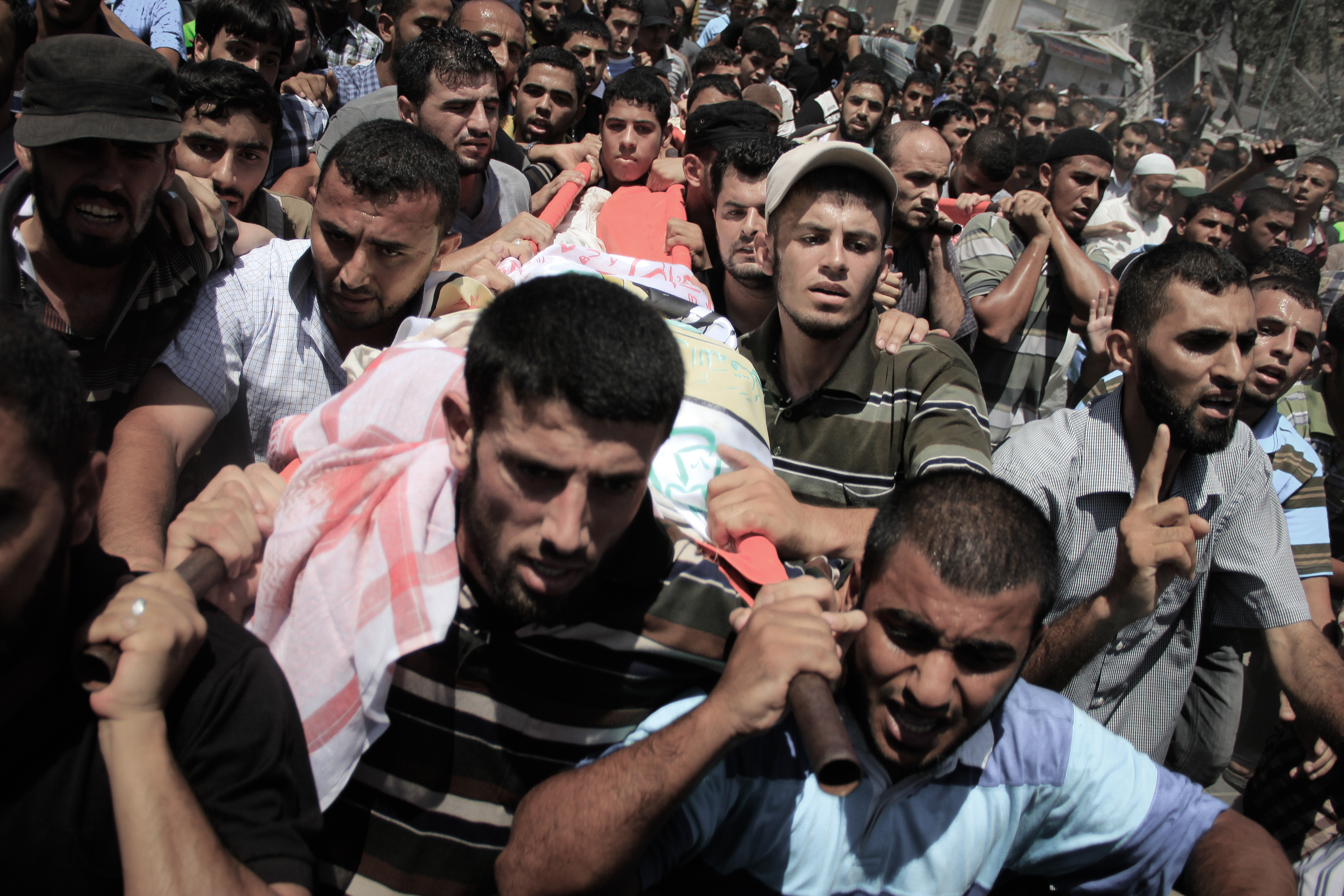
Palestinians carry the body of Mohammed Abu Shammala, one of

The IDF assassinated three Hamas commanders in a strike on a building in Gaza yesterday:

Israeli forces had a day of successful air strikes Thursday, killing three senior Hamas officials just a day after the organization claimed responsibility for the kidnapping of three Israeli teens. The strikes targeted leaders of Hamas’s armed wing, the al-Qassam Brigades. According to Hamas, the strikes killed Mohammad Abu-Shamalah, Raed al-Attar, and Mohammed Barhoum, all highly sought by Israeli forces. The IDF initially only confirmed the deaths of Abu-Shamalah and al-Attar, but later confirmed that Barhoum had been killed as well. … These triumphs against the Qassam Brigades leadership came just a day after Hamas’s Saleh al-Arouri claimed responsibility for the kidnapping and deaths of Israeli teens Eyal Yifrach, Gilad Shaer, and Naftali Fraenkel.

Morrissey thinks these assassinations are particularly significant:

The target selection sends a big message, too. For the past several weeks, the Israelis had for the most part resigned themselves to a continuing Hamas presence, in part over fear of what might follow in its place. One need look no farther than the northern Iraqi desert to contemplate the answer to that question. Now, though, Israel seems more committed to decisively breaking Hamas rather than the “mowing the lawn” strategy early in this war. The tunnels may have convinced them, or more likely the large plot for a coup against the Palestinian Authority, but either way the specific targeting of top leadership sends a message that Israel has dispensed with worrying about the pessimistic options and now want Hamas out of the way entirely. The futility of the latest round of talks can’t have helped, either.

But Rami Khouri argues that Israel’s strategy of assassinating Hamas leaders has always been counterproductive and remains so today:

Palestinians have responded to the loss of their militant leaders by developing much more secure, smaller and more secretive leadership structures that cannot be easily penetrated by Israeli intelligence agents. Groups such as Hamas have established more decentralized and localized operational units that continue to function in war or peace if the leadership is hit. More sophisticated command-and-control systems have evolved that don’t rely on a single decision-maker. Support among the Palestinian community for the long-term struggle has increased. And the resistance itself has turned to technologies and strategies — such as rockets and tunnel-building — that are more deeply embedded in Palestinian communities than reliant on the skills or charisma of a handful of individual commanders.

In an apparent response to the assassinations, Hamas executed 18 Gazans suspected of being informants for Israel:

One witness said masked gunmen lined up the seven men in a side street and opened fire on them. He spoke on condition of anonymity, fearing for his own safety. Other witnesses told AFP that six of the victims were grabbed from among hundreds of worshipers leaving the city’s largest mosque, by men in the uniform of Hamas’s military wing. They were pushed to the ground. One of the masked men shouted: “This is the final moment of the Zionist enemy collaborators,” then the gunmen sprayed them with bullets.

On Friday morning, a Gaza security official said that 11 suspected informers were killed at the Gaza City police headquarters, noting that they had previously been sentenced by Gaza courts. The killings of the first 11 were also reported by al-Rai and al-Majd, two websites linked to Hamas.

(Photo: Palestinians carry the body of Mohammed Abu Shammala, one of three senior Hamas commanders during his funeral in Rafah in the southern Gaza Strip. By Ahmed Hjazy/Pacific Press/LightRocket via Getty Images)

The Twice-Displaced Palestinians

by Jonah Shepp

Alice Su highlights the peculiar predicament of Palestinian Syrians, who unlike other displaced people looking to flee the civil war don’t have the right to seek refuge in neighboring countries:

Amid the millions of refugees from Syria flooding into neighboring countries like Lebanon and Jordan, a minority group is being quietly denied entry, detained, deported, and pushed out in any way possible: Palestinians. They are refugees who literally have nowhere to go.

In recent months, Jordanian and Lebanese authorities have acknowledged that Palestinians from Syria are not welcome to asylum in the same way that other Syrian refugees are. Jordan and Lebanon have respectively been barring Palestinians from entry since January and August 2013, in contrast with the treatment of some 600,000 Syrian nationals in Jordan and 1.5 million in Lebanon, according to Human Rights Watch. The organization has also documented forcible deportations of Palestinians—women and children included—from both countries.

I touched on this issue last week, and I’m glad to see it’s getting some more press. This is another example of the many ways Palestinians suffer for having no state of their own and no genuine acceptance in the countries where so many of them ended up after being displaced in the 1948 and 1967 wars.

I’m somewhat agnostic on how best to resolve the Israeli-Palestinian conflict (more on that later), but the severe impact of Palestinian statelessness on the lives and welfare of Palestinian refugees and their descendants is—or at least ought to be—beyond dispute. Israel is the primary agent of this problem, but it’s worth remembering that most Arab states have not exactly been kind to the Palestinians either.

It’s also an example of how the Palestinian experience in the Arab Middle East since 1948 replicates with eerie similarity the experience of the Jews in Europe in the bad old days. Imagine living your entire life in a country where the majority of people look pretty much the same as you do but consider you foreign, undeserving of the rights of citizenship, and somehow a threat to them for reasons they can’t really articulate. Imagine being in perpetual danger of expulsion or worse at the whim of an autocrat or a populist mob, and having no place to go where you know you will be safe from that danger. One would think that two peoples having both been through such a harrowing experience would be able to find more common ground than they do, but perhaps the fearful worldview engendered by that trauma overrides whatever perspective it might provide.

No, Israel And Hamas Can’t Work Out A Deal

by Dish Staff

The Gaza ceasefire ended today with a fresh exchange of fire and the calling off of negotiations in Cairo. Netanyahu –shock– was quick to blame Hamas:

After reportedly coming close to an agreement, the parties appear to be back at square one:

Netanyahu’s right-wing Minister of Economy, Naftali Bennett, said after the renewed fire Tuesday that it was impossible to negotiate with Hamas. “When you hold negotiations with a terror organization, you get more terror,” he said. “Hamas thinks that firing rockets helps in securing achievement in negotiations, therefore it is firing at Israel even during a cease-fire. Rockets are not a mistake [for Hamas], they are a method.”

A Hamas spokesman in Gaza, Sami Abu Zuhri, accused Israel of dragging out the talks and of not being serious about reaching an agreement. “Israel’s foot-dragging proves it has no will to reach a truce deal,” Abu Zuhri said. “The Palestinian factions are ready to all possibilities,” he added, presaging the likelihood of a return to further conflict.

Though the fighting drags on, Israel seems to believe it has already won. Eli Lake watches the victory lap:

On Monday [Israel’s deputy minister of foreign affairs Tzachi] Hanegbi told a handful of reporters that Israel’s campaign in Gaza this summer would deter Hamas for years. “I think Hamas is going to be much more restrained in the coming years,” he said. “It will be very careful before being so adventurous.” Hanegbi went even further. He said there was a chance that this time around, Hamas would reconsider its strategy of building up its arsenal, and instead reconsider exactly what it had achieved after eight years in charge of a strip of land Israel removed its soldiers and settlers from at the end of 2005. The suggestion was that Hamas would know it was beaten and want to discuss a more permanent peace with Israel.

Michele Dunne and Nathan Brown criticize Egypt’s approach to mediating between Israel and Hamas, accusing Cairo of prolonging the conflict and empowering radicals:

Cairo is presiding over a process that follows the priorities of Hamas, which has always rejected the diplomatic process that began with the 1993 Oslo Accords. The current state of negotiations reflects Hamas’s position that only talks about interim arrangements and truces are acceptable; conflict-ending diplomacy is not. The Israeli right can also feel vindicated, as the talks suggest that the conflict might be managed, but that it will not be resolved anytime soon.

The Palestinian Islamist camp and the Israeli right, however, should take little joy in this accomplishment. The diplomatic efforts led by Egypt will likely give Hamas little, and the new Egypt-Israel alliance is based on a short-term coincidence of interests rather than any strategic consideration. Israeli and Palestinian societies, meanwhile, are already paying a high price for the continuing failure to reach a lasting peace accord.

Can Israel And Hamas Work Out A Deal?

by Dish Staff

J.J. Goldberg is growing more pessimistic about the negotiations taking place in Cairo:

Early reports were that the two sides were close to agreement on an Egyptian compromise proposal for a long-term cease-fire. On Friday and Saturday, however, declarations on both sides indicated that positions were hardening as fierce internal divisions emerged, pulling the leaderships on both sides away from the center. The Palestinian side appears to be stymied by the refusal of the organization’s Qatar-based political secretary, Khaled Meshaal, and the head of its military wing, Mohammed Deif, to go along with the compromise proposals laid out by the Egyptians and mostly accepted by both delegations.

On the Israeli side, meanwhile, chaos appears to be reigning. Prime Minister Netanyahu, who rode a wave of popularity during the military operation, has been facing a tsunami of criticism over the past week from the left, the right, the residents of Gaza-adjacent communities and his top coalition ministers. Two of his senior coalition partners, foreign minister Avigdor Liberman of the Yisrael Beiteinu party and economics minister Naftali Bennett of the Jewish Home party, have repeatedly attacked the prime minister’s management of the Gaza conflict from the right, demanding a continuing assault until Gaza has been taken over and Hamas disarmed or dismantled. Broad circles on the right accuse him of giving away the store (i.e. lifting the blockade) in return for “nothing” (i.e. Hamas-Jihad agreement not to shoot, bombard or tunnel).

David Kenner examines one of the key sticking points, namely whether, how, and by whom Gaza will be rebuilt:

In his remarks on Wednesday, Aug. 13, announcing a five-day extension to the cease-fire, Palestinian delegation chief Azzam al-Ahmed said that there had been significant progress in efforts to lift the Israeli economic blockade on Gaza — but that there were still disagreements over reconstruction issues. These debates will not only determine whether residents can rebuild after the war, they also promise to be an important tool in Israeli efforts to weaken Hamas’s hold on the territory. As Finance Minister Yair Lapid put it, Israel would demand that “there is no rehabilitation without some sort of demilitarization [of Gaza].” …

The importing of building materials to rebuild Gaza’s tens of thousands of destroyed homes is one of the most potentially fraught issues. Hamas used large quantities of cement, allegedly smuggled in across the border with Egypt during the presidencies of Hosni Mubarak and Mohamed Morsi, to build its extensive tunnel network, which posed one of the most deadly threats to Israel during the current war. For that reason, Jerusalem has only allowed U.N. agencies to import cement — and is going to be loath to ease restrictions on construction material that could be used by the Palestinian Islamist group to rebuild its tunnel network.

On another major point of contention—lifting the Gaza blockade—the EU is willing to step in and help monitor border crossings in order to make that happen:

The EU has offered to resume its operations at Gaza’s Rafah crossing with Egypt, and to train Palestinian Authority officials who are supposed to take over the bulk of operational work at the crossings. At the U.N. Security Council’s request, it would also expand its operations to other checkpoints. (The EU previously monitored the Rafah crossing between 2005 and Israel’s withdrawal in 2007.)

According to the AP, EU officials said that lifting the blockade is needed for “a fundamental improvement in the living conditions for the Palestinian people in Gaza.” This is one of many outside expressions of disapproval at Israel’s conduct during the latest Gaza operation. The United States recently decided that Israel’s new weapons requests would need individual approval from the presidential administration, rather than going through military channels.

Bibi Bags Bombs Behind Barack’s Back

by Dish Staff

Say that ten times fast. In a sign of just how badly American-Israeli relations have deteriorated during the Gaza war, Adam Entous’ big scoop in the WSJ yesterday reveals that Israel acquired US munitions directly from the Pentagon, bypassing the White House, and may have subsequently used these munitions to bomb an UNRWA school. Katie Zavadski summarizes:

As The Wall Street Journal reports, U.S. officials had been growing increasingly concerned about the civilian toll of Operation Protective Edge in Gaza, particularly in light of the UNRWA school shelling. Imagine their surprise, then, when they found out that Israel had requested mortar shells and other weapons through military-to-military channels ahead of the incident. A diplomat said officials were “blindsided,” though a defense official said that the request had been approved through all the required channels.

Officials subsequently found out that the Pentagon’s Defense Security Cooperation Agency was on the verge of releasing an initial batch of Hellfire missiles to Israel through those same channels. They immediately suspended that shipment. A senior White House official said that more than “check-the-box approval” is required for such releases, this being a time of war and such. Going forward, the Journal reports, such weapons requests will have to get individual approval from the White House and State Department.

But Ed Morrissey doesn’t buy the White House’s claim that it was hoodwinked:

If the standard review process was followed, then why was the White House “caught off guard”?

Isn’t it incumbent on the Obama administration to know how the sale and transfer process works? Israel had conducted a ground war — much to the chagrin of Obama and his “policymakers” — for a few weeks. Why wouldn’t anyone have expected Israel to replenish its supplies? Surely there are a few people who may have at least watched Patton if not studied Clausewitz in this administration. Resupply is a basic function for any army at war.

He advances a theory for why the story is coming out now:

Israel (and probably Egypt too) has marginalized John Kerry after the Secretary of State attempted to legitimize Hamas by attempting to negotiate through Qatar and Turkey. That leaves Barack Obama out in the cold, but still making demands on Israel to be flexible in the final truce settlement. Netanyahu wants Obama to make concessions in exchange for that flexibility. That has angered Obama, who finds himself all but impotent in the matter — which is why we have this big leak about the deteriorating relations between Washington and Jerusalem.

In Beauchamp’s takeaway, this incident illustrates just how one-sided our government’s relationship with Israel has become:

Entous’ reporting illustrates why the US is so bad at pressuring Israel. The United States and Israel are bound so tightly together in so many ways that Israel has all sorts of avenues to get around the limited pressure that administrations might want to bring to bear. US officials admitted to Entous that their influence over Israel has been “weakened” during the Gaza war. That’s because Netanyahu “has used his sway in Washington, from the Pentagon and Congress to lobby groups, to defuse US diplomatic pressure on his government over the past month.”

The American public and Congress both overwhelmingly support Israel and sympathize with it over its enemies during conflicts. That helps maintain a strong US-Israel relationship, even when the leaders of both countries can’t stand each other. It also seriously ties America’s hands when the two countries disagree.

Drum sees dim prospects for the US standing up to Netanyahu anytime soon:

It’s not as if Obama has actually done much of substance to put pressure on Israel despite endless provocations from Netanyahu, but it’s a very good bet that the next president will do even less. On the Democratic side, Hillary Clinton is the heavy favorite, and she’s made it crystal clear that her support for Netanyahu is complete and total. On the Republican side, it doesn’t really matter who the nominee is. As long as it’s not Rand Paul, Netanyahu can expect unquestioning fealty.

And in the meantime, he can count on the US Congress not really caring that he publicly treats the US president like an errant child. I keep wondering if one day he’ll go too far even for Congress, but I’ve mostly given up. As near as I can tell, there’s almost literally nothing he could do that would cause so much as a grumble.