
[Re-posted from earlier today]
As promised, the edited transcript of an August 6 telephone conversation. I’ll now go back to vacation mode – so I’ll deal with whatever dissents and comments when I’m back next month.
Harris: First, Andrew, I’d like to thank you for taking the time to speak with me. As you know, this began with a blog post I wrote to which you responded. I don’t want to focus too much on those articles – readers who want to do their homework can go back and see what we said. However, I want to begin by acknowledging that certain topics are simply radioactive. It seems to me that one can’t make sense about them fast enough to defuse the bomb that is set to go off in the reader’s brain when one fails to align with his or her every prejudice.
Unfortunately, this is true of many topics I’ve written about – such as gun control, torture, profiling, and even wealth inequality – and it’s especially true of the subject of Israel and its enemies. People just get emotionally hijacked here. One sign of this happening is that readers notice only half of what you’re saying – or they discount half of it as something you don’t really mean, as though they knew your mind better than you do.
I wanted to talk to you directly because it seems to me that you have gotten emotionally hijacked on this issue. I felt that your response to my blog post was, in certain places, quite unfair. At the very least, you were misreading me. Again, we’ve put links to both our articles above so that people can make their own judgments. I think we should talk about the issue from scratch here, rather than focus on what we’ve already written. And I’m hoping we can do this on two levels: The first is to talk about the war in Gaza; the second is to reflect on why this topic is so difficult to talk about.
 To start us off on both points, let’s focus on the matter of Israeli war crimes, the existence of which I acknowledged in my original article. The thing we should observe at the outset is that in times of war, ethics degrade on all sides. Every war is an emergency, and in an emergency, people’s ethics tend to fray – or just get tossed out the window. It seems to me that there is nothing remarkable about this. What’s remarkable is when it doesn’t happen. When rockets are raining down on your head, or you’re in a sustained conflict with people who would murder your entire family if they could, it’s very easy, and perhaps inevitable, to de-humanize the other and to respond in ways that begin to look extremely callous with respect to the loss of life on the other side.
We can’t begin a discussion on this topic without acknowledging the reality of collateral damage, because every war fought with modern weapons entails the risk, if not the certainty, that innocent people will be maimed and killed. Unfortunately, pulling dead children out of the rubble in times of war is now becoming a universal experience. This is where the images coming out of Gaza are misleading, because if we had these images from the wars in Afghanistan or Iraq or World War II -you can pick as righteous a war as you like – you would see the same horrific pictures of dead children.
This is why we need to consider the intentions of the parties involved, which is what I was attempting in my blog post. Needless to say, collateral damage is pure horror, regardless of intentions. Consider how we behaved in World War II: We did things that would now constitute the worst war crimes imaginable – the firebombing of Dresden, the nuclear weapons dropped on Hiroshima and Nagasaki. We literally burned hundreds of thousands of noncombatants alive. Was all that carnage strategically necessary? I don’t know – probably not. And we certainly couldn’t behave this way today without invoking the wrath of billions of people. However, the crucial question is, what sort of world were we trying to create? What were the real intentions of the U.S. and Britain with respect to Germany and Japan? Well, you saw our intentions after the war: We helped rebuild these countries. Out of the ashes of this war, we created the allies we deserved. The truth is that we wanted to live in a peaceful world with thriving economies on all sides.
I’m not saying that Israel hasn’t done appalling things – but governments, including our own, do appalling things in times of war. In fact, there is evidence that the Israelis intentionally torpedoed a U.S. ship during the 1967 war, killing some dozens of American soldiers. If true, this was an outrageous crime. But none of this cancels the difference between Israel and its enemies. It seems to me that the Israelis really do want to live in peace, however inept and callous they may have been in trying to secure it, while their neighbors are explicitly committed to their destruction.
The final point I’ll make is to remind people of who those neighbors are: Hamas is a death cult – as  are ISIS, Al-Qaeda, Al-Shabab, the Taliban, Boko Haram, Hezbollah and every other jihadist organization we could name. Despite their differences, they are in fact the same death cult. And in case our readers imagine that jihadists don’t have global aspirations, they should pay attention to what they say among themselves (read, for instance, “The Management of Savagery” [pdf]). It’s in this sense that I claimed in my blog post that we’re all living in Israel – an assertion you found ridiculous. This death cult is springing up everywhere: It’s more or less ubiquitous in the Muslim world, obviously, but it’s also in Boston, with the Tsarnaev brothers who woke up one morning and decided that the best use of their short time on earth was to bomb the Boston Marathon. The fact that they didn’t have a formal link to any established terrorist organization is irrelevant. It’s the ideas of martyrdom and jihad that are the problem. These ideas have entranced millions of people, and they are spreading.
Sullivan: I’m not quite sure where to begin, except to take one thing at a time. So let me ask a question about both history and proportions in the struggle against jihadism. Are you surprised at how few Americans have died since 9/11 by jihadist terror? It’s quite remarkable.
Harris: Not really. But I’m happy so few have.
Sullivan: You focused on the Tsarnaev brothers in the same context as Hamas, which seems to me depicts a disproportionate understanding of the situation.
Harris: I don’t think you can analyze this risk by body count thus far. The fact is that we are now confronted by people who are undeterrable – who really do love death as much as we love life. These are not rational actors, and their access to destructive weaponry is only growing. We’re living in a world in which nuclear terrorism is going to be increasingly difficult to prevent – and yet we must prevent it, year after year after year after year. Pakistan is just a coup away from letting the big bombs fall into the wrong hands. So that’s the lens through which I view the global threat of jihadism. One can easily imagine a terrorist atrocity two orders of magnitude worse than 9/11. And that would change everything.
Sullivan: Well, it’s not entirely bleak. We did see recently a big, successful attempt to sequester the weapons of mass destruction that the Assad regime had: chemical and biological weapons. Of course, Israel is the only power in that region to have nuclear, chemical, and biological weapons without being a signatory to the nonproliferation treaty.
Harris: Correct. But this just speaks to the difference in intention that I consider paramount. Do you lose any sleep over the fact that Israel has nuclear weapons?
Sullivan: No – but you can see why the people in the region do, because it gives Israel absolute impunity to do whatever it wants, whenever it wants, including the many wars that it has been conducting recently. And to talk about the blitz, I agree with you that the Dresden firebombing was a war crime. But look at what was happening in that situation. Britain was being carpet-bombed itself, with huge numbers of civilian casualties. It was, as you say, an “emergency situation.”
 In this current Gaza war, on the other hand, Israelis are all but protected by the Iron Dome, by Israel’s massive superiority in technology, overwhelming military dominance, huge economic superiority, and by being the most powerful country in the entire region backed by the global superpower. And even though the Israelis are protected from any sort of civilian casualties of any significance, they nonetheless have killed an astonishing number of Palestinian civilians in the past few weeks, including roughly 300 children. As you know, there seem to be credible accusations that they have fired into places where, even though they weren’t targeting civilians, they knew full well that many civilians would die, and even may have targeted shelters where children and women are sleeping. So I don’t think Israel was in an emergency. I think it has many other options, rather than killing so many innocent civilians.
Secondly, if one’s worry is jihadism, and it should be our worry, then obviously Israel is making the world a much more dangerous place by its constant provocation of Muslims by putting the Muslims under its control in little-Bantustan regions in the West Bank or cordoning them off into a tiny area in the Gaza Strip. That is where the question of proportionality comes in.
Harris: The Israelis have successfully minimized the consequences of Palestinian terrorism – building the Wall, for instance, and creating the Bantustans you object to – and now you are holding this very success against them as an unconscionable act of provocation. The game is rigged. You can’t say that Israel’s success in containing the terror threat posed by Hamas and other groups is evidence that they need no longer worry about this threat. The only reason that suicide bombing is no longer a weekly occurrence on the streets of Jerusalem and Tel Aviv is that there is now a concrete wall separating Israel from the people who want to carry out such bombings. That is why Gaza is a prison camp.
Sullivan: The Wall is not what makes it a prison camp.
On top of the Wall, they occupy and control that entire region, and maintain checkpoints that burden and enrage many of the inhabitants. And remember, again, and this is where we have to go back to history, when you say the Israelis only want to live in peace with their neighbors, is that why 1948 is regarded by any non-Israeli in the region as a “catastrophe”? Was that living in peace with their neighbors? That was a terroristic campaign of expulsion, of ethnic cleansing, and of mass murder. That’s how Israel was founded. And many of the people living in Gaza and on the West Bank are the descendants of refugees from that original act of ethnic cleansing. One problem of the debate in the U.S. is that this vital piece of context is so often removed, and so we have an utterly ahistorical understanding in which the motives of one side become unintelligible.
Harris: The problem with invoking history in this discussion is that you have to decide when to start the clock. You could go back further than 1948 – but many Jews would have you go back 2,000 years, pointing to the fact that this is their ancestral homeland, as evidenced by the history of the diaspora. The Jews were kicked out of Palestine and hunted and hounded and ghettoized and murdered for millennia – which would seem to justify the decision to return them to their homeland, provided it could be done in a way that wouldn’t ruin the lives of other people.
Sullivan: Well, the problem is that other people happened to live there already in the land assigned to newcomers – and they regarded their lives as ruined. They were the majority, and they were not Jewish. This is the most recent big event in the history of that part of the world – and the Palestinians had almost no say in any of it. So to claim that we just have to accept this as a given and that any complaints about the deep wound in that part of the world are somehow illegitimate or to be bracketed off from the core discussion seems to me to miss the whole point of the conflict.
Harris: As you know from reading my original blog post, I don’t think Israel should exist as a Jewish state. And I don’t support anyone’s religious claims on that land.
Sullivan: But you are supporting Israel based on just such a religious claim, which, given your other arguments, doesn’t make any sense. Because if Israel-Palestine were not an explicitly Jewish state, as you’d prefer, there would be a majority Arab population – that would presumably, in your view, result in the immediate extermination of every Jew in the country.
 Harris: If all the Jews in Israel woke up tomorrow and said “This sucks. We’re sick of being attacked by religious lunatics. Let’s just move to America and forget about this godforsaken desert,” I would fully support it. In fact, it reflects how I live my own life. I’m a Jew who sees no point at all in fighting for land that an imaginary Abraham sanctified with his imaginary footsteps, in thrall to an imaginary God. And I’m more than happy to assimilate and to forget about my Jewishness. I’m just trying to be a rational human being living on the third planet from the sun. And I think all Jews would be well served to do likewise.
In fact, I would consider it the crowning achievement of Judaism if all Jews realized simultaneously that their religion was total bullshit and abandoned it en masse. Is that going to happen? Of course not. But imagine if the Jews did leave Israel. Would our conflict with Islam go away? No. Would we see an outpouring of goodwill and gratitude and a reasonable analysis of why this was the best outcome for humanity, all things considered? No. We would see a deranged victory dance throughout the Muslim world. The fall of Israel would be taken as further justification for a fever dream of an ascendant Islam. And the clash of civilizations would just shift to another front.
Sullivan: Let’s try this non-Zionist counter-factual. Any Jew in the world is free to come to America. American Jews are among the most accomplished, integrated, successful, vibrant contributors to American society and culture. And they are among the most popular religious and ethnic groups in the country. They mercifully have peace, security – far away from this kind of Middle Eastern awfulness. So why wouldn’t that have been a credible alternative, rather than actually going in and seizing land from people who –
Harris: Again, you have to acknowledge the burden of the past. First, you’re painting too rosy a picture of the American attitude toward the Jews, especially at the time Israel was founded. For instance, if you read the book The Abandonment of the Jews, by David Wyman, you encounter the most appalling picture of American anti-Semitism. During World War II, with full knowledge that the Jews of Europe were being exterminated, there were anti-Semitic speeches on the floor of Congress. We even turned back boats of Jews who had escaped the inferno of Europe, knowing that they were thereby doomed. You can’t just say the Jews should have come to America.
Sullivan: It’s a shameful episode in American history; I agree, although plenty of xenophobic speeches have been made on the floor of the Congress about any number of waves of immigrants.
Harris: Not ones who were then being murdered by the millions, for whom immigration would have been, quite literally, salvation. And, again, I would point out the double standard here, because we could be talking about the founding of Pakistan, another incredible confection by colonial powers – where new lines drawn on a map affected the lives of millions of people. In this case, 15 times as many people were displaced from Pakistan as from Palestine. Where are the Hindus calling for their right of return?
Sullivan: But the point of that horrifyingly bloody partition was to create a state for Muslims and a state for Hindus. And there is actually a Hindu state – India. But there is not a state for those people in Palestine. In recent years, the Israelis seem determined to prevent that. And the situation is getting much worse. Now, in the occupied territories, Israel is deliberately and aggressively populating that land with some of the most fanatical Jewish sects imaginable.
Harris: Which I condemn as much as you do.
Sullivan: Your piece kept conflating Hamas with all the Palestinians, and was about the Palestinians as murderous Islamists. But the Palestinian Authority is not Hamas.  And you would not have gotten a better opportunity for peace partners than Abbas and Fayyad on the West Bank. They’ve been begging for two states. You would not have had a better partner for peace than Barack Obama in 2008. But the Israelis do not want to give up that land. And I fear they will never give up that land. And Netanyahu has said he cannot conceive of –
Harris: Well, I was pretty clear in saying that not all Palestinians support Hamas. And I was also clear in saying that Hamas isn’t the worst Islam has to offer – that honor would probably have to go to ISIS for the time being. But on the topic of trading land for peace: Recall that the Israelis gave up Gaza and were immediately bombarded with rockets. You just can’t separate their security concerns from the land.
Sullivan: If this was about security, Sam, why did Netanyahu prefer to release over a thousand murderers and terrorists from prison rather than relent and give up a single brick of a single settlement on the West Bank, or East Jerusalem? And my point is this, that when you have a power like that, which has already taken a large amount of land and then refused to allow a second state to emerge – and in fact has sequestered the other population in such a way as to render their dignity and self-esteem and self-government impossible, then I think what you’re talking about is a very different situation. It’s not simply a nice, peaceful country fighting forces of jihadist Islam. In fact, you can say that one of the major sources of jihadist Islam and anti-Western terrorism has been not just the founding of Israel, but its expansion and its constant presence in the lives of so many Arabs in the Middle East.
Harris: But, Andrew, much of this is the result of Muslim anti-Semitism, not its cause. Jewish crimes are especially significant – and Jewish victories are especially galling – because the Jews are reserved a place of special scorn under Islam.
Sullivan: If I suddenly found that the south of England, where I grew up, had been occupied by the French through a war of conquest, and they were then populating England with French people dedicated to creating France in Britain, then I don’t think I would be some bigoted anti-Semite to be furious about the land that was taken from me. You don’t need anti-Semitism to explain why people would feel enraged about a hostile takeover of their own land. It’s such a canard to say that there’s something outrageous about being offended that you’ve been thrown out of your land, town, or home. And it’s made worse when even in the place left to you, you are then policed, monitored, harassed, and constantly controlled by an occupying force. This is an absolute recipe for disaster.
Harris: Yes, I agree with much of that. But again, we see the consequences of your framing the issue too narrowly. Where are the Jews in Saudi Arabia, Yemen, Kuwait, Iraq, Iran, Syria – or even Egypt or Jordan, states that are ostensibly at peace with Israel? The ethnic cleansing of the Jews has already been accomplished in the Muslim world.
Sullivan: No, no, hold on. The vast majority of that happened because of the creation of the State of Israel. That was the paroxysm that created the great emigration within the regions. Before that, look, you can look at Palestine in the ’20s or ’30s, I mean, let alone in the last part of the 19th century, and there aren’t that many Jews living there. The big majority of it is Arab and Muslim.
Harris: You are being far too chipper about what life was like for the Jews under Islam before the purge. We are talking about a history of apartheid punctuated by pogroms. And, in any case, there are estimates of the population of Jews in Jerusalem going back to the time of the Romans. And there has probably been a continuous presence of Jews in the so-called “holy land” since before the Babylonian Exile.
Sullivan: No one’s denying that there were some there. But there were many, many others. Here’s a link to the Wiki page on Israel-Palestine demographics through history. In 1800, there were 268,000 Arabs and 6,700 Jews. Even by 1947, there were twice as many Arabs as Jews: 1.3 million to 630,000. The original idea gave the Jews half the land, despite being a third of the population. And now they have controlled the entire area for nearly 60 years. If I described that in the abstract, you would need no theory of Muslim anti-Semitism to explain the resentment and anger.
And in fact, the first people who came back to report to Theodor Herzl about the promised land knew this very well. They told him, “The bride is beautiful but she is married to another man.” The land they wanted was already populated by another people. There was an option to allow some Jewish immigration to rebuild Jewish culture, Jewish language, Jewish history, and so on and so forth. But not the creation of an actual, physical state with Judaism as the central pillar of it – let alone one that would control the entire area. Now, it seems to me that that’s an important piece of the context. And it’s worth noting that, along with unbelievable oppression over the centuries, the diaspora Jews also achieved enormous success wherever they went.
Harris: But that’s in spite of how they’ve been treated. Again, my interest is not in arguing the justification for the founding of the State of Israel. I think that’s the wrong focus, for many reasons. If we moved the Jews to British Columbia, we’d still be talking about the problem of Islam – and even about the problem of Muslim anti-Semitism. You do realize that most Muslims have never met (and will never meet) a Jew, and yet they hate them, based upon their religion? My friend Ayaan Hirsi Ali recalls being taught as a child – in Somalia, of all places – to pray for the destruction of the Jews.
However, if we are going to discuss the founding of Israel, it does not seem crazy to point out that many nations were born out of theft and chaos – from someone’s point of view – and yet we no longer question their origins. I’ve already mentioned Pakistan, but consider the United States: No one is talking about Apache claims upon Kansas and Oklahoma. The Native Americans are stateless – and for well over a century the only reasonable question to ask has been, how can we ensure that they have better lives given the fact that the United States isn’t going anywhere? But no one will treat Israel this way – not in the Muslim world, certainly, and not even in Europe – and that is part of the double standard that Israel is forced to operate under. Everything Israel does is doubly questioned and doubly stigmatized.
Sullivan: My favorite headline in the Onion, one of the headlines of the century, was – “War-Weary Jews Establish Homeland Between Syria, Lebanon, Jordan, Egypt.”
Harris: That’s hilarious.
Sullivan: In other words, there has to be some weight put on the fact that we’re also talking about the seizure of land from people who did not consent to it.
Harris: No one ever consents to it.
Sullivan: We’re talking also about modernity; we’re talking about something not that long ago. You’re right, we are also talking about the fact that Islam has a very – Islam and Judaism together have a very strong attachment to specific lands in a way that Christianity, for example, doesn’t. At least not now. So you’ve created a zero-sum situation, and the point of allowing the Jewish homeland in Israel was always predicated upon a two-state solution. There was no idea in 1948 that they would have just Israel and never have another state for the Arab-Palestinians; never an idea of that.
Harris: There’s also been a very cynical game played by the Arab states to maintain the status quo. Keeping the Palestinians in limbo has been a way of keeping the question of Israel’s very existence on the table for debate – immiserating the Palestinians in the process.
Sullivan: So the Israelis bear the primary responsibility, although the Arabs are absolutely partly responsible for their intransigence, just as Israel is responsible for the deaths of all those civilians in Gaza, even though Hamas is utterly complicit in it. I’m not exonerating Hamas, but I’m certainly not going to defend the killing of 1,800 people in this brutal campaign when Israel is not seriously at risk. Israel is not in danger. Israel has the overwhelming resources behind it.
Harris: You’re being too cavalier about the dangers that the Israelis face.
Sullivan: They have nuclear weapons.
Harris: But they can’t use those weapons. They certainly can’t use them on Gaza.
Sullivan: They’re a massive deterrent.
 Harris: Again, you’re blaming the Israelis for how successfully they’ve managed to defend themselves against more or less ceaseless Arab aggression. You just said they’re not under threat -and, therefore, that their actions in Gaza are not truly defensive. But the evidence adduced for this is the fact that there hasn’t been an equal number of civilian casualties on the Israeli side. If there were 5,000 casualties in Tel Aviv as a result of rockets fired from Gaza, you wouldn’t be saying any of this. But the only reasons why there haven’t been massive casualties on the Israeli side is that Israel has had to make its survival a national obsession – building bomb shelters and a missile defense system, among other things – and Hamas doesn’t yet have the rockets it really wants.
Sullivan: Why do you keep listing these hypotheticals? The reality is Israel is secure.
Harris: Having thousands of rockets fired at you, and just waiting for them to land who knows where – that’s security? No missile defense system is 100 percent effective. And there are times when a majority of the population of Israel is now forced to hide in bomb shelters.
Sullivan: When none of them can kill anybody because your defenses are so great, you are pretty secure. You’re secure also in the sense that you have nuclear weapons; you have the support of the superpower, the global superpower behind you. You have the United States, you and I are paying for their rearmament, right now as we speak. And they’re so powerful they’re occupying the region that was designated for the other state for 50 years with impunity. That’s power, Sam. Real power. Easily the dominant power in the region. Overwhelmingly. Militarily. Economically. And it’s come through their alliances.
Harris: Imagine the consequences if that were not the case.
Sullivan: Then I would have a different position on this. If Israel was under that kind of attack, I would totally understand having this kind of response. My point is simply that they’re not the same thing. And when I also have seen the Israeli prime minister talking about “deterrence,” using these wars in Gaza in order to prove to these populations they must simply submit, I’m concerned. We are talking about the impact of collective punishment on people to deter any future attempt to construct their own lives in their own country.
Look, I’m not defending what Hamas is doing. What I’m saying is where we are now is in large part a function of Israel’s inability to understand that it’s powerful enough to make compromises, powerful enough for there to be two states in the region, and its refusing to do so has made the conflict far worse and it also made Israel’s position much less secure. I think we agree on that, right?
Harris: Yes, we agree on that. And I know you don’t support Hamas, any more than I do.
Sullivan: I do support Abbas and Fayyad in attempting to get a two-state solution. I do support the Obama administration in trying to negotiate one for the past six years. But they were repeatedly told to go fuck themselves by the Israeli government while it kept adding settlements to the West Bank.
Harris: There are reasons why the Israelis feel themselves to be in greater jeopardy than you deem strictly rational. For one, you are underplaying the significance of being asked to negotiate with people who – whether they’re going to admit it in every context or not – are committed to your destruction.
Sullivan: Abbas and Fayyad are not committed to Israel’s destruction. They have explicitly recognized the State of Israel and support a two-state solution.
Harris: But Hamas is.
Sullivan: Yes, and if you really wanted to tackle Hamas, you’d give the Palestinians an option with Abbas and Fayyad. But what Netanyahu and the Israelis have done is reward Hamas’s horrible eliminationism with mass brutality, and reward Abbas and Fayyad, who want to have a two-state solution, with more and more settlements, making such a solution impossible. I just want you to understand what it must feel like to be a Palestinian in your own land, constantly having new settlements built, clearly designed to tell you, you do not belong here; in the end, you will be forced out of here as well.
Harris: Of course, I agree with you about the settlements. Let me say it again for readers who have trouble reading through tears of uncomprehending rage: I agree with you about the settlements.
Sullivan: And then we have one of the deputy speakers of the Knesset saying that they want to put up camps, concentration camps for the citizens of Gaza, and want to annex the entire West Bank. And everything in Israeli society is leading towards the one-state solution on exclusively Jewish lines. And you, I think, would say, well the Palestinians deserve it.
Harris: No, that’s not fair. I would say no such thing. And we must deal with the point you just raised about the deputy speaker of the Knesset. I saw your blog post on that where, in a very inflammatory way, you distorted what was actually being said on the Israeli side. You accused this man being a “genocidal bigot.” You noticed how uncanny it is for a Jew to be suggesting “concentrating” a civilian population within “camps” – leaving the reader to marvel at the irony of the oppressed becoming the oppressors. But this was just a play on words. The man was not suggesting that Israel build concentration camps of the sort we saw under the Nazis. He was suggesting moving Palestinian civilians into camps so that IDF could fight Hamas without killing noncombatants.
Sullivan: In order for them to be subsequently expelled from the region.
Harris: Granted – the man was articulating an extreme view – but that’s still not genocide. You can call it “ethnic cleansing,” but moving people from one place to another, however unjustly, is not genocide. Genocide is when you herd them into gas chambers.
Sullivan: It’s ethnic cleansing.
Harris: Fine. But I don’t want us to slide off this point. Go back and read your blog post. You call it genocide, and you draw the concentration camp implication in a way that does not differentiate between the Jewish version, designed to get civilians out of the way, and the Nazi version, designed to reduce them to ash.
Sullivan: But the idea that anybody would come close to that is horrifying.
Harris: They’re not close at all. This brings me back to the other topic I mentioned at the top of this call, regarding why it’s so damn hard to talk about this issue in the first place. We have to be honest about the plain meaning of words. When you use a word like “genocide” to describe a person’s intentions –
Sullivan: I didn’t.
Harris: You do in your blog post. Just go back and look at it.
Sullivan: I’m looking at it right now.
Harris: Do a keyword search for “genocide.”
Sullivan: I’m not good at doing that kind of thing.
Harris: Just type control-F, or command-F, and then “genocide.”
Sullivan: I see now: “Genocide and ethnic cleansing.” You’re right. But he does believe in killing every civilian in Gaza who resists –
Harris: Andrew, he does not believe in killing every civilian in Gaza. He’s talking about combatants. I only know this person from your blog, but I read what you wrote, and I read what you quoted. The man wants to separate the civilians from the militants so that the IDF can bomb the hell out of the militants.
Sullivan: No, but how can you say that and then not admit that he wants to take these people, completely annex Gaza as part of Israel, Judaize it, remove all of its Arab inhabitants who don’t accede to the new order, and “exterminate” – his words – anyone still resisting.
Harris: I’m not defending this person, and I’m not defending his military strategy. I’m defending the meaning of important words – words like “genocide” and “concentration camp.”
Sullivan: Genocide can mean the intention to kill a whole race – rather than the actual successful attempt to do so. The former chief rabbi of Israel, spiritual leader to many Middle Eastern Jews, said among other things that the Palestinians should “perish from the world.”
Harris: Andrew, you are changing the topic. Stick with our man in the Knesset. I have no doubt that you can find a genocidal rabbi who’s going to liken the Palestinians to the Amalekites and deem them fit for slaughter.
Sullivan: The chief rabbi of Israel, whose funeral was attended by 800,000 people, is not some fringe figure.
Harris: I’m happy to excoriate the ultra-Orthodox as much as you want. But the question is, how many Jews in the world does this rabbi speak for? As I make clear in my post –
Sullivan: – the chief rabbi of Israel. Or how about the former head of Israel’s National Security Council who wants all Gazans, including women, to be thought of as enemy combatants and therefore to be killed.
Harris: Are you alleging that a significant percentage of Jews have genocidal intentions toward the Palestinians? Is that the punch line here?
Sullivan: I’m saying an alarming and growing number of Israelis hold those views. And it’s not a punch line.
Harris: Okay. Then let’s get our intuitions in order. If given a magic button to push that would annihilate the Palestinians – not just Hamas but all men, women, and children – what percentage of Jews do you think would push it?
Sullivan: I’m talking about the evolution of Israeli society in a very, very nationalistic, almost fascistic direction.
Harris: I totally agree that there is a problem here. As I said in my article, I think Israel is being “brutalized” – by which I mean being made brutal – by this conflict.
Sullivan: They have no choice in the matter?
Harris: Not much. I think this is just what happens to people who are living in a continuous state of siege and fear.
Sullivan: Which they chose.
Harris: Well, up to a point. They didn’t choose the legacy of anti-Semitism. They didn’t choose having half the Jews on earth fed into ovens in Europe.
Sullivan: Well, neither am I saying that.
Harris: But that’s the context. Again, we can’t leave the problem of language unresolved. You’re using words in such a way as to make the intentions on both sides of this conflict appear equivalent. I will grant you that you can find some genocidal maniacs on the Israeli side. What you cannot find is an entire culture that has been transformed into a cult of death – where children are routinely brought up to be martyrs. Nor can you find a significant percentage of the population that would sanction a genocide. That is an enormous distinction.
Sullivan: Again, I’m not saying they’re as bad as Hamas. I am not. I am saying that a remarkable and growing number of people in Israel seem to paint the Palestinians as a general threat in a way quite similar to what Hamas does with Israeli Jews. And when you have several wars, continuous wars, in which the civilian casualties of Palestinians dwarf anything on the Israeli side, it begs the question: When you have ethnic settlements continuing on and on, what is the project here? What is the project for Israel?
Harris: That’s exactly my interest – what is the project? What project would either side accomplish if it could accomplish its aims? And insofar as your fears are borne out, and the Israelis become indistinguishable from Hamas in their intentions, then there would be absolutely no moral distinction between the two sides. I don’t have an intrinsic bias for the Israelis, and I have no fondness for ultra-Orthodox Judaism. I’m simply saying that if you find a rabbi who talks about the Palestinians as Amalekites who should just be wiped off the face of the earth, that person speaks for the tiniest extremity of the 15 million Jews on earth. When you find an imam in Gaza or Beirut or London speaking that way about the Jews, he is speaking for at least tens (and probably hundreds) of millions of people.
Sullivan: Even though he was the chief rabbi?
Harris: Well, yes. I’d have to research who you’re talking about. I’m simply taking this story on your authority. However, it is a fact that most Jews are secular – and secular in a way that one can’t currently imagine in the Muslim world. I fully grant you that the ultra-Orthodox in Israel are a real problem, but their views do not reflect the aims of Israel as a nation or the aims of most Jews. The picture changes utterly when we’re talking about anti-Semitism on the Muslim side. Anti-Semitism is so well subscribed among Muslims that they basically drink it in the water – and much of it is eliminative, which is to say, genocidal.
Sullivan: And I’m not denying that, but I have to say that I think that it’s gotten worse because of the way in which Israel has behaved. It has not helped itself in any way.
Harris: I agree, for the most part. But you could also make the case that many of Israel’s enemies understand and respect only strength – i.e. violence or its credible threat. Reasonable concessions, and just basic human decency, aren’t always interpreted in the way that one intends.
Sullivan: Let’s talk about what they would each do if they really had their druthers. And I think this is what both would do. I think that the responsible Palestinians – those represented by Abbas and Fayyad – would want a two-state solution. And I think they’ve been basically foiled by the Israeli government in that endeavor. I do think that many if not most Arab Muslims in the region would like to see Israel wiped off the face of the map; absolutely. What do I think the Israelis want? I think if they had their druthers, they’d have a single state from the river to the sea, in which there was no hint of a threat to a Jewish majority. That’s the Likud charter.
Harris: They would probably want to push all the Palestinians into Jordan and the surrounding Arab states.
Sullivan: That’s where they pushed them in the first wave, from ’48 to ’67. The question is whether we’re witnessing a second phase in which eventually those people in Gaza would also be encouraged to flee to other countries – that was the deputy speaker’s proposal. And I think the Israelis would like, in an ideal world, to get the Palestinians on the West Bank to go to other countries as well. And they will argue, look, it’s still only a tiny amount of land that we’re asking for. Look at all the land the Arabs have. All we’re asking for is Greater Israel. I think that’s what they’d want.
Harris: I agree. But forcing people to emigrate and genocide are very different projects.
Sullivan: They are. But both are basically crimes, of different orders. And I think that if we want to see a sane resolution to this, and I actually accept the idea there should be a Jewish state, unlike you, for the historical reasons of protection of the Jewish people, then I think that the basic original plan of two equal states is not that bad of an option.
Harris: Actually, I agree that it is the only feasible option. So I accept it too.
Sullivan: It’s the only option that could possibly work. I don’t think it’s possible at this point because of the bitterness on both sides and because of the facts on the ground. The Israelis have been very successful at creating facts on the ground over the past 60 years that make the possibility of an actual partition in that region impossible. And I don’t think it’s absurd for a fair-minded observer to note that.
Also, I think it’s fair to ask you to try to understand what it must be like to be an Arab living in Israel in 1948 or even on the West Bank in 1967 or 2014, which now has half a million Israeli immigrant inhabitants, and to see that the country that you believe was yours is no longer yours at all. Now, even if you take religion out of it, the conquest like that and expulsion of peoples is an inherently divisive, terribly destructive, and terribly polarizing act, whatever the outcome.
Harris: I completely agree. And, obviously, displaced people need to be compensated. That would be the only ethical way to do it – if it had to be done.
Sullivan: But do you understand why people would still say, “Fuck it, I live in my home. This has been my home forever. Why should I have to leave my –
Harris: It would be remiss of me not to point out that none of this would be a problem in the absence of religion. That’s what makes a “one-state solution” unthinkable – or, indeed, a “one-world solution.”
Sullivan: Ethnically they’re pretty indistinguishable. Genealogically, genetically, and all the rest of it. So look, we both agree on that, I think, but my contention is simply that with respect to this current war, I think that you’ve gotten the balance slightly wrong. I think I understand why you have that balance, but I think you’re underestimating the power of Israel, and being a little too generalizing about what Palestinians want. I don’t think they’re all Hamas supporters.
Harris: But I acknowledged they’re not all Hamas supporters in my article. And I agree with you now that they’re not all Hamas supporters. However, there is another problem for Israel that you’re ignoring. The people with whom the Israelis must negotiate, even the best of them – even Yasser Arafat after he won his Nobel Peace Prize – often talk a double game and maintain their anti-Semitism and religious triumphalism behind closed doors. They’ll say one thing in English, and then they’ll say another in Arabic to their constituencies. And the things they say in Arabic are often terrifying. In fact, there is a doctrine of deception within Islam called taqiyya, wherein lying to infidels has been decreed a perfectly ethical way of achieving one’s goals. This poses real problems for any negotiation. How can Israel trust anyone’s stated intentions?
For instance, consider the grand mufti of Jerusalem, Amin al-Husseini. He was the leader of the Palestinians in the ’30s and ’40s, prior to most of the history we’re talking about that has so enraged the Palestinians. Nevertheless, the man visited Auschwitz in the company of Himmler and aspired to have his own death camps created in Palestine to exterminate the Jews. He was a full-blown Nazi collaborator, and the head of the Palestinians. As late as 2002, eight years after winning the Nobel Peace Prize, Arafat praised al-Husseini as “a hero.” This is the kind of thing Israel has had to deal with continuously.
Sullivan: Sam, you wouldn’t have found a stronger defender of Israel on the lines that you have given than me when Arafat was running the show. My problem is that when the Palestinians actually, finally agreed to recognize Israel, actually cooperated with Israeli security in preventing terrorism, and succeeded in generating some economy and growth and community on the West Bank that is not simply all about death, they were rebuked rather than rewarded. The Israelis have failed dramatically since 2000 to really seize that opportunity, which is an incredibly important opportunity for them and for all of us. Because this conflict also affects us, and it definitely pours gasoline onto the jihadist flames, this whole conflict.
So that’s where I’m coming from, Sam. I’m coming from a sense that the Israeli Right has gotten very powerful. That there is dangerous nationalism and atavistic sentiments that happen when a prime minister stands up and says he wants generalized “revenge” after three murders. I think there are dangerous forces within Israel that have learned to justify or even look at dead children and call them “telegenically dead.”
I know what you’re saying about brutalizing. But I think when a prime minister of a Western country can look at children being dragged out of rubble and call them “telegenically dead,” that a coarseness has overcome the Israelis’ moral sensibility. I’m not saying they’re unique in this moral coarsening at all, but I’m saying I think they’ve gone off the rail in the past ten years or so at a time when it’s crucial that they don’t.
I want to take a moment to discuss why this is so emotional. It’s not terribly emotional for me, inasmuch as I’m only really interested in this topic because I was thrown into it as a New Republic editor and learned it in a very obsessive way over many years. There’s some emotion involved because I had such a strong pro-Israel position for so long that I came to feel I had to speak out in this current situation, to appease my conscience. But I’m not that invested by my identity in any of this. I have been to Israel once and I have nothing but amazed admiration for what they’ve achieved and who they are and have incredible respect for their achievements. I really do. But at the same time, I think they’ve gone overboard and I think that the current mess is a consequence of that.
But the thing that happens to me in this debate in America is that many of my Jewish friends cannot debate this, it seems to me, without extreme emotional investment in it, and that’s a very hard thing to deal with. It seems as if when you criticize Israel, every Jewish American takes it personally. That, I think, makes debate about this very tough. Do you not think that your being a Jew affects the way you talk about this thing? I mean, you seem more emotional about this than many other subjects I’ve talked to you about.
Harris: No, I really don’t. I get emotional trying to keep words like “genocide” from losing their meanings. But I think my being Jewish is irrelevant. I’ve told you that if the Jews decided to assimilate perfectly and cease to be Jews, I would celebrate this decision. And this is how I live my own life. I’m Jewish only in the sense that when it came time to have children, I needed to get screened for the Tay-Sachs gene.
Sullivan: So you feel the same way about Israel as you would feel about Pakistan or England?
Harris: Well, I’m still a Jew in the sense that I know a good pastrami sandwich when I see one. So I’m acculturated in a way that I’m not with respect to Pakistan. But do I harbor any sympathy for the religious project of Judaism? Not at all. Nor do I have any nostalgia for an ancestral homeland in the Middle East. In fact, when I walk the streets of Jerusalem and feel a romantic thrill for antiquity, it’s the Christian thrill that I feel: I think about Jesus having walked those streets. So, I’m not the Jew you’re looking for. The truth is that I just want to live in a sane, global, civil society where religion no longer divides human beings from one another. It is time we recognized that we are all members of the same sect: humanity.
However, there is another thing I do get emotional about – and that’s the threat of Islam, especially when it is systematically obfuscated by my fellow liberals who should know better. If you want to get to the core of my response, emotionally, here is the kind of thing that drives me absolutely nuts: If a Jewish artist in New York covered a copy of the Koran in pig blood, and the act were well publicized, half the Muslims on earth would take to the streets. But when a group like ISIS starts crucifying noncombatants, or attempts to starve 40,000 men, women, and children to death on the side of a mountain, there are no significant protests at all. This psychopathic skewing of priorities extends not only to the “Arab street” and its lynch mobs; it extends to the talking heads on CNN. Spokesmen for a group like CAIR, devious blowhards like Reza Aslan, and liberal apologists like Glenn Greenwald would also attack the artist – and, if he got butchered by a jihadist on Park Avenue, they would say that although such violence had nothing at all to do with the noble of faith of Islam, the poor bastard surely got what was coming to him. He was too provocative; he should have had more “religious sensitivity.” And yet these people say scarcely a word about the mass murders of Muslims, by Muslims, committed on a daily basis in a score of countries.
Of course, some Muslims do denounce terrorism or groups like ISIS, but they almost always do this in a dishonest and self-serving way. They will say that these people “do not represent Islam.” But this is just obscurantism. When not actually lying and seeking to implement their own sinister agenda – here I’m thinking of a group like CAIR – they are just expressing their fear of being associated with such sickening behavior. Most Muslims don’t want their faith tarnished. They don’t want any hassles from the TSA. They don’t want to be stigmatized. All of this is perfectly understandable but perfectly wrongheaded, given the reality of what is going on in the world. The scandal here is that so few Muslims are speaking honestly about problematic doctrines within their faith. The few who are – such as Asra Nomani, Irshad Manji, and Maajid Nawaz – are heroes. The crucial difference is that they admit that the doctrines related to martyrdom, jihad, blasphemy, apostasy, the rights of women, etc. really are at the bottom of all the intolerance and violence we see in the House of Islam. And, needless to say, these brave people are regularly denounced and threatened by their fellow Muslims.
Everything we needed to know about the masochism and moral blindness of the Left, we should have learned during the Salman Rushdie affair. There we saw the whole problem in miniature – the infantile rage of religious maniacs concerned about their so-called “dignity” side-by-side with the complacency, sanctimony, hypocrisy, and cowardice of their liberal apologists. And it’s this same schema that is shaping world opinion about the war between Israel and the Palestinians. If you detect any emotional charge in me, that’s where it’s coming from.
Sullivan: I basically agree that willful blindness as to the extremes of political Islam and the unique sensitivity and overreaction of Islam in the modern world to affronts to its religion is something that everybody, right and left, needs to get into their thick heads. My point is that, nonetheless, it’s pragmatically foolish to provoke jihadism in such a way as to render it even more extreme.
Now, I’m not saying that the State of Israel is itself or should be a provocation. I am saying that its conduct, certainly since ’67, is not helping at all. But I also agree with you. Let me just be clear, because I don’t want to give any false impression, but what is going on in Syria and Iraq right now, the atrocities and the inhumanity, it dwarfs what is happening in Gaza by a factor of ten. Similarly also what has happened with the Syrian civil war – unbelievable, direct targeting –
Harris: But then don’t you find it strange, and rather telling, that the focus is on Israel and Gaza?
Sullivan: Well, I think partly it’s because we’re paying for it.
Harris: That’s surely not the reason on the Muslim side. And that can’t be what is driving European opinion.
Sullivan: All I can tell you is what I think. I think one reason that there’s a lot of fuss about this is that we are so directly involved. And I don’t think it’s crazy to make a distinction between atrocities that are occurring or horrible things that are occurring which we are actually funding and defending, and those in Iraq or Syria over which we have no control –
Harris: You mean to say that if we had not given arms to Israel in the past ten years, there would be less outrage over Israel’s behavior now? I think Israel would be more or less in the same situation.
Sullivan: No, I don’t. I think it would be less. Now, I’m not saying it would disappear. I’m just saying that for a lot of us, those of us who are just simply horrified by this kind of obviously civilian collateral damage, that when I think that my taxpayer dollars are actually paying for that military campaign, I have a slightly different reaction to it than I would knowing that Assad, with arms from Russia or wherever he’s getting them from, has just killed innocent civilians in a civil war.
Now look, on the Dish, we constantly monitor ISIS, constantly monitor Syria, and try to make that distinction. But since Israel is basically in some ways an extension of the United States, I think it’s a problem. Now, I think we’d be in a stronger position if we ended aid to all those countries in that region, especially military aid. I think we could then be better able to have some kind of neutral role. And, frankly, I think a lot of Israelis think that, too. I mean, we wouldn’t have the relationship where we feel responsible for things we have no power over. And we are blamed by the rest of the world for things we don’t really have any control over. I think that’s a genuine matter.
Now, I agree with you that lots of people will hate Israel regardless, but I think some of us would be less horribly conflicted about this.
How do you account for the way in which Arab lives are treated as worth so much less than Jewish lives in this conflict?
Harris: Well, I would point out that they seem to be worth less to the Arabs themselves. Consider what happens when it comes time to have a prisoner swap: Hamas will accept no less than 1,000 prisoners for a single Israeli soldier. Again, I don’t think you can divorce the belief in martyrdom and paradise from this circumstance. Many Palestinians – I suspect most – are under the sway of religious beliefs that devalue human life in this world. And one of the problems, especially for secular liberals, is to understand that they actually believe these things.
Sullivan: Look: a parent wakes up in his home and sees his own child murdered in the bedroom next to him and has to dig him out with the head missing. This does not need to be explained by religious beliefs. I mean, I’m sorry, Sam, but I can’t imagine what these people have gone through.
Harris: Neither can I. But neither am I tempted to ignore how religious beliefs color their thinking and their resulting behavior.
Sullivan: No one in Israel has ever experienced what they’re doing to other people.
Harris: Not so fast. The percentage of Israelis who know someone who has been blown to bits by a Palestinian suicide bomber has to be pretty high. And if you go back to ’48, you’ll find Jordan bombing the Jewish quarter in an attempt to annihilate every Jew in Jerusalem. Of course, there are still a few people walking around who survived the Holocaust. So I think the Jews in Israel can well imagine what it is like to have people trying to kill them, or their children, and succeeding.
Sullivan: If 300 Jewish children had been buried under rubble in Tel Aviv, I think the world would have a completely different view of this, and the United States would, too. And in fact, people would assume that Israel had an unassailable moral right to do whatever it needed to in response to that. And yet the Palestinians in Gaza experience this astonishing loss of life, of innocent life, and they’re told to shut up about their “telegenically dead” children.
Harris: They’re not being told that by most of the world. Most of the world has taken their side and now despises Israel.
Sullivan: Well, I think we’re probably starting to go in circles now. But I think it is good that we can have a civil conversation about these things.
Harris: I agree. And I’m very grateful you took the time to do this, Andrew. It makes me very happy that we can have exchanges like this.
Sullivan: Any time, Sam. Any time.
(Photos, in descending order from the top: Palestinian girl Ansam says goodbye to her little brother Sameh Junaid, killed in an Israeli cannon shot in the morning of Eid al-Fitr at Jabalia Refugee Camp as he was playing in the garden of his house on July 28, 2014 in Gaza City, Gaza. By Ali Hasan/Anadolu Agency/Getty Images;
An Israeli soldier carries a shell as he and his comrades prepare their Merkava tanks stationed at an army deployment area along the border between Israel and the Hamas-controlled Gaza Strip on July 31, 2014. By Jack Guez/AFP/Getty Images;
A Palestinian protester holds an Islamic flag walking towards Israeli forces during clashes in the West Bank town of Hebron on August 1, 2014 following a demonstration against Israel’s military operation in the Gaza Strip and in support of Gaza’s people. A joint Palestinian delegation, including Hamas and Islamic Jihad, is to travel to Cairo on August 2, 2014 for ceasefire talks despite the renewed fighting in Gaza, president Mahmud Abbas’s office announced. By Hazem Bader/AFP/Getty Images;
Police keep right-wing supporters of Israel separated from left-wing protesters during a rally held by the left-wing calling for an end of the Israeli occupation of Palestine and for a ceasefire of the current Israeli-Palestinian conflict on July 12, 2014 in Tel Aviv, Israel. By Andrew Burton/Getty Images.
Israeli soldiers weep at the grave of Israeli Sergeant Adar Barsano during his funeral in Nahariya, Israel on July 20, 2014. Sergeant Barsano was killed along with another IDF soldier on the twelfth day of operation “Protective Edge,” when Hamas militants infiltrated Israel from a tunnel dug from Gaza and engaged Israeli soldiers. By Andrew Burton/Getty Images;
Paramedic team and few journalists access to the Shujaya neighborhood of Gaza during the two-hour humanitarian ceasefire proposal from the International Committee of the Red Cross which was accepted by Israel, July 20, 2014. People frantically attempted to to pick up the dead and the wounded in the blood strewn area while plumes of smoke from the recent Israeli shelling lingered in the air. The latest Palestinian fatalities figures reached 425 in the unrelenting Israeli air and naval bombardment of the blockaded Gaza Strip since July 7. By Mahmood Bassam/Anadolu Agency/Getty Images.
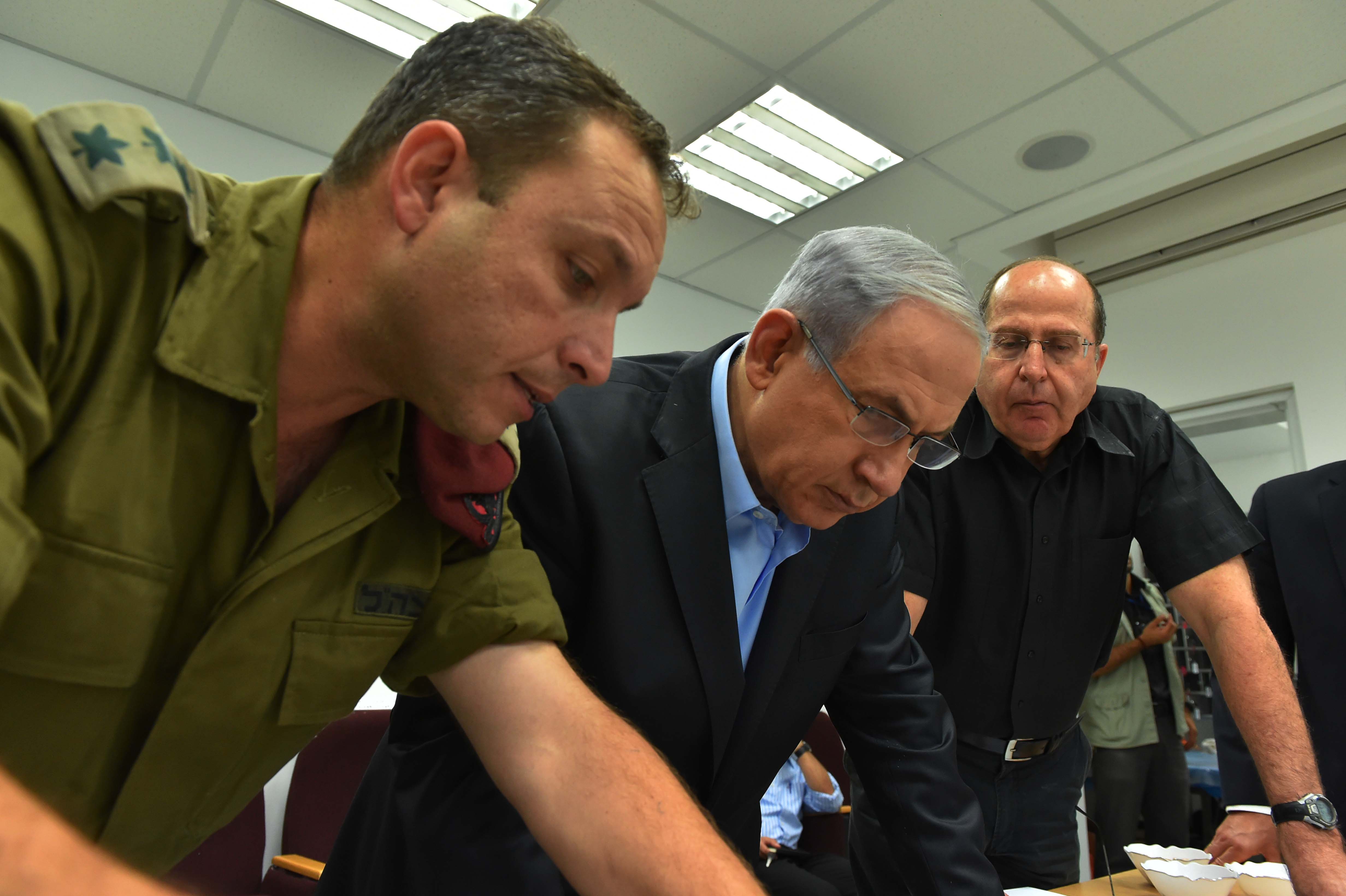
In this Israel Ministry of Defense handout, Israel Defense Minister Moshe Ya’alon (R) and Israel Prime Minister Benjamin Netanyahu meet with IDF forces as they visit the Southern Command in Beersheba, Israel on July 9, 2014. Due to recent escalation in the region, the Israeli army started new deployments at the border with the Gaza Strip. In the past three weeks, more than 130 rockets where reportedly fired from Gaza into Israel. By Ariel Harmoni/Israel Ministry of Defense via Getty Images.
Nine-year-old Dina wounded when shrapnel pieces hit her eyes in an Israeli strike in Gaza, is treated at the Shifa Hospital in Gaza city on August 5, 2014. Palestinian Dina has difficulty in opening her eyes due to the flames and poisoned gas she has exposed in the strike. By Mohammed Talatene/Anadolu Agency/Getty Images.)
 The Dish
