The Myths Of Gaza

Peter Beinart has a relentless rebuttal to several of the talking points by defenders of Israel’s latest assault on Gaza. Since it’s paywalled – but you can get around it by clicking the link in the tweet above – here’s my brief summary.

Myth Number One: Israel left Gaza in 2005. It didn’t in any meaningful way, maintaining control over all of Gaza’s borders, identification of all citizens, and squeezing still further the small space Gazans had to live in. It evacuated a small number of settlers in order to pre-empt any serious two-state negotiation based on the then-operative Saudi and Geneva plans. That’s why the US official position is that Gaza is still under occupation – an occupation that somehow allows Israel to pummel it at will, as if it were a foreign country.

Myth Number Two: Hamas seized power. Nope, it won an election, fueled in part by widespread opposition to Fatah’s corruption and incompetence. Now think about that: the Arab world held a free and fair election … in Gaza. The US reacted by fomenting a Fatah coup against it – that led to Hamas’ seizing power in response. That’s how the US reacts to Arab democracy if the Israelis don’t like it.

None of this excuses Hamas’ war crimes, its rocket fire purposefully directed toward civilians, its extreme theocratic essence and its rabid anti-Semitism. But it sure doesn’t excuse Israel’s brutality and contempt and propaganda either.

Can Israel “Win” This War? Ctd

Brent Sasley says yes to that question:

When the dust settles, Israel will also have restored some of its deterrence against its enemies. Against Hamas specifically, it demonstrated it’s gotten over what we might call Cast Lead Syndrome: recoiling from the type of international opprobrium that war generated against Israel because of the scale of Palestinian deaths. In that conflict, between approximately 1,100 and 1,400 Gazans were killed, depending on what source one looks to for casualty figures. Yet already in Operation Protective Edge, more than 1,000 Palestinians may have been killed. Though Israeli Prime Minister Benjamin Netanyahu has become a cautious administrator since his first term in office, the temptation to keep going to destroy Hamas’ tunnel infrastructure has overcome his reluctance to use large-scale force. And the Israeli public has rallied behind him.

In a debate among Brookings experts, Michael Doran contends that whether or not Israel is “winning”, Hamas is definitely losing:

Six months from now, many Palestinians, especially those in Gaza, will ask themselves what all the pain and destruction that Hamas brought down on them was worth. Their disgruntlement will not weaken Hamas’s grip on power, because it is a dictatorship supported by foreign money. But the organization, as it stands before its people and lectures them on the need for more sacrifice, will surely clock the sullen faces that stare blankly back. As for the “support” that Hamas gets from public opinion in other parts of the Arab world that will certainly dissipate. Of course, it’s never been worth much anyway, throughout modern Arab history, because it never translates into lasting change in the behavior of states, the true power brokers in the region. Meanwhile, Hamas will have lost considerably on the battlefield.

But Shadi Hamid is not so sure:

Even if Hamas “loses” in the ways that you describe, it seems to me that they’re likely to at least be better off than they were before the conflict started.

It’s hard to envision any ceasefire arrangement that won’t include easing the blockade in some way (Hamas has little incentive to agree to a ceasefire that doesn’t alleviate the humanitarian crisis in Gaza). The West Bank surge in pro-Hamas sentiment isn’t just about public opinion; it’s about closing the gap between Hamas and Fatah. If the developments in the West Bank underscore anything, it’s the real, and growing, desire for Palestinian unity. Last week on MSNBC, Mustafa Barghouti said that a new uprising had started. He may be getting ahead of himself, but if a ceasefire doesn’t hold in the coming days, there will be more instability in the West Bank (and corresponding anti-Palestinian sentiment) and that can only strengthen Hamas hand during post-ceasefire negotiations over contours of unity government. Also, the expectation, which I suppose is implicit in these Israeli deterrence operations, is that at some point Palestinians will blame Hamas more than they blame Israel. But, there’s little to suggest this is how most Palestinians process the results of Israeli military operations.

Aaron David Miller considers Hamas the winner, so far:

It’s impossible to predict a winner or loser at this stage. Israel is determined to prevent a Hamas victory or even a stalemated outcome that might appear to represent one. The situation is, as they say, remarkably fluid. But three weeks in, if I had to do a tally now, I’d say Hamas has taken round one in what is likely to be an ongoing struggle. And here’s why:

Survival counts as a winAs in previous confrontations, the organizational imperative dominates Hamas’s tactics and strategy. Against a militarily and technologically superior Israel, Hamas can afford to waste a couple of thousand rockets and lose a few dozen tunnels, but the main goal is keeping both its military and political leadership intact, and not giving into Israel’s superior firepower. Indeed, in a way Hamas wins just by not losing.

And even if Hamas is utterly destroyed in this war, Scott McConnell worries about what would come next:

Suppose Israel succeeds in destroying Hamas. How many terror cells will it have created thoughout the Middle East? Will those cells content themselves in mounting operations against Israel? Or would they also seek vengeance against the superpower which enables, and could even be seen as encouraging, Israel’s annihilation of them. In 2002, a not-very-sophisticated home-grown sniper traumatized the Washington metropolitan area for weeks. If the predictions of one of America’s leading anti-terror officials are correct, Israel is setting the table for much more complex terror operations, in which American civilians will become targets. Sad as it is to contemplate, if that happens, people all over the Mideast will believe we are only getting what we deserve.

Previous Dish on what an Israeli “victory” would entail in the Gaza war here.

We Won’t Make Israel Make Peace

After John Kerry’s efforts to broker a ceasefire in the Gaza war crashed and burned, Zack Beauchamp asks why the $3 billion in aid we give Israel every year doesn’t seem to buy us any leverage:

Talk to Middle East analysts, and you get a clear sense that the US really could box Israel in a corner if it wanted to. “In theory, of course the US has enormous leverage over Israel,” says Nathan Thrall, a senior analyst at the International Crisis Group. But in “the very unlikely event” that “the US were to threaten the very alliance with Israel,” he says, it’d put immense pressure on an Israeli Prime Minister to bend.

Clearly, the United States doesn’t want to do that. But it has successfully pressured Israel before. For instance, the Bush administration forced Israel to back off an arms deal with China in 2005 by threatening to cut off military cooperation on certain projects. The US refused to give Israeli aircraft friend-or-foe codes during the Gulf War, effectively keeping Israel out. It refused to give American support for an Israeli strike on Iran’s nuclear program, which amounted to vetoing it.

So it’s not that the US can’t ever push Israel. It’s that American policymakers aren’t willing to threaten the foundations of the US-Israeli relationship — aid, diplomatic support, and the like — over a ceasefire in Gaza or even a final status peace agreement.

Drum, on the other hand, is skeptical that the US could do anything to make peace between parties whose objectives are fundamentally incompatible. As long as that’s the case, he argues, we should just stop trying:

Quite famously, we all “know” what a deal between Israel and the Palestinians needs to look like. It’s obvious. Everyone says so. The only wee obstacle is that neither side is willing to accept this obvious deal. They just aren’t. The problem isn’t agreeing on a line on a map, or a particular circumlocution in a particular document. The problem is much simpler than that, so simple that sophisticated people are embarrassed to say it outright: Two groups of people want the same piece of land. Both of them feel they have a right to it. Both of them are, for the time being, willing to fight for it. Neither is inclined to give up anything for a peace that neither side believes in.

That’s it. That’s all there is. All the myriad details don’t matter. Someday that may change, and when it does the United States may have a constructive role to play in brokering a peace deal. But that day is nowhere in the near future.

I can see Kevin’s grim point. But as long as we are financing and subsidizing Israel’s wars, we are not neutral. Only if we cut off our aid can we afford the luxury of viewing the entire conflict as irresolvable. Everything else is complicity.

Correction Of The Day II

It’s an honorable apology and correction. But it’s hard not to see in the eight tweets that David sent out questioning the integrity of these harrowing images of grief and murder a desperate need not to see what is in front of our noses. The mind-boggling trauma and terror that Gazan civilians are now experiencing is so very hard to watch, when this country is partly financing it. For those attached to Israel, the experience must be particularly wrenching. Denial is a perfectly understandable response when confronted with nearly 250 dead children.

Gaza Goes Dark

How can you punish a people more than bombing their schools, hospitals and playgrounds? Knock out their only power plant:

The plant’s general manager, Jamal Dersawi, told NBC News that the loss of the structure is a “major disaster” for Gaza’s 1.8 million residents, whose electricity has already been limited by damage to power lines from Israel. According to Reuters, the plant provides two thirds of the energy in Gaza, including the area’s water sanitation facilities and pumps. (Residents are now being told to be careful with their water consumption.) The structure could be out of operation for up to a year.

Jesse Rosenfeld doubts it was an accident:

This is not the first time Israel has knocked out Gaza’s power plant and targeted essential infrastructure. Indeed, this is almost part of a standard playbook. Following Hamas’ kidnapping of Israeli soldier Gilad Shalit in 2006, Israel plunged Gaza into darkness with a retaliatory strike on the power plant.  The bombing and escalation in Gaza set off a series of events that led to a full-on war in Lebanon as well as Gaza. …

It is people like the al Wakeel family who pay the harshest price for this military duel. They fled the Al Shajaya neighborhood under intense shelling last week, and 55 family member are now crammed into a three bedroom apartment in Gaza City. With little water and only a few hours of electricity a day they were unable to shower or bathe the 25 children in the apartment. Now that the power plant has been hit, they have no water and no electricity.

Noting that the power outage also curtails the flow of information out of the strip, Juan Cole attempts a tally of the destruction:

Israel has completely reduced to rubble some 5,000 homes and damaged 26,000. If you figure that Palestinians in Gaza live on average 5 in a dwelling, there would be roughly 340,000 domiciles in Gaza. Israel has therefore destroyed or damaged about ten percent of the housing stock. This is on top of past campaigns of indiscriminate and wanton bombing campaigns. Since Israel keeps Gaza under blockade, it won’t receive the necessary materials to rebuild. The Israelis, having bald-facedly stolen the homes and farms of the people of Gaza, won’t be satisfied until they are forced to sleep in open fields.

Israel has forced some 200,000 Palestinians to flee their homes. But since the Gaza Strip is so small, they have no place to go. Israel won’t let them leave the Strip, but is intensively bombarding it. Some of the places they have taken shelter, including schools and UN refugee shelters, have themselves been bombed by the Israelis.

Another UNRWA school in the Jabaliya refugee camp was bombed this morning. Hayes Brown passes along the news:

For the second time in as many weeks, a United Nations-run school in the Gaza Strip was hit with with artillery fire, with reports that as many 90 Palestinians were wounded in the attack that killed an estimated 19 people. The shelling that struck in Jabaliya landed around 5 a.m. early Wednesday morning, reportedly falling in rapid succession. Around 3,300 Palestinians had been using the United Nations Relief Works Agency (UNRWA) school for shelter from the Israeli campaign to root out Hamas and other militant groups in the strip when the explosions began. “One hit the street in front of the entrance, according to several witnesses,” the New York Times reported. “Two others hit classrooms where people were sleeping.” …

Meanwhile, the death toll continues to escalate, according to the latest report from the United Nations Office for the Coordination of Humanitarian Aid (OCHA). So far in the three week war, 1,118 Palestinians have been killed — including “at least 827 civilians, of whom 243 are children and 131 are women” — and 56 Israelis. More than 240,000 Palestinians are currently displaced, or more than ten percent of the Gaza Strip’s population of 1.8 million. “UNRWA has exhausted its absorption capacity in Gaza City and northern Gaza, while overcrowding at its shelters raises concerns about the outbreak of epidemics,” OCHA wrote.

Ringing In The Post-Peace Process Era?

This time-lapse video purports to show the Israeli military flattening a Gaza neighborhood over the course of an hour. In Rashid Khalidi’s take, Israeli leaders have done the same to the peace process:

What Israel is doing in Gaza now is collective punishment. It is punishment for Gaza’s refusal to be a docile ghetto. It is punishment for the gall of Palestinians in unifying, and of Hamas and other factions in responding to Israel’s siege and its provocations with resistance, armed or otherwise, after Israel repeatedly reacted to unarmed protest with crushing force. Despite years of ceasefires and truces, the siege of Gaza has never been lifted.

As Netanyahu’s own words show, however, Israel will accept nothing short of the acquiescence of Palestinians to their own subordination. It will accept only a Palestinian “state” that is stripped of all the attributes of a real state: control over security, borders, airspace, maritime limits, contiguity, and, therefore, sovereignty. The twenty-three-year charade of the “peace process” has shown that this is all Israel is offering, with the full approval of Washington. Whenever the Palestinians have resisted that pathetic fate (as any nation would), Israel has punished them for their insolence. This is not new.

Contrary to Netanyahu’s purposes, Khaled Elgindy argues, the war has united the Palestinian factions and made a third intifada more likely:

Hamas’ relative success on the battlefield has boosted the group’s popularity while highlighting Abbas’ perceived impotence. According to one recent poll, since the Gaza crisis began, popular support for Hamas has outstripped support for Fatah for the first time in several years. Even so, most Palestinians understand the limitations of engaging in armed struggle against a formidable military power like Israel. As a result, despite the recent collapse of U.S.-led peace talks, Abbas’ negotiations agenda remains relevant.

More significantly, the ongoing devastation in Gaza has forced all Palestinian factions for the first time in many years to close ranks on a major political issue (as opposed to procedural or administrative matters, which were at the heart of the recent reconciliation agreement). Indeed, one of Hamas’ chief demands was that Israel respect its reconciliation agreement with Fatah. During previous conflicts in Gaza, the leadership in the West Bank had been reluctant to side openly with Hamas. Those calculations clearly no longer apply.

But Steven Cook is not optimistic about the prospect of rescuing Abbas from irrelevance:

Almost from the start of the conflict in the Gaza Strip, the commentariat has been seized with the idea of “empowering [Palestinian Authority President Mahmoud] Abbas” as the only way out of the recurrent violence between Israel and Hamas. The discovery of this idea in Washington (and Jerusalem for that matter) is rather odd, not because it does not make sense, but rather because the idea is so reasonable and obvious that one wonders why — ten years after he became the Palestinian leader — it took so long to recognize it. Almost from the moment of Yasser Arafat’s death, Egypt sent high-level emissaries to the United States, warning that the new Palestinian president needed help lest he gradually cede the political arena to Hamas. He did not get it then and now it is likely too late to salvage Abbas. …

Over the last decade the combination of American and Israeli political pressure, missteps, and disingenuousness have consistently left the Palestinian president in a bind, forced to take part in negotiations that he and his advisors knew would never go anywhere, and then hung out to dry when they failed.

And that’s about as bullish as Michael Totten feels about the peace process:

Nobody can know how the next attempt will play out in detail, but none of the actors at this point is optimistic. And that’s without factoring Hamas into the equation, which rejects both negotiations and peace out of hand and vows to wage a decades- or even centuries-long war to the finish. Hamas will gleefully sacrifice a thousand Palestinian lives to kill a few dozen Israelis because its leaders truly believe that if life becomes too precarious and nerve-wracking for Jews in the Middle East that they’ll give up and quit the region forever. It’s a fantastical bloody delusion, but it’s what they believe and they are not going to stop any time soon.

I hate to be too cynical about this myself, but as I’ve said before, the Middle East is a great teacher of pessimism. A few years ago I asked Israeli writer and researcher Hillel Cohen what he expected to see in Jerusalem 50 years in the future. “Some war,” he said, shrugging. “Some peace. Some negotiations. The usual stuff.”

That niggling concern, that the peace process is finally dead, will be keeping political scientists busy long after this war is over, Marc Lynch predicts:

What happens if there is no peace process? There’s a plethora of articles about the vicissitudes of Israeli-Palestinian peace negotiations, but far fewer on how to think about their absence. It has probably been more than a decade since anybody seriously believed in the possibility of a negotiated two-state solution, but most diplomats and pundits continue to go through the motions out of fear of contemplating the alternatives. After the failure of Secretary of State John Kerry’s team, it is hard to imagine anyone else putting much effort in to them any time soon.

Some long-standing assumptions seem ripe for testing. What happens now that peace talks seem unlikely to resume? What is the universe of comparable cases, and how did they end up? Is it really true that Israel cannot sustain the status quo indefinitely? Does the commonly-invoked tension between being a Jewish state and a democracy still really matter to Israelis, given the ongoing changes in Israel’s demographics and the shift rightward in its political culture?
The Best Of The Dish Today

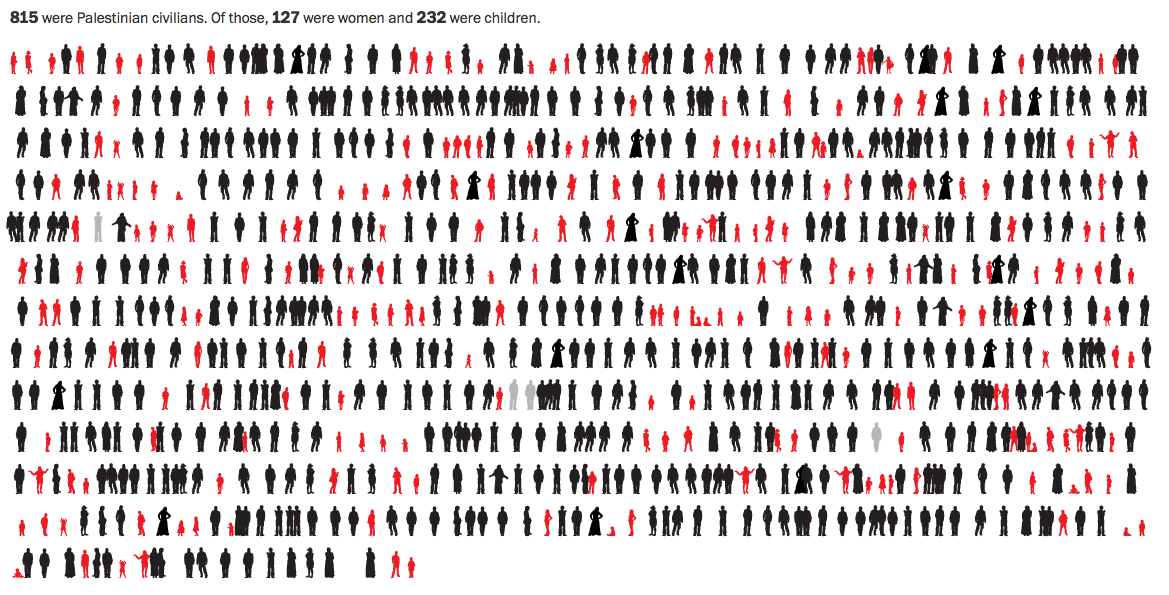
Screen Shot 2014-07-29 at 11.53.08 AM

Above is an info-graphic from the Washington Post that visualizes the 815 civilian dead in Gaza (it’s updated day by day). The small red figures are children. 232 children have now died under the Israeli assault on Gaza, which originated in the outrage at the murder of three Israeli teens. I cede my time to Roger Cohen:

No argument, no Palestinian outrage or subterfuge, can gloss over what Jewish failure the killing of children in such numbers represents.

And to Jon Chait:

It is not just that the unintended deaths of Palestinians is so disproportionate to any corresponding increase in security for the Israeli targets of Hamas’s air strikes. It is not just that Netanyahu is able to identify Hamas’s strategy — to create “telegenically dead Palestinians” — yet still proceeds to give Hamas exactly what it is after. It is that Netanyahu and his coalition have no strategy of their own except endless counterinsurgency against the backdrop of a steadily deteriorating diplomatic position within the world and an inexorable demographic decline. The operation in Gaza is not Netanyahu’s strategy in excess; it is Netanyahu’s strategy in its entirety.

This does seem to be a tipping point, doesn’t it?

Today, we remembered Tony Judt’s prescience and the shifting American debate on Israel; noted a sea-change among the younger generation of Americans; and chronicled the latest bout of Israeli hating on Kerry and Obama. I tried to pre-empt George Tenet’s doomed attempt to prove he wasn’t a war criminal by authorizing torture; I parsed Montaigne’s conservative disposition – and Oakeshott’s “conservatism of joy.” And we noted the progress on the right marked by Paul Ryan’s latest plan on poverty.

The most popular post of the day was Why Am I Moving Left?, followed by The Shifting Israel Debate.

Some of today’s posts were updated with your emails – read them all here.  You can always leave your unfiltered comments at our Facebook page and @sullydish. 24 27 more readers became subscribers today. You can join them here – and get access to all the readons and Deep Dish – for a little as $1.99 month. Gift subscriptions are available here. Dish t-shirts and polos are for sale here. One reader is about to snatch one up:

I’m much taken by the new Dish logo T-shirts and wanted to thank you for producing versions that have only the beagle logo and are thus recognizable only to the cognoscenti. An order will be forthcoming. But surely someone with your experience in pun-laden headlines should not have missed the opportunity to label this approach as “dog-whistle marketing?” Oh, the opportunity lost …

See you in the morning.

The Ruins Of Gaza

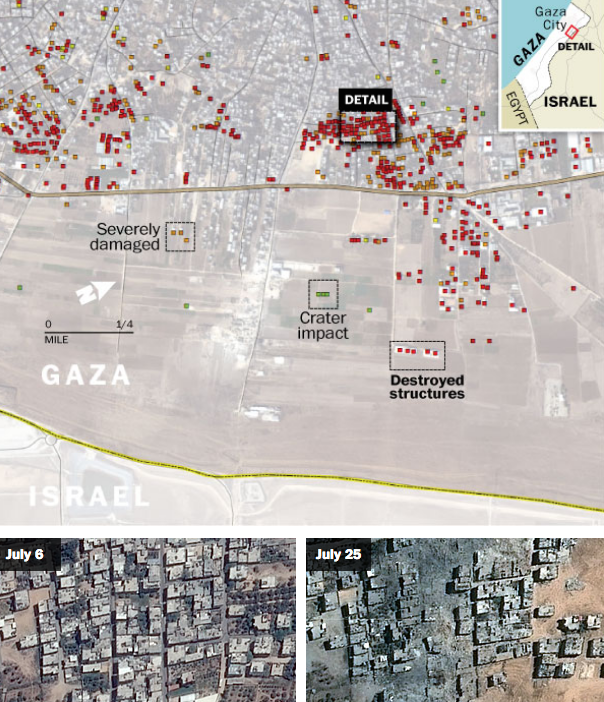
Gaza Damage

The Israeli army is employing what Jesse Rosenfeld calls scorched earth tactics in Gaza, practically leveling entire neighborhoods, as the UN satellite photo above illustrates:

The Israeli military, relentlessly and methodically, is driving people out of the three-kilometer (1.8 mile) buffer zone it says it needs to protect against Hamas rockets and tunnels. According to the United Nations Office for the Coordination of Humanitarian Affairs, the buffer zone eats up about 44 percent of Gaza’s territory. What that means on the ground is scenes of extraordinary devastation in places like the Al Shajaya district approaching Gaza’s eastern frontier, and Beit Hanoun in the north. These were crowded neighborhoods less than three weeks ago. Now they have been literally depopulated, the residents joining more than 160,000 internally displaced people in refuges and makeshift shelters. …

According to Hebrew University political scientist and longtime analyst of the Israeli-Palestinian conflict, Yaron Ezrahi, with or without the phrase [“scorched earth”], the idea does have a certain logic.

Ezrahi says there is a military and political calculation behind this devastation. Some in the Israeli government believe it will create enough Palestinian suffering so that Gazans will rise up against Hamas or force the leaders to come to terms with Israel when they come out of hiding. But that is an assumption that greatly underestimates the resolve of Gazans to see an end to their seven years of Israeli blockade and rid themselves of the Israeli presence that controls the strip like guards positioned around a prison yard.

Sari Bashi argues for lifting the travel restrictions on Gazans:

[I]t would be a mistake to consider the negotiations over the travel restrictions as a zero-sum game—as if lifting them were a concession to militants that must be balanced by concessions to Israel. Ending the restrictions on civilian movement into and out of Gaza would have the primary effect of benefiting Palestinian students, workers, farmers and factory owners, and many Israeli officials say doing so would improve Israeli security.

Closing off Gaza hasn’t made Israel safer. Yet that’s exactly what Israel has gradually done for the past two decades, especially since the 2007 takeover of Gaza by the Hamas movement. While Israel formally recognizes Gaza and the West Bank as a single territorial unit in international agreements, in practice it implements what it calls the “separation policy,” designed to sever Gaza from the West Bank and keep movement of people and goods to a “humanitarian minimum.” Travel to Israel and the West Bank is limited to exceptional humanitarian cases, mostly medical patients and merchants buying essential goods, and the number of Palestinians passing through the Israeli-controlled Erez Crossing is less than 1 percent of what it was in September 2000, on the eve of the Second Intifada.

Previous Dish on the humanitarian disaster in Gaza here.

(Image source: WaPo)

The Lie Behind The War, Ctd

Netanyahu has claimed that “Hamas is responsible” for the recent murder and kidnapping of three Israeli teens. Reporting suggests otherwise. Batya Ungar-Sargon attempts to undermine those reports:

It’s entirely possible that there was some “lone cell” with no more than tenuous Hamas connections—but right now all we have is [BuzzFeed’s Sheera] Frenkel’s ambiguous anonymous source and [BBC’s Jon] Donnison’s source who believes he was misquoted as our only evidence for that proposition.

Sheera Frenkel’s new dispatch provides more info on her source:

[O]ne Israeli intelligence officer who works in the West Bank and is intimately involved in investigating the case spoke to BuzzFeed on condition of anonymity and said he felt the kidnapping had been used by politicians trying to promote their own agenda.

“That announcement was premature,” the intelligence officer said. “If there was an order, from any of the senior Hamas leadership in Gaza or abroad, this would be an easier case to investigate. We would have that intelligence data. But there is no data, so we have come to conclude that these men were acting on their own.”

Meanwhile, Max Fisher, no great friend of Netanyahu, argues that it’s not fair to claim that Netanyahu used these kidnappings as a pretext for war:

In order to say that Netanyahu blamed Hamas for the Palestinians murders in order to invade Gaza, as President George W. Bush premised his Iraq invasion on Iraqi weapons of mass destruction, two things would have to be true. First, Netanyahu would have had to have planned the sequence of events from the beginning such that he would get to invade Gaza; the Middle East is rife with conspiracy theories but unless Netanyahu secretly controls Hamas, Israeli extremist gangs, and Palestinian protesters, he did not plan this. It seems much likelier that things gradually escalated out of control until both sides were sucked into war.

Second, Netanyahu would have had to have wanted to invade Gaza. You don’t devise an elaborate conspiracy to do something, after all, unless you actually want to do it. This is ultimately a question of Netanyahu’s personal internal motivation, which I will not claim to know. For whatever it’s worth, an American veteran of the Israel-Palestine peace process named Aaron David Miller wrote in the Washington Post that he believes Netanyahu did not want or seek the war. Maybe, maybe not.

If you want to get angry about something, get angry about this: Israel has for years refused to change its strategy toward Gaza and the larger Israel-Palestine conflict, even though that strategy shows zero indication of yielding sustainable peace and leads Israel to occasionally invade Gaza to weaken anti-Israel groups there.

For the record, I agree. My point is that Netanyahu’s reflexive, evidence-free, blanket condemnation of Hamas as a whole created a situation that spiraled out of control.

The Age Gap On Gaza

Gaza Blame

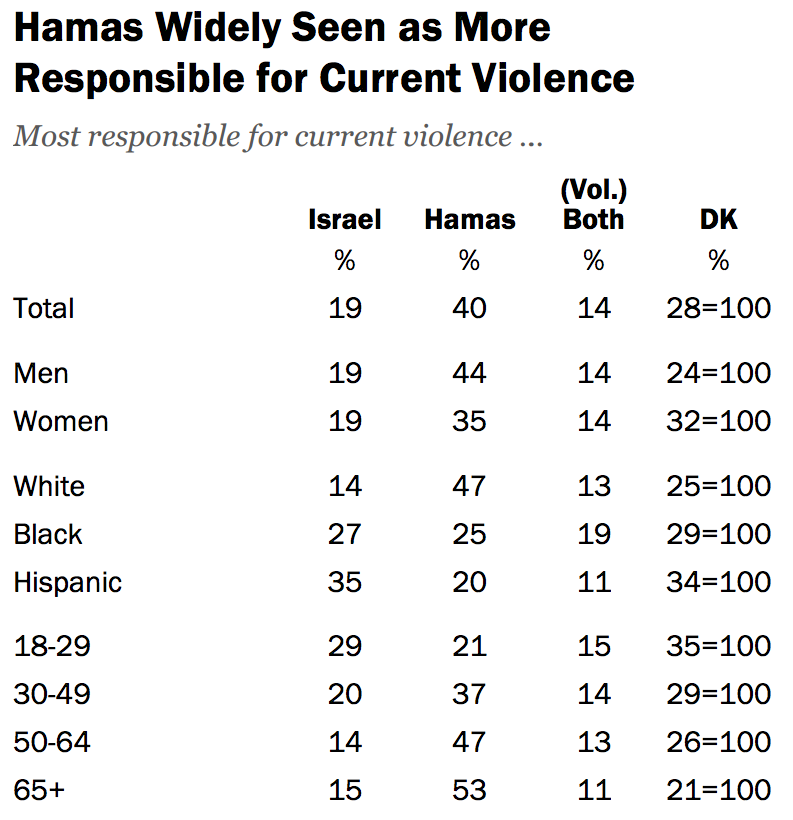
Aaron Blake parses a new Pew poll asking Americans who’s to blame for the war in Gaza:

While all age groups north of 30 years old clearly blame Hamas more than Israel for the current violence, young adults buck the trend in a big way. Among 18 to 29-year olds, 29 percent blame Israel more for the current wave of violence, while 21 percent blame Hamas. Young people are more likely to blame Israel than are Democrats, who blame Hamas more by a 29-26 margin. Even liberal Democrats are split 30-30. The only other major demographic groups who blame Israel more than Hamas are African Americans and Hispanics.

The poll echoes a Gallup survey from last week. Gallup asked Americans whether they thought Israel’s recent actions were justified. While older Americans clearly sided with Israel, 18 to 29-year olds said by a two-to-one margin (51-25) that its actions were unjustified. No other group was as strongly opposed to Israel’s actions.

Ron Fournier warns Israel of what polls like these portend:

[A] generation of global citizens is rising to power without the Israeli narrative embedded so firmly in its consciousness. The so-called Arab Spring and the United States’ diminished influence abroad has created a new set of filters through which young people will consider the Israeli-Palestinian conflict, a viewpoint that might be less inclined to favor the Jewish state. …

Again, none of this is intended to suggest that Israel should bow to Hamas’s demands. Israelis must defend themselves. Neither is this a case for or against Israel completing its current mission to shutter terrorists’ tunnels and silence the rockets. Rather, it’s a warning that Israel’s decades-old public relations and political dominance is coming to an end unless the nation’s leaders change the narrative and reset their strategic position with moderate Palestinians.

Previous Dish on American views of Israel and the Gaza conflict here and here.