The Holy Land From On High

gaza-space

Megan Garber captions:

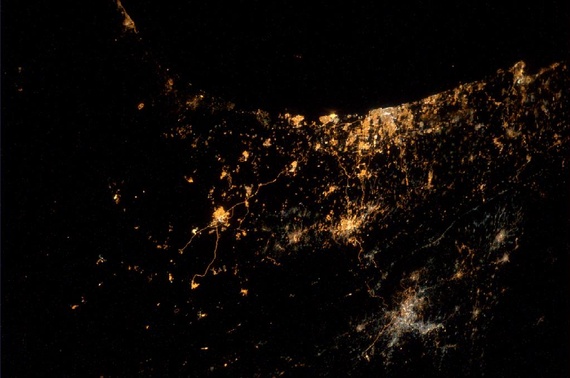
The orbiting space station—itself a symbol of international cooperation and, in that, global unity—passed over Israel and Palestine as it orbited Earth’s surface yesterday. It was nighttime on that side of the planet, as one human habitat passed over another; everything was dark save for the man-made lights studding the land. And save for one other thing, too: explosions. The flashes of bright light—brighter than the other ones—that are distantly visible evidence of human bloodshed. “From  we can actually see explosions and rockets flying over  & ,” [Astronaut Alexander] Gerst tweeted. He then shared the image above. He noted, as he did so, that it was his “saddest photo yet.”

Bibi’s Strategy, Ctd

Larison is unconvinced by Rich Lowry’s cheerleading for Israel in the Gaza war, which Lowry attributes entirely to Hamas’ “depraved indifference to the safety of Gazans”. If Lowry is right about Hamas’ aims, Larison argues, that actually illustrates why Israel going to war hurts its own interests in the long term:

The summary is misleading at best, but even if we accept all of it as true it doesn’t make Israel’s current military operation defensible. Hamas may want war and civilian casualties, and it is fully responsible for everything that it does, but that doesn’t justify Israel in giving them what they want. Nothing could better sum up the irrationality of defenders of the current operation than the argument Lowry is offering here. We’re supposed to accept that Israel’s government mustn’t be faulted for what it’s doing, because Israeli forces are inflicting death and destruction that predictably redounds to Hamas’ political benefit. According to this view, Hamas is the only one to be blamed for the consequences of the military overreaction that has stupidly given Hamas an unwelcome boost. This is little better than the foreign policy equivalent of saying “the devil made me do it,” as if it that made everything all right.

And Daniel Byman argues that Israel’s strategy of heavy-handed deterrence often ends up producing the opposite outcome:

Because Israel is arguably the most casualty-sensitive country in the world, deterrence is even harder. With nuclear weapons and carpet-bombing off the table, Israel needs to go in on the ground to achieve its objectives — but ground operations can lead to Israeli casualties that actually undermine its deterrence.

In 2011, it traded over 1,000 prisoners for Gilad Shalit, an Israeli soldier captured by Hamas in 2006. Israel has even traded high-level prisoners for the bodies of its dead soldiers. As a result, the body counts for successful deterrence are often staggering and highly disproportionate: In the 2008-2009 Cast Lead operation, Israel killed more than 1,200 Palestinians and suffered only 13 losses of its own — roughly a 100-1 ratio. This, of course, makes Israel look even more callous.

Brent Sasley doesn’t think much of Netanyahu’s stated goal of “sustainable quiet”:

As far as I can tell, “quiet” is defined as a number of rockets, preferably not by Hamas, so long as they don’t cause any damage, certainly don’t kill any Israelis, and there’s nothing else that requires a bigger Israeli response. That, I think, is the goal.

Now, my concern is that Israel doesn’t have a strategic agenda for the region as a whole, which means it doesn’t have a strategic goal in this operation. Not a Bibi problem, it’s an Israel problem. There’s a history to it — that’s how Israel developed, it’s been forced on the defensive, it thinks reactively instead of proactively, and so on. Those are all important explanations, but it goes beyond that. After a certain point, it becomes a cop-out to say “Israel just can’t think long-term.”

Now, some people say that there is a strategy — that horrible term “mowing the grass,” or I guess a “war of attrition” is a more sophisticated way of saying it. That’s a holding pattern, as far as I can see. Israel doesn’t have a national security strategy, it’s never really articulated one.

So what Hamas has to gain by firing rockets is more political than anything else:

Israeli officials say the system has intercepted more than 80 percent of the incoming rockets it targeted during this conflict, with most others missing their targets or landing in empty space. But Jeffrey White, a defense fellow at the Washington Institute for Near East Policy, says Hamas reaps benefits from showering Israel with missiles, even if they don’t hit their targets. “Their ability to disrupt life in Israel is big, because every time they fire a volley of rockets, sirens go off and everyone runs for shelter,” White says. “School gets closed, life gets disrupted, it puts people under a lot of strain.”

The strikes could have economic effects as well, as evidenced by this week’s decision from the Federal Aviation Authority to halt all flights into Israel after a long-range missile landed near Ben Gurion airport outside Tel Aviv — a decision that White describes as “a huge development.” (The ban was lifted late Wednesday, after the FAA said it was satisfied with safety measures that Israel implemented.)

Goldblog, however, is more concerned about Hamas’s tunnels than its rockets:

Israelis appear adamant that any cease-fire agreement reached between the parties must eradicate the threat of these kidnapping tunnels, at a minimum. Anything short of this will fail to bring any stability to the region. Hamas, which is incapable of envisioning peace and reconciliation in the manner of advocates for a two-state solution, and which has already rejected multiple calls for cease-fires, is demanding that Israel and Egypt (which has Gaza’s southern border blockaded as well) reopen both Gaza’s borders and its ports.

This would be insanity. For years, Hamas leaders demanded that Israel allow them to import concrete in order to build homes for Gaza’s poor. We now know where so much of this concrete went — into the tunnels that run under Israel’s border, and into bunkers and bomb shelters for Gaza’s ruling elite. (The civilians of Gaza, the ones exposed to Israel’s bombardments, do not benefit from these exclusive bomb shelters).

Overall, Mitchell Plitnick contends, Hamas is sort of winning:

Palestinian President Mahmoud Abbas has been working to help find a ceasefire formula. In the past, Hamas would disavow Abbas’ authority to negotiate for them, but they have not done so this time. That’s because Abbas is arguing for Hamas’ terms for a ceasefire. That makes Abbas, rather than any Egyptian or Turkish leader, the contact point between Hamas and Israel. It also symbolically demonstrates that the Palestinians have a unified government — Abbas is presenting himself as the leader of all of Palestine, including Gaza, without saying so or ruffling any of Hamas’ feathers.

Israel’s goal in starting this round of fighting was to destroy the unity deal between the Palestinian Authority and Hamas. Thus far, the opposite seems to have materialized. Abbas is in agreement with Hamas’ goals, and is apparently fully representing them. That represents a major failure for Netanyahu.

Previous Dish on Netanyahu’s political and military strategy in the Gaza war here.
America’s Mixed Feelings On Gaza

5s7kx2l-zkoypyrmn6f49a

Larison flags a new Gallup poll suggesting that US public opinion on the Gaza war is more complicated than our government’s response to it:

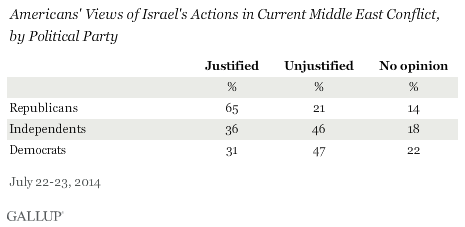
Gallup finds that Americans are split on the question of whether Israel’s actions in Gaza have been justified or not. Overall, 42% say that they are justified, 39% say they are not, and 20% have no opinion. These results are comparable to a Gallup poll taken during the second intifada twelve years ago, but there are slightly more on the ‘unjustified’ side than there were then. As we have seen in other polls on related matters, there is a significant gap between Republicans and everyone else[.]

It is striking how evenly divided the public is on this question when there is total uniformity among political leaders in the U.S. that Israel is justified in what it has been doing. There is always a significant gap between popular and elite views on foreign policy issues, but it is still fairly unusual for a view held by almost 40% of Americans to have virtually no representation in Congress.

Another poll from YouGov finds that more detailed questions yield more nuanced answers:

Americans are much more likely to hold Hamas responsible for the current crisis than they are to put responsibility on Israeli Prime Minister ResponsibilityBenjamin Netanyahu. But that doesn’t mean that Netanyahu is totally blameless:  47% of the public says he deserves at least half the blame.  But two-thirds say that about Hamas. Three in four Republicans give Hamas at least half the blame. Just 40% of Republicans say that about Netanyahu. Democrats share the responsibility more evenly: 60% give Hamas at least half the responsibility; 54% say that about Netanyahu.

But some are concerned about Israeli actions. One in four believes Israel is using too much force in Gaza, with Democrats and those under 30 especially concerned.  But more believe Israel is using the right amount of force; 15% (and nearly one in four Republicans) believe Israel is using too little force.

But as we know, the right wasn’t always reflexively behind Israel. Looking back on the history of American-Israeli relations, Zack Beauchamp susses out the sources of the staunchly pro-Israel foreign policy the US follows today:

For one thing, the US approach to the Middle East didn’t change that much after the Cold War. The US became increasingly involved in managing disputes and problems inside the Middle East during the Cold War, and it maintained that role as the world’s sole super-power in the 90s. Stability in the Middle East continued to be a major American interest, for a number of reasons that included the global oil market, and the US took on the role as guarantor of regional stability.

That meant the US saw it as strategically worthwhile to support states like Egypt, Saudi Arabia, and Israel, which saw themselves as benefitting from an essentially conservative US approach to Middle Eastern regional politics. Unlike, say, Iran, Syria, and Saddam’s Iraq, these countries were basically OK with the status quo in the Middle East. The US also supported the status quo, so it supported them accordingly.

Previous Dish on the partisan divide in American public opinion of Israel here.

Quote For The Day

Tensions Remain High At Israeli Gaza Border

“I still felt the same [way about Israel] in 1973, during the Yom Kippur War when Israel reeled before a devastating Egyptian and Syrian surprise attack. From amid the Israelis’ camp fires, as a correspondent I wrote expressing my admiration for the nation, for what it had created from a near-wasteland: ‘They are a very great people, who have come closer to destruction than blind Europe seems willing to recognise.’

The veteran journalist James Cameron, who had known Israel since its inception, wrote me a generous note after that piece was published, saying: ‘It is quite impossible to work in combat with the Israeli army without this response, if you have any sense of history and drama.’ But then he added reflectively: ‘I have sometimes wondered over the past few years whether this irresistible military mesmerism hasn’t clouded for us some of the political falsities.’

Some 40 years on, I have become sure that Jimmy Cameron was right. Too many of us allowed ourselves to become blinded by military success to the huge injustice done to the Palestinians. Israelis, confident that they can defeat any Arab military threat, bolstered by almost unqualified U.S. support, assume that they can persist indefinitely with the creeping annexation of the West Bank, and the subjection of Gaza …

A few years ago, I revisited the West Bank and Gaza, and like most visitors recoiled from their squalor, the prevailing culture of rage and despair. It is true that the Palestinians, led by men skilled in guerrilla war but little else, speak a language of emotion and unreason. But I have also watched the soldiers of the Israeli Army that I once loved disport themselves among the Palestinians like other arrogant occupiers through the ages, displaying at best casual rudeness, at worst murderous brutality. Israel aspires to exploit its military dominance to create irreversible facts on the ground in the West Bank and Jerusalem, heedless of Palestinian rights,” – Max Hastings, no peacenik, saying what so many others actually think, in the Daily Mail.

(Photo: An Israeli soldier weeps at the grave of Israeli Sergeant Adar Barsano during his funeral on July 20, 2014 in Nahariya, Israel. Sergeant Barsano was killed along with another IDF soldier on the twelfth day of operation “Protective Edge,” when Hamas militants infiltrated Israel from a tunnel dug from Gaza and engaged Israeli soldiers. By Andrew Burton/Getty Images)

It’s Time To Take A Break From Bombing Schools

PALESTINIAN-ISRAEL-CONFLICT-GAZA

It’s not just in American schools that they slaughter kids. To John Cassidy, the alleged shelling of an UNRWA school in Beit Hanoun yesterday underscores the need for an immediate ceasefire:

Alarmingly, hopes for a ceasefire faltered on Thursday. Secretary of State John Kerry left a meeting with Benjamin Netanyahu without securing an agreement. According to a report in the Washington Post, Netanyahu was furious about a ban on commercial airliners landing in Tel Aviv that the Federal Aviation Administration imposed earlier this week, suspecting that “it was an attempt by the Obama administration to squeeze Israel to end its Gaza campaign.” The flight ban was lifted on Thursday night, but Israel and Hamas gave no indication that they were ready to reach a deal. A senior official for Hamas reiterated that it wouldn’t halt its rocket attacks until Israel agreed to end its blockade of Gaza.

Meanwhile, Moshe Ya’alon, Israel’s defense minister, told troops preparing to enter the Strip that the I.D.F. was on the verge of broadening its offensive. “We are preparing the next stages of the fighting after dealing with the tunnels, and you need to be ready for any mission,” Yaalon told the soldiers, according to the Post. “You need to be ready for more important steps in Gaza, and the units that are now on standby need to prepare to go in.” After Thursday’s tragic strike, where can Gaza residents take shelter?

Colum Lynch puts the strike on the school in context:

The tragedy at Beit Hanoun came during a particularly grim week for the United Nations.

Three Palestinian teachers employed by the U.N. Relief and Works Agency (UNRWA) were killed this week, marking the first casualties for the international organization since fighting began 16 days ago. Chris Gunness, UNRWA’s spokesman, announced on Twitter: “1st UNRWA deaths in #Gaza war, all teachers, 2 killed while at home, another walking home after working in an UNRWA shelter.”

During his Tuesday videoconference with the Security Council, Ban praised UNRWA for carrying on in the midst of war. “I want to stress how deeply proud I am of our many U.N. colleagues, with UNRWA in the lead, courageously assisting the people of Gaza under such difficult circumstances.” He also said that the escalation in fighting was “acutely affecting” UNRWA’s operations and that 23 of its installations have been closed and 77 damaged during the latest round of fighting. Palestinian militants have taken advantage of those closures, turning vacant U.N.-administered schools into temporary arsenals for rockets, causing even more friction between the United Nations and Israel.

(Photo: A trail of blood is seen in the courtyard of a UN School in the northern Beit Hanun district of the Gaza Strip on July 24, 2014, after it was hit by an Israeli tank shell. By Marco Longari/AFP/Getty Images)

All Wars Are Important, But Some Wars …

Goldblog wonders why the press is paying so much attention to Gaza and so little to Syria, when the implications of the latter conflict are, in his view, much broader (and the death toll much higher):

[T]he Arab Spring (or Awakening, or whatever word you choose) has given lie to the idea—shorthanded as “linkage”—that the key to American success in the broader Middle East is dependent on finding a solution to the Israeli-Palestinian conflict. This idea, that all roads run through  Jerusalem, has traditionally motivated a great deal of journalistic and foreign policy expert interest in this conflict. Finding a solution to this conflict is very important to the future of Israelis and Palestinians, of course, but not nearly so much to Americans. A peaceful resolution to this conflict would do little to bring about good governance in Arab states, or an end to Islamist extremism in the greater Middle East. Which brings me back to Syria. The war in Syria (and Iraq, since it is more or less a single war now) is of greater national security importance to the United States than the war in Gaza, and it should be covered in a way that reflects this reality.

It’s a familiar, ancient device for Israel apologists: there are worse massacres elsewhere; solving Israel-Palestine won’t help us much in foreign policy anyway; so let’s move right along, shall we? And don’t mention the settlements, except in asides that are designed to credentialize the writer as someone who naturally opposes them – even as he also opposes any serious pressure on Israel to stop the provocations. He attributes the discrepancy to the Western world’s weird obsession with criticizing Israel, which is subtler version of the accusation of anti-Semitism.

One reason, of course, which Goldblog mentions, is that the US is partly paying for the slaughter in Gaza and for the clean-up afterwards. More to the point, condemnation of Assad is universal in the US (while Netanyahu is lionized and egged on by one political party), and the conflict there is an evenly matched civil war, rather than one more relentless pounding of a weak mini-state under Israeli control with casualties massively lop-sided in one direction. This is not to say that what is going on in Syria isn’t unbelievably awful and worse in many ways than what’s occurring in Gaza. We noted the massacre here that Goldblog says the NYT ignored. It is simply to say that we would be far more involved if we were supplying the weapons that were killing Syrians en masse.

Keating, on the other hand, agrees that the world is paying attention to the wrong events, but thinks the reason has more to do with how we react to short-term vs. long-term conflicts:

One big problem with the now prevalent “arc of global instability” narrative is that it lumps together short-lived flare-ups of long-running local conflicts with much larger and more transformative events. Sooner or later, the violence in Gaza will be resolved by a cease-fire, though the question is how many more people will die before it happens. The violence in eastern Ukraine flares up and dies down, but despite the understandable wariness in Eastern Europe, it seems unlikely to spread beyond its immediate region.

The twin civil wars in Iraq and Syria are another story: a long-running and increasingly chaotic situation without an obvious political solution, even a short term one. The violence challenges long-standing borders in the region and could increase the risk of international terrorism, and the refugee crisis it has created will continue to place strain on surrounding countries. Given the Iraq war and the deepening U.S. involvement in Syria, I would also argue that it’s the crisis the U.S. bears the most direct responsibility for. This week’s most discussed tragedies will eventually come to an end. But the chaos in Iraq and Syria isn’t going anywhere.

Violence Triumphs Over Pluralism

That’s the essence of Shadi Hamid’s take on the aftermath of the Arab uprisings and the rise of armed Islamist groups throughout the Middle East:

The July 3, 2013 coup in Egypt has had a chilling effect beyond the country’s borders, strengthening one particular narrative among both regimes and their opposition: that the only currency worth caring about is force. With the relative decline (for now) of the Muslim Brotherhood and other mainstream Islamist groups that had made their peace with parliamentary politics, radicals and extremists have quickly moved to fill the vacuum. They do not counsel patience. They tell followers and fence-sitters that there is little need to wait 20, 30, or 80 years for the Islamic State, or something like it. The Islamic State can be realized now through brute, unyielding violence. Within the varied, often fractious world of political Islam, the radicals remain a minority, but their numbers belie an outsized influence.

We might not like to admit it, but violence can, and often does, “work” in today’s Middle East. This is not just a reference to the Islamic State of Iraq and Syria (ISIS), but also to less extreme militant groups that control territory throughout Syria, providing security and social services to local populations. From Libya to Palestine to parts of the Egyptian Sinai, armed—and increasingly hard-line—Islamist groups are making significant inroads.

William Dalrymple argues that the rise of ISIS and its persecution of Christians bode ill for secularism in the Arab world:

Certainly since the 19th century Christian Arabs have played a vital role in defining a secular Arab cultural identity. It is no coincidence that most of the founders of secular Arab nationalism were men like Michel Aflaq – the Greek Orthodox Christian from Damascus who, with other Syrian students freshly returned from the Sorbonne, founded the Ba’ath party in the 1940s – or Faris al-Khoury, Syria’s only Christian prime minister. Then there were intellectuals like the Palestinian George Antonius, who in 1938 wrote in The Arab Awakening of the crucial role Christians played in reviving Arab literature and the arts after their long slumber under Ottoman rule.

If the Islamic state proclaimed by Isis turns into a permanent, Christian-free zone, it could signal the demise not just of an important part of the Arab Christian realm but also of the secular Arab nationalism Christians helped create.

Relatedly, noting the unusually cold shoulder Hamas has gotten from some Arab states during the Gaza war, Juan Cole attributes this to the region’s recent political realignment around the struggle between states and Islamist non-state actors:

[Y]ou have a bloc of nationalist states– Egypt, Jordan, and Syria — facing off against movements of political Islam, and Hamas has to be counted among the latter. (Iraq, ruled by parties of Shiite political Islam, is trying to join the nationalists in the region in alliance against the “Islamic State”). It is therefore difficult for these states to intervene on behalf of Hamas, since they want the organization, and the whole tendency to political Islam, to drop dead. …

Even the so-called “Islamic State” turns out to be useless to Hamas. Its leadership says that it has to tackle the “hypocrites” among the Muslims before turning to “the Jews.” This is a reference to early Islam. When the Prophet Muhammad emigrated from Mecca to Medina, most people in the latter city came to embrace Islam, even if only pro forma. City notables who outwardly had become Muslims but inwardly resented and tried to undermine the Prophet, were termed “hypocrites” or “those in whose hearts there is a sickness”. The so-called Islamic State views all other Muslims this way. So the struggle between nationalism and political Islam has neutralized most of the Middle East if it hasn’t made them de facto allies of Israel.

Egypt’s Stake In A Gaza Truce

Lina Khatib scrutinizes Egyptian leader Abdel Fatah al-Sisi’s eagerness to broker a ceasefire in Gaza, which she suspects has as much to do with political strategy as humanitarian concerns:

The Egyptian president needs to demonstrate to his own people that he is indeed a leader with clout. He also wishes to assert himself in the international arena. … For Sisi, in addition to strengthening his position within Egypt and confirming the narrative of a “strong Egypt” externally, the initiative would give him the upper hand vis-à-vis Hamas. Further down the line, this would give Egypt greater control over its border with Gaza as well as increase the legitimacy of its measures against Islamist groups within Egypt, particularly Hamas’ ally the Muslim Brotherhood.

The success of the Gaza initiative would also grant Sisi a platform to engage in brokering other deals in the future, such as in context of the Syria and Iraq crises, that would continue to affirm Egypt’s reclamation of its regional leadership. As such, Sisi is heavily invested in the Hamas-Israel deal and cannot afford to see it fail.

The Economist asserts that “Egypt nowadays is simply not well placed to broker peace”:

Since Egypt’s army, then headed by Mr Sisi, ousted the Muslim Brotherhood in a coup in July 2013, official policy towards Hamas has hardened.

Egyptian officials accused Hamas, without presenting evidence, of opening prisons during the revolution of 2011 that toppled Hosni Mubarak. In August Egypt shut its Rafah border crossing with Gaza indefinitely after clashes. An Egyptian court also banned Hamas from carrying out activities in the country. Egypt has lost influence thanks to its terrible relations with Doha, the Qatari capital, where Hamas’s external leadership is based, over the Gulf state’s close ties to the Brotherhood.

Egypt has long enjoyed links with both Israel—with which it has a peace treaty—and Hamas, but that has become more lopsided under Mr Sisi. He appears to reckon that cosying up to Israel and putting the cosh on Hamas will help stabilise Egypt’s Sinai peninsula, where disgruntled Islamists have sought to make mayhem—among other things, by assassinating soldiers—since last year’s coup. The Egyptian media, which obsequiously says what it thinks the regime wants to hear, has been unusually hostile to Hamas, too. Azza Samy, deputy editor of al-Ahram, a state-owned daily, tweeted: “Thanks to you Netanyahu, May God send many of your likes to crush Hamas, agents of the Muslim Brotherhood.” That does not go down too well at home, where many Egyptians sympathise with the Palestinians and grandly consider themselves the Arab world’s “beating heart”.

God’s Foreign Policy

Christian followers of American Evangeli

Every now and again, the absurd that is familiar can become fresh again. What’s absurd is the lockstep support for anything Israel might do in the United States. It’s the only country which, in a conflict with a US administration, will have Congressional Republicans and Democrats backing a foreign government over their own – and being rewarded for it in terms of money and votes. It’s the only country in which a foreign leader can address the US Congress as a rebuke to the US president – and get a standing ovation. It’s the only foreign country that receives $3 billion in aid and still gets to dress down the US president in the White House itself.

And the most important reason why is Christianism. The commitment of America’s evangelicals to the maximalist claims of Greater Israel has only intensified over the last couple of decades. The leader of this movement is a crackpot – a man who believes that the end-times are imminent, that the anti-Christ will be the head of the EU, and that Russia will invade Israel as a harbinger of the Apocalypse. He was once famous for intensely anti-Catholic bigotry, arguing that “a Godless theology of hate that no one dared try to stop for a thousand years produced a harvest of hate.” He’s bonkers, but he’s fanatically pro-Israel, which is why his annual conference of Christians United For Israel attracts the likes of Bill Kristol and Charles Krauthammer, along with Butters.

Dave Weigel – peace be upon him – attended this year’s conference so you didn’t have to. And, of course, defending the Gaza war was at the top of the agenda this year. Now remember that this is called Christians United For Israel. And the message is clear:

American evangelicals needed to imagine themselves as Israelis, praise the “miracle” of the Iron Dome missile defense system, and understand that the Jews had a biblical mandate to the entire Holy Land. “I’ll bless those that bless you and I’ll curse those that curse you,” said Hagee, quoting from the book of Genesis. “That’s God’s foreign policy statement, and it has not changed.” …

Speaker after speaker gave the evangelicals ammunition for the next time someone criticized the Gaza operation, or shamed Israel over the body count. “Here’s a message for America: Don’t ever turn your back on Israel, because God will turn his back on us,” said South Carolina Sen. Lindsey Graham. “More Germans died in World War II than American soldiers. That didn’t make the Germans right.

My favorite moment from Dave’s account – the testimony of one IDF Sgt Benjamin Anthony. He said what even Butters might blush at saying:

What the IDF needed was a total victory. “Rocket factories can be destroyed,” said Anthony. “Weapon factories can be destroyed. Terrorists can be eliminated. Tunnels can be dug out.” But it could only happen if America resisted the temptation to criticize Israel or to stop the operation. “Hamas started this war,” said Anthony. “The soldiers of Israel must smash their skulls and break their spines.”

If there were ever the spirit of Jesus, there it is.

And yet wry humor at this point doesn’t quite capture the bizarreness of this entire enterprise. These belligerent fanatics take Greater Israel as a non-negotiable; they exercise enormous power in the Republican coalition; they foment a foreign policy that is based not on a prudent weighing of America’s national interests, but on reflexive aggressive support for a foreign country based on Biblical texts. In any sane polity, they would be treated as dangerous kooks. And yet they are addressed by Senators as a badge of honor.

(Photo: Christian followers of American Evangelical Pastor John Hagee chant slogans in support of Israel as they wave Israeli and US flags during a rally downtown Jerusalem on April 07, 2008. Several hundreds of Evangelicals, from the Christians United for Israel movement marched in Jerusalem in solidarity with the Jewish state. By Gali Tibbon/AFP/Getty Images.)

Gaza’s Humanitarian Crisis

PALESTINIAN-ISRAEL-CONFLICT-GAZA

“While there have been many news reports on the number of people who have been killed (over 500) and wounded (over 3,000) in the Israeli offensive,” Elizabeth Ferris observes, “far larger numbers of people are being forced from their homes”:

In fact, displacement may turn out to be the defining characteristic of this terrible conflict. As the United Nations Relief and Works Agency for Palestine Refugees (UNRWA) spokesperson Chris Gunness said today, “This is a watershed moment for UNRWA, now that the number of people seeking refuge with us is more than double the figure we saw in the 2009 Gaza conflict. We are seeing a huge wave of accelerated displacement because of the Israeli ground offensive.” …

People are warned to evacuate by the Israeli forces, but there are not many places to go as Gaza’s borders are all but closed. Some have taken shelter with family or friends, some have even sought protection in a Greek Orthodox Church, but many have turned to U.N. facilities for protection. Yet UNRWA’s facilities are close to capacity and, as numbers increase, conditions are likely to worsen.  According to Doctors Without Borders, unhygienic conditions and overcrowding at UNRWA facilities “are extremely worrying.” UNRWA also may not be able to provide the protection which internally displaced persons (IDPs) are seeking. In fact, the agency reports that 64 of its buildings have been damaged in the offensive.

The war will also leave indelible psychological scars, particularly on Gazan children:

Three months after the last period of bombing ended, in January 2009, Abdelaziz Thabet, a child psychiatrist at Al-Quds University in the Gaza Strip, studied the effects of the bombing on Palestinian children. The Gaza war lasted three weeks and saw 1100 Palestinians killed and 13 Israelis. Of the 358 teenagers Thabet studied, 30 per cent were left with full-blown post-traumatic stress disorder. Most other children presented some PTSD symptoms, and only 12 per cent had no symptoms. The study was published in the May issue of the Arab Journal of Psychiatry, just a month before the current campaign. The rates of full-blown PTSD may be worse this time due to the intensity of the shelling, warns co-author Panos Vostanis at the Greenwood Institute of Child Health at the University of Leicester, UK. “I’d expect them to be at least 60 to 70 per cent in the three to six months afterwards,” he says.

Jesse Singal also warns of an epidemic of childhood PTSD:

Gazans do appear to suffer from PTSD to a greater degree than either Israelis or West Bank Palestinians, at least according to a 2009 joint Israeli-Palestinian study also focused on the fallout of the second intifada, which found that 6.8 percent of Israelis and 37.2 percent of West Bank Palestinians met the clinical criteria for the disorder …

There are mental-health resources in Gaza, but they’re overstretched and constantly disrupted. The infrastructure is provided by a mix of the Ministry of Health, NGOs, and UNRWA, Seita explained, with UNRWA providing “psychosocial counselors” at schools, health centers, and women’s centers that can refer patients to more serious treatment from the Ministry. There are many obstacles to treatment. Israel’s blockade (and Egypt’s to the south) has made it difficult for medical supplies to cross the borders into Gaza, and the same goes for people trying to temporarily get out: Gazans who require specialized care must travel to better-equipped medical centers in Israel or Egypt, and they often aren’t allowed to.

Previous Dish on Gaza’s children here. Atef Abu Saif offers a harrowing glimpse at day-to-day life in the Strip:

The first question I ask when I open my eyes is, “When is the truce?” Everybody is asking the same question. After 16 days of attacks, you wish, even harder than at the start, that it is all just a nightmare. Many times I have closed my eyes and thought, “What if I were just sleeping, and everything I saw was a dream?” I shake my head and look around. Everything looks real: The tree in the school yard moves in the wind, the sun shines, the lady next door is sitting in front of her house with other old ladies of the neighborhood, everything looks normal. No sign that this is a dream, a nightmare.

On Monday, more than 100 people were killed in Beit Hanoun and Shijaia. While sitting with my friends Faraj, Abu Aseel, and Wafi in Faraj’s place, smoking nargila as we do every night, Faraj keeps turning the dial on the radio, searching the news, trying to find an announcement that might calm him down. The voice on the radio announces that the total number of people killed during the last two weeks is 567. He starts to break this number down according to where they lived, according to their ages, their genders, the method of attack, and so on. A few hours ago a shell decapitated three kids. They were carried to the hospital headless. The radio reporter continues his presentation of the situation. The number of people injured has reached more than 3,300. Some 670 houses were destroyed, and more than 2,000 were partially damaged.

And here’s more on those families seeking sanctuary in Gaza City’s only Greek Orthodox church, hoping that Israel won’t bomb it:

The panicked search for someplace in Gaza that isn’t under fire has led about 1,000 people to claim refuge in Saint Porphyrios Church. “It’s for Christians so it won’t be targeted,” says Etadil al Saerky, 42, who is staying there with 12 members of her family. But, really, nowhere is safe. The church cemetery was hit with a rocket on Monday night. All that people are sure of is that a church may be a little safer than a mosque, since some 50 of those have been bombed because the Israelis believe weapons are stored in them.

Greek Orthodox Archbishop Alexios of Gaza, who has been organizing the food and shelter for those claiming refuge, refuses—despite all the suffering and fear around him—to focus only on the carnage and destruction in this latest, bloodiest Gaza war. He is determined to fulfill his mission of Christian charity, it appears, and he remains resolutely upbeat. He says a woman went into labor in the sanctuary on Monday during the shelling, and a healthy baby was delivered. “You see,” said the archbishop, “in Gaza there is also life, not only death.”

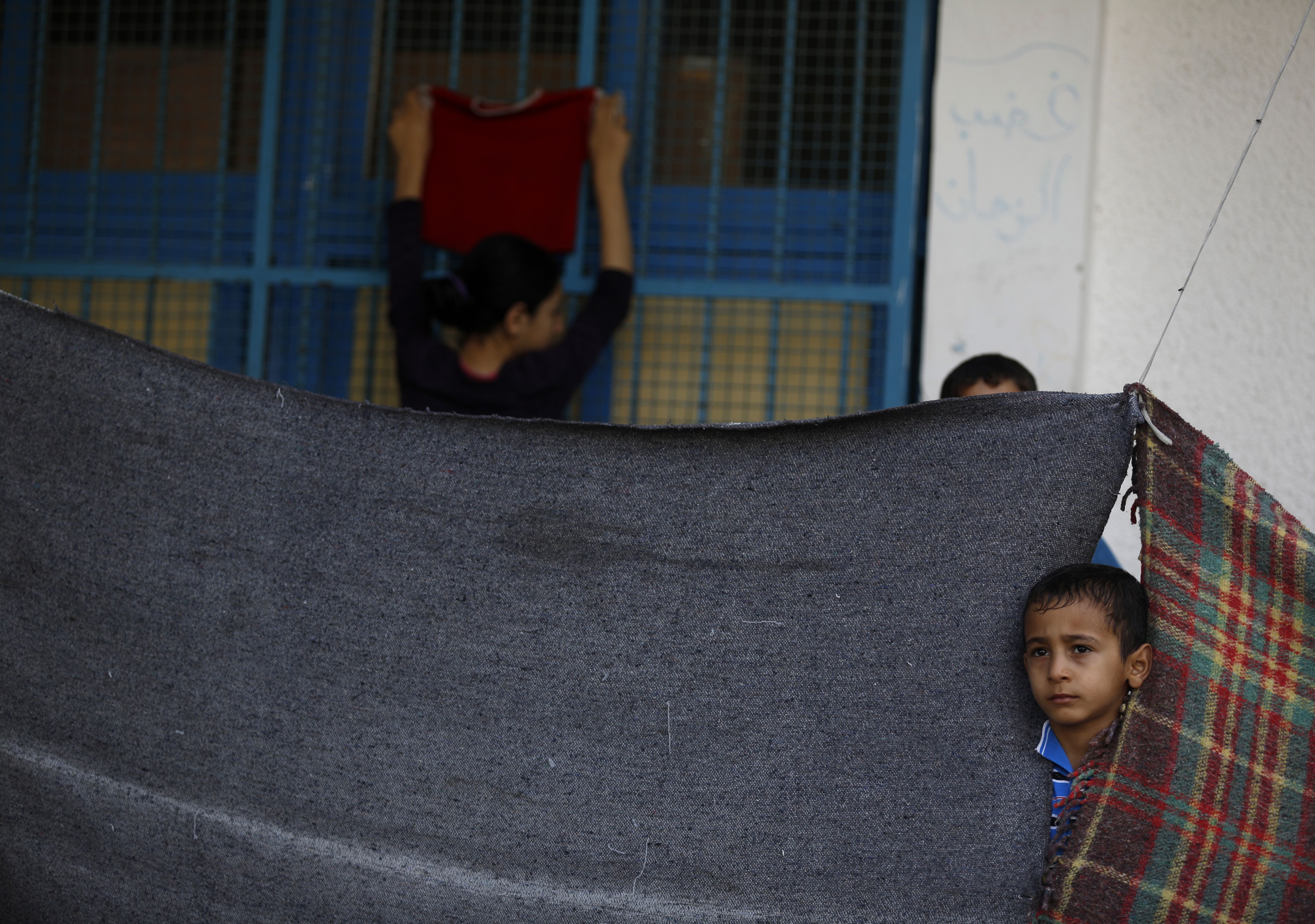
(Photo: A displaced Palestinian boy stands behind blankets serving as a separation curtain for his family on July 23, 2014 at a UN school in the northern Gaza Strip refugee camp of Jabalia where displaced families have taken refuge after fleeing heavy fighting in the besieged Palestinian territory. By Mohommed Abed/AFP/Getty Images)