Beware The Early Exit Polls

Ed Morrissey calls them “worthless”:

Exit polling data gets collected all day long to find the eventual turnout model for elections, especially in demographics such as age, gender, ethnicity, affiliation, etc. That data only becomes valid when it is fully compiled. Partial data sets for exit polling do not provide predictive outcomes because the turnout models can change significantly during the day, perhaps especially because of early voting. That is exactly what happened in 2004, when media outlets used non-predictive data in predictive ways, and while the data sets were still being compiled.

That isn’t to say that completed exit polls are meaningless. The networks will use the data in part to plug into their election models in order to call races — but that takes place while the results of actual voting are being published, after the polls have closed.

Nate Cohn chips in his two cents on exit polls:

They’re not designed to measure the results perfectly or measure the composition of the electorate. I find myself surprised by how just how accurate the exit poll figures can be, despite the obvious issues with the raw responses and the inability to weight to population targets. Unfortunately, most analysts and reporters jump on the surprising, outlying, newsworthy findings. Often, those figures are the ones most likely to be wrong.

Dana Lind identifies another problem with exit polls, their “tendency to oversample a particular kind of voter of color — the kind who lives in majority-white areas”:

Even though the public doesn’t know exactly how the exit poll chooses where to go, it’s possible to make some educated guesses. The exit poll is trying to predict the margin of victory for one candidate over another across the state. So when it decides which polling places to put interviewers outside of, it’s reasonable to assume that it’s choosing lots of swing precincts — precincts that are harder to predict and likely to affect the outcome. Those are going to be largely white precincts. …

Here’s why this is a problem: the voters of color pollsters run into in majority-white precincts might not be representative of the voters of color across the state. In particular, according to Latino Decisions, voters of color living among whites are “more assimilated, better educated, higher income, and more conservative than other minority voters.”

Raising The Minimum Wage In Red States

Efforts to do so look likely to succeed:

Four states have minimum-wage increases on the ballot on Tuesday, an occasion that’s notable for two reasons. All four states — Alaska, Arkansas, Nebraska and South Dakota — lean conservative, meaning that the debate over low wages and income inequality has spread beyond reliably blue parts of the country. And should these four measures pass, as they’re all expected to, a majority of states in the U.S. will soon have higher wage floors than the federal minimum.

Danielle Kurtzleben puts these initiatives in context:

As the Wall Street Journal has noted, all 10 proposed minimum wage measures on state ballots since 2002 have passed. That’s remarkable because the minimum wage is a divisive partisan issue.

When the CBO in February released a report saying that a nationwide $10.10 minimum wage would lead to a decline of around 500,000 workers, conservatives pounced and liberals went on the defensive. But despite these apparent partisan divides in the US, Republican voters aren’t entirely against minimum wage hikes. While Democrats tend to broadly support a higher wage, Republicans don’t always disagree — indeed, they’re roughly evenly split.

Ben Casselman reviews the economic debate over the minimum wage:

Economists are divided over whether these efforts are a good idea. In aworking paper released Monday, David Neumark, J.M. Ian Salas and William Wascher fired the latest salvo in a longrunning battle over the effects of raising the minimum wage. Neumark, his coathors and their allies argue raising the minimum wage leads to lost jobs; their opponents, including University of Massachusetts economist Arindrajit Dube, argue the impact on employment is minimal. A 2008 meta-study looked at 64 minimum-wage analyses and concluded that they generally found little to no impact on employment. A poll of leading economists last year found them nearly evenly divided on the question of whether a $9-an-hour minimum wage would “make it noticeably harder for low-skilled workers to find employment.”

Josh Barro compares the different measures:

The proposals differ in their particulars. Alaska would set its minimum wage the highest, with a gradual rise to $9.75 by 2016. Nebraska would go to $9 in 2016, South Dakota to $8.50 in 2015 and Arkansas to $8.50 by 2017. In Alaska and South Dakota, the minimum wage would continue to rise in line with price inflation in following years, which makes an enormous difference in the long term.

And Reihan wonders how the minimum wage hikes will play out in each state:

[W]hile the discussion of the minimum wage referendums have largely focused on what these states have in common — they’re relatively politically conservative — it hasn’t focused on the fact that among them, Arkansas is unusually poor and that its adult population has an unusually low average skill level. The consequences of a substantial increase in the local wage floor will likely have different consequences in Arkansas, in light of its history of deprivation and isolation, and where higher consumer prices associated with rising compensation costs will have more bite due to its low income levels, than in Alaska, which is considerably more affluent. And while both Nebraska and South Dakota had unemployment rates of 3.6 percent as of August, unemployment in both Alaska (6.8 percent) and Arkansas (6.3 percent) is fairly high. I can’t help but think that Arkansas is making a mistake. But better that Arkansas is making a state-level decision that, as inflation and productivity growth proceeds apace, will be less binding than new federal legislation, which will be less responsive to its particular conditions.

What’s Gonna Happen With The House?

House Seats

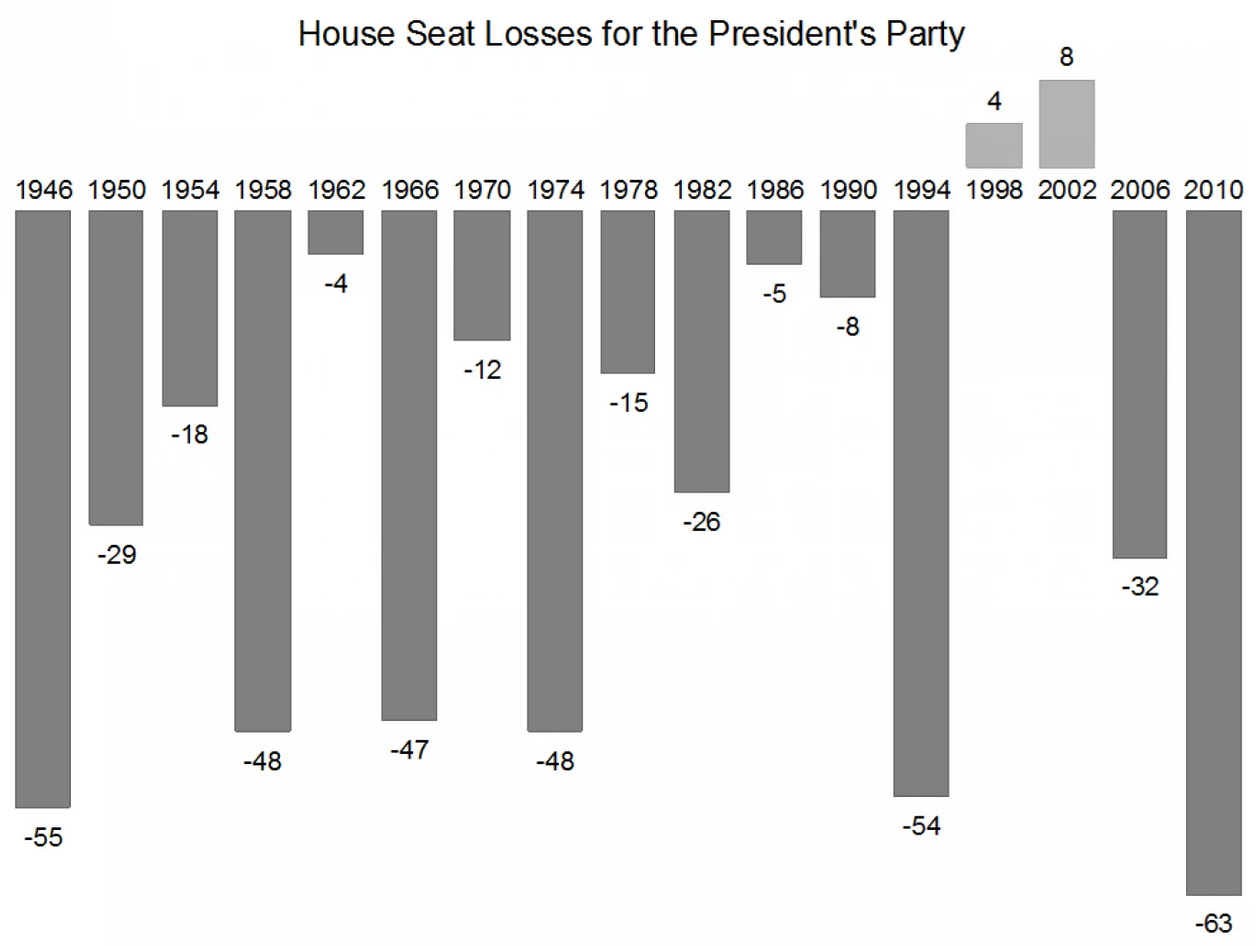
John Sides notes that the “president’s party tends to lose seats in midterm elections. Period.”

Part of the story is that the president isn’t on the ballot, and he often supplies coattails for congressional candidates to ride on.  Part of the story is that the electorate may react against the ideological direction of the president’s party–as it has since Obama took office–and seeks to elect candidates from the other party.  In any case, the “midterm penalty” is important.  In elections from 1980-2012, we estimate that this penalty is 3 points of vote share.

Derek Willis looks at possible outcomes:

For Democrats, who hold 199 seats, a good night would be not losing any seats at all. At best, they could gain perhaps two, but that seems a very long shot. If things go as expected for Democrats, they could wind up with their lowest total since 1949, when they had 188 seats. (They had 193 after the 2010 elections.)

Enten believes that the GOP’s unpopularity is holding it back:

A Republican gain of five to 12 seats is significantly less than one would expect using presidential approval ratings alone as a predictor. If voters cared only about Obama’s performance, we’d expect a much more lopsided result: A Democratic loss of about 25 seats. That seems unlikely. Part of the reason that gains will be kept down is that, at 12.4 percent, this is the lowest congressional approval rating going into a midterm election since the question was first asked in 1974.

Overall, the House is all but determined. It’s falling right along the lines that we thought it would given the factors that normally accurately forecast House elections. Republicans are set to gain because it’s a midterm year and the president is unpopular, but they probably aren’t picking up as much as ground as they would if Congress were more popular.

Regardless, Chait expects the Republican House to keep Washington gridlocked:

If the House could make a deal with Obama, the Senate would sign on to the deal if it were controlled by Republicans or if it were controlled by Democrats. Gridlock will continue through the next Congress regardless of the Senate race.

Indeed, gridlock will continue after 2016 as well, unless Republicans win the presidency (in which case the House will churn out Republican bills for signing, as it did under George W. Bush). To get a sense of just how grim the picture is for Democrats, Benjy Sarlin reported several months ago on a Democratic plan to try to win back the House in 2020. The year 2020 is not picked out of a hat. It coincides with the next Census, which will redraw the House map. Sarlin’s reporting makes it pretty clear the Democrats don’t have an especially good chance of winning back the House in 2020 — it’s simply the next time such a prospect becomes even faintly imaginable.

Divided Government Down The Ballot

Tim Storey predicts more divided state governments:

U.S. states are at historic lows of divided government. Only three legislatures have chambers controlled by opposite parties (not factoring in the coalitions in New York and Washington). The last time that there were only three split legislatures was in 1944. When matched up with control of governors to determine full partisan control of state government, there are only 11 divided states headed into the election — the lowest number since 1952. With at least 11 close gubernatorial contests and about 10 legislative chambers that are truly toss-ups, it looks certain that at least some states will move from unified government to divided. That is almost guaranteed to happen in Pennsylvania, where incumbent Gov. Tom Corbett (R) trails badly in the polls. In several traditionally Democratic states like Massachusetts and Illinois, Republican gubernatorial candidates have a shot at winning, so those states could end up with divided governments as well.

Earlier Dish on the importance of state legislatures here.


The Governor Races Could Go Either Way

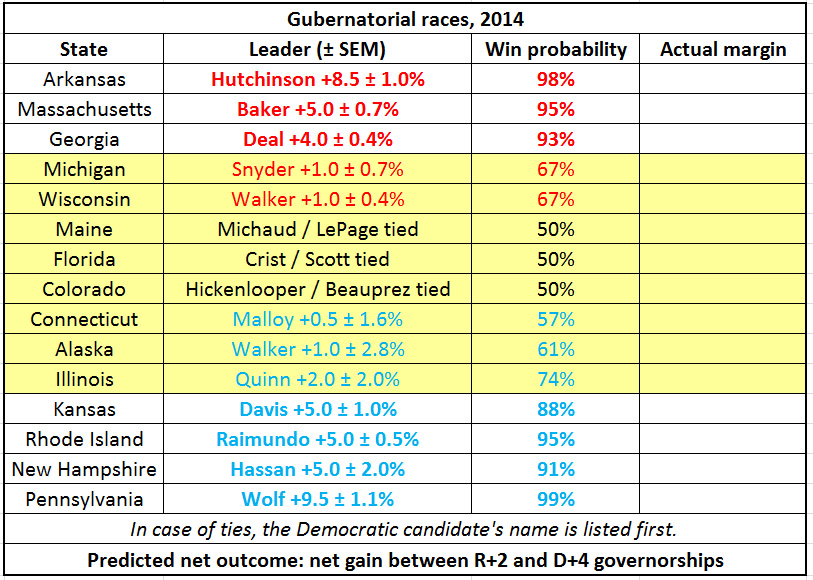
Sam Wang provides “final polling snapshots for gubernatorial races that are either close or likely to switch party control”:

gubernatorial-races-2014

Enten explains the lay of the land:

There are a lot of tight races. Five seats are forecasted to flip from Republican to Democratic or independent control: Alaska, Florida, Kansas, Maine and Pennsylvania. Two seats are projected to flip from Democratic to Republican control: Arkansas and Massachusetts. If all the FiveThirtyEight favorites win, Republicans will have 26 governorships in 2015, Democrats will have 23 and independents will have one.

Dickerson wonders about the lessons taken from the results:

Drawing a conclusion will be more complicated than simply waiting to see if Republican governors are re-elected.

If Gov. Scott Walker wins in Wisconsin and Gov. Sam Brownback holds on in Kansas, they will both be able to argue that they survived even after taking political risks to govern as proud conservatives. If, on the other hand Ohio Gov. John Kasich cruises to a big victory, that might show something different. Kasich, and Gov. Rick Snyder of Michigan, opted to take the federal Medicaid money as a part of the Affordable Care Act. Doing so was once considered heresy in conservative ranks. But now people like Newt Gingrich point to Kasich as a model for expanding the Republican Party with black voters. In Gingrich’s election-eve predictions, he cites that Kasich won the endorsement of a black newspaper. The Ohio governor won that endorsement because he took the Medicaid money. Almost all of the vulnerable Republican governors this cycle did not. Will their victories or defeats render a verdict on that decision?

Larison cautions against over-hyping the Walker result:

If Walker does end up losing, as I am predicting he will, it shouldn’t come as a great shock, nor should it be treated as such a huge setback. Let’s remember that Walker was first elected in an unusually good year for Republicans in a state that had not made a recent habit of electing Republicans to statewide office. In that extraordinarily Republican year, Walker won with 52% of the vote. In a less lopsided election year, it’s possible that Walker might not have won the first time. Considering the controversy in his first term and the attempted recall, it wouldn’t be so strange if the electorate of a normally Democratic-leaning state grew tired of Walker and chose someone else to replace him. It does Republicans no favors to exaggerate the importance of any one governor’s race, and it would be a mistake for anyone to read too much into a Walker loss.

Will The GOP Block Obama’s Judges? Ctd

Sarah Binder isn’t so sure:

[E]ven in recent periods of divided control, the opposition party has been willing to confirm roughly half of a president’s appointees to the bench — not least because such nominees are often favored candidates of opposition party senators. (And as I noted here, even after Democrats banned judicial and executive filibusters, Republican senators voted to confirm most judges even after opposing them on cloture.) This fall, for example, Obama nominated a Utah judge to a federal district court bench with the glowing support of Republican Sen. Orrin Hatch of Utah. Perhaps a Republican Senate will leave advice and consent in tatters, seeing little gain to filling seats better left open for a Republican president.  Still, I wouldn’t be surprised to see Republicans leverage their majority power to continue to secure lifetime spots on the bench for judicial candidates well known back home.

Jeffrey Rosen imagines what would happen if a Supreme Court justice dies or retires. His “optimistic” scenario:

Democrats can point to bipartisan Supreme Court confirmations, like justices Clarence Thomas and Antonin Scalia, where they have voted for nominees with whom they disagree. And there is next to zero historical evidence of gridlock causing extended vacancies (although that could be plausibly chalked up to the fact that we didn’t experience divided government very often in the early years of the republic). Even Obama himself, in a recent interview with The New Yorker, suggested there would be pressure for Republicans to approve a nominee, saying that intense media coverage of SCOTUS nominations “means that some of the shenanigans that were taking place in terms of blocking appointments, stalling appointments [to the lower courts], I think are more difficult to pull off during a Supreme Court nomination process.”

On the other hand, there’s no particular grounds for optimism with a Democratic president and Republican Senate. With their vitriolic obstruction throughout the Obama presidency, including a fight over the debt ceiling and a government shutdown, some Senate Republicans have shown a willingness to paralyze the basic functions of governmentand might be comfortable with an evenly divided Court of eight justices, which could mean repeated 4-4 deadlocks and opinions that lack precedential value.

Earlier Dish on the subject here.


Senate Democrats Are In Hostile Territory

Senate Elections

Patrick J. Egan illustrates the advantage Republicans have in this year’s Senate races:

A good measure of the parties’ relative strength in the states holding Senate elections is the share of the state vote each earned in the most recent presidential election. The figure above plots (in blue) the Democratic share of the two-party presidential vote in the median state of those holding Senate elections from 1950 through 2014. For comparison, it also displays (in gray) the share of the national popular vote the Democrats received in the most recent presidential election. For most of the past six decades, these two trends tracked each other very closely: the parties’ relative strength in the set of Senate seats up for election was no different from their strength nationally. But that changed after the 2000 presidential election, in which the Republican Party’s dominance in the South emerged in full force.

His bottom line:

Simply put, this year’s Senate elections are unrepresentative of the nation to an extent that is unprecedented in elections held in the post-war era. So when we begin to sift through the results on Election Night, the number of Senate seats won and lost will tell us less than we might like about where the two parties stand in the minds of American voters.

Jonathan Cohn adds a qualifier:

Of course, it’s not simply geography that’s undermining Democratic strength this time around. If it were, Democrats wouldn’t be struggling to hold seats in places like Iowa, which Obama won. But the electorate for this Senate race is a lot more conservative than America as a whole. That has surely made a huge, and maybe decisive, difference.

Ben Highton highlighted the Republicans’ structural advantages back in February:

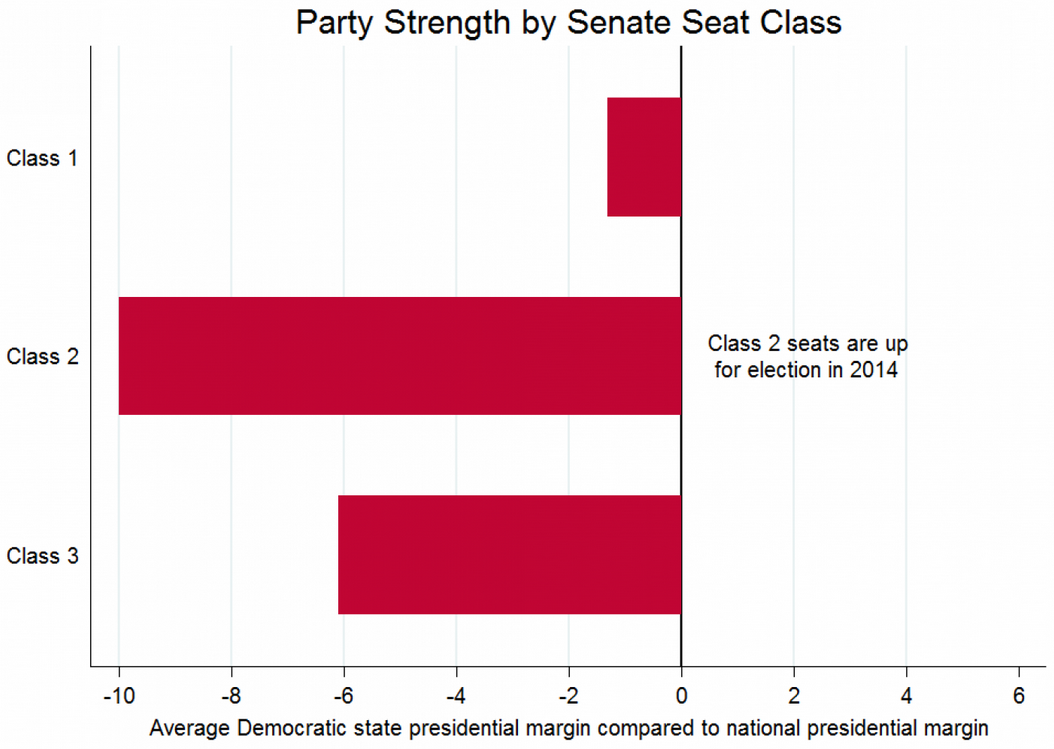
[T]he Senate treats states as equal – irrespective of population – and this gives the Republicans an advantage because on average, less populous states are more Republican than more populous ones.  What about the states that fall into each of the three Senate classes?  Compared to the national two-party presidential vote margin in 2012, class 2 states are 10 percentage points more Republican on average.  Of the three classes, this is the largest skew toward the Republicans.  The average margin in class 3 states is 6.1 points more Republican than the national presidential margin; and, the average margin in class 1 states is just 1.3 points more Republican.   Here’s a graph showing this:

Senate Seat Class

The Final Midterm Predictions

Silver gives Republicans a 76 percent chance of taking the Senate. But be prepared for a long night:

Even if Republicans win, the outcome may not be determined quickly. David Perdue, their candidate in Georgia, has gained in the polls — but the model still has the race going to a runoff about half the time. Louisiana will almost certainly require a runoff. Alaska’s vote may take days or weeks to count, as it has in the past. The FiveThirtyEight model — even with its optimistic forecast for Republicans overall — estimates there’s just a one in three chance that the election will be called for them on Tuesday night or early in the day on Wednesday. For Democrats, meanwhile, there’s almost no chance to win without going to “overtime;” the party will hope to extend the race for as long as possible.

There are two Republican wins, however, that could end the race quickly. Pay attention to races in North Carolina and New Hampshire. Both states have early poll-closing times (7:30 EST for North Carolina and 8:00 EST for New Hampshire) and a Republican win in either state would require Democrats to run the table in almost every other competitive race. But Republican wins would simultaneously indicate that the polls might be biased toward Democrats rather than against them, making a Democratic sweep the rest of the night very unlikely.

Cassidy’s guess is 53-47 for the GOP:

In a post on Friday, I pointed to evidence that late deciders appear to be breaking to the Republicans, particularly in the South. In states like Arkansas, Georgia, Kentucky, and Louisiana, that trend is clearly visible in the latest polls. Alarmingly for the Democrats, something similar may well be happening in Colorado and Iowa, two seats they currently hold. Of the ten battleground states, the Democrats’ best bets are now North Carolina and New Hampshire, where their candidates are holding on to narrow leads. Then there is Kansas, where the contest between Greg Orman, an independent businessman, and Pat Roberts, the three-term G.O.P. incumbent, remains a toss-up.

Sabato also forecasts 53-47. On the close races:

The Kansas race between embattled, weak Sen. Pat Roberts (R) and independent Greg Orman is perhaps the closest, most difficult-to-predict Senate race in the country. However, at the end of the day, a Republican has not lost a Senate race in this state since 1932. It may happen, but we just can’t pull the trigger and predict it. LEANS REPUBLICAN

We’ve been calling Georgia and Louisiana “Toss-up/Leans Runoff” in recent weeks because we expected both to eventually go to runoffs. Louisiana will, and Georgia might, but we now believe Republicans are favored to eventually win both. So we’re just going to call both LEANS REPUBLICAN going into Election Day: If both do in fact go to runoffs, then the Leans GOP ratings will apply, at least initially, to the overtime contests.

John Sides joins the chorus:

[W]hen we debuted Election Lab on May 5, we estimated at that point that the GOP had a 77 percent chance of winning and was predicted to win 53 seats.  We predict 53 seats again today.  The only change is that Michigan and Colorado are flipped relative to that earlier forecast.

Morrissey bets that a “Republican wave will run the table”:

And even if Republicans only manage to win six seats while not keeping Kansas, another dynamic will come into play, which is the desire to be part of a majority. Orman might end up caucusing with Republicans, although that seems temperamentally unlikely, but that’s not as true for Angus King of Maine. King endorsed Lamar Alexander in Tennessee last week, so he’s not hostile to the Republican caucus. If the GOP ends up with 51 or more seats, King may cut a deal to strengthen Republican numbers even further. Whether he’d do that in case the GOP wins only 50 seats is anyone’s guess, but the Maine Sun-Journal thinks that would be unlikely.

Waldman doesn’t expect a “wave,” much less a mandate, for the GOP:

If they manage to take the Senate, it will be because most of the incredibly close races this year tipped their way in the end. Which would undoubtedly be a victory, but it would be hard to argue that the GOP squeaking out wins in deep-red states in the South and adding a couple in swing states like Iowa or Colorado represents some huge shift in public sentiment. New polling data suggests that even if Republicans do take the Senate, we’re hardly looking at a “GOP wave.” The final pre-election poll from NBC News and the Wall Street Journal was released today, and it shows the two parties nearly deadlocked (46-45 in Republicans’ favor) in the generic ballot test among likely voters. Democratic voters’ interest in the campaign has risen to match Republicans’, and approval of the GOP as a party remains abysmal. There’s also evidence to suggest that turnout will be low.

Charlie Cook calculates that “a seven-seat gain would seem the most likely outcome for the GOP, with eight a bit more likely than six, but either highly possible.” What would qualify as a wave?:

The first test of the existence of a political wave is whether the benefiting party avoids losing many of its own endangered seats. The second is whether it wins an overwhelming number of the purple, competitive or, in this case, light blue Democratic-tilting but still endangered seats. So, if Republicans limit their own losses to just one of their own competitive seats (for example, Roberts in Kansas) and win at least three of the four key purple states (the open seat in Iowa and the three seats held by Democratic incumbents—Kay Hagan in North Carolina, Jeanne Shaheen in New Hampshire, and Mark Udall in Colorado), that starts qualifying as a wave. Just winning one or two out of the four neutral-site contests might well help the GOP secure the majority, but it hardly qualifies as a wave. These are seats where it is the political environment and President Obama, not the map itself, that are the cause of Democratic pain. Obama carried all four states in both 2008 and 2012; losses in these would mean voters who voted for him have officially reversed course.

The third test of a real wave is the ability of a party to pull off real upsets, knocking off incumbents who were not on the lists of first- or second-tier vulnerable seats. If, for example, someone like Mark Warner in Virginia, Al Franken in Minnesota, or Jeff Merkley in Oregon were to lose, that would be a wave in the sense of 1980, 1994, 2006, or 2008. These years saw wins that were way more than just a result of the map. There now appears to be little chance that any of these three will lose their races.

Update from a reader:

Cook says that Obama carried Iowa, North Carolina, New Hampshire, and Colorado in 2008 and 2012. This is not correct, as Mitt Romney won North Carolina in 2012.
The State Of The Race In Kansas

http://youtu.be/bXilL3_Xy7E

Last night a reader wrote from the Sunflower State about being “beaten to a pulp … on my phone”:

Hey Andrew & Co., I don’t know if you’re getting any traffic/messages on this, but the robocalls here in Kansas are incessant, demoralizing, and one-sided … at least if my experience, and the experiences of my friends and colleagues, are any sort of indicator. I have used my mobile device to record four calls today – to my office phone. I work at a state university here in Kansas. Pat Roberts has decided to beat people into submission. Here’s Newt GingrichRand Paul, Ted Cruz [embedded above], and Dr. Milton Wolf (he was the biggest threat to Roberts during the primaries and was exposed for sharing autopsy photos on his Facebook account and blog … and making jokes about them).

Again, this is ONE WORK DAY … so far.

My message light has been blinking all morning, which means there are messages from the weekend and Friday night. I’m sure I have more. I averaged about one or two per evening last week, just before Halloween. Tim Huelskamp’s wife called one evening. I think that’s the only state candidate I’ve heard from – all the other calls have been stumping for Pat Roberts.

I can’t wait for Wednesday morning.

Join the club. Update from a reader with some crucial perspective:

I’ve worked on two Congressional campaigns and managed a state legislative campaign.

Every campaign manager with any sense knows robocalls have no effect whatsoever. This has been known, and proven over and over, for at least 10 years. Money quote:

Don Green, a political science professor at Yale, subjected robo-calls to 12 randomized experiments for his 2004 book “Get Out the Vote: How to Increase Voter Turnout.” The results, he says, were revealing. “These calls never raise voter turnout. They have no mobilization effect, and no persuasion effect either. What matters is whether they change the probability of voting, and robo-calls have proven they do not.”

Never. Raise. Turnout. No Persuasion Effect. Ever. Any campaign sending out even one robocall is wasting its money and hurting its own cause.

Previous reader dispatches from Massachusetts, South Dakota, and Texas.

The State Of The Race In Massachusetts

A reader sums up a “bizarre race” in one district:

The race in Massachusetts’s 6th Congressional District is getting strange. The National Organization for Marriage, which opposes same-sex marriage, is urging supporters to vote for Democrat Seth Moulton rather than an openly gay Republican, Richard Tisei. Meanwhile, the Human Rights Campaign is staying out of the race completely, despite having previously endorsed in the district.

From one article cited by our reader:

Asked whether Moulton would welcome or reject votes cast in his favor by NOM supporters, a spokesperson for Moulton responded, “Reject.” “Seth Moulton fundamentally disagrees with everything NOM stands for and has long said that equality is the civil rights fight of our generation,” said Carrie Rankin, Moulton’s communications director. “Fighting against groups, like NOM, that deny equality as a basic human right will be a priority of Seth’s in Congress.” Rankin noted that Moulton has a gay brother and Moulton has said, “It’s fundamentally wrong that he and I don’t share the same rights just because of who he is.”

From another piece:

The nation’s largest LGBT-rights organization is not expected to get involved in the Massachusetts congressional race between openly gay Republican Richard Tisei and pro-LGBT Democrat Seth Moulton, Metro Weekly has learned. …

HRC, which has a policy of endorsing pro-LGBT incumbents, previously endorsed Rep. John Tierney (D) in Massachusetts’s 6th Congressional District. In September, Tierney suffered a surprising primary defeat to Moulton, a young Marine veteran vowing to keep the seat in Democratic control. Two years prior, Tisei lost narrowly to Tierney 47.1 percent to 48.3 percent. Many credited the win by a vulnerable Tierney, whose wife was mired in a federal tax scandal, to President Barack Obama and Senate candidate Elizabeth Warren being at the top of the 2012 ballot. In that race HRC also endorsed Tierney.

The Gay & Lesbian Victory Fund, which seeks to increase LGBT representation, has endorsed Tisei the past two election cycles.

Tisei is one of two men seeking to become the first openly gay Republican elected to Congress. In California, Carl DeMaio is attempting to unseat Democratic Rep. Scott Peters for the state’s 52nd Congressional District. HRC has endorsed Peters in that race and representatives of the organization have been critical of DeMaio’s commitment to LGBT issues.

Previous reader dispatches from Texas here and South Dakota here.