Montaigne, The First Blogger

From an essay on "the tyranny of timeliness":

When we credit Montaigne as the originator of the essay, it’s not because he was the first to write in prose on factual topics — it’s because he turned declamation into conversation. … A Montaigne essay, like a Shakespeare soliloquy, gives us the impression that we are in 550px-Michel_de_Montaigne_1 the presence not of a disembodied, opinion-spouting voice, but of a real person.

Long after those essays lost their relevance, long after the second-hand reports from the Americas and meditations on 16th-century French politics ceased to be news, they have maintained their appeal because they are a personality embodied. And the foremost trait of that personality is freedom: freedom to take up and turn over absolutely any subject in human experience, on any prompting or none; to follow any tangent simply because it catches his eye; to begin and end a continent apart, or simply to trail off; to know for the simple sake of knowing.

In Montaigne’s day, that freedom was the privilege of an aristocrat. Today, unless we trade it away for a mess of relevance, it’s the birthright of anyone with a high school education and an Internet connection.
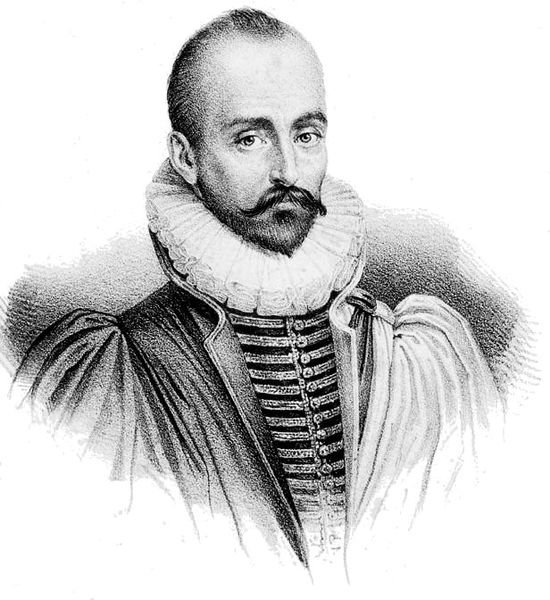
Now you know even more why Montaigne is one of this blog's inspirations. More on his bloggy style here and here.

(Image via Wikimedia Commons)

Montaigne: The Anti-Fanatic

Kathryn Schulz delights in Sarah Bakewell's How to Live: or, A Life of Montaigne in One Question and Twenty Attempts at an Answer:

Montaigne would not countenance torture (he couldn’t even stomach hunting) and, unusually for his era, he spoke out against it. It was, he felt, both strategically and morally flawed. Most torture victims, he reasoned, would say anything to put an end to pain; moreover, torturing someone on suspicion of wrongdoing was “putting a very high price on one’s conjectures.” As the terrorism of France’s religious wars intensified in the region of his family home, Montaigne refused to guard the doors of his estate. To do so would have been to capitulate to violence and, in a sense, to escalate it. He chose, instead, to live out the counsel of the Mishnah: “Where there is no human being, be one.”

It is this quality that has made Montaigne a hero to so many opponents of fanaticism. And it constitutes one of his greatest answers to the question of how to live. As Bakewell distills it: “Be convivial.” In that blithe-sounding word, she helps us hear solemn undertones. Be convivial: live with one another, be on the side of life, forbear. Even as the long party rages on, she reminds us, a long war rages just outside the door. Montaigne’s joy in humanity was not a way of ignoring it, but a way of resisting it.