Getting Paid For The Gift Of Life

Kara W. Swanson, author of Banking on the Bodycontends that “the simple pay-suppliers/don’t-pay-suppliers approach to thinking about body products … needs to be replaced with more nuanced thinking”:

Should we treat different types of organs (hearts v. bone marrow) differently? Can we think about compensation schemes that are not free markets, but are managed to support the public goals of increasing body-product supply? Can those schemes protect suppliers and recipients alike by keeping suppliers safe from exploitation, and recipients safe from diseased products? I use history to suggest that the answers can sometimes be yes. Body products used to be routinely paid for, and doctors thought about these potential problems and addressed them. Over time, we have forgotten this past, and come to assume that buying body products is always dangerous and bad.

I like to remind people that lots of altruistic gestures are compensated—the doctors, and nurses, and everyone who works on a transplant operation are all in caring professions. They are doing those jobs because they want to help people (at least we hope and assume so). But we wouldn’t suggest that they shouldn’t be paid because to offer payment for such efforts would be insulting or immoral or cause their altruistic tendencies to be replaced by mercenary concerns.

Yet that is how we treat organ supply—that offering money would do all those bad things. Why should the supplier of a body product be the only person in that life-saving supply chain who is not compensated? People might choose not to be compensated, but if they want to be, and if more folks will act as suppliers with that incentive, why not?

The Dish has covered these questions extensively over the years.

The Underground Organ Market

A documentary on it premiered Monday night on HBO:

Jennifer Block reviews it:

[Director Ric Esther] Bienstock has screened the film in several cities and began informally polling the audiences. She says about 75 percent consistently say they would consider buying a kidney overseas or selling a kidney. A recent NBC poll had similar results. At a 2007 meeting of the American Society of Transplant Surgeons, after Matas and a colleague each presented opposing arguments, a majority of the audience said they would support a trial of an open organ market.

One logical compromise would be for governments to reimburse altruistic donors for lost wages, child support, and short-term life insurance. That doesn’t exist in the U.S. or Canada, though Australia recently instituted a system in which compensation goes directly to a donor’s employer, who keeps sending paychecks through recovery. “That’s removal of disincentives, and I have no problem with that,” [Gabriel] Danovitch [medical director at UCLA’s Kidney and Pancreas Transplant Program] says. “Even the current law permits payment of all these things, but it just doesn’t happen.”

Ilya Somin wants to let people sell their organs:

If we must ban kidney markets because allowing poor people to take the risk of living with only one kidney is “exploitive,” why should we not also ban poor people from taking dangerous jobs as loggers, coal miners, police officers, firefighters, and NFL players? These and other occupations involve far greater health risks than donating a kidney. And they are often especially attractive to “the desperate poor,” precisely because poor people are more likely to be willing to take risks in order to increase their wealth than the relatively affluent. Furthermore, if “exploitation” of the poor is really the reason for banning organ sales, why not ban such sales by people below a certain income threshold, but permit them if the sellers are middle class or above? This could still save many lives, among the thousands people who die because they cannot get kidney transplants in time.

Earlier Dish on the ethics of selling kidneys here, here, here, here, and here.

Should The Government Buy Kidneys?

Kidney Shortage

Rohin Dhar thinks so:

What’s the advantage of letting Medicare buy kidneys instead of creating a free market? First, it would save Medicare and private insurers money since the current cost of dialysis for people on the waitlist is so high. These parties have a financial incentive to consider a plan like this.

Second, a government-regulated system can address concerns about equity. Rather than rich people privately contracting poor people to buy their kidneys, the government and the UNOS can continue to allocate purchased kidneys based on need (Objection 1). Moreover, the risk for organ thieves is eliminated in this scenario (Objection 2). Would an organ thief show up at the Medicare office with bag of kidneys? Instead, individuals would have to go through an approval process to ensure that they are not selling their organ under duress and understand the risks.

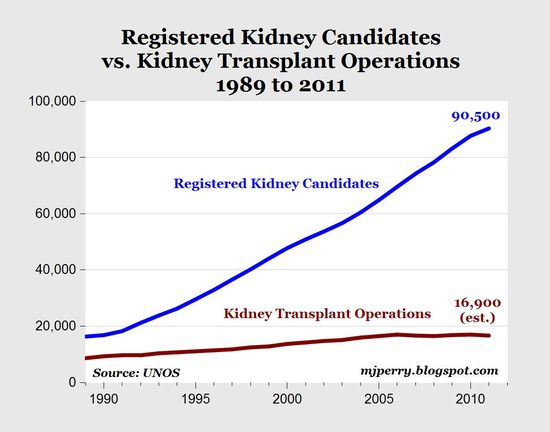
(Chart from Mark Perry)

A Market In Organs

Kidney_Chart

Matt Welch wants to legalize payment for kidney donations:

[W]e know that maintaining prohibition—letting the law be guided by our moral revulsion toward placing price tags on human organs—will certainly increase the body count. We know that boosting the number of kidney donations from the living is the only real way to whittle the waiting list down. And we also know, from such procedures as egg donation, that legalizing monetary rewards is a guaranteed method for expanding the pool of living donors. Your morality may vary, but mine says that sentencing more than 6,000 people a year to an avoidable death falls well short of the Golden Rule. My inquest therefore concludes that the burden of argumentative proof on the legality of kidney sales should fall squarely on those who back the lethal status quo.

Balko is onboard:

With kidneys, and also with vital organs, you could also envision markets that, for example, would pay a smaller sum while you’re still alive if you sign to donate your organs when you die. Another plan might give larger sums to your family once you’re dead, should you die in a manner in which your vital organs remain viable. It also isn’t difficult to imagine “organ brokers” finding that there’s a market advantage to protecting their donors—for example, by including clauses in donor contracts stipulating that any  kidney donor who later encounters health problems requiring a transplant would receive a free kidney,  a paid-for transplant, and move to the top of the donor list—not because organ brokers would necessarily be kind and benevolent, but because if I were donating a kidney, I’m thinking that would be one of my primary concerns, and I’d probably chose a company or system or non-profit that could give me that peace of mind.

(Chart from Mark Perry)

In Defense Of Kidney Markets

Alexander Berger, who on Thursday is donating a kidney to someone he doesn’t know, took to the NYT to advocate for the legalization of selling kidneys. Samir Chopra isn’t convinced:

My worry for the organ market that Berger has in mind is quite simple: in our current economy, it will rapidly devolve into a situation where the number of economically desperate donors will bring down the price of organs to a level that ensures that organ donors will receive little compensation for their contributions. The health of those that can afford organ transplants in our current healthcare system will be enhanced, yes. But it has been enhanced by an economic system that immiserates people sufficiently enough to make them want to give parts of their bodies to others for inadequate compensation.

Roger McShane counters:

[D]onors like Mr Berger see only the slightest increase in their risk of dying from kidney disease. And their altruism is likely to lead to more than a decade of improved and prolonged life for the recipient. Donations are also cost-effective. As we noted in a previous report on the topic, “the cost of one kidney operation and a lifetime’s supply of anti-rejection drugs equals that of three years’ dialysis.” And we have proof that such systems do fill the needs of the ill. Iran adopted a system of paying kidney donors in 1988 and within 11 years it became the only country in the world to clear its waiting list for transplants.

The Dish has covered this issue pretty extensively over the years – some representative links here, here, here and here.

The Organ Bank

Scott Carney visited an Indian refugee camp known as Kidneyvakkam, named because so many of its female residents have sold their kidneys:

One of these women, her name was Rani, gave up a kidney because her daughter had actually tried to commit suicide because she was in a very difficult marriage … In order to treat her, the hospital needed a certain amount of cash — I think it was about $1,000 — and [Rani] didn’t have any money so she did the only thing she could, which was to sell her kidney because an organ broker just sort of approached her very quickly. And that’s a pretty common situation.

NPR features an excerpt from Carney’s new book, The Red Market, where he tallies his total worth according to his organs.

What A Kidney Is Worth, Ctd

by Patrick Appel

Bill Peckham, who is on dialysis himself, presents a criticism of organ markets I’ve not heard before:

By paying for kidneys you change the system that has developed for the acquisition/transplant of other organs and tissues.

If a kidney from a living donor is worth $20,000, what’s a postmortem kidney worth? How much for a postmortem liver? Postmortem donation of hearts, livers, lungs and all manner of other useful tissues rely on altruistic donation. If body parts become commodities what will it mean for all the people waiting for postmortem donations? I think the needs of people waiting for irreplaceable body parts (e.g. hearts, lungs, liver (mostly)) should be considered before the needs of those waiting for a kidney.

What A Kidney Is Worth

by Patrick Appel

Harold Gershowitz and Amy Gershowitz Lask, a kidney recipient and an uncompensated kidney donor,  desperately want to reform our organ donation system:

The math is simple. In a country the size of the United States, a payment, either direct (cash, vouchers, or tax credits) or indirect (tuition, charitable donations, etc.) of, say, $20,000 to kidney donors would probably produce enough donated kidneys each year to eliminate or drastically reduce the backlog of approximately 83,000 people waiting for their turn to receive a donated kidney. This financial inducement would cost about $1.7 billion. The federal government currently pays 100 percent of the cost for treating most people with end-stage renal disease. With the average annual cost estimated at about $30,000 to maintain one person on dialysis, the taxpayers are paying about $8 billion a year to dialyze fellow citizens in kidney failure. Furthermore, people usually wait about five years to receive a donated kidney unless they are fortunate enough to have a living donor offer one of their two healthy kidneys. Thus, the actual total cost to the taxpayers of maintaining fellow citizens on dialysis for five years is approximately $40 billion.

Selling Your Marrow

A suit was filed yesterday by The Institute for Justice over bone marrow compensation:

MoreMarrowDonors.org wants to award the most needed bone marrow donors a $3,000 scholarship, housing allowance, or gift to the donor’s favorite charity. But the National Organ Transplant Act (NOTA), 42 U.S.C. § 274e, treats giving a scholarship to a college student for donating marrow like black-market organ-selling. This makes no sense. NOTA was enacted to criminalize markets in nonrenewable solid organs, such as kidneys. Bone marrow, however, is just immature blood and, like blood, replenishes itself after donation.

NOTA’s criminal ban, which imposes up to a five-year sentence, violates equal protection because it arbitrarily treats renewable bone marrow like nonrenewable solid organs instead of like other renewable or inexhaustible cells — such as blood, sperm, or eggs — for which compensated donation is legal. The ban also violates substantive due process because it irrationally interferes with the right to participate in safe, accepted, lifesaving, and otherwise legal medical treatment.

Megan has a good post on the suit. Virgina Postrel criticizes:

I do take issue with the idea that bone marrow should be exempt from the federal prohibition because, like blood or sperm (but not eggs), it regenerates. The same is functionally true of kidneys, where the remaining organ grows to take up the slack; liver lobes also regenerate.

Selling The Poor

Ilya Somin asks some questions about organ donation:

If it is somehow wrong to allow poor people to assume these very minor risks in exchange for pay, why should they be allowed to brave vastly greater dangers for money? Military personnel, firefighters, police officers, and others accept far greater risks to life and limb than kidney donors do. And of course they are paid to do so. Should poor people be banned from entering those professions? NFL players, most of whom come from poor backgrounds, risk very serious injuries. On average, they also lose about 2-3 years of life expectancy for every season they play. Yet no one argues that poor people should be banned from professional football. If it is permissible to “exploit” poor people for the sake of providing entertainment to football fans, shouldn’t we be able to do so for the sake of saving thousands of lives?

Schwenkler brings the Pope into the argument.