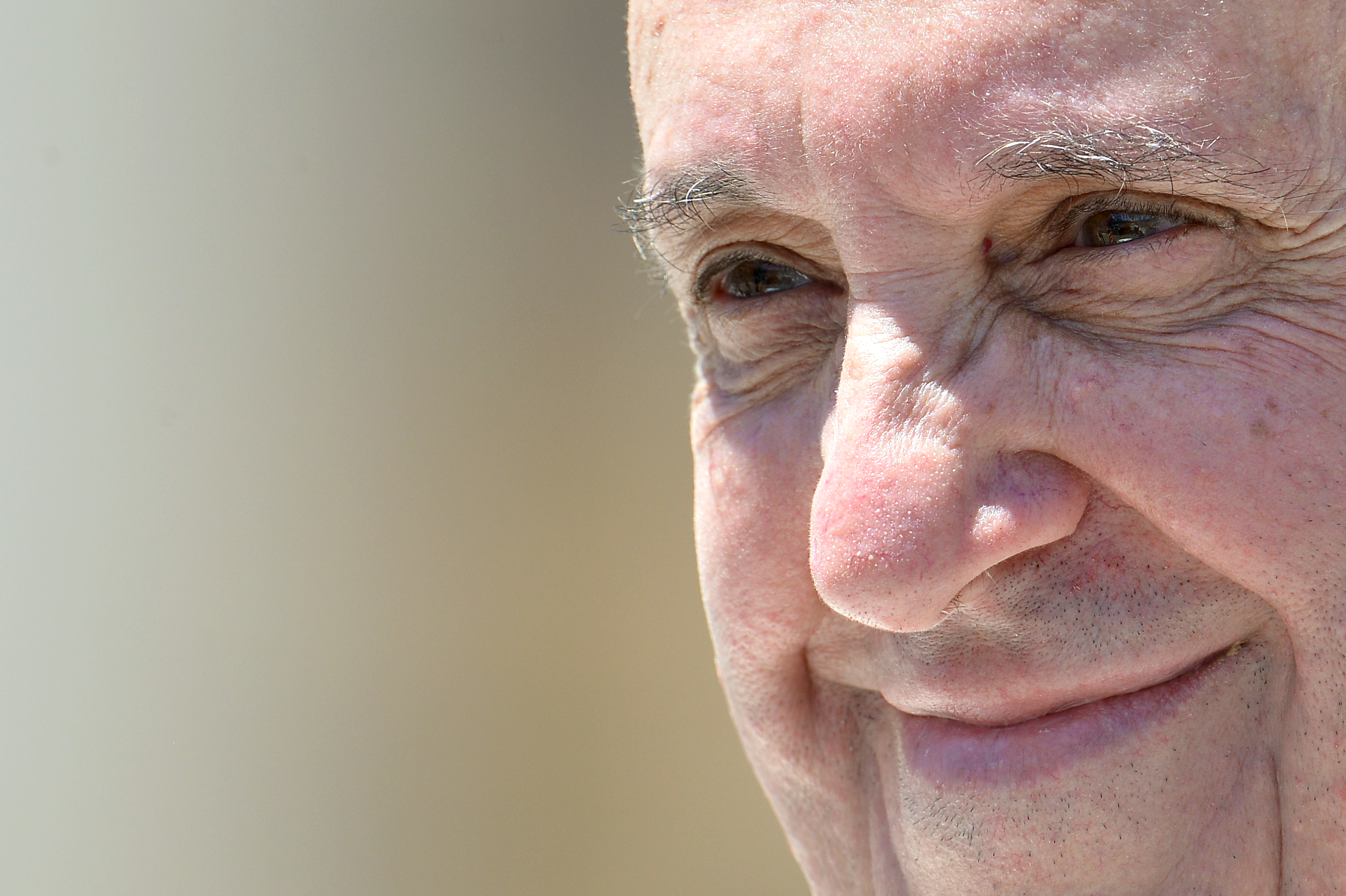
Francis’ Sunlight

This picture taken 21 March 2007 shows a

How can I describe my response to the following simple words:

“There’s a lot of talk about the gay lobby, but I’ve never seen it on the Vatican ID card … When I meet a gay person, I have to distinguish between their being gay and being part of a lobby. If they accept the Lord and have goodwill, who am I to judge them? They shouldn’t be marginalized. The tendency [to homosexuality] is not the problem … they’re our brothers.”

Let’s parse this as conservatively as we can. What does it mean to be part of a “gay lobby”? In the context of the curia, I think it means that a group of cardinals or Vatican officials saw their sexual orientation as what defined them as a group, and operated as a faction within the Church’s center. I find that as repellent as any other kind of lobby that places a particular human characteristic ahead of the only quality necessary for a church official: dedication to God, God’s people, and the Church. But even then, Francis is making light of the hysteria: “I’ve never seen it on the Vatican ID card.” Not since John XXIII has a Pope deployed humor quite as easily and effectively as this one.

But so far, so banal – if utterly different than the panicked, tightly-wound homophobia of the last Pontiff. Then the revolutionary part:

“When I meet a gay person, I have to distinguish between their being gay and being part of a lobby. If they accept the Lord and have goodwill, who am I to judge them? They shouldn’t be marginalized. The tendency [to homosexuality] is not the problem … they’re our brothers.”

The tendency to homosexuality is not the problem. This is a direct rejection of the last Pope and his predecessor. The key letter was issued in 1986 and the key, horrifying directive issued in 2005 barring all gay men from the priesthood – however they conduct themselves and regardless of their gifts and sincerity. Here’s Ratzinger’s CDF statement on homosexuality, which walked back the previous, much more inclusive, position taken in 1975.

In the discussion which followed the publication of the [1975] Declaration, however, an overly benign interpretation was given to the homosexual condition itself, some going so far as to call it neutral, or even good. Although the particular inclination of the homosexual person is not a sin, it is a more or less strong tendency ordered toward an intrinsic moral evil; and thus the inclination itself must be seen as an objective disorder.

This is the new doctrine Ratzinger introduced into Catholicism: that gay people are uniquely inclined toward an intrinsic moral evil, that there is something inherently immoral about us, that we are in a special class of sub-humans, because our loves – when expressed fully with our bodies as well as souls – are intrinsically evil. This doctrine was so contrary to the Gospels, so callous, and so grotesquely unjust – barring any gay man from entering seminaries solely because of something he cannot change – that it was, for me, one of the low points of my spiritual life in the church. Not only was the Pope attacking the souls of an entire class of human beings, he was deeming them unfit for priestly authority. Child rapists could be tolerated; sincere, celibate gay priests were intrinsically disordered unlike any other group in society. I wrote on this page at the time:

Some of the basic principles of the Catholic faith – treating each individual as equally worthy in God’s eyes, judging people by what they do, not who they are – are being violated by this policy. The astonishing work of gay priests across the centuries and across the globe is being denied and stigmatized and ignored. This is a huge stain on the church – reminiscent of its long, terrible history of anti-Semitism.

And so in a few off-the-cuff remarks, Pope Francis returned the Church’s leadership to the spirit and love of the Gospels. This does not mean a change in the doctrine that all non-procreative non-marital sexual expression – from masturbation to foreplay to homosexual or contracepted sex – is immoral. But what it does is explicitly end the Vatican’s demonization and marginalization of gay people made in the image of God, people who have served the Church from its very beginnings, in ways large and small.

It says a lot about the cramped, fearful, nit-picking dead-end of the last Pontiff that simply asserting human dignity should bring such joy. But it has been clear for a while now that the Holy Spirit and the intercession of Saint Francis are opening the windows of the church again – so that sunlight and transparency and simplicity can flood the previously darkened rooms of a retreating reactionary Vatican.

We have a Pope. By God, we have a Pope.

Modern-Day Golden Calves

Reading Pope Francis’s first encyclical, Lumen Fidei, or “The Light of Faith,” Nathaniel Peters notices “an unexpected word” featured prominently in the text – idolatry. How he unpacks its meaning:

As is characteristic of his evangelical boldness, Francis notes that in the story of the golden calf, “the opposite of faith is shown to be idolatry.” Faith demands a kind of patience. It requires us to abide the hiddenness of the God we long to see. The pope notes Martin Buber’s definition of idolatry, which he in turn took from the rabbi of Kock: “Idolatry is ‘when a face addresses a face which is not a face.’” Idolatry takes place when we refuse to abandon ourselves to God, when we look at a faceless thing that we can grasp instead of the face of God which sometimes remains invisible. The pope writes,

[Idols exist] as a pretext for setting ourselves at the centre of reality and worshiping the work of our own hands. Once man has lost the fundamental orientation which unifies his existence, he breaks down into the multiplicity of his desires; in refusing to await the time of promise, his life-story disintegrates into a myriad of unconnected instants. Idolatry, then, is always polytheism, an aimless passing from one lord to another. Idolatry does not offer a journey but rather a plethora of paths leading nowhere and forming a vast labyrinth.

Previous Dish on the new encyclical here and here. Update from rabbi reader:

Y’all quote Nathaniel Peters quoting the Pope quoting Martin Buber quoting the “Rabbi of Kock.”  Well, it’s more likely that Dan Savage would quote the Rabbi of Kock, were he to identify himself; Martin Buber almost assuredly quoted the Rabbi of Kotzk, or the “Kokzker Rebbe,” a famous Hasidic teacher who was a spiritual genius, provocative and eccentric.

Maybe Nathaniel, er, Peters has been reading too much of the Dish lately.

Canonization Fodder

Garry Wills casts a cynical glance at the nearly simultaneous canonizations of John Paul II and John XXIII – the latter being the widely-hailed pope who called the Second Vatican Council:

Though John Paul II is not as hotly resented by liberals as Pius IX, he is still subject to deep criticism. He presided over the church during its worldwide pedophile scandal, and he gave the handling of that problem to Cardinal Joseph Ratzinger, the head of the Congregation on the Doctrine of the Faith—the very man who, succeeding him, would waive the time-lapse needed to begin his predecessor’s canonization. (Who can think that a saint in heaven ever protected a predatory priest?) John Paul had treated as “irreversible” his stands on matters such as homosexuality, married priests, and women priests. He is a symbol, for some people, of things that need remedy in the church.

But—not to worry—the “good Pope John” is again being pressed into service. He was beatified to take the sting out of Pius IX’s promotion. He is now being canonized to make a joint heavenly pair with John Paul II. To rush John XXIII forward, Pope Francis is even waiving the normal requirement of a second miracle for canonization. John XXIII is the feel-good pope in a time of turmoil, even though he is being used to sanction the turmoil caused by John Paul II.

“An Almighty Paradigm Shift”

Damian Thompson notices the deep convergences between Justin Welby, the new Archbishop of Canterbury, and Pope Francis:

The similarities between Archbishop Welby and Pope Francis are almost spooky — once you get past the fact that one is an Old Etonian evangelical Protestant and the other a South American Jesuit who prays in front of garlanded statues of Mary. Archbishop Welby was enthroned two days after Francis was inaugurated. That’s simple coincidence, but the other parallels tell us a lot.

Both men were plucked from senior but not prominent positions in their churches with a mandate to simplify structures of government that had suffocated their intellectual predecessors, who also resembled each other in slightly unfortunate ways. Rowan Williams and Benedict XVI seemed overwhelmed by the weight of office; both took the puzzling decision to retreat into their studies at a time of crisis in order to write books — Dr Williams on metaphor and icon-ography in Dostoevsky, Benedict on the life of Jesus. When they retired, early and of their own volition, their in-trays were stacked higher than they had been when they took office. Their fans were disappointed and the men charged with replacing them thought: we’re not going to let that happen again.

Pivoting off the essay, James Mumford grapples with what the elevation of these two Christian leaders might portend:

Emerging there, [Thompson] argues, is an extraordinary thing: a new ecumenism centred around evangelism. ‘The alliance between Catholics and evangelicals is the most important and surprising development in global Christianity for decades,’ he writes.

This is indeed remarkable – that an Archbishop of Canterbury enamoured with Catholic Social Teaching and devoted to Ignatian spirituality and a Latin American Cardinal who likes reading the bible with Protestant ministers were appointed within weeks of each other; that American evangelicals love ‘our’ Pope Francis and conservative Catholics increasingly find common ground with Protestants around hot-button moral issues.

I don’t think it’s exaggerating to see this development as the twenty-first century church’s ‘perestroika’ (‘reconstruction’) and ‘glasnost’ (‘openness’). A sea-change in attitudes. An almighty paradigm-shift. An opening out onto the ecclesiastical other, rooted in a conviction that what unites Christians of different denominations is far greater than what divides them.

Pontifical Product Placement

Michael McCarthy notes Pope Francis’ ride of choice is a $16,000 Ford compact:

The Pope advised new priests and nuns to travel in more “humble” vehicles rather than driving fast, late model cars. To prove his point, Pope Francis is driving a low-priced Focus around Vatican City, according to news reports.

Scott Monty, Ford’s global head of social media, said via e-mail that the former cardinal Jorge Mario Bergoglio of Argentina appears to be using a “second-generation” Focus instead of a new model.

For Pope Francis, it’s yet another contrast with predecessor Pope Benedict XVI, who had a custom-made electric vehicle donated by Renault and a BMW X5 given to him as a gift by the German auto maker.

Gary Stibel, chief executive officer the New England Consulting Group, sees synergies:

“This is a smart car for a smarter Pope,” said Mr. Stibel. “It’s a simple, real car for a real humble Pope. Clearly Ford does benefit from this because he’s chosen their car.”

Francis put it differently:

“It hurts me when I see a priest or a nun with the latest model car; you can’t do this,” he said. “A car is necessary to do a lot of work, but please, choose a more humble one. If you like the fancy one, just think about how many children are dying of hunger in the world.”

“A Globalization Of Indifference”

The new Pope coins a phrase:

“Where is your brother?” Who is responsible for this blood? In Spanish literature there is a play by Lope de Vega that tells how the inhabitants of the city of Fuente Ovejuna killed the Governor because he was a tyrant, and did it in such a way that no one knew who had carried out the 447px-Rose_champagne_infinite_bubblesexecution. And when the judge of the king asked “Who killed the Governor?” they all responded, “Fuente Ovejuna, sir.” All and no one! Even today this question comes with force: Who is responsible for the blood of these brothers and sisters? No one! We all respond this way: not me, it has nothing to do with me, there are others, certainly not me. But God asks each one of us: “Where is the blood of your brother that cries out to me?”

Today no one in the world feels responsible for this.

We have lost the sense of fraternal responsibility; we have fallen into the hypocritical attitude of the priest and of the servant of the altar that Jesus speaks about in the parable of the Good Samaritan: We look upon the brother half dead by the roadside, perhaps we think “poor guy,” and we continue on our way, it’s none of our business; and we feel fine with this. We feel at peace with this, we feel fine! The culture of well-being, that makes us think of ourselves, that makes us insensitive to the cries of others, that makes us live in soap bubbles, that are beautiful but are nothing, are illusions of futility, of the transient, that brings indifference to others, that brings even the globalization of indifference. In this world of globalization we have fallen into a globalization of indifference.

(Photo by Gaetan Lee via Wikimedia Commons)

“The Light Of Faith” Ctd

A reader responds to the Pope’s new encyclical:

I’m not surprised how much of the media coverage of Pope Francis’s Lumen Fidei has focused on the curious circumstances of its composition – “the work of four hands,” as the pontiff himself noted. Its an interesting element to the story, and relieves the media of having to grapple with the encyclical’s actual content. And, to be fair, it is a rather fascinating intellectual puzzle, playing the game of who-wrote-what and sifting through the document’s various emphases. Yesterday I read the entire encyclical, and its tempting to understand it through the lens of its joint Benedict-Francis authorship. You almost can feel the pen pass from Benedict to Francis, as it moves from a more “existential,” individual focus – rife with references to Wittgenstein and Dostoevsky, the Church Fathers and Greek philosophy – to its concluding chapters on our life together, both in terms of Church and society. The structure of the document almost is an emblem of the two men’s differences. The passages near the end on finding (and showing) God among the poor and the suffering almost certainly were written by Francis and point ahead to what I expect will be a major theme of his papacy.

Beyond all this, what most impressed me about the encyclical was its recovery of what faith might mean in our current context. I found it to be an open, searching document that seemed designed to reach out to those who are searching or doubting, as well as to prod the faithful to a more generous, nuanced understanding of their own religious commitments. Too often, “belief” or “faith” has come to mean a kind of intellectual assent to certain propositions. Faith comes to be about rigid doctrines, or, say, arguments about the existence of God. Christians debate atheists on our public stages, as if God’s existence or the truth of Christianity could be proven on philosophical or scientific grounds. We live in an age of debased religious “apologetics,” assuming that the faithful must meet the scientist’s arguments on the scientist’s own terms, that the “data” of a religion is on par with the data of laboratory. What is fundamentalism but a rendering of religion that treats its doctrines as literally true, shorn of myth, mystery, the numinous, or the ineffable? The fundamentalist believer and the modern atheist merely are two sides of the same epistemological coin. All truth is literal. And so, for example, the Bible gets read for insight into biology, creationism pitted against evolution, a holy text read and interpreted like a textbook. God becomes an object among other objects, to be spoken of and argued about like we would any other topic.

The brilliance of Lumen Fidei is that faith becomes less about “belief” than about a stance toward reality. For Benedict and Francis, faith is not in the first place about assent to certain doctrines, but trusting the Goodness and Love that undergirds and sustains our existence.

I’m tempted to put it this way: the document asks us which is deeper, love or violence? Faith means trusting that deeper than the suffering we see and experience, deeper than the war of all against all, deeper than the survival of the fittest, is love. When we love, when we help the suffering, when we live with compassion, we are moving with the grain of the universe. The glimpses of love, beauty, goodness, and wonder we see and feel point beyond themselves to the source of all things. The most striking passages in the encyclical grapple precisely with this theme. Consider these words from section 32: “Once we discover the full light of Christ’s love, we realize that each of the loves in our own lives had always contained a ray of that light, and we understand its ultimate destination.” Or this from section 35: “Because faith is a way, it also has to do with the lives of those men and women who, though not believers, nonetheless desire to believe and continue to seek. To the extent that they are sincerely open to love and set out with whatever light they can find, they are already, even without knowing it, on the path leading to faith.”

“Open to love” – what a beautiful phrase. For Christians, that is where faith begins, trusting that all the little loves we know in this vale of tears come from and point to the God who is love. And we see in Jesus himself, the suffering servant, who so loved the world that he allowed himself to be brutalized and killed for our sake, the Love that sustains all life made Flesh. When Pontius Pilate asked Jesus, “What is truth?”, he didn’t reply with an argument or apologetics. The truth is not a proposition, it’s found in a person. And the way he showed us was a life lived according to love. Faith is saying “yes” to that way, and seeing in it the ultimate meaning of our nature and destiny. I hope Lumen Fidei can help a world that sorely needs it recover this understanding of faith. It proved to be a moving, helpful document for this reader.

“The Light Of Faith”

VATICAN-POPE-AUDIENCE

Friday marked the release of Pope Francis’s first encyclical, Lumen Fidei – “The Light of Faith.” Rocco Palmo provides context for the how the document came into being:

While the less than four month period between Francis’ election and the rollout of his first major document is a modern record, the pontiff let slip in mid-June that he was reworking a draft text given him by Pope-emeritus Benedict XVI, and that the finished product – ostensibly prepared to mark the ongoing Year of Faith – would be “the work of four hands” …

[W]hile Benedict’s first encyclical, Deus caritas est, was likewise rooted in a late effort of Blessed John Paul II, it emerged some nine months after Joseph Ratzinger’s 2005 election. Until now, the quickest time-lapse between a Pope’s ascent and first encyclical was held by John Paul, whose Redemptor hominis was given in March 1979, four and a half months into his pontificate, while Paul VI and Blessed John XXIIII respectively waited fourteen and eight months before publishing their first top-tier messages.

Elaborating on the theme, Samuel Gregg emphasizes the basic continuity between the two popes – and Francis’s humility:

No doubt some will claim (especially after they read Lumen Fidei) that, because Ratzinger penned the first draft, this encyclical “isn’t really Francis’s text.” But, actually, it is. Francis was under no obligation to use Benedict’s initial draft. Yet he did. Moreover, encyclicals are rarely composed in their entirety by a pope. Others, for a variety of reasons (such as expertise in the subject-matter), are normally asked to contribute to the drafting process. Naturally there’s always speculation about particular persons’ influence upon individual documents. In the end, however, final authorial responsibility for these texts belongs to the pope who signs them. They are truly his documents, for without his signature denoting his assent to every word of their content, they lack magisterial authority and are destined to be mere archival curiosities.

One of the many things I admire about Pope Francis is his genuine humility. And it’s a truly self-effacing pope who freely acknowledges his predecessor’s profound contribution to the first encyclical of a new pontificate.

Reading Lumen Fidei, David Cloutier reaches back to then Joseph Cardinal Ratzinger’s early theological work and the argument that faith includes more than mere belief in certain intellectual propositions:

[I]n Joseph Ratzinger’s 1968 Introduction to Christianity…faith is named as “taking up a position” and “to take one’s stand on something.” Ratzinger is trying to identify faith with a certain type of stance toward reality, rather than with any formulae, claiming that faith is the prerequisite of all real human understanding. Without faith, he suggests, all understanding eventually is reduced to “making” – that is, not to standing somewhere, but to remaking the world in one’s own image…

The overall outline of the [encyclical] suggests its central concern, set out in the initial paragraph, to counter the idea that religious faith is in fact a form of “darkness.” Rather, faith means standing somewhere, taking a stand, one that illuminates rather than darkens. In the first chapter, the existential or dynamic (rather than propositional or doctrinal) aspect of what faith means is vividly described, in particular using Abraham.

Kyle Cupp notes that the encyclical’s description of faith leaves room for life’s uncertainties:

We read that “faith opens the way before us and accompanies our steps through time,” summoning us to an unseen future, but then the encyclical says something striking:  “the sight which faith would give to Abraham would always be linked to the need to take this step forward: faith ‘sees’ to the extent that it journeys, to the extent that it chooses to enter into the horizons opened up by God’s word.”  In other words, to see by the light of faith, you first have to take a step in the darkness.  Faith is a choice to move, to journey, and only on this journey is the path illuminated by faith.  The light shines after the taking of each step, and as faith is a choice one must make at each moment of each day, the sight of faith is neither immediate nor constant.  The light and the dark go together.  In the words of the Lumen Fidei:  “Faith by its very nature demands renouncing the immediate possession which sight would appear to offer; it is an invitation to turn to the source of the light, while respecting the mystery of a countenance which will unveil itself personally in its own good time.”

James Martin elaborates on how Francis connects faith to love, a move that he hopes will appeal to “the seeker, the doubter, the agnostic and even the atheist”:

[A]s the pope says, “Love is an experience of truth.” For those still searching for God, then, Francis encourages them to meditate on their experience of love, not simply as an ephemeral emotion, but as a way of tasting faith and experiencing truth, both of which can lead to faith.  As we reflect on the love that God has shown us in our lives, as the People of Israel did over history, we slowly come to belief. And here is a beautiful line that will speak to many seekers: “To the extent that they are sincerely open to love and set out with whatever light they can find, they are already, even without knowing it, on the path leading to faith.”

To that end, faith is a journey. Lumen Fidei speaks of the “path” and “road which faith opens up before us.” In other words, don’t be afraid to keep looking. “Religious man is a wayfarer,” says Francis (and I would add religious woman, too), “he must be ready to be led, to come out of himself, and to find the God of perpetual surprises.”

So, to the seeker Francis says: don’t be afraid of using your intellect, see what love might teach you about faith, and stay on the path. Then one day, you may be surprised to discover that you are in a relationship with God and, more important, that God is in a relationship with you.

John Allen, Jr., reads the encyclical in much the same way:

[T]he new pope’s first encyclical insists that Christian faith “must be professed in all its purity and integrity,” but also strikes a  pose of open arms to all the “seekers” of the post-modern world.

Anyone who is “open to love,” the document says, is “already, even without knowing it, on the path leading to faith.”

In a sense, the document amounts to a synthesis of the spirit of “affirmative orthodoxy” under Benedict, which is now seemingly being extended into the papacy of Francis: Tenacity in defending the content of orthodox belief, but a determination to phrase that content in the most positive and outward-reaching fashion possible.

For those not inclined to read the entire encyclical, you can read a helpful summary of it here.

(Photo: Pope Francis smiles after his weekly general audience in St Peter’s square at the Vatican on June 12, 2013. By Alberto Pizzoli/AFP/Getty Images)

Santo So Subito

I have a feeling that when historians look back at the recent death-spiral of the Catholic hierarchy, they will note the radicalism of Benedict in a couple of respects: his sudden resignation, upending centuries of tradition; and his continuation of the absurd sanctification policies of his predecessor and ally, John Paul II. John Paul II canonized more saints than all the Popes since 1588 put together. Those new, desperate developments – showing how theoconservatism is, like neoconservatism, anti-traditionalist and radical in its new modes of thought and action – are culminating in the canonization of Wojtila just eight years after his death.

I agree with Catholic historian Michael Walsh, who sees corruption in all this:

My doubts are about John Paul being beatified by his successor, Pope Benedict. It appears incestuous and akin to the habit of deifying one’s ancestors.

The whole point of the very long and arduous process of canonization (pre-Wojtila) was to guard against the emotional judgment of contemporaries, and the narrow interests of Vatican factions, in order to wait for the cool reason of historical perspective. And it is far too soon to tell what John Paul II’s ultimate legacy will be. He radically transformed the papacy into a traveling rockstar world-tour, a precedent that made his successor seem even smaller than he was. He reversed the intellectual openness of the Second Vatican Council. The Catholicism he revered was very Polish and very anti-modern, even though his own intellect was considerable. There’s no denying his charisma, his charm or the depth of his faith and power of his example. His role in guiding Europe away from Communism was integral to the miracle of the late 1980s. But he also presaged the collapse of the church in Europe and presided over the worst scandal in the church since the Reformation: the rape of thousands of innocent children and the cover-up that protected priests rather than kids.

Unlike Ratzinger in Munich, Wojtila didn’t have a direct, personal role in enabling the rape of children under his direct supervision. But his refusal to see what was in front of his nose, and, more specifically, his long and passionate support for one the the greatest monsters of the scandal, Marcial Maciel, seem to me to argue for caution and time, rather than impulsiveness and a rush. Maciel was a bigamist and a drug trafficker and a multiple child rapist. He even raped his own children. He ran a cult devised to satiate his sexual appetites and bring in money in massive amounts. John Paul II was the prime obstacle in stopping this man’s corruption and evil – far more protective than even Ratzinger. The sheer amount of money Maciel was able to shake down from the wealthy was undoubtedly salient here, as was his ability to bring countless new, Francoite priest-bots into the Church. I just don’t see how a Pope with this on his record can be made a saint almost instantly.

Or not without putting the hierarchy once again on the side of the powerful – at the expense of the souls of countless children. Does this not merit at least some measure of circumspection rather than a rush to instant judgment? And does this process not feel like a sudden move to protect his legacy before its full details come to light?