Francis The Pragmatist?

John L. Allen Jr. visited Argentina to report on Pope Francis. He writes that “people who know the lay of the land here insist there’s little meaningful sense in which Bergoglio could be described as a ‘conservative’, at least as measured by the standards of the church.” Some reasons why:

• Bergoglio is one of the least ideological people you’ll ever meet, more interested in concrete situations than in grand political theories.

• The most serious opposition to Bergoglio from within the Catholic fold in Argentina consistently came from the right, not the left.

• Despite a checkered personal history with the [center-left Argentine President Cristina] Kirchner family, Bergoglio had good relations with other members of Argentina’s current government, and is open to dialogue with all political forces.

The fact that he is the first Pope to come from a country that already has marriage equality – and that he was on the liberal wing of the conservative side on that issue within the church – seems salient to me. An ideologue could never have supported civil unions as an alternative, as Bergoglio did. A pragmatist – who could see the actual damage the church was doing to itself with its harsh rhetoric against gay couples – might. But the one thing Allen picked up on that I’ve also heard among Jesuit friends is Francis’ executive skills:

He’s a man comfortable exercising authority. Lozano said that during the twice-monthly meetings Bergoglio held with his six auxiliary bishops in Buenos Aires, he would always go around the table and solicit advice, and he took it to heart. When it came time to decide, however, things weren’t put up for a vote — Bergoglio made the call, and never seemed anxious or overwrought about it.

Third, Bergoglio may be a peace-loving man of the people, but he’s no naïf about the use of power to make his vision stick. Wals, for instance, noted that the new pope’s very first episcopal appointment was the choice of 65-year-old Mario Aurelio Poli of Santa Rosa as his successor in Buenos Aires. That move came on March 28, just 15 days after Francis was elected — among other things, a sign that the wheels may grind more quickly under this pope…

In the same way, Bergoglio also didn’t shrink from holding people accountable. Villarreal, for instance, said he’s familiar with at least one instance in which a priest wasn’t toeing the line, and after giving him a chance to straighten out, Bergoglio didn’t blink about sending him packing.

Francis Emerges, Ctd

by Matthew Sitman

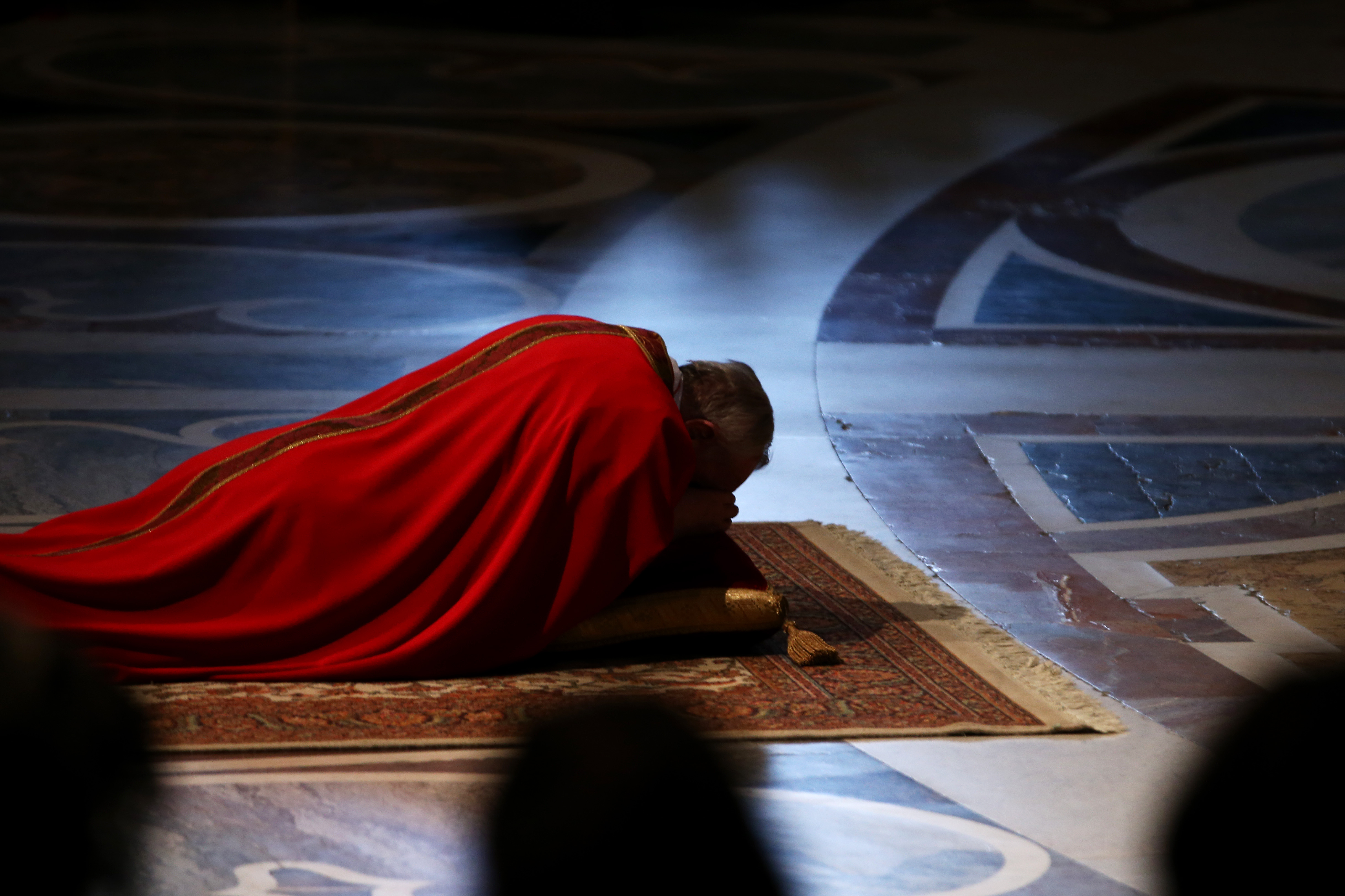
Pope Francis Attends Celebration Of The Lord's Passion in the Vatican Basilica

J. Michelle Molina finds the heart of Jesuit formation – St. Ignatius’s Spiritual Exercises – to be a revealing, but thus far largely neglected, way to understand Pope Francis:

No matter how we stake our political or religious claims, any effort to understand the man ought to include a sense of the Spiritual Exercises, a Jesuit meditative program of spiritual renewal that connects self-reform to transformative action in the world. These meditations offer a framework with which to interpret Francis’s actions because they have provided the key metaphors with which the Jesuit Bergoglio has sought not only to know himself, but also to engage the world.

One point of emphasis in the Exercises:

[The Jesuit] joins the twin goals of contemplation and action in a world understood in both geographical and existential terms. “Jesus knocks from within so that we will let him come out.” These words echo a very Jesuit notion that personal reform is linked, in the words Bergoglio drew upon to inspire the conclave, to an evangelizing church that is “called to come out of herself and to go to the peripheries, not only geographically, but also the existential peripheries: the mystery of sin, of pain, of injustice, of ignorance and indifference to religion, of intellectual currents, and of all misery.” He has eschewed certain liturgical vestments as, quite literally, trappings that would encumber his desire to walk in the world. And this sense of self in the world likely inspires Francis’s controversial symbolics, such as the washing of women prisoner’s feet.

I think this is very perceptive, especially because – as Molina intimates – it allows us to avoid imposing simplistic categories on Francis. Recently we featured a quote from Jody Bottum that made exactly this point, that our usual political labels don’t make much sense when applied to Francis, nor, at its best, historic Christianity more broadly. There’s no reason we should expect a man forged in spiritual practices developed in the 16th century to fit comfortably within any contemporary ideology scheme. And even more, the notion of contemplation joined to action in the world seems particularly fitting when considering Francis, as he appears to be intent on his deeds, from the simplicity of his lifestyle to the washing of a woman’s feet, conveying as much as his words. That style of leadership, that way of living, surely has its roots in the rich tradition of Ignatian spirituality.

There’s one other point worth making here. Molina notes this about Francis’s experiences with the Spiritual Exercises:

Bergoglio has made the full 30-day version of the Spiritual Exercises at least twice and has repeated the shorter, eight-day version every year since he entered the Society of Jesus in 1958.

A 30-day regimen of prayer, meditation, and introspection is an experience most of us probably have trouble fully imagining. One aspect of Ignatian spirituality, as Molina’s article makes clear, is knowing yourself. To overcome or transcend the self one must be acquainted with the darker corners of your soul. The humility and compassion Francis evinces, I suspect, comes at least in part from the rich inner life, the self-critical inward turn, that is a part of the Exercises. A deep awareness of your own faults and failures – a contrite heart – is the precondition for the extension of mercy and love to others. It isn’t surprising, then, that the Jesuit “activism” of Francis has skewed not toward ideological, political ambition, but humble service. Molina’s sketch of the new pope’s Ignatian formation goes as far toward explaining why this is so as any account I have read.

(Photo: Pope Francis prays on the floor as he presides over a Papal Mass with the Celebration of the Lord’s Passion inside St Peter’s Basilica on March 29, 2013 in Vatican City, Vatican. By Dan Kitwood/Getty Images)

The Radical Christianity Of Francis

Pope Francis Attends Easter Mass and Urbi Et Orbi Blessing in St. Peter's Square

What has struck me the most about the new Pope is his reticence. Benedict XVI was as bewilderingly bejeweled in his prose as he was in his elaborate, fastidious outfits. Francis seems to be following his name-sake, who rarely preached as such, but whose actions spoke far louder than any Latin. “Spread the Gospel everywhere – if necessary with words” was the saint’s alleged remark. It was certainly his way of life, although I doubt Pope Francis will suddenly break out into a spiritual dance or song, as Saint Francis was wont to do.

And so Francis was of few and plain words, as he emerged at first: “Bueno Sera” before urging people to go to bed soon. He has simply let the ornate and elaborate vestments of his predecessor fall from his body, as Saint Francis did in renouncing his worldly inheritance from his father. He has spoken of the need to protect Creation from the forces of pure exploitation and greed; he has reiterated Jesus’ message to visit the sick in hospital and the incarcerated in prison. He has washed the feet of a Muslim female juvie. He has refused the Papal throne and its palatial residence. And he has done all this almost instantly. No words could have said as much.

The reaction from the arch-traditionalists, especially in Liturgical matters, has been just a notch short of outright hysteria. One of the new, young priests, who came of age under the counter-revolution of Wojtila and Ratzinger, registers his bafflement at the washing of women’s feet:

I am a young, recently ordained priest. Tonight, I planned on preaching about the Eucharist and the institution of the priesthood. How can I speak about such things – the self-offering of Christ, the 12 viri selecti – when our Holy Father is witnessing to something different?

I feel like going up to the congregation and saying, “I don’t have any idea what the symbolism of the washing of the feet is. Why don’t we just all do what we want.” How hard this is for young priests.

How hard for a young priest to have to grapple with the idea that in Christ, there is “neither male nor female.” Or that some Pharisaical rules, designed to protect the powerful, are what Jesus came to disarm with the power of love, outreach, and embrace of the other. No: what matters to this priest is that those who are selecti are viri, i.e. men, that the washing of the feet is about the supremacy of the male priesthood, not the humility of a God who places the last first and the first last. There is some awkward resistance from the Ratzinger faction as a whole:

“The pope does not need anybody’s permission to make exceptions to how ecclesiastical law relates to him,” noted conservative columnist Jimmy Akin in the National Catholic Register. But Akin echoed concerns raised by canon lawyer Edward Peters, an adviser to the Vatican’s high court, that Francis was setting a “questionable example” by simply ignoring the church’s own rules.

“People naturally imitate their leader. That’s the whole point behind Jesus washing the disciples’ feet. He was explicitly and intentionally setting an example for them,” he said. “Pope Francis knows that he is setting an example.”

The inclusion of women in the rite is problematic for some because it could be seen as an opening of sorts to women’s ordination.

There is no sign that Francis will move to end that ban – although what a day for the church that would be! There are signs rather that Francis wants to break out of the zero-sum dynamic of those issues for a while and reaffirm the central truths of the faith: that the force behind all of creation is love, that Jesus revealed this in his words and in his actions, that those who believe they have everything have nothing, and that those who are marginalized, poor, alone, afraid and vulnerable are by those very facts more capable of seeing God in the world. We have to become more like them to find Jesus, and less like ourselves.

This is a Pope who follows Jesus’ example by simply showing, not telling. Francis of Assisi is the obvious precedent. But this man is a Jesuit as well, an order founded by Saint Ignatius:

St. Ignatius had been a Basque soldier, as well as something of a ladies’ man, until his conversion while convalescing after a cannonball shattered his leg. In his writings, most notably in his “Spiritual Exercises,” St. Ignatius espoused a theology based on loving deeds rather than loving thoughts or words. St. Ignatius calls us not merely to worship Christ but to imitate him.

My italics. Deeds over words; love over law. In the end, the way a human being acts is what his or her religion is. And a spiritual leader can say so much more without words, because he is describing something beyond human understanding. In the washing of a young woman’s feet – from another universe of doctrine – you are witnessing the surrender of law to love. You are witnessing Jesus’ constant resurrection in our world – every day, somewhere, in someone, opening up to the sun, like flowers in springtime.

(Photo: Daffodils in front of St. Peter’s Basilica as final preparations are made before Pope Francis delivers his first ‘Urbi et Orbi’ blessing from the balcony of the Basilica during Easter Mass on March 31, 2013 in Vatican City, Vatican. By Christopher Furlong/Getty Images)

Francis Emerges, Ctd

Pope Francis Attends Celebration Of The Lord's Passion in the Vatican Basilica

The symbolism – a stark departure from Pope Liberace – is like a breath of spring air in a wintry March. From abandoning the papal throne to living communally, Francis is living up to his chosen saint. But this is more significant, it seems to me more than merely a change of tone:

In his most significant break with tradition yet, Pope Francis washed and kissed the feet of two young women at a juvenile detention center — a surprising departure from church rules that restrict the Holy Thursday ritual to men.

No pope has ever washed the feet of a woman before, and Francis’ gesture sparked a debate among some conservatives and liturgical purists, who lamented he had set a “questionable example.” Liberals welcomed the move as a sign of greater inclusiveness in the church.

Speaking to the young offenders, including Muslims and Orthodox Christians, Francis said that Jesus washed the feet of his disciples on the eve of his crucifixion in a gesture of love and service. “This is a symbol, it is a sign. Washing your feet means I am at your service,” Francis told the group, aged 14 to 21, at the Casal del Marmo detention facility in Rome.

“Help one another. This is what Jesus teaches us,” the pope said. “This is what I do. And I do it with my heart. I do this with my heart because it is my duty. As a priest and bishop, I must be at your service.”

Know hope.

(Photo: Pope Francis prays on the floor as he presides over a Papal Mass with the Celebration of the Lord’s Passion inside St Peter’s Basilica on March 29, 2013 in Vatican City, Vatican. By Dan Kitwood/Getty Images)

Quote For The Day

“He is an advocate of the poor who has consistently opposed the Argentinian government’s ostensible programs for the poor. A social activist who rejects most social reform. A churchman who refused many of the elaborate trappings of his office while promoting the power of the church. A populist who denies almost every request for an interview. A leftist who denounces the state power and cultural changes demanded by the left. A reactionary who despises the accumulation of wealth and the libertarian freedoms praised by the right. No attempt to impose liberal and conservative definitions on him will succeed. Pope Francis simply won’t fit in those categories, mostly because the ancient religious insights of Christianity—taken, as he takes them, in their undiluted form—cannot find an easy place in the modern world,” – Jody Bottum.

Greening The Papacy

After the Pope’s inauguration on Tuesday, Alessandro Speciale notes Francis’ focus on the environment:

The pope’s homily was striking for its repeated references to environmental protection, highlighting what is likely to be a central theme of his papacy and setting up the 76-year-old pope as a leading activist against climate change.

When mankind fails to care for creation and for the weak, “the way is opened to destruction and hearts are hardened. Tragically, in every period of history there are ‘Herods’ who plot death, wreak havoc, and mar the countenance of men and women.” Francis addressed himself to “all those who have positions of responsibility in economic, political and social life,” asking them to be “’protectors of creation, protectors of God’s plan inscribed in nature, protectors of one another and of the environment.”

Maybe not a surprising stance from a fan of public transportation. And certainly not from a man who took the name Francis. In my view, the Church has a key role to play in defending creation from frenzied exploitation, in advancing the value of stewardship of nature, in seeing the protection of the planet not as a right or left issue, but as a sacred human duty, a reminder that this speck in a galaxy in an expanding universe is not ours alone, that our species’ dominion over it must always be balanced by care and love.

Francis Emerges, Ctd

The Inauguration Mass For Pope Francis

Where Benedict was a withdrawn absolutist, Francis is an engaged pragmatist. Here are two illuminating examples. The first is that he backed – as a last resort – civil unions for gay couples in Argentina as an alternative to full marriage equality. It’s extremely hard to imagine the mind of Ratzinger being capable of such a nuanced and practical stance in a specific situation:

Faced with the near certain passage of the gay marriage bill, Cardinal Bergoglio offered the civil union compromise as the “lesser of two evils,” said Sergio Rubin, his authorized biographer. “He wagered on a position of greater dialogue with society.”

In the end, though, a majority of the bishops voted to overrule him, his only such loss in his six-year tenure as head of Argentina’s bishops’ conference. But throughout the contentious political debate, he acted as both the public face of the opposition to the law and as a bridge-builder, sometimes reaching out to his critics.

“He listened to my views with a great deal of respect,” said Marcelo Márquez, a gay rights leader and theologian who wrote a tough letter to Cardinal Bergoglio and, to his surprise, received a call from him less than an hour after it was delivered. “He told me that homosexuals need to have recognized rights and that he supported civil unions, but not same-sex marriage.”

Here’s what impresses me: the call back to a gay rights activist. Dialogue. Empathy. I do not expect the Magisterium to change switly on homosexuality – but if we could only have a dialgoe, a discussion, some kind of glasnost on the subject, what an amazing change that would be! If Berguglio had succeeded in persuading the Argentine church to back civil unions, can you imagine how he would have been seen at the Conclave? Can you imagine Benedict’s conniption? Sometimes you need a straight Pope to deal honestly with gay issues.

Then this striking flexibility on priestly celibacy, in an interview last year, after retelling a story of falling head over heels in love as a young man:

Bergoglio admits he was able to choose his path as a priest over the girl but realizes that not all priests can do this. Bergoglio added, “When something like this happens to a seminarian, I help him go in peace to be a good Christian and not a bad priest.

“In the Western Church to which I belong, priests cannot be married as in the Byzantine, Ukrainian, Russian or Greek Catholic Churches. In those Churches, the priests can be married, but the bishops have to be celibate. They are very good priests. In Western Catholicism, some organizations are pushing for more discussion about the issue. For now, the discipline of celibacy stands firm. Some say, with a certain pragmatism, that we are losing manpower. If, hypothetically, Western Catholicism were to review the issue of celibacy, I think it would do so for cultural reasons (as in the East), not so much as a universal option.”

He continued, “If a priest tells me he got excited and that he had a fall, I help him to get on track again. There are priests who get on track again and others who do not…The double life is no good for us. I don’t like it because it means building on falsehood. Sometimes I say: ‘If you can not overcome it, make your decision’.”

Yes, yes, yes: confirmation bias, wishful thinking, you name it. But there is nothing unchangeable about the celibacy requirement. Half of Catholic Christendom has married priests. My old parish in England, where I first received Holy Communion, now has a married priest – a former Anglican. These are management, not doctrinal decisions. Francis understands that, it seems. These procedures can change. For the sake of the survival of the church in the West, they must.

(Photo: Franciscan friars ariive in St. Peter’s Square attend the Inauguration Mass of Pope Francis on March 19, 2013 in Vatican City, Vatican. By Franco Origlia/Getty Images.)

Quote For The Day III

“[W]hile I can appreciate the qualities in Pope Francis that so many people have found immediately attractive, I would trade all the humble mannerisms and charming gestures for the promise that the Mahonys and Sodanos of the church would be consigned, once and for all, to lives of penitence and silence,” – Ross Douthat.

Francis Emerges, Ctd

Pope Francis Gives His First Angelus Blessing To The Faithful

At mass yesterday, you could feel something intangible in the air. Not to go all Peggy Noonan on you, but I sensed both hope and apprehension about the new Pope – as well as a certain distance. Under Benedict, many of us had continued with our faith as if underground, seeing little to connect to in his fastidious liturgy and tone-deafness and weak authoritarianism. Traumatized by the hierarchy’s response to the child-rape epidemic, we clung to our pews with whiter knuckles than usual, reminding ourselves that the church is not its hierarchy, but the people of God seeking the love Jesus promised and the freedom Christianity can unleash in the soul. But we would look up at times to the public leadership, wincing mostly, but still gleaning some nourishment (Deus Caritas Est, for example), before succumbing to anger at the crimes not acknowledged let alone brought to justice, at the hypocrisy and wealth and corruption, at the scandal of a creature like Maciel and a coward named Law.

But now, more heads are poking up a little, like the stubs of new tulips in the softening ground. In the last few days, we’ve found out some more about Francis, and much of it, to my mind, is reassuring. This piece by the usually judicious Thomas Reese relieved me of many worries about his time under the junta. There is no question that Francis was not a profile in courage or an aggressive dissenter in those times, but neither, I think, is it fair to see him as in any fundamental way a collaborator or betrayer of his own priests. Reese goes through the charges methodically. One worth noting:

It is said there is written evidence in the Argentine foreign ministry files that Bergoglio gave information on the Jesuits to the military. The alleged conversation took place when Bergoglio was trying to get the passport of one of the Jesuits extended. Not only did this take place after they were arrested and after they were released, it was after they were safely out of the country. Nothing he could say would endanger them, nor was he telling the government anything it did not already know. He was simply trying to convince a bureaucrat that it was a good idea to extend the passport of this man so he could stay in Germany and not have to return to Argentina.

More recently, Cardinal Bergoglio was involved in getting the Argentine bishops to ask forgiveness for not having done enough during the dirty war, as it was called in Argentina.

How hostile was this man to liberation theology? Again, this is a more complicated question than might at first appear:

What do we mean when we use a hegemonic and singular umbrella term like “liberation theology?” Are we referring to the particular texts that arose in the 1960s and 1970s from the academic and professional theologians like Gustavo Gutiérrez and Leonardo Boff? Both of whose work, by the way, varies in style, method, and outcome. Do we mean the pastoral legacy of the slain Archbishop of San Salvador, Oscar Romero? Do we mean the Jesuits and diocesan priests who took up arms in El Salvador against the will of Romero who, according to the critiques of now-Pope Francis, might also be labeled “opposed to liberation theology” in this context? What exactly do we mean?

If we mean the importation of the materialist arguments of Marxism into Catholic theology, then it seems perfectly clear to me that any Archbishop would oppose it. And should oppose it. But if we mean by it an aggressive posture always in favor of the poor, then we have simple orthodoxy, of the kind Jesus clearly taught. In that respect we have these new words from this new Pope to understand where he is coming from:

And those words came to me: the poor, the poor. Then, right away, thinking of the poor, I thought of Francis of Assisi. Then I thought of all the wars, as the votes were still being counted, till the end. Francis is also the man of peace. That is how the name came into my heart: Francis of Assisi. For me, he is the man of poverty, the man of peace, the man who loves and protects creation; these days we do not have a very good relationship with creation, do we? He is the man who gives us this spirit of peace, the poor man … How I would like a Church which is poor and for the poor!

I know I have a serious confirmation bias at work here. I desperately want reform in the church and although I remain of the conviction that this has to start with us, its ordinary members, the signals and signs of the hierarchy do convey the faith to millions – and that matters.

And so in yesterday’s Gospel, we found ourselves with Jesus and the adulteress again. The gospel passage is one of the most disarming – because it is about disarmament of the ego, openness to the other, and forgiveness. “Neither do I condemn you,” Jesus says, in an astonishing embrace of humanity in all its flaws, left finally alone with a woman facing imminent death by stoning.

His move is a lateral, not hierarchical one – the mysterious, ineffable, sudden crouch that Jesus goes into when questioned by other rabbis. He writes in the sand – words or signs we will never know. The forgiveness is overwhelming – too overwhelming for us to accept it most of the time. And so the Holy Father yesterday spoke directly to me when he called so many Catholics out for not feeling worthy of forgiveness:

Meditating on the Gospel passage (John 8: 1-11 — “Let he who is without sin cast the first stone”), Francis said, “This is Jesus’ message: mercy. On my part, I say it with humility; this is the the Lord’s strongest message: mercy. He himself said: ‘I did not come for the righteous.’ The righteous can justify themselves.… Jesus came for the sinners.”

“‘Oh, Father,’” Pope Francis continued, relating what people often say to priests, “‘if you knew my life you wouldn’t say that.’”

“Why? What have you done?”

“Oh, I’ve done bad things.”

“Good! Go to Jesus; He likes you to tell him these things. He forgets. He has the special ability to forget. He forgets them, kisses you, embraces you, and tells you only, ‘Neither do I condemn you. Go and sin no more.’ He only gives you this counsel. A month later we are the same.… We return to the Lord. The Lord never tires of forgiving us, never! We are the ones who get tired of asking forgiveness. Let us ask for the grace to never tire of asking forgiveness, because he never tires of forgiving us.”

This incomprehensibly comprehensive forgiveness is God in the Christian sense. It allows us to start anew, to see, as Saint Francis did, the forgetfulness of nature itself, its capacity for regrowth, for healing, to look into the buds on the trees in spring:

Last year is dead, they seem to say,
Begin afresh, afresh, afresh.

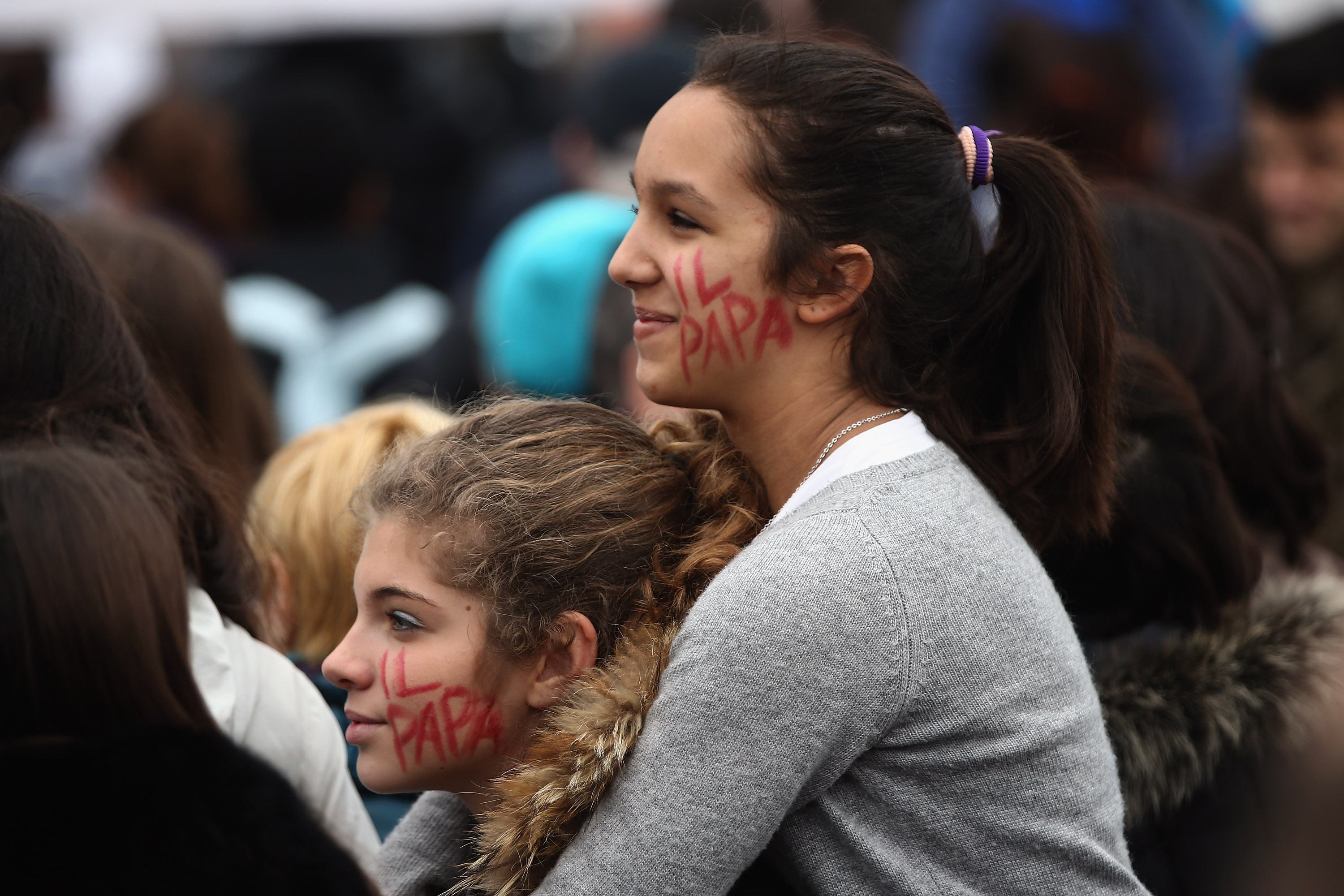
(Photo: People gather in St Peter’s Square ahead of the arrival of Pope Francis who will give his first Angelus Blessing to the faithful from the window of his private residence on March 17, 2013 in Vatican City, Vatican. The Vatican is preparing for the inauguration of Pope Francis on March 19, 2013 in St Peter’s Square. By Dan Kitwood/Getty Images.)