The Pope And The American Right

Pope Francis Visits Sardinia

I borrow the title of the post from Ross Douthat who has a typically nuanced take on the subject. Maybe it’s best to start with where we agree. Pope Francis’ criticism of the market as the core relationship between human beings is not in any way new in Catholicism. Nor is it some form of ideological leftism. It’s simply an orthodox call to remind us of our fundamental duty to the poor and the sick and the vulnerable, our manifest obligation to treat every human we encounter with dignity and worth – both personally and through the social structures we democratically assent to. It is primarily something that only each human soul can accomplish: social justice cannot replace interpersonal caritas, as some theocons have long rightly argued. The former is accomplished via the latter. And yes, a Pope’s treatment of social and economic matters is not doctrinally dispositive. There is room for dissent here, and prudential disagreement in good conscience.

Of course, the theoconservatives were among the last to allow any prudential, conscientious disagreement with papal pronouncements when they held sway in the Vatican. Those of us who dissented on priestly celibacy or the civil equality of homosexual persons or the ban on all contraception or the new and extremist doctrine on end-of-life issues were routinely dismissed as outside the fold. But as the theoconservative project, like the neoconservative one, lies in rubble and manifest failure, there’s no need for tit-or-tat now that the papal shoe is on the other foot (and no longer Prada).

There is, for example, little doubt that the free market has brought more wealth, comfort and health to Israeli Prime Minister Benjamin Netanyahu Meets With Pope Francismore human beings than any other form of economic model in human history. The last 300 years have improved our material lot more than the previous 200,000. Socialism is a grim failure of a system, communism even worse. But what all these systems have in common is a materialist vision of what makes human life worth living. That’s not a criticism in particular. Most such systems do not have within their remit a deeper understanding of human existence, a grounding in something other than prosperity. A Catholic, however, has exactly that grounding, which enables us to examine all such systems from different, higher ground.

And the way in which market capitalism has become a good in itself on the American right is, well, perniciously wrong. As soon as a system ceases to be a means to a human good, and becomes an end in itself, it has become a false idol. Perhaps the apotheosis of that idol worship was the belief – brandished on the degenerate right in the past decade or two – that markets are self-regulating. Of course they’re not, as Adam Smith would have been the first to inform you. Another assumption embedded on the American right is that more wealth is always a good thing. The Church must say no. This is a lie. Wealth is a neutral thing above a certain basic level of non-drudgery. Above that, it can be an absolutely evil, deceptive thing, distorting human souls, warping their dignity, vulgarizing their character. An American right that worships at the altar of both free markets and material wealth, and that takes these two idols as their primary goods, is not just non-Catholic. It is anathema to Catholicism and to the Gospels.

The neoconservative version of American exceptionalism is equally anathema to Catholicism. No country on earth is any more inherently moral than any other. It may achieve great things in advancing human good, as the US has clearly done. But as soon as you identify one country with all human good, and believe that its model, let along its divine providence, is dispositive for the whole of humankind, you are also worshiping a false God. It is that self-worship that allows a country to commit evil and justify it. Torture is such an evil. The American justification of it by the false doctrine of exceptionalism is something the Devil would have celebrated as a great triumph in the Screwtape Letters. And the American Catholic right’s acquiescence to it – including the last Pope’s – is a dark and indelible strain.

This is a critique of English exceptionalism as well, of course, and of colonialism as the purest expression of national self-love. It applies to the lie of communism as well as a global panacea- and to all systems that seek to impose a human set of ideas on mass populations by force of law, and that deny the innate dignity and equality of all of us. So yes, much of the right’s critique of communism, fascism, social democracy and the secular hubris of progressivism endures. But we must add to it the panacea of capitalism.

So in the spirit of conversation, let us get specific about two key issues now on the table: healthcare and Iran.

Now it seems to me that the Church is rightly neutral about the means of achieving the end of universal care. It is not a single-payer Church or an Obamacare Church. But it cannot and is not neutral in any way when it comes to the core moral imperative that each individual in our society, especially the most vulnerable, be able to get care in the wealthiest country on earth. In so far as the Republican party is absolutely indifferent to the millions of Americans without health insurance, in so far as they have relentlessly opposed one feasible plan for universal insurance without offering an alternative that could achieve the same thing, the Republican party simply cannot be supported by Catholics right now. Now there are good-faith proposals for a conservative approach to universal healthcare, as we’ve discussed on the Dish, so this critique does not apply to them. But it sure does apply to the GOP leadership.

Similarly on Iran, there is plenty of space within Christian realism to worry that our current attempt at engagement is foolish, that the Iranian regime is not susceptible to change or any peaceful presence in the world. But to refuse even to try and test the possibility of peace – which seems to be the neoconservative position – is clearly against Church teachings to seek peace at all times whenever possible. Pre-emptive war is just as anathema to Catholic “just war” teaching, as, of course, is torture. How much time have theo-conservatives spent this past decade examining the crime of the Iraq war and the evil of torture? I suspect the Pope’s answer would be: not nearly enough. And it’s high time they did.

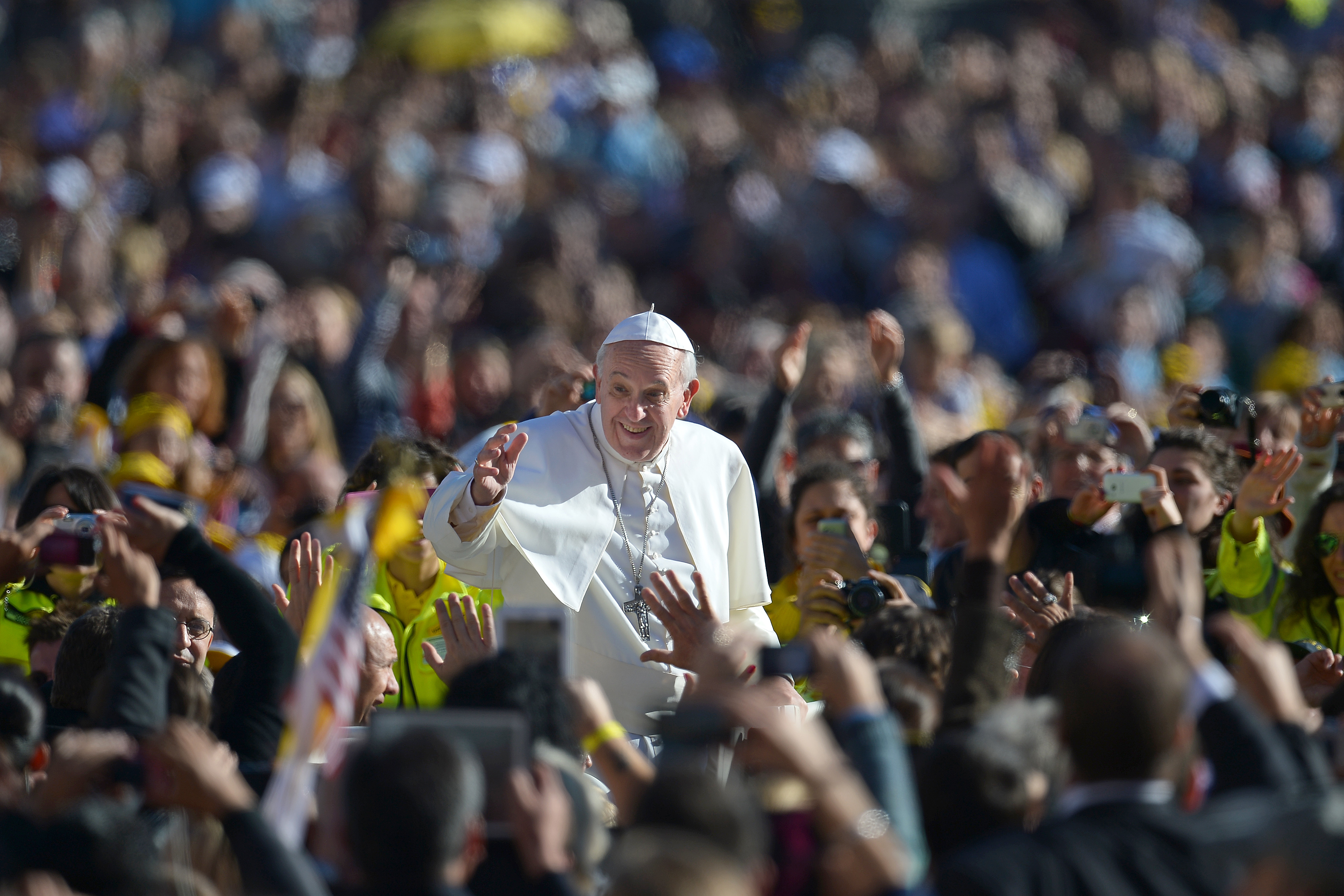
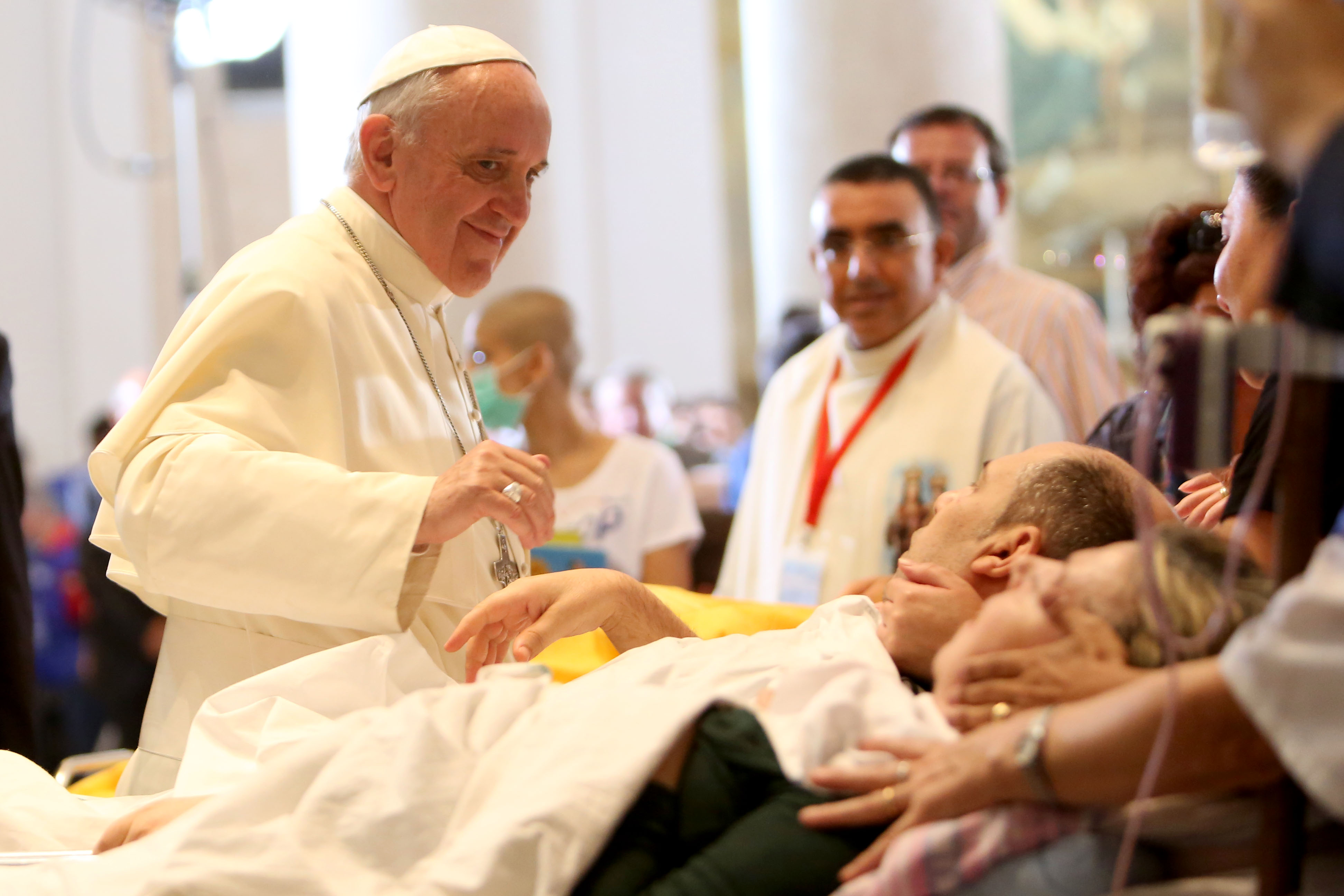
(Photos. Top: The Pope visits the sick on September 22, 2013 in Cagliari, Italy. By Franco Origlia/Getty Images. Right: Pope Francis receives Israeli Prime Minister Benjamin Netanyahu in a private audience at his library on December 2, 2013 in Vatican City, Vatican. By Vatican Pool/Getty Images.)
The Pope’s Economist

Despite Francis’s South American background, gestures toward liberation theology, and his new apostolic exhortation‘s critique of the “tyranny” of the market, Heather Horn argues that we shouldn’t look to Marx to understand the new pope’s approach to economics. Instead, she points us to Karl Polanyi, author of the classic counter-history of the rise of capitalism, The Great Transformation:

Economic activity, Polanyi says, started off as just one of many outgrowths of human activity. And so, economics originally served human needs. But over time, people (particularly, policy-making people) got the idea that markets regulated themselves if laws and regulations got out of their way. The free market converts told people that “only such policies and measures are in order which help to ensure the self-regulation of the market by creating the conditions which make the market the only organizing power in the economic sphere.” Gradually, as free market-based thinking was extended throughout society, humans and nature came to be seen as commodities called “labor” and “nature.” The “market economy” had turned human society into a “market society.”

In short (as social sciences professors prepare to slam their heads into their tables at my reductionism), instead of the market existing to help humans live better lives, humans were ordering their lives to fit into the economy.

How that connects to the vision of Pope Francis:

Where things get really interesting is when Pope Francis brings up the financial crisis. “One cause of this situation,” he writes, “is found in our relationship with money, since we calmly accept its dominion over ourselves and our societies. The current financial crisis can make us overlook the fact that it originated in a profound human crisis: the denial of the primacy of the human person!”

It’s nothing new to say the financial crisis came from a lack of regulation. That’s a fairly popular analysis. But what Pope Francis is saying is more Polanyan, hearkening back to the idea that the tipping point has to do with the relationship between the market and society/humanity, and which is subordinate to the other. Just as Polanyi argued that the extension of the market economy across the globe (through the gold standard) was the root cause of World War I (and you’ll have to go back to the original book for that, but it’s a beautifully, hilariously gutsy, Guns, Germs, and Steel kind of argument), Francis is arguing that failing to keep humanity at the center of our economic activity was the root cause of the financial crisis.

A Saint, An Artist, A Pope

dish_bacon

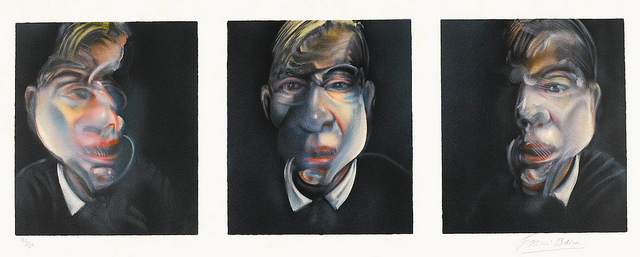
David Griffiths, a Catholic writing professor, broke down in tears when he heard the announcement that the new pope would be named Francis. Looking back, he realized how the experience helped him make the connection between two of his heroes – St. Francis and the artist Francis Bacon, both of whom were “bursting with a desire to embrace the ugliness and spiritual poverty of this world in a way that called attention to it, named it, so that others might see”:

In retrospect, my reaction to Pope Francis’s election makes so much more sense when I consider that during my tenure at the college my artistic guiding lights were St. Francis and the painter Francis Bacon. About as far from a saint as one can imagine, Bacon is infamous for showing us things that perhaps we would rather not see: nightmarish self-portraits, unnerving studies of screaming popes, and writhing and wrestling biomorphic forms.

But Bacon was not interested in merely horrifying us. He was painting, as he said in an interview, to “excite himself”; spreading paint in a way that was expressive of his anger, his lust, and his love of painting. In a rare explanatory moment, he revealed to an interviewer that his numerous paintings that reference crucifixion were not religious but “an act of man’s behavior to another.” Some moralists have said that his paintings are corrupting and harmful, but I’ve always felt that they do no more harm than if one took to hanging around a butcher shop or meat packing plant. To me, his paintings, like all great art, make us confront essential questions about the human condition.

(Image of Francis Bacon’s Three Studies for Self-Portait (1981) from Flickr user Cea.)

Francis Embraces His Critics

Mario Palmaro, a traditionalist Catholic who has strongly criticized Pope Francis, is gravely ill. How Palmaro describes an unexpected phone call from Francis, who contacted Palmaro after learning of his illness:

“I was astonished, amazed, above all moved: for me, as a Catholic, that which I was experiencing was one of the most beautiful experiences in my life. But I felt the duty to remind the Pope that I, together with Gnocchi, had expressed specific criticisms regarding his work, while I renewed my total fidelity [to him] as a son of the Church. The Pope almost did not let me finish the sentence, saying that he had understood that those criticisms had been made with love, and how important it had been for him to receive them.” [These words] “comforted me greatly.”

Dreher, who has had his differences with the Pope, reacts:

Theological considerations aside, Pope Francis is a total Catholic mensch. Can we agree on that? I think we can.

One of Dreher’s commenters adds:

The following is one of my favorite quotes, and it applies, to some degree, to this situation:

“The only sign of humility is the love of one’s enemies. When one loves his enemies, he says in effect that they are as worthy of life as he is, that the Kingdom of God does not depend upon the vindication of one’s own cause. When one loves his enemies, he has accepted the fact that he is not the center of the universe. He is willing to admit that the grace of God may be at work, even in his own behalf, in the resistance and rejection he encounters from others. By love of enemies and by this standard alone can the humility of Jesus be measured. The ‘humble of heart’ whom Jesus admires are those whose hearts have no hatred for their opponents.”

(“Free to Be Faithful” by Anthony Padovano, page 16)

Humility, I believe, consists of more than loving those who oppose or hurt us, but this act is an acid test of the virtue. Good for the Pope.

Can Francis End The Church’s Civil War?

francisshadow

Ross Douthat hopes so:

Ever since the Second Vatican Council, the church has (as most people know) been locked in a kind of low-grade institutional civil war, between a liberal/progressive/modernizing viewpoint that had its moment in the 1960s and 1970s, and the more neoconservative perspective that set the tone for John Paul II and Benedict’s papacies. (I say neoconservative because this was essentially a quarrel over the meaning and implications of Vatican II’s liberalizing reforms, between factions that had both supported them, with critics of Vatican II confined to the sidelines and the fringe.)

For my generation of Catholics, wherever our specific sympathies lie, this inheritance of conflict has created a hunger for synthesis – for a way forward that doesn’t compromise Catholic doctrine or Catholic moral teaching or transform the Church into a secular N.G.O. with fancy vestments, but also succeeds in making it clear that the Catholic message is much bigger than the culture war, that theological correctness is not the only test of Christian faith, and that the church is not just an adjunct (or, worse, a needy client, seeking protection) of American right-wing politics. This desire has been palpable in the Catholic blogosphere for some time, and I think you can see it percolating in many of the publications in whose pages the old intra-Catholic battles were so often fought.

Me too. And that is why Francis’ insistent emphasis on the faith as a way of life – and not an ideology – is so brilliant a way out of this debilitating conflict. And that way of life demands a humility that is simply not consonant with the harsh rhetoric of, say, Cardinal Dolan, over comparatively trivial matters, or, for that matter, the iconoclastic over-reach of some reformers in the wake of the Second Council. Would a humble faith like Saint Francis’ be aligning with the Republican right in a culture war? Is the calm gentleness of Jesus compatible by the rigid enforcement of total obedience to a set of increasingly detailed doctrinal non-negotiables that we are somehow supposed to will ourselves into believing, even when our own lives belie them? The questions answer themselves.

I see Francis increasingly like Jesus in the Gospel story of the woman caught in adultery. I wrote about this last year in this way:

She is about to be stoned. Does Jesus uphold the law he came to fulfill against the woman? No. He demands that those without sin cast the first stones. And he forgives the woman – while insisting she not sin again. Actually, he does more than forgive. He says: “Neither do I condemn thee: go, and sin no more.”

This is the Christian model of sexual morality, it seems to me, as it is of morality in general. Jesus poses an impossible standard and then refuses to condemn an actual tangible human being who fails to reach it. Since we are all completely ridden with sin, we equally have no right to condemn anyone else, even if we are living the most upright lives according to the law.

Forgive us our trespasses, as we forgive those who trespass against us.

And in this classic scene in which religious authorities stand ready to deploy their power to punish sin, Jesus does something strange. He physically defuses the dynamic. She is cowering; they are threatening; they demand he uphold the law. What does he do? He sits on the ground and doodles in the dust. He is neither condemned nor condemner. He breaks that circle. He does not condemn. He forgives.

So I am a sinner.

Francis is defusing the binary dynamic and the authoritarian dynamic. His first words in the America interview were: “I am a sinner.” In the standing-only battle lines of the church’s civil war, Francis has sat on the ground, breaking the cycle, neither condemned nor condemner, just a sinner.

And it is increasingly clear this is not just public relations. The Papal Nuncio to the US just told the US bishops the following:

Pope Francis, Vigano said, “wants bishops in tune with their people.” The pope “is giving us by, his own witness, an example of how to live a life attuned to the values of the gospel. While each of us must take into consideration our adaptability to the many different circumstances and cultures in which we live and the people whom we serve, there has to be a noticeable life style characterized by simplicity and holiness of life. This is a sure way to bring our people to an awareness of the truth of our message.” Vigano quoted liberally from Pope Paul VI’s Evangelii Nuntiandi, which, he noted, Francis has called “the greatest pastoral document written to date.” It was promulgated in 1975.

“The first means of evangelization,” Paul VI wrote, “is the witness of an authentically Christian life, given over to God in a communion that nothing should destroy and at the same time given to one’s neighbor with limitless zeal. As we said recently to a group of lay people, ‘Modern man listens more willingly to witnesses than to teachers. and if it does listen to teachers, it is because they are witnesses.”

Or in the words of Saint Francis: “Preach the Gospel everywhere. If necessary, with words.”

(Photo: Alessandro Di Meo/AFP/Getty Images)

This Extraordinary Pope, Ctd

VATICAN-RELIGION-CHRISTIANITY-POPE-AUDIENCE

Last week the Vatican released a document laying the groundwork for next year’s Synod of Bishops on the Family, a gathering of bishops from around the world focusing on pastoral challenges related to modern family life. As well as laying out the essentials of relevant Church teachings, the document poses 39 questions to the bishops about the actual families living and working in their communities, and how the Church can best minister to them. Here are the questions under the heading, “On Unions of Persons of the Same Sex”:

a) Is there a law in your country recognizing civil unions for people of the same-sex and equating it in some way to marriage?

b) What is the attitude of the local and particular Churches towards both the State as the promoter of civil unions between persons of the same sex and the people involved in this type of union?

c) What pastoral attention can be given to people who have chosen to live in these types of union?

d) In the case of unions of persons of the same sex who have adopted children, what can be done pastorally in light of transmitting the faith?

The meaning of all this is as vague as the questions are conspicuously neutral. The Vatican has given some conflicting signals as to whether this is something new or something habitual, whether it is a consultation directly between the faithful and the Vatican, or whether the various bodies of national bishops will be the intermediary. In England and Wales, the bishops have put the questionnaire online.  In the US, where the bishops are still dominated by reactionaries, no such direct input outside the bishops’ control looks likely. That effectively means, I fear, that the US hierarchy – think Cardinal Dolan – may not convey the real sensus fidelium on these matters:

In the letter he sent to the bishops’ conferences in October, Archbishop Lorenzo Baldisseri, the secretary general of the Vatican’s Synod of Bishops, directed the prelates to distribute the questionnaire “immediately as widely as possible to deaneries and parishes so that input from local sources can be received.”

One question is whether the archbishop and the Vatican meant for the world’s bishops to conduct a survey of their populations using the questionnaire. The U.S. bishops’ conference did not request the U.S. episcopate to undertake that wide of a consultation, telling the bishops in an Oct. 30 memo sent with Baldisseri’s letter only to provide their own observations.

I think American lay Catholics should download the English questionnaire and send their views in directly, if the bishops still insist on controlling the data. And in any case, we already know what American Catholics think on many of these questions. Sophisticated polling outfits have provided the data for a long time. Either this initiative will echo those views or it will skew toward what the bishops want to hear.

But my sense of this Pope – especially in his direct interaction with ordinary people – is that this is a chance for real democratic input, of not democracy itself (which would not be appropriate). Amy Davidson gives them a close read, and comes away thinking that this could be where the Francis revolution begins to move beyond rhetoric:

What Francis seems to be looking for is not a doctrinal or political response to same-sex unions but a pastoral one: taking modern families as they are and live, and seeing how the Catholic Church can be part of their lives. (There is not a question about how best to lobby legislatures.) The synod, according to the document, is meant to address “concerns which were unheard of until a few years ago.” Its summary of these concerns is not in all respects liberal; it mentions “forms of feminism hostile to the Church,” and emphasizes the indissolubility of marriage. And certain situations that it calls novel, like that of single parents and of dowries “understood as the purchase price of the woman,” have been less unheard of than unheeded.

But there are the seeds of something radical here.

There is, for one thing, an attempt to get past pretense. It asks how many people “in your particular church” are remarried, or separated, or are children whose families aren’t the kind in church picture books, and how to reach and include them. In terms of abortion, it asks how people could be persuaded to accept the Church’s teachings—but also how good a job churches are doing at teaching them about “natural” means of family planning, like the rhythm method. Mercy was also a word that came up, with regard to families living “irregular” lives.

It’s not too early to wonder if that synod could be a landmark moment for Francis’s papacy, and his Church.

The divisions in the Vatican are real and obvious:

When Archbishop Lorenzo Baldisseri was asked at the Vatican press briefing Tuesday if that action was something other bishops’ conferences should emulate, he said the “question answers itself” and was “not worth considering.”

I suspect the Pope’s moving accretion of moral authority these past few months with Catholics and non-Catholics alike – along with his new structure of eight cardinals as a kind of cabinet outside the Vatican bureaucracy – will give him more lee-way for change than some might expect. Michael O’Loughlin is optimistic:

I could not have imagined that the church would recognize gays as human beings even a few months ago, never mind ask for ideas on how to serve them, and their children, better. It’s truly revolutionary. And what’s not there in those questions is just as amazing as what is. There’s no mention of sin. Nothing about intrinsically disordered desires. The children aren’t called illegitimate. Instead, there’s language that recognizes gay and lesbian Catholics as human beings, as people who long for lives of faith and meaning.

Update from a reader, who notes something O’Loughlin noted as well:

Regarding the Vatican Survey, there is now a survey that lay Catholics in the US can respond to. Catholics in Alliance for the Common Good has received over 2000 responses since last Friday, and they are incredibly moving. It’s an abbreviated survey, focusing on how folks experience things pastorally in the pews. There is also a Spanish version available to recognize the reality of our US Church.

They may put up the full survey, but the shorter survey is getting a wider range of folks to respond – a priest who printed off a copy and helped a homeless friend fill it in and scan and email it; a 97-year old woman who had waited her life for this. Both surveys have their place – as a person with a theology and a law degree, I’m happy to contribute my thoughts on natural law. But as a person with a sibling who has transitioned from male to female, whether my parish welcomes LGBT folks is a matter of much greater importance – the types of questions the survey asks. When I was struggling most with her transition, mixing up pronouns and so forth, not knowing how to refer to my sibling, not accepting her decision fully, my priest friend provided me with pretty direct fraternal correction: “She’s your sister. Period.” From a guy who is much more comfortable listening and not being too directive about anything, this was a great gift, to be challenged so directly to respect who my sister was created to be.

Please let your readers know about this opportunity. The survey coordinators do have a channel to ensure it gets to the Synod.

(Photo: Pope Francis salutes the crowd as he arrives for his general audience in St Peter’s square at the Vatican on November 6, 2013. By Vincenzo Pinto/AFP/Getty Images.)

Pope Francis As Saint Francis

crespi leproso

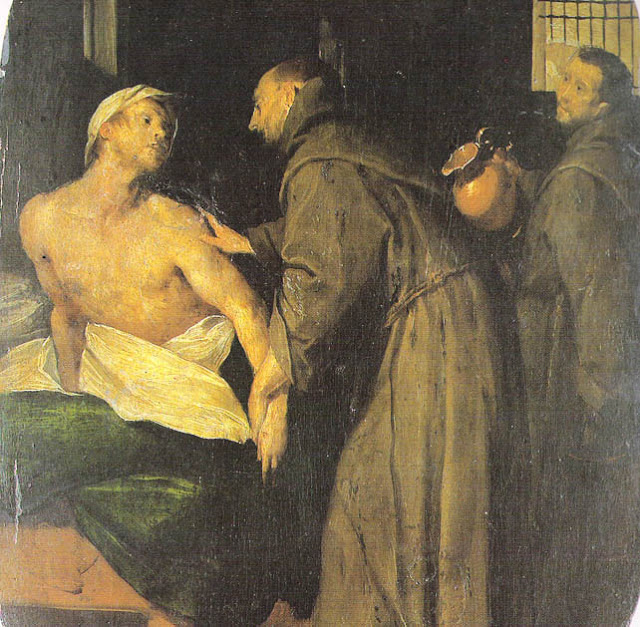
These images say more than a thousand encyclicals. It’s worth recalling that Saint Francis, after a brutal time spent as a prisoner of war, emerged a broken man and on his way back home came across a group of lepers. Previously a wealthy young scion of Assisi, fastidious and fancy, he entered the leper colony and began washing their bodies and living among them. It was the beginning of his ministry. And so it begins again …

A reader adds:

This is the first time I’ve ever been compelled to write you about a non-political issue, but your link to the article about Pope Francis embracing a horribly disfigured man really hit me.

I’m a complete and thorough atheist. I was raised religious, but went away from it very consciously and actively as I rejected the entire logical foundation of religion. I am still as confident in my atheism as I’ve ever been. I preface my thoughts this way merely to put into context the unalloyed awe and admiration I have at the actions this Pope has taken. Acts of profound and sincere compassion are all too rare in this world, and whether those acts come from an atheist or a pope, they are to be treasured and cherish.

The reality of horrible disfigurement has always been something which has struck me very hard.

On one level, its simply the pity one feels looking upon the decrepit, and imagining the difficulty of their lives. On another level, I can’t help but feel of overbearing sense of guilt at my own visceral disgust upon looking at disfigured people; it’s a disgust rooted in evolution and natural instincts, not a moral revulsion, but its an undeserved disgust all the same. I’m not going to pretend that seeing the actions of Pope Francis today is going to be able to change that; human instinct is what it is. But it gave me a little more appreciation for the profound acts of kindness that people are capable of when they truly embrace compassion as an ethos. For that, this man is worthy of intense admiration.

In 6 months, Pope Francis has lifted the image of his faith far above anything I’d thought possible in my 28 years of life. May he continue to do so.

Or as Saint Francis once put it: “Preach the Gospel everywhere. If necessary, with words.”

(Painting: Giovanni Battista Crespi, called Cerano, ‘Saint Francis healing the leper’, 1630.)

Your Moment Of Pope

A little boy wanders on stage with Francis and won’t let him go.

I’m struck by a simple fact: this happened to Jesus a lot, and his response – even more revolutionary in his day  – was Francis’: “Let the children come to me and do not prevent them; for the kingdom of God belongs to such as these.”

From raping children to seating them on the papal chair. Know hope.

Popenomics

Reviewing Papal Economics by Maciej Zieba, Michael P. Orsi surveys the economic philosophy of pontiffs through history up to recent times:

[Author Maciej] Zieba shows how John Paul II believed that democracy and capitalism were good for the human person. Having come out of a socialist state, the Pope recognized the dehumanizing effect that an un-free political system has on personal creativity and the creation of wealth. The Pope, he claims, in no way promoted a “third way” redistributionist economic system. He rather held to the “ordoliberal” principles, perfected in post-World-War II Germany. Ordoliberals maintain that the role of the state is to establish the rules for a real free market in which capitalism and free competition can cooperate for the common good. …

Yet John Paul was no libertarian, as Zieba explains: “The libertarian approach to the right of private property, through theoretically not an absolute right, is in practice free of social and moral obligations.” Instead, Catholic social teaching calls for the state to make available to all its citizens the bounty of the earth which may be attained through work. In Laborem Exercens, the Pope says humans express themselves in their work. In no way does the Pope call for a welfare state, but he does ask that governments help to provide opportunities for their citizens to earn a decent living. To this end he urges just laws, a fair economic system, sensitivity to and the protection of the rights of minorities, and aid for those who fall below the poverty level.

Meanwhile, the current Pope is doing his best to put his own house in order:

The pontiff may be ostentatiously cutting back, but not without a fight. The Catholic church has a long history of extravagance, and sometimes the old ways are slow to die. Though Pope Francis started off by setting new simple sartorial standards, when it comes to throwing out real estate the Vatican elite may prove more resistant. There is a story doing the Vatican gossip rounds of a cardinal turning up in a church to celebrate mass and being offered a splendid red cappa magna to wear. A cappa magna is the liturgical equivalent of an opera cape – all billowing watered silk and a train that would rival Princess Diana’s wedding dress. The cardinal refused, saying: “I sold mine after the second Vatican council, and gave the money to the poor.” The master of ceremonies gave the curt reply: “It’s a shame you didn’t sell one of your two villas, and give the proceeds from that to the poor.”

It may be just a story, but it expresses the feeling of double standards within the Vatican community over self-conscious economy. The current German row, perhaps a Vatican “duck house” moment, is worth considering in the context of the power play between the Vatican and the German wing of the Catholic church. The independent wealth of the German church comes from the state – it is tax funded. In 2012 the Catholic church in Germany took $7.1bn in tax revenue, from the country’s 23 million declared Catholics who by law pay 8-10% of their income to the church. The autocratic nature of the Vatican means that even if a bishop can clearly afford it, if it doesn’t wash with His Holiness’s vision you run the risk of being defrocked.

Previous Dish on Francis’s and Benedict’s views on economics here and here.

The Oskar Schindler Of Argentina?

John L. Allen, Jr. details a new Italian book that claims that title for the man who became Pope Francis:

In reply to persistent charges that the young Fr. Jorge Mario Bergoglio was complicit in Argentina’s infamous “dirty war” from 1976 to 1983, when roughly 30,000 people disappeared, Scavo asserts that Bergoglio was actually a Jesuit version of Oskar Schindler – quietly saving lives rather than engaging in noisy public protest.

The future pope, Scavo writes, saved as many as a thousand targets of the military dictatorship by providing shelter in a Jesuit college, passing them off as seminarians or laity on retreat, then helping them move out of Argentina.

In one case, according to Scavo, Bergoglio gave a man who bore him a passing resemblance his own passport and priest’s clothing to make his escape.