Taking His Message To The Streets

Taking stock of Pope Francis’s three recent headline-grabbing interviews, William L. Portier argues that the new pontiff is pioneering “a new genre of papal pronouncement, minimally authoritative, but unprecedented in its reach”:

Long before his election, Pope Francis urged his people in Buenos Aires not to focus on the internal life of the church but to take the church out into the streets. In response to a journalist on the flight back from Brazil, he described himself as “a street priest” who feels somewhat “caged” in the Vatican. With the papal news media interview, Pope Francis has found a way to pop the bubble that seemed to isolate his predecessor during his last days in office. He has, in a real sense, made it back to the streets. This new genre of papal pronouncement dodges grasping handlers and bureaucrats who would brand the pope restrictively, frustrate his wishes, and control his access. Pope Francis is now an anticipated part of the news cycle. The papal news media interview takes him directly to the people, all the people.

A Catholicism Against War And Shopping

Amid fresh discussion over the nature of Catholicism sparked by the new Pope, Adam Gopnik spots a chance to revive appreciation for J.F. Powers, a Catholic author who “accepted the necessity of the divine institution, without unduly sanctifying its officials”:

The [new] collection of letters reveals that he spent the war years as a conscientious objector, and as a sympathizer with the Detachers—a Catholic movement, never officially approved, but apparently tolerated, that insisted that American materialism and militarism were both evils to be avoided at all costs by good Catholics. The idea of an American Catholicism whose central purpose was to stop the national-security state and the supermarket—in those days, supermarkets were seen as Wal-Mart is now—is alien to us, and Powers’s immersion in the often self-defeating politics of left-Catholic activism, with its glamorized poverty, is fascinating to follow from letter to letter.

Yes, Francis Reached Out To Gay Catholics!

He responded to a letter from an Italian gay group, the first time they have ever received a response from anyone in the Catholic hierarchy. A Dish reader translated the story. Can you imagine Benedict doing such a thing? Money quote:

Pope Francis wrote that “he appreciated very much what we had written to him, calling it a gesture of ‘spontaneous confidence’, as well as ‘the way in which we had written it.’”

The full translated story is here. Know hope.

Francis Happy To Talk To Gay Catholics?

At least that’s what I think this report from the Italian media says. Could a reader translate and I’ll post the whole thing? Update:

Gay Catholics amazed at the Pope: “He answered our letter”

The Kairos group: “We wrote to him, and he blessed us.” Even Don Santoro will write to Bergoglio: “I want to ask him what he thinks of our condemnation”

by Maria Cristina Carratu

Pen and paper. Among the many revolutions of Pope Bergoglio – in addition to phone calls to the homes of everyday people (recently there was news of a family in Galluzzo telephoned by Francis, who, after inviting them to Assisi, asked if he could bless them and invited them to bring “the greetings and blessings of the Pope” to the parish) – there is also the “mail effect”. He receives a mountain of letters every day at his residence in Santa Marta, sent to him directly by those hoping to reach him by bypassing the “obstacles” of the Curia. And now there are those who think it may have been one of those “messages in a bottle” to inspire Bergoglio’s transformation on the subject of gays. A letter was sent last June to the Pope from several Italian Catholic homosexuals, many of whose signatures were collected by the Kairos group in Florence, which is very active in this area. In the letter, gays and lesbians asked Francis to be recognized as people and not as a “category”, asking for openness and dialogue from the Church, and reminding him that closure “always feeds homophobia”.

This was not the first of its kind to be sent to a pontiff, but one which “no one had ever given even a hint of an answer”, said one of the Kairos leaders, Innocenzo Pontillo. This time, instead, the answer arrived. Along with another letter from the Vatican Secretary of State (the contents of both letters are private, and it was only decided recently to make the exchange public), in which, Pontillo explained, Pope Francis wrote that “he appreciated very much what we had written to him, calling it a gesture of “spontaneous confidence”, as well as “the way in which we had written it.”

But not just that. “The Pope also assured us of his benedictory greeting.” “None of us could have imagined anything like this,” stated the Kairos representative, highlighting how, by contrast, the Archbishop of Florence, Giuseppe Betori, “always refused to even meet with us, claiming that if he did we would be legitimized as homosexuals.” Now Pope Francis actually sends us his benediction, and who knows whether his subsequent remarks about homosexuals (“Who am I to judge gays?” uttered on a plane coming back from Rio de Janeiro, and then the explosive words to Civiltà Cattolica [Catholic Civilization, a Roman Jesuit periodical]: “When God looks at a homosexual person, does he approve of his existence with affection, or does he reject him and condemn him? The person must always be considered”) might not actually be due to this exchange of letters.

In the meantime, the prisoners at Sollicciano [a Florentine prison] wrote a letter to Bergoglio (delivered directly to him in the final days of the prison chaplain don Vincenzo Russo), in which they described the ordeals of prison life and invited him to visit them, possibly on the occasion of the National Church Convention of the CEI [Italian Episcopal Conference], to be held in Florence in 2015 and where the pontiff’s presence is expected.

Now, even the Community of Piagge is addressing the Pope: “The climate has changed, and now those who want something different for the Church must stay with the Pope,” recognizes don Alessandro Santoro. “As a Community,” he explains, “we feel liberated from the many doctrinal snares of the past, and Pope Francis demonstrates how it is possible to go from mere doctrinal obedience to faith in the life of people.” Which “doesn’t mean that the Church can’t have its doctrine, provided that man with his suffering is at the center, as the Gospel says.” From this came the idea (on the occasion of the fourth anniversary, on October 27, of the celebration of the religious marriage of a man to a woman who had been born a man, which cost Santoro his job in Piagge), to write to the Pope “to talk to him about our Community, about what we are doing and why we are doing it, and to ask him what he thinks of the disapproval and blame we have suffered” (in addition to marriage, communion is also offered to gays and remarried divorcees).

This Revolutionary Pope

Screen Shot 2013-10-07 at 3.19.07 PM

My take on the very latest – even more astonishing – interview with Pope Francis is here. With every passing day, the radicalism and ambition of his papacy deepens. My view from last year on why Saint Francis is one key to reviving Christianity in the modern world is here.

Update from a reader:

I read your selections from the Pope’s interview, and something struck me very, very deeply about many of the passages.  Pope Francis seems rather like a Quaker.  First of all, he talks about God’s light being everything, in everyone, and that goodness is universal.  This concept is at the core of Quaker theology.  In addition, his mystical experience before accepting the papal seat seems rather like what Quakers seek, often in vain, every single Sunday.  He cleared his head, calmed himself, and listened for God.  In return, God filled him with a sense of purpose and holy light.

Another:

Just as remarkable as the interview is the letter the Pope composed in response to an open letter that Scalfari wrote in the editorial pages of La Repubblica.  The 89-year-old Scalfari holds a very unique place in Italian culture; he’s been a journalist, a publisher, and even, briefly, a parliamentarian – in the public eye for more than 60 years.  Repubblica is definitely on the left-wing side of the Italian newspaper spectrum, probably the most left-wing non-communist paper.

Pope Francis is definitely reaching out. This agnostic Jew continues to be astonished.

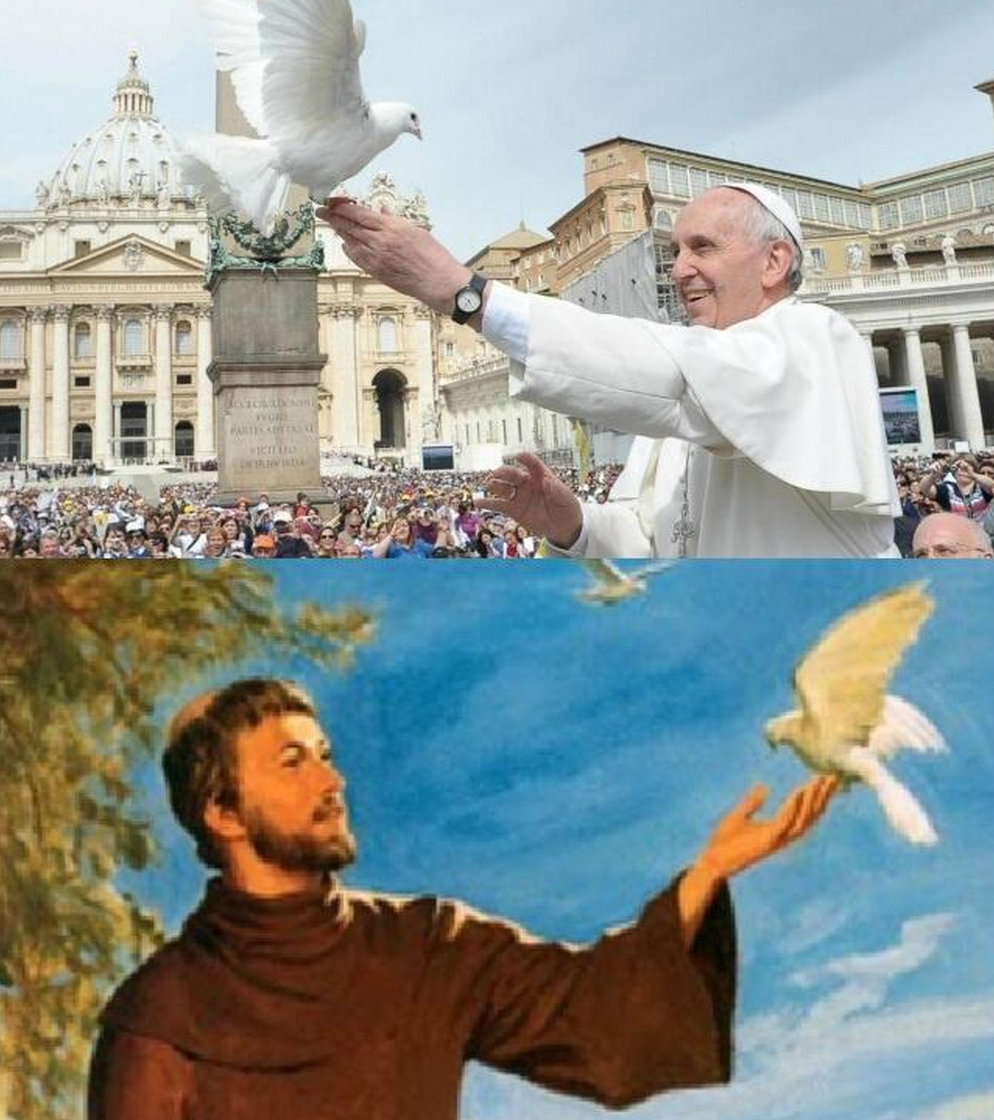
(Image to commemorate last Friday’s Feast Day of St. Francis of Assisi via Xt3.com)

This Revolutionary Pope

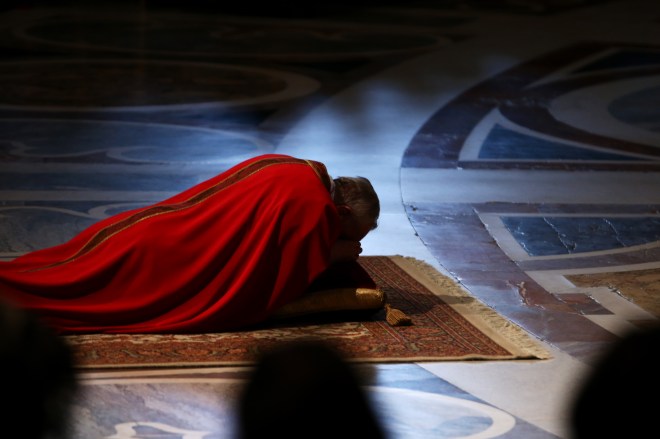
Pope Francis Attends Celebration Of The Lord's Passion in the Vatican Basilica

Last week, as the House Republicans held a gun to the country’s head, I failed to address yet another remarkable interview by Pope Francis, this time to the Italian journalist Eugenio Scalfari, who is an atheist, in La Repubblica. Like his America interview, I urge you to read it, whether you are an atheist, an agnostic, a believer or anything in between. I tried to absorb it all this weekend, and found it difficult. Difficult because it was so overwhelming in its power, and because I need time to pray and think some more about what he said. I mean, what can one say immediately about a Pope who can say:

Proselytism is solemn nonsense, it makes no sense. We need to get to know each other, listen to each other and improve our knowledge of the world around us.

Or this:

Heads of the Church have often been narcissists, flattered and thrilled by their courtiers. The court is the leprosy of the papacy.

Or this:

A religion without mystics is a philosophy.

Or this:

I say that politics is the most important of the civil activities and has its own field of action, which is not that of religion. Political institutions are secular by definition and operate in independent spheres.

It is as if the Catholicism that has been forming and re-forming in my own mind and soul for years suddenly became clearer, calmer, simpler. This Catholicism, like Saint Francis’, is about abandoning power and all the trappings of power; it is about leaving politics alone in an independent sphere, in stark contrast to Christianism which is primarily politics and ultimately about power; it is a faith rooted in mystery and mystics; about love and mercy; about the core teachings of Jesus again – made fresh.

I would say that it is a miracle. Francis’ emergence as Francis is a miracle. Literally:

Before I accepted I asked if I could spend a few minutes in the room next to the one with the balcony overlooking the square. My head was completely empty and I was seized by a great anxiety. To make it go way and relax I closed my eyes and made every thought disappear, even the thought of refusing to accept the position, as the liturgical procedure allows. I closed my eyes and I no longer had any anxiety or emotion. At a certain point I was filled with a great light. It lasted a moment, but to me it seemed very long. Then the light faded, I got up suddenly and walked into the room where the cardinals were waiting and the table on which was the act of acceptance. I signed it, the Cardinal Camerlengo countersigned it and then on the balcony there was the ‘”Habemus Papam”.

Made every thought disappear. And what appears when thought has been left aside? Light!

God is the light that illuminates the darkness, even if it does not dissolve it, and a spark of divine light is within each of us. In the letter I wrote to you, you will remember I said that our species will end but the light of God will not end and at that point it will invade all souls and it will all be in everyone… Transcendence remains because that light, all in everything, transcends the universe and the species it inhabits at that stage.

This is a Pope speaking to an atheist as an equal and in love. Which is where the church must begin again. It’s sad to me that so many orthodox Christians in America cannot yet see this.  Here’s Dreher, in an otherwise positive response to the interview, finding the remarks “incoherent from a Christian perspective”:

I don’t get the universalism behind encouraging people to “move towards what they think is Good.” What the Wahhabist thinks is Good is not the same thing as what the secular materialist thinks is Good, and is not the same thing as what the Amish farm woman thinks is Good. I mean, obviously there will be some overlap, but if the Pope believes there is no reason to insist on Christian particularity, if Jesus is true for him, but not for everyone, then why evangelize at all?

Was Rod reading? “Proselytism is solemn nonsense.” No wonder Russell Moore, a conservative Southern Baptist, calls the interview “a theological wreck. No wonder, at First Things, Mark Movsesian argues that

Some things he said in the interview are a frankly a little shocking.

He told the interviewer, Eugenio Scalfari, “Proselytism is solemn nonsense.” That’s a rather dismissive way to treat millennia of Christian apologetics. The pope’s views on conscience were also odd, from a Christian perspective. “Everyone has his own idea of good and evil and must choose to follow the good and fight evil as he conceives them,” the pope said. “That would be enough to make the world a better place.” With respect, “do what you think is right” is not the Christian view of conscience. That sounds more like Anthony Kennedy than St. Paul. And would the world really be a better place if everyone did what he thought was right? How about jihadis?

Always with the Jihadis, those lost, damaged souls. K-Lo, of all people, defends what Francis said about conscience:

This isn’t “anything goes,” but it’s an exercise in mercy and justice.

What it is is an exercise in engagement, rather than power. This was Saint Francis’ genius, and Paul’s and Augustine’s. They were in their world as well as not of it. Pascal-Emmanuel Gobry has the best take:

[W]hen the Pope says “Everyone has his own idea of good and evil and must choose to follow the good and fight evil as he conceives them”, that could be interpreted as a brief for moral relativism. Of course, the only problem with that interpretation would be that it would be arrant nonsense. Because, you know, he’s the Pope, and also an orthodox Catholic, as he has demonstrated on countless occasions…

The problem here, as always, is pride. We think like politicians. We parse words for whether they help the Republican Party of the Church or the Democratic Party of the Church, whereas we should be humbly receiving the teachings of the Vicar of Christ. When those teachings seem shocking to us, common sense alone dictates that, instead of rending our garments, we should, with humility and charity, check ourselves to see what we can learn.

That’s what I’m still doing. But what leaps out of the interview is a scoop, as John Allen noted and few others did. The scoop is that this Pope has undergone a mystical spiritual awakening – after that great silence and great light before he accepted the papacy. Allen remembers interviewing the new pope’s sister in April, who said “that something was different about her brother since he took over the church’s top job.” He continues:

Recently, I spoke to one of the cardinals who elected Francis (not an American, by the way), who had been received by the pope in a private audience. The cardinal told me he had said point-blank to Francis, “You’re not the same guy I knew in Argentina.”

According to this cardinal, the pope’s reply was more or less the following: “When I was elected, a great sense of inner peace and freedom came over me, and it’s never left me.”

In other words, Francis had a sort of mystical experience upon his election to the papacy that’s apparently freed him up to be far more spontaneous, candid and bold than at any previous point in his career.

One should never doubt the mystical imprint upon the contours of a papacy.

Isn’t it interesting that this story got largely ignored, while a sentence or two that allows Christianists to complain about “relativism” got so much attention? Why not simply examine, and take to heart, what Francis said about his namesake? Here’s what he said:

[Francis] is great because he is everything. He is a man who wants to do things, wants to build, he founded an order and its rules, he is an itinerant and a missionary, a poet and a prophet, he is mystical. He found evil in himself and rooted it out. He loved nature, animals, the blade of grass on the lawn and the birds flying in the sky. But above all he loved people, children, old people, women. He is the most shining example of that agape we talked about earlier…

Francis wanted a mendicant order and an itinerant one. Missionaries who wanted to meet, listen, talk, help, to spread faith and love. Especially love. And he dreamed of a poor Church that would take care of others, receive material aid and use it to support others, with no concern for itself. 800 years have passed since then and times have changed, but the ideal of a missionary, poor Church is still more than valid. This is still the Church that Jesus and his disciples preached about.

This is still the church we can rebuild today.

Read the recent Dish thread on Pope Francis here.
What Does It Mean To Be A Sinner?

In his remarkable, much-discussed interview published last month in America, Pope Francis described himself with the phrase, “I am a sinner.” Patrick L. Gilger unpacks the quote:

[F]or those deeply immersed in the spirituality of Ignatius, being a “sinner” does not mean “having done things wrong” (although that is true). It doesn’t even mean that we will always do things wrong in the future (also true). It means that humans are – at root, ontologically – always in need of the living mercy of God. Michael Ives, author of Understanding the Spiritual Exercises, puts it this way: “sin is always considered in the Exercises in the light of mercy … The essential grace [ ] is that of a conversion arising out of the literally heart-breaking experience of being loved and forgiven.”

The literally heart-breaking experience. This is the reason Pope Francis calls himself a sinner. It is the reason he speaks so relentlessly about mercy. It is because he knows what all women and men who live deeply an Ignatian life know, that God’s mercy reframes our interpretation of everything, institutions included. It does so because, having understood the joy of being wrong, we have learned to hold our own plans loosely so as to be better lead by God. This is what St. Ignatius means by another of his famous spiritual terms, “indifference,” he means the ability to be lead by God into the previously unimaginable. The ability to do a new thing. The ability to let mercy be more fundamental than any plans or theo-political categories.

This Extraordinary Pope, Ctd

A reader writes:

I’m a grateful subscriber, so I thought you might enjoy a copy (pdf) of the first Annual Report issued by the Vatican Bank (IOR) in its 126-year history. This is a direct result of Pope Francis’s call for oversight and transparency. In June 2013, Pope Francis appointed a Papal commission to conduct an “exhaustive report” into the IOR’s juridical standing and activities. The goal of this Commission is “to better harmonize the work of the IOR with the mission of the Church and Apostolic See.” Of note is how small and profitable the IOR actually is: “total assets are approximately EUR 5 billion, while fiscal year 2012 registered a profit of EUR 87 million. Of this, EUR 50 million was given back to the Church for operating purposes.”

One of my Wall Street wizard brothers is working with the Commission. He confirms that even Rome is infused with startled enthusiasm for this Pope. Many of us have been more homesick for the Church than we realized. So thanks for your ongoing coverage. I’m sure you take some heat for it, and not only from Hitch’s spirit.

Oddly, not so much heat. The spirit of this Pope is so obviously sincere and so disarmingly Christ-like I find myself a Catholic cheered on by many atheists right now. Just not the theocons. Or Hitch, I’ll bet you a bottle of Johnnie Walker Black.

The Theocon Panic, Ctd

Pope Francis Visits Sardinia

At first, we got denial. Theocon Matthew Schmitz at First Things even tried to argue that there is no difference between the vestments of the Liberace pope and his modest successor. A Vatican source relayed to me, in contrast, the words that Francis spoke as he was presented with Benedict’s wardrobe before going out for the first time on the balcony of St Peter’s: “Il carnevale è finito.” Then there was the attempt to argue that because Francis excommunicated a rogue Australian priest for violating the eucharist, heresy and misrepresenting the faith, he is no different than Benedict! You can read the details here. Money quote:

The letter, a copy of which NCR obtained and translated, accuses Reynolds of heresy (Canon 751) and determined he incurred latae sententiae excommunication for throwing away the consecrated host or retaining it “for a sacrilegious purpose” (Canon 1367). It also referenced Canon 1369 (speaking publicly against church teaching) in its review of the case.

I don’t know anyone who believed that Francis had just junked canon law, or had somehow come to believe that violating the Eucharist was something the Church should ever tolerate. I have never written or believed that. What I have written is that it is impossible to read the America interview without seeing it as a blunt repudiation of the last thirty reactionary, legalistic, and failed years of the church hierarchy.

And after the initial denial, some theocons are adjusting. Their adjustment is a form of revolt. In a splenetic tirade against today’s Jesuits, George Neumayr argues that Francis must be corrected:

For the good of the faith, laity, clergy, bishops, and particularly powerful cardinals should start playing Paul to Francis’s Peter, as his culturally conditioned liberalism threatens to undermine the unity and orthodoxy of the faith.

Peter snapped out of his pandering phase; let’s hope Francis does the same. Even if given the most charitable reading, Pope Francis’s recent interview with Jesuit publications was alarming in its spirit-of-Vatican II liberalism … It is not petty, disrespectful, or un-Catholic to object to the liberal parts of his agenda. Indeed, the need for a St. Paul to correct him grows with each passing week as his pontificate emboldens the Church’s enemies and undercuts her friends and most loyal members.

Bingo! The reactionaries determined to fuse Catholicism with the Republican right are rightly rattled. But note the pivot. They were only recently the relentless advocates of total obedience to papal authority. Now they’re calling for a mutiny among “laity, clergy, bishops, and particularly powerful cardinals” against the Pope. Well, at least their denial is wearing off, I suppose.

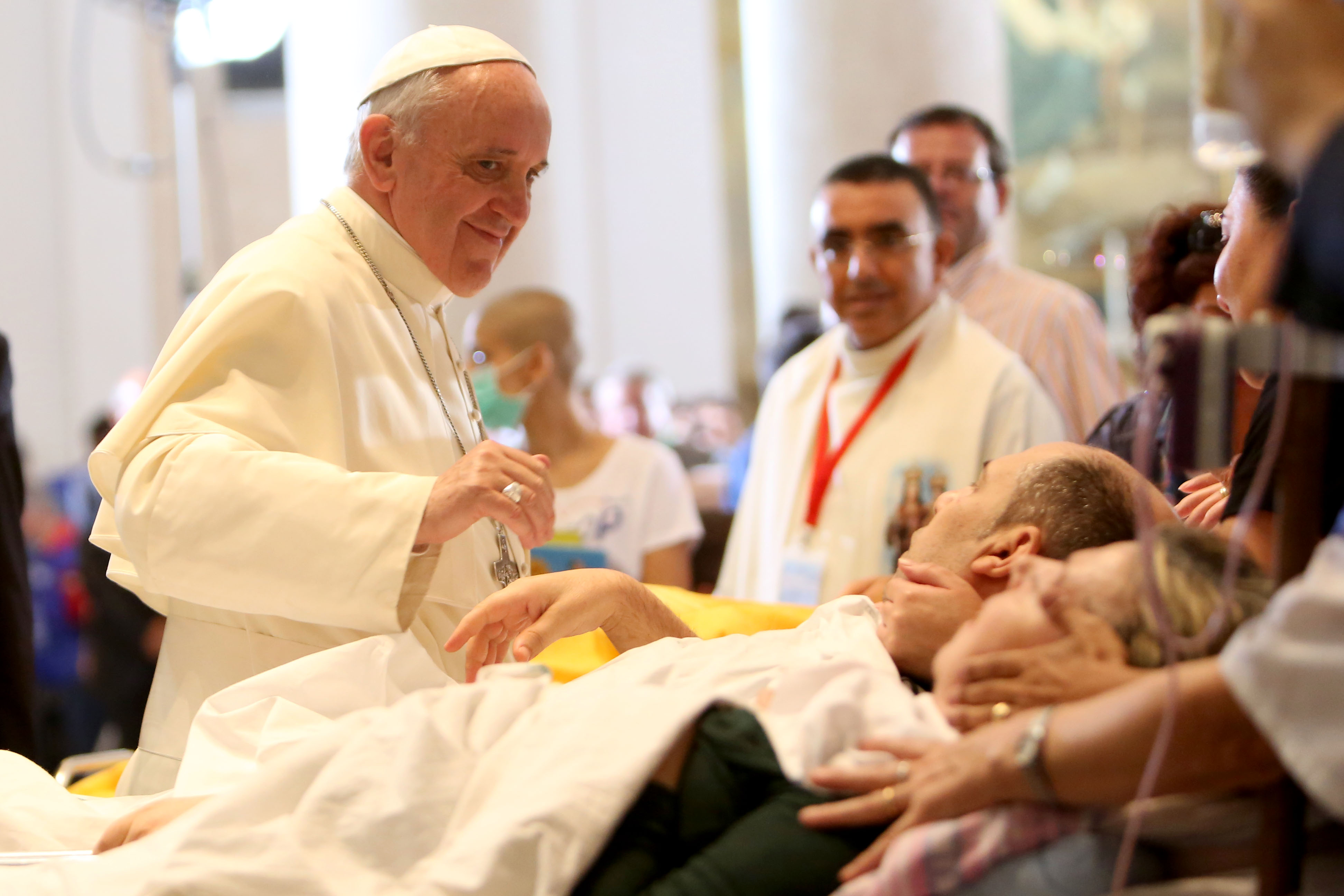
(Photo: Pope Francis greets sick people as he arrives at the Marian Shrine of Bonaria on September 22, 2013 in Cagliari, Italy. By Vatican Pool/Getty.)

Will Francis Empower Women?

800px-Tolentino_Basilica_di_San_Nicola_Cappellone_14

Sister Simone Campbell hopes so:

I must confess that I am a little nervous about what will happen. Currently there are no women in significant decisionmaking positions in the Vatican. There are few in dioceses around the world. Our church has lagged in the acknowledgment of the role of women in shaping faith traditions and as leaders of prayer. In that institutional lag, many of us in religious life and our nonvowed sisters have found ways of supporting each other. The fact is that women are leading by example and witness to the Gospel in their lives and not within the formalized power structure, and that power structure has lost out from not having significant contributions of women. It is difficult for me to believe that women in significant leadership roles would have tolerated the sexual-abuse cover-up.

The question becomes, Will Pope Francis follow through by actually including women in the decision-making as he moves ahead with reforms?

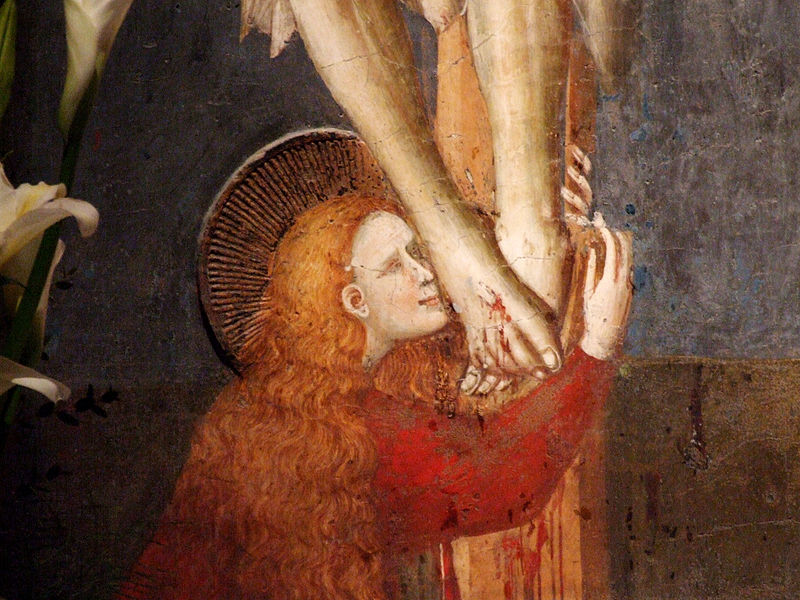
Of course I devoutly hope so, if Francis’s view of the “genius of women” reflects the actions of Jesus who, radically for his time, treated women as equals, outrageously consorted with women such as Mary Magdalen, former prostitute, sided with an adulteress over an all-male stoning squad, and even stayed overnight as a single man with his dear friends, Mary and Martha.

Women, remember, were the most loyal of all his followers. Women, not men, were at the foot of the Cross, as he died. The men were too afraid or too cowardly to be there. Women, not men, were the first to witness the resurrection. One woman, his mother, represents the apex of human acceptance of the divine in Catholic theology. No man comes close to her example.

It therefore pains me deeply that this half of humanity is still treated as some kind of second-class group in the church of Jesus. For me, the ban on female priests is simply absurd, as well as antithetical to the message of the Gospels.

Of course the tradition of a male-only priesthood is entirely a function of the social structures of the past. That’s clear when you hear the ludicrous theological argument in defense of this institutionalized sexism: the disciples were all men, therefore we cannot have women priests. Seriously, that’s it? Yep, that’s it.

The Church will not turn quickly – and it shouldn’t. But one of the great errors of the Ratzinger-Wojtila era was to insist that such matters cannot even be discussed in Catholic universities, seminaries and churches. What Francis should do first of all is allow that conversation to proceed, to explore explicit ways to include the “genius of women” in the Church that do not consign them to mere adjuncts. The Church will never treat men and women as identical – because they are not. But there must be a way to treat men and women as fundamentally equal in the eyes of God. Because

There is neither Jew nor Greek, there is neither bond nor free, there is neither male nor female: for ye are all one in Christ Jesus.

Know hope.

(Painting: Detail of Mary Magdalen kissing the feet of the crucified Jesus, Italian, early 14th century. Via Wiki.)