Francis And Liberation Theology

Ezra Fieser finds that the current Pope, who was ordained as a priest “in 1969, during the height of the Latin American-born church movement,” has had a complex relationship with the school of thought:

While liberation theology influenced generations of Catholic clergy, especially Jesuit priests, Pope Francis never adopted the most left-leaning strands of the movement, according to Argentine Jesuit priest Juan Carlos Scannone, one of Pope Francis’s teachers. In [the] recently published book, Pope Francis: Our Brother, Our Friend, Mr. Scannone wrote, “social Marxists analysis is not used” in Argentine liberation theology. Father [Father José María Cantó, who holds Francis’ former position as rector of the Faculty of Philosophy and Theology at Colegio Máximo in Buenos Aires], says Pope Francis was more influenced by a current within liberation theology based on popular concerns, culture, and historical context. “It is more in line with what the Southern Cone of South America preferred,” he says.

However, Pope Francis has shown an openness to liberation theology, despite years of criticism from the Vatican toward the movement. Earlier this month, he held an audience with [founder of liberation theology Gustavo] Gutiérrez himself, who [historian of religion Jennifer] Hughes calls “one of the most important theological figures of the 20th century.” It remains unclear as to how much the pope is willing to open the Vatican to reconciliation with liberation theologians.

The Theocon Panic

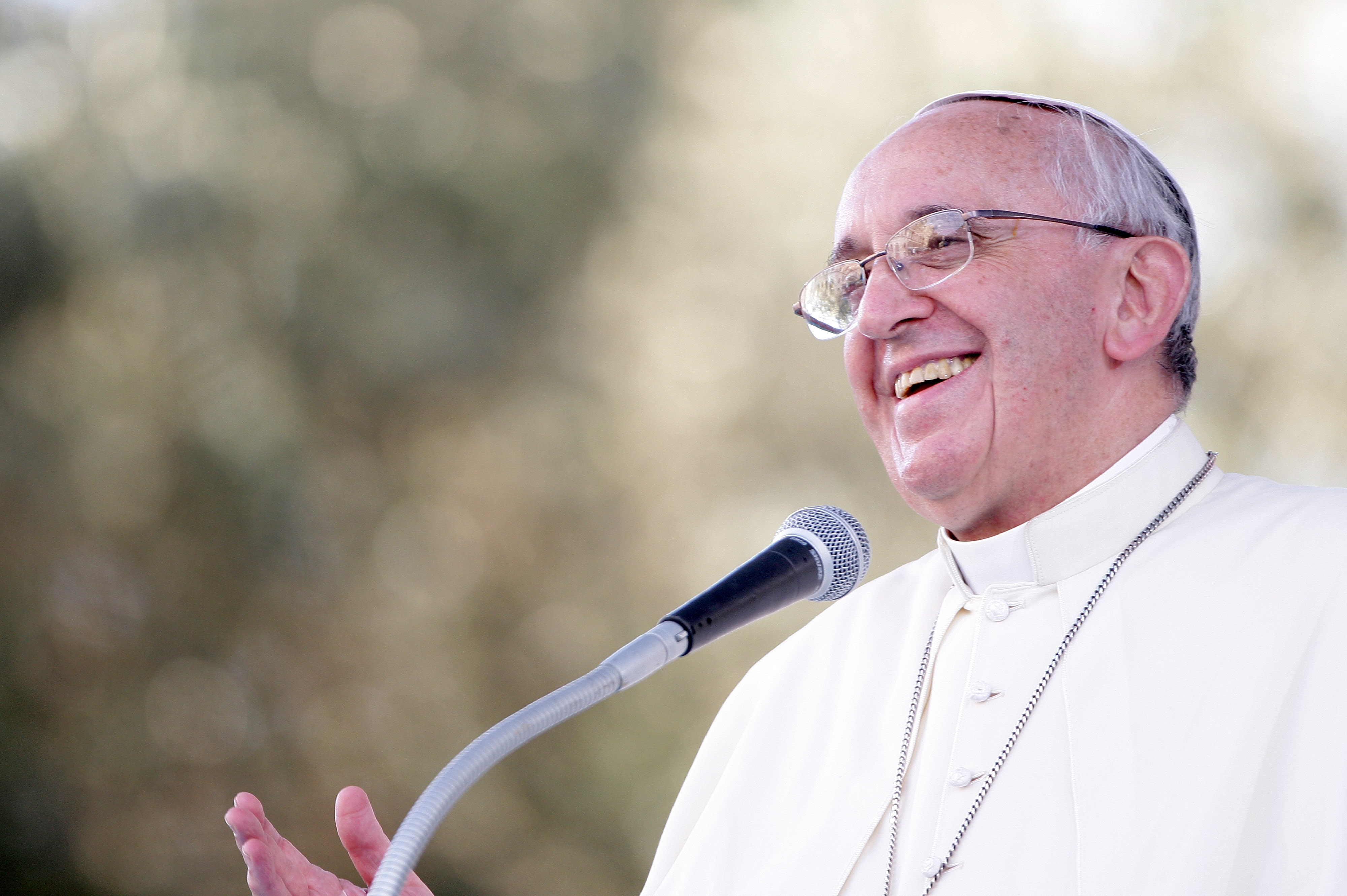
Pope Francis Visits Sardinia

The people in the hierarchy and the hard-right of the American Catholic church have put their best face forward after Pope Francis’ categorical rejection of their entire project. So allow me a big bucket of cold history and fact to show just how over they are.

For the last couple of years, their overwhelming theme has been that basic freedom of Catholic conscience has been denied by a small rule in Obamacare that makes public Catholic institutions, like hospitals and colleges that employ non-Catholics, provide contraception if women want it. The Catholic institutions do not pay for it; there’s a work-around. In the face of this and civil marriage for gay couples, the American hierarchy, backed by rightist Catholic entities such as National Review, launched a veritable crusade. Last summer, the Bishops even launched a Fortnight of Freedom, two weeks in which the hierarchy devoted itself almost entirely to the questions of contraception, homosexuality, marriage and abortion in the context of religious liberty. These themes were deafening and clearly designed to affect the presidential election. So let’s recall Francis’ words of last week:

We cannot insist only on issues related to abortion, gay marriage and the use of contraceptive methods… The dogmatic and moral teachings of the church are not all equivalent. The church’s pastoral ministry cannot be obsessed with the transmission of a disjointed multitude of doctrines to be imposed insistently.

In that context, remember something that wounded me more deeply than any other in recent years, when, in 2009, my own then-archdiocese went to rhetorical war against gay people, using the homeless and sick as pawns:

The Catholic Archdiocese of Washington said Wednesday that it will be unable to continue the social service programs it runs for the District if the city doesn’t change a proposed same-sex marriage law, a threat that could affect tens of thousands of people the church helps with adoption, homelessness and health care.

In the end, the archdiocese, mercifully, relented. But do you not hear the fresh relevance of Francis’ words:

The church sometimes has locked itself up in small things, in small-minded rules?

One of those whose writings have been almost obsessed with abortion, gay marriage and contraception is Kathryn-Jean Lopez. She’s still spinning as if nothing just happened:

As for [Pope Francis], Church teaching on sexual morality is about fruitfulness and surrender. That won’t be understood if catechetical fundamentals aren’t — and none of it will make any sense if Christ’s love isn’t encountered.

But that latter point got lost, did it not, in the recent past as an authoritarian Pope demanded “catechetical fundamentals” on everything all the time, often with more dictatorial fear than Christ’s love. Nothing better illustrated this in recent years than Benedict’s disciplining of America’s off-message nuns – even as orthodox child-rapist priests were routinely allowed to retire in peace. The final report on the nuns was as brutal as it was insensitively delivered:

The assessment accused the sisters of “corporate dissent” on homosexuality and failure to speak out on abortion.

The assessment also castigated LCWR for ties to NETWORK, a Washington-based Catholic lobbying group that supported the Affordable Care Act … Leaving the Holy Office, Franciscan Sister Pat Farrell felt numb. “It was in the press before we had time to brief our members,” she recalled.

Let us again recall Francis’ words. Here he addresses the role of nuns and monks in religious orders and the need for them to speak their conscience, even if they ruffle papal feathers:

In the church, the religious are called to be prophets in particular by demonstrating how Jesus lived on this earth, and to proclaim how the kingdom of God will be in its perfection. A religious must never give up prophecy…Let us think about what so many great saints, monks and religious men and women have done, from St. Anthony the Abbot onward. Being prophets may sometimes imply making waves. I do not know how to put it…. Prophecy makes noise, uproar, some say ‘a mess.’ But in reality, the charism of religious people is like yeast: prophecy announces the spirit of the Gospel.”

And yet Benedict attacked this very charism in favor of top-down papal control of every minute doctrinal issue. On this, how can the theocons ignore the following:

If the Christian is a restorationist, a legalist, if he wants everything clear and safe, then he will find nothing.

To whom do they think the Pope was referring? Who else if not them? Or do they have alternative suggestions?

(Photo: Pope Francis delivers his speech during a meeting with young people on September 22, 2013 in Cagliari, Italy. By Franco Origlia/Getty Images.)

This Extraordinary Pope, Ctd

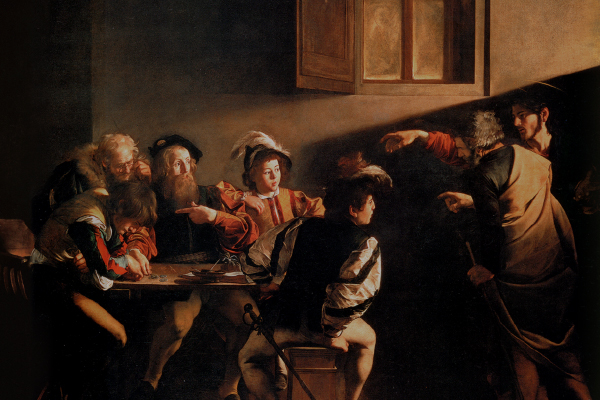
caravaggio_michelangelo_merisi_da_-_the_calling_of_saint_matthew_-600x400

Watching the theocons respond to the rebirth of Christianity in the Catholic church was bound to be a bewildering experience. For thirty years, the Ratzingerian dynamic held sway – an era in which papal authority was elevated far above the faith of the people of God, in which doctrinal orthodoxy in every single particular was the highest virtue and the one by which all other virtues were judged, in which a pure, orthodox, doubt-free and smaller church was supposed to somehow convert all of Europe back to Christianity, in which liturgical esoterica became neurotic fixations, and outreach meant finding ways to bring opponents of the Second Vatican Council, including even Holocaust deniers, back into the fold.

In every single, defining characteristic of Ratzinger’s long rule – from the era of Ratzinger as head of orthodoxy to Pope Benedict XVI himself disappearing inside a fabulous flurry of fabric and jewellery – Francis has turned a corner. Definitively, bluntly, unmistakably. So what do the the “reactionaries and legalists” (Francis’ own words) have to say now? Matthew Schmitz grapples:

The pope certainly does mean to propose an adjustment, though the nature of that adjustment isn’t immediately clear. The hope of many (and too-eager suspicion of some) that he was muzzling the Church’s moral witness was immediately disappointed. A mere day after the publication of his interview, he denounced abortion in the strongest terms of his papacy, some of the strongest of any papacy …

The Pope’s approach is one familiar to any reader of the gospels. Pharisees try to discredit the gospel by trapping its teacher; the teacher refuses the terms of their question and raises the spiritual stakes. The point here is not to compromise on or back away from truth, but rather to reject its caricature. This is good practical guidance. If it’s what he meant in his broader remarks, then those remarks offer wise advice well worth taking.

Note that he immediately has to grasp onto a short statement after the 12,000 word interview to try and belittle the seismic shift. As if Francis were likely to change a deep moral truth about life in the womb. John Zuhlsdorf, in contrast, just goes into total denial:

People who focus just on the comments that Francis made about compassion for homosexuals and “social wounds” or about not talking about abortion all the time or that the Church has no right to “interfere” with people (as if to say that Francis thinks homosexuality is okay or that the Church should be silent in the public square or that we mustn’t talk about abortion) without also underscoring that Francis was talking about things which need healing and that they are matters for confession (read: sins) have distorted his meaning.

Really? Homosexuality is not okay for Francis in exactly the same way it was not okay for Benedict? Let me offer two direct quotes from both pontiffs. Benedict XVI:

Although the particular inclination of the homosexual person is not a sin, it is a more or less strong tendency ordered toward an intrinsic moral evil; and thus the inclination itself must be seen as an objective disorder. Therefore special concern and pastoral attention should be directed toward those who have this condition, lest they be led to believe that the living out of this orientation in homosexual activity is a morally acceptable option. It is not…

The proper reaction to crimes committed against homosexual persons should not be to claim that the homosexual condition is not disordered. When such a claim is made and when homosexual activity is consequently condoned, or when civil legislation is introduced to protect behavior to which no one has any conceivable right, neither the Church nor society at large should be surprised when other distorted notions and practices gain ground, and irrational and violent reactions increase.

There is even a hint that gays deserve bashing for pushing society too far. And this edict was issued as the AIDS epidemic was destroying so many lives – and where Francis’ view of the church as a “field hospital” could not have been more appropriate. Instead: condemnation, marginalization, cruelty, tone-deafness.

Francis, in stark contrast:

A person once asked me, in a provocative manner, if I approved of homosexuality. I replied with another question: ‘Tell me: when God looks at a gay person, does he endorse the existence of this person with love, or reject and condemn this person?’ We must always consider the person. Here we enter into the mystery of the human being. In life, God accompanies persons, and we must accompany them, starting from their situation.

And these words cannot but be understood as a gentle but nonetheless revolutionary rejection of the entire John Paul II-Benedict XVI era, which was fixated first and foremost on doctrinal orthodoxy in all things, from legalistic details about coverage of contraception to refusing even to employ gay people in lay services for fear they might be infected with the horror of a civil marriage. Can the theocons not read? Or is it too much right now for them to absorb? Francis could not be clearer:

The dogmatic and moral teachings of the church are not all equivalent. The church’s pastoral ministry cannot be obsessed with the transmission of a disjointed multitude of doctrines to be imposed insistently.

Remember the American nuns under investigation – still ongoing? Why were they under investigation? Because they were not being insistent enough on the issues of abortion, homosexuality and contraception! They were too busy serving the poor. What did the new Pope just say?

We cannot insist only on issues related to abortion, gay marriage and the use of contraceptive methods. This is not possible.

But this insistence was not just possible, it was mandatory in the US Conference of Catholic Bishops for the last several years, with their ridiculous Fortnight of Freedom, their obsession with contraception in Obamacare – ignoring the vast moral sea-change of universal coverage in their cramped Pharisaical insistence on these sexual matters – and their bitter, nasty, divisive attacks on gay Catholics and our loves, even as they shielded child-rapists from exposure and from accountability.

Now, of course, the Pope is not about to alter core doctrines nor does he have the authority to do so. But what he has insisted upon is that the truth of the faith is not guarded by one man alone, as John Paul II and Benedict XVI tried to argue. Their deliberate attempt to ratchet power back into the papacy, to use that authoritarian office to purge heretics, freeze debate and chase out the “luke-warm” liberal Catholics in favor of a smaller “purer” church … has been replaced by something much more like John XXIII’s and John Paul I’s vision and the Spirit of the Second Council. Francis understands the appeal and temptation of strong authority. Because he once tried it:

My authoritarian and quick manner of making decisions led me to have serious problems and to be accused of being ultraconservative. I lived a time of great interior crisis when I was in Cordova. To be sure, I have never been like Blessed Imelda [a goody-goody], but I have never been a right-winger. It was my authoritarian way of making decisions that created problems.

What replaces that? The authority of the people of God in a journey of faith:

The church is the people of God on the journey through history, with joys and sorrows. Thinking with the church, therefore, is my way of being a part of this people. And all the faithful, considered as a whole, are infallible in matters of belief, and the people display this infallibilitas in credendo, this infallibility in believing, through a supernatural sense of the faith of all the people walking together. This is what I understand today as the ‘thinking with the church’ of which St. Ignatius speaks. When the dialogue among the people and the bishops and the pope goes down this road and is genuine, then it is assisted by the Holy Spirit. So this thinking with the church does not concern theologians only.

No, abortion is not okay. It remains profoundly wrong to take life away from the vulnerable and unborn. But when recognition of this truth springs up from the life of the people of God and does not seek to coerce others by law or intimidation – it has so much more moral authority than when it is imposed by a distant, political monarch in ermine.

One way to ignore these seismic reprimands of the recent past is the following from First Things:

God’s mercy on sinners is the key in which Francis exercises the Petrine ministry. This represents no great change from the pontificates of John Paul II and Benedict XVI, who spoke frequently of the mercy of God and the reality of sin and, in the case of the former, wrote an entire encyclical on the divine mercy.

Sorry – but weak. Read the whole thing. And absorb how deep, penetrating and yet charitable a refutation it is of almost everything that has defined the hierarchy of the last three decades. And rejoice.
“I Am A Sinner”

DSC_0780

A photographer we have featured in the past writes:

I have spent the last three years photographing addicts in the South Bronx. Before that I worked on Wall Street. The first addict I met in Hunts Point was Takeesha. She was standing near the long and high wall of the Corpus Christi Monastery. We talked for close to an hour before I took her picture. When we finished I asked her how she wanted to be described.

She said without any pause, “As who I am. A prostitute, a mother of six, and a child of God.” After spending close to twenty years on Wall Street it was jarring to hear someone so self-aware.

Talking in front of the monastery evoked memories. I grew up Catholic and for much of my early life nuns taught me. In my teens I walked away from the church and into science. Until my work in Hunts Point I thought little about the church or the bible or God. If I did, it was with a degree of cynicism. I heard little of what the nuns taught me coming from church leaders.

In the last three years, I have been reminded daily of what the nuns taught me: That we are all sinners who fall short. Most addicts understand that viscerally. Many successful people don’t, their sense of entitlement having numbed their compassion.

Yesterday, I read the interview with Pope Francis. It got headlines for his discussion about homosexuality, abortion, and contraception. I was more struck by his answer to the first question, “Who is Pope Francis?” “I am a sinner.”

Takeesha, me – every human is fallible. In that we are all the same, and as such, we should pause before judging another.

I immediately think of Mary Magdalen, a Takeesha of her time, who was there at the very end as Jesus writhed in agony on the cross. And of this passage from Luke:

Then he turned toward the [prostitute] and said to Simon, “Do you see this woman? I came into your house. You did not give me any water for my feet, but she wet my feet with her tears and wiped them with her hair. You did not give me a kiss, but this woman, from the time I entered, has not stopped kissing my feet. You did not put oil on my head, but she has poured perfume on my feet. Therefore, I tell you, her many sins have been forgiven — as her great love has shown.

But whoever has been forgiven little loves little.”

Francis And Wagner

It was a fascinating detour in the Pope’s gob-smacking interview yesterday: he is a fan of Wagner, specifically the Furtwängler La Scala Ring and the 1962 Knappertsbusch Parsifal. The peerless music critic for the New Yorker, Alex Ross, has some thoughts:

If I’m not mistaken, Pope Francis is comparing “decadent Thomist commentaries” to Klingsor’s magic garden — a seductive illusion covering a wasteland. Could the Pope’s emergent philosophy of unadorned compassion have been influenced in some small way by Parsifal, that attempted renovation of religious thought through musical ritual? “Through pity, knowing”? “Redemption to the Redeemer”? Possibly, but there are limits to his aestheticism: “Our life is not given to us like an opera libretto, in which all is written down; but it means going, walking, doing, searching, seeing.” This is a remarkable man.

And also a remarkable mind. We were constantly reminded of Benedict’s intellect, and it was and is impressive. But it was also a desiccated variety, crammed with fear, obsessed with order and precision, closed at times to the surprises of life and of God in its attempt to dot every i and cross every t. Francis? A profound intellect, yet also a living, breathing, open-ended one.

This Extraordinary Pope: Your Thoughts

This embed is invalid


A reader refers to the above segment from last night’s AC360 Later:

I am an elderly Catholic Chaplain of 30 years, long a gay rights activist, serving prisons, hospitals and communities as advocate, counselor, and helper-as-able. I was beyond delighted to see you with Anderson Cooper, speaking with such passion about our new Pope. I had not known you were gay, or Catholic. I need to tell you how proud I felt of you, and that I just love you for using that talent; for hanging in there with the Catholic Church; for being you.

Another reader:

Wow! I wondered if Pope Francis could possibly be for real.  He seems the absolute embodiment of what I always thought the Catholic Church was supposed to be about – promoting the ideas and teachings of Jesus, not running a corrupt organization without a shred of mercy, divine or otherwise.  Pope Francis is having a tremendous pull on me.  I rejected the Church long ago, but I’m drawn to this man and what he has to say.  I hear a voice inside me that says “yes”.

Another:

I have been moved, as you have been, by the amazing grace of the Holy Father. What a revelation, indeed. I was recently baptized Episcopalian – it was the only denomination I could find that matched my social values. This Pope is the first Catholic leader in my lifetime (42 years) I remember reacting to in this way. In reading a book about my church, this passage struck me: “As Episcopalians, we are not called to be Christians, we are called to be Christ on earth.” Pope Francis, from everything I have seen, is embodying Christ on earth. What a blessing. I’m proud to take the liberty of the Anglican stretch and call him my Pope too.

Another:

Damon Linker is wrong.  Words matter and so do his actions.  Of course Francis didn’t come out and say “homosexual acts are morally permissible.”  That statement would completely take away from his greater point: God is love.  People would be frothing instead of focusing on who is important: Jesus Christ and his ultimate sacrifice because of his Father’s love for all of us.  As a liberal woman, I don’t need him to make a grand statement about women and the priesthood. The actions of washing young women’s feet on Holy Thursday was deeply profound.  Love for everyone is what he’s projecting.

Of course there will be liberals that will never be happy, and there will be conservatives that twist his words to suit their agenda, but the rest of us will just push away the noise and listen.

Another:

To Linker and Stanley:  “Meepus, meepus.”

Another:

I am amazed at those who poo-poo the words of Pope Francis because they do not change church doctrine. They might not. But they do seem to change an attitude towards those who disagree with doctrine. And that is no small thing. For example, my wife (a Catholic) and I (a Jew) have taken our 14-year-old daughter to church regularly for her entire life. We send her to Catholic school. Yet she chose not to be confirmed. Why? The church’s dogmatic approach to homosexuality for her entire life. But now the Pontiff has told her, “You think we are wrong? Feel free. You can still be Catholic.” That’s a big deal. That might someday make her comfortable coming to the church.

Another:

I’m an atheist, but if anything I’m more enthusiastic about Pope Francis than you are. I think the best of Christianity is a combination of the messages from Jesus about helping the poor and downtrodden; that love is the only solution to the puzzle of humanity; and that forgiveness holds a power much greater than revenge. This pope really seems to get it. If his words can stir emotions in an old non-believer like me, think of what he might do with lapsed Catholics.

Another atheist:

It feels strange, being a nonbeliever, to find myself so avidly following the Pope Francis’s pronouncements these days. A few months ago I felt cheered by his hints of a possible shift in the Catholic Church’s attitude towards homosexuality. Then, a few weeks back, I was struck by his succinct but powerful tweet on the Syrian conflict:

It’s almost poetic in its rhythmic, palindrome-like structure. And today I was stirred, as you were, by the elegant and intelligent answers he gave on the nature of his Christian faith in this interview. I think you are right to suggest that the example of someone (anyone, but especially someone in a position of power) who devotes himself to values of loving, openness, generosity, giving is appealing to many people – even those who, like me, see religion as folly.

And yet. I want to share with you the whole of my experience. Just as I feel myself swept away (I confess: I tend to feel things strongly, like you), I find that my admiration for Pope Francis crashes into an obstacle. The effect is as a wave hitting an unseen reef – it comes as a surprise even to me.

I find myself suddenly remembering that he is devoted to a process of arriving at his values that is diametrically opposed to my own (just as he remarks in his interview, when he speaks of looking for more than mere “evidence” to confirm God’s presence). Where I look for evidence, he looks to an unprovable “faith”. And this has the effect of making me feel sad.

It is, I imagine, the way you would feel if you encountered a loving, kind, wise person, say at an airport, while sitting at the gate, waiting to board your plane. Let’s say this person, who seemed to hold some position of authority, spoke with great clarity about his values, and they seemed very close to your own. You even saw him care for a fellow passenger, who had fallen ill. And then, a little while later, seated next to you on the plane by coincidence, he began to speak about … the many elves that live in the woods. How he knows that they are in ALL the woods, for EVERYBODY, even among the Eucalyptus trees in Australia … the birch trees in Siberia … the rubber trees in …

What would you feel? This is a serious question, Andrew! (My intent is not to mock religion; I am sharing with you a point of view.) Try to imagine. Would your admiration for the evident personal qualities of this individual overcome your embarrassment and disappointment? Imagine then, that you learn, from other passengers, that he is the leader of an organization that has a history of divisiveness in many countries, that has subjected many to feelings of unworthiness, that has even refused to bring to light, in the past, the sexual abuse of some of the most vulnerable of its members. The man is still the same – an impressively loving and kind individual, taken as an individual. Your opinion on that is unchanged. But the context would pull you up short of admiration, wouldn’t it?

In the end, for this atheist at least, my bursts of admiration for the individual man who is Pope Francis make me sad, not happy.

Another is happier:

“Be not afraid” was a central message of JPII. Here we finally have a Pope who gets it in a transformative sense … a real, human sense. I’m an atheist, a former Catholic seminarian. I can never return to Christianity because it is, in a phenomenological sense, meaningless. But so what?

I’ve also been a volunteer EMT and hospice volunteer, along with being in NY after 9/11 with the Coast Guard and the Red Cross. As an atheist, I care for people regardless of who they are.  And this is a pope who gets it. He’s a leader in a very human sense.

When I read his words, even as an atheist, I see a mature, considerate human being who is not afraid of being human. It’s apparent he’s seen poverty and suffering. He’s seen and comforted the dying. He’s been with people worried about their next meal and shoes for their children. Those are concerns that dwarf who you’re having sex with, or whether you use contraception. Those are real, human issues. To watch someone die, to see loneliness in those last moments is to see a kind of suffering that penetrates and breaks one’s idea of love and humanity. And he’s seen it.

While I can never again be a Christian, at least I can see Christianity in a different light – one that says Christians live a message and a life that is intensely human. We will never agree on many things. But this man is not my enemy and I am not his. And that’s something.

The Best Of The Dish Today

This was a day the new Pope proved how remarkable he is – simply for speaking the way Jesus spoke. No ideologies, no rigid certainties, committed to community, engaged with the margins, speaking of mercy, mercy, mercy. Readers will, I hope, forgive me for some of the gushing. But those 12,000 words – after such a long, dark period of rigid enforcement of orthodoxy, after the hideous conflation of the great truths of the Church with the political agendas of the far right, after an American hierarchy obviously more interested in control than in love – came like a shower in the desert. All the intimations we had seen since his papacy began, the hints and guesses, emerged in language as powerful as it was accessible.

My immediate reflections are here; my parsing of the text is here. Responses from others can be found here. A Mozart piece by the Pope’s favorite pianist, Clara Haskill, is above.

Some tempers flared over the terrible tragedy of Matthew Shepard; and a new front opened quite clearly in Syria – now a war between Assad, the Free Syrian Army and the most brutal of Sunni Jihadists. John McCain’s stunt in the Russian online media was as buffoonish as it was deeply unhelpful to resolving the question of Syria’s chemical stockpiles. And Stephen Colbert had the last laugh on me in the editing room.

The most popular post of the day was “The Rebirth of Catholicism.” The second most popular was “This Extraordinary Pope.”

See you later tonight at 10 pm on AC360 Later and in the morning.

A Pope For The Millennial Generation

Michael O’Loughlin, a young gay Catholic, feels the impact Francis is already having on his peers:

At first, I found it odd, though admittedly pleasing, how the secular media covered Pope Francis with such obvious admiration. Reddit and BuzzFeed both featured the pope, often in a positive light, unusual for sites geared toward younger, agnostic-ish crowds. NPR and the New York Times were reporting on what the bishop of Rome had to say the economy, peace, and other issues of importance on a regular basis. MSNBC suggested he was the best pope ever. Even John Stewart couldn’t help but be moved.

But at second glance, it’s all so obvious. Pope Francis is so revolutionary, so engrossing, because he is living out Gospel values of love, mercy, and compassion. These values are often antithetical to those of the world, so it moves us when people in power embody them.

People sometimes ask how I can remain in the church when it’s so hostile to gay people. I explain that the church is simply an instrument I use to understand and attempt to live out the Gospel. Pope Francis recognizes this.

My initial thoughts on the Pope’s remarkable interview here; my longer take here. A roundup of reaction around the web here. An elegant response from a reader here.

The Rebirth Of Catholicism, Ctd

VATICAN-POPE-AUDIENCE

A reader responds to the incredible interview with Pope Francis released today:

After reading the Pope’s remarkable interview, I noticed that James Martin, an editor at America and himself a Jesuit priest, had a short companion piece about preparing the interview for publication. This comment jumped out at me:

Our review process was somewhere between editing and spiritual reading.  One editor said that it was the first time she ever found herself in tears over a galley.

What a testament to the power of the Pope’s words – “in tears over a galley.” I felt much the same way reading it, disarmed from the very start by the sincerity of his own declaration of sinfulness, and moved by how clearly he feels the mercy of Jesus in his own life. You can tell this was not a perfunctory concession, like saying, well, nobody is perfect. His humility, his hesitation to judge, his approach to the life of the Church – all stem from the posture established in the first question: “Who is Jorge Mario Bergoglio?” His reply? “I am a sinner whom the Lord has looked upon.”

There is so much to say about this interview – who knew he loves Dostoevsky and Hopkins? – but this passage in particular struck me as worth noting:

“I see clearly … that the thing the church needs most today is the ability to heal wounds and to warm the hearts of the faithful; it needs nearness, proximity. I see the church as a field hospital after battle. It is useless to ask a seriously injured person if he has high cholesterol and about the level of his blood sugars! You have to heal his wounds. Then we can talk about everything else. Heal the wounds, heal the wounds…. And you have to start from the ground up.

“The church sometimes has locked itself up in small things, in small-minded rules. The most important thing is the first proclamation: Jesus Christ has saved you. And the ministers of the church must be ministers of mercy above all.

There is so much suffering in the world, so much pain – not just because of war and poverty, but through depression and loneliness, broken homes and strained families. The message of forgiveness and mercy brought by Jesus, the simple words, “God is Love,” seem more needed, more fresh and powerful, than ever. The pain I feel at seeing the Church, and Christianity more broadly, turned into an adjacency of the culture wars and mainly understood as the purveyor of backwards, spite-filled moralizing, is because, as Francis argues, the Church should be “a field hospital after battle.” The Church should be a refuge, a place for the walking wounded to stumble into and receive love and mercy and care, without preconditions or expectations. As he puts it, you heal wounds, then you can talk about everything else. You lead with love, not legalism. I imagine Francis, smiling as he does, holding his arms open and saying, “Jesus has saved you, you are loved, come join us!” People need to know that when they walk through church doors, they are loved unconditionally. That it is a safe place, a place where there only is grace, where they are met exactly where they are, joined not by their moral superiors, but by fellow sufferers and sinners – people as much the casualty of the battled called life as they are.

The world needs Christianity, the message of Jesus, more than ever. You can see and feel it everywhere – people, young people especially, are hungry for meaning, are desperate for kindness in a world of strife. I’m amazed at how Pope Francis has met this moment, has felt and responded to this need. I don’t know when, or if, the Church will shift its position on, say, homosexuality. I think the Church will change, and I think Francis knows you can’t change your rhetoric about the issue this drastically without eventually changing substance, too — the cognitive dissonance is just too great. But that, really, is a secondary issue. “We can talk about everything else.” Or, as Francis said, “You have to start from the ground up.” What is that ground? Jesus himself, Love incarnate, friend to the sinner and outcast. That is the real story of Francis – his recognition that first things must be put first, that if the Church becomes a hospital for the wounded, a place of love and healing, then everything else will come in time. How Francis beautifully puts it:

I dream of a church that is a mother and shepherdess. The church’s ministers must be merciful, take responsibility for the people and accompany them like the good Samaritan, who washes, cleans and raises up his neighbor. This is pure Gospel. God is greater than sin. The structural and organizational reforms are secondary—that is, they come afterward. The first reform must be the attitude. The ministers of the Gospel must be people who can warm the hearts of the people, who walk through the dark night with them, who know how to dialogue and to descend themselves into their people’s night, into the darkness, but without getting lost.

This is a man with his priorities straight – and the powerful response to that so far shows us, I think, just how much the message of Jesus, the “pure Gospel,” continues to fascinate and resonate, meeting human beings at the places of their deepest longings, needs, and hopes.

(Photo: Pope Francis smiles after his weekly general audience in St Peter’s square at the Vatican on June 12, 2013. By Alberto Pizzoli/AFP/Getty Images)