Cheap Gas Is Costing The Planet

Fossil fuel subsidies continue to rise:

In 2009, G20 leaders agreed to phase out fossil fuel subsidies by 2020. But it’s clear that most countries are going in the opposite direction, especially the U.S. The government provided $2.6 billion in subsidies for exploration in 2009, which nearly doubled to $5.1 billion by 2013, thanks to a boom in domestic oil and gas production. That means American drilling and investment tax breaks outrank subsidies in Australia, Russia, and Chinacountries not generally known for their aggressiveness on climate change. And yet, President Barack Obama has adopted climate change as a part of his agenda and hopes to convince the rest of the world to do the same.

In fact, according to the International Energy Agency’s World Energy Outlook, released today, governments worldwide spend a mind-boggling $550 billion on fossil fuel subsidies each year. As Chris Mooney notes, that’s four times the amount of subsidies directed toward renewables:

[That] partly explains why despite an overall greening of world energy patterns in the next 25 years, the IEA says we are going to miss climate goals and end up with quite a lot of warming (barring a very significant course correction). The agency cites “the failure to transform the energy system quickly enough to stem the rise in energy-related CO2 emissions (which grow by one-fifth to 2040) and put the world on a path consistent with a long-term global temperature increase of 2°C.” (It was not immediately clear how much the just announced U.S.-China deal to jointly reduce greenhouse gas emissions changes this picture.)

We have some 1000 gigatonnes of carbon left to emit to the atmosphere before locking in a dangerous amount of warming above 2 degrees, and on the current course we’ll use it all up by 2040, says the IEA. In order to stop that, we’ll need four times the current investment in renewable energy — an increase up to $ 1.5 trillion annually around the world

David Roberts shakes his head:

It’s a little crazy. As the Carbon Tracker Initiative has shown in some detail, if the world is to have a chance of limiting temperature rise to 2C, 60 to 80 percent of current fossil fuel reserves have to stay in the ground. That means companies and countries with fossil fuel assets face an enormous potential devaluation, a “carbon bubble.” Exploration for new fossil fuels at this point is just stockpiling stranded assets, at great cost, with money that could far more profitably be spent accelerating the energy transition. Or maybe, as this kind of insane-but-routine set of facts demonstrates, the world won’t get serious about climate change. Then stranded assets could be the least of our problems.

The First Spacecraft Has Landed On A Comet

And naturally, it’s already tweeting:

Gautam Naik details the exciting news:

Rocket scientists at the European Space Agency’s mission control here erupted in cheers as they received the first signal that the Rosetta mission’s probe, called Philae, had touched down more than 300 million miles away on the forbidding landscape of a small comet known as 67P/Churyumov-Gerasimenko. There were even more cheers, hugs and handshakes when it became clear that it had done so safely.

The landing follows a decade long trek through the solar system to get the up-close-and-personal visit with a comet for a lengthy period of time as it hurtles closer to the sun. “We made history today,” said Matt Taylor, project scientist for the Rosetta mission, who sported a pair of shorts revealing a tattoo on his thigh depicting a successful Philae landing. “I can’t see anyone doing this again anytime soon.”

But Victoria Bryan and Maria Sheahan have some sobering details:

[A]n anchoring system problem may hamper planned investigations into the origins of Earth and the solar system. The 100-kilogram (220-pound) lander – virtually weightless on the comet’s surface – touched down on schedule at about 11 a.m. ET after a seven-hour descent from its orbiting mothership Rosetta, now located a half-billion kilometers (300 million miles) from Earth. But during the free-fall to the comet’s surface, harpoons designed to anchor the probe, named Philae, failed to deploy. Flight directors are considering options to ensure the lander does not drift back into space.

Meanwhile, Dave Gilbert describes the probe:

Built by a European consortium, led by the German Aerospace Research Institute (DLR), the landing probe has nine experiments. According to details on ESA’s Rosetta website, sensors on the lander will measure the density and thermal properties of the surface, gas analyzers will help to detect and identify any complex organic chemicals that might be present, while other tests will measure the magnetic field and interaction between the comet and solar wind. Philae also carries a drill that can drive 20 centimeters (8 inches) into the comet and deliver material to its on-board ovens for testing.

Joseph Stromberg voxsplains the landing’s potential significance:

[T]he comet is believed to have formed 4.6 billion years ago, from material leftover as Earth and the solar system’s other planets were coalescing. As a result, understanding the composition of comets could help us better model the formation of the solar system. Moreover, many scientists believe that in the period afterward, when the solar system was still a chaotic, collision-filled system, comets and asteroids were responsible for bringing water and perhaps even organic molecules to Earth. If water ice is present on this comet, as scientists hope, Philae will calculate the ratio of different sorts of hydrogen isotopes present in it — information that could provide an important clue as to whether the hypothesis is correct.

In other words, data collected by a tiny robot on this lopsided, spinning comet, millions of miles away, could provide a window into the history of all life on earth.

Rachel Feltman and Terrence McCoy discuss the mission’s circuitous journey to the comet:

It’s no easy thing to land on a comet’s surface: These chunks of rock and ice are constantly spinning, and Comet  67P/Churyumov-Gerasimenko, which was discovered in 1969, orbits the sun at a speed of about 85,000 mph. It’s irregularly shaped — like a toddler’s play-dough impression of a duck, or something — and its surface is uneven and pitted. And in a universe of unimaginable proportion, Rosetta’s target is just 2.5 miles in diameter — smaller than Northwest Washington’s Columbia Heights neighborhood.

So Rosetta has taken an onerous journey to get in sync with the comet’s orbit, which would allow it to drop down a lander. In 2004, the spacecraft began what would be three looping orbits around the sun, altering its trajectory as it skimmed Mars, just 150 miles from the surface, and enduring 24 minutes in the planet’s shadow to align with Churyumov-Gerasimenko. The cumulative distance traveled by the craft – with all its looping and gravity assists – is a stunning 4 billion miles. “When the Rosetta signal reappeared after the passage behind Mars, shortly after the end of the ‘shadow’ period, there was a collective sigh of relief,” ESA said. At one point in 2011, the spacecraft even had to hibernate for nearly three years. It flew so far from the sun — nearly 500 million miles — that its solar panels couldn’t leech enough energy to keep the spacecraft operational. But in January of this year, Rosetta woke up, and quickly approached its target.

Meanwhile, Victoria Turk perks up her ears:

We recently found out what [the comet] smells like: space farts. And now we know that it’s “singing” this percussive little ditty as it goes. As one commenter put it, it kind of sounds like a dolphin. ESA announced the observation on its Rosetta blog, and explained that the “music” is produced “in the form of oscillations in the magnetic field in the comet’s environment” picked up by the mission’s magnetometer experiment from a distance of around 100 kilometers.

Scientists were delighted by the discovery:

“This is exciting because it is completely new to us. We did not expect this and we are still working to understand the physics of what is happening,” Karl-Heinz Glaßmeier, head of Space Physics and Space Sensorics at the Technische Universität Braunschweig, Germany, explained on the RESA Rosetta blog. The “song” – as the scientists themselves refer to it – was in fact outside the normal range of human hearing range and has to be boosted in volume by a factor of 10,000. According to scientific theory, the comet releases neutral particles into space where they collide with high-energy particles and that’s what makes the sound. However, “the precise physical mechanism behind the oscillations remains a mystery,” according to the blog.

A National Eating Plan?

If a foreign power were to do such harm [from the food system], we’d regard it as a threat to national security, if not an act of war, and the government would formulate a comprehensive plan and marshal resources to combat it. … So when hundreds of thousands of annual deaths are preventable — as the deaths from the chronic diseases linked to the modern American way of eating surely are — preventing those needless deaths is a national priority.

A national food policy would do that, by investing resources to guarantee that: All Americans have access to healthful food; Farm policies are designed to support our public health and environmental objectives; Our food supply is free of toxic bacteria, chemicals and drugs; Production and marketing of our food are done transparently; The food industry pays a fair wage to those it employs; Food marketing sets children up for healthful lives by instilling in them a habit of eating real food; Animals are treated with compassion and attention to their well-being; The food system’s carbon footprint is reduced, and the amount of carbon sequestered on farmland is increased; The food system is sufficiently resilient to withstand the effects of climate change.

Elizabeth Nolan Brown is more than a little skeptical:

The good news, they tell us, is that “solutions are within reach”—and it’s here that this piece really start to get amazing. The authors acknowledge that many of the problems with America’s food economy are not market failures at all but “largely a result of government policies.” So the solution surely must be to get government meddling out of food and farm policy as much as possible, no?

Ha!

“We know that the government has the power to reshape the food system because it has already done so at least once—when President Richard Nixon rejiggered farm policy to boost production of corn and soy to drive down food prices,” they write. And because government can, it should, apparently. The authors are somehow able to see the corrosive effect of previous government overreach on our food system, but they feel confident that this time! they’ll get it right.

“As Obama begins the last two years of his administration facing an obstructionist Republican Congress, this is an area where he can act on his own—and his legacy may depend on him doing so,” they suggest, urging Obama to “announce an executive order establishing a national policy for food, health and well-being.”

The idea that cooking, eating, and enjoying nutritious foods is elitist is a silly and destructive one, and I’ve never been one to mock folks like Bittman and Pollan for their kale chips or food philosophies. But it doesn’t get much more elitist than thinking the U.S. food system as a whole would be better off by circumventing not just markets but also any Congressional debate. Just relax and let the top men take care of it…

Word awaits as to whether the Obama administration will join forces with Vogue in promoting the Pollan family’s quinoa burgers. Update from a reader:

I’m all for improving U.S. food policy, but like Elizabeth Nolan Brown, I’m skeptical. Grocery stores are fairly sensitive to customer demand, and I think if people change their food choices then the foods being sold to them will change. When I’ve wanted particular products at grocery stores, I’ve found managers have been willing to try to get me what I want.

I’d like to see every child take one or two years of nutrition, food safety, sanitation and food preparation instruction in school during the middle school years. It would give students some practical skills and indirectly help them exercise problem-solving skills. They can learn to prepare familiar and unfamiliar foods and learn how to shop and begin to learn menu planning and budgeting skills. Kids don’t need self-esteem as much as they need to know they can feed themselves and cope with daily life.

The other place where I’d like to see government muscle exercised is in the restaurant and fast food industry. I want the salt levels taken down significantly – I can always add salt – so I don’t have to cook a lot and can eat more takeout. Cooking isn’t real thrilling for me now that my spouse has died and I live alone. Being able to go to a restaurant without sending my blood pressure off the charts would be nice. I am eating out less than I was, and I do tell restaurant servers and managers that I’d prefer less salt. The response is often polite commiseration for the sake of being polite (indifference in a socially acceptable guise), but no change. I’m more willing to use government force on restaurants because the managers seem to be less responsive.

Is Russia Invading Ukraine… Again? Ctd

UKRAINE-RUSSIA-CRISIS

Last week, Ukraine’s military claimed that Russian tanks, artillery, and soldiers were pouring across the border between the two countries yet again. Today, NATO and the OSCE confirmed that they had seen the same thing:

Speaking in Sofia on November 12, the alliance’s top commander, U.S. General Philip Breedlove, said the columns included Russian tanks, artillery, air-defense systems, and combat troops. “We do not have a good picture at this time of how many. We agree that there are multiple columns that we have seen,” Breedlove said. Breedlove made the comments after a report from the Organization for Security and Cooperation in Europe (OSCE) said its monitors had seen a convoy of unmarked military trucks — some towing howitzer artillery pieces and multilaunch rocket systems — travelling into the rebel stronghold of Donetsk on November 11.

Shane Harris passes along an assessment from another analyst, who believes “there are as many as 7,000 Russian troops inside Ukraine now, and between 40,000 and 50,000 amassing on the country’s eastern border”:

Phillip Karber, a former Pentagon strategy adviser who has worked closely with the Ukrainian government, said in an interview that he had just returned from Ukraine, where he spoke with commanders at the front. Karber said that in addition to the thousands of ground troops, as many as 100 tanks are inside Ukraine now, more than 400 armored vehicles, and more than 150 self-propelled artillery and multiple rocket launchers. Another 350 to 400 tanks are poised along the border, along with more than 1,000 armored vehicles and 800 self-propelled artillery, Karber said. …

“Clearly something is up. The question is what,” Karber said. He speculated that Russia could be envisioning a number of scenarios, including pushing further into Eastern Ukraine; attempting to create a land bridge to the Crimea peninsula in order to resupply force there; or making a large land grab further into the country.

Anna Nemtsova suspects that the Russians are there to back up eastern Ukrainian separatists in a push to regain territory from which Kiev had driven them out. Accordingly, she fears that Ukraine is on the verge of all-out war again,

“I admit that without Russian multi-layered support, Donbass [the eastern Ukraine region] would have never handled aggression by the Ukrainian army,” says Sergei Markov at a pro-Kremlin think tank close to Russian President Vladimir Putin. Markov tells The Daily Beast he expects the situation in eastern Ukraine to explode in the coming two days. He blames Ukrainian officials for violating the ceasefire agreement and shelling the outskirts of Donetsk city.

“Novorossia soldiers would not initiate the battle,” says Markov, “but I believe their plan is to gradually take control over Piski, Avdiivka, and Schastye, a town with a central heating station.” Markov also added that rebels might make an attempt to take back control of their former strongholds in Sloviansk and Kramotorsk, “symbolically and strategically important towns for them.”

If this is indeed a Russian invasion – and it sure looks like one – James B. Barnes isn’t surprised at the timing. After all, winter is coming:

Winter has long been Russia’s ally, the siege of Leningrad for just one example, but using the modern economics of Winter as an offensive strategy strikes me as both new and absolutely old school. … Doing this now is also very calculated and smart on the part of Russia. Since Europe depends on Russian gas there’s literally nothing the Europeans can do to dissuade the Russian leadership from driving every tank they want straight into Donetsk for later deployment and the U.S. knows that action on their part could lead to action by Russia against Europe. It’s Machiavellian, and while I don’t approve of it (free nations should be free) I’m absolutely impressed by it.

News of these machinations in eastern Ukraine comes at the same time as Russian planes have been making threatening maneuvers in Northern Europe and the Arctic, including simulated attack runs on American and European targets. Now, Russia plans to step up patrol missions by its long-range strategic bombers:

Russian nuclear-capable strategic bombers were making regular patrols across the Atlantic and the Pacific Oceans during Cold War times, but the post-Soviet money crunch forced the military to cut back. The bomber patrol flights have resumed under President Vladimir Putin’s rule and have become increasingly frequent in recent years. Earlier this year, Shoigu said Russia plans to expand its worldwide military presence by seeking permission for navy ships to use ports in Latin America, Asia and elsewhere for replenishing supplies and doing maintenance. He said the military was conducting talks with Algeria, Cyprus, Nicaragua, Venezuela, Cuba, Seychelles, Vietnam and Singapore.

Developments such as these, coupled with increasingly bellicose rhetoric from the Kremlin, have led to chatter about a new Cold War. Brian Whitmore downplays that comparison, but adds a huge, frightening caveat:

No, this isn’t a Cold War. But guess what? It’s even scarier and more dangerous. During the Cold War the Kremlin had a stake in — and was interested in maintaining — the existing international system. Despite its ideology and rhetoric, the Soviet Union after Stalin wasn’t revolutionary at all. It was a classic status-quo power. But in the past 25 years, a new international order has taken shape to replace the bipolar superpower rivalry — and Moscow doesn’t like it. It wants the old 20th-century bipolar world back, or a 19th-century concert of great powers, each free to act in their own spheres of influence. And if it doesn’t get it, it is going to do its best to disrupt the existing order.

Bershidsky psychoanalyzes Putin and wonders if the Russian president might actually be sincere when he says he wants things to get back to normal:

Amid all the anti-American, anti-Western rhetoric, Putin always leaves the door open to a resumption of dialogue. … It’s even possible that Putin’s behavior is a mixture of intimidating swagger and a craving for the restoration of normal, pre-Crimea relations with his Western “friends and partners,” as he likes to call them. It’s only prudent to react to Putin’s threats by shoring up defenses, but it might be smart for the West to exploit his apparent desire to be given a place at the table again. He is only a human being, but Russia and its neighbors are disproportionately dependent on his psychological condition. Perhaps Western leaders ought to consult with psychologists and try to figure out how to handle him rather than continuing to demonstrate their angry rejection, as Obama does.

Regardless of these provocations, new sanctions on Russia don’t seem to be in the offing, at least not from the EU, which could really make them sting:

Speaking in Berlin, German Chancellor Angela Merkel ruled out imposing new economic sanctions,  the European Union’s main source of leverage over Moscow now that gas supplies are in place for the winter. On Thursday, Russia signed a deal with Ukraine and Europe to resume gas shipments to Ukraine, which — if fully implemented — would remove the possibility that Moscow could cut off gas supplies mid-winter.

However, Merkel floated the possibility of issuing travel restrictions on pro-Russian politicians recently elected in the Crimean peninsula, which Russia has annexed. The West has refused to recognize the polls, and Merkel said that the EU could prevent Crimean politicians from attending a meeting of foreign ministers in Brussels next week.

(Photo:A column of tanks drive from a rebel-territory to Donetsk near the town of Shakhtarsk, eastern Ukraine on November 10, 2014. By Dimitar Dilkoff/AFP/Getty Images)

The Public Isn’t Neutral On Net Neutrality

Screen Shot 2014-11-12 at 12.18.15 PM

President Obama’s proposal to classify broadband Internet service as a Title II utility cheered advocates of net neutrality, but FCC Chairmam Tom Wheeler has his own ideas for how to handle the issue, which don’t quite square with the president’s:

The dissonance between Obama and Wheeler has the makings of a major policy fight affecting multibillion-dollar industries. The president wants clear rules to prevent Internet service providers from auctioning the fastest speeds to the highest bidders, a scenario that could favor rich Web firms over start-ups. Wheeler, a former lobbyist for the cable and telecommunications industry, has floated proposals that aim to limit the ability of service providers to charge Web companies, such as Netflix or Google, to reach their customers. But critics have argued that his approach would give the providers too much leeway to favor some services over others.

While Obama and Wheeler may disagree on how, chances are the FCC will get there one way or another, since the general principle of net neutrality is overwhelmingly popular:

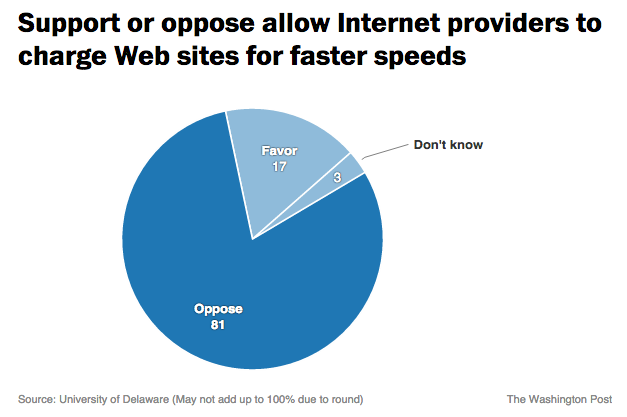
In a new survey, the University of Delaware’s Center for Political Communication found that support for neutrality is strong and widespread — regardless of gender, age, race and level of education. About 81 percent of Americans oppose allowing Internet providers like Comcast and Verizon to charge Web sites and services more if they want to reach customers more quickly, that is, allowing what are often called “Internet fast lanes.” Most surprising of all, given comments by Republican lawmakers over the past couple of days, is that support for net neutrality is bipartisan. Indeed, Republicans were slightly more likely to support net neutrality than Democrats. Eighty-one percent of Democrats and 85 percent of Republicans in the survey said they opposed fast lanes. The poll’s margin of error was 3.2 percentage points.

Another survey, albeit by a pro-net neutrality outfit, finds similar levels of support among self-described “very conservative” voters. Jason Koebler, meanwhile, goes after Comcast, which claims to be totally on board with Obama’s proposal:

In a blog post titled “Surprise! We agree with the president’s principles on net neutrality: Reiterating our strong support for the open internet,” Comcast exec David Cohen notes that the company practices Obama’s proposed rules against blocking, throttling, paid prioritization, and that it supports increased telecom industry transparency. On the first three, he’s technically right, at the moment. On the last one, he’s dead wrong.

It’s true that Comcast practices those three principles of net neutrality— because it is legally obligated to under the terms of its last mega merger, the deal in which it acquired NBC.  … Meanwhile, before the NBC merger, Comcast actively lobbied against net neutrality. In the past, it violated [since overturned] FCC rules on net neutrality by throttling customers. It has helped put into place anti municipal broadband laws all throughout the country with the help of organizations like ALEC and the National Cable & Telecommunications Association. It has run fear mongering campaigns about municipal broadband competitors.

“It seems inevitable,” Katie Benner writes, “that at some point in the future we’ll decide that Internet access is as essential to civilized life as running water, electricity and phone calls.” Thus, she concludes, it’s equally inevitable that we’ll decide to treat it as a public utility:

Messaging and self-driving car apps and health records will reside on your phone, along with the videos of panda cubs wrestling with zoo keepers. And you won’t be able to live without any of it. When that realization hits, it should follow that the Internet service providers –companies such as Comcast and Time Warner Cable now, and likely a company like Google in the future — will be regulated like utilities. They should be held to a different standard if they provide services that are essential to daily life. Water prices, for example, stay within certain bounds so that wild market swings don’t force swaths of the population to live without the ability to bathe, drink and cook. Remember the debacle of the Enron energy traders and the California power crisis and unnecessary brownouts? Regulating services as utilities is designed, in part, to keep things like that from happening.

Bershidsky observes that for all the appeals to “innovation” among proponents and opponents of net neutrality alike, actual innovations in the Internet economy will likely be so disruptive as to upturn both sides’ premises:

[T]he combatants mean two different kinds of “innovation.” Providers are talking about their ability to upgrade networks so they can carry more traffic at faster speeds. Their opponents focus on new services for consumers that might require a lot of bandwidth. In both cases, the i-word is applicable, but it’s not the type of innovation that could change the face of the industry. Not the disruptive kind. …

If the government leaves the Internet alone — letting broadband and content providers hatch whatever devilish plots they feel are in their interest — some startup, or a few of them, will inevitably come up with the next idea that will be far outside the current debate. It might involve advances in compression technology, making all talk of fast and slow lanes irrelevant because they could suddenly allow the existing infrastructure to carry more traffic, or breakthroughs in mesh networking, which might allow people to get broadband connections without using much of that infrastructure. Whatever the game-changing innovation might be, both sides in the current dispute would be forced to deal with it, pitching in with incremental innovations.

All-Too-Common Pleas

US District Judge Jed S. Rakoff notes the near-ubiquity of plea bargaining:

In 2013, while 8 percent of all federal criminal charges were dismissed (either because of a mistake in fact or law or because the defendant had decided to cooperate), more than 97 percent of the remainder were resolved through plea bargains, and fewer than 3 percent went to trial. The plea bargains largely determined the sentences imposed. While corresponding statistics for the 50 states combined are not available, it is a rare state where plea bargains do not similarly account for the resolution of at least 95 percent of the felony cases that are not dismissed; and again, the plea bargains usually determine the sentences

The cause, he says, is a power imbalance between prosecutors and defense attorneys:

[W]hat really puts the prosecutor in the driver’s seat is the fact that he – because of mandatory minimums, sentencing guidelines (which, though no longer mandatory in the federal system, are still widely followed by most judges), and simply his ability to shape whatever charges are brought –can effectively dictate the sentence by how he publicly describes the offense. For example, the prosecutor can agree with the defense counsel in a federal narcotics case that, if there is a plea bargain, the defendant will only have to plead guilty to the personal sale of a few ounces of heroin, which carries no mandatory minimum and a guidelines range of less than two years; but if the defendant does not plead guilty, he will be charged with the drug conspiracy of which his sale was a small part, a conspiracy involving many kilograms of heroin, which could mean a ten-year mandatory minimum and a guidelines range of twenty years or more. Put another way, it is the prosecutor, not the judge, who effectively exercises the sentencing power, albeit cloaked as a charging decision.

The defense lawyer understands this fully, and so she recognizes that the best outcome for her client is likely to be an early plea bargain, while the prosecutor is still willing to accept a plea to a relatively low-level offense. Indeed, in 2012, the average sentence for federal narcotics defendants who entered into any kind of plea bargain was five years and four months, while the average sentence for defendants who went to trial was sixteen years.

Daring To Be Dull

5197901375_5251ce0770_o

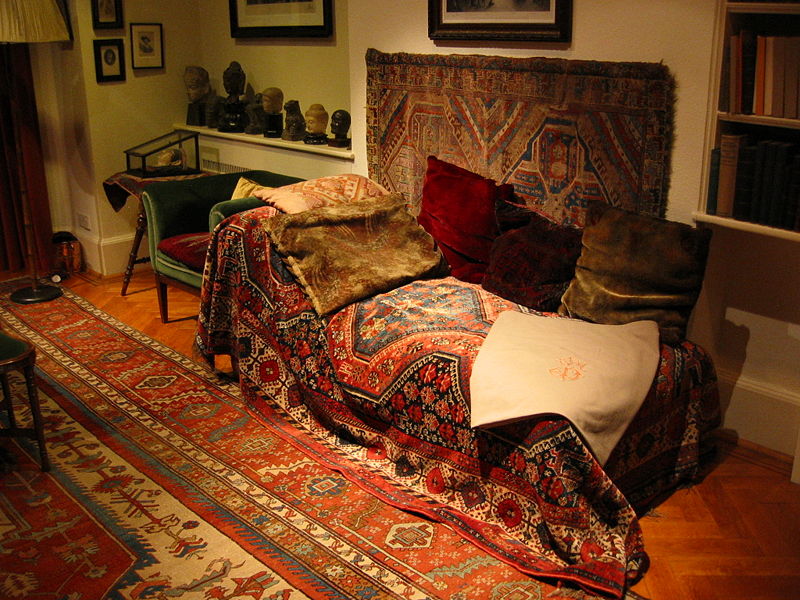
Daphne Merkin describes overcoming a fear of boring her therapists:

My father, who had married at 42 and was more of a distant bystander than an engaged parent, barely took me in at all. My mother was mercurial and easily distracted, brisk rather than lingering in her affections. I learned early on not to take anyone’s interest for granted and was in the habit of checking whether people were actually attending to me — “Are you listening?” I would ask, interrupting whatever I was saying; “Are you really listening?” — or just going through the motions, their thoughts elsewhere. I suffered, you might say, from the anxiety of insignificance — my own insignificance — and assuaged it by developing a dramatic raconteur’s voice, primed with ironic asides meant to keep my audience with me. …

And then came the moment several years ago when I stopped trying to be an entertainer and took the risk of narrating my life more straightforwardly, in all its mundane details and interludes of stuckness, with the broken-record aspects left in, rather than edited out for a smoother delivery. I did so because I was growing older and more desperate for relief and it seemed to me I had found a therapist who wasn’t interested in being charmed by me so much as he was focused on helping me. I did so in the full knowledge that I might end up boring him to tears, even though he was paid to be attentive.

It was just this possibility, of course, that I had always feared and endeavored to avoid. In doing so, it now seems to me, I was denying myself one of the things therapy allows for, which is precisely the repetitive nature of a person’s inner life, the constant regurgitation of ancient grievances and conflicts.

(Photo by Karen Apricot)

A Much-Doubted Detente

MYANMAR-ASEAN-DIPLOMACY-US

President Obama arrived in Burma today for the Association of Southeast Asian Nations (ASEAN) and East Asia summits. Given how the country has backslid on reforms since Obama’s groundbreaking visit two years ago, his return highlights how the rehabilitation Burmese junta didn’t quite go off as planned:

Skeptics warned at the time that the presidential visit and the relaxation of most U.S. sanctions were mistakes because they gave Myanmar’s military leaders too much of a reward for the changes they’d made and diminished U.S. leverage going forward. “Two years after that trip, there have not been a lot of big changes. There has been a lot of backsliding and a lot of inertia,” said John Sifton of Human Rights Watch. “Once the bulk of the financial sanctions were lifted, right after that, reforms began to stall, which is why we urged them not to do it in one go.” After that push in 2012, he said, “There was very little motivation for [the generals] to continue to move.”

One former senior administration official recalled that “there were plenty of arguments about how and when to lift a set of sanctions” to encourage the government’s opening. Now, despite the easing of financial and investment sanctions and the president’s and secretary of state’s visits, he acknowledged that “some of those things have actually gotten worse in the last year,” with officials in Myanmar not allowing a “real opening of the political process” and having done a “horrendous job in their treatment of the Rohingya minority.”

The stalling of the reforms also puts a pallor on Hillary Clinton’s legacy in the State Department, of which the opening of Burma was supposed to be a bright spot. Thomas Maresca reminds us of the continuing plight of the country’s Muslim Rohingya minority, some 140,000 of whom are living in squalid displaced persons camps while another 100,000 or so have fled to neighboring countries:

“The problems facing the Rohingya are among the most desperate human crises in Asia today,” said Murray Hiebert, deputy director of Southeast Asia Studies at the Center for Strategic and International Studies. “With thousands of Rohingya fleeing on boats for Thailand and Malaysia, this problem stretches far beyond the borders of Myanmar.”

In Baw Du Pha, the camp where [Ousman] Gani is confined, families share 10-by-10-foot rooms and subsist almost entirely on rations of rice, chickpeas, salt and palm oil delivered by the United Nations World Food Program. Health care is at a crisis level ever since the Myanmar government expelled the aid group Doctors Without Borders in February, accusing it of favoring Muslims. Death and illness have become grimly commonplace around the Baw Du Pha camp. Noor Jahar, a widow, showed visitors empty medicine packets and photos of her daughter, Sham Sida, who died in April after treatment for her tuberculosis ran out. Others in the camp said 11 children have died in the past month from diarrhea caused by lack of sanitation and clean drinking water.

In an interview with The Irrawaddy, Obama himself acknowledges Burma’s backsliding, but says he plans to put more pressure on the government regarding reforms:

My message to the government … will be that it has a responsibility to ensure the well-being of all the people in the country, and that the fundamental human rights and freedoms of all people are respected. This is one of the most basic duties of any government. Victims deserve justice, and the perpetrators of crimes and abuses must be held to account in a credible and transparent manner. At the same time, every person has a role to play in Burma’s renewal. For example, much of the violence against the Rohingya and other Muslim communities in Rakhine State is being committed by local residents, but the government has a responsibility to work with the people to improve the humanitarian situation, and to address the underlying challenges. That’s why, when I spoke at the University of Yangon two years ago, I spoke directly to the people of the country about the importance of tolerance and the inherent dignity we all share as human beings. All of us in our own lives have to be vigilant aside bias and prejudice. Burma, like all nations, will be stronger and more successful if it draws on the strength of all of its people. Its remarkable diversity should be seen as a strength, not a threat.

(Photo: Burma President Thein Sein (R) walks with US President Barack Obama after the latter arrived at the Burma’s capital Naypyidaw on November 12, 2014. By Christophe Archambault/AFP/Getty Images)

Dissent Of The Day: My “Scorn Of Feminism”

Anti Sexist Stickers

A reader writes:

I see you’re jumping into commentary against feminism again. First, let me just note that I snorted in amusement when you wrote: “Or is it simply that WAM believes that women cannot possibly handle the rough-and-tumble of uninhibited online speech?” You must admit that that is a funny thing for you to write, given your policy of not allowing comments on Dish posts. If it is such a good thing, this rough-and tumble, and if it’s so easy to handle it, why don’t you turn commenting on?

I’m also disappointed in the continuing scorn that you heap upon feminism. You don’t seem to understand even the most basic facts about it and the sneering tone that you take is unbecoming and not like you. You seem to lose all ability to understand nuance when you write about it. I’m a “straight white male” and even I realized that, in that video, my demographic “as a group” was not being disparaged. You’re like a walking poster child for the #notallmen hashtag and the enraged, entitled, petulant man-boys who complain on it.

And the strawmen – could you just stop with that? You wrote: “Instead of seeing the web as opening up vast vistas for all sorts of voices to be heard, they seem to believe … that women are not strong or capable enough of forging their own brands”. Um, what? Show me a feminist who thinks that women are “not strong or capable enough.” Go on, show me one, anyone, anywhere. You cannot, because they don’t exist. It’s the anti-feminists who think that. Just look at the words of Phyllis Schlafly, for example, and the immeasurable damage that she has done.

And then there is this: “They want gender quotas for all media businesses, equal representation for women in, say, video-games, gender parity in employment in journalism and in the stories themselves.” Gender quotas, huh? Well, I looked through WAM’s “About us” page, the “What we do” page, and the “Action center” page, and didn’t see a thing about “gender quotas.” In fact, what they seem to want to do is simply to raise awareness of the disparities – there is no call for legal action to implement and enforce some quota. It’s intellectually dishonest, Andrew, to write things like that when you know them to be untrue.

First up, the Dish has long opted for an edited and curated version of dissents, rather than a comments free-for-all. And that’s because Dish readers have voted down a comments section multiple times and because we want to create a different atmosphere of civilized debate than in many troll-feeding sites. If we were not publishing strong dissents – like my reader’s – it would be one thing. But we do all the time.

Second: let me address the assumption that I am pouring scorn on feminism. I’m really, really not. I favor the removal of any formal or legal barriers to women’s success. And I’m happy to celebrate moments of women’s cultural, political and social success – and they are many and multiplying. But I’m still a conservative-libertarian. I don’t believe in an identity politics that seeks to remove structural oppression by forcing others to say things they may not want to say, or do things they may not want to do, or by ostracizing people for whatever-ism they are found guilty of. And I’m still a believer in some irreducible differences between men and women that have nothing to do with culture, except to shape it.

This is what animates my contrarian skepticism about groups like WAM who seek to police the culture in pursuit of social justice. (No, I won’t use the SJW term again, since it seems to rile people up unnecessarily.) And if you think I’m just singling out feminists, you should see what I have said about the gay equivalent, GLAAD, when they seek to do exactly the same thing.

If you think my opposition to a certain kind of left-liberalism is merely about women, then why is my position identical when it comes to gay rights? Why am I defending the rights and free speech of bigots who refuse to marry gay couples, or the boy scouts (of old), or the Saint Patrick’s Day Parade? It’s because I really believe that the best response to injustice is more free speech rather than less of it. It’s because I believe in maximal freedom of expression – especially by those segments of the society who are rightly reviled by most of us. A defense of free speech that did not include the speech of racists, misogynists, homophobes and bigots is no real defense of free speech at all. And it says something depressing about our contemporary culture that if you make this classically liberal point, you are immediately told you are in favor of misogyny or racism or homophobia.

I can see that an argument on these grounds is hard to make after the extreme polarization and emotional wounds of the past few months over #gamergate and other gender issues. In a pitched battle, you are supposed to pick sides and stick with it. But I have chosen sides. On the question of real harassment, stalking and personal threats, I’m strongly against them on both sides, and emphatically against them when they are laced with foul misogynistic language and hatred. I find the big majority of #gamergate tweets to be repellent. I have no problem with Twitter deciding that that kind of abuse should lead a user to be suspended. I’ve said this in virtually every post I’ve written on this.

Have I misrepresented WAM? Go read their site as I urged readers to do in my first post. Does “gender justice” require that half of all reporters be one gender? Or that half of all media organizations be owned by women? They don’t explicitly say those things but they sure do imply many of them. And I do think they are claiming that abusive rhetoric and language online makes the web an unsafe space for women, in a way it does not for men. But, while such abuse is vile, there’s plenty of evidence that it flies both ways toward men and women – see Cathy Young’s exploration of that here. And I don’t think women need special protection from this. That’s what I think is condescending. We are all capable of having thick skins and that isn’t restricted to one gender or another.

Am I being overly provocative? I plead guilty to some degree. It’s sometimes my job to take a highly unpopular position if I think there’s something awry in the popular consensus. It’s not trolling – because there’s an issue of principle here that I strongly believe in. But it can be seen as tendentious  in a broader context. My hope is that what you read here on the Dish every day balances that out. Posts where I take a strong and sometimes counter-intuitive viewpoint are balanced by reader dissents, aggregation of other views of the subject elsewhere online, and an open debate. This is not a one-person blog any more and hasn’t been for years. Whatever your views of me, I hope you’ll see that we’ve tried to create a place where my bias is balanced. Judge us on the whole rather than the part. And keep the dissents coming.

Update from another dissenter:

You: “we want to create a different atmosphere of civilized debate than in many troll-feeding sites. If we were not publishing strong dissents – like my reader’s – it would be one thing. But we do all the time.”

First, cut the shit. You tend to publish dissents that serve your own agenda: those that you can use to reinforce your own views and easily juxtapose the “correct” view from that which is obviously “wrong.”  Your response to this dissent is quite typical of how this works; it’s as disingenuous as it is self-serving. But hey, it’s your website, so I guess you have a libertarian right to use it as you choose.

Second, if by an “atmosphere of civilized debate” you mean that you intend to frame the debate as you want it framed, well, you may be on to something. But my sense of “civilized debate” is that everybody is entitled to make a contribution as well as frame the debate itself in the way that one sees fit. Your website does not do this. True, neither do many troll-feeding sites.  Sites like the New York Times, however, allow for a much freer and open exchange of ideas than the Dish does. Yet they’re also able to keep the trolls at bay.

Third – and this gets to the heart of the previous two points – I would challenge the statement that the Dish publishes dissents “all the time.” I don’t know what percentage of dissents you publish, but I’m guessing it’s pretty low. I haven’t written many dissents – maybe two or three since I started visiting the site five or six years ago. But I do know this: never were they published or even acknowledged with a response. And I don’t expect this one to be any different.

We get hundreds of emails a day, a large percentage of which are long and thought out – two qualities increasingly scarce in a comments section – so it’s difficult to feature all of your feedback within the concise reading experience of the Dish. But we try our best. You can browse all our Dissents of the Day here and here to determine for yourself if we publish them “all the time”. And critical feedback on the Dish isn’t confined to the Dissent feature; it just contains the most cutting and persuasive examples. Dish editor Chris Bodenner selects almost all of the dissents, thus creating a layer of critical distance that greatly decreases the chance of selection bias on my part. It’s a system that has evolved over the years and we think it’s the best fit for the blog, but we are always open to further change. So keep the feedback coming.

By the way, below are the two other emails our Update dissenter has sent to the Dish in the past, posted here in the spirit of continued dissent. Here’s one from six days ago, in response to my post, “No, Mr President: Wait Some More On Immigration Reform“:

With all due respect, are you fucking kidding me? Obama already delayed executive action on immigration, and what did he get from it? Recent immigrants didn’t vote, while Pryor and Landrieu lost their seats anyway. If he had moved on immigration before the election, it would have likely brought more Democrats to the polls and enabled Democratic politicians to draw a clearer distinction between themselves and the xenophobic Republicans. Given how Pryor and Landrieu voted as senators, Obama simply should have said to them good riddance and moved ahead with securing more of the Latino vote. This is just the latest example of this president’s political ineptitude.

Now you’re suggesting that Obama further delay executive action. So what’s he going to get out of it?

There are two possibilities. The first is that he gets an immigration deal done, but in the process he has to compromise to the point that Republicans will get virtually everything they want while the Democrats will have to fuck their Latino constituents over. The second (and more likely) is that Republicans will continue to bait Obama and lead him on, making him look even weaker and out of touch than he already appears.

What will this mean for Republicans? With the former, they could claim that they’re able to govern and accomplish for immigrants what the Democrats could not. With the latter, Republicans will boast how principled they are because they refused to compromise with the Kenyan Socialist. In either case, though, the Democrats will come off looking as they do today: a bunch of feckless, spineless, cowering milquetoasts.

Now, what happens if Obama takes executive action without delay?

He and the Democrats come off as principled and thus willing to stand up and fight for what’s right. Meanwhile, the Republicans go apeshit over what Obama has done, revealing themselves as the xenophobic assholes that they really are. It might even provoke some in the Cruz caucus to pursue impeachment, which would be the gift that keeps on giving for Obama and the Democrats.

Andrew, I’m fucking tired of this “only adult in the room,” “no red state or blue state,” “meep meep motherfucker” bullshit about Obama. Say what you will about the Clintons and their triangulation strategy, at least they had the balls to stand up to Republicans and dish out as much as they took. What did we get from Obama? It’s nearly impossible to overstate what the 2010 and 2014 debacles mean for Democrats. They are now assured of remaining a minority party for an entire generation, and likely many more years after that. So what about Obamacare? Do you really think that there’s going to be anything left of it now that Republicans control both houses in Washington, to say nothing of all the state legislatures that they took over? Fat fucking chance.

Needless to say, this is not just a matter of which party deserves to be in power; it’s not about whether the blue team or the red team is winning. What’s likely to occur for the next 25 years is further erosion of economic and social equality in this country – above all for African-Americans – further demonization of the federal government and the role that it plays in assuring a level playing field and providing basic services, and further destruction of the environment and denial of climate change. You want to hear something really scary? Do you realize who’s about to become the new chair of the Senate committee on the environment? None other than the climate-change-is-a-hoax-in-chief, James Inhofe. With dipshits like these in power, this nation – if not the whole global environment – is absolutely fucked.

Meep meep motherfucker my ass.

The other email, from 2010:

I’m very much enjoying the YouTube clips that you are putting up regarding your recent talk at Princeton. It has provoked a lot of thought in my own mind regarding not only homosexuality, but more broadly how it should be understood within a free and democratic society – to say nothing of the faith tradition that we happen to share, but which I have recently abandoned for some of the reasons that your blog has helped make consistently clear.

Nonetheless, it seems to me that your position is rife with inconsistency regarding the very principles on which your talk is based, namely reason and freedom. On the one hand, you make an eloquent critique of the Catholic Church’s position on homosexuality, showing how its concept of sex being solely for the purpose of procreation is inconsistent – from a rational point of view – when it concerns the heterosexual infertile, pregnant, post-menopausal, or practitioners of natural family planning. On the other hand, though, you made it very clear in the latest clip that “religion is not about reason.” But if the latter is true, it seems to me that your argument against the Church’s position on homosexuality is thoroughly useless and without merit.

You can’t have it both ways. The only plausible conclusion, then, is that Religion IS about reason in many significant ways; to deny otherwise – particularly when you are discussing a tradition in which faith and reason have perennially been seen as complementary – not only undermines your own argument, but makes a caricature of religion itself.

Similarly, you criticize liberalism as being a bastion for protecting minorities and in effect infantilizing them. At the same time, however, you argue that in your fight against the religious right you have taken shelter behind the First Amendment, which of course guarantees your right to free speech and emboldens you. But if the First Amendment is not based on the principle of liberalism, then the very term, “liberalism,” is thoroughly meaningless. Moreover, was not First Amendment adopted for the express purpose of protecting those who, precisely because they find themselves in a vulnerable minority, are liable to suffer negative consequences for what they say? In other words, you run to liberalism when it benefits your argument and enables you to express it, yet you deride it whenever it is an inconvenient reminder of your need for, and dependence on, minority protection. Your selectivity about liberalism also strikes me as a caricature of this ideology than anything else.

In the end, why not simply admit that your position is as riddled with inconsistency as those against which you argue? And if indeed that is the case, then what the argument really comes down to is a matter of which inconsistencies are more convenient to one’s own intrinsic beliefs, values, and assumptions. In such a case, nevertheless, I’m much more likely to side with you than those against whom you argue.

(Image of “anti-sexist” street-art from Jonathan McIntosh)

Where Do Climate Skeptics Come From?

Climate Study

Jesse Singal flags a new study on the question:

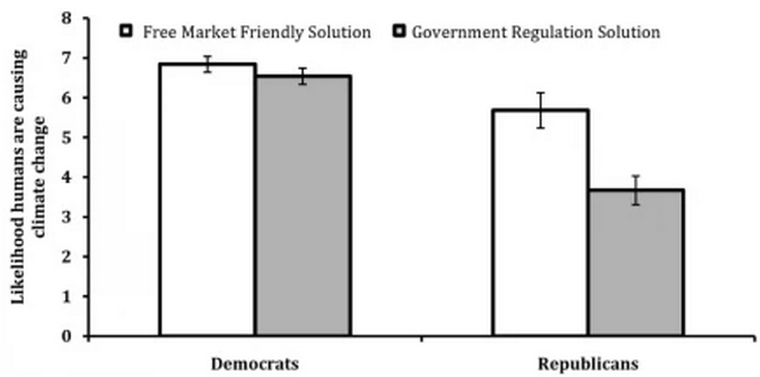
The basic idea here is that people are less likely to believe that something’s a problem if they have “an aversion to the solutions associated with the problem,” as the authors put it. Strictly speaking, this doesn’t make sense — when determining whether or not to believe in a problem, all that should matter is evidence for the existence of that problem. (Just because you believe it will be expensive to replace that leak in your roof shouldn’t make your belief in the leak any less likely.)

But it fits into a broader framework of what psychologists call “motivated reasoning” — the human tendency to form beliefs not based on a strictly “objective” reading of the facts, but in a way that offers some degree of psychological protection.

Chris Mooney chimes in:

[T]he new study has its weaknesses. For instance, we probably shouldn’t assume based on this paper that running out and singing the praises of clean energy and green tech, framed as a free-market solution, would actually work to depolarize the climate issue. Other research, for instance, implies  that the issues of clean energy and energy efficiency have also become infected with partisan emotions, to a significant extent.

Still, it is very useful to bear in mind that often, when we appear to be debating science and facts, what we’re really disagreeing about is something very different.

Andrew Revkin draws “positive lessons” from the study:

As the “Six Americas” surveys run by the Yale Project on Climate Change Communication have shown, there’s plenty of common ground on energy innovation and incentives for efficiency, so it’s possible to have a constructive conversation on global warming science and at least some solutions across a range of ideologies. … And, of course, this doesn’t mean that those with strong views about the merits of a carbon tax or climate treaty or other solution involving strong governance should clam up. They just might do better by speaking in two sentences instead of trying to mash the science and a particular prescription into a single sound bite.