Our Climate Pact With China

Jeff Spross summarizes it:

CHINA-US-DIPLOMACYThe pledge commits the U.S. to cut its emissions 26 to 28 percent below their 2005 levels by 2025. This builds on the current target of a 17 percent reduction below that baseline by 2020, and could actually double the pace of emission cuts set by that initial goal — from 1.2 percent a year to as high as 2.8 percent per year. The White House has actually been looking into the possibility of expanding beyond the 2020 target since 2013, and has been involved in occasional interagency meetings to that effect.

For its part, China is committing to get 20 percent of its energy from non-fossil-fuel sources by 2030, and to peak its overall carbon dioxide emissions that same year. China’s construction of renewable energy capacity is already proceeding at a furious pace, and this deal will require the country to deploy an additional 800 to 1,000 gigawatts of zero-carbon energy by 2030. For comparison, 800 to 1,000 gigawatts is close to the amount of electricity the U.S. current generates from all sources combined.
Rebecca Leber questions whether China and the US will follow through:

The administration says this will be achievable under existing law. It assumes the Environmental Protection Agency’s regulations to slash carbon pollution from power plants 30 percent by 2030 are in full swing. But there is also intense Republican opposition to the EPA’s plans, and to Obama’s. The new Congress is led by climate change deniers, who will obstruct the president’s plans. The next Senate Majority Leader, Mitch McConnell, has suggested he will use must-pass appropriations bills as leverage to force Obama into delaying or weakening his own climate regulations.

Xi may not have to deal with Congress, but China has its own challenges ahead. The next step to watch for is specific regulations and goals that are outlined in China’s next five-year plan. It won’t be easy to meet these pledges: Non-fossil fuels made up 9.8 percent of China’s energy sources energy in 2013. To achieve 20 percent of its energy from non-fossil fuels, China will need to add clean and nuclear energy at an enormous scale.

Sam Roggeveen is skeptical:

This deal is good news for all sorts of reasons, but it’s worth remembering that these are just targets (the UK set targets too, and is on track to miss them) which are not really enforceable. And given the long lead times (2025 for Washington to meet its new emissions targets; 2030 for Beijing’s emissions to peak), it’s going to be difficult to hold both countries to their commitments.

Plumer remarks that it’s “debatable whether either pledge is sufficient to avoid drastic levels of global warming — particularly if China lets its emissions keep rising until 2030”:

Some analyses have suggested that China’s emissions would need to peak in 2025 or earlier for the world to meet its goal of preventing more than 2°C (3.6°F) of global warming. (The White House said it thinks China can peak earlier, particularly if it meets that ambitious clean-energy target. But that’s not certain.) And more crucially, the deal only includes two countries. As climate modeler Chris Hope points out, this deal in isolation still puts the world on course for a likely 3.8°C (6.8°F) rise in temperatures. “These pledges are only the first step on a very long road,” he concludes.

Michael Levi analyzes China’s side of the deal:

The difference between a 26 and a 28 percent cut in U.S. emissions is on the order of 120 million metric tons of carbon dioxide emissions annually. That’s smaller than the EIA’s projected annual growth in Chinese energy emissions for each year between 2025 and 2030. Very loosely speaking, a mere one-year shift in the Chinese peaking year could matter at least as much to global emissions as the difference between the various U.S. targets that have now been announced.

And then there’s the matter not of when Chinese emissions peak but where they peak. Do they peak 25 percent above current levels? 15 percent? 10 percent? That makes an enormous difference for global emissions.

Fallows puts the announcement in context:

Many people thought, hoped, or dreamt that Xi Jinping would be some kind of reformer. Two years into his watch, his has been a time of cracking down rather than loosening up. Political enemies and advocates of civil society are in jail or in trouble. Reporters from the rest of the world have problems even getting into China, and reporters from China itself face even worse repression than before. The gratuitous recent showdown with Hong Kong exemplifies the new “No More Mr. Nice Guy” approach.

A nationalistic, spoiling-for-a-fight tone has spilled over into China’s “diplomatic” dealings too. So to have this leader of China making an important deal with an American president at this stage of his political fortune is the first news that even seems positive in a long while.

We’ll wait to see the details. But at face value, this is better news—about China, about China and America, and about the globe—than we’ve gotten for a while.

That progress gives Brian Merchant hope:

The two biggest polluters, who have never agreed on much of anything about climate change at all, are issuing a deal that seriously reflects the scope and depth of the problem. The agreement will have a profound effect on the international community, and it’s already sending cheers through the climate circles around the world. The two immobile pillars propping the up the bulk of the world’s fossil fuel infrastructure finally feel like they’ve budged.

The challenges in meeting the targets put forward—and pushing them further—will of course be myriad. But in the face of an unfolding planetary disaster that can seem immune to government action, this deal is, at the very least, a much-needed beacon of hope.

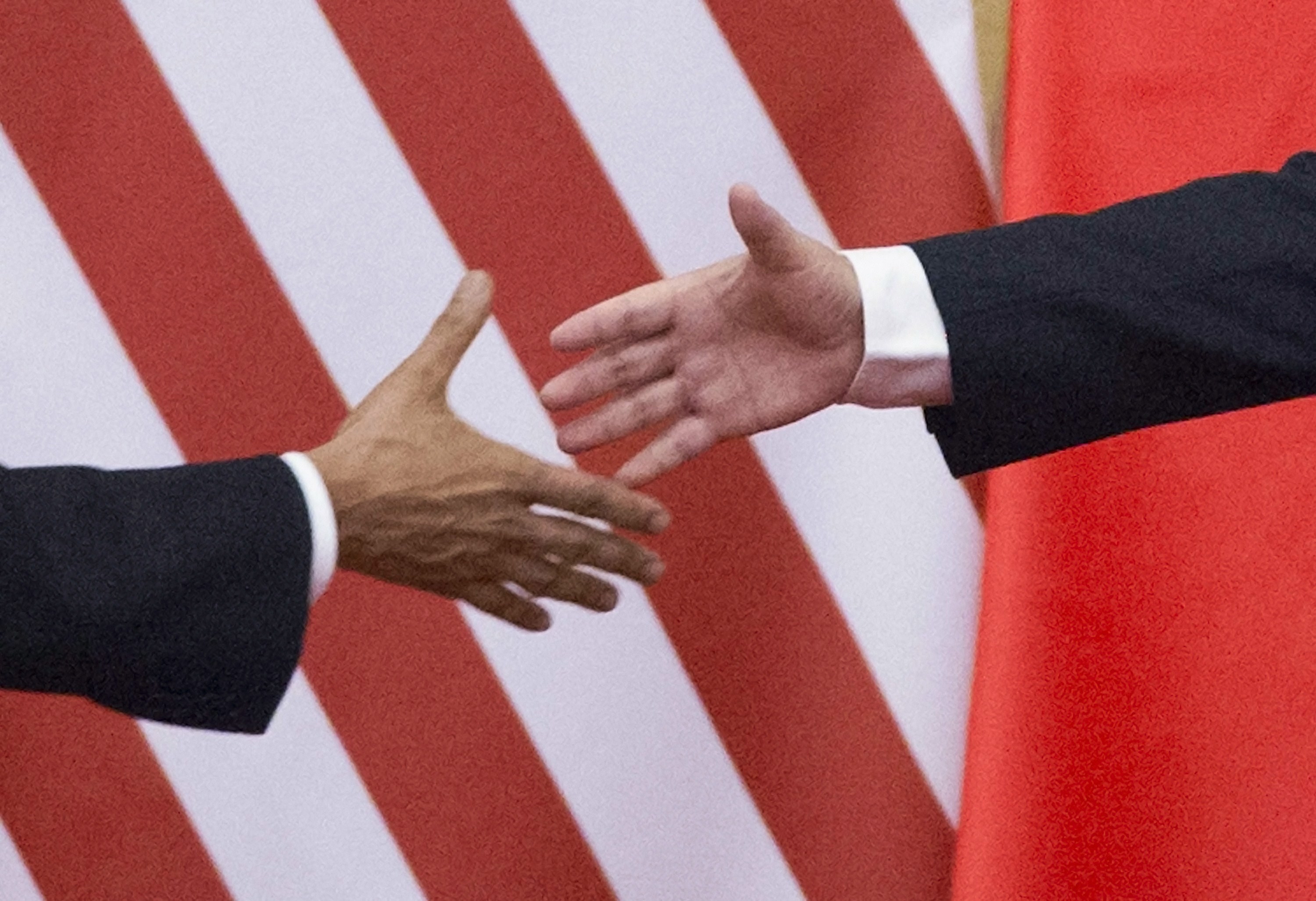
(Photo: US President Barack Obama (L) and China’s President Xi Jinping reach out to shake hands following a bilateral meeting at the Great Hall of the People in Beijing on November 12, 2014.By Mandel Ngan/AFP/Getty Images)
The Midterm Mandate

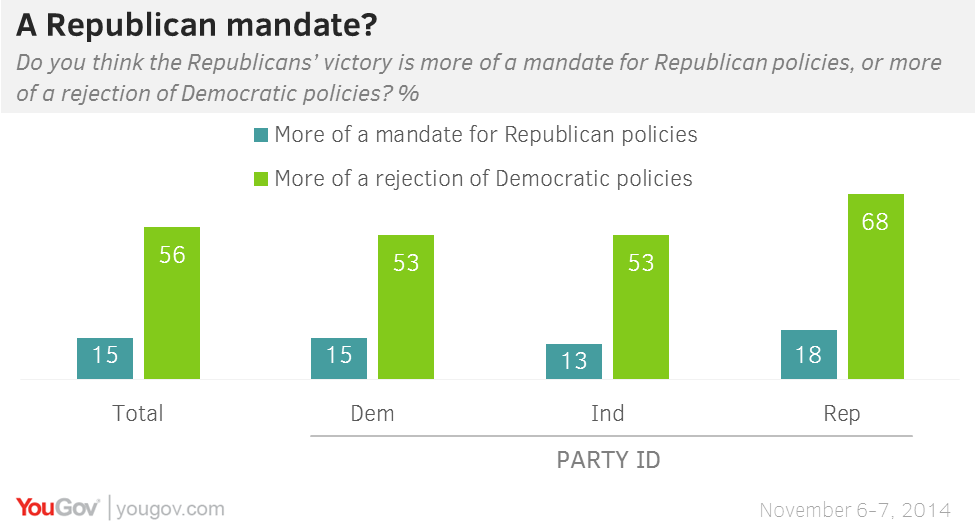
It’s is anti-Democrat, not pro-Republican, according to YouGov:

Republican Mandate

Pew also takes the public’s temperature:

As was the case four years ago, the public is divided over GOP leaders’ policy plans. About as many approve (44%) as disapprove (43%) of Republican congressional leaders’ policies and plans for the future. Following the 2010 election, 41% approved and 37% disapproved of Republican leaders’ plans. The public by wide margins approved of Democratic leaders’ future plans and policies in 2006 (50% to 21%) and Republican leaders’ proposals in 1994 (52% to 28%).

Cillizza focuses on the uncompromising Republican base:

Sixty six percent of Republicans said the they would prefer party leaders “stand up” to Obama “even if less gets done in Washington” while just 32 percent preferred GOP top brass “work with Obama, even if disappoints some GOP supporters.”  That view stands in direct opposition to the view of the broader electorate on that question; 57 percent of all Americans prefer that Republicans work together with Obama while 40 percent favor GOP leaders standing up to the president. Among Democrats, a majority (52 percent) say that Obama should work with Republicans “even if it disappoints some Democratic supporters” while 43 percent would prefer they “stand up” to Republicans even if it means getting less done.

These numbers vividly paint the challenge before Congressional Republicans as they prepare to take over total control of Capitol Hill next year.  McConnell and Boehner — longtime institutionalists — undoubtedly will feel tugged toward trying to find some common ground with Obama in hopes of proving, on some small level, that they are not simply the opposition but can lead on a policy front too.  And yet, there is a clear majority of Republicans who have absolutely no interest in seeing their leaders cut deals — large or small — with the president.

The Consequences Of A Clinton Coronation

Noah Millman asks, “how would a serious challenge to Clinton, even if it failed, affect the Republican contest?”

It seems to me that a Clinton coronation makes life much easier for those who don’t want to think too hard about what the GOP stands for. The GOP would really like to run a largely negative campaign against the Clinton-Obama record without having to declare itself too clearly on any issue. A Clinton coronation would make that easier, because it would take away the need for Clinton to define herself in any specific way.

Take foreign policy.

Clinton is at the extreme hawkish end of the Democratic Party. She pushed hard for the intervention in Libya, favored a more forceful and earlier intervention in Syria, a tougher line on Iran, and so forth. If she faced a serious primary challenge from, say, Jim Webb, she’d either have to defend that record forcefully, or moderate her stance. Now, if she did the first, then what happens on the Republican side at the same time? First, Rand Paul says he agrees more with Jim Webb. Second, the other GOP contenders have to decide whether they want to echo Clinton, echo Paul, or come up with an alternative way of explaining their views while remaining hawkish. Whatever they do, they have to provide more clarity.

Larison expects a “debate over Libya on the Democratic side could have some very interesting and desirable effects on the intra-Republican debate and on Clinton’s ability to use her time as Secretary of State to her advantage”:

Clinton “owns” the Libyan war in a way that she isn’t similarly responsible for other policy decisions, and that war was a terrible mistake that she urged the president to make.

Webb could attack her consistent support for recklessly hawkish policies without having to recall a debate from a decade earlier, and Paul could use the intervention to highlight an episode where he demonstrated better judgment than the then-Secretary of State. The more that Clinton is forced to defend her record on the Libyan war itself, rather than endlessly relitigating the 2012 attack in Benghazi, the worse it will be for her. The record shows that she was one of the architects of a major policy blunder that is still having destructive effects on the country that “benefited” from the intervention.

 advises Democrats to “derail Hillary Clinton.” He calls her “a mortal threat to the next generation of social democratic reform”:

Obama beat Hillary by pointing out that he had been right on the most consequential foreign policy issue since the Vietnam War, and she had been wrong. Amazingly, he appointed her secretary of State, where she pushed hard for military engagement in Libya, which quickly turned into a stateless region dominated by terrorist gangs — a dumpster fire along the Mediterranean.

Hillary Clinton was molded by the Cold War liberal’s fear of looking soft on foreign policy, and she has become the John McCain of the Democratic Party. Already smarting from Obama’s failure to close Guantanamo Bay, his eager embrace of drone warfare, and his expansion of the surveillance state, do liberals really want to lock all that in under Madame Smart Power?

The Mother Of All Premium Hikes

SCOTUS Obamacare

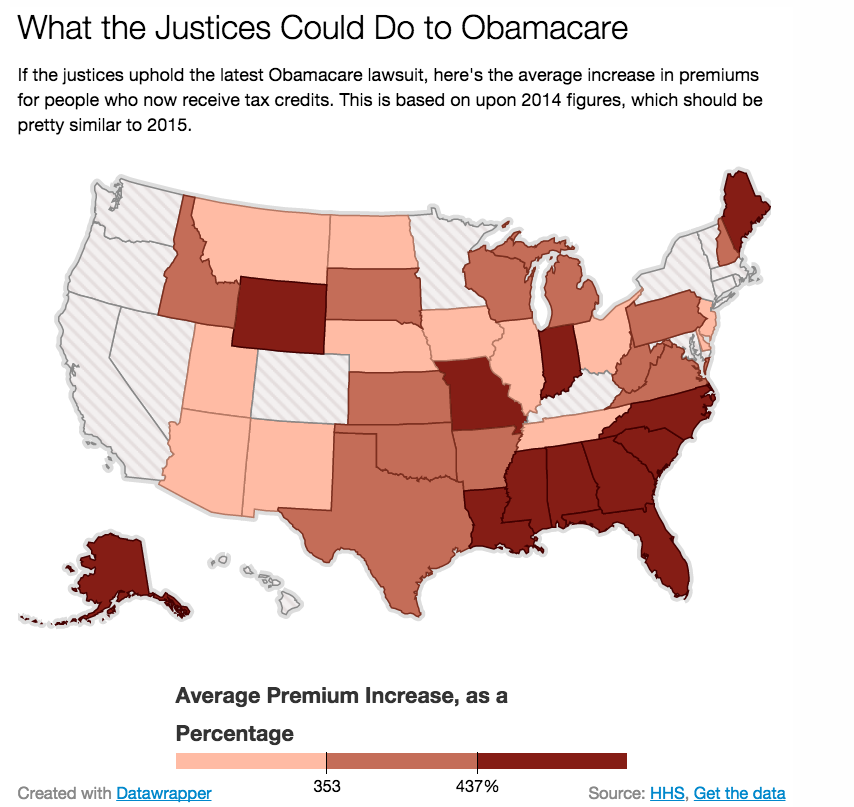
Jonathan Cohn calculates that, should SCOTUS gut Obamacare subsidies in states without their own exchanges, the “underlying premiums for all people buying insurance on their own in these states would rise by an average of 43 percent, while the number of Americans without insurance could be as much as 7 million higher than it would be otherwise”:

More than 800,000 Floridians would see their monthly insurance premiums rise, from an average of around $70 to an average of around $350, or roughly a factor of five. More than 600,000 people in Texas, about 325,000 in North Carolina, and another 275,000 in Georgia would see insurance premiums soar by similar amounts.

Nationwide, more than 4 million people living in 37 states would be in situations like these. Most would have no way to pay the higher bills, forcing them to drop insurance coverage altogether. Their sudden absence would destabilize insurance markets in those states, giving carriers reason to raise premiums by additional amounts or to flee the states altogetherwhich would, in turn, lead more people to give up insurance.

Relatedly, Suderman points out that affordability is the primary reason individuals go without insurance:

Before last October’s Obamacare rollout, a Kaiser Family Foundation study found that the main reason people had no health insurance was cost. Then, midway through the first enrollment period, the polling firm PerryUndem again asked individuals who hadn’t signed up for Obamacare why they were uninsured. Seven in ten said, simply, “I can’t afford it.”

This makes sense when you realize that a lot of these individuals are barely getting by on many fronts. The Kaiser poll also found that 71 percent were very or somewhat worried they wouldn’t be able to pay their rent or mortgage. Some 61 percent said they were struggling to afford gas or transportations costs, while 45 percent said the same about affording food.

Eight in 10 agreed insurance generally is “something I need.” But given the opportunity, they still weren’t buying it. It seems that the type of “comprehensive” health policies Obamacare requires people to purchase are viewed as a luxury among this population.

Looking on the bright side, Ezra touts Obamacare’s success thus far in holding down premiums:

In September, the Kaiser Family Foundation looked at insurance premiums for Obamacare’s benchmark silver plan in 16 major cities and found, to their surprise, that prices were falling by 0.8 percent on average. On November 11th, they updated the analysis with data for 32 more cities — and found that the initial finding held. On average, prices are falling by 0.2 percent.

“Falling” is not a word that people associate with health-insurance premiums. They tend to rise as regularly as the morning sun. And, to be fair, the Kaiser Family Foundation is only looking at 48 cities, and the drop they record is modest (though this is the same methodology they used in 2014, and to good results). But this data, though preliminary, is some of the best data we have — and it shows that Obamacare is doing a better job holding down costs than anyone seriously predicted, including Kaiser’s researchers.

And They Shall Beat Their Melting Pots Into Fenceposts

Concerned that the American “melting pot” isn’t living up to its promises, Reihan argues that curtailing the influx of low-skill immigrants would actually help existing communities assimilate:

If you believe Gregory Clark, an iconoclastic economist at UC–Davis, it might take even more than three generations for the descendants of less-skilled immigrants to reach an average level of social status. Legalizing large numbers of unauthorized immigrants will definitely help them attain that social status. Yet it won’t change the fact that even under the best circumstances, the wages commanded by people with less than a high school diploma tend to be very low, and the social connections they can draw upon are usually limited to other people facing similar challenges. Moreover, while the best evidence we have finds that less-skilled immigration doesn’t have a negative effect on the wages of less-skilled natives, it does have a substantial negative effect on the wages of less-skilled immigrants already living in the U.S. These are precisely the people who have the weakest social connections to other Americans, and who need all the help they can get to put down roots in this country.

Which brings me back to the melting pot. There is an alternative to allowing today’s less-skilled immigrants and their descendants to form the bedrock of an ever-expanding underclass. There is a way to help poor members of our foreign-born population form the social connections they will need to move from the margins of American society to the mainstream. What we need to do is limit the future influx of less-skilled immigrants.

Noah Smith begs to differ:

Would an immigration “pause” really increase the rate of assimilation? Actually, it depends on math. If the chance that someone assimilates is simply a fixed percentage chance (a Poisson process), then adding more immigrants will simply leave the rate of assimilation unchanged. If immigrants assimilate at slower rates when there are more of their co-ethnics around — the “ethnic replenishment” hypothesis — then adding more immigrants will indeed slow the melting pot, and may even increase the fraction of unassimilated people as time goes on. Or it could even be that a higher rate of immigration forces more people out of ethnic enclaves, by decreasing the opportunities available within those enclaves — in this case, more immigration would mean a faster rate of assimilation.

Tyler Cowen presents a related pro-immigration argument. He contends that “developed countries that can absorb new immigrants at a modest cost should have relatively bright futures”:

If you’re not convinced that a declining population is a problem, consider Japan. In terms of real gross domestic product per hour worked, Japan has continued to have good performance, but it has a fundamental problem: The working-age population has been declining since about 1997. And Japan’s overall population has been growing older, so with fewer workers supporting so many retirees, national savings will dwindle and resources will be diverted from urgent tasks like revitalizing companies and otherwise invigorating the economy. Japan has already gone from being a miracle exporter to a country that runs steady trade deficits. Perhaps there is simply no narrowly economic recipe to keep its economy growing; Edward Hugh made this argument in his recent ebook, “The A B E of Economics.”

Japan now has two main options: encouraging more childbearing and learning how to accept and absorb more immigrants. But it does not seem close to managing either task.

The Best Hangover In Fiction? Ctd

A reader, defining “fiction” liberally, nominates Johnny Cash’s version of Kris Kristofferson’s “Sunday Morning Coming Down” as the best depiction of the morning after:

Another suggests a musical one-liner:

A character who awakens after a long night of drinking says, “All my teeth have little sweaters on.” That’s always been my favorite literary description of a hangover. It’s from the 1943 Broadway musical One Touch of Venus – book by S. J. Perelman, lyrics by Ogden Nash, music by Kurt Weill, so the line almost certainly belongs to Perlman.  It’s perfect.

Another points to a novel:

I feel compelled to mention the hangover of Peter Fallow, the expatriate British journalist (supposedly based on Hitch) in Tom Wolfe’s The Bonfire of the Vanities:

The telephone blasted Peter Fallow awake inside an egg with the shell peeled away and only the membranous sac holding it intact. Ah! The membranous sac was his head, and the right side of his head was on the pillow, and the yolk was as heavy as mercury, and it rolled like mercury, and it was pressing down on his right temple… If he tried to get up to answer the telephone, the yolk, the mercury, the poisoned mass, would shift and roll and rupture the sac, and his brains would fall out.

Another nomination:

Neil Gaiman, in his Anansi Boys, does a decent job. Must be an English thing:

Fat Charlie was thirsty and his head hurt and his mouth tasted evil and his eyes were too tight in his head and all his teeth twinged and his stomach burned and his back was aching in a way that started around his knees and went up to his forehead and his brains had been removed and replaced with cotton balls and needles and pins which was why it hurt to try and think, and his eyes were not just too tight in his head but they must have rolled out in the night and been reattached with roofing nails; and now he noticed that anything louder than the gentle Brownian motion of air molecules drifting softly past each other was above his pain threshold. Also, he wished he were dead.

Another:

Surely Malcolm Lowry of Under the Volcano fame deserves a mention in this context. There are so many passages both in his masterpiece and in his other works (all more or less autobiographical) that explore the experience of waking up with a hangover that it’s difficult to point to a representative instance. They are also so tightly entangled with the particular concerns of the book in which they appear that quoting them would not evoke the kind of visceral response Dixon’s experience provides the reader, an experience by the way that seems to me rather shallow, focused as it is more on the physical consequences of drinking a lot (and finding the right metaphors to convey it) than on the psychological consequences an alcoholic like Lowry might experience.

As delightful to read as Amis’ bravura passage may be (despite Dixon’s acute discomfort), Lowry registers the deeper truth of hangovers: that they can be occasions for acute mental anguish. But that’s as it should be. Lucky Jim is a comic novel. Under the Volcano is not.

The Universal Anger Over Money In Politics

Lexington compares political spending Britain and the US:

Total spending by political parties in the British general election was £31.5m ($49.9m). Total spending by outside groups was £2.8m ($4.4m). So all in all: $54.3m. With 45.6m registered voters in Britain, that comes out at $1.19 per voter. Scan down the Brookings list, and that is less than the seventh most-costly Senate race (Arkansas), which cost $56.3m, or $26.47 per Arkansas voter. So the seventh costliest Senate race cost more than the entire 2010 general election in Britain.

But, like Americans, “British voters are convinced that democracy is being undermined by vast sums of corrupting money, to the point that elected representatives are essentially bought and paid for by wealthy special interests”:

Yet British election spending is regulated more tightly than any model dreamed of by even the most starry-eyed campaigner in America. Which suggests, I would submit, that when voters say that rich donors control everything, they may not be talking about absolute amounts of money, or even individual election rules. They are—at least in part—saying something else: that they feel the fix is in and ordinary voters are powerless in an economy run for the benefit of the rich and well-connected.

Next Up: Telepathic Tweeting

NSFW, because Alec Baldwin:

This embed is invalid


Leslie Horn flags a recent study suggesting that Shitter isn’t as fictional as you might think:

Basically what happened is this: One subject was located in one room and the other in another room, and they couldn’t communicate in any way other than via their brains.

They both looked at a game where they had to defend a city by firing a cannon. But one guy had his brain hooked up to a electroencephalography machine that read his brain signals, and instead of having any kind of joystick, he’d just think about moving his hand to fire the cannon. That was be transmitted over the Internet to the other operator, whose hand was situated on a touchpad, and would twitch and tap in the right direction if the signals went through.

Researchers tried this out on three pairs of six, and saw a 25 to 83 percent success rate. Which is a really wide range, but your main takeaway is this: the researchers have now seen enough success with brain-to-brain mind/motor control, they’re confident it’s a thing that works.

Susannah Locke reminds us that this study wasn’t the first telepathy experiment of note:

In August 2014, an international group led by Starlab Barcelona researchers in Spain used similar technology to have someones end a one-word email to someone else. They called it the “realization of the first human brain-to-brain interface.” But the process of sending that one-word e-mail was extremely complicated, not very practical, and far more time-consuming than playing video games. It involved translating a message into a binary code of “0”s and “1”s. The sender imagined moving his feet for 0s and hands for 1s. And then the receiver was hooked up to a device that stimulated his brain to create the perception of flashes of light, which was then translated back into 0s and 1s. All in all, this method of communication had a speed of 2 bits per minute – roughly one millionth the average internet speed in the US. That meant it took roughly 70 minutes just for one person to say “hola” or “ciao” to another.

Going Against The Stream, Ctd

A reader sounds off on Swift vs Spotify:

Musician here, with music on Spotify/iTunes etc. Spotify, and streaming services in general, ARE THE BEST THING TO HAPPEN TO MUSIC SINCE CDs. Why? Because people are paying for music again.

Musicians want to turn back time. Back to the days where people bought CDs for $19 a piece and the record labels and the musicians made a killing. Those days are dead. Napster killed them. But instead of monetizing Napster, the musicians and record companies tried to kill it. Then they fought iTunes (which is also slowly losing to streaming services, unless Beats takes off). In the meantime, most people were just stealing their music from Pirate Bay, Kazaam, Bit Torrent, etc.

The problem with Aloe Blacc, Taylor Swift and every other musician, is that they think their music is worth a lot more than it actually is. They should be happy that people are paying for music again instead of stealing it. The irony is, they are bitching about Spotify when people can still hear all their music for free – on YouTube. Because the major labels refused licensed to Spotify in time, the public went to YouTube to listen to their music, which is 100% free and musicians make NO money from. If most of the public was on Spotify or beats or Pandora, the musicians would be making a lot more money. Instead, they are tilting at windmills.

One of several more readers:

I am a rabid fan of music (and part owner of a vinyl record store) and have always believed that people who create music deserve to reap the fruits of their labor and artistic expression. And although nothing will beat the sound and warmth of a needle bouncing through the grooves of vinyl, there is also no question that Spotify is one of my very favorite applications. Here’s an idea:

Why doesn’t Spotify truly establish themselves as the most Artist-Friendly service, and offer a more expensive Ultra-Premium subscription (say, for $20 or $30 or $50/month more than the $10 they currently charge me), with the understanding that the incremental difference that I choose to pay (because I want to support the artists) gets paid out 80-90% directly to the artist/publisher?  I’d sign up for that in a heartbeat.  Much like I happily pay The Dish more than your asking price for the valuable and independent news content you provide, I would also happily pay a higher price to Spotify as a Musical Content Provider.  They would make more money, and the artists would make more money.

Bill Wyman was right: People will just flock to The Pirate Bay to get Taylor’s music virtually for free. (Frankly, she would have to pay ME to listen to that dreck, but that’s just a matter of taste, I suppose.)  But given the option to pay up a little bit and establish oneself as being committed to paying the artists for the art they give us, while still leveraging the massive benefits of a customizable platform like Spotify … well, that would be the best of both worlds. Digital distribution is never going away, the industry, artists and content providers need to work together more effectively to make the process work for everyone.

Another illustrates how Spotify helps the little guy:

My friend is the founder of a mid-market band and tackled this issue on their blog. As the sort of band that is most financially impacted with a lot less cushion than Swift, he seems willing to take the hit to build their brand:

Spotify has undeniably changed the consumption patterns of our fans…My guess is that Spotify turned a lot of iTunes downloaders into streamers. That certainly affected our bottom line and ability to recoup what we spent on the record. But far more people consumed our music which is the probably more important for long term growth of the band…To me, everyone that streams our songs for free (or pays a tiny amount to do so on Spotify/YouTube) would probably just not consume our music if their only choice was to pay for it. By giving them the chance to hear us for next to nothing we are (hopefully) creating a relationship with a fan that will result in financial support down the road.

I’ve heard this from other musicians struggling to break through. They see streaming as a means to building a fan base, while artists like Taylor Swift may see streaming as a threat to their hegemony in the music business.

Another sees a savvy strategy from that hegemon:

Taylor Swift is either an incredibly talented businesswoman and promoter at age 24 or has some really good people working for her. The two really go hand in hand. Taking her music off of Spotify was not about hating streaming. It’s not even about thinking music should not be free. If she had a problem with streaming, she would have removed her albums from other streaming services. Instead she targeted the largest streaming provider and got THEM to complain about it. Here we are a week after her album release still talking about her and bringing up how many albums she sold in the first week.

It’s an excellent publicity stunt, but considering she makes approximately $6 million a year from streaming on Spotify, it’s not one that will be continued too long. Every media outlet pushing this “story” has been providing Taylor with the best thing ever – free advertising that doesn’t even look like advertising.

The Soldiers Who Didn’t Make It Back

Marine Lance Cpl. Travis Williams was the only member of his squad to survive an explosion by a roadside bomb. He movingly tells the story of the attack and aftermath:

Robert M. Poole reflects on Arlington’s Section 60:

As the last combat troops leave Afghanistan and new fighting spreads over Syria and Iraq, Section 60 is nearing capacity—a testament to the human cost of America’s longest war, a conflict largely hidden from ordinary life in America. “This is one of the few places you’d know we’ve had a war going on,” retired Navy Commander Kirk S. Lippold, skipper of the U.S.S. Cole, said last year, standing near the center of Section 60. He had come to pay his respects to three shipmates—Technician Second Class Kenneth Eugene Clodfelter, Chief Petty Officer Richard Dean Costlow and Seaman Cherone Louis Gunn—now lying side by side beneath neat white tombstones.

The trio of sailors, among 17 killed when Al Qaeda suicide bombers attacked the Cole in Yemen in 2000, were among the earliest casualties in the long war that in fact began months before the phrase “9/11” entered Americans’ vocabulary. “Their deaths were prelude to everything that’s happened in Iraq and Afghanistan,” said Lippold, who regularly visits this part of the national cemetery, just across the Potomac River from Washington, D.C.

In the years since the Cole bombing, Section 60 has been filling up row by row. It is the busiest part of the cemetery, with the crack of rifle salutes and the silvery notes of Taps announcing the arrival of new conscripts with depressing frequency. The whole history of our recent wars can be traced among the closely packed tombstones, which mark the graves of soldiers, sailors, marines and airmen who earned a berth in the national cemetery by volunteering, suiting up and paying the ultimate sacrifice in Afghanistan, Iraq and other battlegrounds of the war on terror.

Sallie Lewis notes that Arlington is being expanded to make room:

Around thirty funeral services take place at Arlington National Cemetery every day. Saturdays are thankfully slower, when there’s typically only six to eight. As the large number of regular burials continues to consume space at Arlington, the question of future availability looms. The Millennium Project attempts to address this by adding twenty-seven additional acres to the northern edge of the cemetery, along with 30,000 new burial sites. The first interment there is expected to occur in the summer of 2019.