An Open Mind In A Secular Age

We’ve featured the work of poet and critic Michael Robbins on the Dish before – notably, this broadside against the New Atheists, which spurred a few rounds of debate over Nietzsche and religion. In an interview about his new volume of poetry, The Second Sex, Robbins explores how his engagement with philosophy informs his poetry, and much else:

I return often to those who recognize that there are historical and cultural constraints on what it is possible for us to believe—“a background,” as [philosopher Charles] Taylor says, “to our thinking, within whose terms it is carried on, but which is often largely unformulated, and to which we can frequently, just for this reason, imagine no alternative”: Marx and Freud, despite their unsophisticated views of religion (the result of just such a background, which no one’s thinking can entirely escape), and Heidegger and Lacan. Such thinkers teach us that people like [Jerry] Coyne are not only mistaken that their beliefs are “obvious” and “rationally grounded” but literally incapable of imagining that they could be wrong about the nature of reality.

They always demand “evidence” for God’s existence, but, as Stanley Hauerwas puts it in a discussion of Thomas Aquinas, “if we could have the kind of evidence of God the evidentialist desires, then we would have evidence that the God Christians worship does not exist.” It’s not simply that the evidentialist doesn’t grasp basic theology and epistemology, but that the notion that the concept of “evidence” is itself not neutral or ahistorical could never occur to him, given the picture that holds him captive. And of course I’m not denying that the language of evidence is proper to its sphere or that my own thinking (or anyone’s) is not subject to all sorts of constraints I don’t recognize. But even if we cannot attain to a view from nowhere, we can recognize that we cannot, which allows us to avoid, to some extent at least, the epistemic arrogance that characterizes scientism. I do not know that God is the creator of heaven and earth, or that Jesus Christ is his only son, our Lord.
The Gift That Stopped Giving

Ruth Margalit recently reread The Giving Tree, Shel Silverstein’s classic children’s book, and was dismayed to find that the feel-good appeal doesn’t quite hold:

The beginning of the story is innocuous enough: a boy climbs a tree, swings from her branches, and devours her apples (I’d never noticed that the tree was a “she”). “And the tree was happy,” goes the refrain. But then time passes, and the boy forgets about her. One day, the boy, now a young man, returns, asking for money. Not having any to offer him, the tree is “happy” to give him her apples to sell. She is likewise “happy” to give him her branches, and later her trunk, until there is nothing left of her but an old stump, which the old man, or boy, proceeds to sit on.

Margalit continues:

“The Giving Tree” might be read as … a cousin to a song Silverstein wrote, called “Fuck ’Em,” in which he cheerfully exclaims, “Hey, a woman come around and handed me a line
/ About a lot of little orphan kids sufferin’ and dyin’
/ Shit, I give her a quarter, cause one of ’em might be mine.” … The dismay I felt on rereading the book soon gave way to something else. Finding that a childhood favorite wasn’t at all what I remembered carried with it a peculiar thrill, a kind of scientific proof that I’d grown up and changed. And, if I’ve changed, perhaps “The Giving Tree” has, too.

What, for example, does Silverstein mean with his injection of the flat, repetitive “happy”? He wasn’t one for happiness. In fact, the book’s illustrations seem to undermine this very conceit. “And the tree was happy,” we are told, but all we see is a sorry stump and a hunched old man staring forlornly into the distance. Is she happy? We have to ask. Is he? Or maybe the book isn’t about love or happiness at all, but a lament about the passing of time, an unsentimental view of physical decay, a withering away. Maybe it’s enough to take Silverstein’s own reading of it. “It’s about a boy and a tree,” he once said. “It has a pretty sad ending.”

Beyond Hellfire And Brimstone

Jonathan_Edwards_engraving

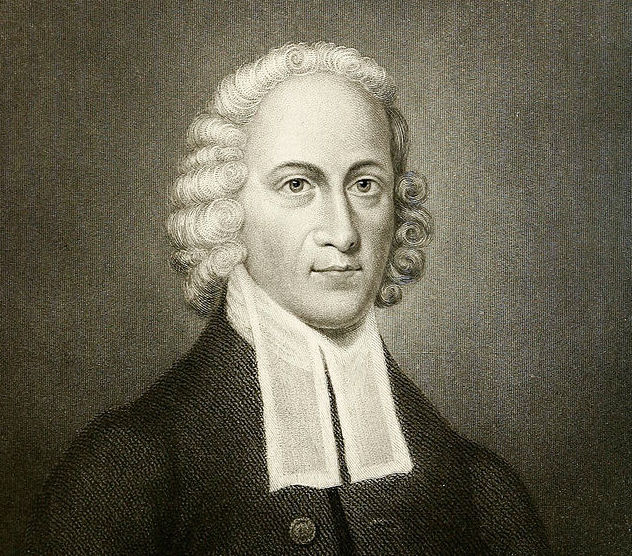
Jonathan Edwards, the great 18th century American theologian and preacher, exists in the popular imagination mainly as a dour purveyor of God’s judgment, famous for his sermon “Sinners in the Hands of an Angry God.” Marilynne Robinson rises to his defense, praising his understanding of sin as “a kind of unawakened experience or perception that is blind to the glory of God and therefore to the glory that pervades being”:

For Edwards, sin was the state everyone was in, in the absence of a conversion experience, which was a kind of religious ecstasy that began with a profound awareness of guilt and a sense of utter dependency on God’s grace. Religion without conversion was almost a kind of Pharisaism, the enactment of faith and virtue without the substance of either. It was, at the same time, where the predisposition to conversion was formed. Edwards meant by his preaching and teaching to lift his hearers into the realm of spiritual light, where they would be capable of true faith, true hope, true love. They would be raised to a heightened esthetic experience, beside which the manifest natural glory of the world would seem a poor thing. Minus the theological frame, the same impulse to apprehend reality through a vision of it that is both higher and truer is present in much American poetry, from Whitman to William Carlos Williams and Wallace Stevens.

Again, for Edwards as for Emerson, this was not contempt for the world but transcendence of a kind that allowed the world and being itself to be seen in its real glory.

Given his very fixed association with hellfire preaching, it is important to remember that it was not particular transgressions that interested Edwards finally, though of course from the pulpit he deplored failures of honesty and charity. Nor was he much concerned with meritorious acts, since these were equally beside the point in the matter of personal salvation. Salvation was for him a revolution of consciousness that opened on an overwhelming sense of the beautiful, the glory of God in all its manifestations. In Edwards’s view, fallenness, the natural state of any human being, as blindness, takes no specific form as behavior and is not to be mitigated by any act of will. But the ontological nearness of humankind to God means that, through grace, perception of the purest, highest and truest kind, itself a kind of ecstasy, can be enjoyed by them, eternally and in this life.

(Image: An 1855 engraving of Edwards, via Wikimedia Commons)

Borges On God

A new collection of radio “dialogues” the late Jorges Luis Borges recorded with the poet and essayist Osvaldo Ferrari in March 1984 have been translated and published as Conversations, Volume 1. Here’s an excerpt from one of them, which details the Argentinian writer’s thoughts about God:

Osvaldo Ferrari: Many people still ask whether Borges believes in God, because at times they feel he does and at times that he doesn’t.

Jorge Luis Borges: If God means something in us that strives for good, yes. If he’s thought of as an individual being, then no, I don’t believe. I believe in an ethical proposition, perhaps not in the universe but in each one of us. And if I could I would add, like Blake, an aesthetic and an intellectual proposition but with reference to individuals again. I’m not sure it would apply to the universe. I remember Tennyson’s line: “Nature red in tooth and claw.” He wrote that because so many people talked about a gentle Nature.

Ferrari: What you have just said confirms my impression that your possible conflict about belief or disbelief in God has to do with the possibility that God may be just or unjust.

Borges: Well, I think that it’s enough to glance at the universe to note that justice certainly does not rule. I recall a line from Almafuerte: “With delicate art, I spread a caress on every reptile, I did not think justice was necessary when pain rules everywhere.” In another line, he says, “All I ask is justice / but better to ask for nothing.” Already to ask for justice is to ask for much, too much.

Ferrari: Yet, you also recognize in the world the existence of happiness—in a library, perhaps, but other kinds of happiness too.

Borges: That, yes, of course. I would say that happiness can be momentary but that it also happens frequently, it can happen, for instance, even in our dialogue.

Keeping The Faith Offline

8eb87783e

Emma Green ponders a new Pew study (pdf) on religion and electronic media that found “only 20 percent [of respondents] said they had ‘shared something about [their] religious faith on social networking websites/apps’ in the past week.” That’s only about half as many who claimed they did so in person:

[The] relationship between on- and offline sharing was roughly the same across Christian denominations and the religiously unaffiliated: Twice as many people talked about their religious beliefs offline vs. online. Perhaps the most interesting thing about this is that there’s hardly any variation among age groups: People younger and older than 50 were nearly equally likely to say they’d talked about their faith on social media within the last week. That’s remarkable for two reasons: In general, younger Americans are less religious than older Americans, and they’re also much heavier users of social media. Across two demographics who think about both faith and the Internet very differently, the mores of talking about God online seem to be similar.

This survey doesn’t say much what those mores are. But it does suggest that people like talking about their religious beliefs face-to-face more than they do online—or, perhaps, they’re more willing.

Cathy Lynn Grossman reminds us, however, that there’s still plenty of God-talk online:

Megachurch pastors have mega-followings online. Joel Osteen of Lakewood Church streams his Houston services online. Rick Warren of Saddleback Church has 1.8 million likes on his Facebook page. And Pope Francis has more than 4.6 million English-language followers, chiefly American, for his @Pontifex Twitter feed.

Not only do religious people find faith online; so do 50 percent of the “nones” — people who claim no denominational identity, from atheists to the vaguely spiritual. … David Silverman of American Atheists, tweeting @MrAtheistPants, has more than 29,000 followers.

A Very Small Penis Club

Alexa Tsoulis-Reay tracked down members of it:

While a precise number is open to scientific debate, it’s commonly accepted that the average size of an adult male penis is five and a quarter inches, erect. Generally speaking, measure in under about three inches erect, and you have what’s called a micropenis — the least common of the conditions falling under the banner of an “inconspicuous penis,” which includes a webbed penis, where it is difficult to decipher exactly where the scrotum ends and the penis begins; or a buried penis, where the shaft of the penis is hidden by skin and fat.

One man she interviewed, “a 51-year-old English teacher from the U.K., gave an in-depth account of his life with a micropenis”:

[Q.] Do you think about your penis size every day?

[A.] I can tell just by the way people walk and the way they look and the way they relate to other people that they have a big penis. You go into a meeting and the guys are swaggering around with their legs akimbo as if they’ve been riding a horse because they’ve got such an enormous package they can’t really walk straight and it’s just crazy. I have got to a point where I am quite amused by it and I’m fascinated by all this sex stereotyping and gender stereotyping. I’ve got strong heterosexual instincts and if I see a woman I feel strongly towards, even if I just glimpse somebody, the next thing I think is, No, don’t! You know what will happen … Well, nothing will happen, but if something did happen, you know how it will end up.  It will be that terrible scene again; it will be that thing with the regrets and the apologies. And there’s nothing worse than that.

After a while, you just accept that you can’t ever do it properly. You can try all the textbook stuff and advice column stuff about positions, but thinking about that kills things. You want it to be more natural and you just start thrusting away and it’s popping out all the time. It just doesn’t stay in because it’s just too small. That’s what it comes down to, I’m afraid.

I’m laughing, not crying, by the way. But I might cry as well.

Live From Bob Dylan’s Basement

This week saw the release of a 6-CD set from Bob Dylan, The Basement Tapes Complete, which features 138 songs that he recorded with members of The Band in the late 1960s, some which have been circulating in bootlegged form for decades, and Dylanologists are rejoicing. Sasha Frere-Jones provides the context for these remarkable, freewheeling sessions – Dylan’s famous 1966 motorcycle accident, which spurred a relatively reclusive period of his career:

There is no official documentation of the accident, and it’s not clear what injuries Dylan incurred, though he said that he suffered a concussion and “busted” some “neck vertebrae.” It is also unclear how many people witnessed the accident—Dylan said that his wife, Sara Lowndes, was behind him, in a car. “It happened one morning, after I’d been up for three days,” he said. He told one interviewer, “I probably would have died, if I had kept on going the way I had been.”

After a short convalescence, Dylan tinkered with a tour documentary he was making, called “Eat the Document.” (It has never been commercially released, but bootleg copies have circulated for years.) In the spring of 1967, he began making music again. He worked in his house and in the basement of a house outside Saugerties, near Woodstock, with his touring band, a mostly Canadian group originally called the Hawks and later renamed The Band. He performed no live dates in 1967, made a single appearance in 1968, and played only three shows in 1969. He removed himself from public view for all of 1970, and then, in 1971, he appeared at the Concert for Bangladesh, a benefit in New York organized by George Harrison. That year, he told Shelton, “Until the accident, I was living music twenty-four hours a day.” In the summer of 1967, he was recording music without living it, or living it differently from before. The recordings he made in Woodstock are a document of Dylan determining where he and his songs and his audience and his country and his past overlapped, or didn’t.

Tom Moon offers advice on how to approach these recordings:

It’s best appreciated not as a collection of songs, but as a kind of audio documentary, a painstaking account of the daily song-chasing that went on for nearly seven months at Dylan’s house and then Big Pink.

It catches Dylan in a fertile writing period, and offers telling glimpses into his process — his use of absurd placeholder words (“You Ain’t Goin’ Nowhere”) and nonsense syllables that would eventually become lyrics in subsequent versions. At the same time, it shows how resourceful his collaborators were as they cobbled together, often on the fly, a rustic and rarified textural landscape that could complement and enhance his images.

By all accounts, very little premeditation was involved: Hudson once noted that they were doing anywhere from seven to 15 songs in a day. Dylan worked constantly on lyrics, banging them out on an Olivetti typewriter sometimes right before tape rolled. He’d bring a page downstairs, and in a matter of minutes, a song would take shape. Not just any song, either: These sessions yielded “I Shall Be Released,” “Tears Of Rage (co-written with Richard Manuel), “Quinn The Eskimo,” “Northern Claim,” “This Wheel’s On Fire” (co-written with Rick Danko) and others.

Clinton Heylin adds:

[T]his banquet really needs to be savoured entire. After all, seeing the stack of reels that sat in a Toronto studio awaiting transfer to digital, one can’t help but be reminded the boys at Big Pink took their time. The Basement Tapes, which for years were seen as the work of a few summer days, turn out to be nine months in the life of a former boy wonder and a family man, at a time when he could still make music in the most idyllic of settings and count his blessings.

Even Dylan allowed himself to wax lyrical about those times when prompted to remember them by a young Wenner: “You know, that’s really the way to do a recording – in a peaceful, relaxed setting, in somebody’s basement, with the windows open and a dog lying on the floor.” No expectations, no commitments. Just for the love of it. Expect to spend a lifetime unravelling the mystery that is Big Pink. Dylan has.

The Best Hangover In Fiction?

A Dish reader flags the above video, in which Boris Johnson nominates Kingsley Amis’ famous account from Lucky Jim. Here’s the passage in question:

Dixon was alive again. Consciousness was upon him before he could get out of the way; not for him the slow, gracious wandering from the halls of sleep, but a summary, forcible ejection. He lay sprawled, too wicked to move, spewed up like a broken spider-crab on the tarry shingle of the morning. The light did him harm, but not as much as looking at things did; he resolved, having done it once, never to move his eyeballs again. A dusty thudding in his head made the scene before him beat like a pulse. His mouth has been used as a latrine by some small creature of the night, and then as its mausoleum. During the night, too, he’d somehow been on a cross-country run and then been expertly beaten up by a secret police. He felt bad.

Do readers have a better suggestion? For those unfamiliar with Amis’s novel, there might be no better introduction than this essay from Hitch, which particularly emphasizes what makes the book so funny:

I happened to be in Sarajevo when Kingsley Amis died, in 1995. I was to have lunch the following day with a very clever but rather solemn Slovenian dissident. She knew that I had known Amis a little, and she expressed the proper condolences as soon as we met. Feeling this to be not quite sufficient, however, she added that the genre of “academic comedy” had enjoyed quite a vogue among Balkan writers. “In our region zere are many such satires. But none I sink so amusing as ze Lucky Jim.”

This, delivered with perfect gravity in the lugubrious context of the Milosevic war, made me grin with inappropriate delight. How the old buzzard would have gagged, with mingled pride and disdain, at the thought of being so appreciated by a load of Continentals—nay, foreigners. And what the hell can his masterpiece be like when rendered into the Serbo-Croat tongue?

Just try to suggest a more hilarious novel from the past half century. Something by Joseph Heller? Terry Southern? David Lodge or Malcolm Bradbury? Yes, the Americans can be grotesque and noir; and the Englishmen have their mite of irony. (In fact, the academic comedy is now a sub-genre of Anglo-Americanism.) But even so. The late Peter de Vries—much admired by Amis for his Mackerel Plaza—depended too much on the farcical. No, the plain fact is that Amis managed in Lucky Jim (1954) to synthesize the comic achievements of Evelyn Waugh and P. G. Wodehouse. Just as a joke is not really a joke if it has to be clarified, I risk immersion in a bog of embarrassment if I overdo this; but if you can picture Bertie or Jeeves being capable of actual malice, and simultaneously imagine Evelyn Waugh forgetting about original sin, you have the combination of innocence and experience that makes this short romp so imperishable.

“What Exactly Is An Unusual Sexual Fantasy?”

Screen Shot 2014-11-05 at 5.12.10 PM

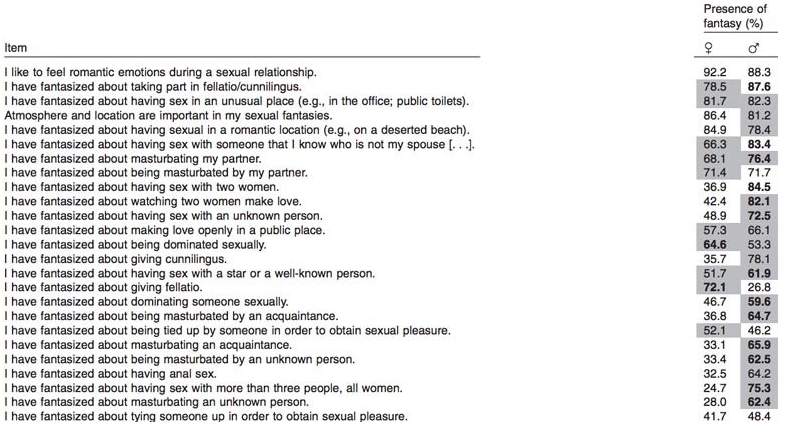
That’s the refreshingly straightforward title of a recent study in the Journal of Sexual Medicine. Andy Cush sums up its findings this way: “The bad news: you’re probably a freak. The good news: everyone else is, too”:

Researchers from University of Montreal presented 799 men and 718 women—85.1 percent of whom identified as heterosexual, 3.6 percent homosexual, and 11.3 percent somewhere in between—with a long list of statements regarding fantasy scenarios, asking them to rate their agreement with each on a scale of one to seven. Anything rated over three was counted as a fantasy.

Some notable trends: women were far more likely to fantasize about sex with strangers or in particular locations, while men were more interested in oral and anal, as well as sex with acquaintances. Men also tended to describe fantasies that weren’t on the list more vividly and expressed more interest in actualizing their fantasies than women.

Jessica Orwig has more:

Interestingly, both sexes were about equal when it came to participating in group sex, although more men reported wanting to have an active versus passive role during group sex. When it came to whom the subjects thought about, men reported fantasizing more about people they were not currently involved with. Of particular interest to the researchers was the high number of fantasies that were mostly unique to men, for example, fantasizing about anal sex and watching their partner have sex with another man. “Evolutionary biological theories cannot explain these fantasies,” researcher [Christian] Joyal said.

Check out the researchers’ full chart of common and rare fantasies here.

What’s In A Title?

F. Scott Fitzgerald almost went with Trimalchio in West Egg; Edward Albee got Who’s Afraid of Virginia Woolf? from bathroom graffiti in a Greenwich village bar. In a piece for The Millions, Chloe Benjamin talks to five authors about how they came to name their novels. Among them is Matthew Thomas, who found the title for his book We Are Not Ourselves in the pages of King Lear:

While re-reading Lear in preparation to teach it, I came to the line in Act 4, Scene 2, where Lear is wondering why Cornwall won’t appear, even though he’s been ordered to. To explain away the offense to his ego, Lear says, “Infirmity doth still neglect all office/Whereto our health is bound”—i.e., sickness prevents us from doing the duties we’re required to do when healthy. The next line elaborates on this theme: “We are not ourselves/when nature, being oppressed, commands the mind/to suffer with the body.” Lear justifies Cornwall’s flouting of his authority by appealing to the universal experience of being beholden to our bodies: when the body isn’t working, the mind doesn’t work perfectly either. I found rich resonance in the idea of locating both the mind and the body in Lear’s formulation in the brain, so that the body that isn’t working is the mind, in fact — and then positing the mind in Lear’s formulation as what we think of as the spirit, the soul, the personality. When the brain isn’t working at its optimal best — when there’s an obstruction of function through illness, or a fixation or obsession that springs from traumatic early childhood experiences — the animating spirit of the person, what we think of as personality, is impaired as well.

The phrase struck me immediately as being at the heart of my concerns in the book.

We Are Not Ourselves suggests characters who are not at their best, who by dint of circumstances are not allowed to be themselves. It also suggests that we’re always learning and evolving, that we’re works-in-progress. We are not ourselves yet, in a sense; there’s hope in that. In a different vein, we are not reducible to whom we appear to be in our biographies. We contain multitudes in our rich internal lives that our lived lives don’t reveal. Another resonance for me is that we need each other to experience the full flowering of our humanity and our greatest happiness. We are not only ourselves; we are not islands unto ourselves. I liked that the phrase opened up fields of interpretation that would extend beyond the more circumscribed concerns of my original title, so I grabbed it and didn’t look back. As soon as I knew it was the title, it was as if it had been the title all along.