MLK’s “Other America”

King delivers a speech, “The Other America,” before an audience at Stanford University on April 14, 1967:

Eugene Robinson looks back at how King, in the final weeks of his life, increasingly turned his focus to Americans plagued by poverty – “the other America”:

King explained the shift in his focus: “Now our struggle is for genuine equality, which means economic equality. For we know that it isn’t enough to integrate lunch counters. What does it profit a man to be able to eat at an integrated lunch counter if he doesn’t earn enough money to buy a hamburger and a cup of coffee?”

Robinson continues:

[W]hat King saw in 1968 — and what we all should recognize today — is that it is useless to try to address race without also taking on the larger issue of inequality. He was planning a poor people’s march on Washington that would include not only African-Americans but also Latinos, Native Americans and poor Appalachian whites. He envisioned a rainbow of the dispossessed, assembled to demand not just an end to discrimination but a change in the way the economy doles out its spoils.

King did not live to lead that demonstration, which ended up becoming the “Resurrection City” tent encampment on the National Mall. Protesters never won passage of the “economic bill of rights” they had sought.

Today, our society is much more affluent overall — and much more unequal. Since King’s death, the share of total U.S. income earned by the top 1 percent has more than doubled. Studies indicate there is less economic mobility in the United States than in most other developed countries. The American dream is in danger of becoming a distant memory. … Paying homage to King as one of our nation’s greatest leaders means remembering not just his soaring oratory about racial justice but his pointed words about economic justice as well. Inequality, he told us, threatens the well-being of the nation. Extending a hand to those in need makes us stronger.

Max Ehrenfreud, citing Robinson’s article, remarks that “persistent economic inequality has arguably undermined some of the most important achievements of the civil rights movement”:

Legally, our schools are integrated, but in practice, research suggests they’re becoming more segregated. White and black children in kindergarten and younger are much more likely to be separated from each other than whites and blacks in the population at large, which is largely because black families still can’t afford to live in the neighborhoods with the best schools, as Emily Badger has explained. And while segregation between neighborhoods has been steadily decreasing, there are still many places like Ferguson, Mo. where the economic ramifications of decades of racially biased business practices and government policies keep low-income blacks from finding a way out.

It’s often said on Martin Luther King Day that the civil rights movement still has unfinished business, but somehow, the events of the past year seem to have made that fact especially clear.

Read the text of the speech above here.

Why Orwell Still Matters

Charles Paul Freund traces the reputation and influence of George Orwell’s 1984, noting the way it’s been rediscovered by the Left after Communism’s decline:

No Stalin, no USSR, no Cold War. The technology of surveillance, suppression, and control is wholly different from what the book imagines. Even the book’s George-orwell-BBC eponymous year has long since become a matter of literal and figurative nostalgia. Yet the book retains its power, if indeed its power has not grown as its contemporary concerns have faded. The more immediate the state’s threat to readers and their vulnerable technology, perhaps the more compelling Orwell’s message.

In his 2002’s Why Orwell Matters, the late Christopher Hitchens presented a string of examples from leftist British thinkers of “the sheer ill will and bad faith and intellectual confusion that appear to ignite spontaneously when Orwell’s name is mentioned.” But most left-leaning readers have “reclaimed” Orwell—a committed socialist—and long ago learned to love re-imagining Big Brother in terms of Margaret Thatcher, George W. Bush, Dick Cheney, and similar figures. (Of course, it’s not only left-leaning readers who do so.)

Certainly, the reaction from readers within tyrannies has never changed. In the early 1950s, the Polish writer Czeslaw Milosz described how Communist Party members throughout Eastern Europe became fascinated by 1984, which they could only acquire surreptitiously. “Even those who know Orwell only by hearsay,” he wrote in The Captive Mind, “are amazed that a writer who never lived in Russia should have so keen a perception into its life.”

Maajid Nawaz, however, claims a different Orwell novel – Animal Farm – led him away from radical Islam:

It was while in prison, surrounded by several prominent jihadist leaders, that Nawaz realized he wanted to take a different path. He was reading George Orwell’s Animal Farm and came to a new understanding of “what happens when somebody tries to create a utopia.”

“I began to join the dots and think, ‘My god, if these guys that I’m here with ever came to power, they would be the Islamist equivalent of Animal Farm,” Nawaz says. He says he began to see that it’s “impossible to create a utopia.”

“I’m living up close and seeing [the radicals’] everyday habits and lifestyle, I thought, ‘My god, I wouldn’t trust these guys in power,’ because when I called it, back then, and said, ‘If this caliphate, this theocratic caliphate, was ever established, it would be a nightmare on earth,'” Nawaz says.

(Image of Orwell in 1941 via Wikimedia Commons)

What’s In A Black Name? Ctd

Claude S. Fischer reflects on research on racial discrimination and hiring practices, noting a recent study that found “applications with typically white names were notably likelier to get responses [from employers] than those with typically black ones.” He considers a recent study by sociologist S. Michael Gaddis that “explicitly looks at whether racial discrimination is mitigated when job candidates clearly have sterling credentials. The answer is no”:

Gaddis targeted online job listings, analyzing employer responses to about 1800 realistic job applications that he e-mailed. For example, Gaddis used actual home addresses. He systematically varied several candidate attributes. One was race, indicated by first names that tend to be more common among blacks versus whites—e.g., Lamar v. Charlie; Nia v. Aubrey. The key innovation he introduced was the prestige of the college that the applicant had presumably graduated from (with honors)—Harvard v. U. Mass., Amherst; Stanford v. the University of California, Riverside; and Duke v. UNC, Greensboro.

“Applicants” from the elite colleges received an answer 1.7 times more often than those from less elite colleges (15 percent versus 9 percent). White-named “applicants” received an answer 1.5 times as often as black-named ones (15 percent versus 10 percent). The results suggest that having a typically white rather than a typically black name is worth about as much as graduating from an elite rather than a good college. Importantly, the racial factor is probably underestimated, given that employers have to read those names as racially distinctive for them to matter, a reading which is not as obvious as college prestige. Even among the elite-college “applicants,” race made a substantial difference. Looked at another way, black-named “applicants” from elite colleges were about as likely to get a follow-up as white-named “applicants” from non-elite colleges.

Previous Dish on attitudes toward black names here.

Not So Much At Home On The Range

Jonathon Sturgeon, praising Ben Metcalf’s Against The Country as “one of the more necessary — and most eloquent — expressions of a distinctly American, provincial rage in some years,” names the book the “first good novel of 2015”:

Ben Metcalf’s Against the Country is a strange, essayistic, and autofictional novel that reads like a series of grievances against family, state, soil, dog, snake, chicken, corn, trash heap, school bus, and, well, nearly every thinkable trapping of life in rural America. The book is nothing short of an encyclopedia of American provincial rage in all its irrepressible hideousness. This makes it a thing of beauty.

Metcalf, who was once the literary editor at Harper’s, cultivates an archaic, idiom-damaged style that meshes two regionalisms: the clarity of Midwestern sentences (he was born in Illinois) and the unabashedly cadence-drunk prose of the American South. This makes sense, given that the book’s target is Virginia, and, more specifically, Goochland, the hilarious but honest-to-God actual name for a town where Thomas Jefferson went to school and where the author was raised.

Jason Sheehan also has rapturous praise for the novel, calling it “a book that is like a test-to-failure experiment on modern literature as a whole”:

Against the Country is a supremely challenging book — eschewing plot or, you know, anything in the goddamn world happening, and not made for relaxing with but, rather, for obsession. I read it sometimes out of ecstasy at Metcalf’s virtuoso sprays of words, working his keyboard like Horowitz at the piano (and sometimes, oftentimes, more like Errol Garner playing stride), and sometimes out of rage at its author for being so clever and persnickety and in love with the sound of his own voice and trickeries.

But regardless, it is absolutely and completely worth all investment of time and effort, because it is an undeniably beautiful object, sharp as a new razor, its wandering and deliberate plotlessness, by the end of things, congealing into something better: a story.


Bronwen Dickey also praises the novel, but remarks that “there comes a point when virtuosity, even at its most entertaining, simply isn’t enough”:

Unmoored from larger themes, the once-amusing winks and nudges start to grate, the footnoted asides nested within other asides become exhausting, and you just get tired of being grabbed by the lapels so forcefully and so often. Even the most devout admirer can begin to feel, after too many pages of plotless pétit allegro, stuck in some as-yet-undiscovered circle of hell with Yngwie Malmsteen or Joe Satriani: The good news is that every note in every solo is sounded with exquisite perfection. The bad news is that every note is part of a solo.

In Against the Country, that point of derailment happens in Book 5, almost 200 pages in, when the narrator abandons his social critique and focuses on his abusive father, devoting several incomprehensible chapters to the man’s middling appraisal of Salinger. … That abrupt shift wouldn’t have been so disappointing had the rest of the book not been so promising and so ferociously original, and had it not been written with such obvious, even obsessive, care. It’s possible that the final chapters are, in a nimble-smarty way that is most definitely beyond my patience, part of a prank that only Metcalf and a small clique of eccentric geniuses are in on (“Better to hate at the end of a book, I say, than to love,” Metcalf tells us at novel’s conclusion), or that fans of ultra-trippy metafiction will see these sections as a triumphant rebuke of the reader’s expectations. Oh, you want an ending? I’m sorry. Have some oddball vignettes about family dogs instead.

Adam Rosen offers a mixed review:

Life is different, we learn, in “town,” the narrator’s term for those places with a population density to rival Mayberry. Town is consistently deployed without an article or any identifiable referent, as much a state of mind as a physical location. Its civilizing nature, however, saps its power to haunt. Town may be a refuge from horror, but it is also boring. It was the country that gave us Thomas Jefferson, and corn, and the Carter Family, as the book reminds us.

At least, I think so. Themes are in here, buried beneath the thickets of prose, but Lord if you don’t have to work to find them. Against the Country presents a challenge many may relish. It offers a strange, imaginative take on our national mythology. Still, the story takes so much effort to comprehend that exhaustion sets in long before its merits can be appreciated. What we’re left with is a sense of heavy atmosphere, a vague feeling that all is far from well.

Signs Of The (End) Times

5966932327_b4c1a4db38_b

Samantha Allen notices that “in the South, rural billboards have become a bizarre battleground for tired culture wars” and that the region “is where the irrepressible subconscious of white America waves to you from the side of the road”:

But why does it manifest itself in the form of billboards, flags, and crosses? And why is the roadside such prime real estate for incendiary rhetoric in the first place? Billboards remain relatively effective forms of commercial advertising in cities with a large commuter presence but billboards with social messages are not advertising a product, nor are they typically placed in urban areas where ad space would be more expensive. Driving past a loud billboard in the middle of nowhere feels a little bit like watching someone shout impotently into the void. As for flags and crosses, well, they’re just sort of there, aren’t they? What is anyone who rents a cheap billboard or who snatches up land on an access road hoping to accomplish?

The driving factor behind these ads, flags, and attractions seems to be the simple urge to be seen. The Southern Party of Georgia, for example, brags that the Confederate flag outside Tifton is “highly visible to traffic from both directions.” The Sons of Confederate Veterans similarly note that the flag has been “strategically placed” so that it can “be easily seen by the millions who travel Georgia’s main interstate back and forth to Florida.” Cross Ministries, the church affiliated with the Texas cross, claims that “10 million people pass by [the cross] every year” and that it “can be seen from 20 miles away.” The farmer and welder who bought the land for the Confederate flag outside of Tampa was looking for a “high-profile site” that he could still afford. But these roadside sights are nothing more than last-gasp bids for cultural relevance in a world that is, quite literally, passing them by. The people who buy them are playing a no-stakes game of “made you look” with a dogmatic twist.

(Photo by Flickr user me and sysop)

How We Got Modern Political Parties

Lyndon_Johnson_and_Richard_Russell

Reviewing Julian E. Zelizer’s The Fierce Urgency of Now, an account of Lyndon Johnson and the Great Society, Sam Tanenhaus traces our ideologically-sorted political parties to a 1950 report by the American Political Science Association, “Toward a More Responsible Two-Party System”:

This report grew out of a project supervised by E. E. Schattschneider, a professor at Wesleyan and a leading exponent of Wilsonian party government. A political party that “does not capitalize on its successes by mobilizing the whole power of the government is a monstrosity reflecting the stupidity of professional politicians who are more interested in the petty spoils of office than they are in the control of the richest and most powerful government in the world,” Schattschneider had written.

This argument became the overriding theme of the 1950 report. Schattschneider’s team of fifteen scholars and policy experts had talked to congressional leaders, to officials in the Truman Administration, and to state and local politicians. It concluded that the two major parties were “probably the most archaic institutions in the United States”—scarcely more than “loose associations of state and local organizations, with very little national machinery and very little national cohesion.”

The Republican or Democrat sent to Congress was seldom screened by the national party and so felt no obligation to support the party’s program, if he even knew what it was. Once in office, he delivered patronage and pork to his constituents back home. He operated free of a coherent agenda and belonged to no “binding” caucus. The parties, in other words, were failing because they weren’t sufficiently ideological, partisan, and polarizing.

The solution was a “responsible party system”—centralized, idea-driven, serious-minded. Each party needed stronger central “councils” that met regularly, not just in Convention years, to establish principles and programs. Candidates should be expected to campaign on these platforms and then to carry them out, with dissidents punished or expelled. The party in power would enact its program, and the minority party would provide strong criticism and develop alternatives to present at election time.

(Image: President Johnson endeavors to give “The Treatment” to Senator Richard Russell in 1963, via Wikimedia Commons)

The Christian Case For Fighting Climate Change

Francis wants to make it with a new encyclical:

Its message will be spread to congregations around the world by Catholic clergy, mobilising grassroots pressure for action ahead of the key UN climate summit in December in Paris. The encyclical may be published as early as March, and may be couched in terms of the biblical parable of the Good Samaritan, which teaches that we have responsibilities to our fellow humans.

It will be the first encyclical to address concerns about a global environmental issue, and will provide “important orientation” to all Catholics to support action on climate change, says Bishop Marcelo Sánchez Sorondo, chancellor of the Pontifical Academy of Sciences and Social Sciences in Vatican City. Last May, he organised a workshop there discussing the science and impact of climate change. Participants issued a hard-hitting statement, which laid the groundwork and set the tone for the encyclical.

The most likely thrust of the pope’s appeal will be that failure to combat climate change will condemn the world’s poorest people to disproportionate harm. “The sad part is that the poorest three billion will be the worst affected by the impacts of climate change, such as sea level rise and drought, but have had least to do with causing it,” says Veerabhadran Ramanathan, a climatologist at the Scripps Institution of Oceanography in San Diego, California, and a scientific adviser to the Vatican on the encyclical.

Thursday, when asked if he thought mankind was mostly to blame for global warming, the Pope responded:

“I don’t know if it is all (man’s fault) but the majority is, for the most part, it is man who continuously slaps down nature,” he said. The words were his clearest to date on climate change, which has sparked worldwide debate and even divided conservative and liberal Catholics, particularly in the United States. “We have, in a sense, lorded it over nature, over Sister Earth, over Mother Earth … I think man has gone too far.”

When the encyclical was originally previewed late last month, Catholic Climate Covenant’s Dan Misleh put the move in context:

“It is the first time ever an encyclical letter has been written just on the environment,” Misleh said. “The faithful, including bishops, and all of us who adhere to the Catholic faith, are supposed to read it and examine our own consciences.”

Mobilizing believers to embrace climate action could be a very big deal, given the sheer number of people who identify as Catholic in the US—around 75 million—he said. “If we had just a fraction of those acting on climate change, it would be bigger than the networks of some of the biggest environmental groups in the US,” he said. “That could help change the way we live our lives, and impact our views on public policy.”

Plumer has more:

For what it’s worth, surveys in the US have found that white Catholics tend to be among the least concerned groups about climate change, whereas Hispanic Catholics are some of the most concerned. Here’s a PRRI poll from November 2014:
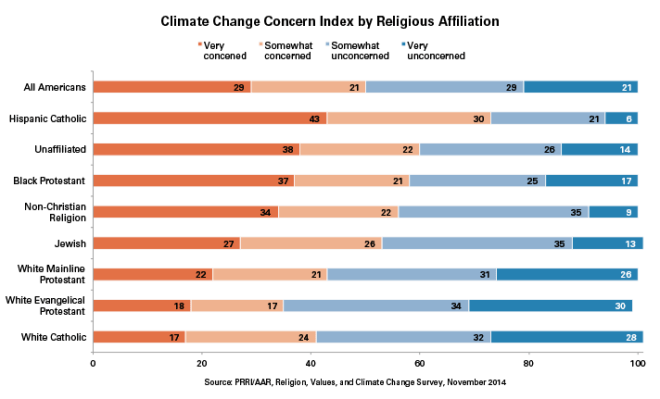
Figure3.0

But, of course, Catholics don’t just automatically follow the pope’s lead on every last political question. (Gay marriage is a perfect example.)

And of course with the Pope’s high approval rating around the world, he might also be able to influence Evangelicals, who, as Chris Mooney noted last month, are already moving toward more environmental action:

The biblically based stewardship or “Creation Care” message — which went very, very mainstream [last] year in the blockbuster film Noah — may not have won out with a majority of these believers. But it appears to have made substantial inroads. And evangelicals leaders like the climate scientist Katharine Hayhoe are working every day to convince more believers, by making theologically (and politically) resonant arguments for why they need to take climate science seriously.

He’s cautiously optimistic:

There’s no doubt that many religious people around the world cling to their beliefs (or, to what they think their beliefs require) in the face of evidence, and history shows science-religion conflicts popping up at regular intervals. But it also shows something else: Believers who find a way to reconcile faith and science.

If Pope Francis continues on his current course, he has the power to make this latter group a whole lot more prominent than it already is.

But seeking more than just rhetoric, Leber challenges Francis to pony up the Vatican’s fossil fuel investments as well:

There are two main arguments for divestment from fossil fuels, on moral and financial grounds. The former is that we have responsibility not to aid companies that imperil the planetGod’s creation, according to Catholicsespecially when it particularly impacts the poor. And while some financial experts claim divestment is impossible to detangle fossil fuels from a portfolio and retain balanced, stable growth, others argue that in a low-carbon world, fossil fuel stocks become worthless, risking ruin for those who retain too much faith in oil, gas, and coal. The head of England’s central bank, for instance, has already warned investors that their focus on short-term profits in the fossil fuel market may be foolish in the long-term. (Rolling Stone’s Tim Dickinson has a worthwhile read on the economics of divestment.)

One can see how the Vatican, which has an estimated $8 billion portfolio, could make wavessymbolically and financiallyif it were to divest from fossil fuels. Environmental group 350.org is pushing the Church to do exactly that, and claimed Wednesday that hundreds of protesters attended a divestment vigil just before Francis arrived in Manila. Now it’s time for the Pope to put his words into action. What better way to show the world that 2015 is the year for global climate action than to lead by example?

Regardless, the editors of New Scientist are nonetheless pleased to have the Vatican as an ally:

For all the railing of secularists against the idea that the church has any special claim over morality, and despite its influence being [on the wane], many people heed religious authority more readily than any scientific or economic argument. And the pope’s case is one that leaders of rich, carbon-intensive nations are reluctant to put forward: that they owe it to the world’s poor to cut emissions.

Not every churchgoer will be swayed. Evangelicals are among the staunchest of climate sceptics; even those who accept the reality often view it as God’s will. It remains to be seen if the pope can appeal to these recalcitrants – or if the jeering of denialists will take on a theological, rather than scientific, tone (to which we can only say: god help us).

It was 350 years before a pope admitted that the church had wronged Galileo, whose reputed parting shot was to say of the Earth: “eppur si muove”– “and yet it moves”. In contrast, it has taken the Vatican hardly any time to accept that Earth is warming. It helps that the Bible contains precious few verses pertinent to carbon emissions. Perhaps we will start to see evidence reshaping the Vatican’s views on other issues where scripture still holds sway: the role of contraception in tackling population growth, say. One can only pray it will.

A God Of Liberation

John Schad profiles the literary critic Terry Eagleton, noting the way his Catholic upbringing mingles with his radical politics:

There was a time, mainly in the 1980s, when Catholicism was all but invisible in Eagleton’s writing. For some time now, it has been very evident; nevertheless, to date, Christianity has seemed to be primarily a language for Eagleton’s Marxism, or communism, with the crucifixion being a way of unearthing what Eagleton seemed to think of as a tragic vision otherwise buried within communism. However, what I am hearing now, as he speaks, is not so much communism-via-Christianity but rather communism-and-Christianity, a genuinely double act.

Is Eagleton, then, back where he was 50 years ago when he would often refer to himself as a Christian? I am tempted to ask this rather dumb, card-carrying question but resist. I do, though, summon the stupidity to ask the “afterlife” question, the heaven question. Given that he makes so much of the crucifixion, what, I ask, should we make of the biblical account of resurrection? What, if anything, is its significance and does that in any sense include an afterlife? “No,” he says, “the after-life is not a Judaeo-Christian belief. As Wittgenstein says somewhere, ‘How strange that people believe that when you die eternity starts.’ The Christian belief is in an eternity that is here and now.” “But,” I ask, “is eternity limited to here and now?” To which he replies that “eternity does not mean we will live on and on – that would be hell”.

In a recent review of Eagleton’s latest book, Culture and the Death of God, Eugene McCarraher also emphasizes the theological views that undergird his politics:

The itinerant and crucified Jesus, not his Dad, is the apotheosis of Eagleton’s political theology. To the curer of leprosy and blindness, pain and disease are “unacceptable”; misery and despair are not “enviable opportunities to flex one’s moral muscles.” Jesus mends without compensation or moral inquiry; he never tells the afflicted to learn the edifying lessons the Almighty is teaching them, however inscrutably. If there must be suffering, it comes as the price of personal and collective transfiguration; our condition is so awry that the only way out is through a turbulent journey of self-dispossession. As Eagleton explains, the Christian life as portrayed in the Gospels is not that of the pious, hard-working, familial accumulator dear to the conceits of suburban believers. It is rather “homeless, propertyless, peripatetic, celibate, socially marginal, disdainful of kinsfolk, averse to material possessions … a thorn in the side of the Establishment and a scourge of the rich and powerful.” In the life and death of Jesus—resurrection goes unmentioned—Eagleton discovers the most stringent and fundamental rebuke to capitalism, as well as the point of departure for any future revolutionary politics. It is in that crucible of downward mobility that “a new configuration of faith, culture, and politics might be born.” This is unvarnished liberation theology, and here Eagleton returns to the prophetic Marxism that animated his earlier career.

Broad Humor

Lenika Cruz praises the second season of Broad City, which premiered this week:

[T]he show isn’t getting complacent, subject-wise: The first few episodes weave rape, sexual experimentation, discrimination, death, and socioeconomic privilege into their storylines, but avoid shoehorning commentary or moralizing. [Show creators and co-stars Ilana] Glazer and [Abbi] Jacobson proved in the first season that they could pull off outrageous without being tone-deaf or relying on stunt scenes—an admirable achievement for a show that centers on two self-absorbed female millennials. Sweet (flatulent) Abbi is often passive and self-doubting, given to bursts of energy and gall at the urging of Ilana, who is equal parts bullshittery and sincerity, and whose deep ignorance and irony are only sometimes redeemed by her sensitivity and good intentions.

In a profile of the two comedians, Rachel Syme appreciates that “as broad and slapstick as the comedy on the show can be, Glazer and Jacobson ultimately traffic in precision; their jokes could not be anyone else’s jokes.” She notes that “sex is a big part” of the series:

They both seek it, desire it, and talk about it constantly (in one episode, Ilana tells Abbi her detailed fantasy for a sexual position featuring them both, called the “Arc de Triomphe”). They treat sex with no judgment or sneers; Abbi and Ilana’s carnal victories are always shared. In the new season, when Abbi decides to “peg” one of her hookups with a neon-green dildo, she immediately calls Ilana (who happens to be at her grandmother’s shiva). Ilana screams, “This is the happiest day of my life!” What’s funny about the sex on Broad City is not that women are openly having it (we have Sex and the City to thank for that, as well as just about every cable show that has followed), but that when Abbi and Ilana do it, things tend to go horribly wrong. In the case of the strap-on triumph, Abbi quickly finds a way to melt the apparatus in the dishwasher and must embark on a Chaucerian quest to find a new one before the clock runs out.

Stephanie Boland compares the show to Girls:

While Girls – a frequent point of comparison – is known for its characters’ awkwardness, the cast of Broad City are framed as likeable even, or perhaps especially, when their behaviour is questionable. The shame which is one of the central emotions of Girls is almost entirely missing here. Broad City’s surrealism lets its creators play disgust for laughs while also revelling in its truth. At one moment, the girls accidentally get a sixteen-year-old high school student stoned; another scene shows Abbi using a blow-dryer on her genitals before the aforementioned heat wave sex. At no point, however, does our revulsion transmute into dislike for the protagonists – and rarely do they suffer consequences.

This is the central contradiction at the heart of the showUnlike Dunham’s wonderfully unlikable Hannah Hovarth, Broad City demands we find its women charming while they do terrible things. When Hannah quotes Missy Elliot during her break up with Donald Glover’s character Sandy, he is rightly horrified. By way of contrast, the intern Ilana pictures singing slave spirituals still seems happy enough at the end of the skit. The difference is partly one of absurdity, but also one of politics. Drugs, sex, and troubling attitudes to race and gender are part of the texture of city life, and Broad City suggests to sanitise would be remiss. It’s a winning feature for the show’s young demographic, and the programme has already been renewed for a third season.

Meanwhile, Nate Jones looks back at the web series that inspired the Comedy Central series. He highlights “VChat,” the episode above, as especially worth revisiting:

There’s one thing about friendship that the web-cam segments of Broad City get at so well: the feeling that life is just one long conversation punctuated briefly by the interruption of outsiders. “VChat” is the first of these—the format would later turn into a spinoff series, Hack Into Broad City—and it sees Ilana advising Abbi on a potential hookup. Their interactions are gold; you get the sense that the actual things that happen to the two of them are secondary to the experience of talking to each other about it.

Defining Deviancy Up

Adam Gopnik looks back at the work of the iconoclastic sociologist Howard S. Becker – who also spent many nights in clubs and strip joints as a jazz musician. Those two aspects of his life came together in his famous 1953 paper in the American Journal of Sociology, “Becoming a Marihuana User”:

Becker insists that his accomplishment in the paper was no more than the elimination of a single needless syllable: “Instead of talking about drug abuse, I talked about drug use.” “Deviance” had long been a preoccupation of sociology and its mother field, anthropology. Most “deviance theory” took it for granted that if you did weird things you were a weird person. Normal people made rules—we’ll crap over here, worship over here, have sex like so—which a few deviants in every society couldn’t keep. They clung together in small bands of misbehavior.

Becker’s work set out to show that out-groups weren’t made up of people who couldn’t keep the rules; they were made up of people who kept other kinds of rules. Marijuana smoking, too, was a set of crips, a learned activity and a social game. At a time when the general assumption was that drug use was private and compulsive, Becker argued that you had to learn how to get high.

Smoking weed, he showed, was most often strange or unpleasant at first. One of his informants (a fellow band member) reported, “I walked around the room, walking around the room trying to get off, you know; it just scared me at first, you know. I wasn’t used to that kind of feeling.” Another musician explained, “You have to just talk them out of being afraid. Keep talking to them, reassuring, telling them it’s all right. And come on with your own story, you know: ‘The same thing happened to me. You’ll get to like that after a while.’ ” In the sociologese that Becker had not yet entirely discarded, he wrote, “Given these typically frightening and unpleasant first experiences, the beginner will not continue use unless he learns to redefine the sensations as pleasurable.” He went on, “This redefinition occurs, typically, in interaction with more experienced users, who, in a number of ways, teach the novice to find pleasure in this experience, which is at first so frightening.” What looked like a deviant act by an escape-seeking individual was simply a communal practice shaped by a common enterprise: it takes a strip club to smoke a reefer.