The Immigration Battle Begins

Yesterday, I urged the president to hold off on amnesty by executive order. In his first post-election press conference, John Boehner warned Obama against “playing with matches” and “poisoning the well” with the incoming Congress by pursuing unilateral action on immigration reform, stressing that there would no chance of reform legislation passing both Republican-majority houses if the president went ahead. Russell Berman gauges the seriousness of that threat:

It’s a lot of sound and fury, but it probably won’t change the mind of a president who has been waiting for House Republicans to act on immigration reform for nearly two years. Boehner can’t do any less on the issue than he’s already done, and few in Washington gave much chance to an overhaul passing under Republican rule in 2015 anyway. …

Perhaps a more legitimate worry for the president is that beyond killing the slim-to-none prospects for congressional action on immigration, he would extinguish the hopes for bipartisan cooperation with the new Republican Congress on other issues. Well, those are limited to begin with, and as McConnell made clear with his remarks on Wednesday, Republicans need to get legislation signed by the president to advance their political interests, not his.

I don’t buy this. Portraying the president as a lawless illegal-lover is also in their political interests. Waldman argues:

I’ll bet that John Boehner would like nothing better than to have Barack Obama issue some executive orders on immigration. Then he’d have an easy answer every time someone asked when he was going to allow a vote on a comprehensive immigration package. What can I do? Obama poisoned the well. It’s not my responsibility anymore.

Peter Weber wants Obama to call Boehner’s bluff:

Boehner and his fellow GOP leaders aren’t just threatening to withhold something they can’t deliver anyway — they are threatening to withhold something they still need. Latinos are angry that Obama threw them under the bus by not acting before the election, but they still gave Democrats 62 percent of their votes (in a terrible year for Democrats). As Obama told Boehner in their discussions, “There will never be another Republican president again if you don’t get a handle on immigration reform.”

Republicans, traditionally in favor of a robust executive branch, may be hoping that Obama falls into a trap, enacting unpopular immigration measures and bolstering their assertion that he’s an imperial president. Maybe the second part will stick, but voters are with Obama on this issue. Even among the Democrat-slaying electorate that showed up on Tuesday, 57 percent favored giving illegal immigrants a path toward legal status.

Randal O’Toole advises the GOP to give up this fight:

Considering that Latinos are one of the nation’s fastest-growing demographics, and that they regard a war on illegal immigration to be a war on their families, Republicans should reverse course. The economic truth is that immigrants have always added more to our economy than they take away, and by achieving the American dream for themselves, they create demand for more work for people who already live here.

Worries that immigrants will abuse our welfare system are just symptoms that the welfare system should be reformed, for if it gives immigrants bad incentives, it must also give American citizens bad incentives. Reversing course on immigration is not just the economically correct thing to do, it is also politically strategic because it will allow Republicans to regain the support of Latinos, many of whom hold conservative beliefs and should feel right at home in a Republican Party that doesn’t treat them as enemies of the state.

But Jonathan Tobin suspects the executive order will backfire, as I do:

[F]or the president to now defy both public opinion and the will of Congress by acting on his own will do more than embitter his Republican antagonists. Though it will mollify one part of his coalition, rather than putting the issue to bed this end run around the law will create even more anger in the political grass roots around the country that will ensure that this issue will still be red hot in 2016. As they should have learned this year, it takes more than an energized base of minorities to win elections. Amnesty for the current crop of illegals will bring us more border surges and more damage to the rule of law. Obama may be content with that being part of his legacy, but it will be his fellow Democrats who will still be stuck trying to explain a move that can’t be defended when they go back to the voters in the future.

Greg Sargent gears up for what he expects to be a long and nasty rumble:

If this reaches such incendiary levels, how far will GOP leaders feel compelled to go in fighting it? McConnell is already pledging that “there is no possibility of a government shutdown.” But if there is any area where conservatives will continue to demand maximum confrontation, you’d think it’s here. If so, they will demand a Total War posture against Obama’s efforts to defer the deportations of millions. Democrats should be ready for this. It could very well be a huge battle. And by the way, the politics of it won’t be easy. While majorities favor legislative legalization, it’s not clear how the public will react to executive action on immigration.  I would not be surprised if the broader public disapproves of it.

Me neither.

The Greatest Threat To Obamacare

Yesterday, Stuart Butler doubted that “a Republican Senate, in tandem with the House, will rip out the vital organs of the ACA”:

[T]hat’s an unlikely scenario, mainly because these organs aren’t so vital anymore. For one thing, the Administration recognizes that the mandates will likely have to be watered down to maintain much public support. But as individuals and businesses adapt to the law, and more Americans obtain often-subsidized insurance, the mandate stick is less necessary to achieve enough coverage for the ACA to be viable. Meanwhile expect worried insurers to pressure the GOP enough to prevent adjustments to the risk corridors from causing a collapse.

A lethal blow is unlikely to come from the Republican Congress. Rather a more likely threat is from the Supreme Court’s Halbig case. If the Court does strike down federal insurance subsidies in states with federal rather than state-run exchanges, that would be quite a body blow. At the very least it would eliminate a central plank of the ACA in over 30 states.

That threat to Obamacare just became reality. Earlier today, SCOTUS announced that it will hear a case challenging Obamacare’s subsidies:

The case, King v. Burwell, contests the financial help available to some enrollees on the federal insurance exchanges in 36 states. It makes a similar argument as a better-known case, Halbig v. Burwell. Without subsidies, health reform starts to fall apart.

Lyle Denniston explains what’s at stake:

Since the health care exchanges have been in operation, nearly five million individuals have received federal subsidies to help them afford health insurance on an exchange run by the federal government. The fate of those subsidies apparently will now depend upon how the Court interprets four words in the Affordable Care Act.   In setting up the subsidy scheme, Congress said it would apply to exchanges “established by the State.”

The challengers to subsidies for those who shop for insurance on a federal exchanges have argued that those words limit the availability to the tax benefits solely to state-run exchanges.  That argument failed in the U.S. Court of Appeals for the Fourth Circuit, in the ruling now under review.  It was accepted in the U.S. Court of Appeals for the District of Columbia Circuit, but that ruling has now been set aside while the full D.C. Circuit reconsiders the issue.

Allahpundit is shocked:

The big mystery: Which four justices voted to grant cert? There’s no way to know since the Court doesn’t release that information so we have to guess. It stands to reason that it wasn’t any of the Court’s liberals: With the D.C. Circuit set to overrule the three-judge panel, why would they tempt fate by voting to give the Supremes’ five conservatives a chance to wreck ObamaCare? It had to be four justices from the conservative wing. And I agree with Benjy Sarlin: It seems highly unlikely that John Roberts, having taken withering fire from the right in finding the mandate constitutional two years ago before O-Care launched, would now turn around and nuke the law a year after implementation based on a dispute over statutory construction, with millions of people’s coverage hanging in the balance. Roberts probably wanted no part of this. So odds are it was Scalia, Thomas, Alito, and Kennedy(!) who pulled the trigger, and now Roberts is in the hot seat again. Will he double down by saving ObamaCare a second time? Or will he effectively destroy the law by ruling the subsidies for federal consumers are illegal?

Nicholas Bagley reads tea leaves:

None of this bodes well for the government. That’s not to say the government can’t win. It might. As I’ve said many times, the statutory arguments cut in its favor. But the Court’s decision to grant King substantially increases the odds that the government will lose this case. The states that refused to set up their own exchange need to start thinking—now—about what to do if the Court releases a decision in June 2015 withdrawing tax credits from their citizens.

Is Russia Invading Ukraine… Again?

Ukraine’s military claims that a column of “32 tanks, 16 howitzer artillery systems and trucks carrying ammunition and fighters” crossed into the country from Russia yesterday:

“The deployment continues of military equipment and Russian mercenaries to the frontlines,” spokesman Andriy Lysenko said in a televised briefing referring to Thursday’s cross-border incursion.

Nato said it has seen an increase in Russian troops and equipment along the Ukraine border was looking into the reports. “We are aware of the reports of Russian troops and tanks crossing the border between Ukraine and Russia,” a Nato military officer told Reuters. “If this crossing into Ukraine is confirmed it would be further evidence of Russia’s aggression and direct involvement in destabilising Ukraine.” The report of a new Russian movement of armour across the border follows a charge on Thursday by pro-Russian rebels in eastern Ukraine that Kiev government forces had launched a new offensive – which Kiev immediately denied.

Morrissey calls this a move “directly out of the Crimea playbook”:

In that seizure, Russian troops infiltrated the peninsula in uniforms without insignia, seized control of the region, and then held a plebescite on annexation to the country that had occupied their land. Immediately afterward, Russia invaded Crimea militarily, this time openly, and secured its new possession. This is exactly what has unfolded in Donetsk and Luhansk, just over a longer period of time. …

It’s the classic fait accompli challenge: what is the world to do when an aggressor nation simply takes what it wants in defiance of the international community, especially on the arguable basis of self-determination with the phony plebescite? It’s always a bit dangerous to reference analogous actions from the 1930s, but this was also the way Adolf Hitler expanded German reach, with the Austrian Anschluss and the seizure of Czechoslovakia despite Western security assurances to both nations.

The situation on the Ukrainian border was already tense; Ukraine also claims to have killed around 200 rebel fighters with artillery shelling near the Donetsk airport yesterday. And that’s to say nothing of relations between Russia and the West in general. Even before the latest escalation, Dimitri Trenin sounded the alarm that these relations were in a state of permanent crisis:

In contrast to the Cold War with which the present Russian-Western confrontation is often compared, the current situation lacks agreed, if unwritten, rules, is characterized by gross asymmetry in power, and is utterly devoid of mutual respect. There is also a near-universal lack of strategic thinking. It is thus more prone than the US-Soviet conflict to lead to a collision in the style of 1914. The Cold War, after all, stayed largely cold. There is no such certainty about the present situation. Crisis management must ensure, at minimum, that there is no resumption of hostilities in eastern Ukraine. Should Kiev, with Washington’s blessing or its acquiescence, attempt to retake Donetsk and Lugansk, the Kremlin may not confine itself to restoring the status quo. It may be that the Russian military will then receive an order to go for Kiev.

Marriage Equality Heads Back To SCOTUS? Ctd

Gay Marriage Becomes Legal in 5 States After Supreme Court Declines Challanges

After yesterday’s circuit split, Dale Carpenter’s hunch is that SCOTUS will rule on marriage in June 2015:

Petitions filed now don’t guarantee a decision during the current Term, of course. Ultimately, the Supreme Court’s decisionmaking schedule is in its own control. The Justices could receive petitions now and hold them over until next Term. Considering Justice Ginsburg’s view as expressed in September at the University of Minnesota Law School that a circuit split on same-sex marriage would create “urgency” on the issue, I don’t expect the Justices would do that.

To the extent that same-sex marriage advocates believe there are already five votes at the Supreme Court for same-sex marriage (a view shared by astute Court-watchers on both sides, including NRO’s Ed Whelan), any delay only raises the risk that there will be an unfavorable change in the Court’s composition. In light of Tuesday’s election result in the Senate, there can be no certainty that a favorable Justice would be replaced by an equally favorable one in the next couple of years. The seat could remain vacant, meaning a 4-4 split at the Court (which would affirm the adverse lower court ruling) and perhaps mean a re-argument after 2016 when the Court returned to full strength. Nobody can know what the 2016 election holds. Why risk it?

I’m not a constitutional lawyer, but I found the ruling a rather eloquent defense of judicial minimalism that ducked a lot of the core issues raised by the Supreme Court’s more recent rulings on the matter. It felt more like an essay in the Claremont Review than a tight constitutional argument. But a legal reader argues that it should not be under-estimated:

Jeffrey Sutton wrote the majority opinion.  He is by far the most-risen of the conservative “rising stars” in the judiciary, and if a Republican wins the White House in 2016, he WILL be the next Supreme Court justice.  His opinion is all about the limited role of the federal judiciary and is one of the most eloquent examples of what judicial conservatives think the opposite of “judicial activism” looks like.  I have a hard time envisioning the 5 conservatives on the Supreme Court reading Sutton’s opinion and not saying “Damn!, he’s right.”

I’ll qualify this by admitting that I am a pessimist by nature, but I am convinced that this Supreme Court will soon grant cert on one or more of these cases and will (in a 5-4 decision, of course) uphold the constitutionality of gay marriage bans before July 2015, and will do so in an opinion that looks a lot like Sutton’s.

Ilya Somin nonetheless points out some weak spots in Judge Sutton’s argument:

Sutton believes that the entire question of heightened scrutiny was foreclosed by the Supreme Court’s one line opinion in Baker v. Nelson (1972), which dismissed a same-sex marriage case on the grounds that it failed to present a “substantial federal question.”

Sutton argues at length that Baker is still good law, despite multiple Supreme Court decisions since then, which seem to cut against it. But Sutton completely ignores the fact that Baker was decided before the Supreme Court first ruled that gender classifications are subject to heightened intermediate scrutiny, which did not occur until Craig v. Borenin 1976. If Sutton wishes to rely so heavily on Baker’s cursory non-analysis of the same-sex marriage issue, he at least needs to explain why Baker was not superseded by the Craig, and by the many other Supreme Court decisions applying heightened scrutiny to gender classifications since then (including in cases where the discrimination in question was not motivated by animus or hostility to either men or women, as such).

Jay Michaelson likewise reads through Sutton’s ruling. His bottom line:

Ultimately, the jurisprudential tour de force that is the Sixth Circuit’s opinion is full of sound and fury, but it signifies less than it appears. It is a valiant, encyclopedic attempt of a star jurist to give voice(s) to an embattled philosophical position. You’ve got to admire the effort. But in a few years, it will likely be a footnote.

Judge Martha Craig Daughtrey, who was on the panel with Sutton, issued a strongly-worded dissent. Zack Ford highlights her key argument:

While Daughtrey’s opinion challenged many of the majority’s arguments, she made an overall point that encapsulates what’s lacking — and harmful — about the most modern arguments against marriage equality.

“In the main, the majority treats both the issues and the litigants here as mere abstractions,” she wrote. “Instead of recognizing the plaintiffs as persons, suffering actual harm as a result of being denied the right to marry where they reside or the right to have their valid marriages recognized there, my colleagues view the plaintiffs as social activists who have somehow stumbled into federal court, inadvisably, when they should be out campaigning to win ‘the hearts and minds’ of Michigan, Ohio, Kentucky, and Tennessee voters to their cause.”

That’s the biggest divide between the two sides on same-sex marriage: is it an issue, or is it about people?

(Photo: Suzanne Marelius, (R) and Kelli Frame, (L) hold hands as they wait in line at the Salt Lake County Recorders Office to get a marriage license on October 6, 2014 in Salt Lake City, Utah. By George Frey/Getty Images

Don’t Count On A Democratic Comeback

hillary-fotd

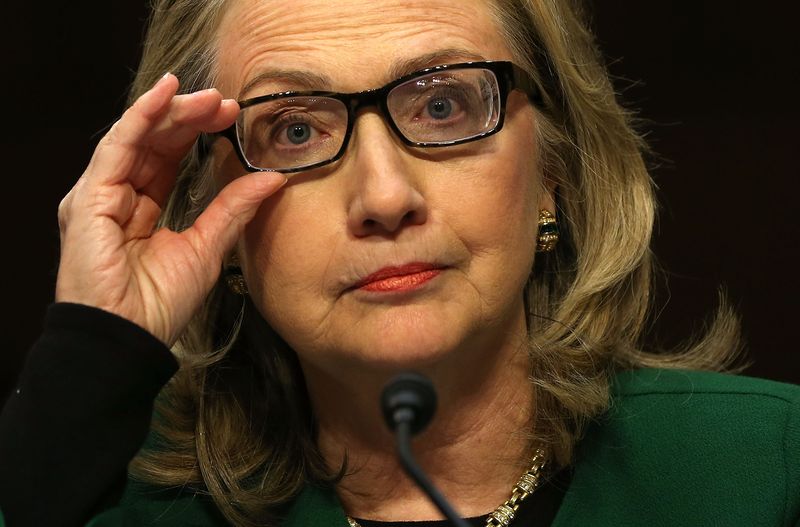
Ambinder warns Democrats against overconfidence for the next presidential election:

Obama has noted that he won’t be on the ballot in 2016. Not technically, of course, but every open general election uses as a point of departure the shared wisdom of how the last eight years went. Obama’s approval rating by the time he leaves office needs to be higher than it is now. The collective “sense” that his administration was successful needs to be shared more widely than it is in order for Democratic presidential candidates to have a basic foundation for messaging. And since Obama won’t be on the ballot, it might be harder to replicate the exact “Obama coalition” that proved critical to his election and re-election. Will he be a net negative for the Democratic nominee? How will the nominee work with the White House? Will they run together? Can they run together? Obama won’t be on the ballot, but he’ll be around the ballot, and how voters feel about this will be determined by what happens over the next few years.

My view is that the only way the Dems come back from this is if they embrace this administration and this president, make the case for the progress they have made since 2008, and fight proudly to entrench its achievements. Running away from Obama in 2016 will be as effective as running away from him in 2014. The obvious precedent is Al Gore’s decision not to run as the proud natural successor to Bill Clinton. That alone probably cost him an election he should have won easily. Now, of course, we are no longer living in an elysian late 1990s bubble economy before the 21st Century hit us like a ton of bricks. So you tell that like it is – and make the case for the success of the strategy since 2008 and the need to keep its gains and extend them further. I wish I believed the Clintons could see this. Their unity with Obama was critical in 2008; it will be just as critical in 2016.

Beinart draws a similar lesson from the midterms:

Think about the Democrats who ran in contested seats Tuesday night: Grimes, Nunn, Hagan, Pryor, Hagan, Shaheen, Landrieu, Braley, Udall, Begich, Warner. During the entire campaign, did a single one of them have what Joe Klein once called a “Turnip Day moment”—a bold, spontaneous outbreak of genuine conviction? Did a single one unfetter himself or herself from the consultants and take a political risk to support something he or she passionately believed was right?

He urges Clinton to take a stand (good luck with that):

In general, young people don’t have the same passion for Hillary that they had for Obama. Neither do African Americans. Neither do many liberals. If she’s going to rouse them to the polls in the same remarkable numbers that Obama did, she’s going to have to take the risk of actually saying something. She’s going to have to find a big issue that she truly cares about and speak about it with reckless conviction.

But what if her last moment of actual, genuine conviction was 1994? Nyhan adds:

[T]he widespread Democratic losses weren’t a “repudiation” of Hillary Rodham Clinton (who played a minor role). But despite claims that they actually offer her a useful opportunity to contrast herself with a Republican Congress, she doesn’t face a “great situation” for her prospective 2016 presidential candidacy either.

Historically, midterm results, which are typically unfavorable to the president’s party, tell us relatively little about the coming presidential election … The record shows that the president’s party can rebound from major losses to win at the polls in two years. Bill Clinton, for instance, bounced back from the 1994 Republican landslide to easily win re-election in 1996. Similarly, President Obama, whose party suffered major losses in 2010, went on to defeat Mitt Romney in 2012, and George Bush won the 1988 election after Republicans suffered major losses in 1986, President Reagan’s sixth year in office.

But Andrew Prokop pushes back on the narrative that Dems will easily retake the Senate in 2016:

It’s not easy to defeat a Senate incumbent. Even in this wave election, Republicans will only have managed to knock off five at the most (Mark Udall, Kay Hagan, Mark Pryor, and probably Mary Landrieu and Mark Begich). … [T]he most Senate incumbents who have lost in any one cycle recently is six. Kyle Kondik of Sabato’s Crystal Ball has a useful breakdown of these losing incumbents by party.

Now, those tallies may be a bit incomplete, because some incumbents who believe they might lose opt for retirement rather than another run. But, in general, the tendency of incumbents to win is well-known. So if the GOP manages to prevent retirements in potentially competitive states, Democrats will have to knock off a pretty high amount of sitting senators, historically.

Albert Hunt sizes up the next Senate races:

In 2016, Republicans will have to defend 24 of the 34 Senate seats that are up; and 17 of those will be in states that President Barack Obama carried in 2012. Even before last night’s vote, Democratic operatives were eyeing Republican targets in blue states, including Senators Ron Johnson in Wisconsin, Pat Toomey in Pennsylvania, Mark Kirk in Illinois and Kelly Ayotte in New Hampshire, where Democratic strategists hope to persuade Governor Maggie Hassan, who was re-elected yesterday, to run for the Senate in 2016.

Nonetheless, Democrats may have some problems of their own, starting with the Nevada Senate seat held by Harry Reid.

(Photo via Getty Images)

A Slimmer Marijuana Majority?

Gallup finds that support for legalization has ticked down:

marijuana gallup

Gallup’s attempt to explain the decline:

Last year’s finding of 58% in favor was recorded as Colorado was preparing to become the first state to implement a law decriminalizing the use of small amounts of marijuana for recreational use. Although the law passed in November 2012, it did not go into effect until January 2014. Americans may have warmed some to proponents’ arguments in 2013 in the ongoing discussion around the Colorado law.

More recently, Colorado has been in the news over the sale of marijuana-infused edibles—everything from brownies to gummy bears—and the risk they pose to children, possibly sparking public concern. Also, a year ago, proponents in California were poised to launch a ballot initiative for 2014 to legalize marijuana in the Golden State, adding to the sense of momentum for legalization, but later decided to wait until 2016 for fear of losing at the polls, as they did in 2010. The relative lack of attention to new legalization initiatives throughout 2014 may have caused public support to subside.

This strikes me as plausible. It’s highly predictable that when a reform actually seems as if it will happen – as opposed to seeming like a great and new idea – there’s a natural “hey, wait a minute” reaction. Support for marriage equality dipped 5 percent in the Gallup poll in the wake of the first state to legalize it – Massachusetts – from 2004 – 2005. There was another dip in 2011, following another burst of progress. These things are not linear; a completely reasonable conservatism creeps in from time to time; what matters is if that conservatism marshals an actual argument that sticks; and, of course, the overall long-term direction and demographics of support.

What you also see here in the cannabis debate is exactly what we saw in California on marriage equality – a moment when a reform seems imminent and when the opponents pay their final card.

That card is usually children, and the potential harm to them if society changes. That’s what led to Prop 8’s success at the polls in 2008. But so far, we’ve seen no such failure in the cannabis initiatives so far.

Sullum’s two cents:

Gallup adds that “as long as support hovers around the 50% mark, it will be difficult for proponents to promote legalization beyond the more Democratic and liberal-oriented states.” I’m not sure about that, since 55 percent of Colorado voters approved legalization in 2012, when Gallup put national support at 50 percent, and 52 percent of Alaskans went for legalization on Tuesday. Colorado and Alaska are purple and red, respectively, so I don’t think they qualify as “the more Democratic and liberal-oriented states,” although both have libertarian streaks.

I actually think that weed unites red and blue America in ways both sides are reluctant to admit. But never mind. No one knows what you do in the polling booth.

How The Democrats Ran From Their Own Success

Screen Shot 2014-11-07 at 11.35.59 AM

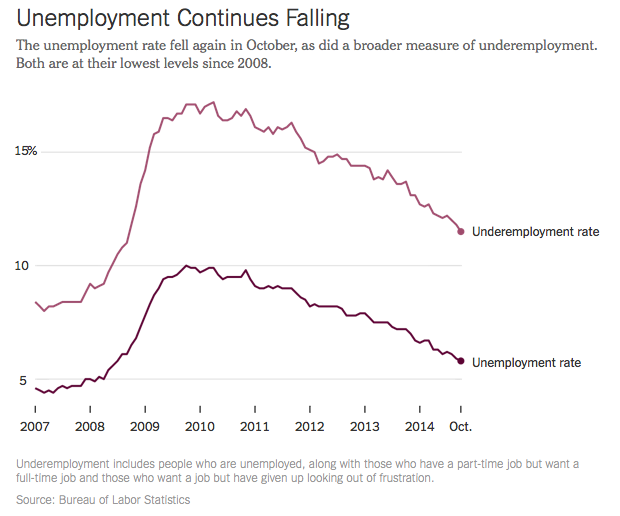
So the number one issue in the midterms was the economy. And a Democratic president has managed to halve the unemployment rate in the wake of a historically grim near-depression, and his own party decided never to mention this – or him – in the campaign. I wish I were surprised. He also managed to slash the deficit at the same time. But shhh … just tell women the GOP is out to get them.

Voters do not always have access to all the relevant data – but they sure can detect political fear. And fear, after all, is what the Democrats have wallowed in for decades since Reagan. Many of them privately believe that their ideas or proposals, however sensible, can never win majority support. So they hide them, or argue for them only before certain constituencies, or play the usual defensive crouch on foreign policy, and bob and weave until the voters are offered a choice between a decisive extremist from the GOP and a quivering pile of jello from the Democrats. The one figure who broke this cycle was Obama in 2008. He managed to do so again in 2012. And yet the default DNA of the Dems is to go back into a defensive crouch, the masters of which are, of course, the Clintons.

You can see it again with the ACA. You couldn’t have a stronger argument: we have given everyone more security in their health, and removed some of the cruelest aspects of the previous system. We have gotten huge numbers of people insured for the first time. And we have managed to halt the rise in healthcare costs in ways that could truly make a dent on future debt. These are huge achievements, but the Democrats couldn’t bring themselves to utter them, let alone craft a narrative of success to contrast with the fear-mongering and nihilism of the Fox News right.

And here’s my point: the defensive crouch doesn’t even work. Waldman marshals some evidence:

Democratic candidates gave Democrats lots of reasons to stay home, particularly those most loyal to Obama. Now let me take a counter-example. The one Democratic Senate candidate in a close race who won on Tuesday was New Hampshire’s Jeanne Shaheen. How did she avoid the fate that befell so many others?

While Shaheen wasn’t exactly begging for Obama to come campaign for her, she didn’t try to “distance” herself from him either. She also didn’t try to execute some double-twisting salchow when it came to the Affordable Care Act, channelling voter displeasure and pretending she shared whatever ill-informed opinion whoever she was talking to happened to have. When she got asked whether she was still proud of it, she said, “Absolutely.” To be sure, she was critical of things that didn’t go well (like the web site roll-out), but no Democratic voter would think she was turning her back on the most important Democratic domestic policy achievement in decades, or dissing their party’s leader.

And for whatever combination of reasons, while turnout was down from 2010 in most places in the country, New Hampshire was one of the few places where it actually increased this year.

A GOP strategist argues along the same lines:

“They sidelined the president,” Rob Collins, the Executive Director of the National Republican Senatorial Committee (NRSC) told reporters at a backslapping post-election briefing. Instead, Collins argued, Democrats shouldn’t have been scared off by Republican attempts to tie Obama to their candidates.

Collins said NRSC polling had long identified the economy as the issues voters cared about most, and one where Democrats stood to gain. “We felt that that was their best message and they sidelined their best messenger,” he said. Collins added that in many states, Democratic candidates had positive stories to tell. “In Colorado, unemployment is 5.1 percent and they never talked about it,” he added.

“They were so focused on independents that they forgot they had a base,” Collins said of Democratic Senate candidates. “They left their base behind. They became Republican-lite.”

They’re a bunch of clueless cowards, as far as I can see. And they have reaped the dividends of fear.

(Chart: the Upshot.)

A Pro-Life Election?

abortion_states

Rebecca Leber worries that the GOP’s victories on Tuesday, especially in statehouses across the country, spell danger for abortion rights:

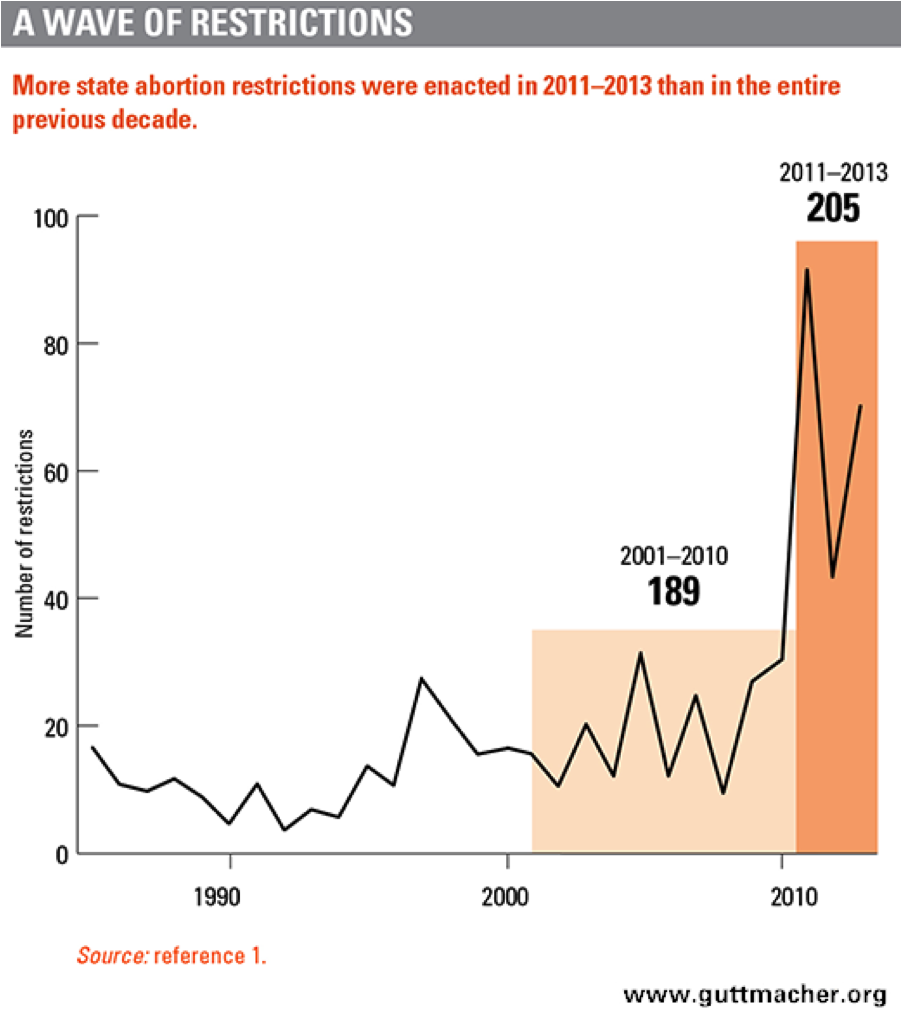
Before Tuesday, Republicans controlled 60 of 99 legislative chambers. Thanks to the election, they will soon control at least 66. Majority status in two others remain undecided, according to the National Conference of State Legislatures. The only two Democratic “successes” of the night were holding onto majorities in the Iowa Senate and the Kentucky House. The GOP also picked up three gubernatorial seats. This has bad implications for women, particularly on abortion rights. State legislatures were responsible for 200 new abortion restrictions between 2011-2013.

At the federal level, Susan B. Anthony List president Marjorie Dannenfelser celebrates the fact that “the next Congress will usher in a record-breaking number of pro-life women”:

The Congress that convenes in January will have at least 21 pro-life women, breaking a high of 18 following the 2010 elections. In 2010, there were no pro-life women in the Senate. In the next Congress, Iowa Senator-elect Joni Ernst will become the third pro-life woman to serve, joining Kelly Ayotte (R., N.H.) and Deb Fischer (R., Neb.).

While prenatal “personhood” initiatives failed by wide margins in Colorado and North Dakota, Robin Marty worries that personhood activists are already working on a new strategy focusing on the local level:

While North Dakota and Colorado were busy pushing for yet another statewide voter referendum, groups like the Personhood Alliance, a “life at conception” pro-life group formed by Dan Becker, president of Georgia Right to Life, intend to launch a “ground-breaking campaign” for 2015 that will introduce “pro-life ballot initiatives at the county and municipal level.” … By moving to a city-by-city strategy, anti-abortion activists can target just the places where actual abortions are being performed. There, at the clinic doors, they hope they might find some moderate success, since their statewide plans to pass personhood have been nothing but one failure after another.

Emma Green has more on at Tennessee’s Amendment 1, which will allow the state to enact more restrictive abortion laws:

The amendment language is specifically framed in response to the state Supreme Court’s 2000 decision in Planned Parenthood [v. Sundquist]. In that ruling, the court overturned several state statutes, including requirements that abortion procedures must take place in hospitals; that women must get counseling from physicians before getting an abortion; that they must then wait two days until having the procedure; and that “a physician may bypass the requirements of [these statutes] only when ‘necessary to preserve the life of the pregnant woman,’ regardless of her health.” …

Now that the amendment has passed, the General Assembly may have more flexibility to legislate what women must do in order to terminate a pregnancy, including those “resulting from rape or incest.” State legislators still can’t create statutes that violate federal legal standards on abortion—it can’t be outlawed entirely, for example. But they will “almost certainly” have a greater ability to pass restrictions on how and where women get the procedure, said [Hedy Weinberg, executive director of the American Civil Liberties Union of Tennessee]—and they plan to, she added.

 notes that Tennessee was previously “something of an anomaly in the South, where it was the only state without significant abortion restrictions on the books”:

That meant a large number of women from surrounding states such as Arkansas, Alabama, Mississippi and Kentucky would travel to Tennessee to receive the procedures. About a quarter of the abortions in Tennessee are performed on women traveling from out of state, the Tennessean reported.

Anita Wadhwani talks with a supporter of the law who “believes Tennessee lawmakers will now have the ability to pass laws that deter out-of-state women from coming to Tennessee for the procedure”

“If we have an informed consent law and a waiting period, the incentive for women to leave their home state to come to Tennessee will be reduced,” said David Fowler, president of Family Action Council of Tennessee and a former state senator who originally proposed the constitutional amendment in 2001. “Tennessee in my opinion took the notion of abortion on demand to a new level, saying you can show up in the morning, have an abortion and leave that afternoon,” he said. “When the state has a waiting period law, I think you will see fewer who will find it expedient to travel to Tennessee.”

When Does Exploration Become Abuse?

Certain excerpts of Lena Dunham’s book have led some to accuse her of having abused her sister when they were both children. Dunham denies this and may even sue. Dreher insists that the same story coming from someone without Dunham’s upscale background would be received differently:

I have known at least two friends over the years who were sexually abused by older siblings. In both cases, the abuse had profound and lasting consequences on their psyches. What Lena Dunham describes doing to her little sister is sick and disgusting. But her little sister Grace, all growed up and having embraced a lesbian identity, doesn’t necessarily agree with the critics. She tweets that critics are dedicated to maintaining “heteronormativity,” and that, “As a queer person: i’m committed to people narrating their own experiences, determining for themselves what has and has not been harmful.”

Now, imagine if Grace Dunham’s older brother had confessed to having done these things. Would he have any defenders? Imagine if the woman confessing to this abuse were not from a liberal Manhattan family, and had not been dubbed by some media outlets as the “voice of her generation,” but was instead a burger-flipper living in a trailer park, having confessed this on a blog. How would you feel about it then? What if an NFL player had written the same kind of thing in his memoir? Or a Catholic priest?

Jia Tolentino shows how such criticism of Dunham’s privilege has caught on among pundits on the left as well:

Childhood bodily play is peculiar and near-universal and complicated, with a thousand valid valences on the long spectrum from normative to predatory. To me, these stories are mostly early and wonderful examples of the body as a zone of curiosity free from the burden of adulthood and sex, but of course, in a few cases, they are darker: reminders that children don’t have a lot of agency, or remembrances of unplumbed abuse.

To some people, Dunham’s story looks very much the latter way. It was the conservative media outlet TruthRevolt that incited this discussion by posting the Not That Kind of Girl passage with Dunham’s age originally (and disingenuously) quoted as 17, under the headline “Lena Dunham Describes Sexually Abusing Her Little Sister.” Dunham responded to this “right wing news story” quickly and sharply. The conversation picked up as writers who are on the other side of the political spectrum—who I respect greatly, and are normally a gulf of ideology away from TruthRevolt or Return of Kings—voiced their fervent agreement. Feminist writer Mikki Kendall wrote, “The gap between the attitudes that let R. Kelly prosper & the ones who excuse Dunham is incredibly thin. Nonexistent to be honest.” Lachrista Greco, founder of Guerrilla Feminism, added, “It’s NOT NORMAL. It’s NOT OKAY.”

This is indeed where the sex police want to take us – and there are increasing numbers of those people on the new feminist left. Rich Juzwiak raises an eyebrow at such criticism:

Most of the analysis of Dunham’s account of her childhood behavior has been coming from amateurs, mostly with axes to grind. I thought, then, it might be useful to add an expert opinion into this stew of non-professional opinions about whether the incidents Dunham describes—examining her sister’s vagina, plying her sister with candy, and slipping her hand into her own “underwear to figure some stuff out” while lying next to her sister—constituted abuse.

I asked Sam Rubenstein, a psychotherapist who specializes in childhood abuse, for his take on whether what Dunham describes would be considered abuse in a clinical setting.

The short answer is: no.

Wanting Not To Waste

58054395_26958403b9_b

Cecilia Chen, Dan Zook, and Dan Tuttle discuss how to reduce food waste:

The solution to feeding a growing population is not simply to produce more food, but also to save, preserve, or recycle the food already produced. Cutting current food wastage in half, for example, would yield enough food to feed one billion people—half of the additional population expected by 2050. …

Food loss, which accounts for 90 percent of unconsumed food in developing countries, refers to the decrease in edible food mass during production, postharvest processing, and distribution. The primary drivers of food loss are a lack of skills training for actors within the supply chain in handling, packaging, and storing food; insufficient on-farm storage technologies or postharvest storage facilities; and farmers’ poor market access, which leads to spoilage before products can be sold.

Food waste, on the other hand, refers to food that is fit for human consumption but is discarded by retailers or consumers. In developed countries, high aesthetic standards, stringent food company contracts, large portion sizes, and promotion-driven sales often lead to the overproduction of food, much of which is discarded. Food discarded by the consumer—the last actor in the supply chain—wastes the resources used in every previous step in the chain.

(Photo by Flickr user GloomyCorp: “A misshapen green tomato is menaced by its ripe, perfectly-proportioned brethren.”)