Maps Of The Day

Medicaid Expansion

Many states not expanding Medicaid has denied millions of Americans healthcare:

More than three million people, many of them across the South, would now have health insurance through Medicaid, according to an Upshot analysis of data from Enroll America and Civis Analytics. The uninsured rate would be two percentage points lower.

Today, the odds of having health insurance are much lower for people living in Tennessee than in neighboring Kentucky, for example, and lower in Texas than in Arkansas. Sharp differences are seen outside the South, too. Maine, which didn’t expand Medicaid, has many more residents without insurance than neighboring New Hampshire. In a hypothetical world with a different Supreme Court ruling, those differences would be smoothed out.

Jonathan Cohn makes the economic argument for expanding Medicaid:

It’s easy to recognize the human toll of refusing to expand Medicaid. It’s not so easy to recognize the economic toll. Maybe this chart will help:

GA-Medicaid

It comes from the Georgia Budget and Policy Institute and looks at the implications of that state’s decision not to expand Medicaid eligibility, as the Affordable Care Act’s architects intended.

Josh Barro and Margot Sanger-Katz calculate that today’s elections “could decide whether as many as 1.3 million more people get health coverage in the years ahead”:

There are 15 governor’s races this year in states that have declined to expand their Medicaid programs as part of the Affordable Care Act. But we count only the five where the election is likely to make a difference. The races we’re watching are genuinely competitive and could result in a policy change if a Republican governor is replaced by a Democrat or an independent. We’re also keeping our eye on a sixth state, Arkansas, which has already expanded its program, but where the legislature has to reauthorize the program every year with a three-quarters majority, leaving the program vulnerable to political shifts.

Update from a reader:

In addition to the states in which the the governorship could change, here in North Carolina, Republican Governor Pat McCrory said this week that he is “assessing” whether to expand Medicaid here, after signing a bill last year that blocked its expansion with approval of the General Assembly. “Assessing” might sound like weak tea, but it’s actually a sea change given the tenor of the NC GOP these last couple of years. (I’ll leave it to the reader to infer why he’s floated this the week before an election, when it has mostly gone unnoticed in the local news.)

Sweet 16 At The Polls?

Libby Nelson argues that 16-year-old Americans should be allowed to vote:

A study of Austria’s expanded electorate found that 16- and 17-year-olds were not less informed than 18-year-olds. Nor were they less willing to participate in politics. And they could pick candidates who represented their own political beliefs just as well as older voters. That addressed several of the common arguments against lowering the voting age: that 16- and 17-year-olds simply aren’t ready to vote. …

During the 1960s, the movement to lower the voting age from 21 to 18 started in four states. It then spread nationwide with a constitutional amendment passed in 1971. A handful of states seem like a natural place to experiment with setting the voting age even lower today.

State legislatures set many of the policies that most directly affect 16-year-olds’ lives, from whether they’re able to drive to how much state funding their schools get to what they’ll eventually pay in college tuition. If we’re going to experiment with giving older teenagers a voice in politics, it makes sense to start at the state level, where it could make the most difference in their day-to-day existence. For the same reason, allowing younger voters into local school board elections would be a logical step.

Osita Nwanevu recommends we keep the age of candidacy in line with the voting age:

Even if progress on youth issues continues to stall and even if young candidates are beaten out by older and more established politicians—as they certainly will be most of the time—establishing a universal right to stand for public office is worthwhile on its own merits. “It’s sort of like in 1919, when the franchise was extended to women for 1920, if people had said, ‘Well all of this hinges on whether women will actually start voting in big numbers next year,’ ” Seery says. “The principle sort of trumps the practice.”

Whether it yields policy changes and boosts participation or not, a constitutional amendment doing away with age of candidacy restrictions will simply extend rights to a politically underprivileged constituency just as the 15th and 19th Amendments did for women and blacks—a worthy objective in and of itself.

Car Repair For The Soul

After co-hosting the NPR show “Car Talk” with his brother Ray for a quarter century, Tom Magliozzi died yesterday at the age of 77:

In a remembrance, Mike Riggs declares, “If you are, or ever were, one of the 25 percent of Americans who can’t afford a major repair, Tom and Ray weren’t just funny, or just entertaining, they were very close to necessary”:

Car Talk did not pioneer consumer advocacy. Many local newspapers and TV stations employ columnists and on-air talent who will hound service providers accused of fleecing people. But most consumer protection journalists aren’t experts, and they certainly aren’t philosophers. Tom Magliozzi – a grease monkey with a degree from MIT – was both. Which is why what you got from Car Talk wasn’t just a first or second opinion on your car problem, but counsel and succor. Some of the people I heard call into Car Talk were anxious and more than a few were borderline frantic. …

Tom and Ray knew that for many of the people who listened to them, a car was not a luxury; they knew that millions of Americans need their cars – to get to work, to transport their children, to buy groceries. So they didn’t stop at diagnosing your about-to-break CV joint or a bad power steering pump, and they didn’t stop at coaching you on how to stand up to your mechanic. They wouldn’t let you off the line until they knew that you knew that there was a solution to your problem.

At least, that’s how it felt as a listener. We never actually called in to Car Talk. But we listened to Tom and Ray the way some people listen to televangelists, waiting for nuggets of divine wisdom that applied to our exact situation.

A classic clip from a reader:

Bob Collins remembers Magliozzi as “the man who made it OK to laugh on public radio”:

Public radio was a lot of things back in the day, but it wasn’t much for personality. You just didn’t laugh on public radio. Even within the public radio industry, a contingent thought the show threatened the dignity of the institution. To others, however, the show liberated public radio from itself, clearing the way for subsequent shows such as “Wait Wait Don’t Tell Me.”

And John Biggs notes that “Car Talk” had a special significance for a generation of tinkerers:

The brothers, and Tom in particular, reminded us that building and fixing isn’t scary and that repair, in fact, was the way forward. We aren’t supposed to be scared of getting our hands dirty because that’s how progress is made and that’s how you have fun. Tom taught a generation of hackers that there is nothing frightening about taking things apart.

Not Demeaning Ex-Cons

Ben Casselman discusses a ballot initiative in California:

Proposition 47 would reclassify some drug and property crimes as misdemeanors rather than felonies. Proponents of the measure have focused primarily on the cost savings from sending fewer people to prison, but they argue it would also help non-violent offenders like [Richard] Martin become productive members of society.

Opponents counter that any benefits aren’t worth the tradeoffs. The initiative would reclassify possession of date-rape drugs and the theft of many firearms as misdemeanors, which some law enforcement officials argue could result in the release of violent or potentially violent offenders.

But beyond the specifics of Proposition 47, there is an emerging consensus from across the political spectrum that some sort of reform is necessary to help millions of Americans with criminal records find work. Attorney General Eric Holder and other Democrats have spoken frequently about the issue, but so have conservatives such as Rand Paul and New Gingrich, who penned an op-ed in the Los Angeles Times supporting the California initiative.

Sonya Shah explains why ex-cons seeking employment aren’t the only ones who might benefit:

Proposition 47 stands to benefit survivors of crime, and people concerned about sexual assault should especially be interested in its promise. I know from hearing survivors’ stories how poorly we currently help sexual assault survivors access the trauma services that can be vital in their recovery and ability to avoid future harm. And I know this from first hand experience. …

The “Safe Neighborhoods and Schools Act” would reduce certain nonviolent offenses (e.g., drug possession, petty shoplifting, etc.) from felonies that can bring prison sentences to misdemeanors that bring county jail time, supervised probation, treatment or other forms of accountability. This will prioritize space in our crowded jails and prisons and, importantly, save $750 million billion over five years, according to a state agency. These savings will be allocated to amongst K-12 program, mental health and drug treatment, and victims’ services. Specifically, $75 million in new funds could be available for victims’ services within five years. If $2 million opened two new trauma recovery centers, imagine what $75 million would mean?

The View From Your Window Contest: Winner #229

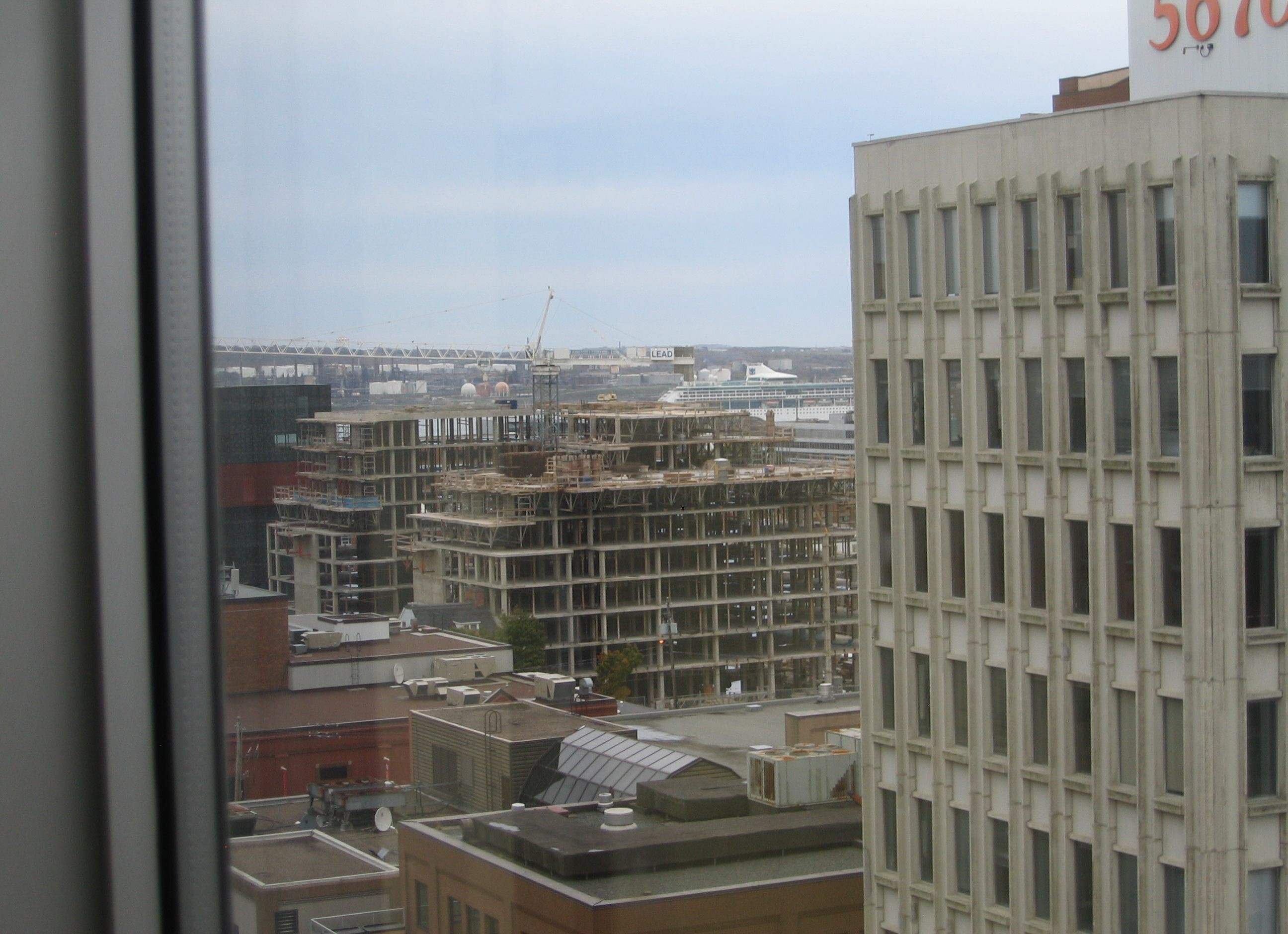
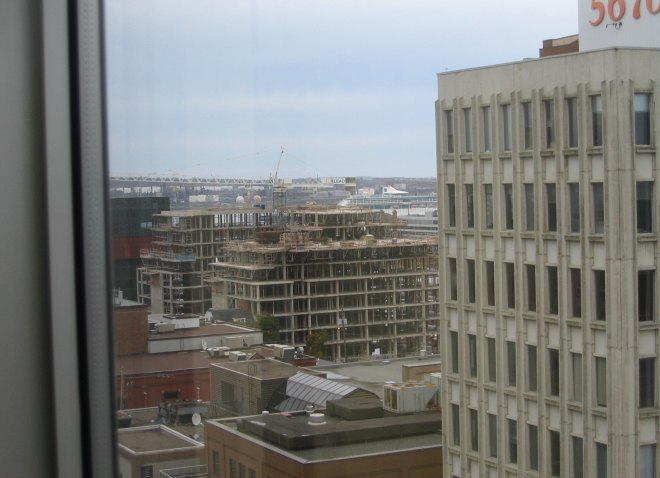
VFYWC_229

If you’re already sick of the midterms, perhaps you’d rather be in …

Cocoli, Panama. That’s the best I can do. Google Earth is not my friend today, so I can’t pinpoint it. I thought I’d guess on the off chance no one else gets it. You can’t win if you don’t play!

Another glares through the in-tray:

Jesus H. Christ on a taco, that could be just about anywhere.

Like the Middle East?

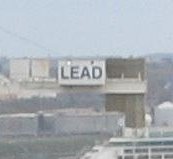
VFYWC_229_leadI think it’s Beirut. The Lead construction crane is a clue. There is a Lead construction firm that operates in Lebanon. And Princess Cruise Lines do feature Beirut as port of call on Mediterranean cruises.

That sign led another reader astray at first:

The big billboard with LEAD printed on it led me down the path, of all things, of Bishop Eddie Long.

And according to other readers, the view might be Galvaston, Texas or Bustan, South Korea or Bayonne, New Jersey or Brazil:

Well, at first I got a bit turned around, and ended up in Taipei, thanks to the LEAD crane, and the fact that Royal Carribean does sale there. But, not the ship that was in the port, which is either the Legend of the Seas or the Splendour of the Seas, both of which had itineraries that included Rio. Where there’s a lot of construction going on near the port. The photo was taken, I believe, from the recently renovated Hotel Sao Francisco, 95 Rue Visconde de Inhauma. Apparently, a renovation that did not go over well with at least one traveler, who has dubbed it “the worst hotel in the last 7 years of travel.

This reader hits the right country:

I’ve gone through every possible port city, thinking Norfolk or Baltimore seemed worth digging into. Boston, Portland? Even stabbed at the Southern Hemisphere. The Legend of the Seas cruise ship would have been on the Canada, New England schedule the week of this VFYW but I can’t match Quebec City, Saguenay, Sydney, Halifax, Charlottetown or towns of any size between. So for a guess, unless I can waste more time before the deadline instead of voting:

Let’s guess Quebec City, which would offer a view east across water while the ship sails south … never mind that there don’t appear to be any buildings in the right places.

I think I’ll go vote.

Meanwhile, the old satellite-dish-direction trick helps this reader nail the right city:

Well, it’s a port of call for Royal Carribean cruise, and based on the satellite dish angles, it’s pretty far north. Alaska’s port cities are  too dinky, but RC also goes up the Canadian coast. So, I’m guessing Halifax, Nova Scotia.

Another more labored but still correct guess:

This week is a woeful tale of a red herring. That giant crane with the word “LEAD.” I found a manufacturer of cranes and hoists based out of Tiawan. Combine that with a list of Royal Carribean ports of call in Asia Pacific, easy to spot oil and gas tanks in the distance for reference and this should be a slam dunk. Several hours later, and very cold coffee, I gave up for the day. Fast forward to Sunday morning and the extra hour of sleep and I came at it with fresh eyes. The house whose roof we can see amidst the otherwise commercial buildings looks distinctly North American in style. And the leaves on the nearby tree are beginning to blush, suggesting a Northern Hemisphere locale. So I combine these tidbits of information with said list of Royal Caribbean ports of call and came to Halifax, Nova Scotia. There are oil tanks in the proper orientation to the city, and an airport further on behind them, indicated in the view by the red and white water tower just visible above the crane.

This reader nails the hotel and floor:

Thank goodness for the extra hour of sleep. I started with the numbers in the top right and had no luck. The only other clue for me was the Royal Caribbean cruise ship, which I actually narrowed down to one of two vessels in their fleet and began mapping out their (extensive) ports of call before nodding off. I dreamed I had found the right city and felt when I woke up I’d just need to do some sightseeing on Google Earth to pinpoint it. Instead I felt the need to start over, and glad I did.

Retrying the numbers as 5670 (initially I thought the last digit was 6 or 8) easily brought up the distinctive concrete facade – and a Canadian flag flying out front! The view is from the 9th floor of the Lord Nelson Hotel, looking east-ish down the hill towards the waterfront. I’ll guess and say room 902.

Other clues kept this reader on target:

The Lord Nelson Hotel & Suites - Google Maps 2014-11-04 00-05-20There are a lot of clues in this photo. The cruise ship seemed like an easy starting point, but Royal Caribbean has dozens of departure points and even more ports of call. The oil refinery in the background seemed like the next easiest thing, but the Wikipedia list of oil refineries has 100s of entries. Even cross referencing the refineries with the ship wasn’t worthwhile.

The biggest takeaway from this week’s puzzle is how freakin’ huge those cruise ships are. This photo was taken about a mile from the ship and yet it blends right into the line of buildings. After spending some time on their website, I think that’s one of Royal Carribean’s vision-class ships known as “Grandeur of the Seas“. It’s got 11 decks, a casino, 8 themed bars, a great dining hall that spans 2 decks, and (my favorite) a “piano area”. At capacity, the ship holds 2,446 passengers and 760 crew who are all off to spend 8 or 9 nights looking at Canada & New England.

Thanks for a fun challenge!

A Canadian Dishhead gets sentimental:

After years of bitter VFYW failures, I finally find a piece of Halloween candy left in the Dish… It’s Halifax, the capital of Nova Scotia.

In the distance (in front of the cruise ship) is the grey roof of the Canadian Museum of Immigration at Pier 21 (Canada’s “Ellis Island”); my wife and I visited the museum a few years ago, and found the arrival records of our families. Not many dry eyes that day, and not just because of the omnipresent Haligonian fog! Thanks for picking a view that I know. Win or lose it’s a sweet memory.

Another adds:

File-Halifax_Explosion_blast_cloudThere is an incredible piece of history associated with Halifax.  At 9:04 am on December 6, 1917, the “Mont Blanc”, a cargo ship chock full of explosives headed for the western front, caught fire and exploded in Halifax harbor.  It was the largest man-made explosion in history to that time.  The ship’s 1000 lb anchor landed two miles away, and the resulting cloud rose 11,800 feet into the air.  Laura MacDonald’s excellent book, Curse of the Narrows, tells the story in all of its stunning detail.  Highly recommended.

A more modern take on the city:

The largest city in the maritime provinces, Halifax is a beautiful little city.  Some people would associate the city with the Citadel, the establishment of responsible government in British North America, the Halifax Explosion, the naval base, or maybe the “Halifax Pop Explosion” from the mid-90’s (which gave rise to such bands as Sloan, the Superfrienz, Hardship Post and Jale – although maybe I am just tipping my hat to both my age and my CanCon-ness) – or maybe even our favourite band of petty criminals, the Trailer Park Boys.

But for me, I most associate Halifax with Pizza Corner, at the corner of Grafton and Blowers. It’s in an area chock-a-block full of bars and late on a Friday or Saturday night, kids from Dal or Saint Mary’s spill out of the streets and head to Pizza Corner for some nosh.  Three pizzerias front Pizza Corner, but the place is actually less known for its pizza and more for its donairs, for this is where the Halifax donair was born.  The Halifax donair is a beautiful thing – pretty much the same as doner kebabs found worldwide, but lean ground beaf and a distinctive sweet sauce of condensed milk, sugar, vinegar and garlic.  It also appears to be quite regionally-specific, although places have popped up across Canada where you can find it.  But since the doner kebab is pretty much a global phenomenon at this point, I was just hoping to maybe expound on the wonderfulness of that tangy garlic sauce and maybe we’ll see it on the streets of Ankara or Berlin someday…

Another place to visit:

If you find yourself in HFX with some time, I recommend checking out the greatest self-generated museum ever — the Happy Face museum across the harbour in Dartmouth. It’s a labour of love created by Debbie Power, whose pet grooming shop is next door; and while you might at first deem it pure kitsch, you will get more out of it if you check your irony at the curb. It is a place that is full of genuine compassion. A photo from my visit there:

image

Chini nods off:

BOOOORRRRINNNG. We want Botswana, we want Botswana…or Benin…or Borneo. Seriously, anything but this. Not only was it dead simple, but if you tried a hundred times I don’t think you could come up with a more depressing shot of this town. The leaden skies, the sea of gas tanks on the far shore, that modernist mess at right, yuck.
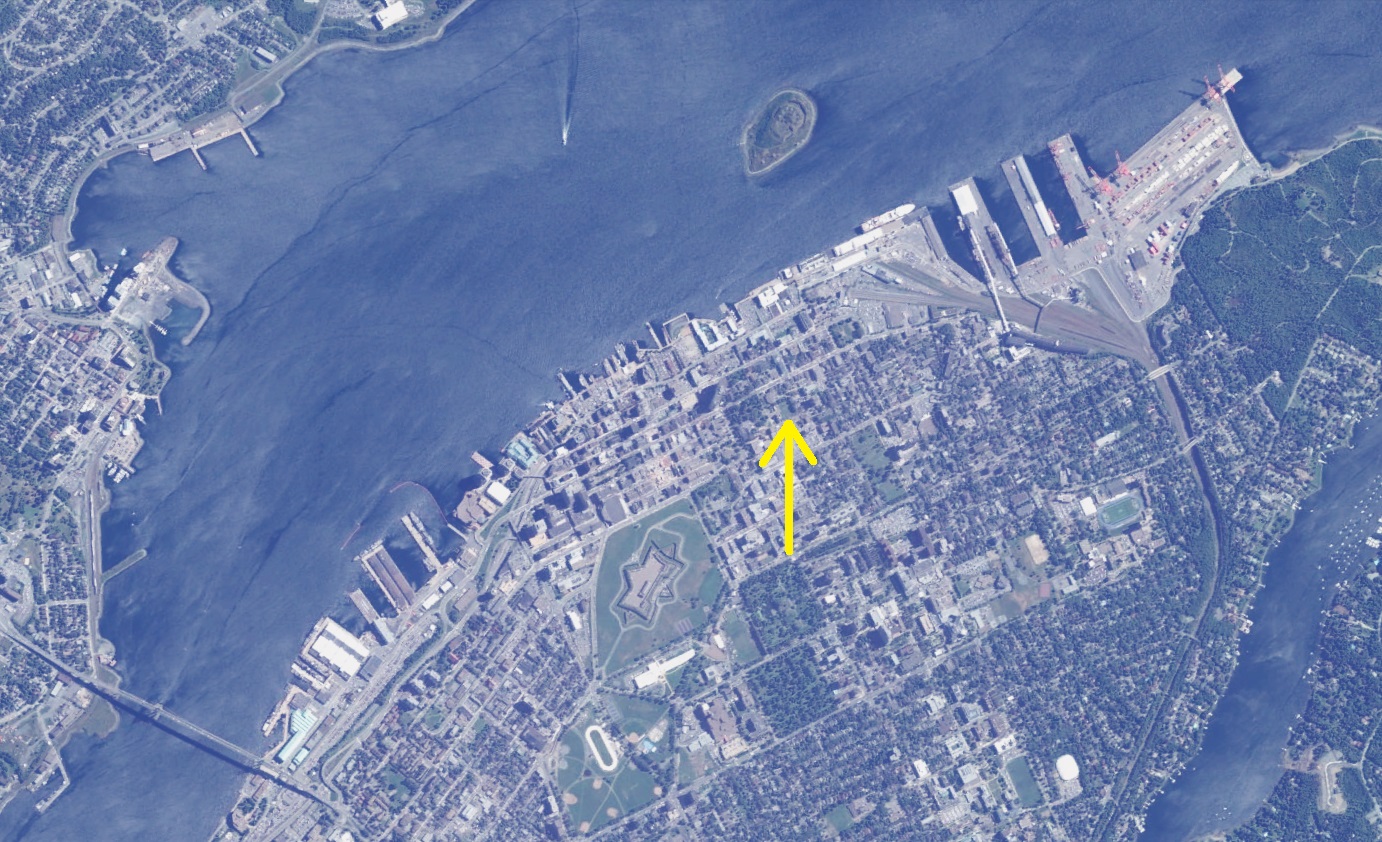
VFYW Halifax Overhead Marked - Copy

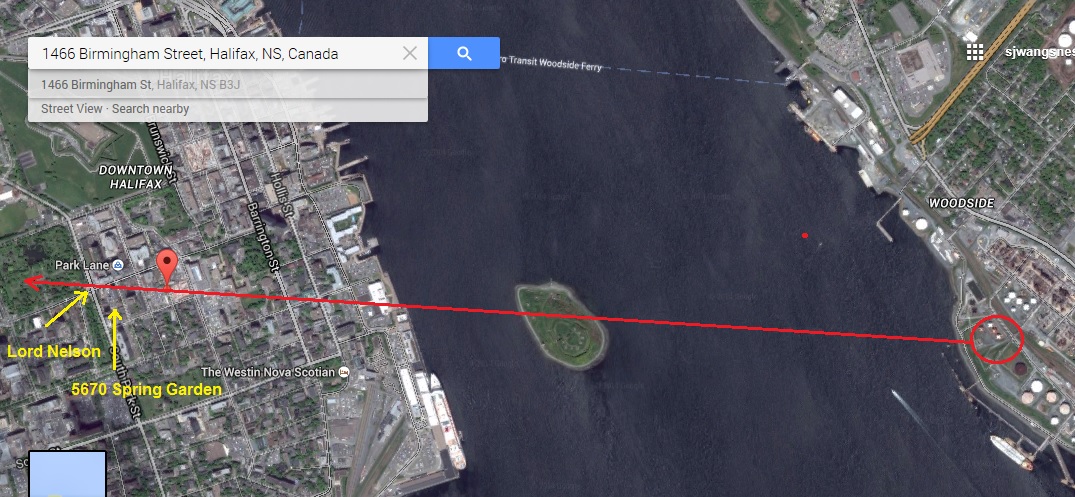
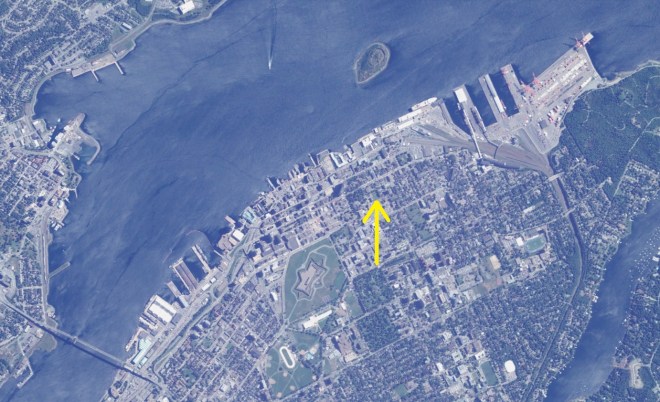
This week’s view comes from the normally lovely city of Halifax, Canada. The picture was taken from a room on roughly the seventh floor of the Lord Nelson Hotel and looks almost due east along a heading of 96.6 degrees. Now if you’ll excuse me, I’m gonna go stare at that tree-house view from Costa Rica until the depression wears off.

Well this pair of former winners did something more productive with their boredom, like a GIF:

Half-Nelson

Or a poem!

Yes, I’m a past winner, it feels like a curse,
So I’ll just have fun by submitting in verse:

The secret to this, if you don’t want to lose?
Just take a Royal Carribean Cruise,
Or Google cruise logos, they’re proudly displayed,
And research their ports, you’ll soon have it made!

Those trees of Autumn …. it must be up north,
It feels like the New World, so I’ll chart that course.

RCC ports and 5-6-7-0,
When Googled, will lead you to Spring Garden Road.

(Charlottetown, Charleston, others I’d tried,
But Halifax! that was the end of my ride.)

What view to the harbour shows eight windowed floors?
The Lord Nelson Hotel & Suites ……. What a score!

Ol’ Nelson ain’t tall, so floor nine is my guess,
And no doubt I’m missing some surefire test.

So now for the final room window assignment,
I’ll try my luck with some landmark alignment.
Cross Halifax Harbour: white, brown and tan tanks,
Align with roof features atop Scotiabank.

It’s no corner window, it’s two or three in,
I’m pegging the second, it damn well should win!
And as for room numbers, I shan’t chase that scoop,
It’s all yers, more Chini-esque internet snoops.

Another contest veteran zooms in on the window specifics:

vfyw_collageHalifax_11-1-2014

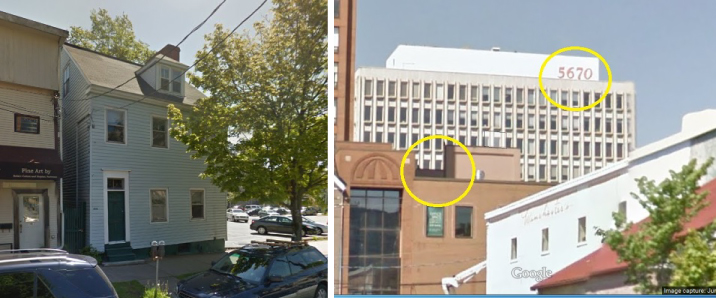
I am guessing the contest photograph was taken from the upper, easternmost window on the southern face of The Lord Nelson Hotel although I could not rule out windows immediately to the west and below this window (see above). There are eight large windows on this side of the 1966 addition to the hotel. Each has nine panes of glass with the central pane being the largest. I was initially concerned that the contest photograph could not have been taken from one of these windows because the window frame visible to the left in contest photograph appeared flush with the wall. The side panes of the nine-pane windows appeared too narrow for the contest photograph. This discrepancy was rectified by a hotel guest’s YouTube video which showed that the framing of the large central pane was identical to that in the contest photograph. My choice of the upper and easternmost window relied on it being relatively at the same height as the 5670 building (hotel said to be 9 stories, the insurance building 10) and the end widow allowing a wider view of the harbor than those farther west. Street views near the lone quaint house in the contest view, however, demonstrate that it could be others..

I will now remember Halifax as the city with a model of the Titanic in the pond of its lovely public garden across from The Lord Nelson Hotel.

No one guessed the right room number this week, and we weren’t able to pinpoint the exact window, as there wasn’t even a consensus among our best players as to which one it was. Thus we’re awarding this week’s prize to a player who guessed one of the only four windows it could be, and he’s on top of the pile because he’s been racking up correct guesses since 2011:

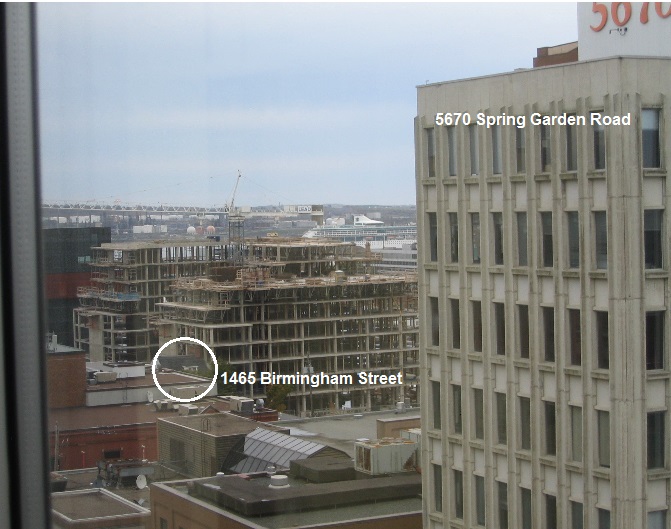
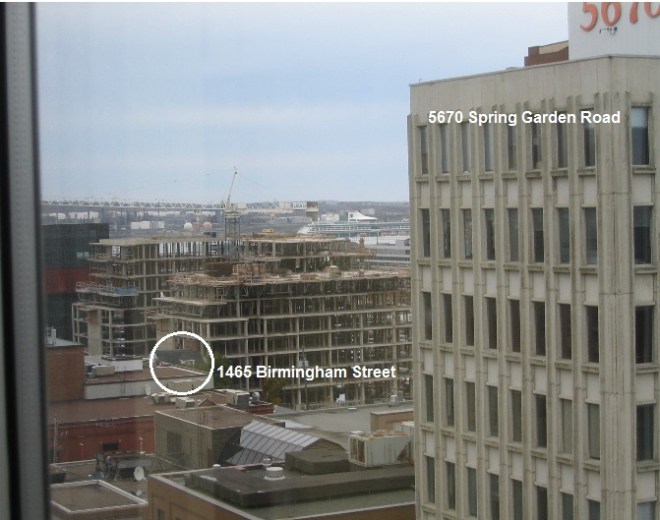
My initial thought was to check out ports of call for Royal Caribbean, since that’s one of their ships in the harbor. However, after looking around Bayonne, New Jersey for a while, I realized that scoping out all those port cities would be too onerous. Scouring the photo for clues again, I decided to search for “5670 building” and found a picture of the distinctive windows on the building on the right at 5670 Spring Garden Road in Halifax, Nova Scotia. Confirming this was easy enough by identifying the distinctive, globe-like fuel tanks across the way and finding the little frame house proudly standing among all those tall buildings, which stands at 1465 Birmingham Street. A view looking back to the northwest gives us another view of 5670 Spring Garden Road and what may be that odd roof in the middle of the picture.
halifax2hal3

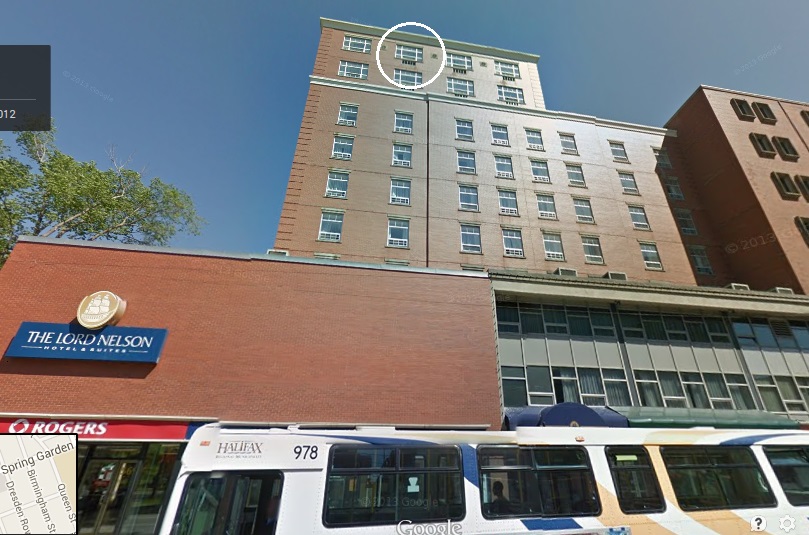
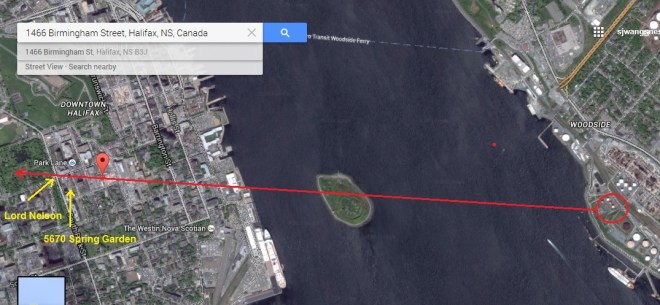
From there it was fairly easy to determine that the photo was taken from the southwest corner of the Lord Nelson Hotel and Suites, also on Spring Garden Road.
hal street

The hard part, as always, is finding the right window. I’m just going to guess this one, top floor, second from left, because it’s close to the middle and seems about the right height compared to the window level over at 5670 and all.
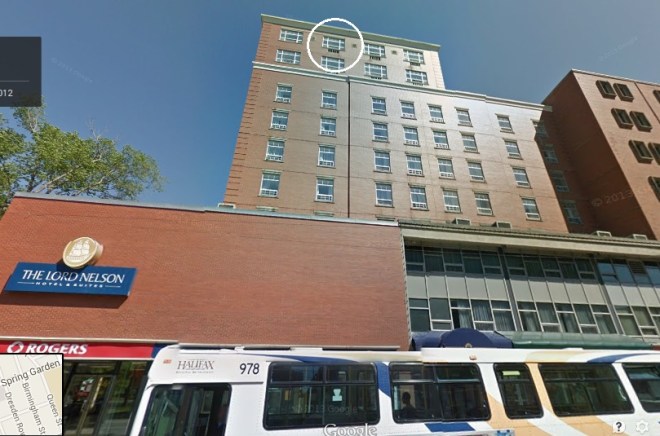
hal3

Congrats! For the record, the reader who submitted this week’s view said it was room 915, and added that “apparently the Lord Nelson was one of the Rolling Stones’ favorite hotels, or at least it was where they preferred to stay in Halifax.”

And thanks to all of you for preferring the Dish for all your maddening Google Map puzzle needs. Here’s this week’s guess collage:

VFYWC-229-guess-collage

(Archive: Text|Gallery)
Who’s The Real Chickenshit?

President Obama Meets With Israeli Prime Minister Netanyahu At The White House

The White House, answers Stephen Walt, for lobbing childish insults at Netanyahu via anonymous officials rather than acknowledging the real problems with our relationship with Israel. Indeed, in his view, chickenshit-gate itself demonstrates just how messed up that relationship is:

Netanyahu’s decision not to attack Iran wasn’t a show of cowardice (or being a “chickenshit”); it was a sensible strategic choice. The war talk from Israel was intended to distract attention from the settlements issue, keep Iran in the crosshairs as Public Enemy No. 1, and convince the United States to impose stiffer sanctions in the hopes of securing a better deal from Tehran over its nuclear program. But an actual attack was never a serious possibility. Bibi’s bluster might have fooled journalists like Goldberg — who has raised bogus alarms about an imminent Israeli attack on more than one occasion — but sensible observers should not have been taken in by all this folderol.

In the end, this minor incident mostly confirms the unhealthy effects of the “special relationship” itself. The sad truth is that top U.S. officials still can’t say openly what they really think about Israel’s behavior, or what they really think about the relationship itself. The mildest criticism invites automatic abuse from the lobby, and of course, anyone aspiring to a top foreign-policy position still has to mouth embarrassing platitudes and repudiate any previous criticisms in order to get appointed and confirmed. Just ask Samantha Power and Chuck Hagel how this process works. Ironically, it is U.S. leaders who mostly lack courage on these issues, not Netanyahu.

Walt is right so far as he goes – but what administration would want to directly confront the Greater Israel lobby, when it could manage to make some progress by other means?

And look at the long game with Israel – which, beyond the daily headlines, really has been fruitful. Not so long ago, we were warned (by Jeffrey Goldberg among others) that Israel was determined to attack Iran’s nuclear program unless the US intervened and did so itself. This was an existential issue, we were told. The task of the United States was, as ever, to fall in line behind the policy of the state of Israel. The Obama team handled this bluff – and what kind of government bluffs about what it calls an existential threat? – with varying levels of equanimity and exasperation. But they also constructed truly potent sanctions against Iran to prod Tehran to come to a deal.

The sanctions worked. Netanyahu railed against the policy, holding up his famous cartoon bomb at the UN, which measured the Iranian progress. But as the Iranians agreed to talk, and temporarily suspended parts of its program, the threat receded.

We’re now in the critical stages of a negotiation that could provide a breakthrough, relieve the sanctions and enable a reliable inspections process to ensure that the West gets a year’s notice if the Iranians decide to renege on their commitment against a nuclear bomb. If an agreement is reached, Netanyahu will be on the opposite side of all the major international powers, and Israel isolated as never before – but also more secure than before.

This maneuvering – around rather than against the Israel lobby – puts the US in a much stronger position vis-a-vis the two state solution. With the Iran threat neutralized, Netanyahu’s constant provocations on the West Bank will appear more egregious than ever. And as Matt Duss argues,

the U.S. might then be less energetic about providing diplomatic cover for Israel in various international venues, especially as the Palestinians consider a new strategy to put pressure on Israel in organizations like the United Nations, possibly through another resolution condemning settlement activities, and the International Criminal Court.

Netanyahu will then look for salvation from the Clintons (but he royally pissed them off a long time ago) and, of course, from the GOP’s neocons. But his preferred policy – a US-led attack on Iran’s nuclear facilities – is hardly likely to play well in American public opinion, fearful (and rightly so) of yet another lurch into the unknown in the Middle East, with incalculable and unknowable consequences for the entire region and the world.

Well, and I guess I haven’t been saying this very often lately: meep meep.

(Photo: U.S. President Barack Obama, left, looks on as Benjamin Netanyahu, Israel’s prime minister, speaks in the Oval Office of the White House in Washington, D.C., U.S., on Monday, March 3, 2014. By Andrew Harrer/Bloomberg via Getty images.)

What’s Gonna Happen With The House?

House Seats

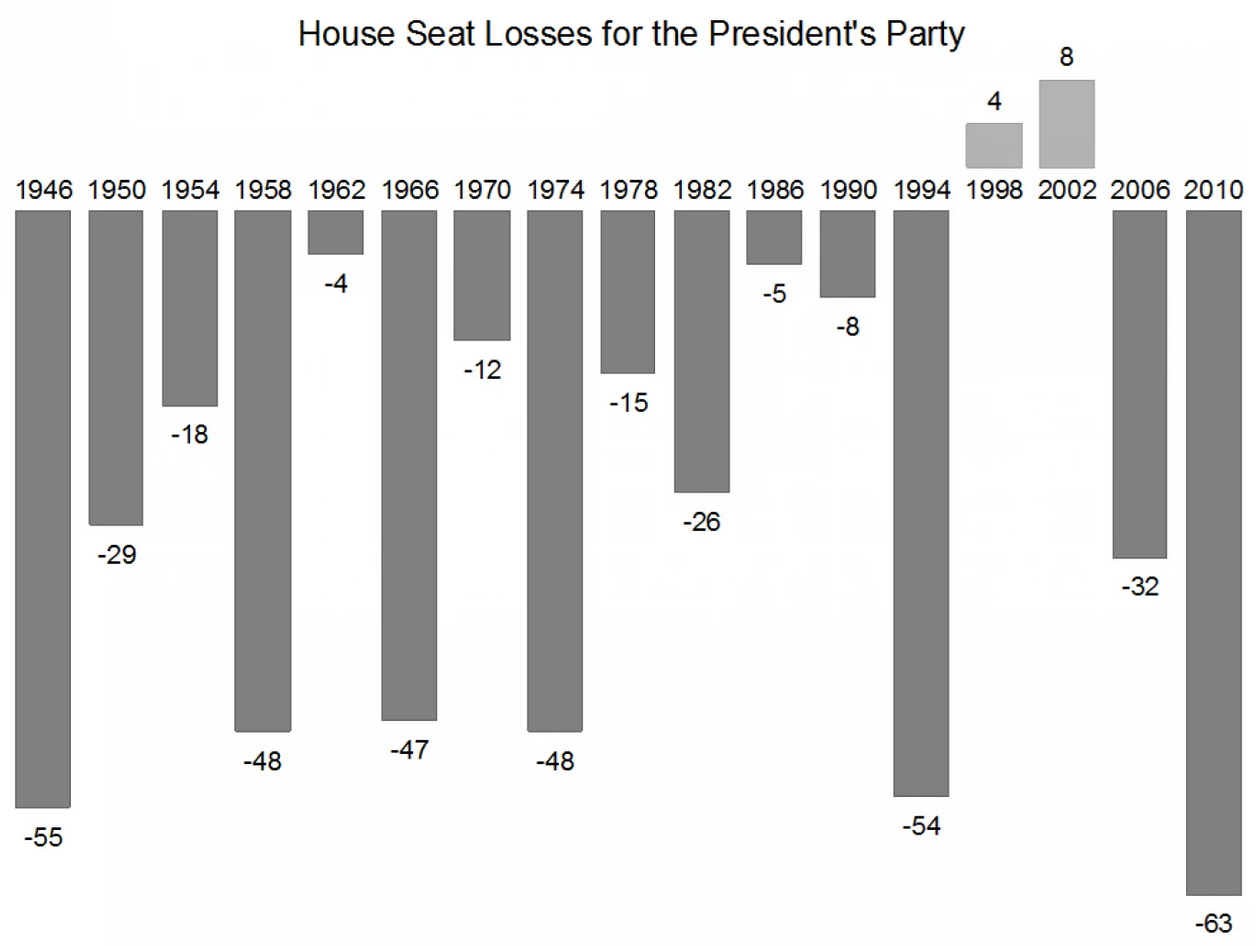
John Sides notes that the “president’s party tends to lose seats in midterm elections. Period.”

Part of the story is that the president isn’t on the ballot, and he often supplies coattails for congressional candidates to ride on.  Part of the story is that the electorate may react against the ideological direction of the president’s party–as it has since Obama took office–and seeks to elect candidates from the other party.  In any case, the “midterm penalty” is important.  In elections from 1980-2012, we estimate that this penalty is 3 points of vote share.

Derek Willis looks at possible outcomes:

For Democrats, who hold 199 seats, a good night would be not losing any seats at all. At best, they could gain perhaps two, but that seems a very long shot. If things go as expected for Democrats, they could wind up with their lowest total since 1949, when they had 188 seats. (They had 193 after the 2010 elections.)

Enten believes that the GOP’s unpopularity is holding it back:

A Republican gain of five to 12 seats is significantly less than one would expect using presidential approval ratings alone as a predictor. If voters cared only about Obama’s performance, we’d expect a much more lopsided result: A Democratic loss of about 25 seats. That seems unlikely. Part of the reason that gains will be kept down is that, at 12.4 percent, this is the lowest congressional approval rating going into a midterm election since the question was first asked in 1974.

Overall, the House is all but determined. It’s falling right along the lines that we thought it would given the factors that normally accurately forecast House elections. Republicans are set to gain because it’s a midterm year and the president is unpopular, but they probably aren’t picking up as much as ground as they would if Congress were more popular.

Regardless, Chait expects the Republican House to keep Washington gridlocked:

If the House could make a deal with Obama, the Senate would sign on to the deal if it were controlled by Republicans or if it were controlled by Democrats. Gridlock will continue through the next Congress regardless of the Senate race.

Indeed, gridlock will continue after 2016 as well, unless Republicans win the presidency (in which case the House will churn out Republican bills for signing, as it did under George W. Bush). To get a sense of just how grim the picture is for Democrats, Benjy Sarlin reported several months ago on a Democratic plan to try to win back the House in 2020. The year 2020 is not picked out of a hat. It coincides with the next Census, which will redraw the House map. Sarlin’s reporting makes it pretty clear the Democrats don’t have an especially good chance of winning back the House in 2020 — it’s simply the next time such a prospect becomes even faintly imaginable.

Divided Government Down The Ballot

Tim Storey predicts more divided state governments:

U.S. states are at historic lows of divided government. Only three legislatures have chambers controlled by opposite parties (not factoring in the coalitions in New York and Washington). The last time that there were only three split legislatures was in 1944. When matched up with control of governors to determine full partisan control of state government, there are only 11 divided states headed into the election — the lowest number since 1952. With at least 11 close gubernatorial contests and about 10 legislative chambers that are truly toss-ups, it looks certain that at least some states will move from unified government to divided. That is almost guaranteed to happen in Pennsylvania, where incumbent Gov. Tom Corbett (R) trails badly in the polls. In several traditionally Democratic states like Massachusetts and Illinois, Republican gubernatorial candidates have a shot at winning, so those states could end up with divided governments as well.

Earlier Dish on the importance of state legislatures here.


The Governor Races Could Go Either Way

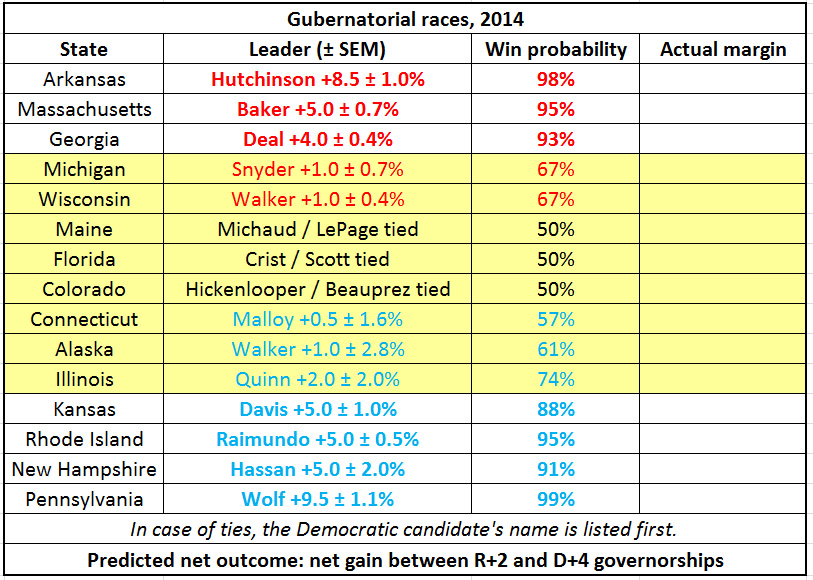
Sam Wang provides “final polling snapshots for gubernatorial races that are either close or likely to switch party control”:

gubernatorial-races-2014

Enten explains the lay of the land:

There are a lot of tight races. Five seats are forecasted to flip from Republican to Democratic or independent control: Alaska, Florida, Kansas, Maine and Pennsylvania. Two seats are projected to flip from Democratic to Republican control: Arkansas and Massachusetts. If all the FiveThirtyEight favorites win, Republicans will have 26 governorships in 2015, Democrats will have 23 and independents will have one.

Dickerson wonders about the lessons taken from the results:

Drawing a conclusion will be more complicated than simply waiting to see if Republican governors are re-elected.

If Gov. Scott Walker wins in Wisconsin and Gov. Sam Brownback holds on in Kansas, they will both be able to argue that they survived even after taking political risks to govern as proud conservatives. If, on the other hand Ohio Gov. John Kasich cruises to a big victory, that might show something different. Kasich, and Gov. Rick Snyder of Michigan, opted to take the federal Medicaid money as a part of the Affordable Care Act. Doing so was once considered heresy in conservative ranks. But now people like Newt Gingrich point to Kasich as a model for expanding the Republican Party with black voters. In Gingrich’s election-eve predictions, he cites that Kasich won the endorsement of a black newspaper. The Ohio governor won that endorsement because he took the Medicaid money. Almost all of the vulnerable Republican governors this cycle did not. Will their victories or defeats render a verdict on that decision?

Larison cautions against over-hyping the Walker result:

If Walker does end up losing, as I am predicting he will, it shouldn’t come as a great shock, nor should it be treated as such a huge setback. Let’s remember that Walker was first elected in an unusually good year for Republicans in a state that had not made a recent habit of electing Republicans to statewide office. In that extraordinarily Republican year, Walker won with 52% of the vote. In a less lopsided election year, it’s possible that Walker might not have won the first time. Considering the controversy in his first term and the attempted recall, it wouldn’t be so strange if the electorate of a normally Democratic-leaning state grew tired of Walker and chose someone else to replace him. It does Republicans no favors to exaggerate the importance of any one governor’s race, and it would be a mistake for anyone to read too much into a Walker loss.

Will The GOP Block Obama’s Judges? Ctd

Sarah Binder isn’t so sure:

[E]ven in recent periods of divided control, the opposition party has been willing to confirm roughly half of a president’s appointees to the bench — not least because such nominees are often favored candidates of opposition party senators. (And as I noted here, even after Democrats banned judicial and executive filibusters, Republican senators voted to confirm most judges even after opposing them on cloture.) This fall, for example, Obama nominated a Utah judge to a federal district court bench with the glowing support of Republican Sen. Orrin Hatch of Utah. Perhaps a Republican Senate will leave advice and consent in tatters, seeing little gain to filling seats better left open for a Republican president.  Still, I wouldn’t be surprised to see Republicans leverage their majority power to continue to secure lifetime spots on the bench for judicial candidates well known back home.

Jeffrey Rosen imagines what would happen if a Supreme Court justice dies or retires. His “optimistic” scenario:

Democrats can point to bipartisan Supreme Court confirmations, like justices Clarence Thomas and Antonin Scalia, where they have voted for nominees with whom they disagree. And there is next to zero historical evidence of gridlock causing extended vacancies (although that could be plausibly chalked up to the fact that we didn’t experience divided government very often in the early years of the republic). Even Obama himself, in a recent interview with The New Yorker, suggested there would be pressure for Republicans to approve a nominee, saying that intense media coverage of SCOTUS nominations “means that some of the shenanigans that were taking place in terms of blocking appointments, stalling appointments [to the lower courts], I think are more difficult to pull off during a Supreme Court nomination process.”

On the other hand, there’s no particular grounds for optimism with a Democratic president and Republican Senate. With their vitriolic obstruction throughout the Obama presidency, including a fight over the debt ceiling and a government shutdown, some Senate Republicans have shown a willingness to paralyze the basic functions of governmentand might be comfortable with an evenly divided Court of eight justices, which could mean repeated 4-4 deadlocks and opinions that lack precedential value.

Earlier Dish on the subject here.