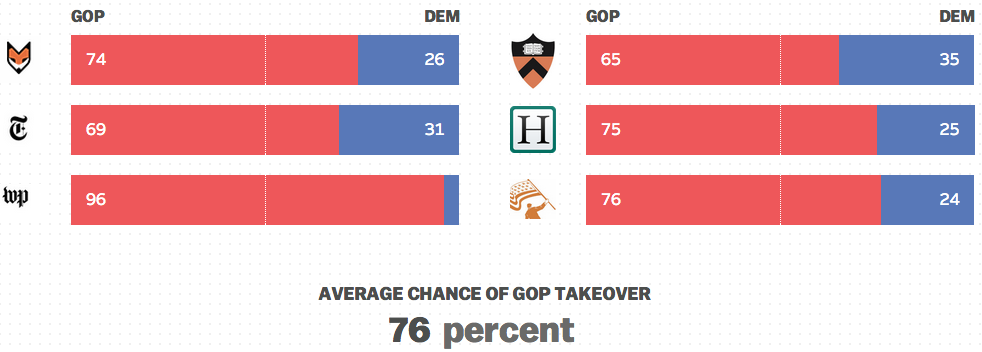
At this point, Democrats hoping for an upset are largely banking on the polls being wrong. Nate Silver explains:
The FiveThirtyEight model accounts for the possibility that the polls could be systematically biased — in either direction. If I instead tell the model to assume the polls have no overall bias — even though they might be off in particular states — the Democrats’ chances of keeping the Senate would be just 17 percent. Democrats are becoming increasingly dependent on the possibility that the polls will prove to be “skewed.”
But Silver notes that the polls “could be biased against Republicans, too”:
Historically, that’s been the case often than not in red states like the ones where some of the most crucial Senate races are being held.
Enten thinks “the more pressing question now may be the size of the Republican majority come next Congress”:
New polls out this weekend suggest that Republicans may not just win the six seats they need for control, but quite possibly eight seats — Republicans now have a 41.4 percent chance of doing just that. … If we add up all the states where Republicans lead, they will win eight seats for 53 seats in the next Senate. Sure, Democrats still have chances in Alaska, Colorado, Georgia and Iowa. But the Republican position is holding steady, if not improving, in all the states they need for a majority.
Any outcome we’ll see is likely to be roughly consistent with the underlying electoral fundamentals — a Democratic president’s low job approval rating, a tepid economy, a bad playing field for Democrats in the Senate and a good one in the House. Back in the winter, when “fundamentals”-based models were being produced, people were predicting Republican gains in the Senate in the range of six-to-eight seats, with error margins putting us in something of the four-to-10 seat range. This seems to be where we are headed.
But the upshot of this is that we can’t make grand predictions about 2016 and beyond. If 2014 was well-predicted by fundamentals (as were 2008 and 2012), we should continue to expect that elections will be well-predicted by fundamentals; we should prefer a parsimonious explanation to a more complex one. It is Republicans substantially over-performing or under-performing that might be meaningful, not Republicans getting what we’d expect, given the circumstances.
But, in Nate Cohn’s estimation, if Tuesday “night ends with tight races in Iowa, North Carolina, Colorado and Georgia, as the polls suggest, then the results will not be as great for Republicans as many analysts will surely proclaim”:
If there were a time when the Republicans ought to be making inroads into the Obama coalition, this should be it. The economy remains mediocre in many respects; there is turmoil in much of the world; and the American public is decidedly downbeat about the state of the country under Mr. Obama. His approval ratings have sagged into the low 40s. A significant proportion of Democratic-leaning voters say they disapprove of his performance.
Historically, presidential ratings like these have permitted the party that does not hold the White House to make substantial gains. This year, however, Democratic Senate candidates in the battleground states have largely reassembled the coalition that supported Mr. Obama two years ago. Democratic candidates would probably win Colorado, North Carolina, Iowa and Georgia — along with control of the Senate — if those who vote were as young, diverse and Democratic as they were in 2012 or will be in 2016.
Kenneth Chang brings us the latest on the Virgin Galactic tragedy:
The Virgin Galactic space plane that broke apart over the Mojave Desert on Friday shifted early into a high-drag configuration that was designed to slow it down, federal accident investigators have said. The accident killed the co-pilot, Michael Alsbury; the pilot, Peter Siebold survived after parachuting out of the plane.
From the beginning in 2004 there has always been a credibility gap between the fairground hyperbole of [Virgin Group founder Richard] Branson’s formidable publicity machine and the scientific reality of the enterprise. Somehow, probably because he is such a consummate showman, Branson has been able, year after year, to override the story of continual delays, flagrant over-promises and a voracious, seemingly open-ended budget. This time it’s different. A National Transportation Safety Board investigation will deliver a forensic rigor that has been so far lacking. It will strip away the vocabulary of the promoter. And it will reveal the world as lived daily by the engineers and test pilots who knew how much was left to be understood among the hazards of the dream.
Adam Rogers predicts that, following this crash, “we’re going to hear a lot about exploration, about pioneers and frontiers. People are going to talk about Giant Leaps for Mankind and Boldly Going Where No One Has Gone Before.” He recommends we “call bullshit on that”:
SpaceShipTwo—at least, the version that has the Virgin Galactic livery painted on its tail—is not a Federation starship. It’s not a vehicle for the exploration of frontiers. This would be true even if Virgin Galactic did more than barely brush up against the bottom of space. Virgin Galactic is building the world’s most expensive roller coaster, the aerospace version of Beluga caviar. It’s a thing for rich people to do: pay $250,000 to not feel the weight of the world.
Jazz Shaw focuses on the financing of such projects:
The problem I’m wondering about here is that there are really only two target customer markets for these ventures. The government is the only viable buyer for services to ferry materials and astronauts to the space station. And while the government is a very regular customer, one change in administration or shift of a few decimal places in a budget committee report can dry up your sales overnight. The only other customers for an entity like Virgin Galactic are very high end, wealthy tourists. Initial ticket sales – even at a quarter million a seat – have been brisk, but one or two explosions can dampen the enthusiasm of your target audience. And even if everything had gone perfectly, there is surely a limit to the number of buyers for a service like this once the novelty has worn off.
Mataconis calls Virgin Galactic “little more than a Richard Branson vanity project that was unlikely to lead to a viable business in the near future.” But he is more optimistic about “the side of commercial space travel represented by companies like SpaceX, Boeing, and Orbital Sciences”:
For the time being, there’s obviously not going to be the kind of free market in space that some evangelists for commercial uses of space have talked about in the past. One imagines, for example, that Branson’s “space tourism” idea is pretty much dead for at least the next decade in much the same way the civilians in space program was put on hold after the Challenger disaster, but the involvement of private companies in the space program is likely to increase. Don’t be surprised, for example, to see things like SpaceX, Boeing, and other companies contracting directly with private companies for launches rather than going through the Federal Government. In other words, there is a future for the commercialization of space to some degree, but much of most of our efforts to “slip the surly bonds of Earth,” it is still at the point where we are moving slowly.
Wilson da Silva, who pre-purchased a Virgin Galactic ticket, is still excited about going into space. He compares the histories of space and air travel:
The pioneers of powered flight, brothers Wilbur and Orville Wright – who gave birth of the modern age of flying – experienced a fatality in September 1908, on their third demonstration flight for the US Army before a crowd of 2,000 people in Fort Myer, Virginia. Orville took up one passenger with him, and the third of these – 26-year-old Lieutenant Thomas Selfridge – became the first passenger to die in an aircraft accident: the propeller came off, and the plane nosedived 23 meters; Selfridge died from a fractured skull, and Orville suffered a broken leg and ribs.
Aviation become important in World War I, but despite some advances in the 1920s, it was still dangerous and fatal accidents were routine. Pilots flew 100m above ground, navigating by roads, railways and compasses. It took years of flying and experimentation before air travel became safe. Between 1920 and 1926, one in every four pilots was killed annually; in the 1930s, one in 50. By 1966, it was one in 1,600.
Alex Tabarrok remarks that “the safety of rockets continues to be far too low to support significant tourism”:
Virgin Galactic’s VSS Enterprise, which crashed [Friday], was just on its 23rd powered flight suggesting a failure rate of perhaps 5%, in line with expected values. An earlier tragedy involving tests of the rocket motor killed 3 people. As I said ten years ago, even a failure rate of 1 in 10,000 is far too high to support space tourism of the “fat guys with camera” variety and we are not yet close to a failure rate of 1 in 10,000.
Dish’s coverage of last week’s other aerospace accident, the Antares rocket explosion, is here.
(Photo: Debris from Virgin Galactic SpaceShip 2 sits in a desert field north of Mojave, California on November 2, 2014. By Sandy Huffaker/Getty Images)
The Social Welfare Research Institute at Boston College estimated that a minimum of $41 trillion would pass between generations from 1998 to 2052. This huge transfer, the researchers believe, will usher in what they call “a golden age of philanthropy.” Even as most younger Americans struggle to obtain decent jobs and secure property, the Welfare Institute concluded, America is moving toward an “inheritance-based economy” where access to the last generation’s wealth could prove a critical determinant of both influence and power.
He realizes that “the biggest long-term impact may come from the nonprofit institutions that the wealthy fund”:
Nonprofit foundations have been growing rapidly in size and influence since the late ’20s, paralleling the expansion of other parts of the clerisy like the universities and government. Between 2001 and 2011, the number of nonprofits increased 25 percent to more than 1.5 million. Their total employment has also soared: By 2010, 10.7 million people were employed by nonprofits—more than the number of people working in the construction and finance sectors combined—and the category has expanded far more rapidly than the rest of the economy, adding two million jobs since 2002. By 2010, nonprofits accounted for an economy of roughly $780 billion and paid upwards of 9 percent of wages and 10 percent of jobs in the overall economy.
Nonprofits, due to their accumulated wealth, are able to thrive even in tough times, adding jobs even in the worst years of the Great Recession. In the past these organizations might have tended to be conservative, as inherited wealth followed the old notions of noblesse oblige and supported traditional aid to the poor, such as scholarships and food banks. But the new rich, particularly the young, tend to be more progressive, or at least gentry liberal.
The leading lights of the Enlightenment weren’t as worldly as we imagine they were, according to recent research from Stanford:
CESTA’s biggest project is Mapping the Republic of Letters, a catch-all title for a series of studies, including [Giovanna] Ceserani’s, that aim to shed light on the internet of the Enlightenment: the network of correspondence that linked intellectuals in the 17th and 18th centuries. “We’re like the NSA,” says Dan Edelstein, a professor of French. “We look at who wrote to whom, when and where.”
An obvious target for this form of surveillance was Voltaire.
Among his many contributions to the Enlightenment was his “Lettres Philosophiques”, published in 1734, which he claimed introduced Locke to a French readership. Voltaire had lived in Britain for three years and spoke English. So when Edelstein first looked at the visualization of his correspondence, “what jumped out at me was that Voltaire wrote so little to Britain. There were only 140 letters out of a total of around 15,000—less than 1 percent.” …
This is a recurrent theme in the Republic of Letters project. The networks of the intellectuals of the Enlightenment were far more restricted than the academics had imagined. Paula Findlen, a professor of Italian history, says the same was true of Galileo. “We think of him today as perhaps the first scientific celebrity. But he lived in a relatively local world until he was forced not to.” It was only after this great polymath came under the menacing gaze of the Inquisition that he reached out for help to non-Italian intellectuals.
For the reader who says that you can’t arrive at the position that the self doesn’t exist by argument, in fact the Gelug lineage of Tibetan Buddhists (the one in which the Dalai Lama belongs) believes that not only is logic helpful in this endeavour, it is essential. You must first convince yourself of the logic underlying the no self position before meditating on it. They liken it to taking a horse through a race course before a race. And the logic used, based on Tsongkhapa’s interpretation of Nagarjuna’s Introduction to the Middle Way, is extremely convincing. A great summary of it can be found in Guy Newland’s Introduction to Emptiness. The Dalai Lama’s How to See Yourself as You Really Are is a bit more bare bones.
However, I do agree with the reader that you and most of your other readers are misunderstanding what the absence of self infers. It doesn’t mean a zombie-like annihilation of personality. It simply means recognizing that the thought “me” refers to something that you believe to exist inherently, whereas nothing can be said to exist inherently. There is still a “me”, it’s just that it exists moment to moment. For a good discussion of this, listen to this Philosophy Bites podcast on a possible connection between Hume and Tsongkhapa. As to how the belief in an inherently existing self dominates our day-to-day existence, check out the YouTube video [seen above] by Sakyong Mipham, spoken word artist and son of Chogyam Trunkpa.
Another reader flags a recent podcast between Sam Harris and Joseph Goldstein:
Another practicing Buddhist:
The question of “does the self exist” troubled me for several years before I came to a place of peace. Buddhism says that nothing exists in a permanent state – the whole of reality is in a constant state of change. The English word used to describe this within Buddhist circles is Impermanence. Mountains erode, water evaporates, molecules change composition over time, and even the cells of our body are being replaced.
It was easy to see this when I looked at external things. My trouble was that I felt like no matter what my childhood memory was, “I” had always been there, and “I” would be here tomorrow too. After all, who is experiencing these things, if it’s not “me?” And so I struggled through meditation and reading the dharma, adhering to the Buddha’s advice to rigorously test every proposition put forth in the writings.
This impasse was finally broken when I began to realize that I was taking the first part – “not existing” – and ignoring the second part – “in a permanent state.”
The self, like the mountain, is a creation of forces outside it, subject to new forces every day that change its shape in varying degrees. From one small, indefinable moment to the next, the mountain, and the self, are different. We may build upon the past, or we may have a part of ourselves chipped away, but there is no part of us, or the mountain, that is safe from the expanses of time. We may maintain residues from previous experiences, and we may get new things heaped upon us. I will never forget my wife’s first miscarriage, or the death of my close high school friend, or the first time I kissed a girl, or the moment my daughter was born. But even these memories are constantly shaped and reshaped by new experiences and reflections. They happened to “me,” and they continue to happen to a different “me” every time I think about them.
When I stopped fearing my own “non-existence” and instead embraced how different life events had and would continue to shape me, the world slowly opened up. New tragic experiences are no less tragic, but a calming peace is generally present in spite of acute suffering. Somehow life seems a bit less sad.
Another connects the idea of the self not truly existing to my own attachment to Christian moral ideas:
As a former Catholic, I can identify with much of where you’re coming from in your writing, particularly with your fierce sense of morality. What I want to say here is that the idea that there is no inherently existing self is completely compatible with Christian belief. There is still a dependently arisen self from moment to moment that experiences things and acts with moral agency in the world.
On the other hand, saying as you do that the self is filled with God’s love and becomes more itself is fundamentally illogical. On the absolute level, in this present moment, there is nothing to become. There is no target to hit that has somehow been existing forever outside this moment. There is only you, as you are, right now, the you that exists in dependence upon all your previous moments. From a Christian point of view, where this takes us is particularly liberating, because it means that you can change. Given the right causes and conditions (the right training), you can develop more compassion, more love, more tolerance and so on, specifically because your self is empty of inherent existence. To paraphrase the great Nagarjuna, it is only because there is no inherently existing self that morality, even Christian morality, can work.
One more Buddhist:
I’m really enjoying your discussion of Sam Harris’ book, not so much because Harris has discovered something new, but because he talks about things seldom mentioned outside of Buddhist or Advaitic estoerica, which is my personal habitat. Still, he misses a few things, particularly because his agenda is to create a scientific-rationalist version of Buddhism for the modern West. I even approve of such efforts, but in his discussion of the notion of no-self in Dzogchen and Buddhism, he’s really missing the primary point.
In Buddhism, the doctrine of no-self is a major element of the overall viewpoint that is called “dependent origination”. In this view, all suffering begins with ignorance of our true nature, and proceeds from there to create a recurring loop of experience that cycles through all sorts of stages and realms of mind and body and cosmos, endlessly feeding upon itself in a kind of circular logical progression, like a snake biting its own tail. The entirety of the Buddhist teaching is aimed at breaking this cycle built on ignorance, so that the whole thing unravels, and all these illusions fall apart.
Understanding dependent origination in the most visceral of terms is the primary method for breaking this chain of ignorance. Thus, the very process by which this illusion of a personal, separate self is created, also becomes our primary weapon for breaking it down by interrupting that cycle at various key junctures. Because it is so dependent on each link in the chain moving on to the next, any break in the chain causes the whole thing to collapse. The teaching on no-self hits one of those junctures, and by gaining insight into the reality that we have no real intrinsic self, the whole chain of dependent assumptions built on that begins to fall apart.
However, it needs to be said that Buddha did not emphasize focusing on the “illusory personal self” link in the chain, in part because it was so subtle and hard to experientially relate to. Instead, he focused on things much more tangible and real to us: our felt sufferings and cravings. These two elements of the chain of dependent origination are much easier to relate to than abstract notions of a personal self, something it is hard not to simply take for granted. In fact, what Buddha generally pointed out is that what we call a “self” is really just a collection of desires, cravings, and sufferings, or our general sense of dissatisfaction. From all those desires and cravings, our personal sense emerges, as a reflection of our ignorance about these things.
That’s what the Four Noble Truths directly address: not no-self, but dukkha, or the pervasive sense of dissatisfaction and suffering that we cannot seem to escape except through temporary and partial respites; and tanha, or craving, the intense and unavoidable burning desire for escape from that feeling of dissatisfaction. These are things we can immediately relate to, without any abstraction or conceptual thought, whereas this ephemeral self-sense is much harder to find or maintain an approach towards.
The message that the Buddha really wanted to get across was a very visceral one: that our dissatisfaction and the craving for release from dissatisfaction drive all our sufferings in an endless loop, and they even create a corresponding self-sense that feels perpetually depleted, unhappy, and impossibly trapped in an existential cycle that seems inescapable, and thus we mistakenly conclude that the best we can do is find temporary pleasures or respites from this, and find ways to manage or minimize the inevitable sufferings.
Buddha’s revolutionary teaching was that contrary to what seems to be the case, there’s actually a way out of this, which is to see the whole picture of dependent origination, and to stop playing at that game at the most obvious places in that chain. Stop all activity based on craving for satisfaction for this illusory personal self. Stop chasing phantom pleasures and solutions and fantasies of relief and salvation. Stop believing in the nonsense our cravings lead us to believe in. That’s what meditation boils down to, and why it is so beneficial to us, if we do it as the Buddha recommended. Not as a way to fulfill our cravings for satisfaction, but as a respite from the endless cycles of craving for satisfaction that so torture us. In an odd way, a great bliss seems to naturally arise when we stop craving personal satisfaction. As the Buddha once said:
No earthly pleasure
No heavenly bliss
Equals one infinitesimal fraction
Of the bliss of the cessation of craving.
What Dzogchen and other direct approaches to meditation do is not a form of esoteric magic, it is simply break in this cycle, in which we cease to feed our mind and body’s craving for personal satisfaction, which drives most of us most of the time. Even a short moment of respite from this cycle produces great benefits of relief and relaxation that show us that there’s a real life beyond the craven pattern we have assumed to be necessary to our existence. And that’s what meditation is really all about; not merely some sort of good feeling that comes from sitting quietly, but a cessation of the ignorant activity that keeps us running like hamsters on the wheel of craving.
But even that relief can become something we crave and try to hold onto and conceptualize about and make the basis for a new, more spiritual self. Even science is simply something we can misuse as a better, more logical means to satisfy our cravings for a better self. And sometimes I think that’s what Sam is after, rather than freedom from craving itself. As if by holding onto this genuine insight, he can find some kind of actual satisfaction of his more ordinary craven mind’s desires. He’s certainly not alone in this; it’s part of the whole pattern to be understood, but it’s not enough to merely grasp, even experientially, the truth of no-self. One must also understand the much more obvious truths of craving and suffering.
That’s the hard part of Buddhism, because we all have our cravings and our personal needs for satisfaction, and we expect even Buddhism or meditation to address these and give us that satisfaction, just in a deeper and more effective way. But Buddhism says no, don’t fall for that trap either. Just sit – even sit in that total sense of frustration and lack of satisfaction and unfulfilled craving. Let that burn you up, until it burns itself out. That, then, is enlightenment. The cessation of that craving, that has been allowed to burn itself out, is the definition of Nirvana. That’s not the end of life; it’s in reality the beginning of real life, a life based on reality rather than the cycles of craving. It turns out that suffering depends entirely on that cycle keeping itself going, and so when it collapses, not only does our sense of personal, separate self burn out, but so does our suffering. The heart itself breaks open.
Follow the whole Book Club discussion here. And join in by emailing your thoughts to bookclub@andrewsullivan.com.
I watched two decent documentaries on the Islamic State this weekend – long overdue. The Frontline version is pretty tough on the Obama administration – in part because they start the story the day US forces formally left the country, rather than when the US first arrived. And so you see only half the picture. The implication is that Obama squandered the multi-sectarian “success” of the surge, took his eye off the ball, and allowed sectarianism a comeback.
But if your core analysis of the clusterfuck is that we removed a Sunni government of a majority Shia country after decades of Sunni brutality, then surely, Shiite revenge, in various forms, was always inevitable. Some occurred in the horrific sectarian cleansing under the US occupation – but it was met with just as savage Sunni violence and, of course, a resilient, murderous Sunni insurgency as well. In the aftermath, it would have taken a miracle of Mandela-like magnitude for a Shiite majority government, once in power and free of foreign occupation, not to exact some kind of revenge or act out of a deep sense of paranoia about the Sunnis; and it would have taken another miracle for such acts not to have been answered in turn.
And they weren’t. The idea that a few more urgent phone calls or threats would have made a difference doesn’t pass the smell test to me. If we could barely contain the sectarian forces unleashed by the war with 150,000 troops, what hope when we had no troops left at all, or even a couple thousand? The last few years were for the Iraqis to finally make their choice as to what their future could be; and they could not overcome the past, or the entire history of the region. The only real alternative – a US occupation for decades – was simply not there. Maybe at some point Iraqis will be able to overcome their past. I sure hope so. But the only thing I’m sure of is that it won’t happen because America wants it to happen. Au contraire.
And the same sectarian history informs Vice‘s inside look at the IS. What I took from it was the totalizing coherence of the Caliphate’s vision. While the secular dictatorships of Saddam and Assad lie in smoldering ruins, and “democracy” in Iraq is empowering the infidel Shiites, of course a radically idealized theocratic invocation of the ancient Caliphate would have huge appeal (at least for the moment). It has erased the Sykes-Picot borders; it favors the most austere and ascetic form of Sunni Islam, and adds to these elements a kind of preternatural savagery toward its enemies or even its own population. That’s a very potent formula when fused with the Iraqi and Syrian Sunni populations seeking to defend themselves against Shiite regimes. So that’s what we have here – a well-trained, lethal, fanatical Sunni-state in embryonic form. And what Vice explains is how that is the real difference. Al Qaeda never ran a state or sought to. But IS is about a new political entity, attracting every frustrated, alienated young Muslim male left behind by the Arab Spring and yearning for meaning and direction.
How solid is this new “state”? Could they, for example, over-run Kurdistan or take Baghdad?
It seems unlikely right now. Their territory is currently very Sunni. And although the Potemkin Iraqi Army – did any of them ever expect really to fight? – is a slough of corruption and incompetence, there are plenty of nasty Shiite militias and dogged pesh merga who would put up one hell of a fight on their own territory. And it’s worth recalling how these extremist movements have crested and crashed in the past as their savagery and religious purism have alienated the very people they need to control. They could as easily implode at some point as they could explode.
Running an actual state – as opposed to territory being milked to finance and support a sectarian war – has not historically been in the Jihadist skill-set. It requires all sorts of compromises and pragmatism and good government that fanatics tend not to be interested in. All of which leads one to see the prudence of Obama’s very limited pseudo-war. I’d have preferred no intervention at all – because that alone would force the regional powers to reckon with the IS in a way that might actually lead to a resolution. But given that we have intervened, it makes sense for it to be about policing the borders of the IS – and, say, acting to protect Baghdad’s airport – rather than anything more drastic. Fred Kaplan is right to be tart:
Figures released by U.S. Central Command show that the airstrikes over Syria and Iraq, combined, rarely exceed 25 per day. That’s not nothing, but it’s close. A joke recently circulating among Kurds was that they couldn’t tell whether the Americans were not fighting while pretending to fight—or fighting while pretending not to fight.
We would have been better leaving it alone – if only to prevent the huge propaganda and recruiting tool that US intervention has created. (You want Iraq’s and Syria’s Sunnis to resist the fanatics? Don’t make them choose between the IS and the US.) But given Obama’s moment of weakness/panic this summer, what we’ve got is arguably the least worst of most of the alternatives. If the GOP wants to defeat the IS with combat forces, let them make that argument. If they want us to ally with Assad or Iran, ditto. Until then, we are stuck again in a quagmire in which, as yet, only our tippy-toes have gotten swamped. For which small mercies we should remain temporarily thankful.
Caitlin Doughty (of “Ask A Mortician” fame) explains why she believes Americans live in a “‘death denial’ culture”:
[W]e’re not engaging with death as a very natural part of life. We’re not treating it like it’s a very obvious endpoint to all of our activities. We’re trying to act like it’s not in many ways, and even more than that, we’re trying to act like the dead body doesn’t exist in culture. We just don’t see it. It’s hidden.
I think there’s a couple reasons why that happened. In the 1930s, there was a rise in both the medical industry and the funeral industry. Both of those industries said, “Hey, we’re the professionals. You shouldn’t die at home and you shouldn’t have the dead body at home. We’re equipped to do both of these things better than you would do yourself.” And the public, because there were growing cities and growing industrialization in all areas, really went along with it. So, we’re at the point now where we completely question whether we’re even able to die at home or have the body at home and take care of it ourselves. We rely on medical and funeral professionals as professionals.
Doughty also makes the unpopular claim that “death [is] a good thing”:
Death might appear to destroy the meaning in our lives, but in fact it is the very source of our creativity. As Kafka said, “The meaning of life is that it ends.” Death is the engine that keeps us running, giving us the motivation to achieve, learn, love, and create. Philosophers have proclaimed this for thousands of years just as vehemently as we insist upon ignoring it generation after generation. Isaac was getting his PhD, exploring the boundaries of science, making music because of the inspiration death provided. If he lived forever, chances are he would be rendered boring, listless, and unmotivated, robbed of life’s richness by dull routine. The great achievements of humanity were born out of the deadlines imposed by death.
According to Craig L. Blomberg’s Can We Still Believe the Bible?: An Evangelical Engagement with Contemporary Questions, perhaps more than you think. Reviewing the book, Louis Markos highlights areas where Blomberg pushes back against well-known critics of the Bible’s reliability, such as Bart Ehrman, arguing its trustworthiness “does not depend on its living up to logical positivist standards that would have meant nothing to Moses, David, Luke, or Paul”:
In chapter one, Blomberg puts Ehrman’s claim (from Misquoting Jesus) that “there are four hundred thousand textual variants among the ancient New Testament manuscripts” in the proper context. As he demonstrates, there are only two lengthy passages in the entire New Testament (the extended ending to Mark’s Gospel; the woman caught in adultery in John 8) that are sharply contested, and that do not appear in the oldest and best manuscripts. Neither of these passages contains vital theological or historical points that do not appear elsewhere in the Bible, and in all modern translations they are clearly marked as being questionable.
As for Ehrman’s 400,000 variants, Blomberg explains, they are “spread across more than 25,000 manuscripts in Greek or other ancient languages. … This is an average of only 16 variants per manuscript”. And of those variants, only “about a tenth of 1 percent . . . are interesting enough to make their way into footnotes in most English translations”. And the ones that do make it there offer no challenge to the authority of scripture on matters of faith and practice. “It cannot be emphasized strongly enough,” Blomberg concludes, “that no orthodox doctrine or ethical practice of Christianity depends solely on any disputed wording. There are always undisputed passages one can consult that teach the same truths”.
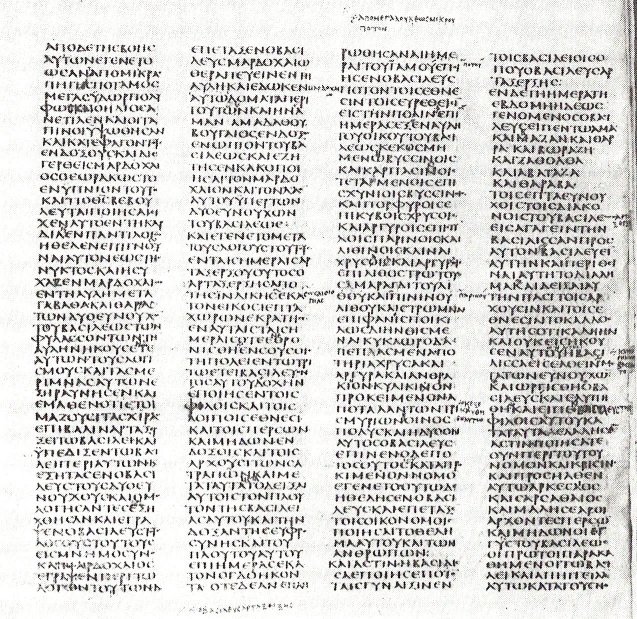
(An image of the Codex Sinaiticus, circa 350 A.D., containing the oldest complete copy of the New Testament, as well as most of the Greek Old Testament, known as the Septuagint, via Wikimedia Commons)




 The Dish
