Worshipping With Warhol

Mark Judge reminds us that the artist was a serious Catholic:

Andy Warhol’s family was Byzantine-Ruthenian, and in the early 20th century they came to America, settling in a Catholic section of Pittsburgh. Warhol’s mother Julia was deeply pious, attending St. John Chrysostom Byzantine Catholic Church. She took her children to Mass, and encouraged Andy, who was sick a lot as a child, to learn how to draw. Warhol drew pictures, went to church, and cut out magazine pictures of movie stars. In those three elements we find his entire life’s work.

Warhol moved to New York in 1949. He then went on to become the most famous artists of the latter 20th century. Warhol is associated with irony, disco, Pop Art paintings of everyday objects like Campbell’s soup cans, and cool. But he never lost the faith. Even during his high-flying Studio-54 days, Warhol would appear at Mass at St. Vincent Ferrer several mornings a week — and as a volunteer at soup kitchens. When his mother moved to New York to live with him, Warhol would warn visiting guests not to curse. Warhol also paid for his nephew to go through seminary and become a priest.

A good, if rare, overview of Warhol’s faith is Jane Daggett Dillenberger’s book The Religious Art of Andy Warhol. There is an entire section dedicated to the over one hundred drawings Warhol made of the Last Supper. When Warhol died in 1987, his eulogist John Richardson said that there were “two Andy Warhols” — the whimsical Pop Art celebrity and the shy and pious Christian.

Previous Dish on the subject here.

(Video: Warhol biographer Bob Colacello discusses the reissue of his Factory memoir, Holy Terror: Andy Warhol Close Up)

Darwin And The Divine

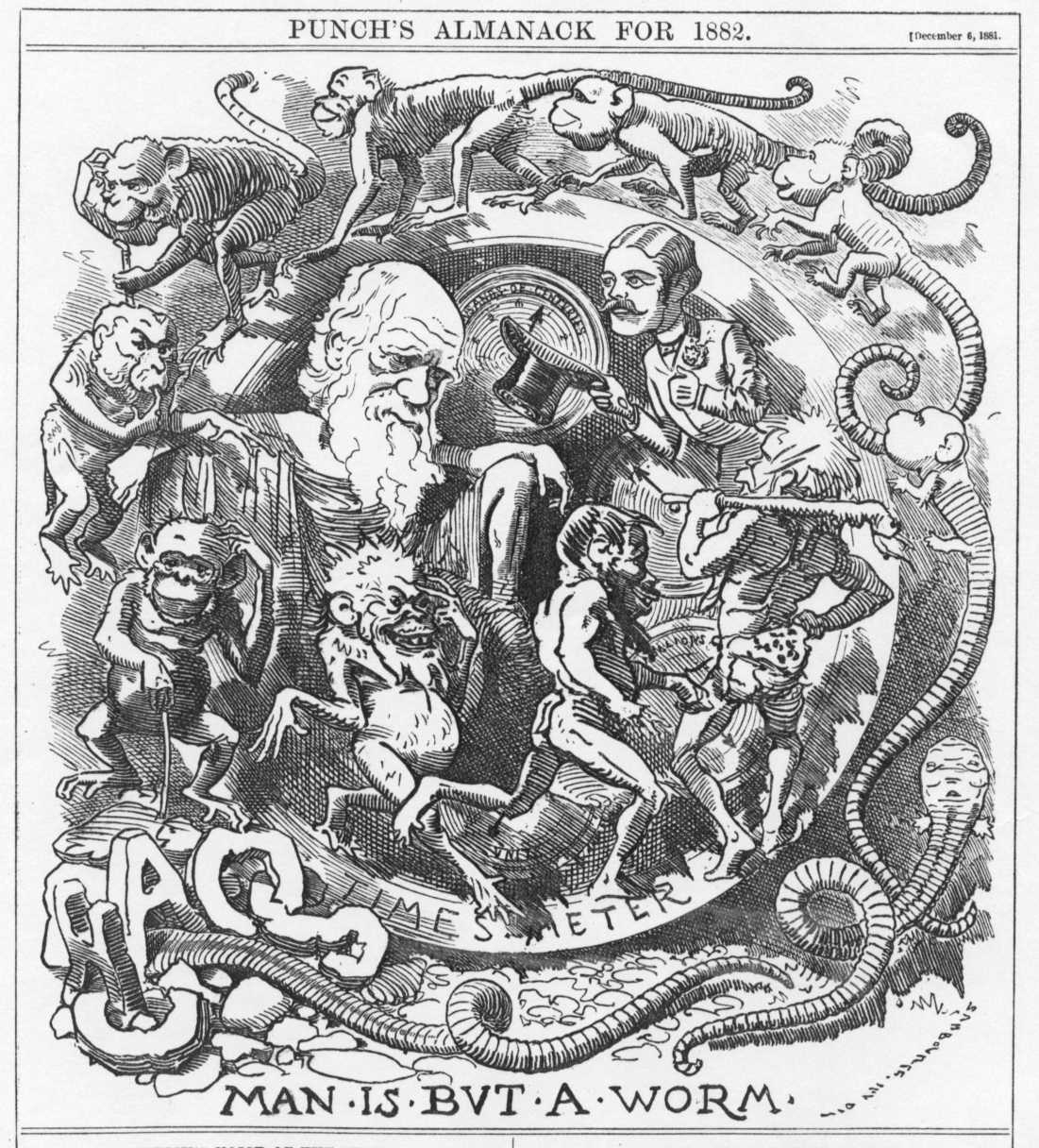
Man_is_But_a_Worm

Drawing from his new book, Darwin’s Dice: The Idea of Chance in the Thought of Charles Darwin, Curtis Johnson pushes back against an understanding of Darwin’s thinking about God that holds “he gradually shifted from ‘early orthodoxy’ to a ‘liberal form of theism,’ and then in later years ‘into an agnosticism tending at times toward atheism'”:

It seems probable that his departure from Christian faith was earlier, more abrupt, and more complete than this view indicates. The reason for thinking so stems from the same source that so many of Darwin’s contemporaries rejected a role for chance in nature’s workings: a chance-governed world seems tantamount to a godless world. Einstein made this very connection himself 75 years later when he famously said, “God does not play dice with the universe.” Darwin undoubtedly understood this implication of his theory, but rather than conclude that chance plays no role in nature he appears to have concluded instead that God does not have much to do with nature at all.

He goes on to excerpt a telling letter Darwin wrote to the Harvard botanist Asa Gray in May 1860, just a few months after the publication of The Origin of Species:

With respect to the theological view of the question; this is always painful to me.—I am bewildered.—I had no intention to write atheistically. But I own that I cannot see, as plainly as others do, & as I shd. wish to do, evidence of design and beneficence on all sides of us. There seems to me too much misery in the world. I cannot persuade myself that a beneficent & omnipotent God would have designedly created the Ichneumonidae with the express intention of their feeding within the living bodies of caterpillars, or that a cat should play with mice. Not believing this, I see no necessity in the belief that the eye was expressly designed. On the other hand, I cannot be contented to view this wonderful universe, and especially the nature of man, & to conclude that everything is the result of brute force. I am inclined to look at everything as resulting from designed laws, with the details, whether good or bad, left to the working out of what we may call chance. Not that this notion at all satisfies me. I feel most deeply that the whole subject is too profound for the human intellect. A dog might as well speculate on the mind of Newton.—Let each man hope and believe what he can.

(Image: Punch’s almanac for 1882, published shortly before Darwin’s death, depicts him amidst evolution from chaos to Victorian gentleman with the title “Man Is But A Worm,” via Wikimedia Commons)

Evangelical Heresies

Kevin P. Emmert relays the results of a new survey showing that “most American evangelicals hold views condemned as heretical by some of the most important councils of the early church.” One example? 22% claim God the Father is “more divine” than Jesus:

No doubt, phrases like “only begotten Son” (John 3:16) and “firstborn of all creation” (Col. 1:15) have led others in history to hold these views, too. In the fourth century, a priest from Libya named Arius (c.250–336) announced, “If the Father begat the Son, then he who was begotten had a beginning. … There was a time when the Son was not.” The idea, known as Arianism, gained wide appeal, even among clergy. But it did not go unopposed. Theologians Alexander and Athanasius of Alexandria, Egypt, argued that Arius denied Christ’s true divinity. Christ is not of similar substance to God, they explained, but of the same substance.

Believing the debate could split the Roman Empire, Emperor Constantine convened the first ecumenical church council in Nicaea in A.D. 325. The council, comprising over 300 bishops, rejected Arianism as heresy and maintained that Jesus shares the same eternal substance with the Father. Orthodoxy struggled to gain popular approval, however, and several heresies revolving around Jesus continued to spread. At the second ecumenical council in Constantinople in 381, church leaders reiterated their condemnation of Arianism and enlarged the Nicene Creed to describe Jesus as “the only-begotten Son of God, begotten of the Father before all worlds, Light of Light, very God of very God, begotten, not made, being of one substance with the Father, by whom all things were made.” In other words, the Son is not a created being, nor can he be less divine than the Father.

Matthew Block, commenting on these findings, blames the prevalence of such heresies on the way many Protestants read the Bible:

Too many Christians mistake “Scripture alone” as if it were a license for them to read the Bible alone—to read it apart from other people. You know the idea: “All I need is me and my Bible.” But that’s not what it means. It means that Scripture is alone authoritative, not that your personal (“alone”) interpretation of Scripture is authoritative.

While Scripture itself is clear on matters of salvation, it nevertheless can be (and often is) misinterpreted by sinful people. Jesus Himself faced this danger when the devil suggested to him misinterpretations of the Word of God (Matthew 4:5-6). We fool ourselves if we think we are somehow exempt from this danger. Christ, of course, did not fall for the devil’s suggested misreading. Unsurprisingly, the Word of God made Flesh knows the written Word of God better than does Satan. But we on the other hand can and do fall into such error—be it error suggested by our own sinful minds, the errant teachings of others, or, indeed, by the devil himself.

Personal piety and a desire for truth are not guarantees that we always read Scripture aright. Consequently, we must rely upon our brothers and sisters in the faith to correct and rebuke us when we err, demonstrating our errors by Scripture (2 Timothy 3:16). And this reliance on brothers and sisters refers not merely to those Christians who happen to be alive at the same time as us. Instead, it refers to the whole Christian Church, throughout time. We rely on those who have gone before us. They too get a say in the matter. As G. K. Chesterton has wonderfully put it, this sort of tradition is a “democracy of the dead.”
Getting Schooled On Athens

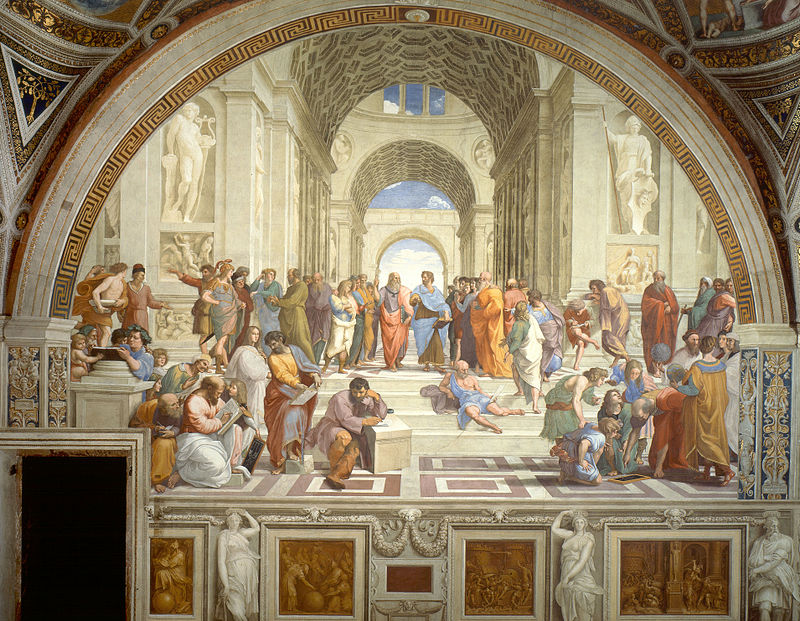
800px-Sanzio_01

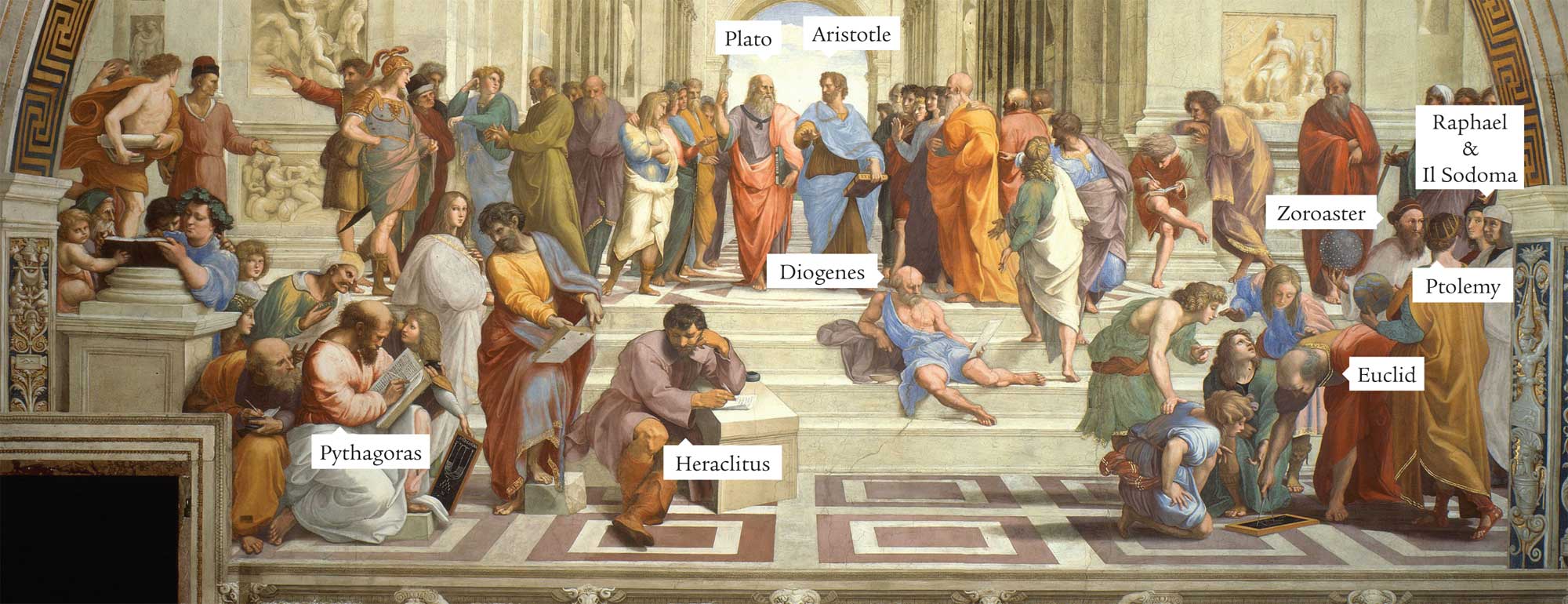
Mary Elizabeth Podles walks us through the characters and meaning of Raphael’s brilliant fresco, giving it a theological gloss:

Plato points to heaven; Aristotle points to earth. Plato’s drapery swirls around him on the diagonal; Aristotle wears the colors of earth and water, and his folds fall in a much more orderly pattern of horizontals and verticals. Plato is old; Aristotle is a man in his prime. Plato stands almost on tiptoe; Aristotle is firmly planted on the ground, perfectly balanced but, like a Classical statue, full of potential movement. Plato’s followers are young and passionate; Aristotle’s are older and more sharply contoured, more precise.

So the poetical and heavenly strain of Platonic discourse is balanced by the lucid clarity of Aristotelian investigation. But still, they are linked, the two streams merge:

Plato, whose main concern was ethics, holds a discourse on nature, and Aristotle, whose main interest was the natural world, holds his treatise on ethics. They stand in an archway in a colossal, unfinished building: is this overarching architecture a portrait of the new St. Peter’s rising next door?

The School of Athens is on the opposite wall from the Disputa, and so would have been read as the other side of the dialectic: Classical philosophy, the highest manifestation of the natural religions on one side, and Christian theology on the other. If the Disputa is the apse of a basilica, is this picture not the nave, so that the philosophy of the ancients becomes the path that leads to the altar where philosophers and theologians meet, where all human thinking finds fulfillment?

You can see a close-up of the work, including labels for all the key figures depicted, here.

(Hat tip: Micah Mattix. Image of Raphael’s The School of Athens, circa 1510, via Wikimedia Commons)

Human-Cyborg “Relations”

A.I. expert David Levy, the author of Love and Sex with Robots, expects that sex – or even an intimate relationship – with cyborgs will be considered perfectly normal within the next few decades:

“I believe that loving sex robots will be a great boon to society,” he says. “There are millions of people out there who, for one reason or another, cannot establish good relationships.” And when does he think this might come about? “I think we’re talking about the middle of the century, if you are referring to a robot that many people would find appealing as a companion, lover, or possible spouse.”

Spouse? “Yes.”

Michael Brendan Dougherty shakes his head:

The truth that Levy has lost is that healthy sexual desire does not take as its object a mere sensation or state, but a person.

We also know this, instinctively. If the hand that is discreetly caressing you is revealed to belong to someone other than your lover, the pleasure the hand gives is instantly poisoned and felt as a desecration. We have words for bestiality, pedophilia, and necrophilia, acts where the sexual object lacks personhood. The existence of anti-fap boards on reddit, as well as the recognition of pornography addiction as a serious problem, is more evidence that something goes wrong when sexual desire is directed away from people.

What healthy sexuality desires is a person. We don’t want mere sensations, but to be wanted and accepted by another. We want another persons’ conscious intentions for us acted upon our bodies, and for our intentions to be received as well. Lovers may use games that temporarily disguise consent and even pleasure itself, but their desire is to be freely wanted and freely given as persons, not as nerve endings. We call perverse those sexual encounters in which people intentionally and radically efface their own or another’s personhood.

A Whale Of A Film

Freddie Moore lovingly reviews 2010: Moby Dick, ranking it alongside other “great man-versus-beast bad movie classics, like Deep Blue Sea or Snakes on a Plane.” It is, she suggests, the “worst adaptation of all time”:

On the surface, the film is based on the book: It’s the ultimate story of revenge sought by a captain who’s had his ship and leg taken from him by a giant sperm whale. As a modern retelling, though, Ahab is a submarine captain and his strikes against the whale involve torpedos, machine guns and nukes. (Yes, nukes.) Not only that, but 2010’s version of the whale doesn’t stick to the ocean; he “swims” over mountains and even flies to attack Ahab and his crew.

She offers a drinking game for brave viewers. Drink up when:

1. Submarine emergency sirens sound;

2. Ahab says the word “whale”;

3. Race awkwardly enters the story (same thing goes for any time something sexist is directed at Dr. Herman);

4. Someone listens to sonar whale sounds;

5. Moby Dick makes rabid bull noises;

6. Someone says the word “hunt”;

7. Anyone tries to say anything remotely scientific.

Sex Shop Talk

3621698248_2b6981e7bc_o

After working in a gay fetish store for several years, Russell Dean Stone shares the “enduring truths” he’s learned about the job:

First, lesbians are the nicest customers. Without exception. Second, the last people you’d imagine buying a particular item will, without question, always be the first ones to buy that item. Tiny leather thongs bought by hugely overweight men, for example, or adult diapers snapped up by tall, hot, ripped biker men who you really, really wish didn’t have a fetish for shitting themselves. Third—and finally—that you must accept that a large portion of your day will be spent fielding prank phone calls and voicemails.

He goes on to ruminate about other occupational hazards, which include lots of TMI from customers:

Mind you, when those specifics are questions like, “I want to get fisted but have my hands free—do you have any harnesses that can accommodate a plastic fist?” you do sometimes have to reconsider the professional choices you’ve made.

(Photo by Corey Doctorow)

Will Literature Tear Us Apart?

Nonsense, asserts Zoë Heller, who declares that “[n]othing in my experience suggests that literary taste is a reliable guide to a person’s character, or that shared literary passions bespeak deeper spiritual kinship”:

I can see how disagreements about certain works of nonfiction might matter. If I were to come across a dear friend scribbling approving comments in the margins of “The Bell Curve,” that could be a game changer. And there are a few explicitly ideological novels (anything in the Ayn Rand oeuvre, for example) that I would be dismayed to find on a friend’s Favorite Books list. But the revelation in both these instances would be one of politics, of worldview, not of literary sensibility. Were a friend to tell me that he hated Jane Austen, my view of him and of our friendship would suffer not at all. I’ve known lots of fine men who did not “get” Austen and quite a few Janeites who were brutes. Besides which, my love of Austen is between Austen and me; it doesn’t need cheerleaders. …

Insisting that your loved one’s literary judgments be in harmony with your own suggests to me a rather dull and narcissistic notion of what constitutes intimacy. Do you really want to be one of those dreary couples who are always delivering their identical cultural opinions in the first person plural? (“Oh, we’re loving the latest volume of Knausgaard!”) One of the happiest romances I ever had was with a man who regarded George MacDonald Fraser’s “Quartered Safe Out Here” as the pinnacle of literary excellence. He also believed that Saul Bellow was a second-rate writer because “nothing ever happened” in his books. I thought he was mistaken in these matters, but I can’t say it bothered me much. Love is not love which alters when a man fails to appreciate “Herzog.”

Meanwhile, in another essay exploring literary intimacy, Helen Rosner suggests that “for a certain sort of person, sharing a book can be as intimate and exhilarating as sharing a kiss”:

Like a kiss, like a crush, like love itself, opening a book at someone else’s suggestion is simultaneously a solitary act and a shared one: We may travel these paths alone, but we visit common territory. When someone you love tells you about a book that he loves, it’s an act of revelation – intentional or not – that’s as intimate and vulnerable as being handed the keys to his childhood home. He’s telling you where he’s been, but even more than that, he’s trusting you to explore it on your own, knowing your steps will fall where his once did. (And oh, the thrilling signs and wonders that attend reading his own copy of the book: There’s a strange and profound power to holding the very same object in your hands that he once held and – by the same portkey – reaching, separately but identically, the same destination.)


The Wonders Of Wonder Woman

Dwight Garner is fascinated by Jill Lepore’s complex, well-researched history of the comic-book icon:

On the one hand, the story it relates has more uplift than Wonder Woman’s invisible airplane or her eagle-encrusted red bustier. It’s a yea-saying tale about how this comic book character, created in 1941, remade American feminism and had her roots in the ideas and activism of Margaret Sanger, the founder of Planned Parenthood.

On the other hand, The Secret History of Wonder Woman is fundamentally a biography of Wonder Woman’s larger-than-life and vaguely creepy male creator, William Moulton Marston (1893-1947). He was a Harvard graduate, a feminist and a psychologist who invented the lie detector test. He was also a huckster, a polyamorist (one and sometimes two other women lived with him and his wife), a serial liar, and a bondage super-enthusiast.

Etelka Lehoczky shares the juicy details:

It turns out that decades of rumors were true: The red-white-and-blue heroine, conceived during World War II, had a decidedly bohemian progenitor. For one thing, it was no accident that Wonder Woman got chained up in every episode. Creator William Moulton Marston actually fought to depict her that way. He also led a highly unusual lifestyle, living with and fathering children by two women at once. And the sex parties? Yep. In the mid-1920s he, his wife and two of his lovers participated in a “cult of female sexual power” organized by his aunt.

Meanwhile, Sarah Kerr considers the icon’s cultural significance:

The superheroine, Lepore argues, has all along been a kind of “missing link” in American feminism – an imperfect but undeniable bridge between vastly distinct generations. Hiding in her kitschy story lines and scant costume were allusions to and visual tropes from old struggles for women’s freedom, and an occasional framing of battles like the right to a living wage and basic equality that have yet to be decisively won.

Wonder Woman stories showed women shackled in endless yards of ropes and chains – a constant theme in art from decades earlier demanding the right to vote. The traditional allegory of an island of Amazon princesses appears in feminist science fiction early in the twentieth century; the rhetoric of a nurturing, morally evolved strongwoman opposed to the war god Mars goes back even further. At the same time, the early comics often included a special insert, edited by a young female tennis champion and highlighting women heroes. Those chosen ranged from white suffragettes to Sojourner Truth to Elizabeth Barrett Browning, professional and sports pioneers, and a founder of the NAACP. It’s unlikely that any platform for American girls’ role models was as popular as this one until three decades later.

Imbued With The Obscure

Damon Linker praises Arthur Melzer’s Philosophy Between the Lines: The Lost History of Esoteric Writing, calling it “the most compelling, surprising, and persuasive defense of [Leo] Strauss’s thought” he’s ever read:

Staying far away from questions of foreign (or any other kind of) policy, Melzer has chosen as his 51mChOBYESL._SY344_BO1,204,203,200_subject Strauss’ notorious assertion that virtually all philosophers up until the early 19th century wrote their books “esoterically” — that is, using a rhetoric of concealment, with a surface teaching meant for general readers and a hidden teaching for those who were intelligent, clever, and tenacious enough to uncover it. This contention has been dismissed by most non-Straussian scholars, who have tended to suggest that Strauss projected the phenomenon onto most of the canonical authors he discussed in his many learned books and essays.

Melzer supplies a mountain of evidence in support of Strauss’ claims — quotes from just about every major philosopher (and many other writers) from ancient Greece to 19th-century Germany testifying to the reality of esotericism. … It seems that up until roughly two centuries ago, almost every culturally educated person took for granted that books of philosophy (and sometimes also works of scripture and literature) were written in a style of deliberate obscurity.

Why the recovery of this way of writing – and reading – matters:

Toward the end of his book, Melzer urges scholars and other interested readers to undertake esoteric interpretations of the entire Western philosophical tradition, at least up through the end of the 18th century. If he merely meant to encourage careful, creative readings of old texts, the suggestion would be a little banal. But of course that isn’t all that Melzer has in mind. After all, his invitation follows an elaborate (and remarkably persuasive) effort to establish not only that pre-modern writers wrote esoterically but also why they did so — in part to shield society from truths that puncture the ersatz nobility of politics and point beyond it altogether, toward the fully examined life of philosophy.

A world in which readers regularly produced revisionist esoteric interpretations that exposed these truths to the light of day would be one in which our understanding of the Western philosophical tradition was radically transformed. It would, for one thing, look far more deeply skeptical, profoundly anti-utopian, and brutally realistic about the permanent problems of political and moral life than it is usually presumed to be.