“The Goldilocks Principle Of Grading,” Ctd

Last weekend, we highlighted Heidi Tworek’s proposed fix for grade inflation – adopting a three-tiered grading system. A high school history teacher nods along:

I think a move to a British-style system with only three grades, as advocated by Tworek, would be easier than it seems. We would just call our grades A, B, and C, rather than 1, 2, and 3. In fact, we’re already using a version of that system.

I teach high school history at a high-achieving public school in Massachusetts. Whenever I see grade inflation in the news, frankly, I’m a little baffled. The problem would disappear if we redefined what each grade represents. Traditionally, an F represents failing, a D represents below average, a C represents average, a B represents above average, and an A represents excellent. What if, as a society, we agreed that a C represents needs improvement, a B represents satisfactory, and an A represents excellent? In that scenario, we would ditch the D, and anything below a C- would be failing. This would simplify the system for everyone involved.

The reality is that today, a grade of a D is meant to be a warning – turn things around or you will fail. It is rarely given. Students who receive Cs are not average – they are students who struggle with the material or are students who are lazy and need to work harder. To recalibrate my grading scale to a traditional bell curve, where the majority of students received Cs, would result in serious pushback from my administration and from parents, and honestly, would be confusing to my students.

It’s time we made the de facto grading system de jure – B is the new C. Accept that, and the grade inflation problem, at the high school level anyway, ceases to be a problem.

That teacher offers a caveat: “I don’t mean this as a response to grade inflation in certain courses at certain colleges and universities where every student receives an A or an A-.” And another reader, who teaches history at the college level, dismisses Tworek’s proposal:

Heidi Tworek writes: “There are also fewer incentives for professors to assign higher grades if students recognize that the majority of them will receive the same mark.” Perhaps. But students respond to incentives (or the lack thereof), too. If there’s effectively no difference between a B and a D (which is how I’m defining that second tier), then the student capable of B work is probably only going to do C or D work, because it’s all the same to them. That’s a rational response. Under the current system, I have students earning a C or C+ at mid-semester who will work harder and learn more to get that B. That’s also a rational response.

Grade inflation is a recipe for mediocrity. So is this proposal.

My solution is simple. I pay no attention to any alleged “incentives” for grade inflation. An A grade goes to an exceptional student, not the norm. Sure, there’s a price to be paid. Students don’t rush to sign up first for my classes. They don’t barrage me with ego-inflating requests for overrides to get into my classes should they fill. I am not beloved the way some of my colleagues – the ones who hand out As like candy on Halloween – are. But I have, I suspect, the respect of at least some of my students (especially the ones who truly deserve As who bristle at the way their less committed peers get the same grade for far less work). And most importantly, I have some self-respect.

With the exception of adjuncts (which is a whole other problem), professors could easily solve the “problem” of grade inflation without any systemic change: show some backbone and enforce some standards. Stop caring about being loved and start caring about truly educating.

On a related note, philosophy professor Emrys Westacott is concerned that a constant focus on grading and assessment in general “chokes out healthier, more idealistic, more creative attitudes among both teachers and students, especially in our high schools”:

On one occasion I asked my daughter’s AP biology teacher if she would be taking the students outside at all during the year to examine nature in the raw. Her answer: she’d love to, but she couldn’t spare the time given the need to cover everything on the AP syllabus. Inevitably, the AP exam would be the guiding star that the class steered by: not love of nature, appreciation of natural forms, or delight in fathoming how living things function, but whatever needs to be known to do well on the test. Success on the test is the “measurable outcome” by which students are judged—and teachers, and principals, and schools, and, ultimately, entire education systems.

Students naturally soak up this message. … Most teachers dislike students trying to haggle over grades, but this behavior is a predictable response to the educational environment students find themselves in. If appearances seem to matter more than reality—grades on a transcript more than less easily measured values like holistic grasp of a subject, appreciation of beauty, intellectual excitement, insight, or wisdom—we shouldn’t be surprised to encounter such strategizing.

The Significance Of A Smile

Smirk

John Brewer looks at a brief history of the French grin in a review of Colin Jones’ The Smile Revolution in Eighteenth-Century Paris:

[Jones] begins with the stiff, courtly smile of supercilious superiority that emanated from the court of Louis XIV and which was associated with succeeding Bourbon monarchs – a look predicated on gross inequality, but also the result of appalling dental hygiene and care. … Courtly smiles were rare – La Rochefoucauld claimed to ration himself to one laugh a year – and could be treacherous when they cracked the facade of imperturbability. Tight-lipped smiles were part of a system of bodily control needed to survive in the duplicitous world of the royal court. They were also a social marker: no courtier wished to be seen (much less portrayed) as open-mouthed, which was at best a sure sign of demotic credulity, levity and bad manners, and at worst a feature of madness.

The 18th-century cult of sensibility, spread through performances on the Parisian stage and nurtured by novels of deep emotional intensity by the likes of Samuel Richardson and Rousseau, loosened the grip of the costive, courtly smile. Charming and tender smiles – transparent expressions of feeling intended to be shared by all men and women, though, in practice, chiefly enjoyed by the Parisian cultural and social elite – became fashionable. Teeth and smiles were chic – and so were dentists.

On a related note, Sarah Smarsh recently considered the psychological cost of living without dental care in 21st-century America:

My family’s distress over our teeth – what food might hurt or save them, whether having them pulled was a mistake – reveals the psychological hell of having poor teeth in a rich, capitalist country: the underprivileged are priced out of the dental-treatment system yet perversely held responsible for their dental condition. It’s a familiar trick in the privatization-happy US – like, say, underfunding public education and then criticizing the institution for struggling. Often, bad teeth are blamed solely on the habits and choices of their owners, and for the poor therein lies an undue shaming.

‘Don’t get fooled by those mangled teeth she sports on camera!’ says the ABC News host introducing the woman who plays [Orange Is The New Black‘s] Pennsatucky. ‘Taryn Manning is one beautiful and talented actress.’ This suggestion that bad teeth and talent, in particular, are mutually exclusive betrays our broad, unexamined bigotry toward those long known, tellingly, as ‘white trash.’

(Image: Portrait of Louis XVI of France, 1785, via Wikimedia Commons)

What Makes Mad Scientists Scary?

Young Frankenstein

Stuart Vyse wonders:

Halloween is a kind of Rorschach test of our common fears, and the available evidence suggests our nightmares fall into different categories. For example, we are afraid of murderous people and monsters, but we find them particularly frightening if they have some kind of extra deficit.

So, for example, zombies (an entirely fictional concept), as portrayed in contemporary movies and television shows—are fearful because, in addition to having the single motivation of gobbling up humans, they are amoral, soulless creatures, machine-like in their unwavering pursuit of flesh. In the case of common horror film villains, an additional creepiness is derived from a mixture of evilness and madness—amoral blankness and psychopathology. Thus the most successful of horror villains, such as Freddy Krueger and Michael Myers, combine both the absence of a moral anchor and the unpredictability of mental illness.

Of particular interest to me is the portrayal of scientists as fearsome crazies.

Science and reason are supposed to be the antidote to paranormal beliefs, and yet fictional scientists often appear as villains of paranormal horror films. Why? Part of the explanation must be the addition of madness to the character of the conventional scientist stereotype.

Cari Romm gets Vyse to expand on that thought:

Romm: In other realms, we don’t find the combination of genius and mental illness to be as threatening—there’s no “mad artist” trope, for example. Van Gogh isn’t scary. What is it about science in particular that makes the mad scientist frightening?

Vyse: It’s the idea that they have powerful knowledge. As an example, I’m an experimental psychologist. I’m a scientist. But if I’m traveling on an airplane and somebody asks me what I do for a living, if I say I’m a psychologist, they sort of become nervous and worried that I’m going to analyze them. There’s this sense that you have knowledge, that you’ll be able to find out things about me that I don’t want you to find out. And I think in the case of science, that’s exactly the case—that genius, combined with the power of science, is frightening, is potentially something that could be used against you in an evil way. If you think about it, there are a number of horror films in which the villain is a psychiatrist or a psychologist. It’s combining this idea of special knowledge that can be used powerfully to make that person frightening.

(Image: Young Frankenstein screengrab from Flickr user twm1340)

Secret Ingredients

Adrienne Raphel reveals some fast food items on secret menus you’ve probably never heard of:

In-N-Out Burger, the West Coast chain, has perhaps the most notorious fast-food secret menu. Since the nineteen-seventies, customers have been ordering Animal Style fries (fries smothered in sauce that resembles Thousand Island dressing and topped with melted cheese and diced grilled onions) and 3x3s (burgers with three patties and three slices of cheese), along with several other modifications that don’t appear on the menu. The corporate Web site now acknowledges some of these options as In-N-Out’s “not-so-secret menu”; they’ve trademarked “Animal Style,” “Protein Style,” “3×3,” and “4×4.” Yet, Carl Van Fleet, the company’s vice-president of planning and development, told me, “We don’t see ourselves as having a secret menu at all.”

These kinds of denials have been successful enough at presenting the impression of secrecy to attract a fair amount of attention. Liz Childers, in a Thrillist article, describes her mission to request secret-menu items at eight chains; J. Kenji López-Alt, the managing culinary director at Serious Eats, ordered every possible item at In-N-Out; and BuzzFeed provides list after list of secret-menu items. Web sites like HackTheMenu aggregate user contributions, encourage customers to rate items, document successful finds, and add new discoveries.

In another area of food secrecy, Phil Daoust test-drives some dessert recipes with an unsettling substitution, and one that’s perfect for your Halloween baked goods today:

Back in January, in a report that British bakers have shamefully ignored, the Copenhagen-based Nordic Food Lab explained how pigs’ blood can replace eggs in sweet dishes. Both ingredients, it pointed out, contain a similar mix of proteins, and both will coagulate when heated. This was great news, it declared, for all those suffering from egg-white intolerance.

The accompanying recipes ranged from pigs’ blood ice-cream to pigs’ blood pancakes. … [Elisabeth] Paul’s recipe was for chocolate sponge cake, which she recommends as the basis for “blood forest gateau”. But that sounded a bit involved for cooking with kids, so I decided to make fairy cakes instead, adapting a recipe from that culinary authority Dr Oetker. I combined 110g of butter with the same weight of caster sugar, 75g of self-raising flour, 25g of cocoa powder and two medium eggs – or rather, 130g of pigs’ blood. According to the NFL, 65g of blood will do the work of one medium egg, while 43g of blood can stand in for an egg white. (To put it another way, since a slaughtered pig yields between 2.25kg and 4.5kg of blood, a single porker can replace three to six dozen eggs. And, come to think of it, you can get bacon, sausages and egg substitutes from the same animal. Isn’t nature wonderful?)

Meanwhile, Roberto A. Ferdman praises John Oliver for pointing out in the above segment how much hidden sugar is “in everything from fruit drinks to salad dressings, cereals, crackers, and ketchup.”:

The FDA, for its part, has proposed a new nutrition label that will better communicate the amount of “added sugar”—how much of any given food’s sugar content wasn’t in the food before it was produced and packaged. But the proposal, which was first put on the table at the beginning of the year, has met fierce opposition from the cash-rich sugar industry. “Being forced to reveal how much sugar you are adding to people’s food might seem pretty mild, but there is no way the food manufacturing industry is going to let that happen,” Oliver said.

The Dems’ Playbook Is Getting Stale, Ctd

Elizabeth Nolan Brown recently questioned the effectiveness of the Democrats’ War on Women rhetoric. Seth Masket asks for more evidence:

One of the races frequently singled out for the failure of the war-on-women strategy is the Colorado Senate race, where Democratic Sen. Mark Udall (or “Mark Uterus,” as some have taken to calling him) is running a few points behind Republican Cory Gardner despite a blistering series of ads portraying Gardner as trying to destroy all forms of contraception ever. Yet Udall is running at almost the exact same position in the polls as Sen. Michael Bennet (D) was at this point in 2010. Bennet’s come-from-behind victory was attributed by some to his aggressive war-on-women rhetoric, portraying his opponent Ken Buck as a retrograde sexist. Indeed, the gender gap in that particular race was an impressive 16 points. So if both Democrats were trailing by two points right before the election, and both were employing the war-on-women strategy, why was it deemed successful in one case and a failure in the other? …

Given the geography of this year’s election, it was always going to be a tough one for the Democrats. But it’s not clear whether focusing on abortion and birth control this year has made their task harder or easier, or whether it’s done anything at all.

Suderman focuses instead on the issues Democrats aren’t campaigning on:

Democrats are winning on issues like contraception, but Republicans are now more trusted on higher priority issues like the economy and the budget deficit. As Gallup concluded, “it has become pretty clear that Republicans have a distinct and emerging issue advantage in the 2014 campaign.”

Part of what’s fascinating is that this is happening despite how thin the GOP agenda continues to be. Republicans have campaigned heavily against Obama this year, but have been reluctant to offer specifics about what they support. Democrats are running on the wrong issues; Republicans are running on no issues. Yet voters seem to prefer whatever it is the GOP stands for to what Democrats have already done and still have to offer.

Ghost Islands

ghost-island

Allison Meier profiles some:

In terms of abandonment, ghost towns get all the love — there are a spooky 160 of them on Atlas Obscura as of this writing. These gaping remains of human activity departed are both unnerving and often beautiful, but what about ghost islands? Around the world whole island communities have been evacuated and deserted, leaving the landmasses to nature and the atrophy of time. Here are eight of these ominous places on the water, and the details on why people left, and if you can visit the isolated ruins.

On the one seen above – Hashima Island, Japan:

Abandoned: 1974

Eerie Elements: Derelict, fortress-like compounds on Hashima Island once housed workers for a coal mining facility. The island was nicknamed “battleship” (“gunkanjima”) for its typhoon-resilient architecture that’s now crumbling like a dystopic wasteland.

Can You Go? Yes, tours have been operating since 2009. You can also explore it digitally through the ominous Hashima Island: A Forgotten World interactive project.

(Photo of Hashima Island by Jordy Meow/Wikimedia)

A Rare Bleed

Penny Bailey profiles a man with an extremely rare, “precious, life-saving” blood type – one shared by only 43 people since it was discovered in 1961:

Rare negative blood is so sought after for research that even though all samples stored in blood banks are anonymised, there have been cases where scientists have tried to track down and approach individual donors directly to ask for blood. And because Rhnull blood can be considered ‘universal’ blood for anyone with rare blood types within the Rh system, its life-saving capability is enormous. As such, it’s also highly prized by doctors – although it will be given to patients only in extreme circumstances, and after very careful consideration, because it may be nigh on impossible to replace. “It’s the golden blood,” says Dr Thierry Peyrard, the current Director of the National Immunohematology Reference Laboratory in Paris.

And it’s a priceless gold, in most countries at least:

The first urgent request came a few years after Thomas began donating, when he got a phone call asking if he would mind taking, and paying for, a taxi to the blood centre in Geneva to donate for a newborn baby. That moment brought it starkly home to him how valuable his blood was. It was perhaps also the first intimation that the costs of donating would ultimately be his. Some countries do pay donors (and some pay more for rare blood) to encourage donations. But the majority of national blood services don’t pay, to deter donors with infections such as HIV.

Ouagadoucoup d’Etat

Burkina Faso’s president, Blaise Compaoré, stepped down today after 27 years in power, in the face of widespread protests – and the ablaze of parliament – against his plans to change the constitution and allow himself to run for yet another five-year term:

The announcement from Mr. Compaoré came on the fourth day of turmoil in Ouagadougou, the capital, as military commanders met behind closed doors and demonstrators urged them to oust the president. His departure was the culmination of 24 hours of frantic maneuvering. Mr. Compaoré declared martial law for a few hours on Thursday, then seemed to relent, offering negotiations on a transitional government and rescinding his martial law decree. …

Opposition to the president’s plans for another term had been building for weeks. Anger exploded Thursday as protesters stormed the Parliament building, bursting past police lines to prevent lawmakers from voting on a draft law that would have allowed Mr. Compaoré to run again next year. Thousands rampaged through Ouagadougou, burning the homes of presidential aides and relatives and looting state broadcasting facilities. Social media sites showed images of demonstrators toppling a statue of Mr. Compaoré.

Adam Taylor gauges whether Compaoré’s ouster “could ultimately be the spark for something bigger”, spreading to other African countries with long-entrenched autocrats:

“In Burkina Faso now it looks like citizens are making forceful demands for respect of democratic rules,” Pierre Englebert, a Professor of African Politics and Development at Pomona College explained in an e-mail. “That would be an unusual degree of political ownership. And it might well give hope to movements elsewhere, first of all in the Democratic Republic of Congo where things have also been coming to a boil.”

Notably, Vital Kamerhe, leader of Congo’s Union pour la Nation Congolaise, has tweeted a message of solidarity for Burkina Faso’s protesters, saying they are in the “same struggle.” And while many analysts are hesitant to make the comparison, some Burkinabè protesters have likened the protest to the Arab uprisings that began in 2010. … Either way, the comparison with the Arab Spring might not be a good thing: Like the protests in the Arab world, even if Burkina Faso’s protests end up being successful in their immediate aim, they may also carry with them a lot of risks and uncertainty.

Paul Melly’s analysis, written before Compaoré stepped down, focused on the possibility that other African leaders might try to relax their own term limits, even though such schemes have not always worked out well for those who tried them:

In Niger, a third term bid by former president Mamadou Tandja provoked his removal by the army in 2010, followed by a transition to new elections. In Senegal, President Abdoulaye Wade did manage to change the rules, only to be punished by the voters with crushing defeat in the subsequent election in 2012. However, political culture in central Africa and the Great Lakes is rather different and authoritarian traditions are still influential in some countries. Few would bet against [Rwanda’s Paul] Kagame or Congo-Brazzaville’s Denis Sassou-Nguesso successfully pushing through a rule change to open their way to further terms of office. Burundi’s Pierre Nkurunziza and Joseph Kabila of the Democratic Republic of Congo might also be tempted to follow suit – although for them it could be a higher risk exercise, governing countries with vocal civil society and state machines of limited establishment power.

The Downgrading Of Our Economic Potential

GDP

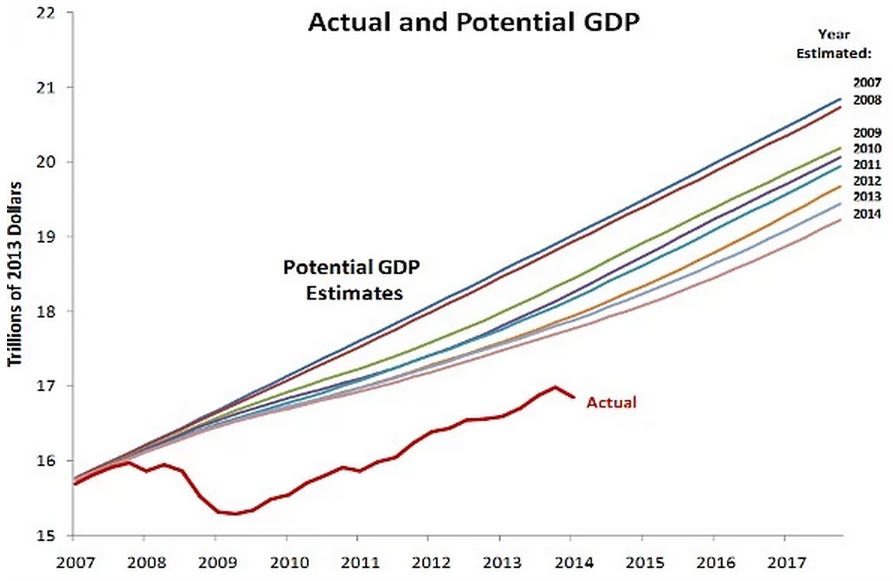
Matt O’Brien is disheartened by the above chart, which was created by Larry Summers:

It shows how much more pessimistic the Congressional Budget Office (CBO) has become about the economy, revising its estimate of potential economic down in each of the last seven years. The economy, in other words, has grown so little that the CBO doesn’t think it can grow quite as much anymore. Although, of course, GDP has still fallen far short of even these diminished expectations.

This is scary stuff. Much more than a series of descending lines can really convey. If it’s right, it means that the Great Recession has made us permanently poorer. That the economy will never get back to its pre-crisis trend. Instead, it will stay stuck in a “new normal” of slow growth that feels like a slump—forever.

O’Brien also throws cold water on last quarter’s seemingly-impressive 3.5% GDP growth:

So how good is the economy, really?

Well, we can get a better picture if we strip out the noisy inventory and net export numbers to leave us with something that goes by the catchy name of final sales to domestic purchasers. Then we can look at growth over the past year to smooth out, for example, the polar vortex-induced dip at the start of the year. This shows us the economy’s underlying strength, basically how much of today’s growth we can expect to continue tomorrow. And … it’s pretty much the same now as it’s been throughout the recovery: growing 2.4 percent a year. Now it might, just might, be picking up ever-so-slightly right now. Or it might just be ticking up. We’ll see. But in any case, it’s not that much different from what it’s been: a recovery that’s given us plenty of head fakes, but has really just been chugging along at the same speed the whole time.

Jared Bernstein is more upbeat:

[T]here’s a lot of momentum in these trends and my expectation is that the steady recovery remains on track. That’s not the express track, to be sure. We never had the needed bounce-back after the Great Recession and we settled into trend growth before repairing enough of the damage. There’s still a lot of slack in the job market and that’s why most households’ real wages and incomes have been pretty flat.

So I’m definitely not saying all’s well. Instead my point is that it will take a lot more quarters and years of this slow and steady improvement to squeeze the remaining slack out of the job market and get back to full employment. And only then do I expect to see many more people benefiting from the growth …

Chico Harlan compares the US to Europe:

That [3.5% GDP] figure came amid growing fears that Europe is sliding into its third recession since 2008. And while the United Kingdom is faring well, too, economists predict that by 2015 the United States will be the rich world’s standout economy.

“GDP growth of 3.5 percent?” said Jay Bryson, a global economist at Wells Fargo. “If you said that to a European right now, they’d start to cry tears of joy.”

The State Of The Race In Massachusetts

A reader sums up a “bizarre race” in one district:

The race in Massachusetts’s 6th Congressional District is getting strange. The National Organization for Marriage, which opposes same-sex marriage, is urging supporters to vote for Democrat Seth Moulton rather than an openly gay Republican, Richard Tisei. Meanwhile, the Human Rights Campaign is staying out of the race completely, despite having previously endorsed in the district.

From one article cited by our reader:

Asked whether Moulton would welcome or reject votes cast in his favor by NOM supporters, a spokesperson for Moulton responded, “Reject.” “Seth Moulton fundamentally disagrees with everything NOM stands for and has long said that equality is the civil rights fight of our generation,” said Carrie Rankin, Moulton’s communications director. “Fighting against groups, like NOM, that deny equality as a basic human right will be a priority of Seth’s in Congress.” Rankin noted that Moulton has a gay brother and Moulton has said, “It’s fundamentally wrong that he and I don’t share the same rights just because of who he is.”

From another piece:

The nation’s largest LGBT-rights organization is not expected to get involved in the Massachusetts congressional race between openly gay Republican Richard Tisei and pro-LGBT Democrat Seth Moulton, Metro Weekly has learned. …

HRC, which has a policy of endorsing pro-LGBT incumbents, previously endorsed Rep. John Tierney (D) in Massachusetts’s 6th Congressional District. In September, Tierney suffered a surprising primary defeat to Moulton, a young Marine veteran vowing to keep the seat in Democratic control. Two years prior, Tisei lost narrowly to Tierney 47.1 percent to 48.3 percent. Many credited the win by a vulnerable Tierney, whose wife was mired in a federal tax scandal, to President Barack Obama and Senate candidate Elizabeth Warren being at the top of the 2012 ballot. In that race HRC also endorsed Tierney.

The Gay & Lesbian Victory Fund, which seeks to increase LGBT representation, has endorsed Tisei the past two election cycles.

Tisei is one of two men seeking to become the first openly gay Republican elected to Congress. In California, Carl DeMaio is attempting to unseat Democratic Rep. Scott Peters for the state’s 52nd Congressional District. HRC has endorsed Peters in that race and representatives of the organization have been critical of DeMaio’s commitment to LGBT issues.

Previous reader dispatches from Texas here and South Dakota here.