Is Education The Enemy Of Religion?

A recent paper found that “that one additional year of schooling in Europe was associated with a 10 percent reduction in the propensity to attend religious services once a week or more.” But the bigger picture is more complicated:

Globally, we’ve seen a massive rise in education, without a uniform change in religious beliefs. In 1970, only about 40 percent of children worldwide enrolled in secondary education; four decades later, the rate had climbed to 73 percent. In developing nations, the increases have been substantial: In sub-Saharan Africa, enrollment rates have grown from 13 percent to 41 percent. In Pakistan, the average adult has had five years of schooling, up from a little over one year in 1960, and in Nigeria the same numbers are 7.5 years, up from 2.4. (The average American adult has 13 years.) If Mocan and Pogorelova’s results held worldwide, this massive rise in education would suggest a cratering in global religious practice.

The available evidence tells a different story.

According to the latest wave of World Values Surveys, 24 out of 42 countries have seen an increasing proportion of people who say religion is important in life. Four have seen the percentage unchanged, and 14 countries have seen it decline. In the countries where it’s declining, the starting points are radically different. The U.S. dropped from 56 percent in the 1990s to 40 percent now, whereas in Iraq, the proportion has dropped to 85 percent, down from 94 percent in the late ’90s. Overall, though, the world is becoming more godly, at least according to this measure of religious adherence.

So what makes Europe different?

[M]aybe you need to go all the way through secondary school to come out a skeptic, and most emerging markets haven’t reached that point yet. A simpler explanation might be that most children in Africa and Asia aren’t learning potentially threatening theories like evolution at school.

Boko Haram Hostages Speak Out

Former abductees tell their stories to Human Rights Watch:

Adam Taylor describes the disturbing findings:

What is life like for the women and girls held captive by Boko Haram? That’s one question Human Rights Watch (HRW) attempted to answer with a new video, in which international nongovernmental organization interviewed a number of people who had been kidnapped by Boko Haram and later released or escaped. In the video, girls detail how they were forced to convert and marry and, in some cases, were raped. In one particularly horrifying account, a young woman describes how she was forced to go on operations with the insurgents and carry their ammunition; she says she considered grabbing a gun and using it to kill herself.

HRW’s video comes as part of a wider 63-page report, “Those Terrible Weeks in their Camp,” which examines the Boko Haram kidnappings and the Nigerian government response to it. HRW reports that the extremist group has kidnapped more than 500 women and girls since 2009.

Charlotte Alter elaborates on the revelations that pertain to sexual assault:

According to the interviews in the report, Boko Haram does not consider any girls too young for marriage. After one 17-year old prisoner complained that she was not yet old enough to marry a Boko Haram commander pointed to his 5-year-old daughter and said, “If she got married last year, and is just waiting till puberty for its consummation, how can you at your age be too young to marry?”

Recent Dish on Boko Haram here.

Flavorful Highs

Jacob Sullum defends them:

Although flavored e-cigarettes and marijuana edibles are intended for adults, appeal to adults, and can be legally sold only to adults, the prohibitionists argue that they cannot be tolerated because they also appeal to minors. The same rationale has been offered for bans on flavored tobacco products and sweet malt beverages. This argument, although couched in the language of moderate and sensible regulation, should be a non-starter in a free society, because it reduces adults to the level of children.

And flavored e-cigs make quitting real cigarettes easier:

Two-thirds of the ex-smokers in the E-Cigarette Forum survey said nontobacco flavors were important in helping them quit. Survey data reported in the International Journal of Environmental Research and Public Health last December likewise indicate that flavor variety is important in quitting. That study, which involved about 4,500 vapers, found that they tended to prefer tobacco-flavored fluid initially but later switched to other flavors. Most reported using more than one flavor on a daily basis and said the variety made the experience more interesting and enjoyable.

Liberty’s Biggest Billboard

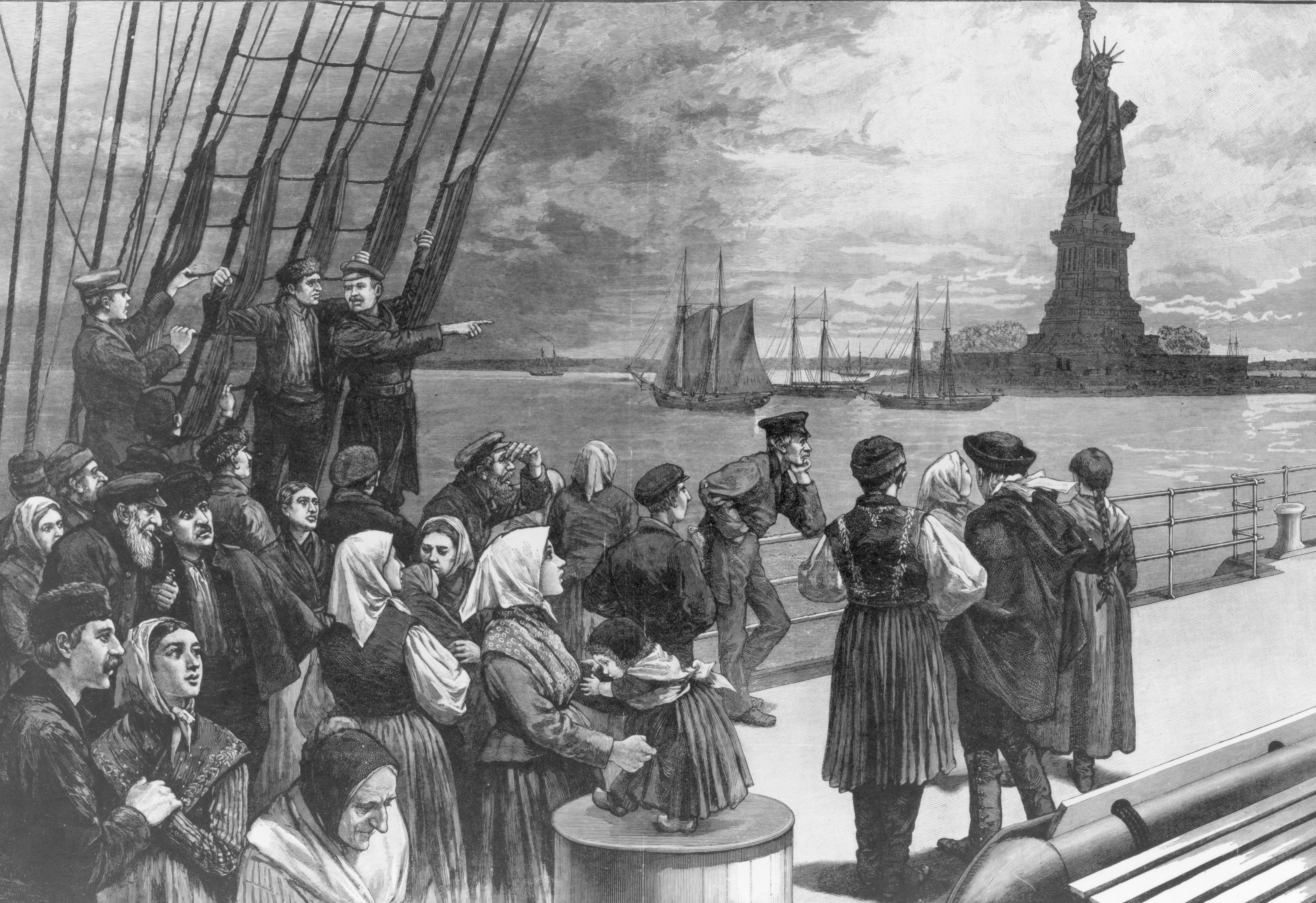
Immigrants View The Statue Of Liberty

The author of Liberty’s Torch: The Great Adventure to Build the Statue of Liberty, Elizabeth Mitchell, celebrates the statue’s 128th birthday, which is today:

[W]hat Bartholdi did back in 1871 when he first came to pitch his idea to America was make Bedloe’s Island, a former oyster bed, home to America’s core promise. If the nation were indeed founded on Life, Liberty, and the Pursuit of Happiness, let America be “pinged” on that notion every day. Passersby, not limited by demographics, would see her. The statue would be called by a title that induced a mantra: Liberty Enlightening the World, shortened down to “The Statue of Liberty.” People would be forced to say the word “Liberty” on a regular basis. Bartholdi would lose his own fame but that word, “Liberty,” would echo on, from every tour bus operator, from every child pointing out a car window, from every mind that glimpsed the iconic image on billboards or print ads.

But this Friday, as Mark Duffy notes, the statue is becoming an ad itself:

New York City’s most beloved Lady is going is to be selling bow ties on Halloween. For the record: Lady Liberty has been used to shill many, many things. India’s Jet Airways even put a bindi on her. But using her to sell bow ties is just fucking stupid. First of all, women don’t wear bow ties. And secondly, they don’t go with robes.

Nick Graham, founder of the Joe Boxer company, isn’t just going to use a representation of her: he is going to use the actual statue to help hawk his new line of bow ties. He supposedly is going to do this by hovering 60-foot [18m], 35-pound [16kg] bow ties in front of the lady via helicopter on Halloween morning.

Ugh.

(Photo: Illustration of a group of immigrants on the steerage deck of a steamship viewing the Statue of Liberty as they arrive in New York Harbor, circa 1887. By FPG/Getty Images)

An ISIS-Guided Tour Of Kobani

In a video, released last night, ISIS prisoner John Cantlie “reports” from Kobani, the northern Syrian Kurdish town that has been under siege by the militants for over a month, purporting to debunk the Western media narrative about the battle while promulgating ISIS’s own version of the story. “Perhaps what’s most odd about the video,” Adam Taylor comments, “is how much it apes the Western media it criticizes”:

The video begins with a logo “Inside ‘Ayn al Islam’ ” (a reference to what the Islamic State calls Kobane) and makes use of a number of relatively sophisticated graphics throughout. Cantlie, who may have been speaking under duress, brings to mind BBC correspondents in his presentation. The Islamic State also uses the video to give its cynical version of recent events, notably suggesting that “good old John Kerry” has been criticizing “Kurd-hating Turkish President Erdogan.” Cantlie also makes reference to the cost of American airstrikes in Kobane (“almost half a billion dollars in total”) and a U.S. airdrop that accidentally landed in the hands of the Islamic State. “The mujahideen is now being resupplied, by the hopeless U.S. Air Force, who parachuted two crates of weapons and ammunition straight into the outstretched arms of the mujahideen,” he says.

This new video is very different from previous propaganda items featuring Cantlie, which have shown him in prison garb, discussing his captivity. Jamie Dettmer wonders what’s up with that:

In the “Lend Me Your Ears” series, the British freelance photojournalist emphasizes that he is a prisoner of the Islamic State, widely known as ISIS or ISIL, and doesn’t know whether he will live or die. But in Monday night’s five-and-a-half minute clip, titled “Inside Ayn al-Islam” (the Arabic name for Kobani is Ayn al-Arab), the 43-year-old Cantlie makes no reference to his captivity, raising questions about whether he has crossed the line and is now a willing propagandist for the jihadists behind the camera.

Dan Murphy cautions us not to make too much of it, partly in order to avoid handing ISIS a propaganda victory:

Not that IS will care, but using captives as a propaganda prop – terrorized by the murder of fellow captives and the threat to their own lives – is a clear violation of the Geneva Conventions. To be sure, this crime seems minor when held up against their executions of helpless captives, enslaving of women and children for sexual and other purposes, and their stated goal of wiping out everyone on the planet who doesn’t practice their particular version of Islam. But the press needs to walk a careful line in not uncritically broadcasting the group’s propaganda, effectively rewarding them for their abuse of Cantlie.

Muddy Medicine

Psychiatrist Simon Wessely suggests that doctors in his field have a deeper appreciation for complexity than other medical professionals do:

Not for us the simplicities of some other parts of medicine. Here is a cancer – take it out. There is a bug – kill it. In psychiatry, the ability to tolerate uncertainty is an essential skill. Because we have to negotiate fuzzy boundaries – between eccentricity and autism, between sadness and clinical depression, between hearing voices and schizophrenia – and there will always be boundary disputes.

Far from backing away from such debates, my experience of psychiatry is that we relish them. We are not the only branch of medicine that argues about classification – so do tumor biologists – but the difference is that the issues that we face in classification are more readily understood by the general public. If there is a little bit of crisis, like argument and discussion it keeps us on our toes, alert to new developments, and is an antidote to complacency.

Update from a reader and neurologist:

I’m a bit behind on my Dish reading, but just saw the post that you referenced from Dr. Wessely, and really have to call complete and utter crap on it.

This is one of the most enduring tropes in medicine, where every specialty sees itself as special and more extraordinary than their peers in lesser specialties. While were all guilty of it from time to time, it’s rare that I’ve seen someone bold enough to put it to print (from the President of the Royal College of Psychiatrists no less!). It would be like me denigrating cardiology by likening the vascular system to something marginally more complex than the pump and plumbing for my pool.

Nothing in medicine is ever as clear cut. Furthermore, we all treat more than a disease; we treat a patient (and often the family issues/fallout arising out of the patient’s disease). And because patients are complex, individual creatures, management has to be tailored not just to the illness, but to them.

Even in cancer, it is not quite as simple as Dr. Wessely suggests. Take prostate cancer for example. Do we have to treat it? The majority are slow growing and aggressive intervention is not always warranted. Psychiatry does itself no favour by promoting exceptionalism.

How Suicide Gets Swept Under The Rug

Lindsay Cox lost both her parents to suicide when she was 12. But she doesn’t want how they died to define them:

If my parents died of nearly any other cause within months of each other before I hit puberty, most people would see it as a complete and utter tragedy; they’d readily accept their deaths as worthy of mourning. Instead, I’m often discouraged from talking about my parents and their passing. A lot of my family members — including my maternal grandparents — pretend like neither of my parents ever existed in the first place. There aren’t any photos of my mom or dad in their homes; they never say their names or bring them up in conversations. Their way of grappling with the depressing reality of their deaths is by not acknowledging them at all.

But I don’t want to forget them;

I don’t want to pretend like my parents never existed because they died a death that isn’t as socially acceptable as others. They did exist, and their existence was important because they created me. They were responsible for my being, and I love them because unconditional love doesn’t always mean loving and caring about someone in picture-perfect circumstances. Life is messy, human beings are flawed, but we can love them anyway. We do love them anyway. I do not want my parents to be remembered for the illnesses that eventually took their lives. I want them to be remembered for the creative, loving, and special people they were, the same creativity, love, and specialness that still runs through my veins.

The Dish’s deep thread on suicide is here.

A Poehler-ized Book

Amanda Hess situates Amy Poehler’s new autobiography in its literary and cultural context:

This month, Poehler finally releases [her] handbook, the comedy/memoir/advice collection Yes Please. In her introduction, Poehler describes reading the works of [actresses Mindy] Kaling, [Tina] Fey, and [Rachel] Dratch (plus Lena Dunham’s Not That Kind of Girl, Caitlin Moran’s How to Be a Woman, and Sarah Silverman’s The Bedwetter) in preparation for her own submission to the genre. “All are superb and infuriating,” Poehler concludes. They’re also profitable. Fey reportedly netted a near-$6 million advance for her book [Bossypants], and Dunham more than $3 million; Poehler’s fee is undisclosed, but she fits the bill.

Women are still underrepresented as writers, directors, and stars of comedy, but the few women who have clawed to prominence on TV can find a comfortable perch in the publishing world. Women buy most books, and personal essay collections, self-help tomes, and celebrity tell-alls are all churned out to peg the demographic. Poehler satisfies the hat trick: She’s a famous woman with a remarkable life and an enviable success, perfectly positioned to preach to what my friend Michelle Dean calls the “smart niece demographic.”

Erik Adams remarks on the inclusive nature of Poehler’s writing:

Ever the gracious ensemble player, Poehler pays that Bossypants favor forward in Yes Please, handing over pages to her parents, former “Weekend Update” co-anchor Seth Meyers, and soon-to-be former Parks And Recreation showrunner Michael Schur. (Fey doesn’t contribute, but she receives a chapter-long tribute and an acrostic poem in her honor, which Poehler teasingly calls “arguably the laziest form of writing.”) It’s a distinct approach to autobiography—and as a hybrid of memoir, essay collection, and Life’s Little Instruction Book, Yes Please is undeniably distinct—one grounded in the type of improv-comedy teachings the author has passed down as a founding member of the Upright Citizens Brigade Theatre.

Poehler is Yes Please’s headlining act, but many of her anecdotes are about projects, communities, and achievements in which she was but one participant.

And Mary McNamara argues that the book’s strengths are in what Poehler doesn’t reveal:

“Yes Please” is a memoir in that it contains some memories, many of which are offered as hard-won — advice seems too preachy, so we’ll go with helpful suggestions. (A chapter called “I’m So Proud of You” should be required reading in high schools.) Also featured are: haiku about plastic surgery, a chapter by Poehler’s mother, a satiric birth plan, a chapter by Seth Meyers, an annotated history of “Parks and Recreation,” a letter from Hillary Rodham Clinton, sex advice, a truly hilarious list of potential books about divorce and a moving account of an apology.

Mercifully, the book does not include: recipes; any discussion of Poehler’s marriage to and divorce from Will Arnett; a treatise on the frustrations of modern motherhood (Poehler is just grateful for all the help she can afford), or a lot of self-deprecating nonsense about luck.

This last one alone makes “Yes Please” worth reading. Too many women at the top of their careers inevitably discuss their actual job as if it were something anyone with a pair of sweatpants, a childhood and a laptop could do.

Dissents Of The Day

A reader quotes new reporting on the Matthew Shepard case:

It was fairly well known in the Laramie community that McKinney wouldn’t be one that was striking out of a sense of homophobia. Some of the officers I worked with had caught him in a sexual act with another man, so it didn’t fit – none of that made any sense.

So that quote is probative in your mind that the attack could not have been motivated or exacerbated by homophobia? Nobody who ever got a blowjob from a guy would lash out in front of his straight buddy at an effeminate kid due to homophobia? Really? That’s the best you’ve got?

The question here is whether the crime was solely a function of the homophobic hatred of two strangers who beat up and brutally murdered someone merely because he was gay. That’s the official line of the Matthew Shepard Foundation and the Human Rights Campaign. Of course these motives could also have been involved. I’m arguing that meth can explain all of it, but may not be the only factor involved. I can’t read the meth-addled minds of the foul murderers. I can detect bullshit from the gay rights establishment. Another reader:

I’m in the awkward position of preferring to think that Jiminez is wrong while acknowledging the strength of his arguments. But I do object to this statement from you: “Those who made a small fundraising fortune off the myth – like the Human Rights Campaign (natch) – will never acknowledge the truth.”

Your clear implication here is that those who resist Jimenez’s interpretation of the events are acting in bad faith, their eyes blinded by all those lovely fundraising dollars. Is it not possible that the Matthew Shepard Foundation’s complete rejection of Jimenez’s work is based on something other than greed? That foundation was, after all, founded by Shepard’s parents. Would you not concede that a mother, facing the accusation that her murdered son was a crystal meth dealing sex worker, might reject that accusation for reasons other than that it might harm her fundraising work? That her attachment to one interpretation of the events leading to her son’s murder has more to do with how she felt about her son than it does with the petty arguments of the gay rights culture war that (I suspect) you are more attached to than she is?

I could equally suggest that your absolute conviction that Jimenez is right is a bad faith interpretation of the facts, blinded by your dislike of HRC and the fact that they’ve used his death to argue for laws with which you don’t agree. But I’d be wrong there, wouldn’t I?

I can perfectly well understand why a mother would feel that way. That doesn’t excuse her foundation of smearing decent reporters who have uncovered a more complicated truth, or justify others raising gobs of cash on her grief (yes, you have no idea how many fundraising appeals I received based on the myth), and turning this complicated and horrible crime into a rallying cry for a pre-existing legislative agenda. Another:

It seems to me that there are two extremes to this debate: one denies that drugs had anything at all to do with Matthew Shepard’s murder, the other (apparently represented by you and Jimenez) denies that homophobia had anything to do with it. Isn’t it possible that both could have been factors?

I have yet to see you address an obvious question: If it was all about the inexplicable consequences of crystal meth – and not, at least partly, “out of a sense of homophobia” – why didn’t Aaron McKinney or his attorneys use that as a defense, when it clearly could have helped him more than the pathetic “gay panic” defense did?

Obviously, the need for another fix can fuel violence. But enough to explain the sheer brutality of the attack on Shepard, when no traces of meth were found in the killers’ bloodstreams by the Laramie Police Department?

No one wants to confess a meth robbery gone haywire, and they may have thought the gay panic defense might work – and it didn’t. As for the further myth of the blood-test, over to Steve:

In the entire unsealed public record that I reviewed at the courthouse, I never saw a toxicology report or any document verifying drug testing. Your reader seems to be referring to a statement made last year on NPR by Dave O’Malley alleging such a drug test. When asked by Rachel Martin on Weekend Edition to produce such a toxicology report, O’Malley was unable to do it, and Rachel ended the show on that note. The only testing that McKinney and Henderson had that I know of was for HIV.

You referred in your recent post to the Casper Tribune’s latest smearing. In that paper last month, Shepard prosecutor Cal Rerucha was quoted as saying that had meth not been involved, there wouldn’t have been a murder. I also have at least 9 named sources on the record about McKinney’s weeklong meth use (and cocaine) in the week leading up to the crime. Let me know if you want to publish their names.

That being said, the more time that elapses between meth use and testing, the harder it is to get a conclusive result. The crime took place on a Tuesday night, McKinney wasn’t arrested until late Thurs night in Colorado, and he gave a statement to police in Laramie on Friday. So any alleged testing couldn’t have taken place before then. In 14+ years, the prosecutor has never told me of a drug test that proves what O’Malley alleges. What the prosecutor did tell me, however, is that O’Malley begged him not to tell the truth to ABC News “because of all the good that’s been done in Matt’s name.” When Rerucha refused, O’Malley asked him if he would at least “clear” what he was going to with Judy Shepard. Rerucha declined, of course.

The Matthew Shepard Foundation and the Human Rights Campaign should not be smearing and demonizing good faith work by a courageous openly gay journalist. They need to apologize, and correct the record. At some point, their convenient untruth must stop.
Egg Freezing On The Company Dime, Ctd

A personal story from the in-tray adds some critical context:

I have read this conversation with some interest, because it is all too close to home. Tomorrow, my wife and I are transferring a frozen embryo after a fresh transfer failed in late August. For these reasons, I have become all too conversant on the subject matter … yet it is a conversation that one rarely has beyond our own home. (I will note that my wife and I are very lucky in that we both have extremely generous coverage and a non-trivial cache of frozen embryos to work from; it is unlikely that we will have to ever do another egg retrieval.)

I think the piece you quoted by Pamela Mahoney Tsingdinos, along with your reader, needs to be placed in a bit more perspective. In Tsigdinos’ case, I suspect the experience she has had (which I can completely empathize with, as fertility treatment is emotionally exhausting) has led to a somewhat jaded perspective. I think a similar critique is in order for your reader.

In any given month, a perfectly fertile couple only has about a 20% chance of conceiving a child if they are trying.

So, a fertile couple doing it the “old fashioned” way, has a roughly 80% fail rate. Suddenly, the 23% success rate of frozen eggs does not seem to shabby, no? In fact, the very study that Tsigdinos cited to support her argument reached a positive conclusion relative to the achieved probabilities. This is why fertility doctors do not take on patients until they have been trying for a year without success; prior to that point, the lack of conception may very well be just due to bad dice rolls.

Here is a PDF on Penn Fertility data on embryo transfers. Of note, they are talking about embryo transfers, which is after the first culling of eggs. They do not appear to post data on frozen eggs but do state the following:

Pregnancy using already retrieved, frozen donor eggs is an incredible step forward and is possible because of the dramatic improvement in egg freezing technology. Methods of rapid freezing called vitrification are now used effectively to freeze eggs. Several large studies have been conducted using frozen donor eggs and indicate that pregnancy rates are no different when fresh or frozen eggs are used.

Under normal circumstances during ovulation, a series of things has to go right in order for a child to arrive. Sex has to happen at the right time, egg and sperm need to meet – the right egg and sperm need to meet – implantation needs to occur, and then the body needs to get on board with the pregnancy. A lot can and does go wrong between a couple having sex and a baby being the result. In fact, one of the most frustrating parts of fertility treatment is the unknown. As of now, in the midst of infertility treatment, our infertility remains “unexplained”.

The problem here is that we are talking about eggs, and our perspective gets skewed when we pull them out of a woman’s body and get to actually trace the failure rates. IVF is instructive in thinking about this. The general rule is that 50% of the retrieved eggs will not fertilize and/or reach a point where transfer is a viable option. Of the resulting 3- and 5-day embryos, a further 50% will not result in a child. What does that mean? We are back in the same ballpark of 25% of retrieved eggs resulting in a child. This is indeed sobering when you break it down, particularly for older women with weaker egg reserves. If you pull less than 8 eggs, the probabilistic expectation is for a single child to result (if that). That, however, needs to be placed alongside the fact that a fertile couple trying for 8 months would be expected to produce <2 children.

With the advent of vitrification as a technique, I suspect we will see freezing become much more common in the years ahead. The practice my wife and I are going to has data that suggests frozen embryo transfers may result in a higher rate of pregnancies than fresh transfers. If true, the reason is most likely a byproduct of the hormonal treatments involved in stimulation and retrieval. An even greater advantage is that freezing effectively stops the clock on egg/embryo aging. So, if you freeze an egg/embryo at age 25, you can transfer it at age 37, and genetically it will be as if you conceived the child at 25 (this has significant benefit given the data we have on egg reserves for 35+ women).

None of this is to suggest that freezing eggs should suddenly become Plan A. There are very real and scary potential side effects of the stimulation and retrieval process, and I worry about the long-term impact on my wife’s health.

That being said, I think expanding coverage for this procedure should be applauded, since it creates an option for women. What the data pretty much universally suggest is that women are much better off making a decision about having a family prior to hitting age 35. After that, the statistics begin to drop rapidly. So if you are an early 30s woman who wishes to have a family but are not ready to do so for whatever reason, freezing and banking eggs is something well worth considering.

Again, yes, the vast majority of the collected eggs will fail to result in a pregnancy – but that’s life, just as is the case in the wild.

Update from a reader:

Your reader is pretty much on the money. I went through two IVFs and have friends who did live and frozen transfers. Those are the stats.

The only kibble I have is about egg freezing versus embryo. Embies do well through the freezing process and the thawing. Eggs? Not so much. They are not like sperm, which also freezes and thaws fine. Eggs are much more fragile.

If companies were offering to help women harvest and fertilize eggs to create embryos for future use, THAT would be truly useful. But they aren’t. It feels more like a con.

That said, why has no one broached the subject of young men storing away their young healthy sperm for future use? The research on older fathers gets grimmer as time goes on, with a laundry lists of mental health, learning disorders and autism now being linked to “old” sperm.

A woman is born with all the eggs she will ever have. They age with her, but they were generated when she was so unlike males whose sperm quality gets spottier all the time because of the DNA damage we all pick up as we age, a woman’s eggs don’t have that particular downside to worry about. Which is why it would be great if they froze well – but they don’t.