Backing De Blasio

Nearly 7 in 10 New Yorkers disapprove of the recent antics:

“Cops turning their backs on their boss, Mayor Bill de Blasio, is unacceptable, New Yorkers say by large margins,” Maurice Carroll, a Quinnipiac University poll assistant, said in a statement announcing the results. “Even cop-friendly Staten Island gives that rude gesture only a split decision.”

Another poll from Quinnipiac shows the mayor’s overall approval up slightly. Friedersdorf runs through more numbers:

I worried New Yorkers would punish Mayor de Blasio for losing control, rather than backing him to insist that the NYPD is subservient to the people. I didn’t give New Yorkers enough credit.

A new poll by Quinnipiac University suggests that the city’s voters have seen through the police union’s tactics, and that its temper tantrum will cost it political support. Consider the following findings:

  • “Police union leader Patrick Lynch’s comments that the mayor’s office had blood on its hands are ‘too extreme,’ voters say 77 – 17 percent, the independent Quinnipiac University Poll finds. There is no party, gender, racial, borough or age group which finds the comments ‘appropriate.'”
  • “Voters say 47 to 37 percent that Mayor de Blasio’s statements and actions during his 2013 campaign and during his first year in office show he does support police.”
  • “The recent slowdown in police activity is more of a protest, 56 percent of voters say, while 27 percent say it is because police officers fear for their safety.”
  • “Voters say 57 to 34 percent that officers should be disciplined if they deliberately are making fewer arrests or writing fewer tickets. Black, white and Hispanic voters all agree.”
  • “Voters give Patrolmen’s Benevolent Assn. President Patrick Lynch a negative 18 to 39 percent favorability rating and say 43 to 27 percent that he is a mostly negative force in the city.”

Josh Marshall adds:

What also emerged in the poll is public anger that Patrick Lynch, President of the Police Benevolent Association has managed to make the public face of an asshole into the public face of the NYPD. And now there are signs of rising opposition to Lynch within the union itself. A raucous union meeting at Antun’s catering hall in Queens Village on Tuesday night broke down into a melee of pushing and shoving and screaming involving some 100 police officers angry Lynch’s leadership of the union. The yelling and screaming and shoving went on for about ten minutes, according to the Daily News, before Lynch walked out.

Noah Rothman searches for a silver lining for conservatives:

But the Quinnipiac poll isn’t all bad news for the NYPD:

New York City voters approve 56 – 37 percent of the job police citywide are doing, compared to 51 – 41 percent December 17. Approval today is 66 – 28 percent among white voters and 54 – 36 percent among Hispanic voters, while black voters disapprove 54 – 41 percent. Voters approve 71 – 25 percent of the job police in their community are doing.

Furthermore, conservatives can rejoice in the poll’s findings that MSNBC host slash activist Rev. Al Sharpton has received his lowest favorability score in the history of Quinnipiac polling. Only 29 percent of respondents view Sharpton favorably while 53 percent have a negative view of the political activist.
Egypt’s Revolution Isn’t Over

Egypt

Thanassis Cambanis checks in on the country. He recognizes that “the core grievances that drew frustrated Egyptians to Tahrir Square in the first place remain unaddressed”:

Police operate with complete impunity and disrespect for citizens, routinely using torture. Courts are whimsical, uneven, at times absurdly unjust and capricious. The military controls a state within a state, removed from any oversight or scrutiny, with authority over a vast portion of the national economy and Egypt’s public land. Poverty and unemployment continue to rise, while crises in housing, education, and health care have grown even worse than the most dire predictions of development experts. Corruption has largely gone unpunished, and Sisi has begun to roll back an initial wave of prosecutions against Mubarak, his sons, and his oligarchs.

But the overthrow of Mubarak has had an impact:

The legacies of the revolution are hotly contested, but one is indisputable: Large numbers of Egyptians believe they’re entitled to political rights and power. That remains a potent idea even if revolutionary forces and their aspiration for a more just and equitable order seem beaten for now.

In the worst of times under Mubarak, and before him Sadat and Nasser, mass arrests, executions, and the banning of political life kept the country quiet. But as Egypt heads toward the fourth anniversary of the January 25th uprisings, things are anything but quiet, despite the best efforts of Sisi’s state. Dissidents are smuggling letters out of jail. Muslim Brothers protest weekly for the restoration of civilian rule. Secular activists are working on detailed plans so that next time around, they’ll be able to present an alternative to the status-quo power. No one believes that this means another revolution is imminent, but the percolating dissatisfaction, and the ongoing work of political resistance, suggest that it won’t wait 30 years either.

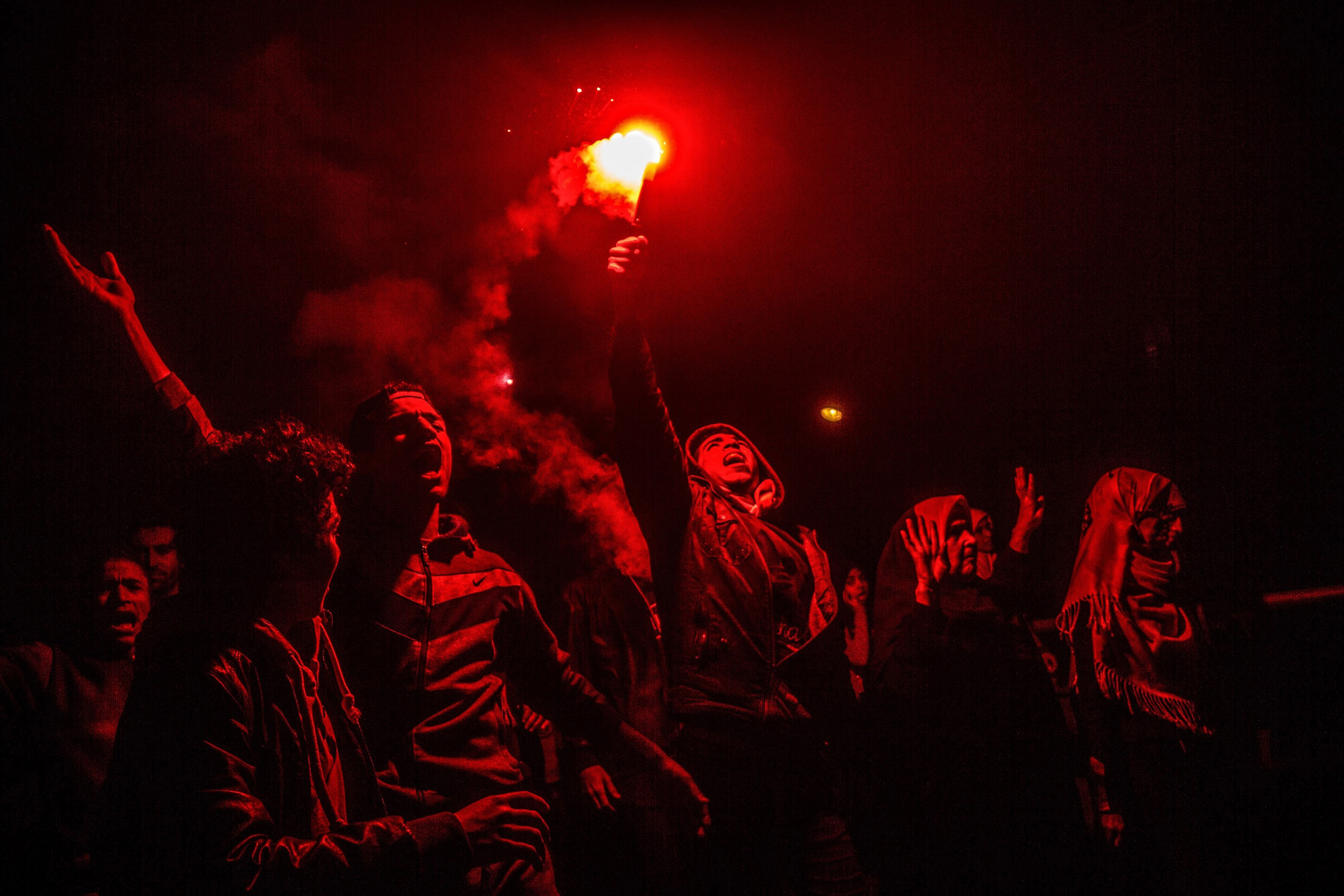
A group of people who call themselves anti-coup demonstrators, stage a protest in the Helmeyat el Zeytun district of Cairo, Egypt on January 8, 2015. (Photo by Stringer/Anadolu Agency/Getty Images)

Inheriting Your Parents’ Nostalgia

nostalgia

Rosie Cima examines research on how “people are disproportionately attached to songs that were on the radio when they were young”:

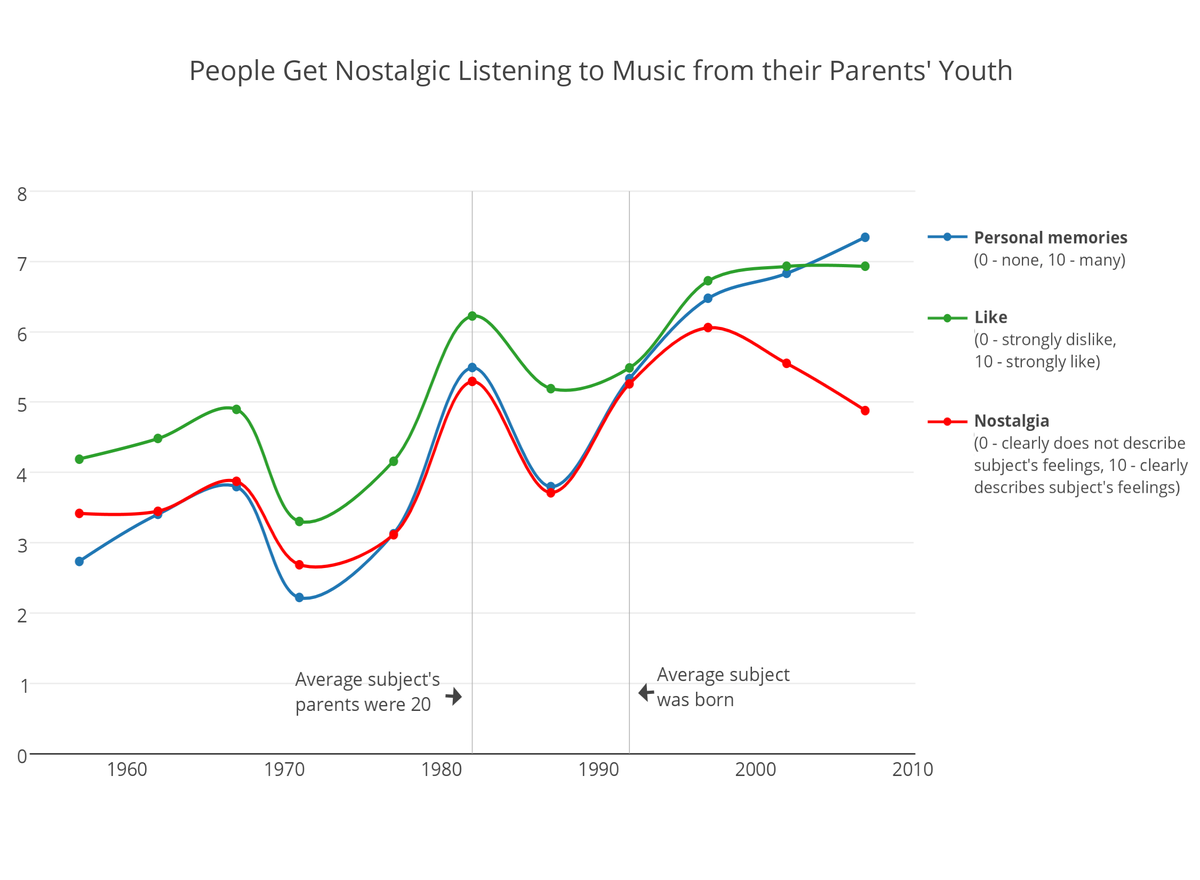
For better or for worse, this preference seems to override things like the critical quality of the music — people just plain like music more if it was popular when they were young, regardless of whether or not that music was terrible. But an even stranger thing about all this is that these preferences appear to be inheritable. In 2012, researchers from Cornell University and UC Santa Cruz exposed a bunch of college-aged subjects to clips of Billboard top singles dating back to 1955. Then, they surveyed the subjects’ responses.

The researchers’ found that, in addition to liking  music from their own generation, “subjects also displayed a similar attachment – including a feeling of nostalgia — to music that was popular in the early 1980s, long before they were born“:

“According to previous research, this would be the time when [the subject’s] parents’ preferences were established,” the researchers write. Their theory is that because of this attachment, parents listened to this music during their “child rearing years” contributing to their children’s musical education.

And there’s another bump in attachment, preference, and nostalgia for music that was popular in the 1960s. Although researchers mention that this music might just be higher-quality and thus have stayed in the popular listening repertoire longer (earning the label “classic rock”), they also say this bump could be the product of grandparents’ influence, either directly or through the parents, on the subjects’ listening habits and music-associated memories.

Megan Garber comments:

What the research also means, on a more collective level, is that there is a psychological reason that “Hey Ya” will inevitably be bringing people to the dance floors of the weddings of 2040—and that only part of that reason can be attributed to humanity’s ongoing desire to shake it like a Polaroid picture. Just as nostalgia tends to confer more nostalgia, popularity also tends to build on itself: Once a song makes it to the top of the charts, the memories people associate with it help to keep it in our cultural consciousness.

What The Hell Is Going On With The Swiss Franc?

Swiss Franc

Matt O’Brien describes yesterday’s events:

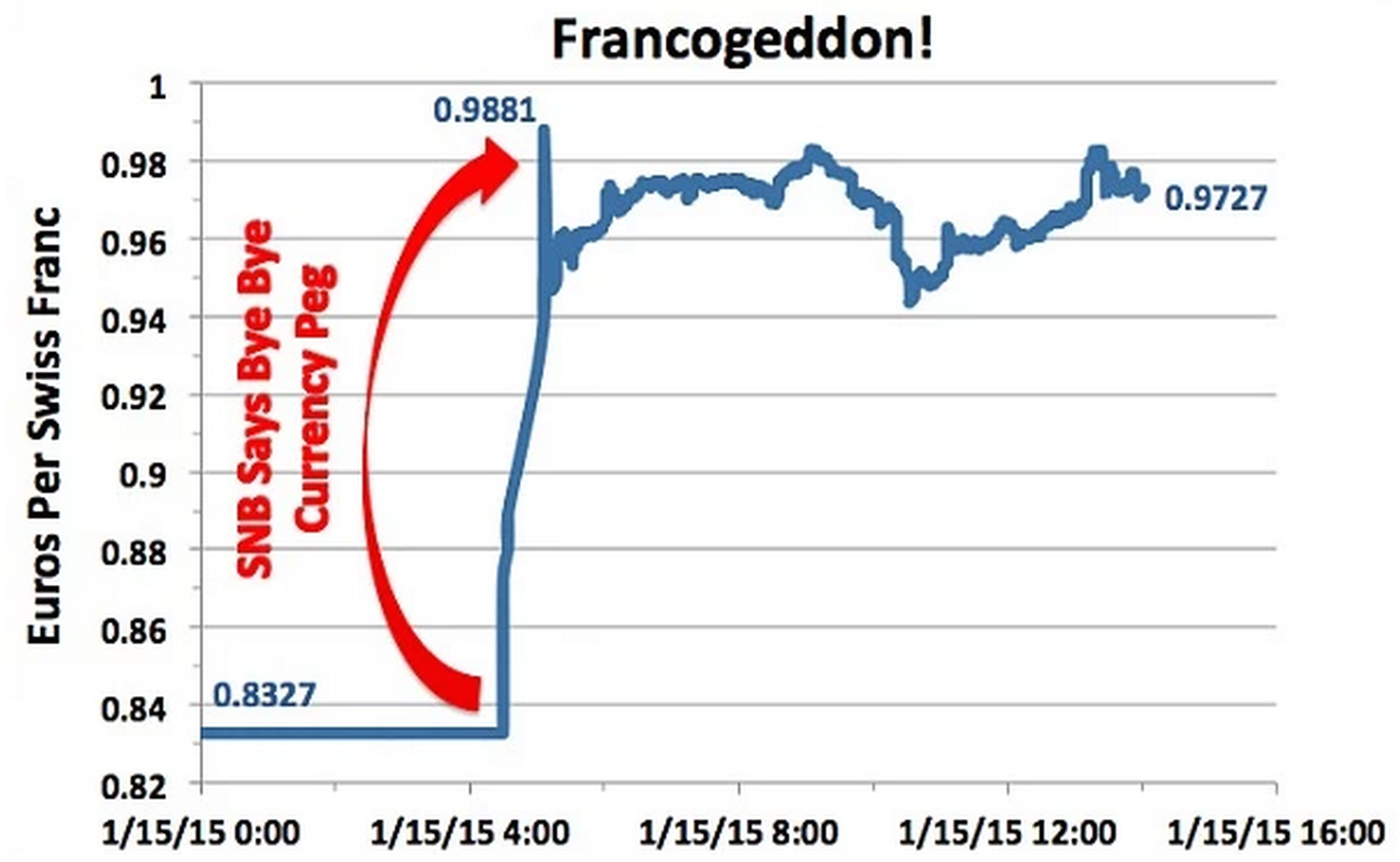
The Swiss National Bank (SNB) shocked markets on Thursday by announcing that it would no longer hold the value of the Swiss franc down at 1.2 per euro, although it would lower interest rates from -0.25 to -0.75 percent. Mayhem ensued. The Swiss franc immediately shot up as much as 39 percent against the euro, before settling at “only” up 17 percent on the day. This is basically the biggest single-day move for a rich country’s currency, as economist David Zervos points out, in the last 40 years. And it’s sent Switzerland’s stock market down 10 percent, as its suddenly more expensive currency will cripple its exporters by making their goods more expensive abroad.

All those people looking to park money in Switzerland, a country of only 8 million people, created incredible upward pressure on the Swiss franc. From the start of 2010 to mid-2011, the value of the franc rose 44 percent against the euro.

Think about that for a minute. It would be as if dollars in the state of Virginia (with a population similar to Switzerland) suddenly were worth 44 percent more than the dollars used in the rest of the country. Virginians would be wealthier, but it would be a catastrophe for businesses in the state. Suddenly their costs would be 44 percent higher, effectively, than that of competitors in other states. Tourism would dry up; why go to a Virginia beach when it is 44 percent more expensive than a North Carolina beach?

Jordan Weissmann reviews the same history:

When the euro crises went into full swing during 2011, panicking money men saw the franc as a safe haven and started buying it en masse, pushing up its exchange rate with the euro, and pushing some exporters into bankruptcy. Sensing an emergency, the Swiss National Bank declared that it would start buying euros in “unlimited quantities” to keep the franc’s value down. Thus, we got the cap.

So what changed? Buying unlimited quantities of euros is about to get expensive. The European Central Bank is about to begin a round of quantitative easing to revive the region’s economy—which, for all intents and purposes, means it will be printing lots of euros, which Switzerland would have to purchase in bulk to maintain its exchange rate. That’s just not sustainable. So, instead, it’s bidding goodbye to the cap, and riding out the nasty economic consequences.

In his column today, Krugman argues that “the Swiss just made a big mistake”:

But frankly — francly? — the fate of Switzerland isn’t the important issue. What’s important, instead, is the demonstration of just how hard it is to fight the deflationary forces that are now afflicting much of the world — not just Europe and Japan, but quite possibly China too. And while America has had a pretty good run the past few quarters, it would be foolish to assume that we’re immune.

Dean Baker disagrees that Switzerland made a mistake:

Switzerland did not see the same sort of downturn as the rest of the OECD in 2008. Furthermore, it has fully recovered from its downturn with a GDP that is 8 percent above its pre-recession level and an unemployment rate of 3.5 percent.

In this context, it is actually doing what we should want Switzerland to do as a good world citizen. By allowing its currency to rise, it will make its goods and services less competitive internationally. This means it will import more from its trading partners and export less, effectively providing them with an economic boost. This is what we should want to see. The countries that are at or near full employment should be running larger trade deficits or smaller surpluses.

However, Scott Sumner sees Switzerland’s actions as monumentally stupid:

I sometimes receive back channel communication from very-well informed people in Europe. Believe me, just as with the earlier nonsense in Sweden, there is no “rational explanation.”  People are appalled.

And Mark Gilbert worries about future financial surprises:

While victims of the turmoil ponder whether Swiss policy makers are irresponsible or just incompetent, the scale of the damage is a timely reminder that contagion is always unpredictable, that markets always overshoot, and that traders, when they smell profit, can outgun central banks.

The Dangerous Marginalization Of France’s Muslims

M.G. Oprea spells out why changing France’s immigration policy won’t prevent future attacks:

The truth is, the men who launched these attacks in the name of Islam were French citizens. They were born and educated in France. They didn’t recently immigrate, and they didn’t import terrorism from a foreign land where they were raised. They were radicalized at home, in France. This is why cutting off immigration from North Africa, where most of France’s Muslim population comes from, or other Muslim countries, will not change the strained state of affairs in France among its citizens, or insulate them from further terrorist attacks.

She declares that “the French Muslim men who join radical Islamist movements often do so in the context of growing up in a country that has never wanted them”:

France has made a series of dangerous mistakes that immigration reform can’t fix. They have alienated a community of Muslims five million strong, and the youths in this community are doubling down on their Muslim identity. Because radical Islam considers itself at war with the West, it appeals to young people who want to reject the Western culture and society they feel has rejected them. So they turn to a fundamentalist interpretation of Islam, often finding their inspiration in prisons, where Arab youths are frequently radicalized.

recent study found that large numbers of Europe’s Muslims are fundamentalist:

For Ruud Koopmans, sole author of a study published in early January in the Journal of Ethnic and Migration Studies and director of the WZB Berlin Social Science Centre (Germany), religious fundamentalism is defined in three ways: that believers should return to the eternal and unchangeable rules laid down in the past; that these rules only allow one interpretation and are binding for all believers; and that religious rules should have priority over secular laws.

He found that “between 40% and 45% of European Muslims have fundamentalist religious ideas, that is they agree with the three definitions of the term”:

The results show that if first and second generations are considered and if each definition is taken independently, almost 60% would return to the roots of Islam, 75% think there is only one interpretation of the Koran possible to which every Muslim should stick, and 65% say that religious rules are more important to them than the rules of the country in which they live. “However in second generation Muslims the levels are slightly lower (between 50% and 70%),” states the expert.

Justin Gest fears that, after these attacks, “French Muslims — particularly their inclusion in French society — may not recover”:

Since the Sept. 11, 2001, attacks, Western countries have enacted policies that prioritize counterterrorism and populism at the expense of social cohesion. Governments have implemented search and surveillance practices that target people based on their appearance or names; exceptional rules that alter detention standards for those held on charges pressed predominantly against certain minorities; citizenship criteria that discriminate against residents of certain origins or faiths; and cultural policies that prohibit certain religious practices and traditions but not others.

Critics have shown how such actions fail to secure societies. Far more worryingly, my research shows that such actions amplify a much greater threat for Western Muslims: their political withdrawal.

When Foreign Fighters Come Home

Belgium raided an alleged terrorist cell yesterday:

In Belgium, officials said they had averted “imminent” large-scale attacks on police targets after raiding a terror cell in the eastern town of Verviers, near the German border, whose members had recently come back from Syria.

John Hinderaker wants to strip returning jihadists of citizenship:

It seems obvious that anyone who leaves the U.S. or a European country to fight for ISIS or al Qaeda should not be allowed to return. But we are talking about citizens here–Belgian authorities have said, I believe, that the terrorism suspects are all Belgian citizens–and so far, to my knowledge, no country has enacted such a ban.

This may not be entirely due to a lack of will. The jihadists travel to a legal destination–Turkey, say–and disappear from there. While authorities may be aware of them and know that they have jihadist sympathies, there may or may not be clear evidence that a particular person joined ISIS or al Qaeda. Still, it seems long past time for Western countries, including the U.S., to try to prevent such obvious terror threats from re-entering the country.

But Juan Cole focuses on how few Belgian Muslims have fought for ISIS or al Qaeda:

About 310 Belgian Muslim young men appear to have gone to fight in Syria, with 40 having been killed there and 170 still in the field. About 100 have returned to Belgium. … Note that 310 volunteers for Syria out of some 500,000 Muslims is not very many, contrary to what some press reports imply. It is a fraction of a percent. You can get 300 people to believe almost anything (e.g. Heaven’s Gate ). Moreover, there are all kinds of rebel groups fighting the government in Syria, and you can’t just assume that the 100 returnees all served with al-Qaeda or Daesh (ISIS or ISIL). Several of the major rebel groups in Syria that they would have joined are extremist. The Support Front or Jabhat al-Nusra is an al-Qaeda affiliate. Daesh controls much of eastern Syria now. The Saudi-backed Islamic Front in Aleppo has become more and more extreme. However, in the past 4 years or so there have been moderate and even secular-minded rebel groups, so that they are returnees does not necessarily mean they are al-Qaeda.

Regardless, Christopher Dickey remarks that “the authorities in Europe now believe it is too dangerous to let potential terrorists who have fought and trained abroad continue to roam the streets”:

Alain Bauer, one of France’s leading criminologists and an expert on counterterrorism, tells The Daily Beast that there’s widening recognition that surveillance tactics and strategies will have to change.

“Counterterrorism used to be like counternarcotics,” says Bauer. “You wait and you wait, and then you get another guy, with the idea that you are working your way eventually to the boss. But time, which was the ally of counterterrorism in the past, is now the enemy.” In the old days, suspects were followed from training camp to training camp, from connection to connection, as authorities mapped out whole networks. But the Internet allows connections to be made very quickly, and inspiration for attacks to take effect without any direct connection at all.

Was Selma Really Snubbed? Ctd

As we covered yesterday, the film’s low number of Oscar nods was probably more a victim of a screener scheduling than anything else. But Noah Millman, contra most film critics, “had the feeling that most people didn’t really love the film”:

Indeed, I suspect that the Best Picture nomination is itself a kind of consolation prize, that voters were reluctant to shut it out altogether from the major categories. I understand why some observers are troubled by the unbearable whiteness of this year’s awards. But it isn’t fair for a single film to shoulder so much expectation. If it’s a problem, the problem originated not in this year’s voters but in casting and financing decisions made years before.

Beutler doesn’t buy that consolation prize argument:

Nearly all of the Oscar trophies are meant to reward skill and stylistic judgment, but the best movie award is the most subjective and thus the most malleable.

It’s capacious enough to allow that a story can be inspired, and the decision to turn it into a film brilliant, even if the technical execution is ultimately flawed. Selma isn’t a best picture nominee because the Academy felt politically obligated to recognize it somehow, but because best picture is the one category that really fits.

Suderman is befuddled as to why the film didn’t as least get an additional nod for Best Director:

I haven’t seen the movie yet, so I’ll leave that argument alone except to note that it’s always a little bit weird to see a movie nominated in the Best Picture category but not in the Best Director category, as if a film could be the best movie of the year but not also the best directed. You can imagine a case for the distinction, of course, but the Academy’s voting and nomination patterns don’t make that case.

But since 2009, the number of Best Picture slots has been double the number of slots for Best Director, shattering that pattern. And again, Paramount didn’t have time to send out screener DVDs to the Directors Guild. A Dish reader puts it well:

While the term “Academy” may evoke visions of hallowed hallways filled with wizened old intellectuals who bestow honors on film artists, it’s actually Hollywood’s PR machine. A qualified film not receiving “enough” nominations is no reflection of the quality of the film. Instead, it’s simply a failure of the film’s PR hacks’ effectiveness at marketing directly to the Academy voters. It’s not the film’s fault, nor is it the Academy’s fault; it’s the film’s publicists’ fault. In the case of Selma, I’ve seen more publicity for Paddington!

David Sims zooms out from Selma:

It’s crucial to note [that] the Oscars’ “diversity” shouldn’t begin and end with more nominations for Selma, which, to repeat, is a particularly Oscar-friendly movie. Plenty more films starring people of color—Beyond the Lights, Dear White People, Top Five, Rosewater, Belle—got barely a sniff of Academy attention (Beyond the Lights did get a Best Original Song nomination).

A reader notes:

It seems to have escaped all these commentators that African Americans do NOT define diversity. Alejandro Friggin’ Iñarritu is the Mexican director of Birdman, nominated for Best Director. He is hardly white. In fact, here in Mexico, his apodo (nickname) is El Negro.

Moving past the “snub” debate, Aisha Harris highlights was makes Selma so deserving of its Best Picture nomination:

[Director Ava DuVernay] rightly and effectively puts the black community at the center of the change of that moment, revealing in dramatic form the many moving parts that it took to get an important bill passed. It is not merely an “MLK biopic,” as many (including me) dubbed it before seeing it—it’s about the many black people (John Lewis, Hosea Williams, Andrew Young) and support from progressive non-blacks (James Reeb, Archbishop Iakovos) that it took to push progress forward when Lyndon B. Johnson wanted to focus on other policy battles first.

And that, perhaps more than anything else, is what makes Selma such an ideal Oscar contender, and what makes its Best Picture nomination truly matter. It rises above other biopics—including its fellow nominees The Imitation Game and The Theory of Everything—because it doesn’t cling to the ingrained falsehood that one extraordinary, brilliant man can be solely, or almost entirely, responsible for a major societal breakthrough. Is King portrayed by DuVernay as the inspiring force that he was? Of course—she doesn’t deny history. But she also shows how King could never have gotten things done without the minds, the risk, the sweat, and the cooperation of many others. And in that sense, the academy has finally gotten this side of history right.

Obama’s Plan To Give Workers Time Off

Paid Leave

Earlier this week, Obama announced his support for the Healthy Families Act:

The legislation calls for businesses with 15 or more employees to let them accrue up to seven paid sick days a year to care for themselves or a family member who falls ill. On a call with press, adviser Valerie Jarrett said the White House estimates that it would give 43 million workers access to leave who don’t already have it. The leave could also be used by victims of domestic violence, sexual assault, or stalking to recover or seek assistance. Obama will also urge states and local governments to pass sick leave laws of their own.

The president will also sign a memorandum that will ensure federal employees get at least six weeks of paid sick leave for the arrival of a new child and propose that Congress pass legislation to give them six weeks of paid administrative leave.

Jared Bernstein sees this as part of a larger strategy:

So the forces of darkness and light will scrum over this stuff and hard to imagine it will get very far in DC, though part of the plan—and the WH is smart to go there—is providing states with some resources to explore the feasibility of introducing some of these measures on their own. But put this together with the Van Hollen tax plan … and you begin to see an interesting dynamic that I suspect we’ll hear more about in next week’s State of the Union speech: the economy is reliably growing, and yet too little of that growth is reaching the middle class. Therefore, policy makers must relentlessly work on the policy agenda that will reconnect growth and more broadly shared prosperity.

Ben Casselman reviews the statistics on paid leave. He finds that “61 percent of private-sector workers in the U.S. are offered at least some paid sick time by their employers, and just 12 percent are offered paid family leave”:

Nearly 25 percent of workers in the top 10 percent of private-sector earners get paid leave compared with just 4 percent of workers in the bottom 10 percent. There’s no significant group, however, where a majority of workers get paid family leave. That said, efforts to expand access to paid leave appear to be gaining momentum. A growing list of cities and states have approved measures to require some form of paid leave for many workers. Overall access to paid time off has expanded significantly since the early 1990s, when just 2 percent of workers got paid family leave.

 points out that the “business case for paid sick leave is a strong one”:

Paid sick leave is also, frankly, a public health issue. According to theAmerican Public Health Association, during the 2009 H1N1 pandemic “an estimated 7 million additional individuals were infected and 1,500 deaths occurred because contagious employees did not stay home from work to recover.” 1,500 deaths! 1,500 people died because a cadre of mucous troopers were unwilling or unable to stay home while infected with the flu. If a terrorist attack caused 1,500 deaths it would be a national crisis. But when those same deaths are caused by workplace sneezes we shrug.

Joan Walsh is disappointed that “so far [Obama is] not supporting the Family and Medical Insurance Leave Act DeLauro is co-sponsoring with Sen. Kirsten Gillibrand”:

De Lauro and Gillibrand’s bill is important, however, because it creates a funding mechanism for paid family leave, similar to disability insurance. Employers and employees would contribute two-tenths of one percent of salary – an average of $2 a week for most workers – that would fund leaves up to 12 weeks when an employee has a child or needs to care for a sick family member.

The funding mechanism means employers aren’t paying a full salary at a time when they’re losing a worker for up to three months, which could make it easier to get temporary help. Just as important, family leave becomes an earned benefit, not a top employee perk, not a welfare program, and not a benefit to be cut back in tough economic times.

In a long feature on maternity leave, Claire Suddath provides more background on the bill:

So why is the Family Act at a standstill? Gillibrand says Congress doesn’t think it’s important enough. “The issue isn’t being raised because too many of the members of Congress were never affected by it,” she says, pointing out that 80 percent of Congress is older and male. “They’re not primary caregivers. Most members of Congress are affluent and are able to afford help or able to support their [wives]. It’s not a problem for most of them.” Hillary Clinton has also admitted that while she supports paid leave, it’s a political battle the U.S. isn’t ready to fight. “I don’t think, politically, we could get it [passed] now,” she said in a CNN town hall meeting last June.

Washington won’t be able to ignore this forever. “You’re finally starting to see momentum on this issue,” says Debra Ness, president of the National Partnership for Women and Families. Over the past decade, Ness has noticed that young parents are becoming increasingly angry at the lack of employer support when they start to have children. “This will be part of the conversation during the next election,” she says. “The sleeping giant is waking up.”

Doing The Right Thing At Rikers

John Surico relays some actual good news out of the Big Apple when it comes criminal justice:

New York City’s Rikers Island, the second-largest jail in America, has been making headlines for the worst possible reasons lately. Between the ritualized beating of teenage inmates and horrendous treatment of mentally ill prisoners, it’s no wonder the feds are suing NYC over civil rights violations at the sprawling complex.

So it came as something of a surprise when, on Tuesday morning, New York City officials announced that, starting next year, Rikers Island will no longer hold anyone in solitary confinement under the age of 21, making it the first jail of its kind to do so in the country. Furthermore, no one—regardless of age—will be allowed to suffer in solitary for more than 30 consecutive days, and a separate housing unit will be established for those inmates most prone to violence.

Suffice it to say this is a big deal: Rikers Island just went from being one of the most dysfunctional jails in America to tentatively claiming a spot at the vanguard of the emerging criminal justice reform movement.

Major props to Mayor de Blasio, who last March appointed a new jails commissioner who promised to “end the culture of excessive solitary confinement.”  But not all the news from Rikers was good this week:

A clean criminal record is not a requirement for a career as a Rikers correction officer, the Times reports. Got a gang affiliation and multiple arrests? No problem! Deep-seated psychological issues? Can’t hurt to apply! The Department of Investigation reviewed the Correction Department’s hiring process and discovered “profound dysfunction.” …

This administrative horrorshow does go a long way toward explaining why Rikers has found itself embroiled in so many awful situations, which include but are not limited to the inmate who was beaten and sodomized by a Correction Officer, the teen who died in solitary from a tear in his aorta, and the mentally ill man who died in solitary after guards declined to check on him.

Indeed, violence against prisoners has been at a record high:

Though the de Blasio administration promised reforms and a federal prosecutor’s report brought new attention to a “deep-seated culture of violence” at Rikers Island, in 2014 New York City correction officers set a record for the use of force against inmates. According to the Associated Press, guards reported using force 4,074 times last year, up from 3,285 times the previous year.

Back to the issue of solitary, it’s worth revisiting Jennifer Gonnerman’s great piece on Kalief Browder, who was sent to Rikers at 16 after being accused, but never convicted, of taking a backpack. He ended up spending three years there, most of it in solitary. A snapshot:

[Browder] recalls that he got sent [to solitary] initially after another fight. (Once an inmate is in solitary, further minor infractions can extend his stay.) When Browder first went to Rikers, his brother had advised him to get himself sent to solitary whenever he felt at risk from other inmates. “I told him, ‘When you get into a house and you don’t feel safe, do whatever you have to to get out,’ ” the brother said. “ ‘It’s better than coming home with a slice on your face.’ ”

Even in solitary, however, violence was a threat. Verbal spats with officers could escalate. At one point, Browder said, “I had words with a correction officer, and he told me he wanted to fight. That was his way of handling it.” He’d already seen the officer challenge other inmates to fights in the shower, where there are no surveillance cameras.

Browder later tried to commit suicide by slitting his wrists with shards of a broken bucket. Also from Gonnerman’s piece:

Between 2007 and mid-2013, the total number of solitary-confinement beds on Rikers increased by more than sixty per cent, and a report last fall found that nearly twenty-seven per cent of the adolescent inmates were in solitary. “I think the department became severely addicted to solitary confinement,” Daniel Selling, who served as the executive director of mental health for New York City’s jails, told me in April; he had quit his job two weeks earlier. “It’s a way to control an environment that feels out of control—lock people in their cell,” he said. “Adolescents can’t handle it. Nobody could handle that.”

Another story of a teen in solitary is seen in the above video. Previous Dish on the inhumane practice here.

To Protect And Bomb

This week ProPublica reported on law enforcement’s overuse of flashbang grenades:

Police argue that flashbangs save lives because they stun criminals who might otherwise shoot. But flashbangs have also severed hands and fingers, induced heart attacks, burned down homes and killed pets. A ProPublica investigation has found that at least 50 Americans, including police officers, have been seriously injured, maimed or killed by flashbangs since 2000. That is likely a fraction of the total since there are few records kept on flashbang deployment.

The U.S. Court of Appeals for the 7th Circuit wrote in 2000 that “police cannot automatically throw bombs into drug dealers’ houses, even if the bomb goes by the euphemism ‘flash-bang device.’” In practice, however, there are few checks on officers who want to use them. Once a police department registers its inventory with the Bureau of Alcohol, Tobacco, Firearms and Explosives, it is accountable only to itself for how it uses the stockpile. ProPublica’s review of flashbang injuries found no criminal convictions against police officers who injured citizens with the devices.

The article goes on to detail several incidents of flashbang misuse. Sullum comments on one of them:

One of those Little Rock raids involved a grandmother accused of illegally selling beer and food from her home—a misdemeanor that triggered the use of a battering ram and a flash-bang, which started a fire in a pile of clothing. “If she hadn’t been selling illegal items out of the home, no warrant would have been served,” the police spokesman told ProPublica. “What you call extreme, we call safe.”

To my mind, tossing explosive devices into the homes of nonviolent offenders is decidedly unsafe; in fact, it is inherently reckless, especially since there is always the possibility that innocent bystanders like Treneshia Dukes or Bou Bou Phonesavan will be injured or killed. Even if the police had found the drugs they were expecting in those cases, that would hardly justify their paramilitary assaults. Flash-bangs, like SWAT tactics generally, should be reserved for life-threatening situations involving hostages, barricaded shooters, and the like. They should not be casually tossed into the mix of techniques for busting unauthorized sellers of bud or beer.

Update from a reader:

To make matters worse in the case of Bou Bou, the county is refusing to pay the $1 million+ in medical bills that the family now has and will continue to have as Bou Bou will need at least 10 more reconstructive surgeries over the next 20 years. The county says that it would be illegal for them to pay the bills as state law grants them sovereign immunity from negligence claims, so any money they would pay the family would constitute an illegal “gratuity”. It’s unconscionable that the police can nearly kill this kid with their reckless and overzealous tactics and just walk away without having to pay a dime to the family they just financially destroyed.