Obama And Torture: Another Win For The CIA?

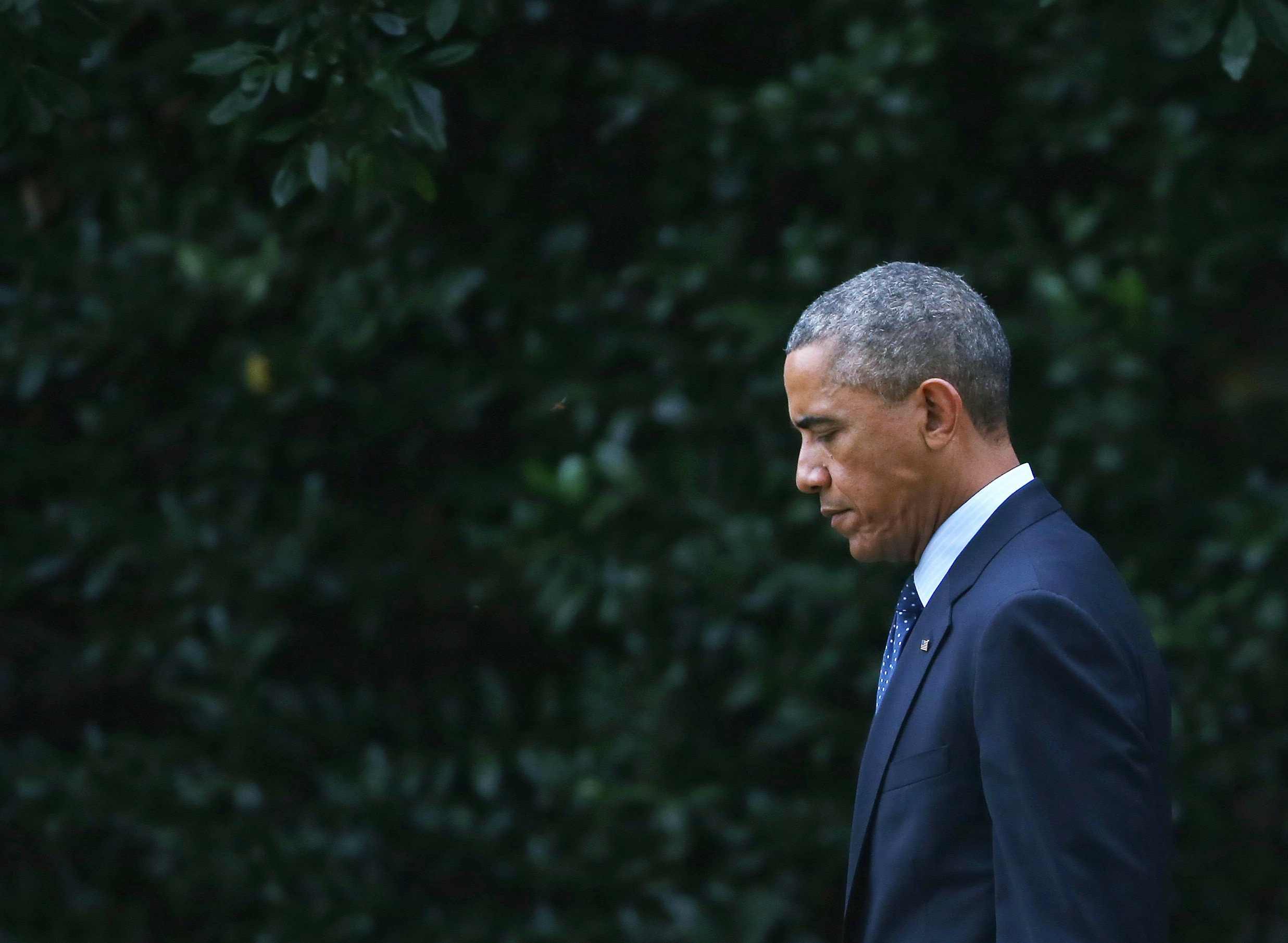
Obama Departs The White House En Route To New York

There have been posts I’ve written over the past decade and a half on this blog that have left me with a very heavy heart. Absorbing the full meaning of what was revealed at Abu Ghraib was one; reflecting on the horrifying child-abuse in the Catholic church was another; reacting to president Bush’s endorsement of a Federal Marriage Amendment or president Obama’s half-assed decision to re-fight the Iraq War one more time were not exactly easy posts to compose. I confess I find it hard to write dispassionately about these kinds of things. The abuse of children; the torture of prisoners; the madness of permanent warfare; and the citizenship and dignity of gay people: these are first order questions for me. I understand, as we all must, that politics is an inherently flawed, imperfect, deeply human and always compromised activity. But some things are not really open to compromise. And torture is one of them.

The mounting evidence that president Obama’s long game may well mean the entrenchment and legitimization of torture and abuse of prisoners is a deeply painful thing to report on. He’ll say otherwise; they’ll reach out and insist otherwise. But the record, alas, is getting clearer by the day. We have seen Obama’s rock-solid support for John Brennan’s campaign to prevent any accountability, even to the point of spying on the Senate Committee tasked with oversight, across his two terms. We have watched as the White House has refused to open up its own records for inspection, as it has allowed the CIA to obstruct, slow-walk and try to redact to meaninglessness the Senate Intelligence Committee’s still-stymied report on torture. Our jaws have dropped as the president has reduced one of the gravest crimes on the statute book to “we tortured some folks,” while doing lots of “good things” as well.

Now for the moment when the stomach lurches. The Obama administration is actually now debating whether the legal ban on torture by the CIA in black sites and brigs and gulags outside this country’s borders should be explicitly endorsed by the administration in its looming presentation before the UN’s Committee Against Torture (which might well be an interesting session, given the administration’s consistent refusal to enforce the Geneva Conventions).

One has to ask a simple question: what on earth is there to debate? Torture as well as cruel, inhuman and degrading treatment has already been banned by the executive order of the president, and it is not bound by any geographical limits. Here, moreover, is the text of the Detainee Treatment Act, pioneered by torture victim John McCain, making it even more explicit:

(a) No individual in the custody or under the physical control of the United States Government, regardless of nationality or physical location, shall be subject to cruel, inhuman, or degrading treatment or punishment.

(b) Construction. Nothing in this section shall be construed to impose any geographical limitation on the applicability of the prohibition against cruel, inhuman, or degrading treatment or punishment under this section.

Well: here is the explanation, as given by Charlie Savage in the NYT yesterday:

Military and intelligence lawyers are said to oppose accepting that the treaty imposes legal obligations on the United States’ actions abroad. They say they need more time to study whether it would have operational impacts. They have also raised concerns that current or future wartime detainees abroad might invoke the treaty to sue American officials with claims of torture, although courts have repeatedly thrown out lawsuits brought by detainees held as terrorism suspects.

The CIA’s lawyers want more time to study whether banning torture and cruel, inhuman or degrading treatment of prisoners in line with the law and Obama’s executive order would have “operational impacts”. But how could it when torture and mistreatment are hereby forever banned? Doesn’t it imply that the CIA still sees an option for restoring torture in the future, especially if a pro-torture Republican wins the presidency?

A strong case for this interpretation can be read here in a post by David Luban. It’s essential, if complex, legal reading for anyone concerned that Obama, by taking the CIA’s side in this debate and promoting and exonerating those implicated in past torture, has actually left open the real possibility of this darkness descending again.

Savage has tweeted in response that “operational impacts” could merely refer to conditions of confinement, or force-feeding, rather than to torture and abuse more broadly understood. But the question is still vague – and we know enough about the appalling record of the CIA in this matter to suspect that even the tiniest loophole in the anti-torture regime – like those dutifully carved by Yoo, Bybee et al. – can lead to more war crimes, whose very existence can be suppressed.

You can see the inherent danger here:

Bernadette Meehan, a National Security Council spokeswoman, said Mr. Obama’s opposition to torture and cruel interrogations anywhere in the world was clear, separate from the legal question of whether the United Nations treaty applies to American behavior overseas.

Say what? Is she really saying that all that matters is that Obama personally opposes torture, regardless of whether the law says so or not? Does the administration think we’re that easily placated? Does the president think that another empty rhetorical gesture to his base will suffice – even though his administration intends to be mealy-mouthed about torture in front of the UN Committee and leave a gaping loophole for the next president to exploit?

Presidents come and go; Congressional majorities go back and forth; but the CIA remains. Because this administration never even considered enforcing the Geneva Conventions on the US – by refusing to investigate and prosecute acts of torture and abuse by government officials under the previous administration – the CIA knows it can get away with war crimes in plain sight. Emboldened by that knowledge, and eager to prove that its previous actions were completely legit, it seeks now to find ways to cover up the record, and get the Obama administration to endorse a loophole for the perpetuation of torture, thus cementing a bipartisan protection of war criminals and of war crimes and prisoner abuse. It does all this for the future: so that it will never be held accountable by any body, domestic or international, and so that it can torture and abuse again, if it decides it’s in the country’s best interests. And only it will make that decision. We know by now it needs no other sanction – just some legal shenanigans to cover its own ass.

So we have a true test of what this president is made of, as the administration preps for its first appearance before the UN Committee. Is this president serious about torture? Or is he a pawn, like so many before him, of a rogue agency that is accountable to no one?

(Photo by Mark Wilson/Getty Images)

When Exactly Might DC Have Legal Weed?

know-dope-shirts

Jon Walker asks around:

“About four months” is theoretically the absolute fastest that stores could begin selling recreational marijuana in the District after the D.C. Council adopts new legislation, according to Rabbi Jeff Kahn. As the operator of Takoma Wellness Center, one of D.C.’s three functioning medical marijuana dispensaries, he is uniquely positioned to provide insight into this question.

But a year to a year-and-a-half is more likely:

One big hold up could be the council and the local regulators charged with writing the final rules.

The council is going to need to not only balance the needs of the customers, the community and business leaders, but also trying to prevent Congress and/or federal agencies from stepping in to shut down the whole thing. After all, voters in the District first approved a medical marijuana initiative back in 1998, but Congress stepped in to prevent the District from actually adopting medical marijuana rules until 2010. Earlier this year, a federal appropriations bill containing a provision to block D.C. efforts to move forward with marijuana legalization actually passed in the House, but it died when the Senate didn’t take it up.

That said, Councilmember David Grosso (I) feels that if voters show overwhelming support for Initiative 71, the council will move quickly to respect the will of the electorate.

Which is a good opportunity to highlight the absurd anomaly of the capital city’s disenfranchisement. Which reminds me: get your Know Dope DC t-shirts here. (Oregon version here and Alaska version here … full details on the shirts here.)

Why Networking Makes You Feel Icky

Jordan Gaines Lewis explains:

Describing ourselves on paper, while blindly attempting to live up to the expectations of others, makes it all feel like a giant lie, doesn’t it? Of course, personal statements and cover letters add a particularly thorny dimension – we have to brag about ourselves.

An amusing study in an upcoming issue of Administrative Science Quarterly suggests that putting ourselves out there professionally actually makes us feel dirty. Literally.

In the study, 306 adults were asked to imagine one of two scenarios. One group recalled a time when they needed to create a relationship with someone who would benefit them professionally. The other group thought about an instance where they socialized casually, like at a party. The participants then filled in the blanks to word fragments such as W _ _ H, S H _ _ E R, and S _ _ P.

Those who had relived situations of professional networking were roughly twice as likely to fill in the blanks with words related to physical cleanliness, such as “wash”, “shower,” and “soap,” while the other group tended to come up with more neutral words, such as “wish,” “shaker,” and “step.” The conclusion drawn by the study’s authors was that “networking in pursuit of professional goals can impinge on an individual’s moral purity.”

Legalization Crosses The Border

Cannabis Supporters Hope For Legalization

Christopher Ingraham maintains that “the news coming out of Colorado and Washington is overwhelmingly positive.” And that other nations are paying attention:

Countries, particularly in Latin America, are starting to apply these lessons in order to craft smarter policies that reduce violence and other societal harms brought about by the drug war. Uruguay, for instance, has moved toward full national legalization of marijuana, with an eye toward reducing the thriving black market there. Mexico’s president has given signs he’s open to changes in that country’s marijuana laws to help combat cartel violence. The Organization of American States recently issued a statement in favor of dealing with drug use as a public health issue, rather than a criminal justice one.

Regardless the eventual direction of marijuana legalization in the U.S., steps toward reform here are already prompting other countries to seek out more pragmatic solutions to their drug problems. In short, they’re making the world a better place.

However, Ed Krayewski is underwhelmed by Uruguay’s experiment:

Just 378 people registered as of last month, and why would there be more? Uruguay’s president, Jose Mujica, who supported legalization even while warning of the illness marijuana use can lead to, is nevertheless term-limited. The front runner to succeed him, cancer doctor Tabare Vazquez, also his predecessor, is excited about using the registry to “better know who uses drugs and be able to intervene earlier to rehabilitate that person.” Meanwhile, the other candidate, center-right Luis Lacalle Pou, is opposed to legalization. Uruguay’s marijuana legalization experiment may not last much longer than Mujica’s term.

Update from a reader:

Of course legalization is going to spread across the world.  After all, the main reason that draconian drug policies are in place, and have not changed already, is that the US government demanded them.  And had the power to make the rest of the world go along, however reluctantly.

As soon as that driver fades, everybody gets to return to their own preferences.  Which, for a lot of countries (although doubtless not all) means legalization of some drugs, and milder penalties for most.  They are especially motivated, since illegal drugs are what fuels the gangs which make law and order a distant dream in so many places.  Most of Latin America would probably legalize tomorrow if US policy didn’t demand that they enlist in the War on Drugs, and be grateful to be able to devote their resources to the real problems that their countries face.

(Photo: A sticker calling for the legalization of marijuana lies on the street at the annual Hemp Parade (Hanfparade) on August 9, 2014 in Berlin, Germany. Supporters of cannabis legalization are hoping legalized sale in parts of the USA will increase the likelihood of legalization in Germany. The city of Berlin is considering allowing the sale of cannabis in one city district. By Sean Gallup/Getty Images)

“Inflation Is Dead. Done. Whipped.”

Inflation

That’s what Matt O’Brien declares:

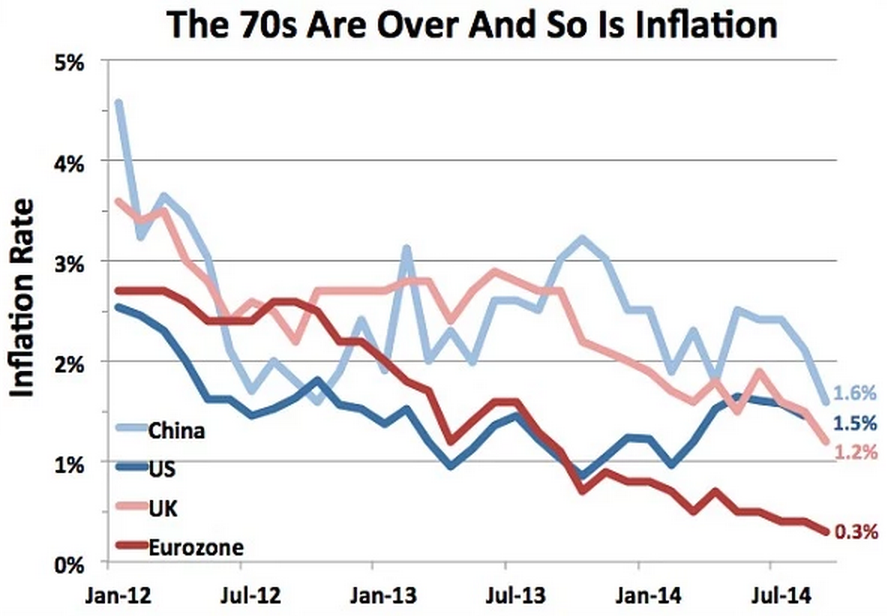
You can see that above. Inflation is just 1.6 percent in China, 1.5 percent in the U.S., 1.2 percent in the U.K., and a minuscule 0.3 percent in the Eurozone. Then there’s Japan, which is harder to compare since its sales tax hike just bumped up prices, but would only have 1.1 percent inflation, if not for that. And it’s probably even lower than that there and everywhere else. That’s because, as Jessie Handbury, Tsutomo Watanabe, and David Weinstein show, measured inflation tends to overestimate actual inflation by about 0.6 percentage points. So inflation might really be about 1 percent in all of the world’s biggest economies.

Drum’s bottom line:

Nobody knows what will happen in the long term, but for now we simply shouldn’t be worrying about inflation. We should be worrying about growth and unemployment. Inflation just isn’t a problem.

But Amity Shlaes doesn’t regret her inflation fear-mongering:

[S]omeone in the world ought always to warn about the possibility of inflation. Even if what the Fed is doing is not inflationary, the arbitrary fashion in which our central bank responds to markets betrays a lack of concern about inflation. And that behavior by monetary authorities is enough to make markets expect inflation in future

Chait pounces:

The inflationistas got the balance of risk totally wrong — unemployment, while falling, has remained above target, while inflation has stayed below it. Shlaes’s defense is not just factually wrong, it’s conceptually bizarre. Somebody has to worry about bear attacks, yes. But if you demand that all children be kept home from school for the year to protect them against bear mauling, it’s not enough to point out that bears exist. You need to somehow engage with the idea of a tradeoff.

Krugman quips:

The ability of inflation derp to persist, even flourish, in an age of disinflation remains remarkable.

A Declaration Of Independents

Surveying the independent politicians on today’s scene, from Michael Bloomberg to current South Dakota Senate candidate Larry Pressler, Michael Kazin waxes nostalgic for when the term meant more than press-pleasing moderation:

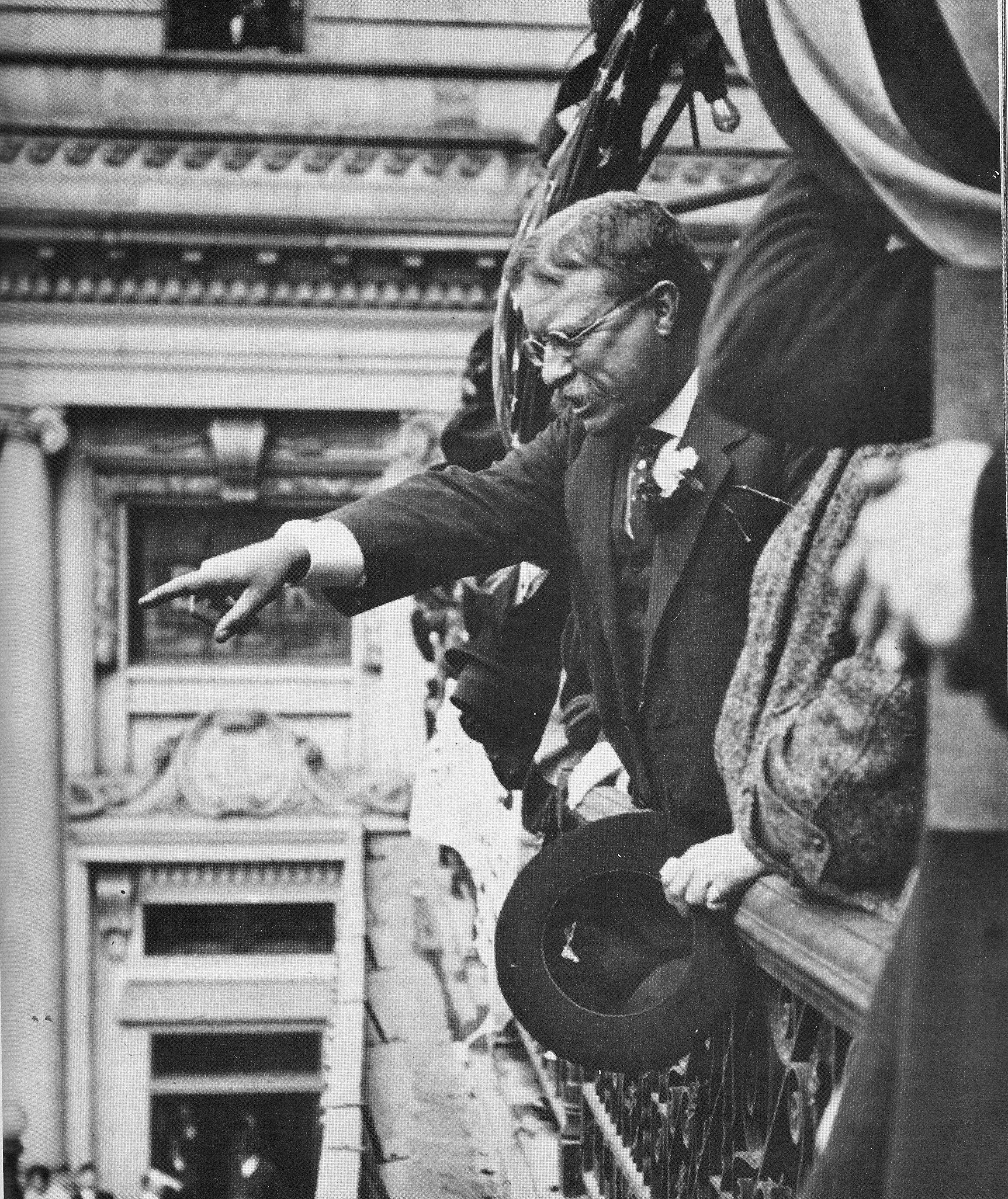
“Independent” wasn’t always a synonym for vapid. In the early decades of the last century, independent politicians played a far more serious and largely Theodore_Roosevelt_Hotel_Allen_1914 beneficial role. Stalwart “progressives,” they advocated open primaries instead of closed party caucuses, non-partisan elections for city government, replacing partisan hacks in the federal bureaucracy with dedicated civil servants, banning corporate spending on campaigns, and giving voters a chance to initiate their own laws or turn down ones passed by often corrupt state legislatures. Figures like Theodore Roosevelt, Robert La Follette, and Fiorello La Guardia left their party, temporarily or for good, to speak out for ideas that were later converted into policy. “There once was a time in history when the limitation of governmental power meant increasing liberty for the people,” TR told his followers in the independent new Progressive Party in 1912. “In the present day, the limitation … of governmental action, means the enslavement of the people by the great corporations, who can only be held in check through the extension of governmental power.”

Not everything such bygone independents did or tried to do lived up to their ambitions.

Big businesses and other “special interests” learned how to hijack the making of ballot initiatives, spending millions on measures designed to boost their profits and power. “Good government” mayors sometimes governed in a bloodless fashion, emphasizing tax-cutting and efficient administration instead of the better housing and health protection which city dwellers badly needed. And, of course, the major parties adapted and enduredand passed laws on the state level that made it difficult for third parties to gain a foothold or to fuse, for any given election, with the Democrats or Republicans.

But the pressure of principled independents and the friendly journalists who covered them did help create a more effective and more professional national state, which legitimated the idea that social programs should serve “the public interest” rather than just the followers of one big party or the other.

(Image: “Theodore Roosevelt Hotel Allen 1914” by Unknown Photographer, Lehigh County Historical Society, via Wikimedia Commons)

Egg-Freezing On The Company Dime, Ctd

Last week, we covered announcements from Facebook and Apple about covering the cost of female employees freezing their eggs. Megan McArdle raises an unaddressed concern:

What I haven’t seen anyone explain is when, exactly, you’ll be ready. For most people, your 40s and early 50s are your peak earning years — is that really going to be a good time to meet that special someone, or finally step back to invest some time in having kids? I don’t know about the rest of you, but I’m already noticing that I have a lot less energy than I used to. It’s not that I can’t get my work done or anything like that. But it used to be that if I had to travel for six days straight and then deliver a 2,500-word essay on the 7th, I could dial up my reserves and power through it — miserable and cranky, to be sure, but functioning. Then one day, around the time I turned 40, I dialed down for more power and there just … wasn’t any. My body informed me that it was tired, and my brain would not be doing any more work today, and we were going to sleep whether I liked it or not.

Along similar lines, Rebecca Mead reflects:

[E]ven with this tantalizing suggestion of reproductive liberty, it’s hard to figure out exactly how long to postpone. A woman might skip having children in her twenties or thirties in order to focus on her career, only to discover by her forties that its demands—not to mention the encroachment of middle age—make motherhood even less manageable than it appeared at twenty-five or thirty.

And it seems overly optimistic to hope that, with nature’s deadlines subverted, a woman’s decision about whether or when to bear children might become an entirely autonomous choice—hers alone to make, independent of cultural and professional pressures as well as biological ones. Might Apple and Facebook’s offers of egg freezing be, in fact, the kind of employee benefit whose principal beneficiary is the company? What if, rather than being a means of empowerment—whereby a young woman is no longer subject to anything so quaintly analog as the ticking of a biological clock—freezing one’s eggs is understood as a surrender to the larger, more invisibly pervasive force of corporate control?

But Chavi Eve Karkowsky stands up for egg-freezing. She insists that it allows women to wait “until they can find a way to have the family they really want, with the partner they really want”:

When asked about delayed child-bearing in many studies, the two factors that come up again and again are financial stability and the availability of an appropriate partner. We really like to talk about that first factor, and tie reproductive lateness to hard-charging women who have their own career-centered, family-unfriendly priorities. But for a moment, let’s talk about that second factor: the appropriate partner. This is the one that I think creates the egg-freezing push. At some point, while dating, and waiting, and having hearts broken (or yes, breaking hearts), many women want to start working with what they have, and not waiting for the right XY chromosome carrier to come around. They want him to come around, they believe he’ll come around, but they don’t want to lose their chance at healthy, genetically related children while they wait for the father of those children.

Katie Benner also defends the corporations:

I know what informs some of the worries that got around after the Apple announcement: Big, technocratic companies might be using these perks to suck the best working years out of their female employees. Evil vampire geniuses at corporate HR ply us with fertility and adoption coverage, thus securing greater access to our young, alert minds.

What happens next? We become 40-something husks (because lord knows, women teeter on the verge of uselessness in every conceivable way at 40) and then and only then do our corporate masters allow us to finally procreate. As our weary 50-something bodies drag toddlers and teenagers from day care to soccer practice, somewhere a corporate overlord will smile with glee: “We got their best years. They never knew what hit ’em. Heh, heh, heh.”

But you know what? That’s not what I think is happening here. For starters, it’s an insane scenario. And it’s also ageist and sexist.

Quote For The Day II

“After a time, tired by his dancing apparently, he settled on the window ledge in the sun, and, the queer dish_graymoth spectacle being at an end, I forgot about him. Then, looking up, my eye was caught by him. He was trying to resume his dancing, but seemed either so stiff or so awkward that he could only flutter to the bottom of the window-pane; and when he tried to fly across it he failed. Being intent on other matters I watched these futile attempts for a time without thinking, unconsciously waiting for him to resume his flight, as one waits for a machine, that has stopped momentarily, to start again without considering the reason of its failure. After perhaps a seventh attempt he slipped from the wooden ledge and fell, fluttering his wings, on to his back on the window sill. The helplessness of his attitude roused me. It flashed upon me that he was in difficulties; he could no longer raise himself; his legs struggled vainly. But, as I stretched out a pencil, meaning to help him to right himself, it came over me that the failure and awkwardness were the approach of death. I laid the pencil down again.
The legs agitated themselves once more. I looked as if for the enemy against which he struggled. I looked out of doors. What had happened there? Presumably it was midday, and work in the fields had stopped. Stillness and quiet had replaced the previous animation. The birds had taken themselves off to feed in the brooks. The horses stood still. Yet the power was there all the same, massed outside indifferent, impersonal, not attending to anything in particular. Somehow it was opposed to the little hay-coloured moth. It was useless to try to do anything. One could only watch the extraordinary efforts made by those tiny legs against an oncoming doom which could, had it chosen, have submerged an entire city, not merely a city, but masses of human beings; nothing, I knew, had any chance against death. Nevertheless after a pause of exhaustion the legs fluttered again.

It was superb this last protest, and so frantic that he succeeded at last in righting himself. One’s sympathies, of course, were all on the side of life. Also, when there was nobody to care or to know, this gigantic effort on the part of an insignificant little moth, against a power of such magnitude, to retain what no one else valued or desired to keep, moved one strangely. Again, somehow, one saw life, a pure bead. I lifted the pencil again, useless though I knew it to be. But even as I did so, the unmistakable tokens of death showed themselves. The body relaxed, and instantly grew stiff. The struggle was over. The insignificant little creature now knew death. As I looked at the dead moth, this minute wayside triumph of so great a force over so mean an antagonist filled me with wonder. Just as life had been strange a few minutes before, so death was now as strange. The moth having righted himself now lay most decently and uncomplainingly composed. O yes, he seemed to say, death is stronger than I am,” – Virginia Woolf, “The Death of the Moth.”

(Photo by Flickr user Dendroica cerulea)

Reading Camus In The Age Of Ebola

Malcolm Jones turns to the author of The Plague as an example of sober, sane thinking about widespread disease:

Based on the evidence in his notebooks, Camus assiduously studied the literature of plague, from Thucydides to Boccaccio to Artaud and certainly the Bible. But always for this author, the plague is foremost a scientific fact, a sickness spread by rats and fleas that infects humans both good and bad indiscriminately. Like the white whale in Moby-Dick, a favorite novel of Camus’s, the plague is lethal but it has no rationale. It is a force as opaque as it is deadly.

Camus is not interested in explaining bubonic plague. He only cares about exploring its effect on a population and most particularly on their responses.

He concentrates on a handful of characters that includes a doctor, a bureaucrat, a criminal, a priest, and a journalist. Each of these men views the plague differently. The crook, for instance, welcomes the quarantine that comes with the epidemic because he thinks it will hide him from the authorities. The priest at first sees God’s agency behind the disease, a view that changes as the novel progresses. But by far the most complicated character, and the man through whose eyes we see most of the action, is Dr. Rieux, a man of science and healing who does all he can to save lives and hold death at bay but yet a man who emerges at the end with his humanity badly damaged.

“As [Rieux] watches the exuberant crowd on the night when [the quarantine is lifted after a year of confinement and] the gates of Oran finally open, he realizes that he will always be a prisoner of the plague,” writes Germaine Bree in her brilliant critical biography Camus. “For him the plague is, in essence, the clear inner awareness of man’s accidental and transitory presence on the earth, an awareness that is the source of all metaphysical torment, a torment which in Camus’s eyes is one of the characteristics of our time.”

Two Steps Forward, One Step Back

Synod On the Themes of Family Is Held At Vatican

[Re-posted from earlier today]

The inevitable media headline from the final Relatio of the Synod on the Family will be: “Bishops scrap welcome to gays.” And this is literally true. The astonishing mid-term Relatio’s language of outreach, inclusion and welcome shrank last night into much more arid, cold and unsparing prose.

We don’t yet have an official English translation of the critical paragraphs, but the gist is clear. Gone are the paragraphs that extol the “gifts and qualities” of gay people; gays are no longer to be “welcomed” in a “fraternal space” but merely “accepted with respect and sensitivity”; the church should no longer “value” homosexual orientation; it should merely accept people with “homosexual tendencies.” Of the three paragraphs in the mid-term report, the two with the most positive language have been excised completely; and the remaining one reaffirms the tone and language of Benedict XVI and John Paul II. Here it is – in my unofficial Google-enabled version:

55. Some families live with members with homosexual orientation. In this regard, our view of the pastoral care appropriate to this situation refers to what the Church teaches: There is no foundation whatsoever to assimilate or to establish  same-sex unions as even remotely analogous to the plan of God for marriage and the family. “Nevertheless, men and women with homosexual tendencies must be accepted with respect and sensitivity. In their regard should be avoided every sign of unjust discrimination” (Congregation for the Doctrine of the Faith, Considerations Regarding Proposals to Give Legal Recognition to Unions Between Homosexual Persons, 4).

Notice the very Ratzingerian foot-stamping:

There is no foundation whatsoever to assimilate or to establish same-sex unions as even remotely analogous to the plan of God for marriage and the family.

It’s not exactly subtle. My marriage, according to this version of the text, is light years away from the marriage of my own sister. There isn’t even a remote analogy between her family and mine. In fact, there is no foundation whatsoever to compare the two relationships in any way. Let me simply respond by saying what most Catholics who have encountered these relationships in our own lives would say: it is indeed hard to read this and believe it. This is not because I differ one iota from the church’s view that the life-long, procreative marriage between a man and a woman is a precious, beautiful and unique thing. Two men or two women cannot replicate it, if only because of basic biology. The sacrament of matrimony is a celebration of this unique institution – and cannot be re-fashioned into something else without diluting its central truth.

But where I differ from the old guard is in their refusal to see anything good or precious in the mutual love, responsibility and sacrifice that are as integral to same-sex unions as they are to heterosexual ones. To see nothing worthwhile there, nothing to value, nothing to affirm seems, well, untrue to the reality more and more of us live. As Cardinal Marx of Germany said earlier this week:

“Take the case of two homosexuals who have been living together for 35 years and taking care of each other, even in the last phases of their lives. How can I say that this has no value?”

He cannot, which is why this paragraph – along with two others on the pastoral care of divorced or re-married people – failed to win the 2/3 majority vote for it to be part of the official text.

But it was included anyway – with the vote tallies appended. And there you see why it is not wishful thinking to believe that something profound has indeed occurred so far in this Synod. Neither of the two previous popes would ever have allowed the original language to even see the light of day – Ratzinger as arbiter of church doctrine for decades could sniff heterodoxy on this like a beagle with a distant potato chip – and stamp it out with relentless assiduity. Both John Paul II and Benedict XVI would have excised the outreach to gay people altogether. And the idea of a transparent vote tally – revealing a vigorous internal division on these questions – would have been unthinkable.

The true headline of this past remarkable week is therefore: the Vatican hierarchy cannot find a consensus on the question of pastoral care for gays, the divorced and the re-married, and the Pope is happy for this fact to be very, very public. These remain open questions for a year of continued debate and discussion before the second stage of the Synod this time next year and the Pope’s subsequent summary. That these are open questions is the real result of this Synod.

I also think its worth reading Pope Francis’ concluding speech to the Synod, which was granted a four minute standing ovation. It is a beautiful text – certainly more so than the unavoidable consensus-speak of what might be called the interim communiqué. Here is Francis’ Obama-style weighing of two different temptations to avoid:

A temptation to hostile inflexibility, that is, wanting to close oneself within the written word, (the letter) and not allowing oneself to be surprised by God, by the God of surprises, (the spirit); within the law, within the certitude of what we know and not of what we still need to learn and to achieve. From the time of Christ, it is the temptation of the zealous, of the scrupulous, of the solicitous and of the so-called – today – “traditionalists” and also of the intellectuals.

The temptation to a destructive tendency to goodness [it. buonismo], that in the name of a deceptive mercy binds the wounds without first curing them and treating them; that treats the symptoms and not the causes and the roots. It is the temptation of the “do-gooders,” of the fearful, and also of the so-called “progressives and liberals.”

Avoiding both these temptations is the goal – which has to be accomplished pastorally and with prudential judgment. In his speech, Francis nods to the traditionalists by quoting Benedict XVI verbatim, but then says this:

We will speak a little bit about the Pope, now, in relation to the Bishops [laughing]. So, the duty of the Pope is that of guaranteeing the unity of the Church; it is that of reminding the faithful of  their duty to faithfully follow the Gospel of Christ; it is that of reminding the pastors that their first duty is to nourish the flock – to nourish the flock – that the Lord has entrusted to them, and to seek to welcome – with fatherly care and mercy, and without false fears – the lost sheep. I made a mistake here. I said welcome: [rather] to go out and find them.

It’s hard not to see a little playfulness here. After all, the word “welcome” was one of the most contentious of the Synod, in so far as it was extended to gay people. And if the final Relatio turned that “welcome” into the more neutral “accept”, Francis turns it into something more radical still: to go out and find the lost sheep.

Just as vital in Francis’ vision is the open, tough and lively dialogue that this Synod represents. Nothing like this has been experienced since the Second Vatican Council. And in his concluding speech, Francis reveled in the turmoil:

It has been “a journey” – and like every journey there were moments of running fast, as if wanting to conquer time and reach the goal as soon as possible; other moments of fatigue, as if wanting to say “enough”; other moments of enthusiasm and ardor. There were moments of profound consolation listening to the testimony of true pastors, who wisely carry in their hearts the joys and the tears of their faithful people. Moments of consolation and grace and comfort hearing the testimonies of the families who have participated in the Synod and have shared with us the beauty and the joy of their married life. A journey where the stronger feel compelled to help the less strong, where the more experienced are led to serve others, even through confrontations. And since it is a journey of human beings, with the consolations there were also moments of desolation, of tensions and temptations.

The church is not a political party, voting on a platform, and shifting from one convention to the next. Its core doctrine is unchanged and unchangeable. But it has evolved and grown and changed in the way it has encountered the world throughout history. It has absorbed and assimilated new ways of thinking and newly discovered truths about humankind and attempted over the centuries to integrate them into its internal dialogue. So you have to look at a Synod like this one and not get too caught up in developments from last Monday to Sunday. You have to look beneath that surface to the tectonic shifts beneath. And the real shift, I’d argue, has been the glasnost of Francis – which may or may not lead to perestroika. The intellectual life of the church was a dark and stifling and deadly silent place until very recently. There is now a crack in the window, where light has been let in, and words said that can be excised from the final text but not expunged from the collective consciousness. And at the end, no consensus on the most contentious questions at hand. And a year to debate them further.

Those knots? They keep unraveling.

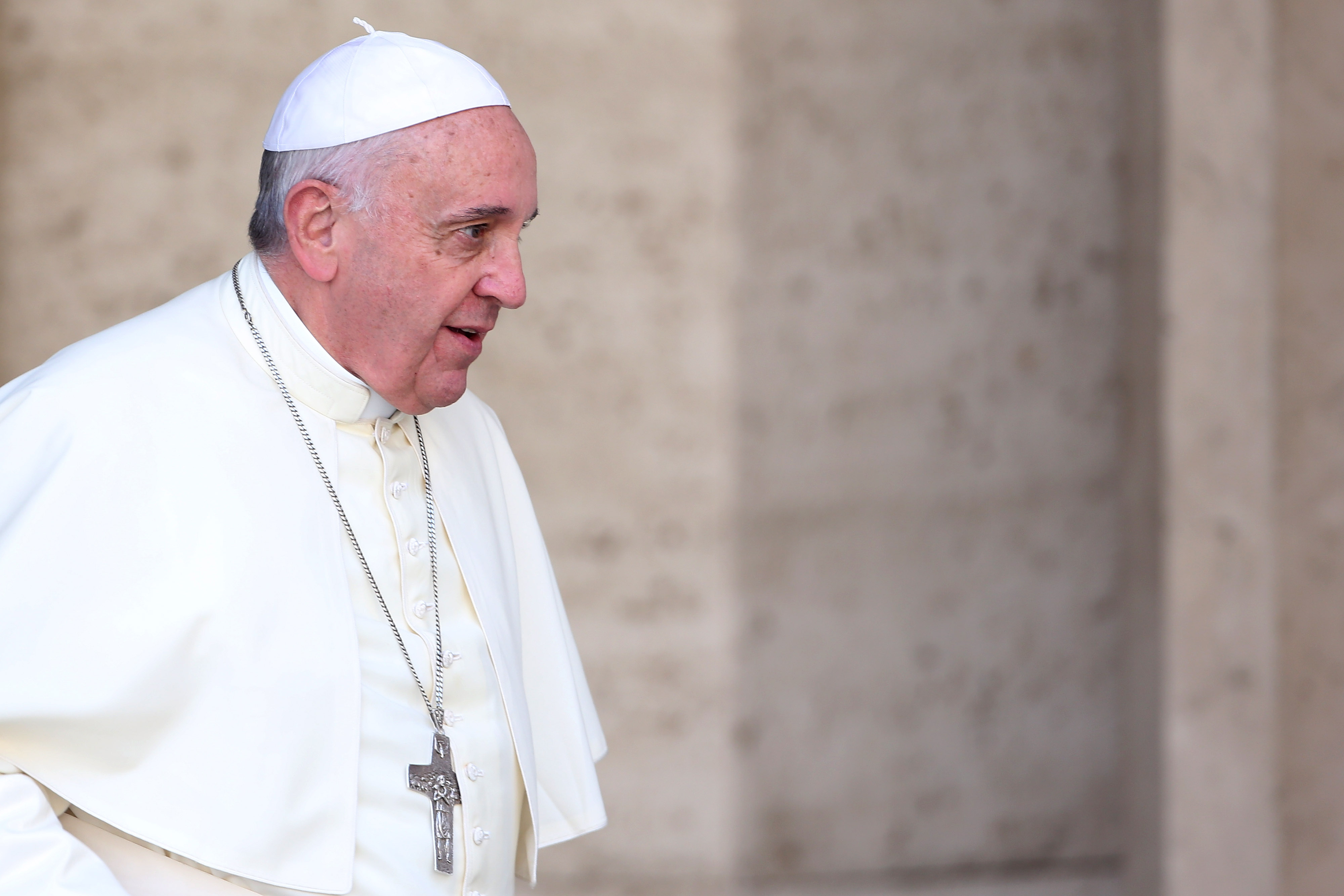
(Photo: Franco Origlia/AFP/Getty.)