Fake Limbs That Work Like Real Ones, Ctd

Last weekend’s post about mind-controlled artificial limbs left a reader his shaking head:

It frankly drives me crazy to watch videos about developments in myoelectric upper-extremity prosthetics like the one you posted and to read commentators like Victoria Turk “herald this breakthrough.” Yes, I can choose not to watch or read, but I’m an upper-extremity amputee, and I’ve worn a body-powered prosthesis most of my life. So why wouldn’t I let my curiosity reign?

Reports like this are crazy-making because for me, the products they tout inevitably disappoint. Indeed, I probably wouldn’t wear the prosthetic device with implanted electrodes, even in the very unlikely event that I were offered the opportunity. They evoke the hoary sci-fi cliché of the melding of man and machine, and while mildly interesting, they aren’t the answer for the everyday, prosthesis-wearing amputee.

I once tried a myoelectric arm with surface electrodes.

I promptly went back to my body-powered prosthesis, which is fitted with a hook for a terminal device. It’s far lighter, easier to manipulate, more dexterous, and more robust, and it’s not subject to the involuntary opening and closing of the surface electrode prosthesis. It also doesn’t discolor in the sun (that ‘hand’ is a silicon glove, of course) or run out of power.

Look at the video and see what the terminal device (the hand itself) can do: open and close. The end. It’s gross motor movement, at best. Dexterity at the individual finger level is coming, but it’s still a long, long way off (decades, if you ask me) from what you, the ‘handed’ majority, enjoy and take completely for granted. As it is, given the prosthetic hands in this video, give me a hook any day.

Then, there’s the bottom line: price. Who pays for these fantastically expensive myoelectric limbs? My new arm cost $7,500 and is as basic as they come. A myoelectric starts in the tens of thousands of dollars. One with implants? Few know, but I imagine that we’d likely start the conversation at $100,000. Impractical, in other words, for anyone but the well-off or those lucky enough to live where the state funds their prostheses (I live in Canada, and the state paid 65 percent of my artificial-limb cost. My supplementary, work-paid health plan covered the rest, but it would have capped at $3g).

For the working man, the poor, those who live in countries where state health care is weak, or in other words, likely for the majority of upper-extremity amputees in the world, simple, body-powered prostheses are the past and for the moment, also the future.

Forgive the rant, but this touched a nerve, as it were.

Martin Amis’ Auschwitz

Martin Amis’ new novel, The Zone of Interest, takes place in the death camps at Auschwitz. Sophie Gilbert provides an overview:

The Zone of Interest is a strange book, indeed; a grim satire, part office comedy, part romance, part lyrical dissection of civilization gone very, very wrong (the sky over the camp one day, we are told, is “a vulgar dark pink, the color of café blancmange”); part visceral, oozing, pestilent horror. The comic interchanges are no less funny for being interspersed among the brutal renderings of depravity, but they do, conversely, make that horror even more jarring. They also remind us of our most basic and familiar impulse when faced with the bleak despair of existence. Amis isn’t making Auschwitz funny—he’s making it human.

The novel weaves between three different narrators. Angelus “Golo” Thomsen is a womanizing “desk murderer” with Aryan good looks who has a clerical position at the camp, but whose Uncle Martin (later revealed to be Martin Bormann, Hitler’s powerful private secretary), grants him a degree of privilege beyond his rank. Paul Doll, colloquially known among officers as “the Old Boozer,” is the ghastly, sociopathically pompous commander, styled after Rudolf Höss and very much in the model of the classic Amis grotesque (his “spongy red chest hair is dotted with beads of sweat”). The last voice belongs to Szmul, one of “the saddest men in the history of the world.” As a Sonderkommando, one of the Jews charged with disposing of the remains of murdered prisoners, Szmul justifies his brazen ability to go on living by listing his three motivations: to bear witness, to seek revenge, and to save a life, “at the rate of one per transport.”

Amis spoke about the idea of Auschwitz as a “mirror of the soul” in a recent interview:

[Y]ou say that Auschwitz, that experience, would tell people who they were. Could you talk about that?

It’s actually a terrifying notion that many survivors say. It’s a real theme of survivor testimony, which is often of astounding quality. Amazing eloquence. But they all said that during peace and civilization you only ever see 5 percent of someone’s character. And you should dread seeing it all, because you find out whether you’re brave, adaptable, determined, immune to despair, and that sort of thing. That’s for the victims. And for the perpetrators, you find the terrible potentialities … But the banality of evil, Robert Jay Lifton said the best thing about that: “Well, they might have been banal when they started out, but they weren’t banal once they started killing people.”

In a review, Ruth Franklin pronounces Amis more a master of words than concepts:

Amis is one of the most inventive users of language currently at work in English — his sentences cannot help crackling — as well as a uniquely talented satirist. But when it comes to the deeper problems of the Nazi pathology that gave rise to the jargon he so brilliantly parodies, he does not have much to offer. Is the brutal Paul Doll correct in his repeated insistence that he is “completely normal”? Is Golo Thomsen, as he claims, one of “hundreds of thousands . . . maybe millions” of ­Nazis who passively tried to obstruct the regime? Was Auschwitz truly a mirror of the soul that reflected people as they ­really were? Such questions may be unanswerable. Still, a novel that raises them should at least make an attempt at grappling with them.

But, in a damning assessment, Michael Hofman finds even Amis’ style overwrought:

It elicits not one but both types of unwelcome reaction from the reader: both the ‘so what?’ and the ‘I don’t believe you’ and sometimes both together, as in many of the weather sentences (in The Zone of Interest the weather ends up having to stand in for reality). ‘The grey sky went from oyster to mackerel’: it’s a pretty notion and catchpenny-clever, but really not. The big and medium-sized things in it – the vision thing – almost completely don’t work. At one stage, Thomsen writes:

I walked on for another ten minutes; then I turned and looked. The Buna-Werke – the size of a city. Like Magnetigorsk (a city called Sparkplug) in the USSR. It was due to become the largest and most advanced factory in Europe. When the whole operation came on line, said Burckl, it would need more electricity than Berlin.

I can’t be persuaded here that anyone is seeing anything. First the stray Soviet comparison (and – mainly authorial – explanatory, as it were, self-basting gibe), then the slither (‘due to become’) in time, then the switch of person to Burckl. There’s nothing here, not even a placeholder, a piece of cardboard with ‘Forest’ on it. Or take a swank Berlin government room in 1942 or 1943: ‘The air was full of tobacco smoke and existential unhappiness.’ Surely not! One might as well say it was full of low-hanging zeugmas. I can’t imagine a contemporary speaker (‘I liaise’ or not) for these lines from a departing train: ‘And now Berlin started off on its journey, westward – Friedrichshain with its blocked sebaceous glands and pestilential cafeterias, the Ahnenerbe with its skeletons and skulls, its scurf and snot, the Potsdamer Platz with its smashed faces and half-empty uniforms.’ They are just magniloquent and omniscient like any other third-generation synthesised Isherwood.

Reviewing the book last month, Joyce Carol Oates also found Amis’ style an awkward match for his subject:

“The Zone of Interest,” like “Time’s Arrow,” focusses upon the vicissitudes of personality and situation, and does not take up such larger questions, except fleetingly. The author’s rage at Holocaust horrors is portioned into scenes and sentences; it does not gather into a powerful swell, to overwhelm or terrify. Is it inherent in postmodernism that, no matter the subject, such emotions are likely to be held at bay? “To produce a mighty book, you must choose a mighty theme,” as Melville declares in “Moby-Dick”; but such mightiness may be precluded by a mode of writing whose ground bass is irony rather than empathy. In the afterword, Amis cites the famous passage in Primo Levi’s Auschwitz memoir in which Levi asks a German guard, “Warum?,” and is told by the guard, “Hier ist kein warum”—“There is no why here.” Perhaps that terse reply is the only adequate response to all questions of “Why?” relating to the Holocaust.

The Rise Of The LitBots

Liam O’Brien entertainingly surveys the history of computer-generated literature:

Vonnegut made up a computer that wrote love poems in 1950 – and the Brits did the same thing, but IRL. The reason why you don’t have a bunch of computer-written books on your shelf is because they’re traditionally looked on as novelties. A few years back a Russian computer wrote a Tolstoy homage in the style of Murakami, but unless McSweeney’s has hired this program on the sly, this is the first and last we’ve heard of it. And this isn’t new – over thirty years ago, a program called “Racter” allegedly composed an entire book called The Policeman’s Beard Is Half Constructed. A decade later, another programmer and his creation composed a apparently-not-bad Jacqueline Susann knockoff. Seven years later, someone managed to create the automated equivalent of a tiresome MFA student.

Zooming out, O’Brien suggests contemporary novelists have little to fear:

[A]lgorithms are fairly good at making and collating contentbut not literature. The Associated Press and Forbes uses bots to author articles; Penguin Random House doesn’t have the same option. (Though I do have a very convincing theory that James Michener was in fact a clockwork automaton.)  Which brings us to the story of Philip Parker, who created a program that’s effectively allowed him to “write” over 100,000 books – granted, they’re books that nobody would ever buy, esoteric (and expensive) market research and industry study titles like The 2007-2012 World Outlook for Wood Toilet Seats. The program is a content compiler rather than a composer – though Parker claims to be able to write poetry and fiction with it – and Parker has posed it as a crucial element in getting textbooks and other types of educational content to poor areas, all because it cuts out the author.

But in a review of Peter Swirski’s From Literature to Biterature, Jennifer Howard notes that not everyone is confident that humans have a definite literary advantage:

Inspired in part by the work of Stanisław Lem, Swirski analyses the prospects for “computhors” as he calls these imagined but (he believes) soon-to-be-real machine entities. His focus zigzags across the fields of artificial intelligence, computing history, cognitive science, narrative theory, the evolution of men and machines, and post-Turing attempts to figure out how to identify computer intelligence if (Swirski would say when) it arises. “Underlying my explorations is the premise that, at a certain point in the already foreseeable future, computers will be able to create works of literature in and of themselves”, he writes.

The trick will be recognizing that we have arrived at that point: “There will never be a moment of epiphany, a discontinuous rupture, a sudden awakening” – no “equivalent of a burning bush”, Swirski writes. It might not even matter whether humans will be able to recognize true autonomous intelligence in a machine. More important is whether we are ready to believe it’s possible. … The “computhors” themselves may well not care whether we fully appreciate what they create, Swirski speculates. They’ll be too busy doing their own thing.

Nobel? No Thanks

Stefany Anne Golberg considers why Sartre turned down the Nobel Prize in Literature:

Written words are a compact between writer and reader. “A writer should never dish_sartre say to himself,” wrote Sartre in What Is Literature?, “‘Bah! I’ll be lucky if I have three thousand readers, but rather, ‘What would happen if everybody read what I wrote?’” A writer can ignore this compact or take responsibility for it. The imperative remains.

It matters, therefore, what institutions a writer allies with, what her political sympathies are, what prizes she accepts. This is to say, Sartre’s rejection of the Nobel Prize was not personal. It was metaphysical. Every act I take as a writer, Sartre was saying, affects the existence of my readers. Accepting the Nobel Prize would have been, for Sartre, to compromise the freedom of his readers. Indeed, it would have compromised the freedom of all mankind.

Golberg goes on to contemplate why, for Camus, accepting the Nobel posed less of an existential conflict:

The difference lay, perhaps, in Camus’ understanding of freedom. The human condition, for Camus, was fundamentally absurd. Man desires reason, meaning, happiness. And yet he lives in a world that is irrational, cold, and silent. Such a confrontation of life’s absurdity could drive a man to despair, possibly to suicide. But despair is only a negation of the Absurd. When one truly embraces the Absurd — i.e., embraces life with all its unreason and messy contradictions — there is an imperative to live. Only in the full acceptance of the absurdity of life can man become free. True freedom is found not just in action — in existing — but in coming to terms with existence. In acceptance.

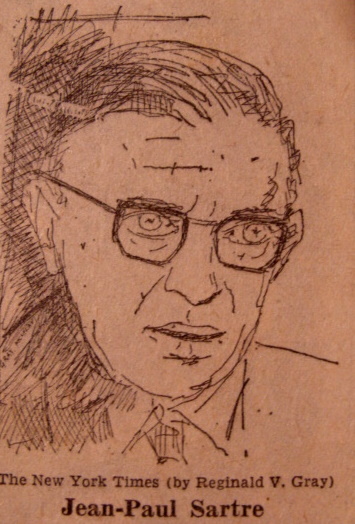
(Image: 1965 sketch of Sartre for the New York Times by Reginald Gray via Wikimedia Commons)

Generation Sext

In the latest Atlantic cover-story, Hanna Rosin explores the ubiquity of teen sexting:

A consistent finding is that sexting is a pretty good indicator of actual sexual activity. This year, enhanced-buzz-15911-1361559002-10researchers in Los Angeles published a study of middle-schoolers showing that those who sent sexts were 3.2 times more likely to be sexually active than those who didn’t. A story in the Los Angeles Times described the study as proof that “sexting is not a harmless activity.” But in fact the findings seem a little obvious. Since most kids who sext report doing so in the context of a relationship, it makes sense that sex and sexting would go together. As Amy Hasinoff, the author of the forthcoming book Sexting Panic: Rethinking Criminalization, Privacy, and Consent, points out, “Sexting is a form of sexual activity,” not a gateway to it.

But kids also sext, or ask for a sext, or gossip about sexting, for reasons only loosely related to sex. A recent New York Times story explored the practice of “vamping,” or staying up after midnight to check in with friends online. The kids in Louisa County, like kids everywhere, are chronically overscheduled. They stay late at school to play sports or to take part in other after-school activities, then go home and do their homework. Nighttime is the only time teens get to have intimate conversations and freely navigate their social world, argues Danah Boyd, the author of It’s Complicated: The Social Lives of Networked Teens. For the Louisa County kids, that means checking up on the latest drama on Twitter—“Anyone still awake?” is a common post-midnight tweet—and filling up their Instagram accounts, or asking a girl for a pic.

Amanda Hess defines a loaded slang term Rosin encounters in her reporting:

A thot, for the uninitiated, is shorthand for a constellation of riffs on a central theme:

“that ho over there,” “that ho out there,” “thirsty hoes out there.” On the surface, it appears to be a synonym for slut. (And for rappers and Internet meme producers, it is conveniently both easy to rhyme and effortless to pun.) But the thot label is wielded to indicate class status as much as it refers to sexual activity. Thots are criticized based on sexual behavior, yes, but they’re more broadly identified via their consumption habits; this makes it possible to denounce them on sight even when their sexual histories remain private. …

The archetypical thot, as constructed through memes circulated on Instagram and Twitter, drinks cheap alcohol, eats Chipotle, uses a Metro PCS phone card, and shops at mall staple Aeropostale. She has a beauty mark piercing on her upper lip, just as the “tramps” who came before her sported tattoos on their lower backs. She is“grocery shopping in heels looking like” she’s “going to the EBT awards.” In their most absurd forms, thot memes position thotness as a quality that’s predestined from birth: A thot is named “Jasmine” or “Sasha,” and she stands 5-foot-1 to 5-foot-5. Most of the time, she’s black.

(Screenshot via Matt Stopera)

The Story Of Citizenfour

Fred Kaplan reviews Laura Poitras’ new Snowden documentary:

At one very interesting point in the film, Snowden tells Poitras and Greenwald, “Some of these documents are legitimately classified,” and their release “could do great harm” to intelligence sources and methods. He adds, “I trust you’ll be responsible” in handling them.

This is what most baffles me about the whole Snowden case. What kind of whistleblower hands over a digital library of extremely classified documents on a vast range of topics, shrugs his shoulders, and says, I’ll let you decide what to publish? He tells the two journalists that he’s “too biased” to pick and choose himself. What does that mean? These are esoteric, in some cases highly technical documents; he’s in a better position to know their implications than Poitras and Greenwald; certainly he could warn them, “Oops, I shouldn’t have included this one. It’s really sensitive.”

During a profile of Poitras, George Packer provides his take on the film:

Among the leaked documents are details of foreign-intelligence gathering that do not fall under the heading of unlawful threats to American democracy—what Snowden described as his only concern. [N.S.A. whistle-blower William] Binney, generally a fervent Snowden supporter, told USA Today that Snowden’s references to “hacking into China” went too far: “So he is transitioning from whistle-blower to a traitor.” This is a distinction that Poitras might have induced Binney to pursue. Similarly, the tensions between Greenwald and Assange—their struggle over Snowden’s legacy and the rights to his archive, and its ideological implications—aren’t depicted onscreen. Because Poitras is so close to her subject, politically and psychologically, “Citizenfour” is not the tour de force it might have been.

Regardless, Friedersdorf recommends the documentary:

“I feel good in my human experience to know that I can contribute to the good of others,” Snowden says in one scene. In another, Greenwald delights in a righteous “fuck you” to a spying government he regards as criminal and officials he sees as betraying core liberal principles. At film’s end, we learn that Snowden is living with his longtime girlfriend in Moscow in circumstances far more pleasant than a Supermax prison, though how long he’ll be permitted to remain there is anyone’s guess.

History is rife with dissidents who took satisfaction in various causes—some worthy, others abominable. Snowden’s critics will continue to insist that his actions were unjustified, no matter how earnest he appears to be about the nobility of his purpose. Yet I suspect that even they will find some merit in this film, if only for its footage. Seldom has the public gotten so intimate a glimpse at how a key figure felt and acted in private moments of profound historic consequence.

Wired talked to Poitras about the encryption tools she uses:

In the closing credits of Citizenfour, Poitras took the unusual step of adding an acknowledgment of the free software projects that made the film possible: The roll call includes the anonymity software Tor, the Tor-based operating system Tails, GPG encryption, Off-The-Record (OTR) encrypted instant messaging, hard disk encryption software Truecrypt, and Linux. All of that describes a technical setup that goes well beyond the precautions taken by most national security reporters, not to mention documentary filmmakers.

Poitras argues that without those technologies, neither her reporting on the Snowden leaks nor her film itself would have been possible.

And T.C. at the Economist reveals the film’s ending:

Ms Poitras has one surprise left to spring, and it may turn out to be a big one. Mr Snowden now lives in Moscow, where he claimed asylum after the American government cancelled his passport while he was travelling to South America. The film finishes with a visit from Mr Greenwald, in which he and Mr Snowden discuss the existence of a second leaker inside the NSA—something that has been rumoured for months in the press and on computer-security blogs. When Mr Greenwald shows Mr Snowden what his new source is offering, his eyebrows almost climb off the top of his head. Like an action film setting up a plot hook for a sequel, viewers are told in no uncertain terms to expect more leaks—and soon.

The Whiteness Project

It is conducting “1,000 interviews with white people from all walks of life and localities in which they are asked about their relationship to, and their understanding of, their own whiteness.” The trailer:

This embed is invalid

The project got ridiculed on Twitter last week. Jessica Roy interviewed filmmaker Whitney Dow about the response:

The level of reaction I got [online] was, This is outrageous, what you’re doing. My response to it is:

What is outrageous about speaking the truth? The one video about the woman talking about the woman being afraid of black men and the statistics saying 40 percent of whites think black men are inherently violent: It’s a real fact. It’s an uncomfortable fact; it’s a strange, terrible fact; but why is saying that out loud so outrageous? I think that my goal is to get white people to sort of confront the disconnect between how they experience the world and the reality of the place they hold in the world. So far, I think it’s done a good job of creating these conversations.

Carla Murphy also spoke with Dow:

[Q.] I’m going to be frank. I’m not really interested in hearing white folks talk about race or whiteness. I’ve been a minority in majority-white spaces since I was 12 years old. I feel like I know what your subjects are going to say. Why should I take the time to watch?

[A.] I would say that people like you and me who have thought about race a lot and have been around and processed it, maybe that’s not who this project is for. But, again, I go back to all these women of color who’ve written me from Albuquerque to Australia, who’ve said it was really painful but incredibly cathartic to hear what white people say when they’re not in the room. That’s all I can say.

Interviews from the series can be viewed here.

A Glass Habit

Jordan Pearson flags a first-of-its-kind “addiction”:

San Diego doctors recently identified the first case of “internet addiction” involving Google Glass in a 31 year-old Navy serviceman who checked himself into rehab for alcohol abuse. His symptoms included involuntary temple tapping and seeing his dreams through Glass’ tiny gray box. He used Glass 18 hours a day for work, only taking it off to sleep and bathe. Why? Because it made him very, very good at his job.

According to a paper published yesterday in Addictive Behaviours, the patient used Glass to quickly take photos of convoy trucks and tag them with identifying numbers and equipment lists (his exact job title is not specified), boosting his workplace productivity. He became so dependent on his newfound abilities at work that an addiction began to form, according to the doctors. But, really, what was he addicted to? The internet? Google Glass itself? No—he was hooked on work, and Glass merely made it possible.

Jesse Singal can relate:

This is consistent with “game transfer phenomena,” or GTP, a weird cognitive quirk that I’ve written about for the Boston Globe here and here. It’s when you’re playing a game that involves some repetitive sensory elements — images or sounds or button combinations — and aspects of them start to seep into the real world and/or your dreams after you turn the game off.

It’s happened to me in the past, and when it has, it’s always been worst around bedtime — I remember trying to sleep after playing a first-person shooter game and, upon closing my eyes, feeling the sensation of traveling through the game’s hallways and seeing slight hallucinations of walls racing past. Another time, during the height of my GTA IIIplaying days, I was wandering around near my parents’ house and wanted to look behind me, and I could feel the part of my brain responsible for getting me to press the middle mouse button — that is, the command to look behind you in the game — go off. (No, these are not stories I will be telling on first dates anytime soon.)

Vengeance Of The Nerds, Ctd

The controversy over violent, misogynistic trolling in the gamer community returned to the spotlight this week when death threats compelled feminist critic Anita Sarkeesian – no stranger to such threats – to cancel a public appearance:

Sarkeesian, who is currently in the middle of a lengthy project dissecting sexist tropes in video games, was forced to cancel an upcoming speech at Utah State University, after an anonymous letter threatened a mass shooting should her speech proceed. Sarkeesian canceled after officials were unable to make sure there would be no concealed weapons at her speech. Utah law allows for concealed carry with a permit. Though the threat on Sarkeesian’s speech was almost certainly the work of a disaffected, unaffiliated troll, it plays into a larger trend involving the critic — she does pretty much anything, and angry threats, often from self-described “gamers,” follow.

But there is always the risk that drawing too much attention to these anonymous misogynists and their distant violent threats could actually empower them, when otherwise they might simply molder in their basements. And changing one’s behavior in the face of such terrorism is giving the troll a win of sorts, in the same way we saw with the Mohammed cartoons and ISIS beheading tapes on a much grander scale. But ignoring such threats is never an easy call of course, and Sarkeesian deserves the utmost sympathy. Alyssa Rosenberg insists that such threats be taken seriously:

To some observers, threats made online are ephemeral, abstract even in their fantastical, violent detail. And yet, a threat to carry out a school shooting does not actually have to result in an auditorium full of bodies to achieve what the letter-writer intended, to make it impossible for Sarkeesian to move forward with her talk. And a threat does not have to meet the legal threshold of a crime — in some states, evidence that the person issuing the threat has an actual intent and clear plans to carry it out – to levy extremely high social costs.

Sarkeesian has had to leave her home because someone who threatened her claimed to have her address and that of her parents. Brianna Wu, who co-founded the video gaming company Giant Spacekat, also moved to avoid threats made in response not even to sustained criticism of video games, but to jokes she made about the Gamergate campaign. “Depression Quest” developer Zoe Quinn went into hiding after a vengeful ex-boyfriend published a long account of her alleged infidelities that seemed to imply she chose her partners for professional advancement.

And also:

Take the case of Gamasutra blogger Leigh Alexander, who was targeted after she questioned the changing nature of “gamer identity” and claimed that “gamers are over.” In apparent response to her piece, a subreddit arose imploring gamers to flood the Intel Corporation with complaints about her, resulting in Intel ads being pulled from Gamasutra’s site. And while Intel issued a boilerplate statement against gender discrimination, the ads remained down and #Gamergate claimed victory. “They targeted me specifically,” Alexander told Vulture. “They were offended by the assertions in my article and by my progressive/feminist work in general. And they continue to harass me and others on a regular basis.”

More broadly, Sarkeesian’s critics – including those who don’t threaten her with rape or murder on a regular basis – accuse her of being part of a culture of corruption in videogame journalism. Yet, as we’ve seen, these critics’ targets are primarily women, and the “criticism” too frequently crosses a line into trolling or outright threats, so it’s often difficult to separate the good critics from the bad. Jim Edwards is amazed that there is any controversy here in the first place:

Gamers who have rallied around the hashtag #GamerGate insist that the death threats are trivial. It’s only Twitter, they say. Grow up and ignore it the way the rest of us do. More importantly, they add, the death threats are not the TRUE issue at the heart of GamerGate. Rather, it’s the video game industry’s cozy relationship with video game journalists and the conflict of interests they indulge in. Sometimes, the writers sleep with the game coders, apparently. “Video game journalism [is] in need of urgent reform,” writer Milo Yiannopoulos insists. …

But look at the priorities here. On the one hand, a handful of women have said, “Some of these games are frankly not great, guys!” and been threatened with death for having that opinion. And on the other hand, a huge chunk of the gaming community is now fiercely arguing that the death threats aren’t important. Rather, the technicalities of video game reviewing are the priority. It’s completely insane. It’s insane that you even have to say out loud that sending death threats to people who disagree with your opinion of video games is wrong. Yet here we are: Apparently, it needs to be said.

Jesse Singal views Gamergate as a form of backlash against the maturing of videogames as a creative industry:

We are never going back to a time when there aren’t developers making games about nuanced, mature themes, some of which may be of little interest to some stereotypical “traditional” white male gamers. That’s why Kyle Wagner’s comparison of hardcore Gamergaters to tea partiers is so accurate: Like members of the tea party, some Gamergaters are seeing big, real changes and wrongly predicting that said changes will bring them personal hardship or persecution. Hence the outrage, and hence the “deep sense of entitlement coming out of a section of the male gaming community,” as Sarkeesian described it to me.

It’s easy for a male observer of all this to wax hopeful about the “silver lining” of the vibrant, endlessly fascinating indie game scene, of course — I’m not the one who has been driven from my home because of harassment, and I’ve never known the feeling of having to cancel an event because of the threat of a mass shooting. But at some point this paroxysm of misogynistic, revanchist rage will die down. When it does, fascinating, quirky indie games will still be there, and the creative forces behind them will only be growing in power and visibility.

The Syrian-Turkish-Kurdish Clusterfuck, Ctd

Adam Chandler narrates the latest diplomatic twist in the Mideast turducken:

On Thursday, things got a little stranger. The State Department announced that it had held direct talks with the Kurdish Democratic Union Party (P.Y.D.), a Syrian Kurdish group that is linked to the P.K.K. In other words, American diplomats met with the Syrian affiliate of a group that Turkey had just bombed and that the United States has listed as a terrorist organization since 1997. …

During Thursday’s press conference, [State Dept. spokesperson Jen] Psaki offered that the United States is “certainly aware of the connection” between the P.K.K. and the P.Y.D., but tempered word of the meeting by saying that it “does not represent coordination — it represents one conversation.” Nevertheless, the news comes as the United States appears to be in the market for new ground forces in Syria. As Hannah Allam reports, the U.S. announced it plans to scrap its affiliation with the Free Syrian Army to recruit and train its own moderate force to do battle in Syria.

And the quicksand deepens. Alia Malek observes that the PKK is gaining a following among Iraqi Kurds as well, making the Kurdistan Regional Government nervous:

In the past, the PKK did not count many Iraqi Kurds among its members, nor was the separatist group a critical player in Kurdistan’s internal affairs. But since ISIL fighters swept through northern Iraq this summer, that has changed. Increasingly, Iraqi Kurds are embracing the PKK fighters as heroes, lauding them for recapturing the northern Iraqi town of Makhmour and its surrounding villages and for rescuing thousands of members of the Yazidi ethnic group who were trapped in nearby Sinjar. …

The PKK’s newfound popularity in Iraq’s semiautonomous region of Kurdistan has been watched warily by the government here. Not only could the group’s rise upset internal politics; it could also destabilize the region’s relations with other nations. The Kurdistan regional government, or KRG, has long maintained good relations with Turkey, which has for 30 years been locked in a violent struggle with the PKK.

Matthias Christensen criticizes the haphazard way in which weapons have poured over Turkey’s border to various Syrian rebel groups since the start of the conflict. He urges NATO to step in and start directing traffic:

Turkey’s laissez-faire policy on weapons flows has failed miserably. Studies show that there are currently around 1,500 different opposition groups in Syria – and that number relates directly to the way weapons are distributed. A policy guided by strategy and implemented with the help of other NATO members would beget a coherent Syrian opposition – an absolutely central component to bringing the war to an end. This streamlining of supplies would be a top-down process, but it would be effective, since Syrian fighters are quite naturally drawn to groups that can supply them with weapons, training, food and a basic living standard. Military coherence, in other words, will result in a politically legitimate opposition movement.

And in coalition news, as it is, Lake and Rogin report that the Turkish government has agreed to let the US launch drones, but not manned planes, from its key airbase at Incirlik:

“They are letting us do a ton of signals work,” a U.S. official working the issue said, using military jargon for the interception of hostile communications. “They have not objected to just about anything on the surveillance side. The fights have been about manned aircraft coming in and out.” …  One U.S. intelligence official told The Daily Beast that overall Turkey has been willing to allow the United States to fly drones out of Incirlik but has not allowed the United States to fly manned aircraft. Instead, those missions have been flown from other locations and from aircraft carriers stationed in the region.