The Iran Hawks Chomping At The Bit For War

While Secretary Kerry and Iran’s minister of foreign affairs, Mohammad Zarif, met in Geneva to continue their pursuit of a nuclear deal, Josh Rogin reports on the new GOP-led Senate:

The final language for the updated Iran sanctions bill by Republican Mark Kirk and Democrat Robert Menendez was agreed on this week, according to several lawmakers and senior staffers in both parties. The bill, which both senators want to pass as soon as possible, would impose several escalating rounds of increased sanctions on the Iranian economy that would begin on June 30 — but only if Iran fails to sign on the dotted line of any negotiated agreement or fails to live up to whatever it stipulates.

The Obama team has made it clear they oppose Congress voting on a new law before the negotiations are complete, even though the actual sanctions implementation would be delayed. The new Republican Senate leadership, however, is committed to moving forward, setting up a political brawl that could peak just as the negotiations enter their crucial final stages. … [Bob Corker, the new chair of Foreign Relations,] is preparing his own legislation that would mandate that the Senate vote on a joint resolution of disapproval of any final nuclear deal with Iran. He feels this is necessary in case the White House decides not to designate any new Iran pact a “treaty,” and thus avoid a ratification process in the Senate.

Larison responds to newly minted senator Tom Cotton’s remark that the US needs to make our military threats to Iran “more credible”:

Hawks imagine that Tehran sees Washington as weak vacillating when Iranian leaders have consistently perceived the U.S. as an extraordinarily powerful, menacing, and implacable foreign power. The Iranians are the ones caught in the bind of having to appease Washington or potentially face even more serious consequences. Our threats are not doubted. It is our pledges not to strike that so few believe, and after the last fifteen years it is no surprise. … Of course, hard-liners everywhere always assume that the other regime in any negotiation is getting the upper hand, because that is what being a hard-liner requires, but it makes for appallingly bad “analysis.”

And doing their part, the hardliners in Iran are still attacking President Rouhani over his administration’s continued push for a deal. Roger Einhorn believes one is still possible, but it won’t be easy:

[W]hile the Republican-controlled Congress will undoubtedly give the administration a tough time, it is likely that President Obama will be able, without legislative interference, to continue negotiating an agreement that he believes is in the U.S. interest. … [T]he domestic obstacles are more formidable on the Iranian side.  Iran’s failure to show sufficient flexibility over the last year on the central issues in the nuclear negotiations has raised questions not just about its willingness to reach a balanced agreement but also, given internal divisions, its ability to do so.  The answer to the question of whether Iran is capable of reaching a nuclear agreement lies with the Supreme Leader.  If he is prepared to overcome his own reservations, overrule hardline opponents of a deal, and give his negotiators the green light to work out the necessary compromises, there can be an agreement.  If not, there will be no deal.

Potentially making matters worse for the US side, Rouhani just announced that Iran would be building two more reactors in the country’s southern province of Bushehr. Jonathan Tobin pounces:

The supposed moderate [Rouhani] claimed that this shows that Iran was only interested in peaceful uses of nuclear power, but the massive investment in nuclear infrastructure for a country with some of the largest oil reserves in the world is inherently suspicious. Western intelligence agencies have already conceded that they have little confidence about their ability to detect any secret military nuclear programs hidden throughout the country. The decision to build more expensive nuclear plants at a time when the country is financially pressed demonstrates that their commitment to expanding their capability is about more than clean energy.

We can’t know exactly what the Iranians are up to in Bushehr. But the brazen nature of this effort while they continue to stall the Geneva talks speaks volumes about their belief that they can tell the Americans anything they like and still expect Kerry to keep crawling back to see them in the vain hope that next time they’ll gratify his zeal for a deal.

Meanwhile, it’s the price of oil that may be having the biggest effect on ordinary Iranians:

The nosedive in global crude oil prices to around $50 a barrel places additional strain on next year’s state budget, which reckoned with a projected rate of $72 per barrel. The budget for this fiscal year, which ends in March, assumes a rate of $100 per barrel. While the general population has yet to feel the impact of the resulting spending cuts, it makes for foreboding news at the currency bazaars as well as supermarkets.

Who Is Funding The Fight Against Disease?

Drug Funding

America is no longer the only game in town:

Though the United States is still leading the world in research related to diseases, it is rapidly losing its edge, according to an analysis in the American Medical Association’s flagship journal JAMA. If you look at biomedical research around the globe, the United States funded 57 percent of that work a decade ago. The U.S. share has since dropped to 44 percent, according to the study published online Tuesday.

Jason Millman adds that “medical investment in the United States grew at just .8 percent per year between 2004-2012, a major slowdown from the 6 percent annual growth between 1994 and 2004.” And, using the above chart as evidence, he questions how wisely that money is being spent:

It’s not just that the investment is slipping, the authors argue. The funding priorities are leaving major research gaps. In all, 27 diseases account for 84 percent of U.S. mortality, but together they receive just 48 percent of funding from the National Institutes of Health. Some diseases, like cancer and HIV/AIDS, get funded at better rates than predicted based on the disease burden, while others like stroke and depression fall short, according to an analysis by study author Hamilton Moses III of Alerion Advisors. Research into migraines is particularly underfunded, even though 36 million Americans, or 12 percent of the population, suffer from migraine headaches, according to the American Migraine Foundation.

Bill Gardner thinks America’s declining dominance is a “concern only to the degree that the US is doing less than it could”:

The growth of investment in health research across the rest of the world is only to the good. But here is the thing that shocked me. The authors looked at what health systems (that is, hospitals and hospital systems) and insurers invest in improving the services they provide. I would have hoped that insurers — who finance health care — and health systems — who deliver care to patients — would have invested significantly in service innovations. This is not the case. …

To get a sense of how little health systems (that is, hospitals and larger integrated systems) invest in improving their product, you should know that the median US industry invests about 2% of its revenue in research and development. Health system investment in service innovation is an order of magnitude less than that.

The GOP’s Opening Move On Immigration

President Obama to Announce Executive Action on Undocumented Immigration Issue

After yesterday’s vote in the House, Francis Wilkinson asserts that “Republicans are now openly supporting mass deportation for the nation’s estimated 11 million undocumented immigrants”:

Republicans voted for what might be called “comprehensive anti-immigration reform.” As promised, they backed an amendment to a Department of Homeland Security appropriations bill to roll back President Barack Obama’s November 2014 executive action easing deportations for up to five million undocumented immigrants living in the U.S. Then they kept pushing. They proposed to undo Obama’s 2012 executive action easing enforcement against more than half a million “Dreamers” — undocumented immigrants who were brought to the U.S. as children. And to unravel the administration’s edifice of enforcement discretion, which enables government agents to prioritize enforcement against different classes of undocumented immigrants — thugs now, grandmothers later — and dates back to Obama’s first term.

Dara Lind’s take is more nuanced:

What’s interesting about these amendments is that they would return to a world where unauthorized immigrants lived in constant fear of deportation — but they don’t do much to ratchet up deportation itself.

Republicans were reportedly considering some measures that would require state and local law enforcement to turn over all unauthorized immigrants in local jails to the federal government, for example, or even to allow local police to force the federal government to take any unauthorized immigrant they’d picked up. But that wasn’t reflected in the bill they brought to the floor.

And while the bill maintains the current mandate for ICE to keep 34,000 beds in immigration detention facilities (while providing more money for detaining families and children coming over the US/Mexico border), it doesn’t force ICE to expand detention capacity for people living in the US — nor, importantly, does it actually require those beds to be filled.

So the bill isn’t exactly mass deportation.

Not all Republicans voted for the bill:

Notably, eight of the ten Republicans who voted against the funding bill did so because they rejected the attached anti-immigration provisions. Though all five amendments passed, the one amendment that received the most opposition was also the one that exclusively rolls back President Obama’s existing 2012 executive action for the undocumented community. More than two dozen Republicans opposed Rep. Marsha Blackburn’s (R-TN) amendment, which strips away the Deferred Action for Childhood Arrivals (DACA) program that has already granted temporary legal presence and work authorization to more than 600,000 undocumented immigrants.

What [Michigan’s Republican Gov. Rick] Snyder—and [Ohio’s Republican Gov. John] Kasich, to some extent—are articulating is a viewpoint on immigration from the Midwest that is different from the national debate, which tends to center on border fences and deportation. In these post-industrial states, which have seen huge population loss and economic distress in cities such as Detroit and Cleveland, Snyder and other Republican political leaders are seeing immigration as a tool to help the region “grow and thrive,” as Snyder said in his statement. Or as Karen Phillippi, deputy director of Michigan’s Office of New Americans, puts it: “The focus of our immigration policy is more on economic impact than on social justice.”

The main thrust of the Midwestern pro-immigration argument is based on two points: first, that immigrants tend to be more entrepreneurial than native-borns and therefore are job creators; and second, Midwestern colleges and universities have large numbers of foreign students, and the region wants to keep them after they graduate by opening up the number of visas available.

Sargent wants to know where the presidential contenders stand:

Does today’s House GOP stance have the support of Jeb Bush (who has explicitly called for recognizing the moral complexity of illegal immigrants’ plight); Mitt Romney (who presumably learned the pitfalls of a hard line on immigration); and Marco Rubio (who championed the Senate bill)? Spokespeople for all three have not answered emails asking that question.

(Photo: A man walks next to the U.S. – Mexico border wall on November 19, 2014 in Calexico, California. By Sandy Huffaker/Getty Images)

The CIA Kicks Its Outgoing IG In The Nuts

I wrote a little about this yesterday, but the actual details of the fallout of the CIA’s spying on its Senate overseers are jaw-dropping. The CIA “Accountability Review Board” (try not to burst out laughing) put out a report over some Senators’ objections exonerating everyone at the CIA and castigating the CIA’s out-going inspector general, David Buckley, for finding fault with the spying on the Senate ordered by John Brennan, Obama’s duplicitous, self-serving CIA chief. Buckley announced he was quitting only last week.

So the CIA wins yet one more round against the Senate, its purported over-seer, cementing its role as the government agency in which no one is ever held accountable for anything, including torturing innocent prisoners to death:

Feinstein noted that Brennan himself had previously apologized for the actions of some CIA officials in the dispute. “The decision was made to search committee computers, and someone should be found responsible for those actions,” Feinstein said in her statement. But Bayh, in a statement, said the board found that no discipline was warranted for the five CIA employees — two of whom were lawyers — because “they acted reasonably under the complex and unprecedented circumstances.”

That would require reversing every conclusion made by the previous inspector-general; and so the report does exactly that:

The accountability board headed by Bayh and Bauer rejected nearly every finding by the inspector general. It concluded that there was “no basis” for the Justice Department referral, noting that one of the officials who oversaw the matter “reasonably believed” he was acting under the authority of Brennan himself and that the director had cautioned against intruding on the Senate’s internal work product.

The board also found there was no basis for the charges against the officials for showing a lack of candor, noting that the inspector general’s office did not record its interviews with the officials or keep a record of the questions it had asked them. Among the panel’s recommendations were that the inspector general keep “more complete records of interviews.”

So the only two men actually held accountable in any way by the CIA and the president on the issue of torture and of unconstitutionally wire-tapping the Senate staffers’ emails are the whistle-blower on torture and the very inspector-general who had the integrity to call a crime a crime. They are thorough at the CIA. Anyone guilty of war crimes must be protected at all costs; anyone who challenges that cover-up will be jailed or publicly castigated. And the president is fine with all of it. He has created precedents which essentially grant impunity to future torture, which many Republican candidates will surely want to bring back, and to future wire-tapping of Senate staffers tasked with oversight.

Obama has made torture much more likely to return – and will bequeath to his successor a CIA that knows it can do anything and no one can touch it. In this long game, the torturers have won. Because the president surrendered.

Where Censoring Muhammad Drawings Leads

Alyssa Rosenberg thinks “it’s important that we acknowledge the full spectrum of speech that’s in potential danger.” She contends that “more moderate people should recognize that they owe a debt to blasphemers and satirists, who create a free speech zone in which the rest of us can operate”:

The violent responses to “The Innocence of Muslims,” the provocative – and low-quality – film that played a role in sparking protests that gave cover to the attack in Benghazi, Libya, might not seem to be an indicator of risk for a more respectful project about Muhammad, like two that are in production in Qatar and Iran. But as the Hollywood Reporter explained in 2013, one of the projects had already been met with calls that it be banned on the grounds that it showed part of the prophet’s body, though it does not reveal his face.

Among other incidents, she highlights “when Yale University Press published an academic book about the response to the [Danish Muhammad] cartoons that declined to reproduce those images or other depictions of Muhammad, discussing them in absentia“:

[Reza] Aslan suggests that while such decisions often come out of a desire to be respectful, they don’t just deny audiences important opportunities to see powerful relevant images, but they reinforce a kind of soft anti-Muslim sentiment.

“The idea that Yale University Press thought that a book that 13 people would read anyway, an academic tome about the cultural, political and religious ramifications of these images,” he said, “that somehow that would threaten the lives of Yale University Press employees, it’s that kind of silly, knee-jerk cowardice that only feeds into this notion that Muslims are this kind of irrational, almost animal-like being who have to be handled with gloves.”

Satire intended for a small readership of Danish nativists no longer stays in Denmark. Cartoons that work for a sophisticated Parisian audience are now flashed around the world to an audience that wouldn’t know the difference between brie and Beaujolais. All that most people in places like Yemen or Pakistan see in those cartoons is someone defiling a religious tenet. They also fail to understand the difference between Charlie Hebdo and Le Monde, or Mad Magazine and Time.

This, I think, is the crux of why, in this day and age, “those damn cartoons” seem to be so uniquely inflammatory. Cartoons, because they’re mostly visual, can uniquely carry satire across cultural and language barriers. In some ways, this is a great asset, but that transmission of images doesn’t mean the joke, the intent, the cultural resonance is transmitted as well. In fact, the tone and humor often are lost in transmission while the offense and provocation are not.

Taking A Stand On The Can, Ctd

drunk-octopus

Probably the last batch of the bunch. A reader sends the above photo:

I had to share my favorite piece of bathroom graffiti – not the most sophisticated I’ve ever seen, but it made me laugh out loud.

This one probably will:

A buddy of mine is in the U.S. Navy. In one of the restroom stalls at his naval base someone wrote, “Describe your shit using the name of a movie.” Dozens of people contributed to the list. Some examples from the crowd-sourced latrinalia: Children of the Corn, The Green Mile, Grease, Little Rascals, and (my personal favorite) Big.

Another passes along an apocryphal story:

Abraham Lincoln loved to tell a story about [Ethan] Allen. He returned to England after the war, and the British made fun of him. One day they put a picture of George Washington in an outhouse where Allen would be sure to see it. He used the outhouse but said nothing about he picture. Then the British asked him about it and Allen said it was a very appropriate place for an Englishman to hang the picture because “nothing will make an Englishman shit so quick as the sight of General Washington.”

Many more below:

Okay … okay … I can’t resist submitting my favorite one.

I think I saw this at Cafe Intermezzo on Berkeley’s Telegraph Avenue back in the mid-’90s. Of course, someone had written “Free Mumia” on the wall. Someone edited that to read “Free Mumia action figure included with every Happy Meal!”

Another:

In one of the stalls at school in the UK in the ’80s, I still remember it fondly …

The US has Ronald Reagan, Bob Hope, and Stevie Wonder.
The UK has Maggie Thatcher, No Hope and No Bloody Wonder.

Another reader:

Here are a few I have enjoyed over the years. Above the urinals in Waggoner Hall at the University of Texas at Austin and home of the Classics and Philosophy Departments, circa 1972: “Veni, Vidi, Wee Wee.”

In the same men’s room: “Don’t throw toothpicks in the toilets. The crabs here can pole vault.” And written just below: “Yeah, but do they throw the javelin?”

Another passes along this photo “from the bookstore here in Greenwood”:

unnamed (29)

Another:

I’ve hesitated to join in on the bathroom graffiti thread, simply because the two I remember are not quite the stuff for family viewing, but I still thought they were funny. One was in a bathroom at the famous Hole in the Wall club in Austin, Texas: “I don’t care how gorgeous she is – somebody, somewhere, is sick of her shit.”

And another, spotted in a stall in Arkansas during a road trip: “What does Texas have in common with a old lady’s [vagina]? Everybody knows it’s down there, but nobody gives a shit.”

(Upon reflection I think either could be transposed to the other sex.)

Another:

Many years ago I read an article (in Esquire, I think) about graffiti on the walls of women’s public restrooms.  My favorite was “Let him sleep on the wet spot tonight.”

Another:

Seen in ladies room, Oslo, Norway, 1974:

I saw a man ride up on a bike.
He took off his knickers and said,
“Take what you like.”
I didn’t like his knickers
So I took his bike.

Another:

Could I submit one that I saw in Germany many years ago? Translation wouldn’t carry the rhyme.

In diesem Hause wohnt ein Geist,
Der, wenn man drin zu lange scheisst,
Kommt, und dir in die Eier beisst.

Update from a reader:

Oh, but I have to try and translate and still make it rhyme:

In this house there lives a Geist (Ghost)
Who, when you sit too long and shites
Appears and you in the cajones bites

In another update, a reader provides a “variant on the German submitted by a reader, this one with a reply (and my own rhyming translation)”:

In diesem Hause wohnt ein Geist,
Der jedem, der zu lange scheisst
Von unten auf die Eier beisst.

Mich aber hat er nicht gebissen,
Ich hab ihm auf den Kopf geschissen.

Translation:

Within this stall a ghost doth flit
Who, if you take too long to shit
Will nibble on your balls a bit.

So far I’m safe, he hasn’t bitten,
Because upon his head I’m shittin’

Wunderbar. Another reader:

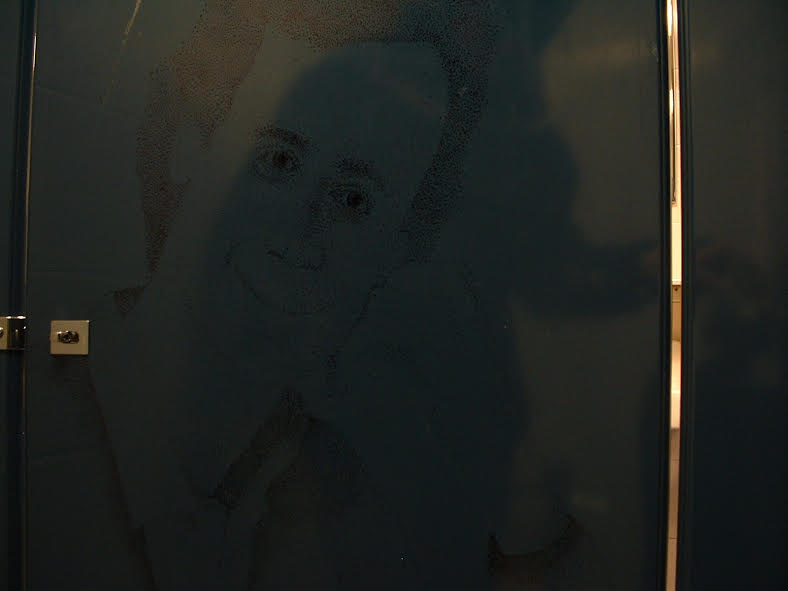
If you happened to sit down in the first stall of the fourth floor bathroom of the Folsom Library on the campus of Rensselaer Polytechnic Institute in 2006, you would find a portrait of Bob Saget staring directly at you – in pointillist style of course:

unnamed (30)

Why did someone spend hours of their own time on this? Because Bob Saget.

Another:

My all-time favorite: “I’d rather have a bottle in front of me than a frontal lobotomy.”

And one more:

My personal favourite from college (between the Theology and Ancient History departments):

Don’t worry if you don’t know what eschatology is
It’s not the end of the world …

The Plan To Make Community College Free, Ctd

Popping up in the in-tray, Freddie comments on the discussion thread:

I note with a little frustration that one of your readers has endorsed the “trade school is the answer to our economic problems” meme. I don’t blame that particular reader, as it’s a very common claim. But as I noted in a piece last year, there’s essentially no credible evidence to suggest that we need to send more people to trade school. The ranks of the jobs with the highest unemployment are riddled with skilled trades, which is not surprising in the post-financial crisis world; skilled trades are massively exposed to the boom-and-bust cycle of the housing market. I’m not saying that I’m sure that more people going to trade school is a terrible idea, and like the reader I am an opponent of the “college for everyone” attitude. But it’s an idea that gets asserted as a solution a lot with a remarkable lack of compelling evidence for it.

While I agree that more education is not the solution, I differ from your reader (with his complaints of Marxist academics) in that I believe the problems with our labor market stem from very deliberate policy choices to favor the desires of a tiny percentage of the vastly rich over the needs of the great mass of working people.

Several more readers sound off at length:

Your readers who think Obama’s community college plan is a good idea would do well to read the September 2013 article from the Washington Post titled “Is Government Aid Actually Making College More Expensive?

To anyone who has studied economics, the thought immediately comes to mind. The rapid increase in tuition costs happened right when the government started spending extraordinary sums to subsidize college tuition. It seems very unlikely this is a coincidence. As with anything, there is a market price for college, and giving out money to people to be spent specifically on college allows colleges to charge more than the market price. The Post article reviews all the research on this topic. From the last paragraph of the article: “All but one study I’ve seen found some evidence of a price response to increases in aid, for some section of the higher ed market.”

Here’s a likely outcome if government starts paying for two-year community college: four-year universities will raise their prices. The reason for this is because their customers were always willing to spend a certain total amount of money on an education. If government foots the bill for the first two years, the university providing the second two years can raise its prices and find its customers still willing to attend, since they got the first two years for free.

Another illustrates a point made by Shackford that, in the reader’s words, “Obama’s proposal will incentivize community colleges to dilute their curriculum to ensure they get a steady stream of funding from the federal government”:

The proposal requires student maintain a C- average.  Instructors and teachers will be pressured to grant C’s even when students don’t deserve it or will back students who appeal their low grades. This already occurs to some extent.  The Mrs. is an adjunct at a local community college for a course program that requires students keep a C- in all classes to maintain enrollment.  Her students who have prior military service get their tuition paid by the federal government.  She has some students who are barely literate.  When they inevitably fail, they often dispute the grade and the administration always backs the student for the simple fact they want the money.

The average incoming college freshman reads at the 7th grade level because these same incentives promote grade inflation at the high school level.  School simply do not flunk and expel students because the number of students enrolled determines the funding they receive from the state and federal government.

And regarding your reader’s comparison of another to Judge Smails, a more apt movie analogy may be Ben Kingsley’s character in Searching for Bobby Fischer

Are we actually helping young adults, or society at large, just because we give students a certificate that is meaningless?  Like Josh’s Grand Master certificate in the film, a community college degree will mean nothing.

Another provides “a view from a Community College Professor”:

Many of the statements by readers reflect a lack of specific knowledge regarding community colleges, their role and their student populations.  They seem to equate some idyllic image of Harvard+Animal House with all of college; a dream world of fuzzy ideas, tweed wearing professors and Voltaire.

1. In NJ, all of our courses are legally transferable to public (and most private) schools in NJ.  The Lampitt Bill has streamlined a lot of our coursework.  Gone are the electives – there’s no time for leftist indoctrination of academians.  Also, community college is overwhelmingly taught by part-time adjuncts.  They are not researchers, writers on sabbatical and certainly not Marxist indoctrinators (BTW, Marxism-Leninism-Stalinism failed, so no one indoctrinates that philosophy anymore, or ever – please take a history course at your local community college to find out how and why).

If you took a factory and transferred the model to education you would have a modern community college.  I really wish community college was that idyllic dream of high-minded liberalness the political right accuses us of but, alas, we go to work, teach our classes overfull classes, prep more classes, deal with student problems and concerns, and then grade, edit, and comment on papers and tests – all for a pay significantly less than the level of required degree would indicate. Ph.Ds are held by less than 1% of Americans yet professors earn decidedly middle American wages. I could triple my income if I went into international corporate consulting, for example.

2.  We have over 100 certificate programs, from cooking to nursing.  Our dental program is 35 years old  – and gives free cleanings to kids in the community.  The great lie of education is that the for-profit schools do this training while college does some soft liberal arts reading and thinking stuff.  In fact, we offer more programs than the three for-profit schools in our neighborhood and do it at a tenth of the cost.  (Our advertising budget though can’t compete.)  Air conditioner repair – we got it.  Computer animation – got it.  Want to build apps for a startup? We got all the hands-on coursework you need. Community colleges have filled this space for a long time – but the stigma that they are the “13th grade” looms large.  More money would mean more services, which would mean more programs, certificates and training.

3.  70% of our students are remedial.  This means they are not prepared for college-level reading, writing or math.  Reading I is a third grade reading level – and those classes are full.  So while we should spend more money on pre-K education, there is still a massive number of people failed by K-12 education.  With high-stakes testing, No Child Left Behind, and teacher pay tied to grades, these numbers have gone up.  There is less incentive to educate and more incentive to pass high-cost standardized tests.

4. Community College students are, in our case, poorer, less educated, and much more racially diverse than the surrounding schools.  Those with means and drive head off to the private schools of Philadelphia, Baltimore and Washington.  Or they go to the public schools of Northern Jersey and Pennsylvania. We also take in a far larger number of immigrants, ESL students, first-time college families, working adults, mentally and physically handicapped, and military veterans than the surrounding colleges.  All of these students require expensive services and programs.   The idea is that we educate a large number of people who have limited choices in their education – and who are expensive to educate.

Which brings us to the most important part of the President Obama’s proposal: forcing states to pay. Our school was set up in the 1960s, and the charter indicated that for tuition, the state and the county would each contribute an equal share to operating costs (33% each).  In 2014, our budget received 12% from the county and 17% from the state meaning tuition made up 71% of our operating budget.  All the pledges of “no new taxes” is being paid for by higher tuition, fees and less services.  This budget situation is simply breaking the back of the school and the students.  We are not a school that can charge $50K for tuition nor can we pre-screen our students.  If the state just paid the amount it guaranteed in our charter, we could educate students pretty easily and cheaply.  So if the president can force states to pay their actual fair share (or more), that would be a budgetary godsend for us.

Charlie, Blasphemer

[Re-posted from earlier today]


You can probably tell I’ve been really sick because I couldn’t manage to write about the Charlie Hebdo Jihadist mass murder. Now that the immediate crisis is past and my fevers are back under some control, some thoughts.

I was actually surprised and gladdened by the response to the slaughter – an overwhelming wave of revulsion and disgust, expressed with great dignity and courage (and yes, it was an absolute disgrace that Obama sent no one of a higher rank than the ambassador). I had begun to think that a defense of free speech was no longer a pillar of the American right or left, but for a while, at least, I was wrong. People do draw the line at the murder of blasphemous cartoonists in the name of God. It seems we have at least achieved a consensus on that. Two cheers!

Was it enough to prompt the New York Times to be a newspaper, instead of a quivering pile of bullshit fearful of offending people? Nah. Baquet is a man worthy to succeed Bill Keller, the editor who refused to use the word torture because it would offend the American government, which was trying to conceal war crimes (and has gotten away with all of it). The NYT is a fantastic paper in so many ways. But it is run by those o-CHARLIE-COVER-570educated in the view that anything that might offend any non-white minority is the worst human sin imaginable. The brutal truth is: Charlie Hebdo employees would last a week at most at the NYT before being fired. A liberal church like that will not tolerate blasphemy either. And can you imagine Charlie being allowed to be published on any US campus? For merely its depictions of Jews and Christians, it would never survive. It is, after all, a “macro-aggression”, right? Students would need counseling for years to recover from such images. Still, hypocrisy is the compliment vice pays to virtue, and in an America dedicated to rooting out “hate speech”, this is probably as good as we’re likely to get.

Then the deeper disappointment. Even now, many will not concede that religion was the root cause of the attack, and that the name of that religion is Islam. Reading the cartoonishly liberal Nick Kristof was like watching a Monty Python Piranha Brothers sketch (see above). Yeah, they have murdered thousands of Westerners and far larger numbers of Middle Eastern and Nigerian and Pakistani Muslims. Yeah, they did that. They also declared at every one of their slaughters that their motivation is Islam. They have beheaded people, mass murdered school children, flown planes into buildings, cut women’s genitals, employ sex slaves, commit mass rape, and on and on. They have taken over a large part of the Iraqi and Syrian deserts to advance their desire for religious purity.

But Islam has nothing to do with this. There are just a few loonies who are suffering from false consciousness, and their real motivations are economic or personal or secular or just purely violent. You can believe that, if you want. Or you can pretend to believe it because it might be more pragmatic to do so. Or you can open your eyes. This is not to say that most Muslims support this kind of mass murder – and the global Muslim response was particularly encouraging. But it is to say that it is not a coincidence that so much terror and violence all over the world is currently being committed in the name of Islam. Some core parts of it are, quite simply, incompatible with post-Enlightenment thought and practice. And those parts have all the energy right now.

And the core issue here is blasphemy. For almost all of human history, rooting out blasphemy has been the norm. Many Western countries still have moribund blasphemy laws and the Muslim world is crammed with them. The death penalty is common. Prison time is expected. Mob mass murder is another phenomenon. Today, the NYT dutifully cites some verses from the Koran that instruct Muslims to simply “not sit with” blasphemers. There are others:

Those who annoy Allah and His Messenger – Allah has cursed them in this World and in the Hereafter, and has prepared for them a humiliating Punishment. Truly, if the Hypocrites, and those in whose hearts is a disease, and those who stir up sedition in the City, desist not, We shall certainly stir thee up against them: Then will they not be able to stay in it as thy neighbours for any length of time: They shall have a curse on them: whenever they are found, they shall be seized and slain (without mercy).

Or the prophet himself:

The Prophet said, “Who is ready to kill Ka’b ibn al-Ashraf who has really hurt Allah and His Apostle?” Muhammad bin Maslama said, “O Allah’s Apostle! Do you like me to kill him?” He replied in the affirmative.

You can get thrown in jail and have mobs calling for your execution by teaching kids about a teddy bear in Sudan, to give a simple 2007 case. In Pakistan, 50 people arrested for blasphemy over the last three decades have been murdered before they got to trial. In Saudi Arabia, an ally, blasphemy is on the same level as apostasy: it’s punishable by death.

Screen Shot 2015-01-14 at 12.04.34 PM

The map above from the Pew Foundation shows where blasphemy laws are on the books. See a pattern here? Pew notes that 64 percent of the world’s populations still live under blasphemy laws and they are marginally more common than the other deeply anti-Enlightenment prohibition on apostasy.

Again, it’s vital to point out that Islam is the norm for most religions on planet earth since the beginning of time – except for a brief period in the modern West. It is not so much that they have gone backward so much as we have gone forward so rapidly on the question of religious liberty and free speech that some core elements of Islam cannot tolerate it. It’s too great a cultural gulf. I have tentative hope that this vast gap on a fundamental question may take as long for Islam to arrive at as Christianity did. But that means a century at least of more bloodletting – and given the presence of so many disaffected young Muslims in Europe, a series of slaughters to come, and the possible erosion of support for free speech outside these rare moments of cherished unity. I see no other way of getting through this: surveillance, vigilance, an end to invasion, occupation and torture, and patience. And to give not an inch to any infringement on free speech.

The rest is for the Muslim world.

“Take Your Medicine” Taken To An Extreme, Ctd

Readers keep the thread going:

Cassandra is being called immature simply because she believes in quality over quantity of life, which is a concept that is pretty alien to most First Worlders who believe that science can/should keep us alive (and young) for as close to forever as possibly. In a very death-fearing culture, anyone who questions it is usually written off as crazy – when they are an adult – and “immature” when they are a teen.

By the way, the recent Canadian case where the Aboriginal girl was allowed to stop chemo because a judge found it violated her freedom of religion came to mind when I read about Cassandra. I followed that case in the news a bit. The interesting thing that came up in comment sections was not so much about how the girl and her parents were wrong to pursue alternative medicine (some did think this) but how lucky they were that they were Aboriginal and could therefore use their Charter rights to do so.

And that girl was 11 years old. Another reader:

There is one aspect I haven’t seen discussed about the right to refuse medical treatment, and I think it is a pretty big elephant in the room: Cost.

Who is going to pay for all that chemo?  I am assuming Cassandra is covered by some sort of insurance policy, but what if she wasn’t?  This decision might often be more than just the self-centered struggle about whether a patient wants to endure much pain in exchange for survival. It can also be decision about whether to allow one’s family to spend their life savings and face bankruptcy.  College funds, retirement plans, homes, farms, and just about everything money can secure are often lost in the struggle to keep a family member alive longer than nature would allow.

Health care in the U.S. is still a privately financed affair.  Can or should the state be able to force a family to purchase expensive medical services that they may not have the capital for?  Shouldn’t the state pick up the tab if they are the ones ordering the services?

Another circles back to the age question:

I’m not going to get into the merits of Cassandra’s case, except to point out that regardless of the outcome, this case should point out the confusion and continued absurdity of how we deal with the question of “At what point are you considered an adult?” The general consensus (and legal definition in most cases) is that 18 is the point when you are considered an adult. Many of the things that are considered the hallmark of reaching adulthood occur at 18. You’re allowed to vote, join the military, take on credit, live independently, and do things without requiring parental consent.

Yet, the same consensus also dictates that there are certain things 18 year olds are not mature enough to act rationally on, the most obvious regarding the consumption of alcohol. It’s the old argument that comes up when discussing alcohol: the state feels you are mature enough at 18 to join the military and kill someone if needed, but God forbid you need a drink to unwind after a long day. Furthermore, in many states, the age of sexual consent is dependent on what state you live in. In some cases, it can be as young as 14 or 15. It would seem to me that nothing would require the highest level of maturity than engaging in a sexual act, but then all hell breaks loose if the subject of handing out condoms or discussing birth control is even broached.

I know it’s not as black and white as this, but either have a consistent point where you say that under 18, your child and the law will treat you as such, or have all laws apply equally regardless of the person’s age.

Another turns the conversation to alternative treatments:

I must tell you about our experience with a serious disease.  It is the kind of experience that supports Cassandra’s decision. My husband was diagnosed with Aplastic Anemia, at the age of 55, in 2005.  With AA, the bone marrow stops making adequate blood. The prognosis was poor.  He was given transfusions to keep him alive and chemo to treat the AA.  After the IV chemo, he was put on powerful oral medication.  It was strongly suggested that a bone marrow transplant might be in his future.

The chemo helped lift his blood counts, but because the longterm prognosis was so poor, we started researching.  We tried to avoid quackery, and it’s definitely out there.  And when you’re desperate, you’re certainly vulnerable.  But we also found thoughtful testimony from people who had nothing to sell, nothing to gain, but simply wanted to tell their story.  We also found links to medical research that contradicted some of the doctor’s advice.

As a result of this research, my husband discontinued the oral medication.  He also began to refuse platelet transfusions.  The reaction of his nurse was angry:  we will discontinue you as a patient if you do not do as we say. It became clear that her motivation was not healing, but power.

Because the truth is: my husband was not doing nothing instead of the medication. He changed his diet completely.  He went to an acupuncturist and learned and practiced Qi Gong. He did a lot of soul-searching.

And his blood counts began to rise.  Sadly, none of his doctors seemed interested in this phenomena.  He stopped going in for blood tests.

In a similar situation I was following online, the end was much sadder.  The patient, 10 years younger than my husband, followed doctor’s orders – and died, leaving behind two teenage daughter.

My husband is alive and well.  We have a four-year-old granddaughter who is the joy of our lives, and another on the way.  Chances are good that he would have missed this joy if he had followed doctor’s orders.

So: please don’t dismiss all questioning of cancer treatment as foolishness and quackery.  Sometimes saying “no” can save a life.  And is it really appropriate to drag the family to court, to ridicule them in such a public way?  To post guards outside her door?  Could the doctors consider a heart-to-heart talk, and be open to her ideas about healing? Could they possibly take the time to listen, instead of just scolding and insisting?   Could a compromise be found?

Another relays the details of a famous case of refusing chemo for alternative treatments:

Concerning what your reader said about folks buying into myths to avoid chemotherapy, let’s not forget about what Steve Jobs did to himself. From the Wikipedia page on him:

Barrie R. Cassileth, the chief of Memorial Sloan–Kettering Cancer Center’s integrative medicine department, said “Jobs’s faith in alternative medicine likely cost him his life…. He had the only kind of pancreatic cancer that is treatable and curable…. He essentially committed suicide.”

According to Jobs’s biographer, Walter Isaacson, “for nine months he refused to undergo surgery for his pancreatic cancer – a decision he later regretted as his health declined. Instead, he tried a vegan diet, acupuncture, herbal remedies, and other treatments he found online, and even consulted a psychic. He was also influenced by a doctor who ran a clinic that advised juice fasts, bowel cleansings and other unproven approaches, before finally having surgery in July 2004.” He eventually underwent a pancreaticoduodenectomy (or “Whipple procedure”) in July 2004, that appeared to successfully remove the tumor. Jobs apparently did not receive chemotherapy or radiation therapy.”

Amazon Invests In Woody Allen

James Poniewozik ponders the new deal:

Allen agreeing to make a TV series for anyone would have been big news in itself a few years ago. But now, after last year’s renewal of charges that the director sexually abused his adopted daughter Dylan Farrow when she was a child—charges Allen has long denied—it’s going to be a lightning rod. The re-emergence of rape accusations by many women against Bill Cosby was evidently enough last year to scuttle preliminary plans for him to return with a sitcom for NBC, even though he continues to deny them. Maybe Amazon feels that Allen’s circumstances are different, or that the blowback will be worth taking. But it’s hard to imagine there won’t be blowback; as many fans as Allen may still have, we saw around last year’s Oscars that there are legions who will view this deal as rewarding a predator.

Jessica Goldstein wonders, “Why do repeated accusations of rape just bounce off some beloved figures and burn others to the ground?” Among her theories:

Our collective vision of Bill Cosby was that of a warm father, the Jell-o pudding man. His crimes feel personal to the viewers who love him, who grew up on The Cosby Show, thinking of him as the Platonic ideal of a dad. Audiences feel betrayed on an intimate level, like they were sold a false bill of goods. And so the dismantling of Cosby’s myth, though it was many, many years in the making, was ultimately quick.

Allen’s public persona has never relied on the same mainstream appeal. He is, in the eyes of even his most ardent fans, a bit of weirdo; his self-aware awkwardness is essential to his shtick.

Momentarily putting aside the abuse allegations, Todd VanDerWerff asks, “Why on Earth did Amazon want to make a TV series with Woody Allen?”:

The writer/director has shown no real affection for the medium, even though he got his start in show business writing for it. He’s made some solid-to-great films in the last decade, sure, but TV requires a very different skill set, one Allen doesn’t particularly possess.

Yet there he is. And the answer for why Amazon wants to be in business with him is the dark flip side of my argument for why ratings increasingly don’t matter to niche outfits. When all a network cares about is media buzz and potential awards attention, then it’s easy enough to pre-game that system by signing big names who will generate buzz by virtue of having big names.

Alyssa Rosenberg views the deal as “proof that even the companies that want to lead us into pop culture’s future are anxiously looking over their shoulders back at the past”:

Rather than elevating new voices, as Amazon did previously with filmmaker Jill Soloway and her groundbreaking series “Transparent,” a Woody Allen television show feels like insurance. It’s an attempt to get his existing fans to sample Amazon’s streaming offerings, rather than as proof that Amazon can do things other outlets can’t. …

Maybe Amazon has bought itself the next “Blue Jasmine,” or “Vicky Cristina Barcelona,” or “Match Point,” all of which stand among Allen’s better projects in recent years. Or maybe the streaming service will end up with his latest “Scoop” or “The Curse of the Jade Scorpion.” As of this writing, Allen apparently has no idea what story he wants to tell, and Amazon seems to be okay with that, as long as Allen can fit the company into his already frenetic schedule, which has produced such uneven results.

David Sims remarks that “Amazon’s motive in signing Allen up for his first TV series is a smart one—as online studios further fracture the TV landscape, the value of a well-known brand is crucial.” But he still sees the series as a major risk for Amazon:

Will the viewer boost outweigh whatever hit Amazon’s prestige might take? It’s hard to say. Thinkpieces will undoubtedly flood the Internet, but despite the chilling nature of Dylan Farrow’s public letter, when actors who worked with Allen were asked about it, they mostly referred to the matter as a complicated family issue too sensitive to wade into, and the furor eventually died down. Other networks have worked with unappealing creative personnel without really harming their brand—FX gave accused serial domestic abuser Charlie Sheen 100 episodes of Anger Management in 2012, but remains best-known for highly praised original programming like Louie, The Americans and Justified.