Linda Holmes calls Cameron Esposito’s new comedy album, Same Sex Symbol, “raunchy and sharp, insightful and very funny”:
What comes through in the record throughout is a particular point of view in which people who believe lesbian pornography represents actual lesbians, or people who believe that they’re looking for threesomes, or people who otherwise fail to understand the basics of her life, are sort of amusing and clueless weirdos she can finally see clearly because, as she explains: “I am so happy with where I am in my life. Just finally, my look sorted out, you know, my gender reflected to you accurately — my gender being ‘fighter pilot.'” And even though “fighter pilot” is a punch line, there’s no punch line to the underlying idea that she is happy. That part is true. It’s not all that common for comedy to come from a place of settled satisfaction with where you’ve ended up, and from the clash between that feeling and the constant expectation of others that you are somehow unsettled by their disapproving or just ignorant gaze.
In an interview, Esposito shares how she got comfortable incorporating more of her personal life into her routines:
When I was starting I was really just figuring how to be out as a person and how to be in the world and be gay because I came from a really conservative, Catholic background. So when I first starting doing standup, part of it was because I wanted to be onstage talking about the person I am. I couldn’t do that yet, so my jokes were more surreal, they were more superficial in some ways, and now I feel like, through standup, I’ve figured out how to talk about myself in a way that makes me more comfortable.
And now I’m just totally chill and it’s a lot easier, and sometimes people are like “Do you always talk about your sexuality onstage?” And I’m like, “No, I just always talk about myself the same way that any comic does.” So the natural evolution of that is that I’m just trying to get closer and closer to what I really am. That’s what people are interested in. The more specific you can be, the more universal it is. If you speak in broad strokes you miss everybody but if you’re like “Are you ever terrified of this thing?” even if they’re not terrified of that thing they still know terror. That’s what makes us people.
A reader relates to this post about autonomous sensory meridian response:
I probably won’t be the only Dish-head to write you about this, but ASMR is most definitely a physical sensation. It’s not a matter of belief. (Although it tends to attract people who believe in all manner of woo, like Reiki and chakras and so on.) It’s similar to a frisson, or the chills you experience when you hear a particularly moving piece of music. Or a piss shiver. They are all of a piece. I’ve experienced it my whole life, and yes, Bob Ross was the first trigger. For me, it’s a tingling sensation that starts at the nape of the neck and spreads to the scalp.
While it’s very pleasant, it’s not sexual. Many people who experience it, including myself, have some degree of anxiety and related insomnia. Listening to ASMR videos is very helpful for getting my mind to slow down so I can relax and go to sleep.
There is a very good (short) This AmericanLifesegment about ASMR here.
Another reader with ASMR grumbles:
Oh god, you did another post about ASMR and yet again managed to insert a non-existent sexual connotation (with the post title “Aural Sex”).
As someone with ASMR for 40 years, who like many others, only learned it was a “thing” that others had from a This American Life episode a few years ago, I cannot overemphasize how annoying and damaging it is to have ASMR related to sexual experiences. I’ve heard it referenced as a “brain orgasm” (what does that even mean?) among other attempts to describe what it is.
But it has nothing to do with sex. It’s a weird, unbelievably pleasant feeling that you get when experience certain things that trigger it, often watching videos of someone doing a monotonous task in a deliberate matter. I describe the feeling as like a rush of endorphins that start in the top-back part of my head and cascade down my spine like a warm waterfall.
So why is it so bad to connect it to sex? What’s the harm? Well consider this: ASMR is weird. It’s something that singularly hard to explain to people that don’t have it. You’re stuck with metaphors. And the easiest one for people who don’t have ASMR to jump to is basically that it’s just like porn. In fact consider this description:
A person loves going to their home office in the evening, locking the door, firing up the computer and searches for videos. He knows what he’s looking for; he has very specific tastes. He can only really get what he needs from certain videos; certain performers. He has them bookmarked. If he has time, he might spend 30 minutes or an hour watching… and the ultimate pleasure he gets is divine.
Am I talking about ASMR there? Or porn?
In many ways, having ASMR a much bigger challenge to admit to others than admitting you watch porn. With porn, you pretty much know that essentially every guy, and most women, watch it. Even if the people you are talking to doesn’t watch it; they get it , they understand it. But with ASMR, it’s much weirder and foreign to them. Is it any surprise they jump to the parallel to porn and assume it’s related to sex?
But it isn’t; and every time I see someone blithely making that connector or offering up a “lightly humorous headline like “Aural Sex” I just want to scream. Especially today… “NOT MY BELOVED DISH!”
But another loved the post:
Thank you! I have experienced ASMR for much of my adult life but never before knew what it was. Now I have a name for the pleasurable tingly feeling in the back of my head I experience from time to time, often in very casual and one might say inappropriate settings.
In fact I first noticed it in my freshman algebra class in high school. I was usually a little drowsy since it was just after lunch. The guy who sat behind me couldn’t keep his mouth shut, but he whispered since we were in class. His deep voice set me off nearly every day. At the time it freaked me out a little. Forgive me, but as a 14 year old in the rural Midwest I was not raised to believe homosexuality was normal or natural, and it worried me that I was getting such a kick out of this guy’s endless monologue.
Fast forward twenty years, and I’m both comfortably heterosexual and comfortable with homosexuals. Yet to this day men, or at least male voices, tend to set off my ASMR more than female voices, though both can do it. I figure it has something to do with the deeper tone, as lower female voices trigger it more often as well. I wouldn’t say it’s sexual necessarily, or at least not exclusively. It’s just an intensely physical pleasure. I’m sorry to learn not everyone experiences it.
Another reader who’s experienced ASMR:
When I was a student a (decidedly unsexy) philosophy prof used to trigger it. So did a young Chinese woman who worked in the youth hostel in Miami Beach in the late ’80s. I would sit listening to her ramble about China for hours, never feeling any sexual attraction to her. But she was fascinating both for platonic reasons and for the physical effects she had on me. It is these people’s detached, disinterested nature that makes me drop all my defences, which seems to be a necessary condition for ASMR in my case.
Sadly, I haven’t experienced it in a long time. Not sure if it’s because I’ve physically changed or because I don’t get out enough (I work from home) or because when you get older you confront fewer people like that.
PS: Had no idea there was a name for this thing. I’ve never known anyone else with it. Thanks so much for posting it. Guess I should subscribe now :)
One more reader:
Just by way of further illustration of the effect Bob Ross had on countless thousands (including many like me who had no intention of even trying to learn to paint). Back in Bob’s heyday, my best friend and I used to toke up, turn on PBS to Ross’ show, and listen – with the brightness control turned to complete darkness so that we could only hear, not see, what he was describing. Now THAT was a trip.
Julian Baggini identifies a “highly contagious meme [that] is spreading around the world,” one that “takes serious ideas and turns them into play, packages big subjects into small parcels, and makes negativity the deadliest of sins.” The culprit? What he terms “Generation TED”:
To be progressive and radical once meant being sceptical and opposed to large corporations. For Generation TED, however, this is outdated thinking that leads only to cynicism and inertia. It’s time to grow up and accept that to do good things in a capitalist world you often need to tap the wealthy. In reality, this has always been true: think of Engels supporting Marx, or Beatrice and Sidney Webb funding Fabian Socialism with inherited wealth.
The rejection of cynicism, however, sometimes looks less like realism and more like naive, starry-eyed optimism.
In its mission statement, TED says: ‘We believe passionately in the power of ideas to change attitudes, lives and, ultimately, the world.’ It goes without saying that this change is supposed to be for the better. Viewers get to choose which adjective best describes the video they’ve watched: beautiful, courageous, funny, informative, ingenious, inspiring, fascinating, jaw-dropping, or persuasive. ‘Bullshit’ and ‘misleading’ are not on the list. Generation TED believes that if you can’t say something nice, don’t say it at all.
He continues, “Generation TED does lack sufficient scepticism”:
Truly great ideas are sculpted with the chisel of critical thought, not created fully formed by spontaneous genius and good intent. We don’t need to wallow with postmodern irony in the contradictions and paradoxes of the modern world but nor should we ignore them. There are signs that Generation TED is learning this lesson. TED, for example, has added an asterisk to its strapline ‘Ideas worth spreading’, which leads to a series of wry footnotes including ‘and challenging’. It is as though even TED has realised that undiluted positivity is not enough and that critical, sceptical voices are needed too.
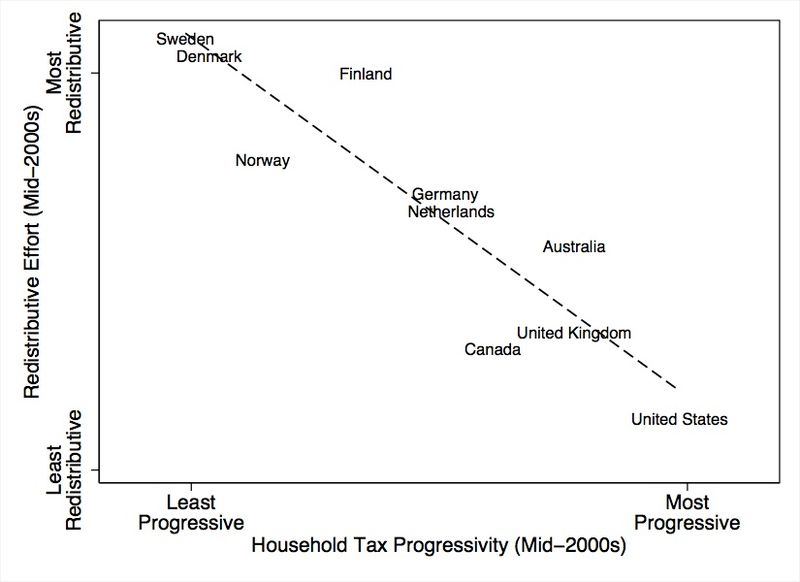
Cathie Jo Martin and Alexander Hertel-Fernandez note that countries with bigger welfare states tend to have less progressive taxation:
The reason Northern European countries with more regressive taxes achieve such high levels of labor market equality, despite less progressive tax systems, is that they spend money on increasing the skills and earning power of low-end wage earners.
Countries with the lowest levels of inequality have learned that policies to cultivate skills for all workers and to achieve full employment policies can accelerate economic growth while also reducing inequality. Large investments in human capital reduce societal conflicts over the distribution of resources, even while expanding the economic pie.
Countries like Denmark and Sweden also redistribute income, but this largely occurs through the funding of egalitarian social benefits — public health care, education — that also contribute to a productive, healthy workforce. Whereas these countries raise most of their revenue in a relatively more regressive manner, they use this revenue to fund social benefits that improve both the living standards and productive capacities of lower-class residents. In contrast, countries with the most progressive tax systems, like the United States, tend to raise most of their revenue through levies on the wealthy and on capital, and end up investing little in job training and other social benefits that reduce inequality.
Franklin Foer argues that the company is “the shining representative of a new golden age of monopoly that also includes Google and Walmart”:
We seem to believe that the Web is far too fluid to fall capture to monopoly. If a site starts to develop the lameness of an AltaVista or Myspace, consumers will unhesitatingly abandon it. But while that meritocratic theory might be true enough for a search engine or social media site, Amazon is different. It has a record of shredding young businesses, like Zappos and Diapers.com, just as they begin to pose a competitive challenge. It uses its riches to undercut opponents on price—Amazon was prepared to lose $100 million in three months in its quest to harm Diapers.com—then once it has exhausted the resources of its foes, it buys them and walks away even stronger. This big-footing necessitates a government response.
Yglesias counters that “having a lot of the market is not the same as having a monopoly”:
One important hint about Amazon’s non-monopoly status can be found in its quarterly financial reports. That’s where you find out about a company’s profits. In its most recent quarter, for example, Amazon lost $126 million. Losing money is pretty typical for Amazon, which is not really a profitable company. If you’d like to know more about that, I published 5,000 words on the subject in January. But suffice it to say that “low and often non-existent profits” and “monopoly” are not really concepts that go together.
Competitors hate Amazon because retail was an ultra-competitive low-margin game before Jeff Bezos ever came to town. To delve into this field and make it even more competitive and even lower-margin seems somewhere between unseemly and insane — but it’s the reverse of a monopoly.
While conceding that Amazon “does have something like a monopoly over the books market,” Annie Lowrey also fails to see how the term applies to the company overall:
Who is losing when Amazon is winning? Does the government really need to step in to protect Amazon’s rivals, provided that the market remains a market? Why is it wrong for Amazon to demand more and more from its suppliers? Is there any evidence that Amazon controls other markets like it controls the books market? All this is unclear.
She continues:
None of this is to say that Amazon should not face new regulations to force it to treat its workers better. None of this is to say that Amazon could not become a monopoly by pushing out or buying up more of its e-commerce rivals. None of this is to say that its harassment of Hachette is right or should be legal or should not face some serious pushback from the government and consumers. None of this is to say, either, that our legal framework should not view seemingly benign monopolies, like Google, with anything other than skepticism. But Amazon being a shitty, vicious competitor and Amazon being a monopoly are hardly the same thing.
Derek Thompson joins the “what monopoly?” chorus but acknowledges that Foer’s essay raises an interesting point that “there is something devilishly seductive to the conveniences of digital capitalism that makes life better for us as consumers and worse for us as workers”
Does buying diapers once from Amazon makes one morally complicit in the working conditions of its warehouse employees? What about subscribing to Amazon Prime? Having an Amazon credit card? These are harder questions, but they have nothing to do with Amazon’s mythical status as a monopolist. If the government thinks warehouse workers deserve higher wages and better conditions, we don’t have to go through the Justice Department’s anti-trust squad to improve their lot. We can just pass new laws. Don’t ask consumers to boycott a good deal.
Previous Dish on Amazon’s controversial business tactics here.
Arguing that the Middle East is not nearly as important to US interests as we’re led to believe, Justin Logan deconstructs the notion that we focus so heavily on the region because of terrorism:
This explanation for why the Middle East supposedly matters is peculiar, in that the basic contours of U.S. policy in the region predate 9/11. It is tough to think that a concern that emerged after a policy began explains the policy. But there is no evidence that terrorism is a threat that warrants an effort to micromanage the Middle East. The chance of an American being killed by terrorism outside a war zone from 1970-2012 was roughly one in 4,000,000. By any conventional risk analysis, this is an extraordinarily low risk. Perhaps this is why, as early as 2002, smart risk analysts were asking questions about counterterrorism policy such as “How much should we be willing to pay for a small reduction in probabilities that are already extremely low?”
The amount we’re paying now to fight terrorism—roughly $100 billion per year—is simply crazy.
If someone ran a hedge fund assessing risk the way the U.S. government has responded to terrorism, it would not be long for the world. Indeed, it is difficult to identify how U.S. policy across the region—with the possible exception of some drone strikes and special operations raids—have reduced the extremely low probability of another major terrorist attack. If anything, our policies may have increased them.
But terrorism, as Shana Gadarian’s research confirms, drives Americans toward more hawkish policy positions, particularly when we see images of it on TV:
Political and media observers, particularly on the left, worry that media coverage of the Islamic State is terrifying Americans and persuading them to support foreign policies and candidates that they would otherwise not support. Political science suggests that their fears are warranted. My own research – conducted in the wake of 9/11 – provides strong evidence that both the amount and tone of media coverage of terrorism can significantly influence foreign policy attitudes. Americans who were already worried about future terrorism after 9/11, were more likely to support the use of military force abroad and increased spending on security at home after seeing news stories about terrorism with images like the World Trade Center on fire.
That’s what residents of Seattle and Minneapolis, and schoolchildren in Portland, Oregon, are celebrating today. Daniel Beekman reports that “Native American activists laughed, wept and sang their way out of Seattle’s City Hall on Monday after watching the City Council unanimously approve a resolution designating the second Monday in October as ‘Indigenous Peoples’ Day'”:
“It’s beautiful to see,” said Matt Remle, a Seattle resident of Lakota heritage who wrote the first draft of the resolution, “the people walking out with smiles on their faces. Bringing that good energy and spirit to the people is what this was all about.” The legislation provoked some opposition because October’s second Monday also is Columbus Day, a federal holiday named for explorer Christopher Columbus and widely marked by the celebration of Italian-American history and culture. In the council chambers [last] Monday, a half-dozen people held Italian flags to demonstrate their support for Columbus Day. … But for each Italian American activist at City Hall there were scores of Native American activists, many wearing pieces of traditional garb and some carrying drums.
[I]t turns out that opposition to Columbus Day is nothing new.
As far back as the 19th century, activists sought to ban celebrations of the day (which was made an official holiday in 1934) because of the Italian diaspora’s association with the Knights of Columbus — a then-secretive organization that some feared was working to expand Catholic influence. “The move to replace Columbus Day with indigenous peoples day has its roots in one of the first indigenous advocacy groups, the Society of American Indians, nearly a century ago,” [Cultural Movements and Collective Memory: Christopher Columbus and the Rewriting of the National Origin Myth author Timothy] Kubal said.
This debate is not unique to North America, either. And it doesn’t have to be an either/or question. There is a near-exact parallel debate unfolding Down Under. “Australia Day” celebrates Captain Cook’s arrival there in 1788. Some people now derisively call the holiday “Invasion Day,” points out Christine Outram, vp, invention director at DeutschLA.
[The Colbert video initially embedded above – which was autoplaying for many readers – here]
They believed that beauty mattered. “I always thought of myself as a humanities person as a kid, but I liked electronics,” [Steve] Jobs told me when I embarked on his biography. “Then I read something that one of my heroes, Edwin Land of Polaroid, said about the importance of people who could stand at the intersection of humanities and sciences, and I decided that’s what I wanted to do.” The people who were comfortable at this humanities-technology intersection helped to create the human-machine symbiosis that is at the core of this story.
Like many aspects of the digital age, this idea that innovation resides where art and science connect is not new. Leonardo da Vinci was the exemplar of the creativity that flourishes when the humanities and sciences interact. When Einstein was stymied while working out General Relativity, he would pull out his violin and play Mozart until he could reconnect to what he called the harmony of the spheres.
Speaking with Christina Pazzanese, Isaacson suggests that people in the arts would do well to learn about the sciences:
I do believe that it’s important for people to have an appreciation for the arts and humanities. But I also think that one problem is people who love the arts and humanities are too often intimidated by science and math, and they don’t appreciate the beauty of science and math. They’d be appalled if somebody didn’t know the difference between Hamlet and Macbeth, but they could happily brag that they don’t know the difference between a gene and a chromosome, or an integral and differential equation, or a transistor and a capacitor. So as much as I’d like to lecture the engineers that they should appreciate the humanities, I also think that people from the tradition of the humanities should embrace the beauty of engineering and science, as well.
He’s long been a hero of mine – intellectually and politically. He broke with the neocons over the Iraq catastrophe and was subjected to the familiar payback of ostracism, but went on to produce scholarly work as impressive as his The End of History and The Last Man, specifically the magisterial and widely acclaimed books, The Origins of Political Order and his latest, Political Order and Political Decay. His sanity continues with his opposition to the current intervention in Syria and Iraq to do again what we tried to do last time, i.e. to defeat a Sunni insurgency on behalf of a hapless and largely useless Shiite government in Baghdad. It’s such a mug’s game you have to have the judgment of the man who picked Sarah Palin as a vice-presidential nominee to endorse it.
Unlike so many in our political elites, Fukuyama has also had the wisdom to reassess the question of Jihadist terrorism after 9/11 and come to a different conclusion than the hysterics in the media and the political opportunists in Washington. To wit, from a great new profile in the New Statesman:
“There was a really serious question: is this the wave of something generally new and important in world history, or was this just a really lucky blow they got in?” Fortunately for his academic consistency, he concluded it was the latter. “These are really marginal people who survive in countries where you don’t have strong states . . . Their ability to take over and run a serious country that can master technology and stay at the forefront of great-power politics is almost zero,” he says now.
As ISIS threatens Baghdad and the war-machine and neocons go into high gear demanding a full scale re-invasion, that’s worth keeping in mind. And his view of our current predicament in Mesopotamia is pretty close to my own:
When I suggest that half-hearted interference is likely to prolong conflict in the region, he comes close to agreeing with me. The wars engulfing the Middle East are essentially a Sunni-Shia war, he says, that “could go on as long as the Thirty Years War in Europe”, which raged between 1618 and 1648. “Under those circumstances, I think it’s a little hard to figure out how American power is going to settle that conflict. I don’t think we’ve got the wisdom to actually see our way towards a political settlement.”
Does he believe that the rise of Isis might have been avoided if the US had intervened militarily earlier on in the Syrian conflict? It is possible, but unlikely, he concludes. “The one thing that both the Iraq and Afghan wars should have taught us is that, even with a very heavy input in boots on the ground, and nation-building, and the trillions of resources poured into these countries, our ability to bring about a specific political result like democracy, or even basic stability, is very limited.”
Let me remind my readers: this is fundamentally a reality-based conservative position. Do not let the fanatics on the right persuade you otherwise. The neo in neoconservatism stands for war – always war. It is close to an end in itself.
A real-life patient now has a fully-implanted “mind-controlled” robotic prosthetic for the first time. A Swedish truck driver who had his arm amputated over a decade ago became the first to properly get the arm, which is surgically implanted so as to be controlled by his biological nerves and muscles.
That means that he can control the arm in a pretty natural way, with the nerves and muscles sending signals to the prosthetic in order to move it. It’s like you’d move your own arm—you don’t have to really think about it. … The device is “osseointegrated,” which means it’s attached directly to the skeleton. The user doesn’t have to wear it all the time, however, as only a titanium implant is actually integrated with the bone, and the arm attaches to that.
Other researchers are working on prosthetics that feel like the real deal:
Restoring sensation has practical uses.
Modern prostheses are able, by reading electrical signals from muscles using electrodes attached to the skin of the missing limb’s stump, to perform tasks such as picking things up. Delicate tasks, however, can be tricky, since the user must rely on a combination of sight and experience to work out how much pressure to apply. For example, when Dr [Daniel] Tan blindfolded his volunteers and asked them to pluck the stalks from cherries without crushing the fruit, they succeeded only 43% of the time. But when he connected pressure sensors attached to the protheses’s fingers to the signal-generating machine, and gave them appropriate feedback, the success rate jumped to 92%.
Intriguingly, one unexpected benefit was that the device’s feedback banished the phenomenon of phantom limbs, in which an amputee perceives that his missing appendage is still present. Without the computer-generated sensations, both volunteers reported that their prosthetic hands felt like external tools (one described it as like an artificial hand that he was holding with his phantom hand). Switching the sensations on made the hand feel like an integral part of the body.
 The Dish