Of Whiskers And Worship

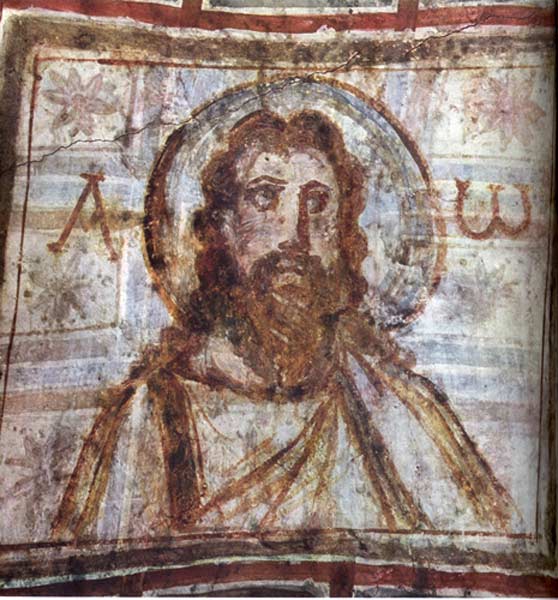
Christ_with_beard

Kimberly Winston analyzes Christianity’s “on-again, off-again relationship with the beard”:

St. Augustine wrote: “The beard signifies the courageous; the beard distinguishes the grown men, the earnest, the active, the vigorous.” But around 1000 A.D., the Canons of Edgar forbade clerical beards, declaring “Let no man in holy orders conceal his tonsure, nor let himself be misshaven nor keep his beard for any time, if he will have God’s blessing and St. Peter’s and ours.” And as for cleanliness (of face) being next to godliness, the Franciscans equate the beard with manliness. “The Friars shall wear the beard, after the example of Christ most holy,” their constitution reads, “since it is something manly, natural, severe, despised and austere.”

Ditto for the Eastern Orthodox, where a clergyman’s beard is seen as a sign of his devotion to God.

Orthodox Christians frequently cite Numbers 6:5 for their beards: “a razor shall not come upon his head, until the days be fulfilled which he vowed to the Lord: he shall be holy, cherishing the long hair of the head all the days of his vow to the Lord.” Today, beards are super popular among Christian hipsters. Exhibit A:Bearded Gospel Men, a blog for Christian men with big beards. Last year, Christianity Today published a handy-dandy guide to parsing a Christian man’s theology, denomination and profession by the cut of his beard.

(Photo: This fourth-century mural painting from Rome’s catacombs of Commodilla is one of earliest known images of a bearded Christ. Earlier Christian art in Rome portrayed Jesus as the Good Shepherd disguised as Orpheus: young, beardless, and in a short tunic. During the fourth century, Jesus started to be depicted as a man of identifiably Jewish appearance, with a full beard and long hair, a style not usually worn by Romans. Via Wikimedia Commons.)

God And Other Extraterrestrials

Merill Miller asks, “What would it mean for belief – or non-belief – if we discovered the existence of extraterrestrial life?”

This question is central to the premise of a new book, Religions and Extraterrestrial Life: How Will We Deal with It? by David Weintraub, an astronomy professor at Vanderbilt University. The book examines the stances, if any, of the world’s major religions in regards to the possibility of life beyond our own planet. Wintraub reports that one-fifth to one-third of Americans believe that alien life exists, and with the exponential increase in the discovery of new planets, finding one that would harbor living beings seems more and more likely.

However, not all Americans are quick to embrace the idea of extraterrestrials. While Weintraub found that 55 percent of atheists felt that the existence of aliens was possible, his book also states that evangelical and fundamentalist Christians are the least likely of any religious group in the United States to embrace the thought that life may exist beyond Earth. An article on Futurity examines this reticence of fundamentalists Christians to believe in aliens in terms of salvation – Christian concepts of original sin and the need for atonement through Christ’s sacrifice on the cross would be complicated by the existence of otherworldly beings who may or may not require the same redemption.

But as Megan Gannon notes, “some Christians who interpret the Bible quite literally might actually have an easier time incorporating the existence of aliens into their spiritual cosmology”:

Many Seventh-day Adventists, for example, are creationists who believe the Earth was literally created by God in six days some 6,000 years ago and that humans descended — and inherited original sin — from Adam and Eve. In that line of thinking, life could exist on other planets, but beings that didn’t descend from Adam and Eve on Earth wouldn’t be inherently sinful, and effectively, they wouldn’t need Christianity to be saved, Weintraub told Live Science.

Seventh-day Adventism’s flexibility with regard to aliens might be a product of the time in which the religion was founded (the 19th century). During the 1700s and 1800s, there was a strong popular belief in extraterrestrial life, Weintraub said. The telescope (a relatively recent invention) finally allowed astronomers to peek at other planets and moons in our solar system, but scientists didn’t yet fully understand that these celestial bodies were barren. And perhaps it’s no coincidence that the religions that began at that time — Mormonism, Seventh-day Adventism, Jehovah’s Witnesses, the Baha’i Faith — all have a strong belief in extraterrestrial life, Weintraub said. In contrast, the notion of extraterrestrial life was for the most part irrelevant to religions that began thousands of years ago.

But more ancient religious traditions might be coming around. Last month, the head of the Vatican Observatory Foundation, Guy Consolmagno, declared the discovery of alien life basically inevitable.

Pray Tell

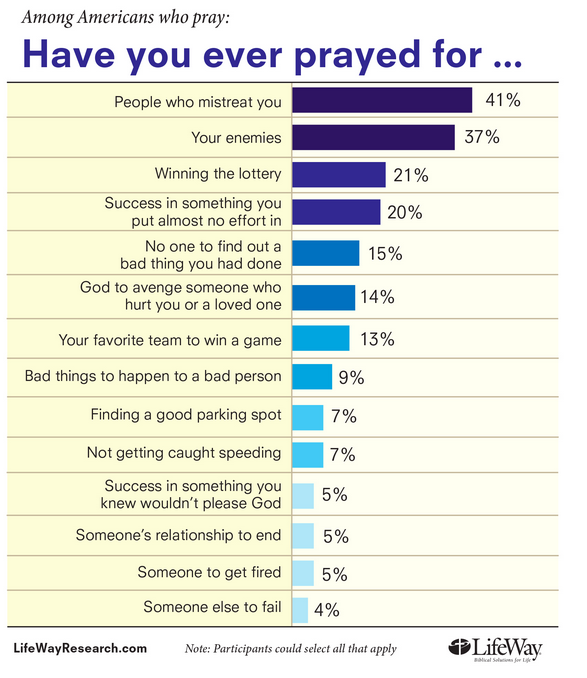
dish_prayerchart

Brandon Ambrosino flags a new survey suggesting that “among praying adults [in the US], 1 in 4 say God answers all their prayers, and 37 percent say God answers some of them. Only 3 percent of those who pray think God answers none of them”:

Religious people aren’t the only ones praying. A Pew study from 2013 found that more than 1 in 5 religiously unaffiliated, or “nones,” said they pray daily. This trend is particularly evident among Millennials, as I recently reported. According to a study out earlier this year from Carnegie Mellon University’s Integrated Innovation Institute, while only 52 percent of Millennials look to religion for guidance, 62 percent of them say they talk privately to God. This suggests that Millennials aren’t giving up on God — more of them are just cutting out the middleman and going straight to God with their prayers.

As for what Americans are praying for, LifeWay reports that 74 percent pray for their own needs and difficulties, and 42 percent pray for “my own sin.” The study also found that Americans are generous with their prayers: 82 percent pray for friends and family, and 38 percent pray for those who’ve experienced natural disasters. People who pray seem less concerned with praying for politicians (12 percent) and celebrities (5 percent).

Morgan Lee has more:

One-third of Americans said they pray several times a day, and 17 percent pray once per day. Less than one in five say they never pray. Among Protestants, 61 percent pray at least daily, and 43% several times a day.

Who prays? Men are less likely to talk to God than women: one in five say they never pray (22 percent), vs. 1 in 10 women (11 percent). Roughly 20 percent of whites (19 percent) and Hispanics (20 percent) say they never pray; in contrast, only five percent of African Americans say the same.

Drum snickers that his favorite result “is the 5 percent of respondents who prayed for success in something they knew wouldn’t please God”:

This is great. Apparently these folks are more willing to be honest with a telephone pollster than with God despite the fact that God already knows. If it displeases Him, then that’s that. You aren’t going to fool Him into making it happen anyway. I’m also intrigued by the 20 percent who prayed for success in something they “put almost no effort in.” That’s fabulous! Not that they did it, mind you. That’s just human nature. But that they were willing to fess up to this to a telephone pollster. Is there anything people aren’t willing to confide to telephone pollsters?

Going To War For God? Ctd

John Gray heralds Karen Armstrong “one of our most perceptive and thoughtful writers on religion” in a review of her book Fields of Blood:

Armstrong performs an invaluable service by showing that religion is not the uniquely violent force demonized by secular thinkers. Yet neither is religion intrinsically peacefula benign spiritual quest compromised and perverted by its involvement with power. The potential for violence exists in faith-based movements of all kinds, secular as well as religious. Evangelical atheists splutter with fury when reminded that a war on religion was an integral part of some of the 20th century’s worst regimes. How can anyone accuse a movement devoted to reason and free inquiry of being implicated in totalitarian oppression? It is a feeble-minded and thoroughly silly response, reminiscent of that of witless believers who ask how a religion of love could possibly be held to account for the horrors of the Inquisition.

Conventional distinctions between religious and secular belief pass over the role that belief itself plays in our lives.

“We are meaning-seeking creatures,” Karen Armstrong writes wisely, “and, unlike other animals, fall very easily into despair if we fail to make sense of our lives.” We are unlike our animal kin in another way. Only human beings kill and die for the sake of beliefs about themselves and the nature of the world. Looking for sense in their lives, they attack others who find meaning in beliefs different from their own. The violence of faith cannot be exorcised by demonizing religion. It goes with being human.

In another positive review, David Shariatmadari draws on Armstrong’s writing to interpret the current conflict with ISIS:

Armstrong begins and ends her book with reflections on the scapegoat – the animal burdened with the sins of the community and sent out into the desert. She argues that we, in the secular, rational west, have become incapable of properly acknowledging our own ferocious violence. The madmen are the ones who believe in a man in the sky, who strap on suicide belts imagining that they will be rewarded with virgins in heaven – not we, who debate and legislate and only then slam hellfire missiles into wedding parties.

But what of Islamic State? Theology motivates its actions; that theology derives from the Qur’an. Surely this is religious violence. In a narrow sense, yes. However, it represents a grossly mutated version of a doctrine that survives in much of the world in its original form as a stabilising, communitarian practice. To extend the analogy of the virus: we know that environmental stress accelerates mutation in the natural world. The faith communities subjected to the most stress over the past two centuries are those of Middle Eastern and subcontinental Islam; as Armstrong sets out in grim detail, its members have endured colonisation, the expropriation of land, authoritarian rule and military occupation. Could these stressors come to be seen as the greater cause?

None of which is to excuse the revolting acts of Islamic State fanatics. In this arena, the tendency for attempts to explain and understand to be taken as acts of apology is deeply frustrating. But we must not turn our backs on history, which is the only way the arguments set out by the likes of Sam Harris and Tony Blair make sense. The urge to blame others is strong, and old, as the ritual of the scapegoat shows. The first step towards extirpating it is to acknowledge it. In her efforts to bring this about, Armstrong is doing us a great service.

Previous Dish on Armstrong’s book here and here.

(Video: Tom Sutcliffe interviews Armstrong)

Selfies In Mecca

SAUDI-RELIGION-ISLAM-HAJJ

Amena Bakr takes note of a new phenomenon on the hajj:

It’s one of the biggest trends taking over the social media world, and now during the annual Muslim hajj pilgrimage visitors to the holy sites can’t resist the urge to take a selfie. Between calls for forgiveness from God, the word “selfie” echoes through the white marble halls inside the Grand Mosque in Mecca where pilgrims walk around the Kaaba, the black-clad cube towards which the world’s 1.6 billion Muslims face to pray,

“I’m taking a selfie with Kaaba behind me to post on my Facebook so my family and friends can see me. That’s the way we communicate these days – no need to call,” said Mehmet Dawoud, a Turkish student. To many, selfies are just another way to preserve the memory of being in a holy site and also share the experience in the trendiest of ways with loved ones. “Selfies are just a way to make the memory last in the coolest possible way. Hajj is always seen as something very serious and for older people. Selfies make it cool again,” said Amir Marouf, a 30-year-old Egyptian architect.

Antoinette Lattouf ties the trend to to the Saudi government’s decision to allow cell phones at the Holy Mosque. But John Bowman raises an eyebrow, noting that the most widely read article about the “craze” was published before the Hajj even started :

Here’s now it happened. Saudi photographer Jameel Musleh posted [the above] selfie to Twitter in April. The pilgrims shown in the photo may have been on the lesser pilgrimage, the umrah, that can be performed at any time of year, says Fareed Amin, the president of the Islamic Institute of Toronto. This photo has been retweeted and reposted thousands of times.One Twitter user dubbed it the #selfieoftheyear. Another tried to get the photo more retweets than Ellen DeGeneres’s Oscar selfie. This may be where the hashtag and name #HajjSelfie originated.

The meme was persistent enough that last week, ArabNews.com wrote an article ahead of the hajj, quoting Islamic studies teachers and scholars who advised against “photography without a legitimate reason.” The story used the above umrah photo was illustration. “The Prophet (peace be upon him) when he went for Haj, he said: O Allah, I ask of you a pilgrimage that contains no boasting or showing of. Taking such selfies and videos defy the wish of our Prophet,” said scholar Sheikh Assim Al-Hakeem in that article. This led to a discussion among Muslims on social media. The Twitter account @MuslimMatters put the question to its followers.

When Buzzfeed got a hold of the story, it became Muslim Pilgrims Are Taking “Hajj Selfies” And Clerics Are Not Happy. “‘Selfie fever’ has taken over the hajj,” they wrote, proclaiming it a “craze” before it even occurred.

Meanwhile, Boer Deng looks into another way new media is engaging with ancient tradition:

The prototype for a new app, Mecca 3D, was released this summer, and lets users explore a true-to-scale digital rendition of the Mosque at Mecca. It has been downloaded about 80,000 times on Android and iOS, according to its creator, Bilal Chbib.* He hopes to add interactive lessons and to integrate the program with Oculus Rift, a virtual reality simulator. Going on a technologically mediated pilgrimage might resemble the experience of a flight simulator. “You can never substitute the place where the Prophet stood,” as Chbib says. But virtual participation in religious activities can still give people an authentic experience, though of a different sort. Krystina Derrickson, an Islamic scholar, writes of visiting Mecca in the virtual world program Second Life: “When my ‘avatar’ visits the Mosque, I feel compelled to take off my avatar’s shoes,” she says, “because, really, it’s me visiting that Mosque.” The Mosque is not real, but that does not mean it lacks “a rather noticeable social and cultural reality.” Derrickson thinks that this gives it and other digital religious spaces a kind of “ambiguous” sacredness.

(Photo: Muslim pilgrims pose for a selfie during the Jamarat ritual, the stoning of Satan, in Mina near the holy city of Mecca, on October 4, 2014. Pilgrims pelt pillars symbolizing the devil with pebbles to show their defiance on the third day of the hajj as Muslims worldwide mark the Eid al-Adha or the Feast of the Sacrifice, marking the end of the hajj pilgrimage to Mecca and commemorating Abraham’s willingness to sacrifice his son Ismail on God’s command in the holy city of Mecca. By Mohammed Al-Shaikh/AFP/Getty Images)

Robinson’s Revelatory Prose

Like previous critics, Michelle Orange emphasizes the role of grace in Marilynne Robinson’s new novel, Lila:

Robinson’s genius is for making indistinguishable the highest ends of faith and fiction, evoking in her characters and her readers the paradox by which an individual, enlarged by the grace of God, or art, acquires selfhood in acquiring a sense of the world beyond the self—the sublime apprehension that other people exist.

Which is to say that Robinson’s animating theme—grace—is also central to her genius. Described as “a sort of ecstatic fire that takes things down to essentials,” grace is evidenced in both the particular and the abstract: as laughter, a beloved face or voice, or as “playing catch in a hot street . . . leaping after a high throw and that wonderful collaboration of the whole body with itself”; but also in forgetting “all the tedious particulars,” in feeling the presence of a “mortal and immortal being.” “A character is really the sense of a character,” Robinson has written, and hers suggest, above the particulars, how the mysteries of grace persist in human beings, those wanting creatures who move Ames with their incandescence, the presence “shaped around ‘I’ like a flame on a wick, emanating itself in grief and guilt and joy and whatever else.”

Wyatt Mason focuses on how Robinson’s characters approach self-understanding:

She documents how Lila’s mind changes, not owing to the efforts of some external force but out of a righteous need of her own: to understand her husband, to speak his language, to forge a language of her own that will be spoken with, to, and for him and for them.

One of the book’s most telling passages involves watching Lila’s mind as she sits in her house, pregnant, reading the Book of Job, registering the lines and considering them. The act of reading the Bible as high drama may seem unlikely, but through it, Robinson has managed to portray how a mind with no religiosity might meet a book Robinson loves fiercely and, in its pages, find a road to a self that learns a new language: her own language. As it turns out, there is extraordinary drama in the story of how we learn to speak to ourselves.

In a recent interview, Robinson addressed this connection between faith and language:

As you write, do you draw on language found in your faith? What are the strengths of religious language, or what are the limitations of language when it comes to talking about faith and belief?

Language is limited in its nature. It’s like consciousness itself. It’s defective, and you can push at it. You can make it do things you wouldn’t have known it can do. One of the things that is a benefit to me is that, because I have been interested in a particular theology, it makes a coherent language. It’s internally self-referential, in a way. This could be true of anyone who is deeply acquainted with any tradition. This particular tradition was very verbal, so you have a very rich literature that pushes the articulation of certain basic ideas.

We have anxiety about differences. We are different, anyway, so we might as well calm down about it. But one of the things that we have to do is understand that within the system that is anyone’s difference is incredibly enabling. It means people before me have pondered the response to death. People before me have pondered the reality of time in different dialects. This is beautiful. This is not a thing to be anxious about. For my own Calvinistic purposes, I would like to see the tradition that I speak from re-animated, fleshed out. It’s human, it’s experience. Only religion fully realizes the arc of human life, and so much beautiful thought has gone into this over our eons of time.

Recent Dish on Lila here.

Face Of The Day

dish_burlesque2

For his series Burlesque, Sean Scheidt photographed performers before and after their transformations:

In his portraits, Scheidt captures the virtually nondescript everyday face of the performers. These are people who, aside from the occasional colored hair, look, well… normal. In Scheidt’s description of the work, he says that they tended to be quite reserved at first, which made the transformation into their characters all the more transfixing.

Scheidt described his inspiration in an interview earlier this year:

It was really a confluence of two separate things.  First, I was hired to do a shoot for DNA theater.  This allowed me to go backstage and get a glimpse of the transformation of the actors.  About this time, I was also reading Harpo Marx’s autobiography.  Marx talked a lot about Judy Garland, which sent me to search her out on YouTube.  I was amazed to see how, even in her declining years, Garland lit up, once she stepped onto the stage.  I guess it was then that I realized the stage has the power to transform a person into someone else.  The question I wanted to explore was finding the reality within that transformation.

He added:

Capturing those moments, I believe, helps to humanize these performers.  If you were just seeing the “after” shots alone, you might make certain pre-conceived judgements about the person behind the make-up.  I hope this series gets people to think about their reactions to these men and women.

See more of his work here and here.

A Hard Sell?

A new Viagra ad, which features a woman breathily imploring viewers to talk to their doctors about the drug, prompts Ian Crouch to consider a history of advertising for E.D. drugs:

[A]lthough the ad is essentially a come-on by a beautiful woman, it is refreshingly frank about sex, which means that it is markedly better than past ads that relied on silly or crass innuendo: Levitra’s football-through-the-tire-swing ad; Viagra’s “We Are the Champions” mass male celebration; Cialis’s adjacent his-and-her bathtubs. The rare exception  is the first television commercial Viagra ever ran, which turns out also to have been the brand’s best, featuring the former Senator and Republican Presidential candidate Bob Dole. That ad, which looks rather oddly like a campaign spot, became a punch line, mocked later by even Dole himself. But, watching it now, it seems far more forthright, honest, and even dignified than the ads that followed. Dole makes note of the ways in which the subject might make viewers uncomfortable, but he tells the audience, basically, to grow up: “You know, it’s a little embarrassing to talk about E.D., but it’s so important to millions of men and their partners, that I decided to talk about it publicly.” It was a little embarrassing; that was the point. In the intervening years, Viagra steered away from talking much about sex in its TV ads: its most recent campaign had showed ruggedly capable men at work, and alone.

The new ad, however, gets remarkably specific.

The problem under review is “not just getting an erection but keeping it”—the woman says this twice in less than a minute. The suggestion is that male sexual performance isn’t an all-or-nothing proposition but something that exists on a continuum—and it implies that men could be performing better. In another context, this plain talk about erections might have been the beginning of a more comprehensive, and truly honest, discussion about sex: it might have included the psychological and relational aspects of sexual experience; it could have suggested to men that sex wasn’t a sporting event, and that it need not be judged in terms of wins and losses; and it might have included the voices of real women. Here, the solution to a complicated issue remains simple: get yourself a prescription.

Recent Dish on Viagra here.

Squares Dancing

dish_mondriangif


On a visit to the Gemeentemuseum in his home country of the Netherlands, Joseph O’Neill paused before a work by Piet Mondrian:

There was one painting which triggered no déjà vu: Mondrian’s final work, the unfinished “Victory Boogie-Woogie”. The museum acquired it in 1998. Here was something I could inspect with critical purity. I was looking at a large, lozenge-shaped surface occupied by hundreds of quadrilaterals of varying sizes distributed in an irregular gridiron. I was looking at blue and yellow and white and black and grey. I was looking at a canvas marked with oil and rectangles of painted paper tape. I couldn’t help it:

I went from seeing to sensing, which is to say I detected a strong painterly gladness and vibrancy in what I saw, as if a mark, before it is anything else, is a feeling. And then, by a further reflex of subjectivity, I transgressed into the realm of interpretation Mondrian so strenuously resisted: this was a jazzy and urban painting, surely, a homage to the city in which the artist lived as a war exile from 1940 to 1944—New York, where I live. How else to explain the taxi-yellow squares? How else to account for this humming and tooting gridlock? …

Mondrian always worked to music, and in his New York years he loved to paint to jazz. With “Victory Boogie-Woogie”, he never tired of applying and re-applying provisional squares of painted paper tape to the canvas. Either the painting never achieved a satisfactory stasis, or Mondrian joyfully lost faith in the idea of the static. The latter seems more likely. What is seen cannot be reconciled with what is remembered.

(Animated GIF of Mondrian’s Victory Boogie Woogie by Rosa Menkman)

Consumed By Cronenberg

At the age of 71, David Cronenberg has stepped away from filmmaking to pen his first novel, Consumed. Karina Longworth offers an overview of the story:

Consumed begins as the story of a journalist couple, Nathan and Naomi, who travel the world separately with their laptops and high-tech portable camera packages looking for stories. They move quickly, self-styled mercenaries who rarely make time for introspection. It’s a rare moment when these two are not interfacing with another human in person, via technology, or both. Nathan and Naomi are a new spin on the old trope of the lone wolf: They work alone, but no one with an iPhone is ever truly alone. …

As a couple, and as journalists, Nathan and Naomi seem to be mostly post-moral: Their work is intentionally exploitative, and they draw little if any line between the professional and personal. Certainly, neither has a compunction about sleeping with a subject, and infidelity as such only becomes an issue when Naomi becomes frustrated that, during the one scene in the novel in which the pair are actually in the same room, Nathan manages to pass her an obscure STD. Cut from the same cloth in some sense, Nathan and Naomi call one another “Than” and “Omi”—as if to embrace the parts of the other that don’t overlap. In fact, this evocative baby talk is the primary continuing indicator that Nathan and Naomi do have a shared history that they care to hold on to. Otherwise, their alienation from one another expands, even as the stories they’re separately tracking start to converge and become open for, as Naomi puts it in what could be a quintessential Cronenberg phrasing, “cross-fertilization.”

Steven Poole finds Cronenberg in familiar form:

The novel is driven by a fascination for the interplay between technology and sex: there is an extended episode of close-up iPhone cock photography, an artwork using 3D-printed body parts, and a set of hi-tech hearing aids specially tuned so that a man can hear the insects allegedly living inside his wife’s breast. (Fans of Cronenberg’s The Fly will enjoy the entomological interludes.) A man says to a woman: “Let me unbox you” – alluding to the video genre in which geeks delicately open the packaging of new gadgets. A woman muses playfully about “the sexuality of camera apertures”, deciding that “stopping down the fixed 35mmm lens’s diaphragm … to a tight f/16 would be the equivalent of executing a Kegel pelvic floor exercise”. It reads somewhat like a mashup of William Gibson, the king of near-future SF cool, and 1970s horror maestro James Herbert.

Jason Sheehan is impressed that the novel is “skillfully executed in the way that few first-time novels from crossover artists ever are and, more than that, absolutely fearless in its handling of subject matter that most writers wouldn’t touch with sterile gloves and a long stick”:

Get far enough into Consumed and all notions of “reality” without quote marks around it become highly fluid. Everyone lies. Everyone has secrets. Everyone is bonkers. Every photo Naomi and Nathan take is edited and doctored until it shows the reality they want, if not the reality that is.

Consumed has weaknesses. Beyond the fact that not everyone is as into bondage, medical oddities, acrotomophilia, insect infestation and gear porn as Cronenberg is, there are bits that drag … and some leaps of coincidence and interconnectedness that strain even Consumed‘s flexible credulity. But still, if you’re a dedicated connoisseur of weird, looking to shock your book club, or just to take a walk on the literary freak side, Consumed is your book. It’s admirable in its unflinching gaze and beautiful in the depiction of its consensually twisted reality. And if you’re going in as a Cronenberg fan? Then Consumed will not disappoint because the whole thing — with all its artfulness and all its flaws — rolls out like a long-lost film from the man’s wilder days, expansive and strange and pulled, wet, dripping and whole, out of Cronenberg’s own head.

So is Cronenberg dying to adapt Consumed for the screen? He addressed the question in a recent interview:

At first I thought, of course I’m going to want to make a movie of my own novel, because how many directors get a chance to do that, or how many novelists get a chance to do that? And I have like five producers who I’ve worked with before who all tell me, “We’d like to make a movie of this with you.” But then I realized it was the last thing in the world I wanted to do, actually, because it feels complete. I feel like I’ve done it [already], and I think it would be actually kind of boring for me to do it again. And that surprised me. I didn’t expect that reaction on my own part. And it didn’t feel to me that the novel needed a movie to be validated or to be fulfilled or completed or whatever. And so I’m in the position where — though, I honestly doubt this will happen — but if some other director wanted to do it, I would sell them the the rights.

In another interview, Cronenberg emphasized that he found novel-writing a liberating experience compared to screenwriting:

One of the reasons I wanted to write a novel was: Do I have a literary voice? Do I have a prose voice? And if so, what is that voice? The only way you can discover that is to write and to let it flow in a natural way without a preconception of what you should be writing or what people expect you to write based on your movies. You have to forget all that stuff and just relate directly to your own head, which is part of the intriguing wonderfulness of writing for days and days and days. You can play that sort of game with yourself. It just arises organically out of the desire to create a narrative and to have characters who come alive, who feel physically and intellectually as though they exist to the reader.