Just Read The Fun Stuff?

Benjamin Hale suggests someone has to stand up for pleasurable reading:

Some part of me is afraid of the reason why the college kids who want to be writers are still anxiously forcing themselves to slog through The Recognitions: because the accepted knowledge that this is a “smart” book has been handed down to them by their literature professors, who in their time were told this is a “smart” book. And how do the “smart” books become the “smart” books that get handed down to you?

Could it be that the books that become the “smart” books are the ones that are fun to teach? The ones that give the English professor something to do? You can’t say much about a fairly straightforward narrative, but one that requires a lot of critical unpacking is one that will get a lot of play in the classroom, and probably survive in the classrooms of the future. There are some ponderously overrated, heaps of pretentious gobbledygook that have been kept alive for decades this way. I’m not saying smart is bad.

Smart is good … but what about pleasurable? [John] Gardner shouted and banged on the table trying to remind everyone not to forget about morality and the “true purpose” of art, but all I want to do is something much more humble: please do not forget to please. Something about your book must on some level give pleasure. This is not a low virtue.

Similarly, Nick Hornby recently argued that readers should ditch difficult books if they’re not captivated:

Battling through them, he said, would only condition people to believe reading is a chore, leaving a “sense of duty” about something you “should do”. Instead, Hornby argued, reading should be seen more like television or the cinema, and only undertaken as something people “want to do.” Speaking at the Cheltenham Literary Festival, about his new novel Funny Girl, Hornby argued even children should not be compelled to read books they do not want to, saying setting targets of books they “should” read is counterproductive.

Laura Thompson is ambivalent:

My instant reaction to this was a sense of laughing relief, that somebody had not only admitted to doing such a thing, but had portrayed it as a positive act. Why on earth should anybody read a book if it is not fulfilling its most basic requirement, which is to entertain? Then doubt crept in. Advising people to cast aside a book, simply because they are not “loving” it? Comparing the sacred act of reading with that of box-setting one’s way through Lewis? Is this not a certain way to render the classics obsolete?

Who, taking on such a mindset, would grind their way through the opening chapters of Bleak House or The Return of the Native, or refrain from skipping to the more obviously attention-holding passages in D. H. Lawrence? As for books such as Clarissa, To The Lighthouse or Ulysses: surely their continued life depends upon a touch of masochism in the reader? Nick Hornby knows this quite as well as anybody, of course. What he is actually saying is serious and sensible. There is absolutely no point, no long-term gain, in turning reading into a duty, when it can be one of life’s greatest pleasures.

At the same time, I am extremely glad that I read “difficult” books when I was young. They form part of my internal furniture, as it were. I am glad that I was obliged to think about Jane Austen rigorously, and therefore do not subscribe to the idea that Pride and Prejudice is simply Bridget Jones’s Diary in bonnets. … In other words, I think that there does need to be a degree of benign compulsion when it comes to young people’s reading.

Going, Going, Gone

Ruth Graham explores the world of conservation science, where a precise tally on the number of extinct species is hotly debated:

Actual documented extinctions are vanishingly rare. “If you ask any member of the public to name 10 species that have gone extinct in the last century, most would really really struggle,” [conservation scientist Richard] Ladle said. “Then you’ve got the world’s most famous conservationists telling you that 27,000 are going extinct every year. The two don’t tally up.” The International Union for Conservation of Nature, which keeps the most definitive list of extinct and threatened species, has counted just over 800 total confirmed animal extinctions since the year 1600.

Graham continues:

The huge numbers of extinctions being thrown around may be overstated, or they may be understated. They may also, some say, be the wrong thing entirely to focus on. “It bothers me, and you can quote me on this, that we are still talking about species-level extinction,” said Ross MacPhee, a paleontologist at the American Museum of Natural History who studies extinction. There are other vital questions: Is there a wild population diverse enough to be healthy? Does the animal exist only in zoos? Is a threatened species a linchpin in a large ecosystem? Is it particularly unusual genetically? As Ladle pointed out in a 2010 paper, “extinction” isn’t as binary as it seems: There’s local extinction, extinction in the wild, extinction of subspecies, theoretical extinction of unknown species, and so on—each of which can grab headlines, depending on the fame of the animal.


The Cultural Side Effects Of Prozac

Retro Report dusts off coverage of the antidepressant:

John M. Grohol celebrates the marketing legacy of the drug, despite it not being “as great an antidepressant as its makers claimed”:

Prozac showed how a mainstream marketing effort targeted toward a specific mental illness could change the entire conversation. Before its introduction, depression was stigmatized, people were embarrassed to admit they had it, and they often hid it from others. It was because of Prozac’s marketing campaign that, for the first time in American society, we could have a serious and real discussion about mental disorders like depression.

Not only was it suddenly O.K. to be taking an antidepressant, for many it became a badge of honor. Its marketing let everyone know, “hey, depression isn’t a personal failing or due to poor morals or bad parenting. It’s a biochemical thing that a medication can help with.”

Lisa Schwartz and Steve Woloshin differ:

Prozac has clearly been effective in its marketing campaign but may have faltered, remarkably, in treating depression – especially mild depression, that muddy realm between normal sad emotions and disease. Here, Prozac-type drugs are barely better than placebos and no better than talk therapy, which has a longer-lasting effect, no sexual side effects or withdrawal symptoms.

It’s also unclear if these drugs reduce suicide, the worst outcome of depression. The F.D.A. actually requires a black box warning because of increased suicidal thoughts in young adults.

The pharmaceutical treatment of severe depression has undoubtedly helped many people. But many more have been overtreated for symptoms that don’t require drugs.

Jerry Avorn looks at the broader impact:

Prozac helped usher in the era of the blockbuster drug – a product that brings in over $1 billion of annual sales. With broadening expectations of what medications can do to increase life satisfaction, and the allowance of direct-to-consumer advertising in the mid-1990s, sales of these drugs went into orbit. Psychotherapy withered on the reimbursement vine (“a pill is worth a thousand words” and is much cheaper), and weltschmerz became reason for patients and doctors alike to seek solace from the pharmaceutical industry.

The Straights Leaving The Closet

Christine Grimaldi visited a support group for the straight spouses of formerly closeted gays and lesbians:

Straight spouses are largely absent from the national conversation about gay marriage and the modern family. Certainly, it’s easier to talk about two moms or two dads who have been together from the start than to talk about why Mom left Dad for another woman, or why Dad left Mom for another man. (Forget about it if Mom or Dad is elsewhere on the sexuality and/or gender spectrum.) But we need to include straight spouses in that conversation, because as tolerance for LGBTQ people spreads throughout the culture, more closeted spouses will undoubtedly come out. While for them, the light beyond those doors can be liberating, for the straight partners stumbling out behind them, it can be quite harsh.

The Straight Spouse Network is attempting to kick-start the discussion by creating a safe place for straight spouses to share their stories.

Grimaldi also talks with psychotherapist Kimberly Brooks Mazella, who treats straight spouses:

​“Straight spouses are often struggling with competing emotional experiences—their own feelings of grief and loss, anger at the gay spouse’s betrayal, and compassion for their partner’s own painful journey,” she says. Empathy for gay spouses is not unusual among the straight spouse community. Degrees vary based on personal experience, as in any divorce. But ask a straight spouse, any straight spouse, what awaits him or her on the other side of the closet door. The most common answer is a deep sense of isolation.

“Most [straight] spouses endure their pain in silence on their side of the closet, while their gay, lesbian and bisexual partners find support from their respective communities,” SSN founder Amity Pierce Buxton wrote in her 1991 book The Other Side of the Closet: The Coming-Out Crisis for Straight Spouses and Families. From her years treating straight spouses, Mazella adds a few more factors to the mix. The straight spouse can be blamed as complicit in the closet. A gay spouse’s infidelity can be viewed as an expression of his or her true self instead of an act of unfaithfulness. “How did you not know?” is a common question. There are those who are dismissive of the entire marriage, as Mazella encountered. “People said to me, ‘Oh, it wasn’t really a marriage anyway,’ ” she says.

Go To Congress, Mr. President, Ctd

Screen Shot 2014-10-10 at 11.39.43 AM

Aaron Blake passes along the results of a new CBS News poll showing that 62 percent of Americans think the ongoing campaign against ISIS in Syria requires congressional authorization. But that doesn’t mean it will happen:

Similarly, 80 percent think member of Congress should desert the campaign trail, come back to Washington, and debate the use of force against the Islamic State. Those are pretty strong numbers. But it’s highly unlikely they’ll force any kind of action.

That’s because, however many Americans feel Congress should approve military action, very few of them are speaking out against the decision to go into Iraq and Syria without congressional approval. To be sure, Americans would like for their duly elected representatives to sign off, but they’re not exactly incensed that Congress hasn’t been asked. And people largely approve of what they’ve seen so far, as far as the airstrikes go.

The latest Reason-Rupe poll turns up a similar result, with 78 percent saying Congress should return to Washington to vote on this war:

Fully 63 percent of Americans say members of Congress haven’t voted on the authorization of military force because they don’t want to put their vote on the official record. Only 15 percent of Americans think Congress hasn’t voted because it believes President Obama does not need their authorization for military action, and 8 percent felt Congress simply hasn’t had enough time yet to hold the vote. This is a rare non-partisan issue in which overwhelming majorities of Democrats (77%), Independents (78%), and Republicans (83%) feel Congress should weigh in on this important decision.

Noting that Obama’s 60 days are up, Jack Goldsmith infers that the White House’s shifting legal basis for the operation is meant to avoid a Congressional vote:

Section 5(b) of the [War Powers Resolution (WPR)] requires the President to “terminate any use of United States Armed Forces” 60 days after he introduces such forces into “hostilities” unless Congress “has enacted a specific authorization for such use of United States Armed Forces.”  Senator Cruz is thus right that the WPR requires the President to seek new congressional authorization from Congress unless the 2001 and 2002 [Authorizations For Use of Military Force (AUMFs)] are specific authorization” for the airstrikes against the Islamic State. Recall that the President originally (in August and September) relied on Article II alone as a basis for the strikes against IS.  He then switched about a month ago to say that the strikes are also based on the 2001 and 2002 AUMFs.  The switch in legal rationales has enormous significance for – and in my judgment was likely motivated by – compliance with the WPR.  For if the AUMFs are a proper basis for the strikes against the Islamic State, then there is no issue under the WPR because Congress has authorized the conflict.  Only if the President is wrong about the applicability of the AUMFs to the Islamic State is there a problem under the WPR.

The Greatest Show In Your Butt

Martha C. Nussbaum advocates forgoing anesthesia for colonoscopies, arguing that the painless procedure is worth being awake for:

Yesterday I saw my appendix.

It was pink and tiny, quite hard to see, but how interesting to be introduced to it for the first time. In for a routine colonoscopy (my fourth, on account of a family history), I refused sedation as I always do, and I had the enormous thrill of witnessing parts of myself that I carry around with me every day, but never really know or acknowledge. I chatted with my doctor about many things, including the various justices of the Supreme Court, the details of my procedure, and, not least, the whole question of sedation and anesthesia. He told me that 99 percent of his patients have either sedation or, more often now, general anesthesia, since that is increasingly urged by the hospitals. (In Europe, he said, about 40 percent refuse sedation.) He listed the costs of this trend: financial costs that are by now notorious, lost workdays for both patient and whoever has to drive the patient (whereas a non-sedated patient needs no caretaker and can go right back to work), lost time for nurses and other hospital staff, and, of course, the risks of sedation and the even greater risks of general anesthesia.

And, I’d add, the loss of the wonder of self-discovery. You are only this one body, it’s all you are and ever will be; it won’t be there forever; and why not become familiar with it, when science gives the chance? I began refusing sedation out of a work ethic; I continued through fascination.

Our Outstanding Student Loans

StudLoans2

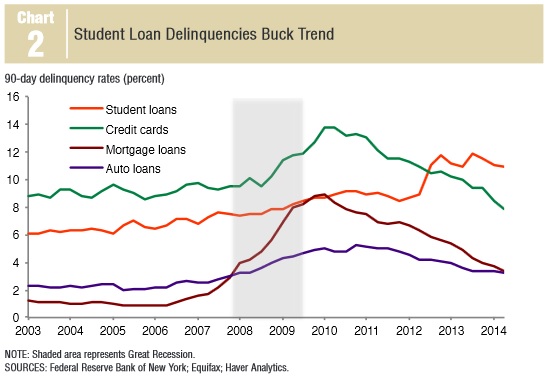
J.D. Tuccille flags a report from the Dallas Fed, showing that America’s student loan delinquency rates are still high, even as we get other forms of household debt under control:

Unshockingly, while defaults decline for credit card debt, mortgages and auto loans, they’re on the rise for student loans. “At 10.9 percent, the second quarter 2014 delinquency rate on student loans was more than three times that of mortgages and auto loans, and more than 3 percentage points higher than the rate of serious delinquencies on credit cards.” Apparently, young grads with overpriced sheepskins and no decent jobs in the offing have trouble meeting the tab.

And they’re certainly not about to take on mortgages. John Aravosis points to another new study estimating the impact of student debt on the housing market:

8% fewer homes will transact than normal in 2014, purely due to student debt. … Our conclusion is that 414,000 transactions will be lost in 2014 due to student debt. At a typical price of $200,000, that is $83 billion per year in lost volume.

Meanwhile, an analysis from Pew shows that more students of every class background are graduating college in debt today than 20 years ago:

In the early ’90s, only among graduates from low-income families did a majority of graduates finish college with student debt. Now, solid majorities of graduates from middle-income families (both lower-middle and upper-middle) finish with debt, and half of students from the most affluent quartile of families do the same. … Among recent college graduates who borrowed, the typical amount of cumulative student debt for their undergraduate education increased from $12,434 for the class of 1992-93 to $26,885 for the class of 2011-12 (figures adjusted for inflation). The increase in the median amount of debt by newly minted borrowers between the class of 1992-93 and the 2011-12 varied somewhat by the graduates’ economic circumstances. But regardless of family income, the typical amount owed at graduation increased about twofold over this time period.

Where’s Kim Jong Un?

Isaac Stone Fish analyzes the significance of the North Korean leader’s month-plus-long disappearance:

Setting aside for now the impossible question of where Kim has gone — Pyongyang’s state-run media say he is sick, though he could also be under house arrest, dead, on vacation, or simply bored of appearing in public — North Korea is arguably much more stable with Kim at the helm. (First, the eternal caveat when writing about North Korea: The country is more opaque than an eye afflicted with cataracts, so much of what I’m writing is speculation.)

The most dangerous thing about North Korea is its unpredictability. Because we know so little about what Pyongyang wants, or why it does what it does, it’s difficult to prepare for contingencies.

… Much of the burden of an imploding North Korea would fall on the backs of North Koreans, but the country’s collapse could also destabilize northeast China by sending hundreds of thousands of refugees across North Korea’s northern border — and allow rogue elements in North Korea to sell nuclear material to enemies of the United States.

William Pesek elaborates on the China angle:

[W]hat’s most intriguing about North Korea these days are signs China is fed up with Kim’s antics and may be tightening the financial screws. Concrete evidence is hard marshal, of course; Beijing keeps a tight lid on its machinations at home, never mind its relationship with Pyongyang. But whereas former Chinese President Hu Jintao maintained a working relationship with his North Korean counterpart Kim Jong Il, who died in December 2011, China’s current leader Xi Jinping has been decidedly cool toward Kim the younger.

And Joshua Keating focuses on the timing:

Kim’s absence also comes at a critical moment. North Korea sent a surprising and unprecedented high-profile delegation, including Kim’s two closest aides, to Seoul last weekend, and the two sides have agreed to resume reconciliation talks. This is a major shift after months of aggressive rhetoric from the North Korean side.  This resumption of talks could be a sign that something serious has changed behind the scenes in Pyongyang. Or, less excitingly, as unnamed U.S. officials suggest to Reuters, it could simply be “diplomatic tactics by Pyongyang, aimed at dividing and weakening international pressure over its nuclear weapons program and human rights record as well as propaganda for domestic consumption.”

Split Decisions On Voter ID

imrs

Opponents of voter ID requirements scored two court victories this week against controversial laws in Wisconsin and Texas:

On Thursday, the Supreme Court issued an emergency order blocking a voter ID law Wisconsin Gov. Scott Walker signed in 2011. The court cited no reason for its move, which is common for emergency orders. Voting rights advocates challenging the law had charged that if it were in effect in November it would “virtually guarantee chaos at the polls,” the New York Times reported, as the state would not have enough time to issue IDs and train poll workers before the election. There are about 300,000 registered voters in Wisconsin who lack an ID. Most of them are black or Hispanic. Also on Thursday, a federal trial court in Texas struck down that state’s voter ID law, ruling that it overly burdened minority voters, who are less likely to have a government-issued ID, and as such violated the Voting Rights Act. More than 600,000 registered voters in Texas lack appropriate IDs.

But North Carolina voters weren’t as lucky:

Voters in North Carolina will not have access to same-day registration or out-of-precinct voting in this midterm election, after the U.S. Supreme Court on Wednesday blocked an appellant court order to stay parts of a sweeping voting law that voting-rights advocates say could leave many voters disenfranchised come November.

Richard L. Hasen make sense of these ruling:

Sometimes (as in Wisconsin) the Supreme Court has been protecting voters; at other times (as in Ohio and North Carolina) it appears to be protecting the ability of states to impose whatever voting rules they want.

But there is a consistent theme in the court’s actions, which we can call the “Purcell principle” after the 2006 Supreme Court case Purcell v. Gonzalez: Lower courts should be very reluctant to change the rules just before an election, because of the risk of voter confusion and chaos for election officials. The Texas case may raise the hardest issue under the Purcell principle, and how it gets resolved will matter a lot for these types of election challenges going forward.

Waldman tells Democrats not to count on the courts to strike down voter ID laws:

[W]e shouldn’t be encouraged by the Wisconsin ruling: it doesn’t imply that the Court believes these restrictions are unconstitutional, only that it would be a mess to have them take effect just a few weeks before the election. It’s a narrow question of election procedure.

It would be going too far to say that Democrats should just abandon all court challenges to these voting laws. You never know what might happen—by the time the next major case reaches the Supreme Court, one of the five conservatives could have retired. But the only real response is the much more difficult one: a sustained, state-by-state campaign to counter voting suppression laws by registering as many people as possible, helping them acquire the ID the state is demanding, and getting them to the polls. That’s incredibly hard, time-consuming, and resource-intensive work—much more so than filing lawsuits. But Democrats don’t have much choice.

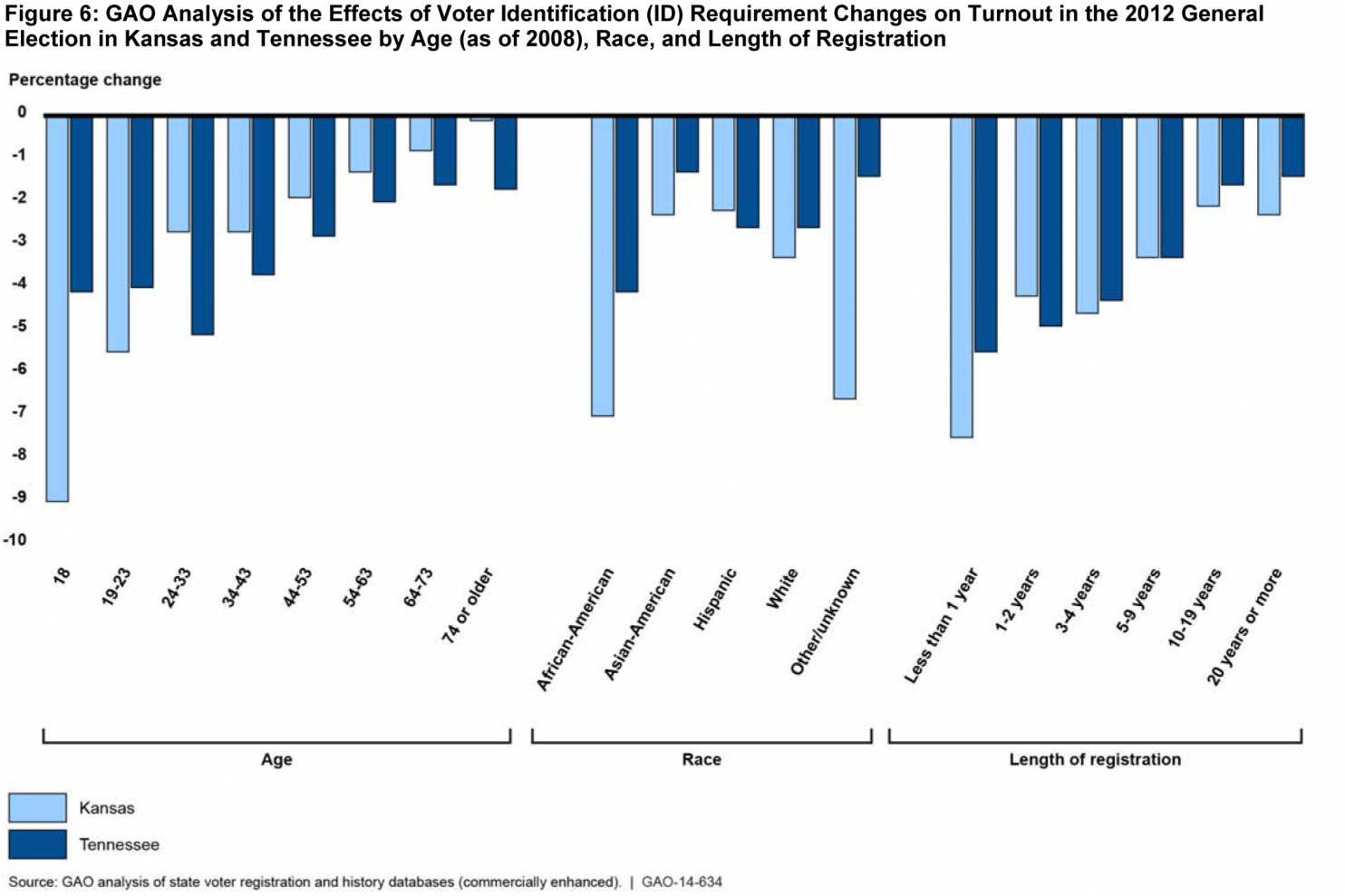
Referring to the above chart, Philip Bump outlines the Government Accountability Office’s findings about the effects of the Kansas and Tennessee voter ID laws, which had significant impacts on turnout in 2012, especially among young and minority voters:

According to data from the states (here and here), turnout dropped 5.5 percentage points overall in Kansas and 4.5 percent in Tennessee. With registered voter pools of about 1.77 million and 4 million, respectively, that means that 34,000 Kansans and 88,000 Tennesseans likely would have voted if the new laws weren’t in place. The effects of the change weren’t evenly distributed. … Young people, black people, and newly registered voters were the groups that were more likely to see bigger drops in turnout. Sixteen percent of voters in Kansas in 2012 were under the age of 30, according to exit polls. In 2008, the group comprised 19 percent of the vote. That change wasn’t entirely due to voter ID, of course, but the GAO report suggests it played a part.

The Business Of War

Justine Drennan counts the costs of the campaign against ISIS so far:

[E]ach U.S. “strike” against the self-proclaimed Islamic State can involve several aircraft and munitions and cost up to $500,000, according to Todd Harrison, an expert with the Center for Strategic and Budgetary Assessments, a Washington-based defense think tank. Harrison said the cheapest possible strike could cost roughly $50,000 — assuming a single plane dropping one of the cheaper types of bombs. … But using his $500,000 upper estimate, Saturday’s strike missions alone cost as much as $4.5 million. And those figures don’t even include the intelligence, surveillance, and reconnaissance flights necessary to scope out targets ahead of strikes, which have helped make even the low-level campaign against the Islamic State hugely expensive. The Pentagon revealed on Monday that it has spent as much as $1.1 billion on military operations against the Islamic State since June.

But this war, among others, is great news for the companies that make those planes and bombs:

Led by Lockheed Martin Corp. (LMT), the biggest U.S. defense companies are trading at record prices as shareholders reap rewards from escalating military conflicts around the world.

Investors see rising sales for makers of missiles, drones and other weapons as the U.S. hits Islamic State fighters in Syria and Iraq, said Jack Ablin, chief investment officer at Chicago-based BMO Private Bank. President Barack Obama approved open-ended airstrikes this month while ruling out ground combat.

“As we ramp up our military muscle in the Mideast, there’s a sense that demand for military equipment and weaponry will likely rise,” said Ablin, who oversees $66 billion including Northrop Grumman Corp. (NOC) and Boeing Co. (BA) shares. “To the extent we can shift away from relying on troops and rely more heavily on equipment — that could present an opportunity.”

Meanwhile, Julia Harte and R. Jeffrey Smith flag a report by Conflict Armament Research, which “indicates that the Islamic State’s relatively newly-formed force has had little difficulty tapping into the huge pool of armaments fueling the conflicts in Iraq and Syria.” The group, the report shows, has gotten its hands on arms and munitions manufactured in 21 different countries, including, of course, the American equipment taken from the retreating Iraqi army. Now that the Pentagon is preparing to send more arms to the Iraqis and Syrian rebels, the jihadists are licking their chops:

On Sept. 18, Congress passed a law authorizing the Defense Department not only to re-equip Iraqi forces that lost territory and abandoned their weaponry to IS, but also to provide arms to “appropriately vetted elements of the Syrian opposition.” …

The Islamic State, meanwhile, has said it welcomes fresh opportunities to get its hands on additional Western-supplied munitions. “Look how much money America spends to fight Islam, and it ends up just being in our pockets,” says Abu Safiyya, the narrator of an Islamic State propaganda video uploaded to YouTube on June 29. Gesturing at a Ford F-350 truck parked in an Iraqi police base captured by the extremist militants over the summer, Safiyya said, “They will lose in Syria also, God willing, when they come. We will be waiting for them, God willing, to take more money from them.”