In his latest Ethicist column, Chuck Klosterman advises a camp counselor to let a Mormon teenager sample coffee, disregarding the parents’ wishes:
As an authority figure, you have an obligation to approach the camper and ask, “Are you aware that your parents requested that you not drink coffee?” You might follow that with a second question: “Do you understand why your parents don’t want you drinking coffee?” This seems like a prime opportunity to have a meaningful discussion that might affect the rest of his life.
But regardless of the teenager’s response, you should not physically stop him from consuming a beverage that is legally and ethically within his right to consume. It’s not as if you’re forcing him to drink coffee against his parents’ wishes or placing him in a position where there’s no alternative; he is choosing to do this, despite his spiritual upbringing. A 16-year-old has the intellectual ability to decide which aspects of a religion he will accept or ignore. He’s not an infant, and you’re not living in the town where “Footloose” happened. It’s the responsibility of a secular camp to respect the principles of any religion but not to enforce its esoteric dictates.
Coffee, of course, has also stirred secular objections over the years. Dan Piepenbring unearths the “rhetorically marvelous if scientifically unsound” advice of one J. M. Holaday, who strongly advocated against the beverage in his 1888 paper “Coffee-Drinking and Blindness“:
Children that are allowed to partake freely of coffee will become restless, fussy and noisy, half wild with mischief. They probably advance in their school studies with abnormal rapidity. But they hate work. At times they are indifferent about education. Their strength goes to the brain. They grow rapidly, but not aright. They develop into men and women three years too soon. Yet their eyes dance with angelic splendor, and their cheeks glow with vermilion, providing that they started in life with robust constitutions. If they began life with puny physiques, however, coffee will make them slim and ghostly, and their eyes and features flat. Coffee … gives a sentimental strength—the strength that pertains to runts. The best thing that can be said of coffee is, that it has a tendency, like opium, to make lawless persons tame.
Theo Hobson ponders Rowan Williams’ new book, The Edge of Words: God and the Habits of Language, emphasizing the way language is “made by bodies in time and space” – a view that “ought to make us utterly resistant to neat tidy systems, and final explanations”:
He therefore argues that there is a sort of wisdom in language, when carefully attended to: it teaches us to affirm our dependence and finitude, and it leads us towards acceptance of linguistic difficulty (or ‘mystery’), and silence. For these things are aspects of how complex meaning is made, rather than just deficiencies. One learns to be patiently attentive to such strange, challenging forms of communication when one grasps that ‘there is no level of representation to which all others can be reduced’.
You could say that attention to language-as-representation promotes a sort of slow humanism, an intense tolerance for how human beings actually make meaning (at one point he discusses the fraught communication of a severely autistic child as illustrative of how all language is rooted in finite bodily life). Furthermore, although one’s meaning-making is limited (by one’s embodied nature), one needs to trust other forms of language that are somewhat alien to one — perhaps this entails positing a general meaningfulness in which all particular, limited meaning shares. Is there an argument for God here?
Well, the atheist is unlikely to have broken into a nervous sweat. And Williams cheerfully admits it. But maybe this is what ‘natural theology’ should do, he ventures: not try to find evidence of the Christian God in the world (an erroneous aim, as it undermines the concept of revelation), but give an account of the world that is congruent with the religious view.
Christopher Orr sets up the story of David Fincher’s new movie, an adaptation of Gillian Flynn’s novel:
Like the book, the film tells its story, for a while at least, in the form of two interwoven strands of he-said/she-said: the narrative DNA of an unraveling marriage. We watch as Nick [Dunne (played by Ben Affleck)], on the morning of the couple’s fifth anniversary, goes to the bar he co-manages with his sister, Margo (Carrie Coon), for a far-too-early whiskey. When he returns to his home—a lifeless McMansion in depressed North Carthage, Missouri—his wife [Amy (Rosamund Pike)] is missing, and there are signs of a struggle. He calls the police, and two detectives (Kim Dickens and Patrick Fugit) arrive to conduct an investigation that leads, inevitably, to Nick himself. Does he seem insufficiently concerned about Amy’s disappearance? How can he be so clueless regarding her daily life? Why doesn’t he even know her blood type? And what’s with that shit-eating grin he seems incapable of suppressing?
Some people said that this was a film that only Mr Fincher, the director of “Seven” and “The Girl with The Dragon Tattoo”, could have done well. They were right. Mr Fincher has managed to pace this perfectly, showcasing snippets of scenes before ruthlessly cutting away and moving on to the next.
“Gone Girl” isn’t Mr Fincher’s best film. It suffers from too many of the same flaws as the novel: a tendency towards absurdity that undermines its granular observations about the reality of domestic life. And yet this could be Mr Fincher’s most exemplary film. He is known for his cold, clever precision, and “Gone Girl” is ever so cold, ever so precise. It is drowning in muted colours and a sense of inevitability. Like Ms Flynn’s novel, its cleverness lies in the fact that it is so raw and yet so empty at the same time. This may not be the perfect film—but it is a perfect adaptation.
In a review that merits a mild spoiler alert, Kevin Fallon goes wild over Affleck’s performance:
[W]hen Gone Girl’s famous mid-point twist arrives, Affleck’s performance zings with sudden energy as Nick transforms from douchebag to Erin Brockovich, diving into the case of Amy’s disappearance (of sorts) himself. Critics often describe the kind of barreling, madcap work Affleck does in the second and third acts of the film as a “wild ride,” and, truly, the one Affleck goes on could not be more entertaining to watch. By the time he lands the line reading of the year—“you fucking bitch”—at the film’s climax, you’re a fool not to erupt in applause: As it turns out, Ben Affleck, star of Gigli and survivor of Bennifer, is a fantastic actor.
Andrew O’Hehir finds Affleck’s “bland characterization … a weak spot,” but heaps praise on Pike’s acting:
Pike may well get an Oscar nomination for this performance, and I daresay she deserves it, but not because Amy resembles a human being. She resembles about six of them, as if Amy were a female archetype splintered into overlapping and competing personalities by the pressure of trying to live up to her beauty, her blondness, her wealth and her “love affair” with the “perfect guy.”
An unimpressed Ryan Gilbey, however, suggests that Fincher – who used to direct commercials and music videos – here “is falling back on his skills as an adman.” Meanwhile, David Thomson sneers that the film “is not just a stepping stone in Fincher’s absorption in misanthropy, but a willful plunging off its cliff”:
Fincher is fifty-two, and one longs to see him reaching out for more than cruelty. Yet, somehow character and intelligence have not emerged. You may know a film is Fincher from the snap of his film-making and its remorseless, depressive view of human situations, but there is no sense of these criminal melodramas amounting to a portrait of the world as a whole. Gone Girl promises to be an unnerving portrait of marriage as ruin, but then it opts for madness and implausibility. Can he find himself and keep working within the mainstream? I’m not sure, and I remain uncertain as to whether he is simply a glittering craftsman in compelling but sometimes self-satisfied pessimism.
Matt Zoller Seitz agrees that “the director is a misanthrope, no question,” but maintains that “misanthropes can be entertaining”:
The most intriguing thing about “Gone Girl” is how droll it is. For long stretches, Fincher’s gliding widescreen camerawork, immaculate compositions and sickly, desaturated colors fuse with Trent Reznor and Atticus Ross’s creepy-optimistic synthesized score to create a perverse big-screen version of one of those TV comedies built around a pathetically unobservant lump of a husband and his hypercontrolling, slightly shrewish wife. For most of its running time, “Gone Girl” is “Everybody Loves Accused Wife-Murderer Raymond,” sprinkled with colorful-verging-on-wacky supporting players (including Tyler Perry as a Johnnie Cochran-like defense attorney and Neil Patrick Harris as a former flame of Amy’s who’s still obsessed with her). Then it takes a right turn, and a left turn, and flips upside down.
Dana Stevens questions how the film handles gender roles:
There’s no way to wade into the stickier wickets of Fincher and Flynn’s gender politics without giving away large chunks of the mystery plot. But there are moments, several of them, in which Nick’s unsavory feelings about his complicated missing wife and about women in general—feelings that might be charitably summed up as “bitches be crazy”—seem indistinguishable from the filmmaker’s own vision of Amy as a black hole of ineffable female needs, moods, and desires. Does this make Gone Girl a sexist movie? A movie about sexism that isn’t fully in control of its tone? Or some unholy hybrid of the two?
David Edelstein also wonders about how the film represents women:
I can’t leave Gone Girl without going back to its depiction of women, though here I risk the dreaded “spoiler.” (Stop reading if you wish.) The timing for a film that features instances of trumped-up sexual assaults could hardly be worse, and while it’s nowhere near as extreme as Fatal Attraction—which discredited feminist shibboleths by putting them in the mouth of a psychopath—the movie, like the novel, plays to the stereotype of weak men entrapped by pretend-helpless women. The Spider Woman is, of course, a noir archetype, and I’m not prepared to renounce my affection for Double Indemnity and its ilk. But I can’t say those movies don’t have real-world consequences, and coming in the middle of mounting outrage over the pervasiveness of sexual abuse, I’d hate to see the likes of Rush Limbaugh buoyed by the film’s bloodcurdling specimen of a predatory slut. For the rest of us, it’s preferable to view Gone Girl as a profoundly cynical portrait of all sides of all relationships: First you’re blind to the truth of other people, then you see and wish you could go back to being blind. See it with your sweetie!
Alissa Wilkinson insists “this is not a movie about modern marriage at all”:
[I]t is about surfaces and images that we project to one another, but it’s a farce, a movie that takes our silliest ideas about what constitutes a marriage and slams them against the wall repeatedly till they go insane. There’s a lot that’s wrong with a lot of marriages, and plenty to criticize about how we approach marriage. But seriously: this movie does not take place in our universe, or at least, it stops being our universe when they walk through the door of their house. It is, if anything, about one truly messed-up marriage that is so messed up not because of ordinary human flaws, but something like psychosis, maybe.
“Gone Girl” is meant to inspire debates about whether Amy is victimized or vengeful, and whether Nick deserves everything he gets, but, really, who cares? All I could think of was the verdict of Samuel Butler on Thomas Carlyle: “It was very good of God to let Carlyle and Mrs. Carlyle marry one another, and so make only two people miserable and not four.” Or, in the words of Tanner Bolt (Tyler Perry), Nick’s unflappable attorney: “You two are the most fucked-up people I have ever met, and I specialize in fucked-up people.”
Peter Schjeldahl scoffs at New Portraits, the new Richard Prince exhibit that consists of Instagram pictures printed onto canvas:
Possible cogent responses to the show include naughty delight and sincere abhorrence. My own was something like a wish to be dead—which, say what you want about it, is the surest defense against assaults of postmodernist attitude. Come to think of it, death provides an apt metaphor for the pictures: memento mori of perishing vanity. Another is celestial: a meteor shower of privacies being burnt to cinders in the atmosphere of publicity. They fall into contemporary fame—a sea that is a millimetre deep and horizon-wide.
You needn’t visit the show to absorb its lessons about the contagion of social networks. But there’s a bonus to viewing the images as material stock in trade, destined for collections in which they will afford chic shocks amid somewhat subtler embodiments of the human spirit. They add a layer of commercial potency to the insatiable itch—to know oneself as known—that has made Instagram a stupefying success.
But Jerry Saltz defends Prince’s “genius trolling”:
With these new works, the protests against him center on three things. First, he’s making money from these things, a lot of money, and given how easy they seem to be to make, that seems like theft, or at least a con; second, he’s using other people’s Instagram feeds without their permission; and most prevalently, he’s a lech for looking at and making art with pictures of young girls. Never mind that all these images shadow us everywhere now and already exist in a public uncopyrighted digital realm. And yes, he’s making money. About $40,000 a pop, to the best of my knowledge. And even though the thought of an artist raking it in at such rates when so many other artists — many of them as well known as he is — can barely get by and sell next to nothing makes me hate our current bifurcated top-versus-everyone-else system even more, the guy is a famous artist in his mid 60s. If anyone deserves it, he does.
As for him “stealing other people’s pictures,” my view of an artist using other people’s Instagram pics is no different than an artist using any other material. By now, we have to agree that images — even digital ones — are materials, and artists use materials to do what they do. Period. In my way of thinking, too many artists are too wed to woefully outmoded copyright notions – laws that go against them in almost every case. … Prince’s new portraits number among the new art burning through the last layers that separate the digital and physical realms. They portend a merging more momentous than we know.
And Rhett Jones appreciates what Prince brings to the images through his comments:
These comments appear to be mostly tongue in cheek, like “I remember this so well (tent emoji) glad we had the tent” under Kate Moss posing with her legs spread. The frequent use of emoji adds an extra graphic layer. The comments themselves create another level of participation in the work. If nothing else, you can’t say Prince didn’t add anything this time. His name’s right there. He’s saying something. …
Your average Instagram comment isn’t, “ah yes post-modern redux meets Warhol celebrity-bacchanal meets Benjamin’s age of mechanical reproduction flipped back on itself.” You say “I’ve never seen a tat like that.” Then you click like, because you like it, and sometimes that’s enough.
The exhibition runs through October 25th in New York City.
A new paper suggests that Stanley Milgram’s 1963 “obedience” experiments – which, infamously, involved volunteers delivering what they believed to be painful electric shocks to strangers on the instructions of an authority figure – might not be as damning as previously thought. Josie Glausiusz runs down what was found when the paper’s authors revisited the Milgram archive at Yale, noting that the participants were not “passive conformists blindly following malevolent orders, but rather ‘engaged followers’ who identified with the noble goals of Milgram’s research”:
Forty-four percent of respondents were “very glad” to have participated in the study. Sixty-four percent indicated that, once the experiment was over, it had not bothered them at all. One volunteer wrote, “I am very delighted to be apart of this project. … I sure hope my efforts, and cooperation have been somewhat useful.” Another replied, “I did not like the idea of giving the shocks, but had complete confidence in the instructor and the nature of the experiment.” While the experiment had prompted depressing thoughts and nightmares in some, others expressed satisfaction that they had been “of some small help,” and a firm belief in “experiments that will help to understand people.”
[Alex] Haslam and colleagues’ statistical analysis of the responses revealed that participants were “highly engaged” in the science, seeing it as a social good to which they were pleased to contribute. Milgram himself had convinced them of this when he wrote to them, at the conclusion of his study, that “the experiments you took part in represent the first efforts to understand [obedience] in an objective, scientific manner.” Their investigation, the researchers say, “supports the view that people are able to inflict harm on others not because they are unaware that they are doing wrong, but rather because—as engaged followers—they know full well what they are doing and believe it to be right.”
Reviewing Letters to Vera, Philip Hensher marvels at what Vladimir Nabokov’s correspondence with his wife reveals about his talents as a writer:
The letters are full of rapturous comment, of course, but their substance, and the reason they are so absorbing, is Nabokov’s intense interest in the world around him. He knows that when you are in love, the slightest detail of the beloved’s world and days are interesting: what he might have learnt, through writing these letters, is that the specific is always interesting for readers, too. All through those 1926 letters, he remembers to tell Véra what he has eaten — it’s slightly comic, because Vladimir is not an adventurous eater, and it becomes a litany of good plain food — ‘lamb chop, and apple mousse… meatballs with carrot and asparagus, a plain brothy soup, and a little plate of perfectly ripe cherries… broth with dumplings, meat roast with asparagus and coffee and cake… chicken with rice and rhubarb compote’. The point is that Véra will be interested, because it’s her man eating his meals far away from her; we are interested because the writer evokes and specifies.
Nabokov is such a great letter writer because he wants to interest, not just pour out his emotions. These letters must have been a joy to receive. He keeps his eyes open, and concentrates on recording what he sees:
Alongside the paths coloured stripes are daubed on beech and oak trunks, and sometimes simply on the rocks, like little flags to show the way to this or that hamlet. I noticed too that peasants put red earflaps on their percherons and are cruel with their geese, of whom they have plenty: they pluck off their breast feathers when the geese are still alive, so that the poor bird walks around as if in a décolleté.
Love, and intense care for what will interest his readership of one, directed Nabokov’s writing, and shaped it for the future. The clarity of observation here about a moment of terrible animal sadness holds in it the flash of insight at the beginning of Lolita, the parable about the monkey learning to draw and producing an image of the bars of its own cage.
Jacob Silverman mulls over whether coding counts as art:
Coding, some of its practitioners claim, is an art form. This argument often hinges on the notion, promulgated by prominent industry figures like the venture capitalist Paul Graham, that coders are “makers.” They produce remarkable things — essays crafted out of the programming languages C# or Javascript that, like a literary essay, depend on elegance, precision, and a knowledge of form. Their creations sometimes affect humanity on a massive scale. According to this calculus, the operating system designed by Steve Wozniak for the Apple II might be as important as Macbeth.
For the novelist Vikram Chandra, who spent years working as a computer programmer and consultant, this comparison holds some appeal. But, as he argues in Geek Sublime: The Beauty of Code, the Code of Beauty, his first nonfiction book, it’s a rather facile argument, one that incorporates some unacknowledged biases, including the American tech industry’s particular blend of nerdy arrogance and latent machismo.
Yes, Chandra acknowledges, “coders – like poets – manipulate linguistic structures and tropes,” he says, and coders also “search for expressivity and clarity.”
But the virtues of what might be called “beautiful code” are different than those of beautiful art. “Beautiful code,” he writes, quoting Yukihirio “Maz” Matsumodo (the creator of the Ruby programming language), “is really meant to help the programmer be happy and productive.” It serves a purpose. Art, by its very nature, serves no purpose. Code is practical and logical. Art is about affect, associations, and emotional responses — part of what Chandra calls dhvani. The term, developed by Anandavardhana, a ninth-century Indian literary theorist, derives from a word meaning “to reverberate.” Dhvani is resonance or “that which is not spoken,” as Chandra says. Code is explicit. Art can be irrational and leave some of the most important things unsaid.
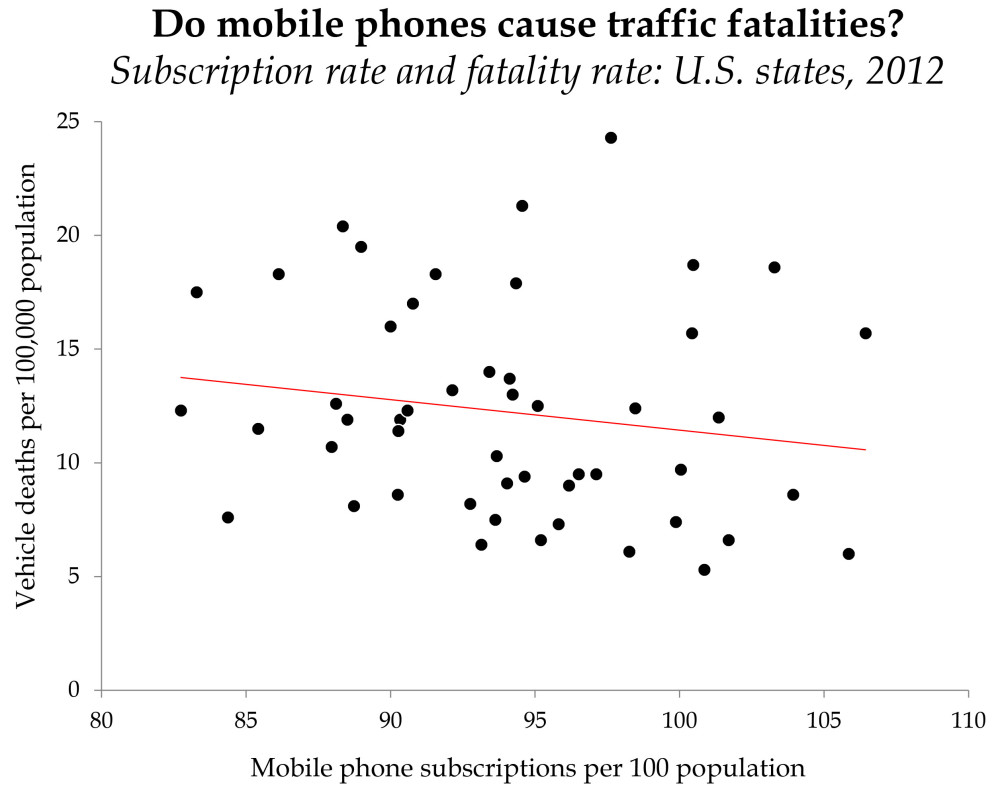
What does predict deaths? Driving. This isn’t a joke. Sometimes the obvious answer is obvious because it’s the answer…. I also put both of these variables in a regression, along with age and sex composition of the states, and the percentage of employed people who drive to work. Only the miles and drive-to-work rates were correlated with vehicle deaths. Mobile phone subscriptions had no effect at all. … [T]exting while driving is dangerous and getting more common as driving is getting safer, but driving still kills thousands of Americans every year, making it the umbrella social problem under which texting may be one contributing factor.
Doug Hartmann nods along, adding that Cohen’s analysis “reminds me of a thought experiment Joseph Gusfield posed in his brilliant, if under-appreciated 1981 book on drinking driving and the culture of public problems”:
Gusfield asks his readers to imagine that some all-powerful god has come to America and offers to give us a new technology that will make our lives immeasurably better by allowing us to go wherever we want, whenever we want, faster than we have ever gone before. The only catch? The god demands that we as a society sacrifice 5000 of our citizens every year for the privilege of this great technological innovation. Do we take that bargain? Would you? With our reliance on the automobile, Gusfield says, we already have. In rejecting the conventional wisdom and moralistic outrage about texting and bringing new data to bear on the dangers of just being in traffic on the roads, I think Cohen is just trying to force us to grapple with this consequences of this collective decision more honestly and directly.
Read the Dish thread on driving with cell phones here.
James Poniewozik has mixed feelings about nostalgia over the Internet:
News outlets have always loved the convenience of anniversaries, of course; we’re in the middle of experiencing the 50th birthday of everything that happened in the ’60s. But lately we’ve been buried in “Wanna Feel Old?” listicles and “___ Turns 20″ features. (Some of them, I fully admit, written by me.) A lot of this material is aimed at millennials (see the outpouring of love for cultural landmark Saved By the Bell), but I wouldn’t want to overstate this as a generational phenomenon. My own people, Gen Xers, grew up on Happy Days and gave the world the Schoolhouse Rock Live! musical. Premature nostalgia may just be our general way of dealing with our society’s extended nether-zone between childhood and independent adulthood.
Whatever the explanation, though, online sharing and social media have positively weaponized nostalgia.
In an era where people flock to Facebook to find friends or communicate solely via text, a growing niche of entrepreneurs is building businesses that help people meet the old-fashioned way: in person.
As digital connections have blossomed, so too has a sense of loneliness among some users. Patrick Janelle, a founder of Spring St., is one of them. He said he started the society, in part, because his digital life, which includes an Instagram account with about 276,000 followers, lacked the human contact he craved.
Guests now depend on him, not a computer algorithm, to do the social sorting for them, betting his parties will create an atmosphere that fosters meaningful relationships. “I want to be remembered for bringing these people together,” said Mr. Janelle, of the get-togethers he plans with his Spring St. partner, Amy Virginia Buchanan. He added: “It resonates right now because there is a mystery and surprise, and you are discovering new things.”
Cody C. Delistraty, meanwhile, insists on the authenticity of online relationships:
The question, then, is whether these relationships in the virtual world are still the same as relationships pursued in the real world or is there a fundamental difference, as Baudrillard would have claimed? Can we still call love “love” if it’s passing through a screen?
For the past decade, Paul J. Zak, a professor of neuro-economics at the Claremont Graduate University who sometimes goes by “Dr. Love,” has been conducting studies on how relationships maintained over social media differ from relationships in real life. What he has found is that there’s hardly any difference at all.
“It’s as if the brain doesn’t really differentiate between you posting on social media and you being there in person,” he told me. “We’re such hyper-social creatures that we have a large release of dopamine when we’re with other people. But we can also get that release through Twitter or any social media, really.”
Arrested at sixteen, Kalief Browder was imprisoned at Rikers Island for three years without ever being convicted of a crime. His case was eventually dismissed. From Jennifer Gonnerman’s excellent coverage of the injustice:
In order for a trial to start, both the defense attorney and the prosecutor have to declare that they are ready; the court clerk then searches for a trial judge who is free and transfers the case, and jury selection can begin. Not long after Browder was indicted, an assistant district attorney sent the court a “Notice of Readiness,” stating that “the People are ready for trial.” The case was put on the calendar for possible trial on December 10th, but it did not start that day. On January 28, 2011, Browder’s two-hundred-and-fifty-eighth day in jail, he was brought back to the courthouse once again. This time, the prosecutor said, “The People are not ready. We are requesting one week.” The next court date set by the judge—March 9th—was not one week away but six. As it happened, Browder didn’t go to trial anytime that year. An index card in the court file explains:
June 23, 2011: People not ready, request 1 week.
August 24, 2011: People not ready, request 1 day.
November 4, 2011: People not ready, prosecutor on trial, request 2 weeks.
December 2, 2011: Prosecutor on trial, request January 3rd.
The Bronx courts are so clogged that when a lawyer asks for a one-week adjournment the next court date usually doesn’t happen for six weeks or more. As long as a prosecutor has filed a Notice of Readiness, however, delays caused by court congestion don’t count toward the number of days that are officially held to have elapsed. Every time a prosecutor stood before a judge in Browder’s case, requested a one-week adjournment, and got six weeks instead, this counted as only one week against the six-month deadline. Meanwhile, Browder remained on Rikers, where six weeks still felt like six weeks—and often much longer.
In an additional post, Gonnerman highlights Rikers’ use of solitary confinement on teens – a practice the jail has promised to phase out:
Jail officials say that there are now fifty-one inmates in solitary confinement between sixteen and seventeen years old. By January 1st, that number should be down to zero, if jail officials follow through on their promise. Meanwhile, the months that Browder spent locked in the Bing left him with his own theories about the power dynamics of solitary. In his view, its very setup insured that guards who wanted to dole out extra punishment to inmates—deprive them of the phone or rec or even food—could get away with it. Among the general jail population, Browder said, “they’ll do their job, because they know the inmates will jump on them. But in solitary confinement, they know everybody is locked in, so they curse at us, they talk disrespectful to us, because they know we can’t do nothing.”
Jon Walker connects Browder’s case to the war on drugs:
A very big reason the justice system is overwhelmed and conditions at our prisons are so terrible is due to overcrowding from the drug war. According to the FBI’s nationwide statistics, “The highest number of arrests were for drug abuse violations.” … This doesn’t just hurt people caught up in the drug war and their families. It harms everyone who needs to use the justice system including the victims and those accused of all other crimes. The drug war has so overwhelmed our system of justice that it is has effectively destroyed the constitutional right to a speedy trial.

 The Dish