The Long, Twilight Struggle For Independent Journalism, Ctd

Go here and here to catch up on our coverage of the Simmons-Goodell row. Sports fans from the in-tray have the floor:

Your take on Bill Simmons as a fight over journalistic independence is largely misleading.  Does ESPN have a stake in the economic success of the NFL?  You bet.  Does that mean that ESPN is going to stop criticizing the NFL or muzzle its journalists?  Absolutely not.  Don Van Natta, Jr. and Kevin Van Valkenburg, two ESPN writers, wrote the single best piece of investigative journalism in the Ray Rice affair.  Their carefully researched and written article was sharply critical of the Ravens and Goodell.  Not only did ESPN publish the piece – making it the lead story on their website for most of a day – but ESPN defended it on air, while other ESPN journalists and broadcasters praised it on twitter. That doesn’t wash with your conspiracy theory.

The problem for Simmons is that he wants to be both a journalist and an entertainer.

It is fine for radio shock jocks to call Goodell a liar (and most people would probably agree), but it is not ok for a journalist to make that kind of bald and inflammatory statement. You can criticize ESPN for trying to draw a line between journalism and entertainment when the network has frequently has blurred that line in other contexts, but that issue is a lot different from journalistic independence.  In the long run, ESPN needs legitimacy even more than it needs the NFL.

But Simmons was saying this on an avowedly free-floating podcast where the style is “anything goes” (see below). That context is relevant, I think. It’s possible to be a chatty entertainer in one media form and a sober journalist in another. Another reader pushes back in the opposite direction:

You write that Simmons was suspended because “Simmons out-and-out named Goodell as a liar – without proof.” At this point, we have four sources that verify that Goodell was told about the contents of the video. In addition, we have a source that says that the NFL received a copy of the video and has a voice message confirming his story. Further, we have multiple sources saying that at the very least the NFL was offered a copy of the video. Finally, we know for a fact Goodell lied when he said New Jersey law forbid him from getting a copy of the tape. What more proof do you need that Goodell is a liar? Do you need a video of him watching the video?

Bill Simmons spoke the truth and now he is being punished, while the most incompetent, immoral commissioner in sports continues in his job. The longer this continues on, the less I start to care about the NFL. I do not think that I am alone.

Another:

I’m a long-time Simmons reader/listener, and I want to give you some context and also contend that this is a blow for independent journalism, not a harbinger of its death.

I don’t think this was a spontaneous rant, as you say. Bill had a bee in his bonnet and he needed to get it out. The rant came in the middle of a weekly podcast he does during football season with his Cousin Sal where they talk about betting lines and generally ridicule themselves and all degenerate sports gamblers. It’s pretty light and funny. He stopped Sal in the middle of that to make his statement. He knew what he was saying was going to get his bosses’ attention, and even dared them to call him on it. He may not have anticipated the three-week suspension, but he knew there would be consequences.

That he did it despite knowing the consequences tells you everything you need to know about the power relationship between Simmons and ESPN/Disney. He knew they would have to take disciplinary action to kowtow to the NFL, but that the likelihood of them firing him was very low, and even if they did, there would be a slew of large offers from other media outlets bidding for his services, much in the way Nate Silver was wooed. He has the upper hand, not ESPN.

Had anyone else at Grantland said what Simmons said, they would likely have been sacked. During podcasts, when someone else takes a pregnant pause while discussing a controversial subject, Bill interjects: “Don’t get fired.” But he knows that doesn’t apply to him.

Another reader:

I don’t have a dog in this fight, but I rather suspect that Simmons‘ suspension by ESPN resulted from several factors you failed to note in your coverage, e. g., use of terms such as “fuck” and “fucking liar” in his rant filled harangue against Goodell and his acknowledgement that he had no evidence or proof that the commissioner was “lying.”

But another knocks that theory down:

Simmons‘ podcast begins with the disclaimer: “The B.S. Report is a free-flowing conversation that occasionally touches on mature subjects . . .” Ever since adding that disclaimer, and particularly since the advent of Grantland, foul language is common on the B.S. Report.  And the discussion frequently involves “mature” subjects.  Simmons referring to Goodell’s press conference as “fucking bullshit” is tame compared to the recurring discussions involving sex and drugs.  Not to mention, articles on Grantland routinely use swear words.

Another reader backs me up a bit:

I am a freelance sports reporter, journalism teacher, and avid Dishhead, so I feel I am uniquely positioned to riff about this Bill Simmons thing in context for a bit, so forgive me if I blabber.

First, I am also a Simmons/Grantland fan, and I listened to the podcast minutes after it was released. I thought his take was strong, but even I was a bit like, “Whoa, there. Careful.” The reason why is exactly what you stated: He called Goodell a liar without proof, and more importantly, without providing himself an out. Keith Olbermann, who has a show on ESPN TV nowadays, has also consistently championed Goodell’s resignation, but for all his blowhardiness, Olbermann cleverly leaves himself an out each time, saying for example (and I’m paraphrasing poorly here), that Goodell is either incompetent or lying, and therefore should resign. But never did he say Goodell is a liar, full stop. So that’s where Bill got into trouble with ESPN’s Journalistic Standards police: Lack of parsing.

But here’s the thing – I personally find even that laughable. Simmons isn’t a journalist per se; he’s an opinion-maker and a columnist, and also a pretty good, if homer-ish, NBA analyst. ESPN has no problem playing the journalism card on him in this case, but it’s totally cool with allowing fellow opinion-maker, columnist and NBA analyst Stephen A. Smith participate in Oberto beef jerky ads with Richard Sherman of the Seattle Seahawks. That, apparently, is totally cool in Bristol.

It should also be noted that I personally believe the aggressive coverage of the Ray Rice case has partially been a reaction by all the networks to what they have long-viewed as heavy-handedness by the NFL in TV and advertising contract negotiations in the Goodell era. It’s no secret in the sports business world that the NFL has a very difficult reputation in negotiations. It’s as if the networks mutually decided when they found out that their reporters were lied to publicly that they would go open season on the league. And now that the story is waning a bit, and the league is regaining some ground (largely thanks to the consumption of its regular product every weekend), ESPN is pulling the reins in a tad.

I think there’s a bit more inside baseball going on here, since it’s in the networks’ interest to try to devalue the NFL as a commodity for the next round of negotiations by, well, doing their jobs and reporting facts. The NFL appears on ALL of the major networks – FOX, CBS, NBC and ESPN (which is owned by ABC/Disney), so whatever they can do to rein the NFL’s negotiating power in is  gravy to them, I’m sure, since it also owns the ratings for the dying major networks across the board.

I hope that helps at least a bit. Thanks again for all you and your team do!

The Gender Gap On The Big Screen

Female Characters

Alyssa Rosenberg flags new research on female characters in film:

[W]hen a new study from the Geena Davis Institute on Gender and Media, produced by the scholars at the Media, Diversity and Social Change Initiative at the University of Southern California Annenberg, rounded up the representation of women in movies from the world’s top-ten markets outside of the United States, I was curious. Are audiences in Australia, Brazil, China, France, Germany, India, Japan, Russia, South Korea and the United Kingdom accustomed to see women on screen in numbers and in ways that might force the heavily-male American movie industry to cater to their preferences?

She explains the “mixed” results:

The study’s authors looked at the movies that played in those countries’ theaters between the beginning of 2010 and May 1, 2013. During that time, 29.3 percent of characters in American movies were female. Seven countries had a higher percentage of female characters in movies–Australia, Brazil, China, Germany, Korea, Russia, and the United Kingdom. But the numbers were not dramatically higher. The United Kingdom had the highest overall percentage of female characters at 37.9 percent, a figure that hardly suggests a yawning gap between what the U.S. provides and what international audiences are accustomed to at home.

Molly Mirhashem takes a closer look at the study’s findings:

Less than a fourth of all characters with jobs were female, while in reality women represent 40 percent of the global workforce. Beyond that, very few female characters held powerful roles in any field; leadership and “prestigious” positions, like judges, doctors, executives, and professors, skewed overwhelmingly male. Only 10 percent of workers in STEM (Science, Technology, Engineering, Math) fields were women, as compared to about 25% in actuality. …

The team further surveyed the levels of revealing clothing, nudity, thinness, and implications of attractiveness for female characters across age groups. For example, in the German films, 40 percent of all female characters wore revealing clothing (defined as “tight and alluring”). In American films, for comparison, 29 percent of the female characters were scantily clad. And in perhaps the most disturbing finding, teenage girls as young as 13 were as likely to be sexualized as women in their thirties.

Pessimism Inc.

Bourree Lam tracks Westerners’ dim hopes for corporations:

In developed economies of North America and Western Europe only 44 percent of the public see corporations as a source of hope, compared with 57 percent of executives. 55 percent of the public polled in developed markets feel that corporations have not been humbled by the recession, and haven’t been acting more responsibly either. In the U.S. last year, the SEC announced a record $3.4 billion in fines, and 2011 was the year with the most actions filed in the agency’s history.

Compared with China, where 84 percent of people consider corporations a source of hope, the U.S. is not very optimistic about corporations making the economy stronger—only 36 percent feel hopeful toward them. Interestingly, the U.S. general public is more than 10 times as likely as the Chinese general public to say that corporations have more power than the government. 95 percent of those surveyed in China say the government has more power than corporations in their country, compared to just 51 percent in America. Nearly half of Americans surveyed feel that corporations have too much influence on the future of the U.S. economy.

Neil Irwin interprets the survey’s findings:

When it comes to business exerting power over the economy, Americans have mixed views but are generally comfortable. But when it comes to business exerting power over government, they are much more exercised.

Americans aren’t antibusiness, in other words. They’re just against business having what they see as too much power in Washington.

Compare that with China, where citizens seem to view businesses as less powerful in terms of lobbying (only 19 percent seeing a lot of influence by corporate lobbyists, a full 40 percentage points lower than in the United States) but are more likely to believe it is good for companies to be strong and influential. One might imagine that Chinese citizens see less a phenomenon in which business overly influences government and one more in which government overly influences businesses.

Black-ish Is Beautiful

Alyssa Rosenberg declares the ABC sitcom “the best new comedy pilot of the fall television season”:

The series focuses on an upwardly-mobile black Los Angeles family, headed by Andre (Anthony Anderson), an advertising executive, his doctor wife Rainbow (Tracee Ellis Ross), Andre’s father (Laurence Fishburne) and their four children. Andre appreciates the opportunities that are open to him, including a nice home and a possible promotion at his firm, but when “Black-ish” begins, he is also gravely concerned that his kids are drifting from his own sense of what it means to be black, in part because they have grown up in such relative comfort. …

But the tension Andre is feeling does not simply play out in his own family, where he and Rainbow–who is mixed-race–have radically different perspectives on everything from their own children’s choice of sports and attraction to Judaism to an ongoing disagreement about whether O.J. Simpson is actually guilty. Instead, the great insight of “Black-ish” is that everyone has a relationship to black culture now, as well as to issues of class and gender, and that there is great comedy and great insight to be mined in looking at the fine-grained differences in the perspectives everyone brings to blackness (and whiteness), family life and money.

While watching the first episode – available in full here – Judnick Mayard felt a pang of recognition:

The pilot, which airs this week on ABC, follows “Dre” on the day he is promoted to senior vice president at the ad agency where there are no folks of color on the management team. To his surprise, he is named SVP of the Urban Division, essentially boiling his job down to black man in charge of black stuff. His boss insults him further by requesting that he also keep it real on his first pitch, which incenses Dre into a mad spiral of reaffirming his blackness to himself and his family. Dre’s anger and antics throughout the rest of the episode come from feeling like his blackness (and his family’s blackness) is being attacked. It’s a feeling that many of us can understand.

Linda Holmes contends that “while the racial politics of Black-ish are interesting and feel pretty fresh … what’s even more unusual is Dre’s mention of money”:

What makes the show interesting and the comedy more pointed, for me, is that there’s a candor about the way that having money affects Dre and Rainbow’s sense of who they are and how they’re raising their kids that’s very uncommon in a world where the obviously rolling-in-dough families on Modern Family, for instance, almost never discuss it. That’s not to even mention, of course, the many much-maligned examples of people living in palatial New York apartments they would never be able to afford in their proffered professions, from everyone on Friends to Carrie Bradshaw on Sex and the City, who was somehow supporting herself in high style and hot shoes by writing one column for one outlet, rather than living in a closet with four roommates and a cockroach infestation. Black-ish concerns itself largely with the way Dre’s sense of racial identity intersects with the introduction of wealth.

Willa Paskin adds, “What ultimately gives Black-ish so much warmth – a warmth reminiscent of, yes, The Cosby Show – is its optimism that audiences, of all colors, will not be turned off by its specificity”:

Black-ish is about the affluent black experience, no apologies, no soft-pedaling. And that experience, of course, encompasses the anxiety of raising your children, the sustaining of a great marriage, and the ongoing project of being the person you most want to be. Like the many, many sitcoms about the affluent white experience, this is a show that is meant to be seen and enjoyed by everyone.

But Kellie Carter Jackson longs for more all-black casts:

How is it that in the “Age of Obama,” there is even less black programming on TV, save the ratchet reality TV shows of Love and Hip Hop, Basketball Wives, and the Real Housewives of Atlanta? Not only are these reality shows a false and horrible representation of black culture, but they are essentially made for pennies on the dollar when compared to a network drama or comedy.

Of course, if reality TV such as Love and Hip Hop was about authentic, complex characters, I’d watch it. I’d watch a show about drug dealers, if it were authentic and thoughtful. Who didn’t love The Wire? Who doesn’t love a good anti-hero? Black TV isn’t always about the politics of respectability. What American television should be about is presenting America with a world as diverse and complex as it really is. TV’s visual binary should not consistently be limited to that of black success or black struggle: Most of us live somewhere in between.

Perhaps in the age of Obama, the decline of all-black casts is simply because African-American actors are more woven into the fabric of TV overall. If anyone knows of any demographic data pointing either way, email us at dish@andrewsullivan.com.

Tech’s New Political Charge

In an analysis of the “long, awkward relationship between Silicon Valley and American politics,” Ben Smith sees tech industry on the brink of a new era:

The relationship between tech and politics is “radically changing,” said Ace Smith, a San Francisco political consultant whose clients have included the biggest names in both Democratic politics and technology. The startups jangling transportation, housing, and an array of other consumer areas have “opened the tech world’s eyes to needing a broader perspective, and it’s opened every one else’s eyes – it’s really brought them much more into the world of politics and government and communications.” Indeed, 2014 feels like the end of one era and the beginning of another.

A generation ago in Silicon Valley, “you didn’t even think about government until you were a public company – and even then it was a culture of avoidance,” said Matt Mahan, who has worked for a decade at the intersection of politics and tech and now runs Brigade, a startup aimed at reforming U.S. politics. … Now Uber, in particular, is winning more fights than it’s losing in an endless series of tussles with local regulators. The same is true for Airbnb, whose spokesman, Nick Pappas, had previously been selling Obamacare from the West Wing press office. (Two other former top Democratic staffers also work there.) These companies carry the confidence (at times, arrogance) and sense of destiny that has driven Silicon Valley’s burst of innovation; they also are being shaped by urgent battles with regulators of the sort that Microsoft, for instance, didn’t quite see coming (on a far larger scale) until the Department of Justice came calling. They are showing a new willingness to compromise the purism that sometimes made tech companies leery of dirtying themselves up in Washington.

Relatedly, Daniel Ben-Ami praises urbanist Joel Kotkin’s recent book The New Class Conflict, which tracks the ascent of tech power elite, as “an innovative attempt to rethink the main contours of US society”:

[Kotkin] sees the American elite as split between two mutually antagonistic oligarchies. On one side is a new elite based largely on information technology, although with substantial support from Wall Street. On the other is the old plutocracy centered on sectors such as agribusiness, construction, energy and manufacturing. The new oligarchy differs from the old in important ways. Its technology wing is concentrated in and around San Francisco, with a secondary cluster in Seattle, and it employs far fewer people than traditional industries. Kotkin estimates that in 2013 the leading social media companies together directly employed fewer than 60,000 people in the US. By contrast, GM employed 200,000, Ford 164,000 and Exxon more than 100,000. The different nature of technology firms, with far less dependence on cheap energy, helps explain why they are predisposed to green thinking. They also tend to be both geographically and emotionally distant from middle America.

A Grim Update From Libya

Sign of clashes near 27th Bridge of Tripoli

The situation is increasingly chaotic:

Leaders of the Islamist militias that have been wreaking havoc across Libya have unleashed an army of loyal, unemployed, and mostly uneducated followers to carry out a campaign of intimidation.

They are threatening, kidnapping, and targeting the relatives of politicians and civil society activists. “Militia leaders are now using an army of young people who will carry out their orders without any questions,” said prominent activist Ahmed Ghedan, who had to flee Libya to Tunisia after he spoke out against the militias. These foot soldiers have been bribed into joining the militia-gang culture. For activists, dealing with this army of brainwashed criminals is much harder than dealing with the militia bosses, who are leading from behind. The new recruits are clueless about the intent and consequences of their actions, and their loyalty simply lies with those who pay their checks. Political groups with links to the militias are taking advantage of this chaos to take out their opponents one by one.

These same groups are also targeting journalists and activists, who have found their lives and livelihoods threatened in myriad ways. For example, their movement is being restricted, and they have been unable to travel around or out of the country, since airports are still under the control of the militias. Not only does this threaten their reporting ability – a blow to press freedom – but the detours require them to travel by land through areas in which they could be stopped, identified, and either prevented from traveling or kidnapped.

(Photo: Empty cases, sign of the clashes, are seen near 27th Bridge in Tripoli, Libya on September 24, 2014. By Hazem Turkia/Anadolu Agency/Getty Images)

Who Will Fill Holder’s Shoes?

Ed Morrissey ponders the timing of Holder’s resignation:

The White House is apparently worried that a Republican takeover of the Senate will make confirmation of Holder’s replacement very difficult unless Obama appoints someone Republicans like. Resigning now allows Obama to appoint a replacement soon, and Senate Democrats to schedule the hearings during the lame-duck session (and don’t forget Harry Reid’s rule change on filibusters for presidential appointments, too, which expires at the end of this session).

But naming a replacement for Holder carries significant political risks if it happens ahead of the midterms, too; if Obama picks someone too radical, Republicans will jump all over the choice in Senate races, and warn that the Democratic incumbents (or challengers, as the case may be) will be a rubber stamp for confirmation. It really puts the rubber-stamp issue front and center in the Senate races, which is exactly what Democrats who are trying to distance themselves from Obama didn’t need.

Scott Lemieux runs through a handful of possible replacements. The one currently getting the most attention – even for his facial hair:

Some administration sources have suggested that the Solicitor General is already a top candidate to replace Holder. [Don] Verrilli, a corporate lawyer without [Massachusetts Governor Deval] Patrick’s civil rights experience before becoming the nation’s top lawyer, is far from an exciting choice (that mustache notwithstanding). He’d also seem particularly unlikely to demonstrate any independence whatsoever from his boss. But having already gone through the Senate confirmation wringer and as a well-known Obama confidante, he’d be a safe choice who would require a minimum of political capital to get confirmed, something that (for better or worse) has always been important to Obama.

Dylan Matthews provides some background on Verrilli:

Perhaps Verrilli’s most significant private client was the Recording Industry Association of America, and he worked on a number of copyright-related cases on the side of copyright holders. He successfully argued MGM Studios v. Grokster, in which the Supreme Court held that entertainment companies could sue peer-to-peer services like Grokster for copyright infringements committed by their users. Before joining the Obama administration as associate deputy attorney general in 2009, he coordinated an infringement lawsuit by Viacom against YouTube that has since been settled after a number of court rulings in favor of YouTube and its parent company Google.

So it’s not too surprising that copyright reform activists are skeptical of Verrilli.

Waldman expects fireworks at the confirmation hearings:

[T]here’s no doubt that the fact that [Holder] has been involved in so many racial controversies is the key reason why he is the second-most-hated member of the Obama administration among conservatives.

When Republicans get a chance to question the person nominated to replace him, each and every one of those issues is going to come up. The nominee is going to be asked to repudiate everything Eric Holder did. And when that doesn’t happen, Republicans in Congress will turn on the nominee with everything they can muster, in a demonstration to their base that they feel their anger.

In 2009, Holder got confirmed in the Senate by a vote of 75-21. It’s going to be a lot closer, and a lot uglier, this time around.

Relatedly, Harry Enten points out that “the confirmation of an attorney general has been the most contentious of any Cabinet position”:

Attorney general nominees are by far the most likely to face serious resistance. The average number of “no” votes for all Cabinet position is just 4.5. AG nominees average 13 more than that — 17.4 “no” votes — far ahead of labor secretary nominees at No. 2, who have averaged 10.3 votes.

A lot of these averages, though, are skewed by one or two confirmation votes in which the nominee was particularly controversial. For example, defense secretary nominees would average half as many “no” votes if we didn’t count John Tower’s 1989 confirmation — 53 senators opposed him.

That’s why the median column is quite instructive. The median attorney general nominee received 21 “no” votes. That is, the majority of AG nominees since 1977 have faced combative hearings.

Follow all of our Holder coverage here.

What The Hell Is Happening In Yemen? Ctd

YEMEN-UNREST-ANNIVERSARY

The State Department ordered some US embassy workers to leave the country today, following this weekend’s Houthi takeover of the capital. Adam Baron says the events in Sana’a reveal the myth of the so-called “Yemen model,” which he describes as “a general steamroller of a narrative casting the United States’ intervention in the country as a multifaceted success”:

Yemen’s internationally-brokered transition, we were told, was a model for a region in post-Arab Spring upheaval; the Obama administrations cooperation with the Yemeni government, Obama trumpeted roughly two weeks ago, had lead unparalleled progress in the battle against the Yemen-based Al Qaeda in the Arabian Peninsula (AQAP). Both narratives have come to a head with an increasingly disparate reality as of late, as rebel fighters belonging to the Zaidi Shi’a lead Houthi movement managed to seize virtual control of Sanaa, the Yemeni capital, with little resistance from the Yemeni military, raising immediate questions regarding the utility of hundreds of millions of dollars in US military aid and a US-sponsored program of military restructuring, to say nothing of the viability of Yemen’s already fraught transition. …

Regardless of the ultimate fallout – which remains unclear – the fact remains that such issues as the battle against Al Qaeda in the Arabian Peninsula (AQAP) cannot be dealt with as separate issues from the larger challenge facing Yemen at the moment:

the establishment of inclusive, accountable governance and the shoring up of state authority – which, at the moment, verges on nonexistent – across the country. As the US-supplied military equipment currently being paraded in the streets of Sanaa by jubilant Houthi militants demonstrates, a counter-terrorism centered policy risks missing the forests for the trees.

The UN humanitarian news agency IRIN suggests the turmoil in Sana’a will have “significant” consequences for the Yemeni government’s fight against AQAP:

In recent months the group, the virulent local franchise of the extremist organization, has been stepping up its activities and rhetoric, with at least 20 people killed in attacks on military outposts by the group in August. Earlier this year the military launched a major campaign against AQAP, but it has struggled to make gains; the offensive has not been able to significantly weaken the group, which has even expanded its presence in the eastern province of Hadramawt.

There are also fears that the Houthis’ power play could encourage the Sunni Islam AQAP to increase violence in Sana’a as they seek to fight back against the Shia group.In mid-September a regional leader of Ansar al-Sharia, an AQAP offshoot which does much of its work on the ground, announced that the group was increasing its presence in Sana’a in preparation for a fight with the Houthis. Government officials say the standoff and fighting with the Houthi rebels distracted the military – which is both weak and divided – from the fight. “I think the Salafists and Al Qaeda will use the opportunity to strengthen their presence in Sana’a; that would be logical for them,” said a senior government official. “Al Qaeda are attacking the army and the PSO [intelligence agency] … This is a good environment for Al Qaeda.”

Meanwhile, a reader responds to our previous post with some personal history:

How fitting that this week of turmoil and chaos in Yemen is also the 52nd anniversary of the Great Revolution. Well, there have been government changes, and coups d’etat, and uprisings since then, but this one was the most significant, since it ended the centuries long monarchy and propelled Yemen into a Republican state. There have been subsequent Great Revolutions, and not many of the young people know much about the one in 1962.

The monarch, Imam Ahmad, died Sept 18, 1962, and his son Muhammed al-Badr assumed power. My family arrived in Taiz on September 23, where my father would take up his new post as political officer in the US Embassy. Communication in those olden days meant that, between the time we left Washington, DC (which was in the throes of the Cuban Missle Crisis), then sailed across the Atlantic and the Mediterranean to Athens, from whence we flew to Cairo, and then to Aden (then a British Colony), and then drove a jeep up the rough unpaved roads to the mountain lair of Taiz, a whole revolution had occurred.

Egypt’s Gamal Abdul Nasser, wishing to set up a puppet government that he could control in his conflicts with Saudi Arabia, appointed a Yemeni Army Colonel named Sallal to head the government. The heir Muhammed al-Badr could not get the support of Yemeni Army officers, so he disappeared from Sanaa and escaped to the northeast, near the Saudi border, where his tribal supporters gathered. I heard rumors that al-Badr couldn’t get enough support from tribes because he was believed to be a homosexual, but I’ve found very little documentation to that effect, outside of my own late mother passing along gossip, and the beliefs of Arabists who knew all of the monarchs in the 1950s and 1960s.

That Revolution ended up being a disaster for Yemen and even moreso for Egypt, which was committing 50,000 soldiers a year for the conflict, plus it was very expensive. It was subsequently known as “Egypt’s Vietnam”, since there was never any real resolution, despite the presence of UN Peacekeeping forces.

Sadly, things just got worse for Yemen. The new dictators, especially Saleh, were really mediocre rulers, only interested in extracting graft for their relatives. The Saudi oil boom from the 1970s on meant that working-age Yemeni men were leaving in huge numbers to work all over the kingdom, as well as in the Gulf States, which meant that Yemen’s former excellent agricultural infrastructure collapsed, and farmers resorted to growing more khat and less food. The birth rate was, at one point in the past 20 years, the highest in the world. Urbanization, overcrowding, political chaos, religious chaos, and then add jihad on top of it, and it’s a really sad country.

I’m so sorry to see it deteriorate even further. The Yemenis were the kindest, most pleasant nationality I encountered in my life as the daughter of a Foreign Service Officer, and Yemen had a special place in my heart. It’s devastating to realize that the people of this country are living among such violence and chaos, and there is no end to it in sight.

(Photo: Yemeni girls scouts salute as they take part in a parade marking the 1962 revolution that established the Yemeni republic, in the capital Sanaa on September 25, 2014. President Abdrabuh Mansur Hadi warned earlier this week of “civil war” in Sunni-majority Yemen, vowing to restore state authority, as Shiite rebels cried victory over their apparent seizure of much of the capital. By Mohammed Huwais/AFP/Getty Images)

The Fight Holder Didn’t Pick

Danny Vinik wishes the soon-to-be-ex AG had taken on Wall Street:

Prosecuting the banks with their well-funded legal teams for criminal crimes wouldn’t have been easy. But the DOJ has a lot of legal firepower as well. Holder simply never tried to use it to hold Wall Street executives accountable. That is a major blemish on Holder’s record. Bankers sleep easier at night thanks to his decisions. And when the next financial crisis hitsand when we discover that financial fraud was a major cause of itHolder will deserve blame as well.

Wonkblog explains Holder’s reluctance to tackle the banks:

In defense of his agency, Holder has stressed the difficulty of bringing criminal charges against top-level executives who are rarely involved in the day-to-day operations of their firms. Prosecutors, he has said, need evidence of culpability, the kind of proof that often comes from cooperating witness or whistleblowers. Just last week, Holder called for Congress to increase the whistleblower award as an incentive for Wall Street executives to come forward with information.

Danielle Kurtzleben adds more rationales:

There are all sorts of reasons why the department might have been timid — going up against banks’ well-funded legal defense teams would be tough, particularly when trying to prove wrongdoing to a jury in the byzantine world of finance, says James Angel, associate professor at the Georgetown University McDonough School of Business. In an article in the July/August edition of Politico Magazine, Glenn Thrush writes that a test criminal case against bankers ended in an acquittal, which scared Holder away from actual prosecution against individual bankers.

In addition, the Justice Department simply had a lot of other things on its plate in the last few years: terrorism and voting rights, for example. But if the Obama DOJ simply doesn’t have the manpower to handle all of the problems thrown at it, that may signal that it’s time for a new structure, says one expert.

Holder’s Civil Rights Legacy

African American Activists Call For Justice In Shooting Deaths In Ferguson And NYC

Jeffrey Toobin declares that after Obama was reelected, “Holder found himself—or rediscovered himself”:

He decided to embrace civil rights as his cause. His civil-rights division filed lawsuits against the voting restrictions imposed by the legislatures in Texas and North Carolina. He began the process of reducing the number of nonviolent offenders in the federal prison population. He went to Ferguson, Missouri, to assure its citizens that there would be a full and fair investigation into the death of Michael Brown, a teen-ager shot dead by a police officer. It is tempting, even hopeful, to believe that this was the real Eric Holder.

Holder also spoke multiple times about the discrimination he believed he had experienced as a black man.

“I am the attorney general of the United States, but I am also a black man,” he said during a visit to a community meeting in Ferguson, Mo., this year, where he recounted his anger at being stopped by police while running down the street in Washington, D.C., and while driving on the New Jersey turnpike. “I remember how humiliating that was and how angry I was and the impact it had on me.”

Like many other efforts, he spoke these words not just as a cabinet secretary but as a social activist, urging the country to be better. “The same kid who got stopped on the New Jersey freeway is now the Attorney General of the United States,” he said in Ferguson. “This country is capable of change. But change doesn’t happen by itself.”

David Graham adds:

With Holder’s departure, Obama will lose a close friend—an apparently rare breed—and an essential ally on issues close to the president’s heart. Who Obama nominates to succeed him, and whether the nomination is successful, will offer some hint of how the president intends to close out his term in office. But the new attorney general is unlikely to have as eventful a term as Eric Holder.

But Eric Posner argues that Holder’s record is not one “that a civil-rights-promoting attorney general can be proud of”:

But two things can be said in Holder’s defense. First, the attorney general just doesn’t have much power to compel a president to comply with civil rights. The attorney general is merely the president’s legal adviser; he doesn’t have any authority to force the president to obey the law. In principle, Holder could have resigned in protest of these civil rights violations, but he surely thought that he could do more for civil rights by staying in office and picking his battles, and rightly so.

Second, while Holder’s decisions disappointed civil libertarians of all stripes, they were not obviously wrong. Indeed, they were mostly right. “In times of war, the law falls silent,” said Cicero. This is something of an exaggeration in the United States today, but it remains true that the rights of people considered a threat to a country tend to diminish as the magnitude of that threat increases, for good reason. Holder, like his Bush administration predecessors Alberto Gonzalez and John Ashcroft, adopted a pragmatic rather than rigidly legalistic position on civil rights, human rights, and the laws of war. That pragmatism will be his legacy.

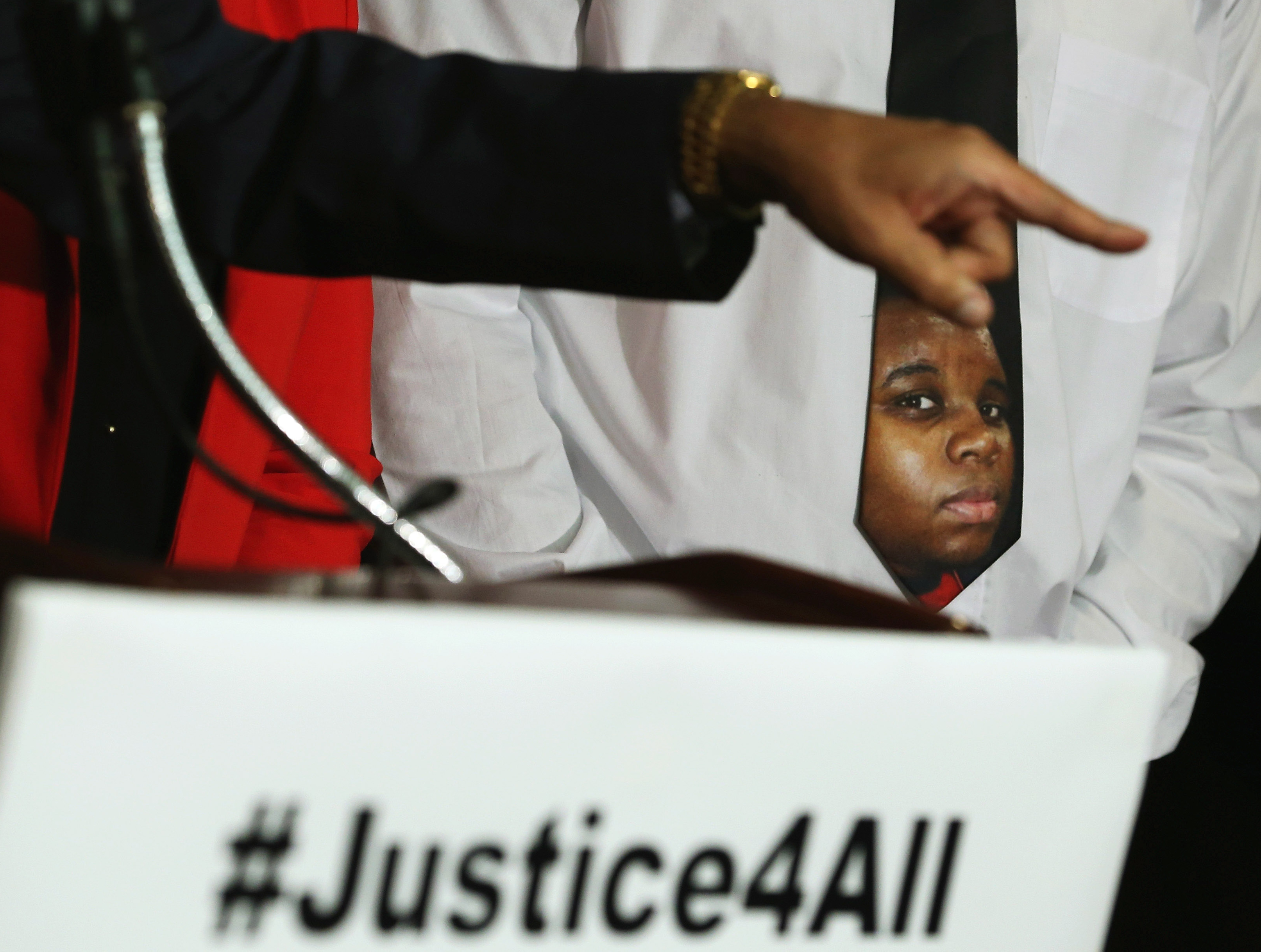
(Photo: Michael Brown Sr., father of Michael Brown, who was killed by police in Ferguson, Missouri, wears a tie with his son’s image on it during a news conference at the National Press Club in Washington, DC on September 25, 2014. Rev. Al Sharpton called for federal review of racial violence and discrimination in the law enforcement community. By Mark Wilson/Getty Images)