What’s The Best Way To Die?

Many readers discuss Zeke Emanuel’s essay on wanting to die at age 75. One pivots off a point of mine:

Sorry, but Alan Arkin beat Leonard Cohen to that punch back in the 2006 movie Little Miss Sunshine. He plays the part of a grandfather in a nursing home who has decided to take up heroin addiction … “What’s it going to do, kill me?”

Another wasn’t a fan of the essay:

I wanted to agree with it, but as he went on, the essay went further from my expectation – a statement about dignity and quality of life in the face of our focus on more years – and into a “if it’s not going to always be awesome like now, forget it” entitlement piece. Where I really turned on him:

Today he can swim, read the newspaper, needle his kids on the phone, and still live with my mother in their own house. But everything seems sluggish. Although he didn’t die from the heart attack, no one would say he is living a vibrant life. When he discussed it with me, my father said, “I have slowed down tremendously. That is a fact. I no longer make rounds at the hospital or teach.” Despite this, he also said he was happy.

He swims, he reads, he lives independently, he enjoys his family. But he’s slowed down! Better off dead, since nobody can possibly live a vibrant life without climbing Kilamanjaro.

One of my aunts has been a cripple since childhood, when she contracted polio. She’s led a very interesting life, even with lots of outdoor activities, such as snow and water skiing. Good thing Zeke Emanuel wasn’t her father.

Another is even more harsh:

Emanuel’s piece is the kind of jibberish that makes it challenging to have serious discussions with religious people.

It’s easy to say dreamy things like that when your soul “lives” forever. When you consider the equally plausible (more plausible for me, but let’s say “equally plausible” for the sake of argument) chance that we have a limited amount of time sandwiched between an eternity of darkness and nothingness, I want every single second I can squeeze out before eternity continues on without me, and if some douchebag is willing to give up their precious time prematurely, I’ll gladly take theirs too.

Of course EVERYBODY hopes to have a good quality of life while they are alive, but what kind of dolt wants to die while there is still the potential of multiple decades of vibrant life? Not everyone is John McCain, Joe Biden, or Hillary Clinton, but to see those people in their 70s, if not 80s (McCain?) reminds me that even if a little slower, a little grumpier, and a little more prone to hyperbole, my 70s, 80s, and maybe even 90s can be a rich experience.

And I am looking as forward to those years, as my 40th year is coming up. Emanuel’s piece is a kind of preachy selfishness typically reserved for millionaire inheritance babies pining for a “normal life” in a studio apartment while most everyone else works their ass off just to get by.

Another thinks of the children, and more:

While I like several of Emanuel’s philosophical points about shortening old age, he doesn’t state one of them clearly enough: for some people, old age is just really boring. Which leads me to wonder if his comments are a bit academic when it comes to creativity, because there are a lot of people who don’t particularly value creativity and don’t practice it.

But my biggest problem with Emanuel’s proposal is that he doesn’t discuss a decision to “die at 75” if the person in question has a spouse or dependent child (such as a mentally handicapped child, perhaps one without siblings). Emanuel talks about his daughters, who are presumably independent, but he seems to think that by 75 a parent’s job is over. That’s true for most parents, but for some, there’s a dependent child who will be left without a caregiver if the parent dies. Certainly plans need to be made so the child will get decent care even when the parents are gone, but the child may need the comfort of a parent’s visits as long as possible when the child isn’t a fully functioning, independent adult.

For a couple, aging is kind of a mutual endeavor, and one person often supports the other in some way, while the other provides other kinds of support. In a lot of the marriages I’m familiar with (conventional marriages from the 1940s and ’50s), the aging male supports the wife financially, because his retirement and pension benefits are greater, and she supports him through caregiving – cooking or nursing, for instance. Each may act as an emotional anchor for the other. I knew one older couple where the husband, a physician, was warned that he might be developing prostate problems indicative of cancer. He chose to ignore the diagnosis and died a decade or so before his wife. She was devastated when he died, and when she developed dementia he wasn’t there to help her. She felt betrayed because he hadn’t cared enough about her to get medical care so they could be together longer.

I also question the decision to avoid medical care altogether after age 75 as an expedited path to a quicker death. I am thinking of conditions like Lyme disease or rheumatoid arthritis that make life pretty uncomfortable but may not lead to a quick and deadly end – just a long-drawn-out decline. It seems to me that there is a flaw in his medical reasoning, but I’m not a physician, so I’m just making guesses here.

Another makes many essential points:

As a former smoker who is also HIV positive, I want to chime in on Emanuel’s piece and the dying thread. I agree with Linker that Emanuel’s piece seems to be obsessively focused on productivity, and I have a problem with that.   But, this has been a recent topic of discussion in our family, and I would like to share my thoughts.

Both my mother and her sister (mid-80s) are in full-time assisted living.  Both have Alzheimer’s.  Both are confined to wheelchairs.  The last time I saw my mom – this summer – I lost it.  She is no longer my mother.  She can’t even put together a sentence.  You can see her trying – but that’s about it.  She’s not there.  She’s gone.  She is, sadly, a lump.

I will not die that way.

My siblings and I talk about dying well, and we talk about the fact that we have come to believe that part of living well means dying well. For my brother, that means driving a Harley into the Grand Canyon.  My sister talks about taking a rowboat on Lake Michigan in January, and then slipping overboard.  My plan is more involved.  I want to spend a full summer at the family retreat, inviting my friends in staggered groups to hang out and say goodbye.  And then taking poison.

No matter what, everyone in our family wants to die well.  No matter what – and unlike Emanuel – suicide seems a decent enough option.

For me, this is not some “out-there” concept.  During the AIDS crisis, I participated in gentle deaths. Usually it just involved cranking up the morphine.  In both cases, I was the designated look-out.  But, whether done in the hospital (with the tacit approval of hospital staff) or at home (with the tacit approval of Hospice staff), we knew what we were doing.  The disease was gruesome and painful.  Brain lesions often took away mental faculties.  You know what it was like, Andrew. Helping our friends to die well was the humane thing to do.

My cousin insists that despite our talk, we won’t take action.  And I admit I am slow at putting the plan on paper.  I also admit that it is likely at least one of us – perhaps all three of us – will fail in our dream of dying well.

But I know this: At least our generation is talking about it – something my mom’s generation never did.  We simply didn’t talk about death in our family and other than the basic paperwork (powers of attorney, wills, etc.); there was no discussion about how to die.

We are having that discussion now, and we should.  And it WILL mean a gradual and eventual embrace that our deaths are a part of our lives – and that there’s nothing wrong with shaping them, no matter how you choose to do so.

My dad dropped dead of a heart attack at 70.  It was shocking – very hard to deal with.  But, it was a good death.  He didn’t fuck around.  He split.  (He used to say, “Let’s blow this pop stand.”  And, that’s what he did.)

Seventy is my goal, too.  I figure that’s an outside shot anyway, given the fact that I’ve been HIV positive for now nearly twenty years.  I have seventeen years to go to get me to seventy.  If I make that – if I live as long as my father – I will be thrilled.  (I will have beat the odds.)

And you bet your ass I will start smoking then.  That’s my plan.  I can’t wait to taste the sweet smoke and the nicotine rush of my beginning-of-the-end celebration.

For me, dying well has nothing to do with productivity.  For me – like you – having been given a new lease on life in my late thirties – it’s about cherishing this precious gift but also knowing that part of the gift is to let go when the time is right. I hope I do it well.  I hope my brother and sister do, too.

I hope you keep this thread going. It’s necessary.

Dissents Of The Day

The first reader:

As an atheist, I take issue with this line of yours: “How ironic that it’s the faithless who are the most able to appreciate the struggles of other minorities.” How so? It’s only ironic if you ignore the fact that all of the world’s major religions preach persecution and victimhood to their flock – and not just that they are persecuted, but that they are UNIQUELY persecuted above all others.

I’m reminded of that old anti-drug ad with the father and son: “Where did you get this persecution complex?!!”

“You Jesus! I learn it from watching you!”

Another:

Those findings aren’t surprising, and they certainly aren’t ironic. Atheists pass by default. We never need do anything that marks us as atheist – we don’t look atheist, dress atheist, or attend atheist parties, or have atheist names. So we never feel vulnerable, unless we intentionally open ourselves up to it. Any discrimination we encounter is theoretical, and we can hide from it anytime we like without compromising our beliefs. This isn’t true of any other group on that list.

And another notes:

It’s probably worth adding that also according to Pew, Americans have the most negative associations with Atheists and Muslims. It’s a bit ironic that the most popular groups think they’re under attack while groups that empathize the most are perceived as the least positive/trustworthy.

Is Obama Pulling A Bush?

United Nations Hosts World Leaders For Annual General Assembly

Tomasky insists no:

The first and most important difference, plainly and simply: Obama didn’t lie us into this war. It’s worth emphasizing this point, I think, during this week when Obama is at the United Nations trying to redouble international support to fight ISIS, and as we think back on Colin Powell’s infamous February 2003 snow job to Security Council. Obama didn’t tell us any nightmarish fairy tales about weapons of mass destruction that had already been destroyed or never existed. He didn’t trot his loyalists out there to tell fantastical stories about smoking guns and mushroom clouds.

The evidence for the nature of the threat posed by the Islamic State is, in contrast, as non-fabricated as evidence can be and was handed right to us by ISIS itself: the beheading videos, and spokesmen’s own statements from recruitment videos about the group’s goal being the establishment of a reactionary fundamentalist state over Iraq, Syria, Jordan, and Lebanon. That’s all quite real.

The in-tray has been full of similar sentiments. My response is: sure, so far as it goes. But Tomasky’s argument doesn’t go very far. And the way in which Obama supporters have lamely acquiesced to this reckless war fomented by a dangerous executive power-grab is more than a little depressing. It strikes me as uncomfortably close to pure partisanship. I can’t imagine them downplaying the folly of this if a Republican president were in charge.

Sure, we are indeed not being grotesquely misled this time about non-existent WMDs. But we are going to war despite the fact that ISIS is no more a direct threat to the United States than Saddam was – arguably much less, in fact. We have no answer this time to the unanswered question last time: what if our intervention actually galvanizes Islamist extremism rather than calming it? And the Arab coalition that Tomasky cites as evidence that this war is a far less American-centric one than 2003 has some issues when you confront reality. Here’s the latest:

Jordan said that “a number of Royal Jordanian Air Force fighters destroyed” several targets but did not specify where; the Emirati Ministry of Foreign Affairs said that the air force “launched its first strikes against ISIL targets” on Monday evening, using another acronym for the Islamic State. American officials said that Saudi Arabia and Bahrain also took active part in the strikes, and that Qatar played a “supporting” role.

This may be important window-dressing, but window dressing it still is. It sure isn’t close to the coalition George H W Bush assembled in 1990 – and it’s much smaller than George W Bush’s coalition in 2003. More to the point, the key element of any successful strategy will be the position of the Sunni Arab tribes – and they are still sitting on the sidelines. Turkey is AWOL so far. And the fact that the Arab states do not want their contributions to be broadcast more widely reveals the depth of the problem. Obama has Americanized the problem. Once you do that, the regional actors get even more skittish, because the only common thing for so many of the populations represented by these autocrats is loathing of the United States. This is the Arab world. The US will never get anything but hatred and cynicism and contempt from it.

Then there’s the question of authorization.

George W Bush got a few Security Council resolutions (if not the final, vital one). Obama hasn’t even bothered – he’s bombing a sovereign nation without even feigning a request for formal authorization. GWB – against Cheney’s wishes – procured a clear declaration of war from the Congress. Obama seems to have decided that he is more in line with Cheney’s views of executive power than George W Bush’s – and has blown a hole so wide in any constitutional measures to restrain the war machine that he has now placed future presidential war-making far beyond any constraints. If that isn’t an outright abandonment of almost everything he has said he stands for, what would be?

Bush’s war had a vague and utopian goal: the establishment of a multi-sectarian democratic republic in Mesopotamia. He had close to no plans for the occupation; and no real understanding of how quixotic a project he was promoting. Obama’s goals are just as quixotic – “ultimately destroying” ISIS from the air alone – and he has no Plan B for failure. Bush tried to defeat a Sunni insurgency with a multi-sectarian government in Baghdad. It never happened – and we had to bribe the Anbar tribes instead, and, even then we needed 100,000 troops to keep the lid on the whole thing.

Obama says he is fighting a Sunni insurgency with a broadly based Baghdad government – but replacing Maliki has led to no such thing. There is still paralysis in Baghdad over the interior and defense ministries, no cross-sectarian national entity to take the fight to ISIS, and the real risk of a Shiite government actually reinforcing the Sunnis’ sense that the US and the Shiites are now intent on persecuting them even further. That makes the prospects for this attempt at pacification even worse than in 2006.

And look: I think Obama is sincere in doing what he can with the Baghdad mess; but we have to be crazy to buy this line of argument in counter-insurgency at this point in history. We are fighting a Sunni insurgency on behalf of a Shiite government and a near-independent Kurdistan, a fight which might well empower Iran and even Assad. This is about the worst formulation for this struggle as one could come up with. It does not bring Sunnis into the struggle; it may well keep them out.

Of course I wish I didn’t have to write this. And it is, of course, true that we are not torturing prisoners with the sadism and insanity of the Cheneyites. It is true we are not sending in 140,000 troops into another country. We are sending almost none – but to achieve the same result! To do the same thing we did last time and hope for a better outcome is the definition of insanity. But to do the same thing with even less of a chance to achieve it takes things to a new level of incoherence.

This is an illegal war, chosen by an unaccountable executive branch, based on pure panic about a non-existent threat to the United States, with no achievable end-point. Apart from all that, it’s so much better than Bush, isn’t it?

(Photo: Obama holds a bilateral meeting with Prime Minister of Iraq Haider al-Abadi during the 69th United Nations General Assembly in New York City on September 24, 2014. By Allan Tannenbaum-Pool/Getty Images.)

Was Afghanistan’s Election A Farce?

Afghans Head To The Polls In Presidential Run-Off

Chris Mason sounds the alarm:

The  runoff round of the Afghan presidential election on June 14 was massively rigged, and the ensuing election audit was “unsatisfactory,” a result of Afghan government-orchestrated fraud on a scale exceeding two million fake votes, completely subverting the will of the Afghan people. That is the watered-down conclusion of the press release of the European Union’s yet-to-be-released report detailing its thorough and non-partisan investigation of the entire Afghan election. The report was completed last week, according to sources in Kabul who have seen it, but political pressure has so far resulted in heavy redaction and kept it from public release.

The key point is this: Ashraf Ghani did not win the election.

The U.S. Center for Naval Analysis (CNA) concluded in July that it was mathematically impossible for Ghani to win, given Afghan demographics and the initial 46 percent to 32 percent first-round vote spread, according to sources familiar with the analysis. According to sources who reviewed the private report, the top experts in statistical analysis in the United States used every known computer model of election balloting and concluded that a Ghani victory was scientifically impossible. In simple terms, there is no mathematical doubt that Abdullah Abdullah won.

Though he admits there was “massive fraud,” Jonathan Murray defends the election:

As an auditor, I personally invalidated thousands of votes — a task which I did not take lightly. But in a country that has never before experienced a peaceful transfer of power from one leader to another, fraud and imperfect elections are to be expected. Democracy will mature over time in Afghanistan, and in five years elections will be more legitimate than they are now, and even more legitimate five years after that.

Some elections “experts” and academics will call the 2014 runoff a farce, and in some ways, that may be true. Nonetheless, the Afghan people who stood up to the Taliban and risked their lives to go to the polls deserved a clear and decisive result, and one which reflected the will of the people. I know more than a few Afghans questioned the point of the runoff if there was just going to be a power sharing agreement anyway. But the fact that these questions are being asked in the first place show that Afghans know just how much is at stake when it comes to future elections; while this will discourage some who will stay home next time, others will work that much harder for more transparency, less fraud, and higher participation.

Jonah Blank remains hopeful:

Just as Afghanistan has been lucky in its choice of president, it has been fortunate in its choice of opposition leader. Abdullah is a veteran of the bloody conflicts of the 1990s. But, unlike many of his comrades and adversaries from that period, he is sober-minded, responsible, and moderate. The past few months have sown some ill will between him and Ghani, but he has shown himself able to rise above personal politics before: he did so when he joined Karzai’s first administration as foreign minister, he did so when he reined in potentially violent supporters after losing a fraud-ridden presidential contest to Karzai in 2009, and he did so when he resisted the threats of present-day backers (such as Atta Muhammad, the governor of Balkh) to launch a civil war in support of his most recent campaign. Abdullah saw Kabul’s future as a bomb-strewn rubble field and had no desire to be president of it.

Reasons for guarded optimism, however, go much deeper. Perhaps even more important than the election result itself is the power-sharing agreement that Ghani and Abdullah (aided by U.S. Secretary of State John Kerry) finalized over the weekend. Under this arrangement, Abdullah or his proxy will serve as the government’s chief executive, a newly created post that is expected to evolve into a prime ministership. Why is a rejiggering of the Afghan government so important? Because many of Afghanistan’s failures over the past dozen years have resulted from a mismatch between the structure of Afghanistan’s post-Taliban government and the realities on the ground.

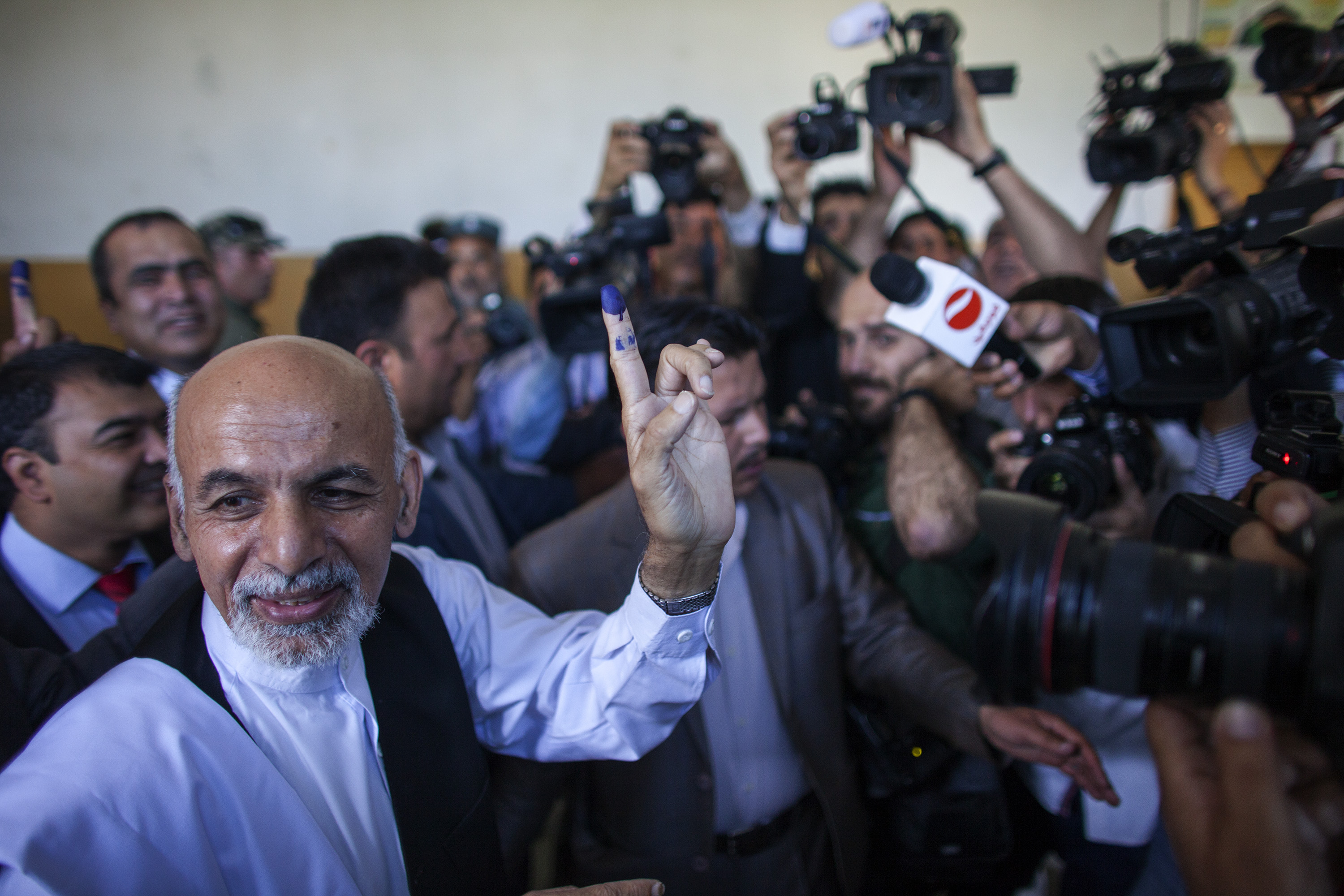
(Photo: Afghan presidential candidate Ashraf Ghani holds up his inked finger as he speaks to media after casting his vote at a polling station on June 14, 2014 in in Kabul, Afghanistan. By Majid Saeedi/Getty Images)


Dreher On Blow

After reading Charles Blow’s intense and fascinating account of his own childhood abuse and his particular experience of bisexuality, Rod Dreher actually comes out with this:

The thing that stands out to me about it is Blow’s (very modern) belief that his passions constitute an essential part of his identity as a person. That is, he seems to believe that his freedom consists in accepting his desires, and that he is “subject to the tide.”

But is this really true? Somehow, reason tamed his homicidal passion in the case of avenging his rape. Why is that passion restrainable, but sexual passion is not? He would say that the passion to kill someone is not the same thing as the passion to have sex with someone, and he would, of course, be right.

But he would be wrong in another sense. According to Dante (speaking from a position informed by both classical and medieval Catholic thought), all sin comes from disordered passion. To be truly free is to master our passions by making them subject to our reason. We cannot prevent our desires, but if we make ourselves “subject to the tide” of passion, we cannot be said to be free.

This is a very strange response to the essay. Rod insists that his point is not about bisexuality, but about “passions” in general and our modern sense that we should accommodate them, rather than “master” them with reason. But I didn’t find any evidence in the piece that Blow had somehow “surrendered” to his “passions”. What he did was simply come to terms with who he really was – to probe what his sexual orientation really was and is. This is an integral part to mastering any passion. If you are not fully aware of who you are, you can act out in all sorts of ways, or enter relationships you really shouldn’t, or make horrible mistakes, or suppress feelings without ever really confronting them. What Blow describes is very much an exercise of reason, of inquiry, of remarkable poise in the face of a troubled past (including sexual abuse). Surrendering to passion meant in this case a seven-year marriage to a woman, including kids. And Blow rather movingly explains how an actual homosexual relationship was not something he could pull off.

If Blow were heterosexual, I doubt Rod would have said anything about “disordered passion”. We all have unique and complex sexualities – and all Blow did was examine his own past and his own nature and channel both toward a constructive present. It has to be the element of homosexual attraction that provokes Rod’s splutter – as if anyone can simply master by reason who they actually are. We do not have control over that. But those who come to terms with their sexual identity, who face it squarely, are likely to have a much better chance of channeling such passions toward good ends.

One other note about Blow’s piece: it’s a very convincing and eye-opening explanation of a certain kind of bisexuality:

I had to accept a counterintuitive fact: my female attraction was fully formed—I could make love and fall in love—but my male attraction had no such terminus. To the degree that I felt male attraction, it was frustrated. In that arena, I possessed no desire to submit and little to conquer. For years I worried that the barrier was some version of self-loathing, a denial. But eventually I concluded that the continual questioning and my attempts to circumvent the barrier were their own form of loathing and self-flagellation. I would hold myself open to evolution on this point, but I would stop trying to force it. I would settle, over time, into the acceptance that my attractions, though fluid, were simply lopsided. Only with that acceptance would I truly feel free.

Dan Savage adds:

As Blow’s piece makes clear, writing “lopsided bisexuality” out of the bi experience, the constant and often smug framing of bisexuality as the capacity to be sexually and romantically attracted to both men and women equally, excludes men like Blow and makes it harder for men like him to accept themselves as bisexual. Men like Blow walk around believing that they’re either not really bi (like this guy who wrote me at “Savage Love”), or that they’re bi but defective or broken.

But bisexual guys like Blow aren’t broken.

They sure aren’t. Which is more than one can say, sadly, for many men who refuse to confront their identity, and construct lives based on fantasies about what they’d like to be rather than what they are.

For much more on the nuances of bisexuality, check out this Dish thread.

Abuse In The Public Eye, Ctd

Ta-Nehisi Coates comments on comparisons between two controversial athletes:

Soccer star Hope Solo is alleged to have assaulted her sister and 17-year old nephew in June of this year. Unlike Ray Rice, Solo is still plying her trade as a goalkeeper for the national team. This led several people to claim that Solo is the beneficiary of a double standard. …

In the history of humanity, spouse-beating is a particularly odious tradition—one often employed by men looking to exert power over women. Just as lynching in America is not a phenomenon wholly confined to black people, spouse-beatings are not wholly confined to women. But in our actual history, women have largely been on the receiving end of spouse-beating. We have generally recognized this in our saner moments. There is a reason why we call it the “Violence Against Women Act” and not the “Brawling With Families Act.” That is because we recognize that violence against women is an insidious, and sometimes lethal, tradition that deserves a special place in our customs and laws.

This is the tradition with which Ray Rice will be permanently affiliated. Hope Solo is affiliated with a different tradition—misdemeanor assault. If she is guilty she should be punished.

Amanda Hess explains another “startling false equivalence” between the men’s football and women’s soccer scandals:

Rice was cut from his team and suspended from the NFL in response to overwhelming criticism from fans, domestic violence advocates, and sponsors who were finally fed up with the fact that the NFL has, for decades, taken domestic violence less seriously than it does, for example, drug offenses. Rice’s indefinite ban (which he plans to appeal) is the NFL’s attempt to demonstrate that it takes his crime seriously, sure. But it is also a bid to deflect criticism directed at the Ravens and league officials, who stand accused of purposefully misleading the public about the details of Rice’s crime and their investigation of it. All of the players who have been benched in the past couple of weeks are taking the heat for their league’s long-standing ignorance of domestic violence.

It’s not clear that this approach—which penalizes highly visible players while letting the league off the hook—is ideal. What we do know for certain is that it’s not applicable to U.S. women’s soccer, which has no such systematic, decades-long history of ignoring the fact that certain players abuse their partners.

She also notes an eerie coincidence:

If we’re interested in elevating Solo as the symbolic face of women perpetuating domestic violence, let’s really investigate what exactly she represents. [NYT’s Juliet Macur] oddly omits the fact that former NFL player Jerramy Stevens—who is no longer in the league after amassing a truly impressive list of sexual assault, battery, and DUI accusations—was arrested for attacking Solo the night before their wedding. The case was dropped for lack of evidence, largely stemming from Solo’s nonparticipation. The couple was married shortly thereafter, kinda sorta exactly like what happened with Ray and Janay Rice.

Previous Dish on male victims and female perpetrators here. The far greater problem of violence against women covered here and here.

Ted Cruz Thinks Ross Douthat’s An Anti-Semite [Updated]

And Mollie Hemingway and Matt Lewis and K-Lo and Rod Dreher and Michael Brendan Dougherty … and so many others who, however politely, expressed their misgivings over Cruz’s inflammatory speech to Middle East Christian groups, in which he “trolled the victims of genocide”, as Dougherty memorably tweeted. Ross’s piece is the best I read on the subject, and if you can find a scintilla of anti-Semitism in it, well, you’re probably Leon Wieseltier. But this is what Cruz just said to The World magazine in response to his critics:

Among one particular community, which is sort of the elite, intellectual Washington, D.C., crowd, there has been considerable criticism. … A number of the critics, a number of the folks in the media have suggested, for example, that my saying what I did distracted from the plight of persecuted Christians. What I find interesting is almost to a person, the people writing those columns have never or virtually never spoken of persecuted Christians in any other context. I have spoken literally hundreds of times all over the country. This is a passion. I’ve been on the Senate floor, and I intend to keep highlighting this persecution. I will say it does seem interesting that the only time at least some of these writers seem to care about persecuted Christians is when it furthers an anti-Israel narrative for them. That starts to suggest that maybe their motivation is not exactly what they’re saying.”

“Almost to a person”?

Cruz should name names if he believes that his critics have never written about Christian persecution in the Middle East before now. It is not my impression. But the imputation of anti-Semitism is yet another instance in which the neocon right simply refuses to engage the arguments about policy in the Middle East without resorting to this kind of rhetorical blackmail. It’s a reminder not just of Cruz’s deep McCarthyite tendencies, but of a dangerously crude view of the world in which bright and permanent abstractions – Israel always right! America just needs to bomb its enemies! – have replaced any actual engagement with reality.

Cruz is a domestic creature. He cares about marshaling and exploiting the fanaticism of the Zionist Christianist right and winning the mountains of cash available to any GOP candidate who backs Likudnik policies and the permanent annexation of the West Bank. What he isn’t is a thinker on foreign policy, someone who has any sort of clue how to engage a messy and dangerous world. And yet what he represents is clearly a rising force on the right – a kind of Jacksonian myopia that we thought had suffered a mortal blow in the sands of Mesopotamia but is now back, pristine, and ready to go to war against Islam all over again.

Update: Perhaps sensing that he had falsely accused so many writers of being anti-Semites and not caring about Middle East Christians, Cruz has just walked back his words in an email to Matt Lewis:

It was a mistake to suggest that critics of my remarks at IDC had not spoken out previously concerning the persecution of Christians; many of them have done so, often quite eloquently.  It was not my intent to impugn anyone’s integrity, and I apologize to any columnists who took offense.  The systematic murder of Christians in the Middle East is a horrible atrocity, and all of us should be united against it.  Likewise we should speak with one voice against the persecution of Jews, usually being carried out by the very same jihadist radicals.

Insurers Want In On Obamacare

Obamacare Insurers

Jonathan Cohn heralds a new HHS report (pdf):

Obamacare critics hadn’t predicted the markets would evolve this way. On the contrary, they expected that that young and healthy people would stay far away from the new marketplaces, because the new coverage would be pricier than what they were paying before. Without enough business, the argument went, insurers would get skittish and withdraw. At best, the marketplaces would all become oligopolies and monopolies, with just a handful of insurers continuing to sell policies. At worst, the whole scheme would fall apart. That quite obviously isn’t happening.

Waldman wishes Republicans would face facts:

As the insurers’ behavior makes clear, it isn’t just that the exchanges have not become ground zero for a death spiral. It’s also that the exchanges are a place where there’s money to be made, even as premium increases have slowed. The market is working, and those most noble actors pursuing that most noble goal — private corporations seeking profit — are responding.

In a rational world, conservatives would say, “Well, I don’t like all that increased regulation and expansion of Medicaid, but this does demonstrate one good thing about the law. I guess it’s a complicated story.” But of course that’s not what they’ll say.

Ezra catches conservatives ignoring this another other good Obamacare news:

[C]osts are lower than expected, enrollment is higher than expected, the number of insurers participating in the exchanges is increasing, and more states are joining the Medicaid expansion. Millions of people have insurance who didn’t have it before. The law is working. But a lot of the people who are convinced Obamacare is a disaster will never know that, because the voices they trust will never tell them.

Can The Church Survive In America? Ctd

Another day, another firing of a faithful Catholic parish music director … because he married his longtime boyfriend. The structure of the story is deeply familiar and depressing:

After marrying his long-time partner over the weekend, parishioners got an email from Father Bob White. It told them that Archbishop John Nienstedt had asked for Moore’s resignation, and Moore intended to resign. In a statement, Nienstedt said he was contacted by St. Victoria about the situation with Moore, and he told parish leaders that the church’s teachings must be upheld. Nienstedt never mentioned the Catholic Church’s stance against gay marriage, but added: “The … conduct of church employees can inspire and motivate people, but it can also scandalize and undermine their faith. Church employees must … recognize and accept the responsibilities that accompany their ministry.”

Disheads will know something about Nienstedt – and it encapsulates so much that’s so profoundly wrong with the Church. The archbishop accusing a popular music director of scandalizing and undermining the faith of others has a back-story:

Archbishop John Nienstedt of St. Paul and Minneapolis is being investigated for “multiple allegations” of inappropriate sexual conduct with seminarians, priests, and other men, according to the archbishop’s former top canon lawyer, Jennifer Haselberger. The investigation is being conducted by a law firm hired by the archdiocese. Nienstedt denies the allegations…

“Based on my interview with Greene Espel—as well as conversations with other interviewees—I believe that the investigators have received about ten sworn statements alleging sexual impropriety on the part of the archbishop dating from his time as a priest in the Archdiocese of Detroit, as Bishop of New Ulm, and while coadjutor and archbishop of St. Paul and Minneapolis,” Jennifer Haselberger, [the archbishop’s top canon lawyer who resigned in protest in 2013] told me. What’s more, “he also stands accused of retaliating against those who refused his advances or otherwise questioned his conduct.”

Haselberger also brought to light the issue of Nienstedt’s handling of child abuse cases – as recently as last year:

She contacted MPR News in July 2013 and disclosed how Nienstedt and other top officials gave special payments to abusive priests, failed to report alleged sex crimes to police and kept some abusers in ministry. Her account was especially stunning because it involved decisions made by church leaders as recently as April 2013.

Nienstedt has been cleared of an accusation of grabbing a boy’s buttocks, and the rest is still under investigation. Nienstedt, moreover, has admitted errors in handling accusations of child abuse, been forced to act against several priests he allowed to stay in their jobs, but refuses to resign:

A bishop’s role is more like that of a father of a family than that of a CEO. I am bound to continue in my office as long as the Holy Father has appointed me here.

So contemplate this: a man credibly accused of protecting child abusers, of violating his vow of celibacy by having relationships with other men, and of, by his own admission, creating dissension and distraction in his own archdiocese cannot ever quit. A faithful Catholic in a local parish is nonetheless forced to resign – during his honeymoon, for Pete’s sake – because he decided to commit himself in love and responsibility to another man in perpetuity. No thinking, moral person can find that dissonance anything less than disgusting.

A question for Pope Francis: why on earth is this staggering hypocrite and divider still an archbishop? And why would anyone be a part of a church as morally bankrupt as this?

Jim Webb Flirts With A Run

Senate Holds Cloture Vote On Immigration Bill

And comes out against Obama’s foreign policy recklessness:

“Our country has been adrift,” Webb said in a speech at the National Press Club in Washington that rattled through a list of his disagreements with the Obama administration’s foreign policy.  “We continue to be trapped in the never-ending, never-changing entanglements of the Middle East.”

Allahpundit doubts Webb poses a real threat to Clinton. And Doug Mataconis has a hard time imagining Webb on the campaign trail:

As Larry Sabato noted when Webb declined to run for re-election in 2012, while he may have been a good Senator, Webb isn’t a particularly good politician and he clearly doesn’t enjoy the kind of campaigning that someone running for President would need to do on a daily basis if their candidacy is going to go anywhere at all. This was something that was, quite honestly, evident even when Webb first ran for Senator in 2006, especially given the fact that it reportedly took a significant amount of cajoling from state and national leaders for him to agree to run in the first place. Many saw the fact that he didn’t run for re-election as a [reflection] of this disdain for the “meat and potatoes” of politics as well. If you’re going to run for President, you’d better like campaigning because that’s all you’re going to be doing for the better part of a year.

Aaron Blake throws another bucket of cold water:

He has negative charisma. The Fix believes that presidential races have a charisma threshold, by which we mean that candidates need to be at least somewhat compelling to a national audience to achieve viability. Tim Pawlenty (R), for instance, struggled with this. Maryland Gov. Martin O’Malley (D) has a similar problem. Webb would probably make Pawlenty look like Herman Cain. He’s just very dour. We wonder who would get excited about him, in the absence of some galvanizing force that suddenly makes him the perfect candidate for that political moment in time.

Jonathan Bernstein enumerates the growing list of “anti-Clintons”:

Finally, a Democratic presidential field beyond Hillary Clinton may be emerging. Well, it’s a quasi-field, but it got one body larger today, with former Senator Jim Webb of Virginia talking about running on an anti-war platform. We now have five of these possible anti-Clintons: Webb, Maryland Governor Martin O’Malley, Vermont Senator Bernie Sanders, Massachusetts Senator Elizabeth Warren and Vice President Joe Biden. That’s a lot!

Well, sort of. O’Malley is the most active. He is hiring in Iowa and doing pretty much everything an obscure but viable candidate can do at this stage. Sanders, and now Webb, aren’t doing much beyond talking. Warren denies she is running even as she does candidate-like things, and is pointedly refusing to pledge that she won’t run. And Biden is in a holding pattern: He’s not organizing a real campaign, but has declared himself a potential candidate. We can’t know how many of these Democrats will actually be running in 2016, or even in spring 2015.

(Photo by Jamie Rose/Getty Images)