Clay Hanna, a veteran, pleads with Obama to get congressional authorization for his new war:
If Congress declares war, and the full force and might of the U.S. military and her allies is deployed, I have no doubt that we will fatally strike the Islamic State.
But without this clarity, without “boots on the ground” and above all an acknowledgement of what these really are, the president’s strategy amounts to nothing more than amorphous rhetoric and disingenuous platitudes. It is at the core a cynical plan to incite war and fund violence, backed by a vague hope that not only will we remain unaffected but somehow we will achieve peace. Don’t deceive yourself or us any longer, Mr. President: There is no good war and no participant gets to walk away with clean hands. Not even you.
Beutler believes Congress wants war but doesn’t want to authorize a war, because “voting on the issue would violate the Optimal Preening Principle, which tends to govern these debates”:
Killing terrorists, or alleged terrorists, might be popular. But it’s also something the military (and thus, the president) does. Meanwhile, on a good day, Congress votes on legislation. The president might use a new AUMF to do things the public overwhelmingly supports, but that won’t help the embattled congressperson who would have to defend granting the president unlimited warmaking power or defend voting against bombing terrorists because the AUMF wasn’t expansive enough. Instead, by not being forced to take a stance, Obama’s opponents will be able to frame the issue however they want to.
Likewise, when something goes wrong—as it inevitably will—members of Congress won’t want to be linked to it with their votes, and won’t want their votes constraining them from harrumphing about it on camera. Constituents won’t credit them if things go swimmingly anyhow, so they see no upside in sticking their necks out.
Bruce Ackerman chews out Congress for neglecting its duties:
Neither the Justice Department’s Office of Legal Counsel nor the White House Counsel has issued a serious legal opinion presenting its side of the argument. This represents a profound breach of the rule of law. Worse yet, Congress’ failure to address the constitutional issues during its regular session threatens to create a legal vacuum which only the courts will be in a position to resolve. Unless extraordinary steps are taken, the result will be the worst of all possible worlds, in which a problematic Supreme Court decision only exacerbates the ongoing crisis of constitutional legitimacy.
Eric Posner disagrees with Ackerman’s legal analysis:
Ackerman is right that the Obama administration’s reliance on the 2001 AUMF is phony, but he’s wrong to say that Obama has broken with American constitutional traditions. That tradition dictates that the president must give a nod to Congress if he can, but otherwise he is legally free to go to war, subject to vague limits that have never been worked out. That’s not to say that Congress is helpless. It can refuse to fund a war if it objects to it. But the real constraint on the president’s war-making powers is not law, but politics.
Regardless, Jennifer Daskal, Ashley Deeks and Ryan Goodman urge Congress to get involved:
[T]he administration again appears to be invoking the 2001 and 2002 AUMFs – a position that two of us have been critical of in the past. We thus join President Obama in his call to Congress to put the actions on sounder domestic law footing, and pass a new authorization specifically focused on ISIL, and, depending on the facts, the Khorasan Group as well.
Philip Bump argues that yesterday’s UN summit amounts to something new under the sun:
For decades, the United Nations has tried to put together a binding commitment from its members aimed at reducing greenhouse gas emissions – particularly carbon dioxide. … What’s happening right now in New York, in the wake of the largest climate rally in history, is something different. Instead of parties coming together to develop a binding agreement, it’s an attempt to self-regulate, to encourage countries and companies to establish individual goals for reduction that, in the aggregate, will hopefully have a global effect. Mashable is tracking those commitments: a European Union pledge to reduce emissions up to 95 percent by 2050, financial commitments from France and Switzerland, Costa Rica’s switch to clean energy. All of these things could have an effect, and particularly that E.U. pledge. But none will have a huge impact in the absence of other efforts.
Indeed, Ben Adler suggests the conference confirmed all the worst stereotypes about the UN:
A procession of heads of state spoke – so many that they had to be split into three simultaneous sessions — but even the largest session, in the General Assembly Hall, was largely empty during most of the speeches. The few delegates there seemed distracted, mostly talking to each other. The speeches from heads of state and other representatives were billed grandly as “national action and ambition announcements.” Mostly, though, they consisted of familiar talking points, platitudes, and boasts about preexisting national energy policies. … Speakers were eager to talk about the need for action and the general principles of energy conservation and renewable energy, but they avoided mention of specific emissions targets or even precise amounts of funding they want from rich countries for climate-mitigation efforts.
The focus was largely on the United States and China. Ronald Bailey was not impressed by their actions:
The world’s two biggest emitters of greenhouse gases, China and the United States, both held off on making any specific additional pledges regarding their future emissions. In 2012, humanity emitted 36 billion tons of carbon dioxide into the atmosphere, of which 10 billion came from China and 5.2 billion from the United States. Convened by General-Secretary Ban Ki Moon, the Summit is supposed to “catalyze action” in advance of the big U.N. climate change conference at Paris in 2015. At the Paris conference, the nations of the world are supposed to make pledges to cut their emissions sufficient to keep future warming below the internationally agreed upon threshold of 2 degrees Celsius. It is not at all clear that today’s Summit catalyzed much more than pious clichés.
Matt McGrath describes Obama’s speech to the General Assembly as “notable for the absence of big pledges and for its realistic tone”:
Every time the president used the word “carbon”, he tagged the word “pollution” on the end. His goal was to underline that carbon dioxide is damaging to humans in the same way as air pollution, and in the US it should be regulated by executive power rather than by through legislation in a very divided Congress. The president also acknowledged the scale of opposition to his attempts to cut carbon. The most substantial pledge he made was an announcement that early next year he would publish a post-2020 plan to cut emissions.
He appealed to China, saying that together with the US the two countries had a special responsibility to lead. But everyone had to contribute. “No one gets a pass,” he said. The president wants to bind in the Chinese with an ambitious, inclusive – and most critically – a flexible deal that he can sign without recourse to the Senate.
Chinese Vice Premier Zhang Gaoli said the country expects emissions to peak “as soon as possible.” Andrew Freedman analyzes the announcement:
On the one hand, as far as environmentalists and the Obama administration are concerned, the mere mention of a peak in China’s carbon dioxide emissions was new and ambitious, considering how quickly the Chinese economy has grown in recent years and how fast emissions have risen as well. During the past decade, for example, China saw about 10% per year increases in carbon dioxide emissions, although that slowed in 2013, according to a report from the European Commission. China has a goal to reduce its carbon intensity, which is a way of measuring the carbon emissions per unit of gross domestic product, by up to 45% by 2020. Zhang said that China will reveal its goals for reducing emissions post-2020 during the first quarter of 2015, as the United States also intends to do. …
On the other hand, China signaled its continued support for a long-running source of tension between industrialized countries and developing nations regarding the U.N. climate treaty process. The U.N. Framework Convention on Climate Change, which was negotiated in 1992, well before China’s emissions overtook U.S. emissions, mandates that developing countries and industrialized nations have “common but differentiated responsibilities” in addressing the problem. In 2009, for the first time, China and other developing countries committed to taking action to reduce their emissions along with industrialized countries, but it remains to be seen how far they are willing to go when the next treaty is negotiated in 2015. That treaty is due to go into effect by 2020.
Rebecca Leber argues that addressing climate change “will require steps Obama couldn’t promise on Tuesday – perhaps because, though he would happily support them, his political opposition would not”:
Consider what the President did announce – an executive order directing federal agencies to plan for climate change impacts in all of their investments and decisions on international development. The idea is to help make sure these investments are durable and effective in a world where it’s becoming impossible to consider funding parts of the world without considering impacts like extreme weather. The executive order is less about the climate negotiations process than a broader signal to the world that the U.S. takes climate change seriously (even if congressional Republicans don’t).
Obama also declined to pledge any money to the Green Climate Fund, which supports developing countries coping with the effects of climate change: France committed $1 billion, which Suzanne Goldenberg describes as “the first significant contribution since Germany threw in $1 billion last July.” She adds:
The Green Climate Fund was founded in 2010 to help poor countries cope with climate change. UN officials and developing country diplomats have said repeatedly it will not be possible to reach a climate deal in Paris without a significant fund for those countries which did the least to cause climate change but will bear the brunt.
South Korea and Switzerland went on to pledge $100 million each, Denmark pledged $70 million, Norway pledged $33 million and Mexico said it would give $10 million. But the total of $2.3 billion pledged for the Green Climate Fund so far fell short of the $10 billion to $15 billion that UN officials and developing country said was needed to show rich countries were committed to acting on climate change. It also was unclear whether Tuesday’s pledges represented new money.
Meanwhile, Justin Gillis notes that at the summit, “companies are playing a larger role than at any such gathering in the past.” Forty companies signed a pledge to stop tropical deforestation by 2030, and a further 400 voiced their support for putting a price on carbon. Gillis explains:
Several environmental groups said they were optimistic that at least some of these [promises] would be kept, but they warned that corporate action was not enough, and that climate change could not be solved without stronger steps by governments. The corporate promises are the culmination of a trend that has been building for years, with virtually every major company now feeling obliged to make commitments about environmental sustainability, and to report regularly on progress. The companies have found that pursuing such goals can often help them cut costs, particularly for energy.
Tuesday’s attacks hit key Islamic State of Iraq and Greater Syria (ISIS) facilities as well as the little-known Khorasan Group, which is based in northwest Syria. But it is not yet clear to what extent the Khorasan leadership and operatives had been taken out in the attacks. The joint staff director of operations Lieut. General William Mayville said the U.S. was still “assessing the effects of the strikes.”
What is being discussed is not a “new terrorist group,” but rather a specialized cell that has gradually been established within, or on, the fringes of an already existing al-Qaeda franchise, the so-called Nusra Front. What this seems to be about is a jihadi cell consisting of veteran al-Qaeda members who have arrived to the Nusra Front in Syria from abroad, mainly via Iran, and who are in direct contact with al-Qaeda’s international leader Ayman al-Zawahiri, himself believed to be based in Pakistan.
Foreign Policy asks how big a threat the group poses:
“In terms of threat to the homeland, Khorasan may pose as much of a danger as the Islamic State,” Director of National Intelligence James Clapper said at a conference in Washington last week. But according to the top U.S. counterterrorism official, as well as Obama himself, there is “no credible information” that the militants of the Islamic State were planning to attack inside the United States. Although the group could pose a domestic terrorism threat if left unchecked, any plot it tried launching today would be “limited in scope” and “nothing like a 9/11-scale attack,” Matthew Olsen, the director of the National Counterterrorism Center, said in remarks at the Brookings Institution earlier this month. That would suggest that Khorasan doesn’t have the capability either, even if it’s working to develop it.
“Khorasan has the desire to attack, though we’re not sure their capabilities match their desire,” a senior U.S. counterterrorism official told Foreign Policy.
The Khorasan Group has been experimenting with different types of non-metallic explosives for attacks on Western targets, according to U.S. intelligence officials. Most of the members of the group come from Yemen, Afghanistan, or Pakistan and have for months been coordinating with bomb-makers drawn from al Qaeda’s affiliate in the Arabian Peninsula, the most persistent and creative of al Qaeda groups in efforts to bomb U.S.-bound passenger jets.
ISIS and al Qaeda bitterly split earlier this year, and have since attacked one another on occasions. But some analysts now fear that striking at ISIS and al Qaeda could persuade the two groups to put aside their sharp differences and come together. Indeed, jihadist ideologues loyal to both warring factions have had similar messages for their followers in the wake of the airstrikes.
Here’s the nickel version: After months of bellyaching about America’s commitment to fighting ISIS, one single Arab country finally agreed to help out. Only then did anyone else also agree to pitch in. But the extent of their involvement can’t be revealed because it’s a “sensitive operational detail.” Can you guess just how extensive that involvement is? Or do you need a hint?
But Fred Kaplan thinks the coalition is a big deal:
It is highly significant that four Arab nations—Saudi Arabia, Jordan, the United Arab Emirates, and Bahrain—participated in Monday night’s airstrikes and that a fifth, Qatar, supported them. No one has yet said how many bombs the four dropped, or what Qatar’s support amounted to, but it doesn’t matter. During the 1990–’91 Gulf War, these and several other Arab nations, including Syria and Egypt, sent tank divisions and air wings to help push Hussein’s army out of Kuwait. Few of them did much, but the important thing was that they joined the coalition in active force—and, therefore, Hussein could not claim that this was purely a Western, imperialist war. Sending this message is even more important in the fight against ISIS, which bills itself as the Islamic army and its mission as a religious one—the revival of a caliphate. To have Muslim nations, especially Sunni nations, battling against ISIS helps discredit its rationale for existence.
[Obama] has built a formidable alliance of Arab allies to fight Islamic State. Of course these Arab allies are all profoundly threatened by Islamic State and have an incentive to openly align themselves with the world’s only superpower. But the leaders of these countries have until very recently doubted Obama’s commitment to them, and they would not have joined forces with him if they believed he wasn’t in the fight for the long haul.
After long avoiding deeper engagement in Syria and Iraq – for the simple, understandable reason that these countries are seemingly insoluble messes – Obama has pivoted (to borrow a word from another now-dormant foreign-policy debate) in the direction of responsibility.
“Responsibility” is not the word we’d use. Christopher Dickey asks about the coalition’s mission:
Perhaps most striking of all is the absence, in this rump coalition, of the grand pronouncements we heard from earlier U.S. administrations—or from this one five years ago when President Barack Obama sought to turn a new page in Washington’s relations with the Arab and Muslim world. In the current crisis, Obama has articulated no overarching cause, no doctrine about defending freedom and democracy. This offensive is purely defensive. It is not about the future: it is about a desperate effort to hang on to the present status quo as the region, having shed the enthusiasms of the Arab Spring like a soiled party outfit, is now trying to slip back into the drab, predictable uniforms of dictatorship and monarchy.
Now that the Arab kings and princes have joined in, it’s obvious that this is a war to try to turn back the clock to before the Arab Spring of 2011, before Obama’s 2009 initiatives, before the efforts of President George W. Bush and Condoleezza Rice to graft democracy onto the invasion and occupation of Iraq. The people of the region are tired of chaos. And at this point, Obama shows every sign he’s tired, too. He appears to be settling for any tactical approach that might ward off the growing threat of new attacks on Americans and the American homeland posed not only by ISIS, but by the point men of al Qaeda in a group known as Khorasan that also came under attack by U.S. warplanes over Syria on Tuesday.
Saletan points out that the US is “hiding or downplaying the involvement of other countries whose complicity, if acknowledged, might do more political harm than good”:
The ally no one wants to acknowledge is Israel. That would play into ISIS propaganda, which frames Obama as the “mule of the Jews” and Saudi rulers as “guard dogs for the Jews.” In the first Persian Gulf War, we used Israeli intelligence but didn’t advertise it, lest we offend our Arab allies. Two weeks ago, Prime Minister Benjamin Netanyahu said of Israel’s contributions to the anti-ISIS coalition, “Some of the things are known; some things are less known.” An anonymous Western diplomat said the United States was using Israeli satellite images, “scrubbed” of their Israeli traces, to show its coalition partners damage from strikes against ISIS in Iraq.
No such role has been acknowledged yet in Syria. But the Obama administration began its surveillance flights over Syria only a month ago. In all likelihood, Israeli satellite coverage was even more thorough and useful in Syria than it was in Iraq.
Ankara’s position has clearly been complicated by its fraught relationship with the Turkish Kurds. The People’s Protection Units, known by the acronym YPG, have been one of the strongest forces fighting against Islamic State, yet they are linked to the Kurdistan Worker’s Party, or PKK, the separatist guerrilla group that has waged a Kurdish insurgency against the Turkish state for decades. Both Ankarra and Washington consider the PKK a terrorist organization. Many observers suspect that Ankara finds it easier to tolerate the Islamic State’s rampage in Syria than cooperate with Kurdish groups like the PKK or YPG.
Ed Morrissey looks on as Egypt exploits the situation:
In an interview [yesterday] morning with CBS’ Charlie Rose, the Egyptian president whose coup took down the Muslim Brotherhood government favored by the White House says that his country would be happy to join the anti-ISIS coalition, including militarily, and expects to do so. Just as soon as the US coughs up the fighter jets that the Obama administration held up after the coup, Abdel Fattah al-Sisi says with repeated laughter, Egypt will be delighted to help fight terrorism. … There is no such thing as a free ride in this part of the world. But at least Obama doesn’t have an Islamist regime in Cairo that’s giving ISIS political cover, and for that he can thank Sisi — even if those thanks come through clenched teeth
And Michael Koplow isn’t expecting Iran to openly join the coalition anytime soon:
A large element of the Iranian regime’s ideology is opposition to the U.S.; it is the reason that the regime has harped on this point for decades on end. When you base your legitimacy and appeal in large part on resisting American imperial power, turning on a dime and openly helping the U.S. achieve an active military victory carries far-reaching consequences domestically. It harms your legitimacy and raison d’être, and thus puts your continued rule in peril. Iran wants to see ISIS gone as badly as we do, if not more so, and ISIS presents a more proximate threat to Iran than to us. Despite this, Iran cannot be seen as helping the U.S. in any way on this, and simply lining up interests in this case is an analytical mistake as ideological considerations trump all when you are dealing with highly ideological regimes. The same way that the U.S. would never have cooperated with the Soviet Union at the height of the Cold War to defeat a common enemy – despite being able to come to agreement on arms control negotiations – because of an ideological commitment to being anti-Communist, Iran will not cooperate with the U.S. against ISIS. Those naively hoping that ISIS is going to create a bond between the U.S. and Iran are mistaken.
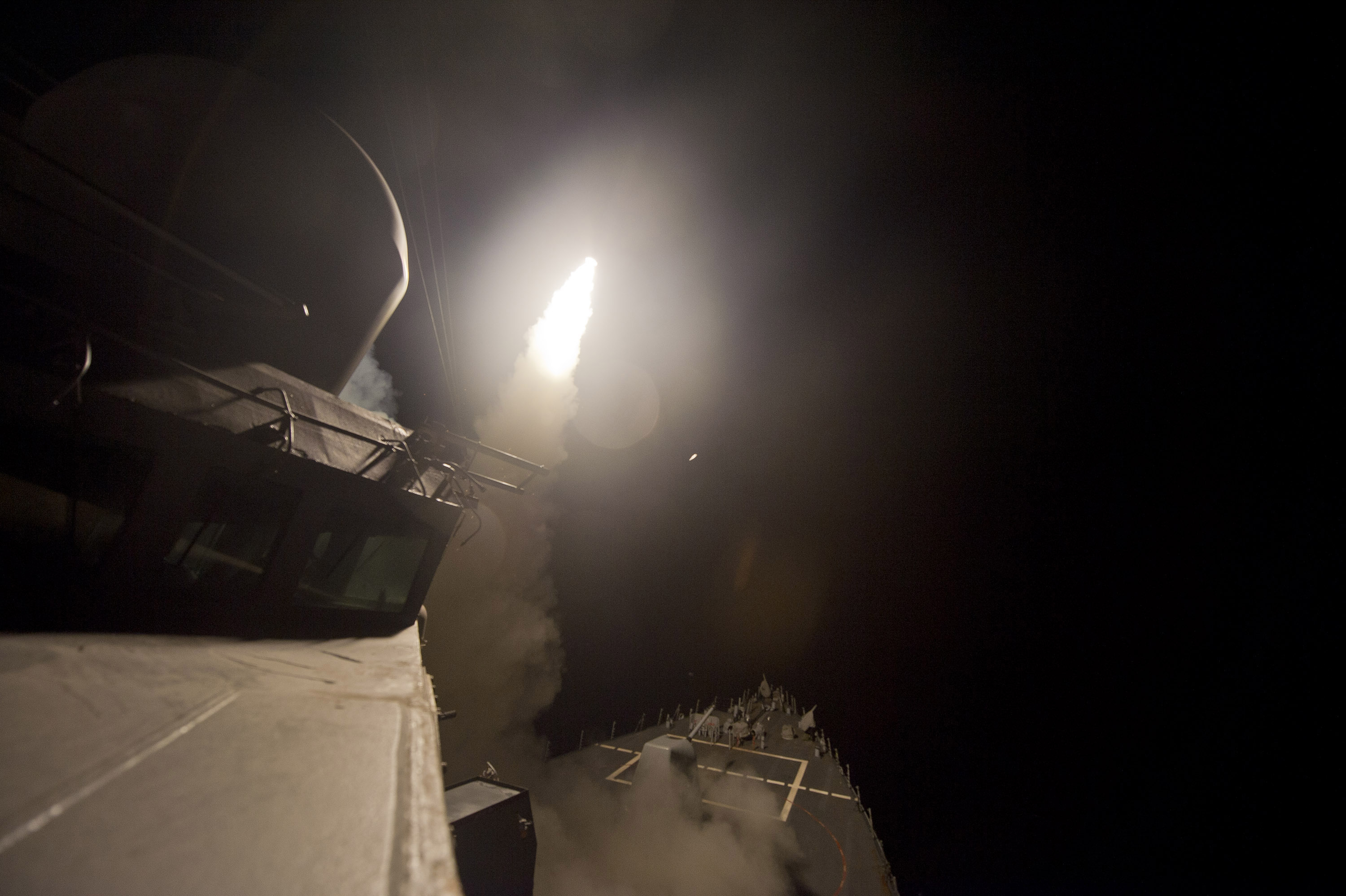
(Photo: In this handout image provided by the U.S. Navy, the guided-missile destroyer USS Arleigh Burke (DDG 51) launches Tomahawk cruise missiles on September 23, 2014 in the Red Sea. By Mass Communication Specialist 2nd Class Carlos M. Vazquez II/U.S. Navy via Getty Images)
Weigel previews what Republicans might do to the law if they take control of the Senate:
Every Republican senator and candidate knows that the Affordable Care Act passed in the budget reconciliation process, the only way to get a bill through without the threat of cloture. Every one of them thinks reconciliation can be used to gut it. “I think we got something with this tax issue,” McConnell reportedly told aides after the Supreme Court upheld Obamacare while defining its health care mandate as a tax. “Figure out how to repeal this through reconciliation.”
McConnell no longer talks like that in public. In a revealing interview with Politico’sManu Raju, McConnell walked through all of his 2015 priorities, all the ways they could be forced through in the budget process. He didn’t promise to repeal Obamacare. He didn’t even say that in a secret (then leaked) speech to a donor conference organized by the Kochs. The current plan is to use next year’s budget process to chip away at the law by ending the medical device tax, or ending the employer mandate, and forcing the president to veto or accept it. Basically, look at what the health care industry wants to change, then expect Republicans to agree with it.
Meanwhile, James Capretta and Yuval Levin suggest ways for Republicans to transition away from Obamacare:
[T]he insurance provisions of Obamacare have now moved millions of people into new coverage arrangements. Granted, many of those who have switched to new insurance plans did so because they concluded they had no other choice, and they would welcome a law that freed them up to get the kind of insurance they would prefer. For these people, the transition could be swift. But Obamacare also provides massive new subsidies to a relatively small portion of the population, and undoing those arrangements abruptly would be both unfair and unwise. Obamacare’s opponents should not make the same mistake its champions made in designing and implementing it.
Building in an adequate transition will not undermine the ultimate effectiveness of an Obamacare replacement plan. The goal is a functioning marketplace where consumers decide how to allocate resources, where all Americans have access to stable insurance, where quality care and medical innovation are rewarded, and where federal support for insurance enrollment is affordable for taxpayers. These are goals that are critically important for the long-term strength and vitality of the country, and they are goals that are more likely to be reached if Obamacare’s opponents wisely design short-term transition provisions to defuse opposition to a full replacement plan.
Gallup finds that 60 percent of Americans support our attacks on ISIS. And a majority from both parties approve:
Aaron Blake is underwhelmed by these numbers. He observes that “the actions in Iraq and Syria have a lower initial level of support than almost every major U.S. military operation over the past three decades”:
60 percent is far less than the early levels of support for the wars in Iraq last decade (76 percent), Afghanistan in 2001 (90 percent), and the first Gulf War in the early 1990s (79 percent). It’s also less support than existed for smaller missions in Somalia in 1993, Afghanistan and Sudan in 1998 and Libya in 1986.
The only efforts which Iraq and Syria beat in initial popularity are the 2011 intervention in Libya, Kosovo in 1999, and Grenada in 1983. Given the negative coverage of the invasion in Grenada and the aforementioned war-weary American public in 2011, it’s not surprising to see Iraq and Syria outrank those too. Kosovo also ranked as a not-particularly-popular intervention.
The fact that only 39% favored military action a few months ago suggests that much of the current level of support for the war is ephemeral and won’t last as the war continues for months and years. That is especially true if the war is perceived as “not working,” and that perception is likely to grow thanks to the unrealistic stated goal of the war. As the Gallup report notes, the 60% figure is relatively lower than polling for most military interventions over the last thirty years, and once the initial “rally round the flag” effect wears off it is probably going to drop back down to significantly lower levels. The public’s underlying aversion to prolonged conflict is still there, and their opposition to sending ground forces into Iraq or Syria remains. Because there appears to be no effort to get Congress to vote on this anytime soon, and because the war is likely to last for several years, declining public support will become a serious political problem for the administration.
A reader brings a personal perspective to a recentthread:
An issue that must be addressed is how Muslims in the Middle-East view Mid-East Christians in the context of the West’s recent military forays in the region: Mid-East Christians are viewed as subversives and American collaborators, because the US is considered a “Christian” nation.
During the 2003 invasion, Iraqi Christians were under constant watch by their neighbors who were looking for signs that these Christians were working with the American soldiers that were, in their view, unjustly occupying a Muslim country. There are many first-hand accounts of Chaldeans and Assyrians in Iraq being intimidated or threatened by both Shia and Sunni Muslims because they were perceived as traitors. This is especially true when American units would conduct sweeps of whole neighborhoods.
My aunt’s family was in Baghdad in 2005 when such a sweep hit their neighborhood.
After ransacking my aunt’s home (whose family is Chaldean), the Marine unit detained several “insurgents” in a nearby home. The next day, several dozen neighbors gathered in front of my aunt’s home and demanded that her husband explain what information he gave the Americans. One of the neighborhood elders (known as a “mukhtar”) demanded that the family turn their two young daughters over to the local militia until the detainees were freed.
My aunt’s family was lucky, as her husband was a well-known merchant with the financial power to bribe his way out of the predicament. Yet many other families were not able to meet the demands of their neighbors and ended up having family members kidnapped, raped, and/or killed. Any one of the neighbors could have been the ones to give some information (if any) to that unit; but it was the Chaldean family that became the prime suspects.
This is the reality that many Mid-East Christians live with every day. It is difficult enough for these Christians to publicly look to the West for help, much less to publicly voice support for Israel.
Yes, admaker Rick Wilson and Americans for Shared Prosperity believe the way to convince women to vote for Republicans is to compare the president to a bad boyfriend. Obviously they think we’re idiots who put romance before reason, even in politics.
Meanwhile, on the Dem side, Greg Sargent explains why 53 percent is their magic number:
[The battle for the female vote] is often discussed in terms of the “gender gap,” i.e., the margin any given Democratic candidate enjoys among women. That’s important, but Dems are also eying another key goal: How to drive up the share of the 2014 electorate that women represent. Democratic strategists familiar with the hardest fought and probably most critical Senate races — in Colorado, Iowa, North Carolina, and Arkansas — all tend to gravitate towards citing 53 percent as an important, if approximate, threshold. That is, they privately say that if the electorates in their states approach 53 percent women, and their candidates enjoy a reasonable advantage among them (as some polls suggest they do already), then their chances of winning improve. This is key to Dem hopes of making the electorate look more like it did in 2012 than in 2010.
This year, it’s Democrats who are on the defensive. In the 10 most competitive Senate races, they are counting on different assets in different states: solid turnout of black voters in the South, Hispanics in Colorado and Alaskan natives. But almost everywhere, Democrats need a big margin — at least in the double digits – with female voters.
But Ramesh Ponnuru downplays the importance of the gender gap. He cites a recent CBS/NYT poll that had the GOP “six points up among likely voters and only one point down among women”:
In 2006, the gender gap was four points: Men gave Republicans 47 percent of their House votes, women 43. In 2010, the gap was six points (55 percent of men and 49 percent of women chose Republican House candidates). In the CBS/New York Times poll, the gap is seven points (49–42).
I don’t get it: Lena Dunham can do a YouTube spot likening voting for the Dems to losing your virginity to the “right one”, but comparing President Obama to a bad boyfriend is something qualitatively different? The problem with this ad isn’t that it’s insulting or not clever, it’s lack of originality:
To the extent that these strikes have a limited military objective that either connects directly to the Iraqi front (by denying the Islamic State a secure rear) or targets groups plotting more actively against the United States, they trouble me much less than a more open-ended strategy in which we seek to conjure up a reliable ally (“you know, whatever the Free Syrian Army ever was,” to quote a U.S. official in Filkins’ piece) to be our well-armed boots on the Syrian ground.
Or put another way:
The idea that we can somehow hope to defeat ISIS outright in Syria, where we currently have no real allies capable of winning a war or securing a peace, without first seeing the Islamic State pushed back or defeated in Iraq — itself probably a long-term project — seems like the height of folly, and a royal road to another quagmire or bloody counterinsurgency campaign. But the possibility that strikes in Syria might modestly help our existing allies in Iraq seems at least somewhat more plausible, with a more limited worst-case scenario than a full-scale Syrian intervention if they don’t ultimately do much good.
But Larison fears that our limited involvement won’t stay limited:
Every step along the way, the administration has set down restrictions on what it would be willing to do, and it then cast those restrictions aside within days or weeks of imposing them. The administration is currently saying that there won’t be American forces on the ground engaged in combat, but as we should know by now every statement like this is entirely provisional and can be revoked at any time. Furthermore, because the administration persists in the lie that the 2001 AUMF covers this military action, it is very doubtful that the president will seek Congressional authorization for this war even if the war involves U.S. ground forces. I very much hope that Obama doesn’t yield yet again to the pressures in favor of escalation, but there is no reason to think that he will be able to resist them indefinitely.
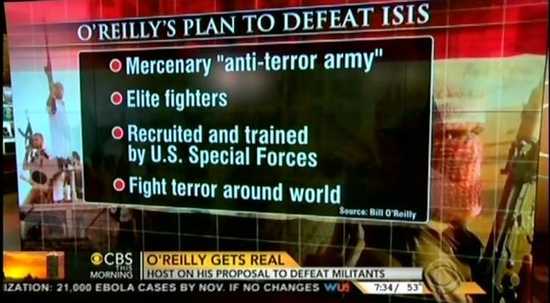
[O’Reilly] knows advocating for American troops to take up the fight themselves is extremely unpopular. O’Reilly, problem solver that he is, has a solution: “elite fighters who would be well paid, well trained to defeat terrorists all over the world.” Since that worked so well in Iraq last time around. What we need is more Blackwater. In the O’Reilly fantasy, the 25,000-person force would be English-speaking, “recruited by the USA and trained in America by our special operations troops,” and dubbed “the Anti-Terror Army,” because the Avengers is already taken.
The flaw is that there’s no obvious next step if the mercenaries succeed in routing ISIS from Raqqa and eastern Syria. Who takes over and rules that half of the country if that happens? Assad? He’ll butcher the Sunni civilians there and the Sunnis know it. A new sectarian rebellion against the regime would spring up overnight. Some sort of multinational Sunni force of Saudi, Turkish, and Jordanian troops? Iran will never let the Saudis have that kind of foothold, and besides, none of those countries want the headache of pacifying radicalized Sunni Syrian civilians. NATO doesn’t want it either, of course; an army of western peacekeepers would be even more culturally estranged from Syrian Arabs than a multinational Sunni force would.
The theoretical virtue of Obama’s “arm the Syrian moderates” plan is that if the moderates were to defeat ISIS, they’d be comparatively well positioned to take over as rulers of eastern Syria. They’re natives and they’re Sunnis; they’re probably acceptable to the locals. But of course, the moderates aren’t going to defeat ISIS, which puts us back at square one.

 The Dish