The Quantified Cop

Dara Lind suggests big data can help police departments identify racially-biased officers:

A growing body of research is showing how people subconsciously act on racial stereotypes without even realizing what they’re doing – a phenomenon known as implicit bias. (My colleagues and I have written about implicit bias in depth, especially as it influences policing and criminal justice.) Now, academics are working to figure out how to counteract those subconscious biases – and how to raise awareness of implicit bias in the real world, especially in police departments. UCLA’s Center for Policing Equity has been working with police departments to figure out whether, and when, cops are letting their implicit bias guide their decisions about who to stop and arrest.

In Denver, for example, researchers are tracking the arrest records of individual police officers, to see which officers might be arresting people of color disproportionately and why. And in San Jose, they’re working with a database of mugshots to check whether cops are more likely to arrest people with stereotypically African-American features — which are subconsciously associated with criminality and can even lead juries to give someone a harsher criminal sentence.

America’s Newest War Spreads To Syria

US launches air strikes against Isil in Syria

The Guardian is live-blogging the US airstrikes against ISIS in Syria. Juan Cole expects them to do little good:

The some 22 sorties flown on Monday will have killed some ISIL terrorists, blown up some weapons warehouses, and destroyed some checkpoints. But ISIL are guerrillas, and they will just fade away into Raqqah’s back alleys. The US belief in air power is touching, but in fact no conflict has ever been quickly brought to an end where US planes have been involved.

Mark Thompson agrees the airstrikes will have limited impact:

The new attacks, against fixed ISIS targets, undoubtedly did significant damage. But they also will force ISIS fighters to hunker down, now that their sanctuary inside Syria has been breached. This means that the jihadists, who have shown little regard for civilians, will move in among them in the relatively few towns and villages in eastern Syria, betting that the U.S. and its allies will not attack them there and risk killing innocents.

That could lead to a stalemate. While air strikes are likely to keep ISIS from massing its forces, and traveling in easy-to-spot convoys, air power can do little to stop small groups of fighters from billeting with and intimidating the local population.

Jeffrey Goldberg admits that “there exists no strategy for victory, and no definition of victory”:

The advantage of launching strikes against ISIS positions early in this fight is that its commanders now have to spend extraordinary amounts of time, energy and resources merely digging in, and protecting their human and materiel assets, rather than pushing on, toward Baghdad, Jordan and Saudi Arabia. A terrorist preoccupied with his own survival has less bandwidth to threaten yours. But these strikes will not bring about the end of ISIS. Like other terror groups, it can “win” this current round of fighting by surviving, and maximizing civilian casualties on its own side.

The relatively easy task for airpower—of blunting ISIS’s lightning offensives against Iraqi cities—may already be accomplished. ISIS has not captured major population centers in Iraq since the beginning of the air campaign and in some areas, such as Haditha and the Baghdad suburbs, it is contributing to modest counteroffensive gains. Tactically, ISIS’s efforts to offensively employ heavy weapons, mass forces on technicals, and stage large amounts of its infrastructure in the open are highly vulnerable to airstrikes. However, it is important to remember that even in Iraq, where the United States has multiple partners and embedded advisers, these airstrikes have yet to precipitate major counteroffensive gains by Iraqi security forces. ISIS has repelled two major counteroffensives in Tikrit using a variety of guerrilla tactics, suggesting that it remains formidable defensively, a strength airpower has rather more difficulty countering.

ISIS’s tactics and structure suggest that rather than hitting only massed ISIS forces in Iraq and its fixed infrastructure across both Iraq and Syria, an offensive campaign should target its battlefield leadership and the elements of the organization necessary for sustaining and coordinating its operations across the region.

But Julien Barnes-Dacey doubts we can defeat ISIS:

The respective positioning of non-IS rebels and Assad highlights an inconvenient truth: as long as Syria’s civil war rages, international attempts to defeat Islamic State militarily will be significantly hampered, particularly if regional allies are also pulling in different directions. While tactical lines may shift as a result of air strikes, they are unlikely to provoke significant strategic realignments. Given their likely inconclusive nature, they risk drawing the West into deeper intervention. While Obama has clearly stated that US intervention in Syria will remain limited, those calling for wider action may see the proposed initial strikes and arming of rebels as the thin edge of the wedge, with further escalation inevitable.

Significantly, narrow air strikes that inflict collateral damage and leave the regime unscathed also risk further empowering Isis, consolidating its self-declared position as the only legitimate defender of Syria’s Sunni population. Isis’s apparent goading of the US to intervene in Syria and Iraq through the public beheading of a number of hostages may appear misguided given the power that the American military can bring to bear. But blunt military intervention may help entrench local support behind the group.

Larison sighs:

Loose talk of “destroying” ISIS practically demanded expanding the war into Syria. Obama stated he would not hesitate to do this. However, there is even less reason to think that U.S. air power will have the desired effect there than it will have in Iraq. It will not be lost on Sunnis in Syria and Iraq (and elsewhere) that the U.S. didn’t intervene directly in the Syrian civil war until it came time to attack a group opposed to their sectarian enemies. Even if the U.S. is not actively cooperating with the Syrian regime in all of this, it will be perceived as siding with it in the current conflict, and that will be to the detriment of American security now and in the future. For the second time this century, the U.S. is fighting a war that will benefit Iran and its regional allies and proxies, and it is doing so in a way that seems sure to trap the U.S. into open-ended fighting for many years to come.

Greenwald piles on:

Six weeks of bombing hasn’t budged ISIS in Iraq, but it has caused ISIS recruitment to soar. That’s all predictable: the U.S. has known for years that what fuels and strengthens anti-American sentiment (and thus anti-American extremism) is exactly what they keep doing: aggression in that region. If you know that, then they know that. At this point, it’s more rational to say they do all of this not despite triggering those outcomes, butbecause of it. Continuously creating and strengthening enemies is a feature, not a bug, as it is what then justifies the ongoing greasing of the profitable and power-vesting machine of Endless War.

And Hayes Brown wonders what comes next:

So far, Washington is mum on just how long the United States plans to keep up the strikes in Syria, though reports indicate that they will not continue at the tempo seen last night. U.S. Central Command has said only that “the U.S. military will continue to conduct targeted airstrikes against ISIL in Syria and Iraq as local forces go on the offensive against this terrorist group.” As for the people living in the areas that are now the target of these airstrikes, residents are reportedly fleeing Raqqa as quickly as possible. “There is an exodus out of Raqqa as we speak,” one resident told Reuters. “It started in the early hours of the day after the strikes. People are fleeing towards the countryside.” As the civil war in Syria has already caused over half of its population to flee their homes, it can only be assumed that the new campaign against ISIS will only exacerbate the refugee crisis the region has struggled to contain.

(Photo: Syrian children stand on the ruins of a destroyed building during a search and rescue operation among the ruins of it, in a region of Idlib, a northwestern city of Syria, on September 23, 2014. The US launched air strikes against ISIS in Idlib. By AA Video/Anadolu Agency/Getty Images)

Slippery Borders

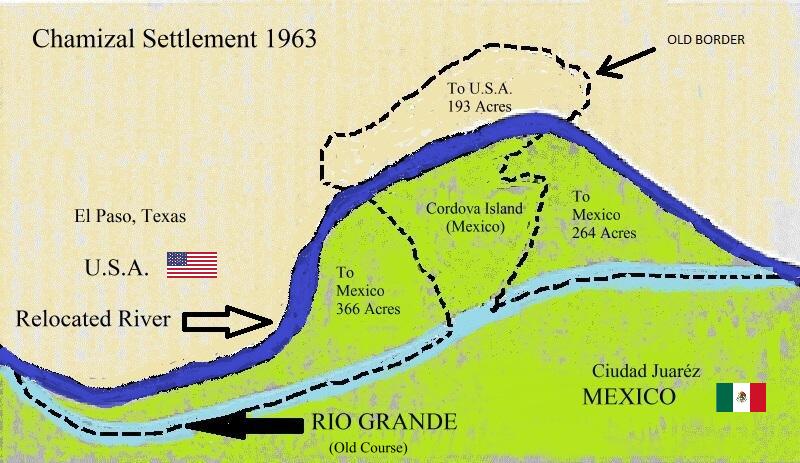
Chazimal_dispute_map_01

In a fascinating history of the Chamizal dispute, Paul Kramer considers what happens when nature refuses to respect national boundaries:

The whole point of setting the border between Mexico and the United States at the deepest channel of the Rio Grande was that the river was not supposed to move.

That was the thinking in 1848, when, following Mexico’s defeat by the United States and surrender of its vast northern lands, boundary surveyors from the two countries were tasked with reinventing the border. The choice of the river for the boundary’s eastern half had been obvious: its use as a territorial marker stretched back into the region’s Spanish colonial past, and it was hard to miss and often difficult to cross. But even as he filed his report on the completed boundary survey, in 1856, Major William Emory cautioned that the river might be an unreliable partner in border making. “The bed of the river sometimes changes,” he wrote, “and transfers considerable portions of land from one side to the other.”

Catastrophic floods in 1860 and 1864 demonstrated how fickle the river could be. The torrents were especially devastating where the river snaked between El Paso and Ciudad Juárez; here the south-moving current veered southeast and slammed into the southern bank, carving out new channels. … By the dawn of the twentieth century, the river’s recurring spring floods had dug a completely new bed for it farther south. About seven hundred acres of land that had once formed part of Mexico – the Chamizal, named for a scrubby plant that grew there – were now connected to the United States. Whether the border had shifted with the river, rounding out the war’s annexationist work, nobody knew.

He concludes:

It was unsurprising that boundary surveyors in the mid-19th century had turned to rivers, in awe and envy, to deliver their borders: the waters were more powerful than the governments that recruited them, and the demands placed on boundaries were light. Over time, the balance of power between states and nature shifted; by the mid-twentieth century, rivers that did not comply with states could be remade in their image.

Is Divesting A Distraction?

Universities are under pressure to divest from fossil fuels. Yglesias spells out the main reason to support this goal:

Fossil fuel companies need to hire staff, they need to lobby politicians, and they need to contract with other companies for services. A world in which it was universally accepted in polite society that fossil fuel companies are problematic and respectable people should avoid dealing with them would be a very different world from the one we live in. Fossil fuel firms would find it challenging to recruit talented staff in a cost-effective way, and would have trouble securing favorable tax and regulatory treatment from the government. This is a real risk, and it’s why no company or sector likes to see high-profile divestment campaigns lobbed against it.

The most famous divestment campaign, waged against the government of apartheid South Africa, is a case in point. It is unlikely that divestment as such had an important impact on South Africa’s corporate sector or financial markets. But it was part and parcel of a larger ongoing campaign that left South Africa socially and economically isolated from the world. That overall isolation did have an impact, and divestment was an important part of that isolation insofar as it gave campaigners concrete asks that were smaller in scale than whole national-level sanctions.

But McArdle dismisses the divestment movement:

In my opinion, activists have selected this issue not because it is useful, but because it is feasible. Unfortunately, it is feasible precisely because it will make no difference in anyone’s consumption of fossil fuel. If it were going to actually be personally costly to members of the community, it would suddenly become very difficult indeed.

Daniel Gross agrees that divestment won’t do much good. What he recommends instead:

Though it resisted divestment, the University of California is pursuing this more difficult path with energy. It’s a giant system, with 10 campuses and five medical centers, 233,000 students, about 190,000 employees, and thousands of buildings. Powering these facilities and people takes about 250 megawatts of electricity generating capacity, roughly that of a “medium size city,” as the university notes.

Right now, the system’s electricity supply is largely free of coal, if not fossil fuels. It gets about 73 percent of its power supply from natural gas sources. But the University of California is seeking to slash its emissions to 1990 levels and wants to become “carbon neutral” by 2025, which, it says, would it make it the first research university to do so. (Here’s the plan.) That’s an ambitious goal—one that the town of Palo Alto has already achieved. And like Palo Alto, which owns a big chunk of a hydroelectric plant, the University of California is becoming more directly involved with energy markets.

Bill McKibben defended divestment last month.

Where Golf Is Driven Out Of Range

In a review of The Forbidden Game: Golf and the Chinese Dream, Maura Elizabeth Cunningham describes the peculiar role of the sport in Chinese society:

[A]s Dan Washburn writes in his compelling new book … golf “offers a unique window into today’s China,” a country of paradoxes perhaps best exemplified by the fact that although construction of dish_kunminggolfnew golf courses has been banned in China since at least 2004, more than 400 were built between 2005 and 2010, making China the only place in the world experiencing a golf boom. Government officials who enjoy hitting the links register at golf courses under false names, afraid of leaving a paper trail connecting them to a game most often associated with capitalism and corruption. And while massive golf course complexes lined with luxury villas populate large tracts of land outside Chinese cities, their owners attempt to hide the courses in plain sight, giving them convoluted names like the “Anji China Ecotourism and Fitness Center.”

Like so much else in contemporary China, golf occupies a gray zone: officially forbidden, yet tolerated — even encouraged — behind the scenes, as local government officials and land developers reap massive profits from the construction of new courses.

Update from a reader:

Perhaps I can contribute a small illustration of the absurdity of golf in China.

My wife and I have lived in China for nearly a year and recently returned from a vacation in Yunnan (very near the course pictured in the thread). One of our stops was Jade Dragon Snow Mountain, which offered wonderful, but in our case, clouded vista at ~4,600m. Coming back down in the cable car and emerging from the fog, we were presented with the last thing we expected at the altitude and surroundings: 18 holes of vibrant green. At 3,100+ meters altitude, Jade Dragon Snow Mountain Golf Club is the longest in the world at 8,500+ yards (par 72). It even boasts villas, but I can’t imagine they would have much conventional luxury at such a remote location.

IMG_20140907_135857_137

(Photo of a golf course in Kunming by Philippe Semanaz)

Is Diet Soda Making Us Fat? Ctd

The latest in artificial sweetener scares:

Artificial sweeteners might be triggering higher blood-sugar levels in some people and contributing to the problems they were designed to combat, such as diabetes and obesity, according to new findings published Wednesday in the journal Nature. Although the precise reasons behind the blood-sugar changes remain uncertain, researchers suspect that artificial sweeteners could be disrupting the microbiome, a vast and enigmatic ecosystem of bacteria in our guts.

Svati Kirsten Naruta reminds us that the “news” isn’t really new at all:

There have been a lot of major news stories about the science behind artificially sweetened products. But I didn’t see a single one this week that acknowledged the ones written earlier this year, or in 2008, or 2005. More often than not, each individual story gives the impression that the latest science is either totally new or surprisingly compelling.

“It seems to amplify every time,” Purdue University’s Susan Swithers told Quartz. “Things don’t have to be shocking and new to get this shocking and new treatment.” Swithers herself has been featured in news stories about artificial sweeteners and diabetes, including an NPR one asking “Do diet drinks mess up metabolisms?” in 2013.

Not many news outlets have the space, time or resources to contextualize, at length, each meaningful scientific study. But there’s something wrong with a cycle in which reporters constantly react to press releases from academic institutions or scientific journals by generating uniquely attention-grabbing stories based on each one.

Daniel Engber looks at the historical pattern:

The supposed risks of saccharin, like those of other sweeteners, have a way of glomming on to whatever other fears happen to be in the public mind. In Roosevelt’s day, we worried over fraud in manufacturing – flour cut with sawdust, coffee mixed with powdered acorns—and saccharin was decried as a cheapo surrogate for sugar. By the time Richard Nixon declared a war on cancer, the sweeteners were seen as dangerous carcinogens. These days we’re more concerned with diabetes and obesity, and so the putative effects of drinking diet soda have shifted once again. Now they’re blamed for bringing on the very thing they’re meant to counter: a growing scientific literature hints that artificial sweeteners could make us fat.

And evidently the first sweetener gave the Romans lead poisoning. Previous Dish on sweetener research here. And Aaron Carroll has made the case that however bad artificial sweeteners might be, sugar is worse.

A Classic Conundrum

What makes a piece of literature a classic? For Saket Suryesh, the work must be introspective:

We, as readers, are able to find our own feelings in such words despite the distances between us and the time and space they were originally composed in because those emotions are universal. The world which surrounds these feelings may change, but the emotions themselves do not. Consider, from Heart of Darkness, the lines: “She carried her sorrowful head as though she were proud of that sorrow, as though she would say, I — I alone know how to mourn for him as he deserves.” Simple words but an ache rises from the heart of even the modern reader, for who wouldn’t want to be loved thus?

Eric Williams, though, refuses to accept that a classic work can exist outside of time and space. He argues, “‘The Classics’ are a fluid and dynamic category, changing with times and tastes and history, and not something transmitted to us across the aesthetic ether”:

The danger of the numinous label of “The Classics” is that it kills texts. It becomes holy writ, studied for its intrinsic rightness, ahistorical and timeless. Nothing is more dangerous. Books are discrete historical objects, written by specific individuals at specific times, and their subsequent histories reflect how people envisioned literature, artistic merit and important ideas in the larger context of their times and culture. By all means, read them for their beautiful language and interesting imagery, and interpret them based on your own private and individual history and perspectives. But at the same time, read them as historical documents, fully aware of the baggage that comes with them and fully cognizant that someone somewhere decided that the book in your hands had more value than other books. Echoing Suryesh, read the classics voraciously — but, I would add, always thoughtfully, critically and historically.

Paul’s Foreign Policy Predicament

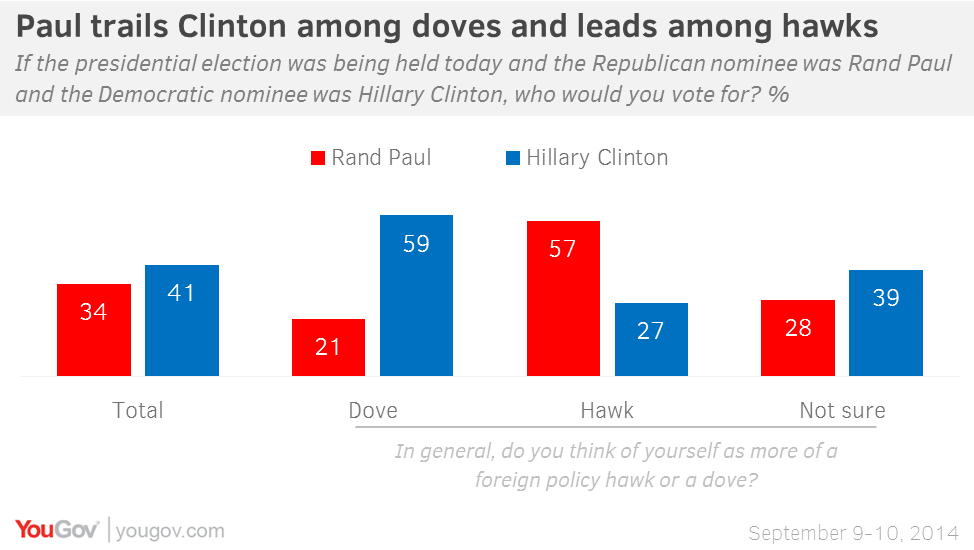
Doves prefer Clinton to Paul:

Paul Clinton

Larison analyzes the survey:

Doves clearly prefer Clinton despite the fact that a few more respondents (correctly) perceive her to be a hawk. However, Clinton also seems to benefit from the fact that 30% of respondents inexplicably perceive her as a dove, and only 27% perceive Paul that way. For all of the attention paid to Paul’s foreign policy views in political media over the last few years, his position is not very well-known or clear to the public at large, since 24% identify him as a hawk and 49% aren’t sure what to call him. Oddly enough, that might be just what Paul wants, since it gives him room to move back and forth between hawkish and dovish stances.

If public opinion or his conscience are guiding him toward military confrontation with ISIS, and if his better judgment guides him away from the available alliances on the ground, he is rapidly backing himself into the trap of Clintonian foreign policy. That means airstrikes and harassment, carried out indefinitely.

An airstrikes-only approach provides all the satisfaction of conflict, and little risk of major casualties for U.S. forces, which quickly swing public opinion against a president and his party. But in recent times, this policy has always had one of two endings. When President Obama and Hillary Clinton did it in Libya, this “smart power” strategy resulted in a stateless region of chaos; the Libyan government can hardly meet safely in the territory it claims to rule. When Bill Clinton did it with his no-fly zone in Iraq, it settled into a kind of stalemate. It was a relatively light drain on U.S. budgets, but it was also vaguely humiliating. A domestic uprising against Saddam never materialized to justify our policy. And American hawks could put pressure on the president for a more robust policy of regime change. What’s the point of military engagement, they’d ask, if victory isn’t on the table?

But Weigel finds that Paul’s anti-war supporters trust him:

The crisis in Iraq, which has caused a surge in the numbers of Republicans ready to send ground troops back into the Middle East, has not really rattled Paul’s people. He has what very few political figures still have; his supporters assume that he simply must agree with them, no matter what he says.

When Rape Allegations Are False

https://twitter.com/JessicaValenti/status/513036486602924032

Cathy Young tackles an uncomfortable truth:

False rape accusations are a lightning rod for a variety of reasons. Rape is a repugnant crime—and one for which the evidence often relies on one person’s word against another’s. Moreover, in the not-so-distant past, the belief that women routinely make up rape charges often led to appalling treatment of victims. However, in challenging what author and law professor Susan Estrich has called “the myth of the lying woman,” feminists have been creating their own counter-myth: that of the woman who never lies. More than a quarter-century ago, feminist legal theorist Catharine MacKinnon wrote that “feminism is built on believing women’s accounts of sexual use and abuse by men”; today, Jessica Valenti urges us to “believe victims en masse,” because only then will we recognize the true prevalence of sexual assault.

But a de facto presumption of guilt in alleged sexual offenses is as dangerous as a presumption of guilt in any crime, and for the same reasons: It upends the foundations on which our system of justice rests and creates a risk of ruining innocent lives.

Young illustrates how the issue is so damn complex:

Not all reports classified as unfounded are necessarily false. In some cases, women who were victims of rape were disbelieved, pressured into recanting, and charged with false reporting only to be vindicated later on—the kind of awful story that adds to people’s skittishness about discussing false accusations.

Some police departments have been criticized for having an anomalously high percentage of supposedly unfounded rape charges: Baltimore’s “unfounded” rate used to be the highest in the nation, at about 30 percent, due partly to questionable and sometimes downright abusive police procedures, such as badgering a woman about why she waited two hours to report a street assault. By 2013, an effort to provide better training and encourage full investigation of all complaints reduced that rate to less than 2 percent.

Megan McArdle insists that good stats are incredibly hard to find:

What we know is that we don’t know. We should not presume that every rape victim is telling the truth because it would make it easier for victims to come forward. Nor should we presume that every rape accusation has a 50 percent chance of being false. We should look at the facts in each case and judge them with the knowledge that some women do lie about rape — for revenge, to cover up some problem in their own lives, to get attention and sympathy from others. And also with the knowledge that men lie, too, violating their victims a second time in order to cover up their crimes. And that while men have gone to jail for rapes they did not commit, many other men have avoided the jail time they deserved for terrible crimes against women.

That’s not a very satisfying answer, because rape is inherently a hard crime to prosecute. If someone comes into a police station with their face bashed in, you can be pretty much certain that unless they’re a professional boxer, a crime has occurred. If a rape kit shows evidence of sexual intercourse, however, all that tells you is that … something happened. Because this is something that a lot of people do to each other voluntarily, you cannot proceed immediately to the arrest. Usually there are only two witnesses, telling different stories. Often drugs or alcohol were involved, and intoxicated people make lousy witnesses.

Previous Dish thread on the controversial topic here.

Legal Weed Heads East

Matt Ferner flags a poll from last week showing that an astonishing 65 percent of likely voters in DC support the city’s legalization initiative:

The NBC4/Washington Post/Marist poll’s finding that district voters support legalization by almost a 2-1 margin “is the highest support ever for a marijuana legalization ballot initiative,” Adam Eidinger, chair of D.C. Cannabis Campaign, the group backing the legalization measure, said in a statement. “It vindicates the work of this campaign so far, but we still have more work to do turning out the vote come Election Day.”

Only 33 percent of likely voters oppose legalization, which puts the scolds on the Washington Post’s editorial board in the distinct minority. Meanwhile, WaPo’s Aaron C. Davis and Peyton M. Craighill register a “major shift toward support [of legalization] among African Americans”:

The District’s black residents, who now account for half its population, once opposed marijuana legalization, partly out of fear it could lead to addiction among black youths. But as new studies have suggested otherwise, that attitude has evolved. One study last year showed that blacks account for nine out of 10 arrests for simple drug possession in the District, while another showed that was the case even as usage likely varied little among races. According to the poll, 56 percent of likely African American voters say they would vote for legalization, a near identical number to a broader question about support for legalization asked in a Washington Post poll in January. Together, the polls confirm a complete reversal of opinions among African Americans from four years ago. Then, 37 percent were in favor of legalization and 55 percent opposed.

But Jacob Sullum warns that even if Initiative 71 were to pass, Congress could still get in the way:

Legalization of the cannabis industry would be left to the D.C. Council, which could be overridden by Congress. Congress also could block implementation of Initiative 71, as it did for years with Initiative 59, the medical marijuana measure that D.C. voters approved in 1998. The last congressional effort to stymie marijuana reform in D.C., led by Rep. Andy Harris (R-Md.), consisted of an amendment that would have barred the District from spending public money “to enact or carry out any law, rule, or regulation to legalize or otherwise reduce penalties associated with the possession, use, or distribution” of a controlled substance. The House approved Harris’ amendment in June, but it was dropped from the final version of the spending bill. Harris plans to try again if Initiative 71 passes.

As Matt Connolly notes:

A full-scale legalization effort, complete with dispensaries like those seen in Washington and Colorado, could provoke the ire of national conservatives again. It’s a fight D.C. is used to having, and its outcome might depend on how the other states with legalization measures – Oregon and Alaska for recreational, Florida for medical – end up voting.

Know dope.