The Climate Change No Shows

On Tuesday, world leaders will meet to discuss climate change. A while back, Michael Bechtel and Kenneth Scheve did a survey “to find out what features of an agreement were important to the public.” The results:

But it’s hard to reach such a deal when some big names aren’t attending this week’s climate summit:

Notably, Chinese President Xi Jinping and Indian Prime Minister Narendra Modi are skipping the event. In empirical terms, it’s hard to think of two more important leaders in the world right now: Together they lead more than 2.5 billion people, more than a third of the world’s population.

And the two countries are not only the first and second most populous countries on Earth; research shows they also were the first- and third-biggest producers of carbon dioxide emissions (the United States holds the No. 2 spot). That figure can only partly be explained away by their huge populations: One study showed that per capita emissions from China recently surpassed that of the European Union, and India is predicted to follow suit in five years.

Alden Meyer downplays the absences:

Take China: Just recently, Chinese leaders announced that a national carbon emissions trading program would begin in 2016, building on the experience gained through the seven regional programs now underway. While China remains the world’s largest emitter, the nation’s emissions intensity, which is the amount of emissions produced for each unit of GDP growth, has declined. And just last week, China’s State Council put forward the draft version of a new law to crack down on air pollution from coal burning, which severely affects Chinese citizens’ health. China will be represented at the New York Summit next week by Vice Premier Zhang Gaoli, who will be the most senior Chinese official to attend a climate talk since the 2009 Copenhagen climate conference. He is expected to elaborate on China’s plans to put limits on its consumption of coal, which is the source of some 80 percent of the country’s carbon emissions.

Dave Roberts agrees that the changes to China’s coal policy could be a “a Big F’in Deal.” But India is another story. Rebecca Leber explains:

Several recent comments made by [Prime Minister Narendra] Modi suggest little commitment to global warming, by implying it is a natural phenonemon. “We should also ask is this climate change or have we changed. We have battled against nature. That is why we should live with nature rather than battle it,” Modi said, in a departure from stronger remarks on climate action Indian officials made in 2011.

Regardless, Bloomberg View’s editors hope that some good will come from the meeting:

A particular focus will be cities, which produce 70 percent of global greenhouse-gas emissions. Many have set their own targets for cutting them and have announced specific measures to that end. In some cases, they’re aiming to improve on the targets set by their respective national governments. (Former New York City Mayor Michael Bloomberg is founder and majority owner of Bloomberg LP, and the UN’s special envoy for cities and climate change.)

The point isn’t to reduce the costs of carbon pollution in their neighborhoods: A ton of carbon released in one place does the same harm to the planet, climate-wise, as a ton released anywhere else. Rather, it’s to show that stronger measures are no great burden. Cities can take them in stride.
Applying Science To Style

Gary Stephen Ross deems Steven Pinker’s new book The Sense of Style as “a manual worthy of a place on a shelf just below Fowler’s Modern English Usage and Strunk and White’s The Elements of Style.” He appreciates Pinker’s book for its “painstaking dissection of the many ways in which language both serves and fails us”:

It’s fascinating to learn the science that underlies the stylistic techniques good writers seem to intuit—for example, a list is most easily grasped if the bulkiest item comes at the end (life, liberty and the pursuit of happiness ; or The Wild, The Innocent, and The E Street Shuffle; or Faster than a speeding bullet! More powerful than a locomotive! Able to leap tall buildings in a single bound!). “Light-before-heavy is one of the oldest principles in linguistics,” Pinker writes, “having been discovered in the fourth century BCE by the Sanskrit grammarian Pānini.” Why? Because the mind must hold the early items in suspension before incorporating the final one, and it’s easier to retain simple things than more complex elements.

John Preston is less taken with Pinker’s analysis, scoffing, “it becomes increasingly clear that Pinker doesn’t have anything new to say, and that anyone who follows his example is far more likely to end up writing waffle and bilge than War and Peace“:

If you had to boil down Pinker’s advice into two main points, they would be: “Keep it snappy” and “Keep it simple”. Unfortunately, he proves wholly incapable of abiding by his own rules. Rather, he’s a colossal windbag, never using three words when 35 can be rammed into the breach, and frequently writing sentences so tortuous that they seem to be eating themselves. He even manages to define what a coherent text is in a way that made my eyeballs rotate in opposite directions: “A coherent text is one in which the reader always knows which coherence relation holds between one sentence and the next.”

Got that? All right then, try this: “In fact, coherence extends beyond individual sentences and also applies to entire branches in the discourse tree (in other words, to items in an essay outline).” I may be excessively picky here, but I can’t help feeling that the phrase “in other words” doesn’t belong in a sentence about the virtues of coherence.

An Actual War On Women, Ctd

Ariel Ahram goes deep in exploring ISIS’s use of sexual violence, arguing that it represents “as much an undertaking in state-making as in war-making”:

The power to control or manipulate sexual and ethnic identity is a key component of all state power. In the Middle East, the regulation of sexual relations is often used as a means to create or reinforce ethno-sectarian boundaries.

In the 19th century the Ottoman authorities prohibited marriage between Shi’i men and Sunni women in the provinces of Iraq for fear that Shi’i Iranians were gaining a demographic foothold in the region. Since Islamic law privileges male prerogative over children, the move was meant to block the propagation of Shi’ism within the Ottoman domain. Marriage of Shi’i women to Sunni men was still permitted, since the children of such a union were deemed Sunni. Saddam Hussein took similar measures in the 1970s and 1980s. In late 1970s, in the immediate wake of the Islamic Revolution in Iran, the government moved to deport some 40,000 people deemed to be of “Iranian” (i.e., Shi’i) origins.  Thousands of families were interned in prison or prison camps for months, where they were subject to rape and torture, before being transported to the border. …

ISIS’s violence is a heinous crime of war, but also represents a particular form of statecraft. At first glance, it might appear that these practices, though justified by selective interpretations of Islamic law, serve only to satisfy prurient sexual urges. Much like its manipulation of water and oil resources, though, ISIS’s use of sexual and ethnic violence has both ancient and modern antecedents. By selectively reinforcing, creating, and severing ties of kinship, these violent practices can affect bonds of loyalty and obedience far more substantially than the simple distribution of resource rents.

“A Wildly Popular, Semi-Secretly Christian Rock Band”

That’s how Joshua Rothman pegs U2 in an essay exploring the faith behind their music:

In some ways, this seems obvious: a song on one recent album was called “Yahweh,” and where else would the streets have no name? But even critics and fans who say that they know about U2’s Christianity often underestimate how important it is to the band’s music, and to the U2 phenomenon. The result has been a divide that’s unusual in pop culture. While secular listeners tend to think of U2’s religiosity as preachy window dressing, religious listeners see faith as central to the band’s identity. To some people, Bono’s lyrics are treacly platitudes, verging on nonsense; to others, they’re thoughtful, searching, and profound meditations on faith.

Christianity Today regularly covers U2, not just as another Christian rock band but as one of special significance. In 2004, the magazine ran an article about Bono’s “thin ecclesiology”—his unwillingness to affiliate himself with a church—that sparked a debate about the health of organized religion. Rowan Williams, the Archbishop of Canterbury at the time, addressed the issue of Bono’s belief in a fascinating 2008 lecture about the place of organized faith in secular society. “Get Up Off Your Knees: Preaching the U2 Catalog” is one of several books exploring the theological ideas in Bono’s lyrics. Churches around the world have held “U2charists”—full services at which traditional church music is replaced with songs by U2. A few years ago, an Episcopal priest I know helped organize one at a church in New Jersey; the service, which featured a huge sound system, stage lighting, cocktails, and a bonfire, raised around forty thousand dollars for an orphanage in Cameroon.

Meanwhile, Nathan Hart looks at religion’s place in their just-released Songs of Innocence:

The power of Songs of Innocence is found within its sacramental atmosphere. There are holy moments throughout. With very personal and vulnerable lyrics, Bono has (probably temporarily) laid down his political megaphone. It feels less like a prophetic diatribe and more like a prayer of confession. For example, even in thinking about the very political “troubles” in Ireland on the closing track, he sings,

You think it’s easier to put your finger on the trouble,
when the trouble is you
And you think it’s easier to know your own tricks
Well, it’s the hardest thing you’ll ever do

Bono points his wagging finger away from the issue and onto himself. In other words, he’s saying, sin is not just something that has infected the big bad world out there, it is also the thing that has infected the self in here. I can’t recall any other U2 lyric that peers so honestly into the farthest corners of Bono’s own heart. Sure, he has been honest about his lustfulness and the origins of his messiah complex. But by vulnerably associating his own sinfulness with the very thing that he normally prophesies against, he offers us a lyrical sacramentology—a holy moment inviting divine redemption. Redemption comes in the same song, which later depicts a thrown lifeline, a rope, “something I could hold on to.” Then, redeemed, he can sing, “God now you can see me. I’m naked and I’m not afraid. My body’s sacred and I’m not ashamed.”

Faces Of The Day

dish_invisibles

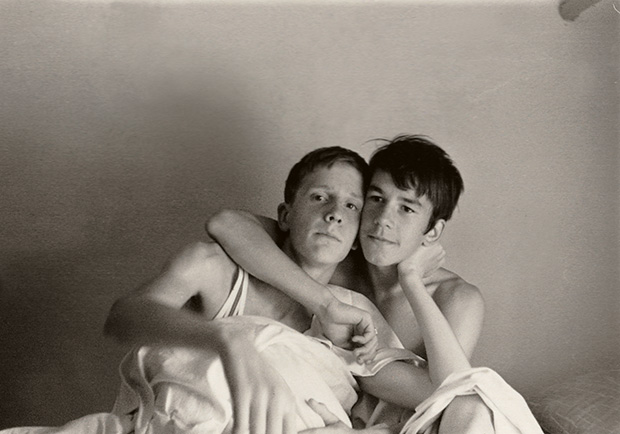
For his book The Invisibles: Vintage Portraits of Love and Pride, Sébastien Lifshitz collected portraits of gay relationships he found at yard sales and flea markets:

Lifshitz, who also made a documentary film on this subject, raises an important point when he reminds us that all of these photos are pre-digital era: “Because to obtain these images, they had to have gone to a small neighborhood photo lab to develop the film and then go back to pick up the prints. They, therefore, had to run the risk of exposing themselves socially. The need to keep a memory of their love was certainly stronger than the disapproval of some business or any concerns about what others might say.”


Lifshitz spoke about the collection in an interview earlier this year:

Who are the individuals featured in these photos?

I don’t know these people — they are anonymous to me. I can’t really even say that each person photographed into the book is gay, except when it’s obvious. What I like is that there are different levels of reading these photos — I would say three levels to be exact. The first one is the pictures of obviously gay single people or couples, the second is the pictures of people which can be seen as “undefined” (we’re not sure) and the third level is the ones that are obviously not gay but playing with a gay attitude (cross-dresser, some “garçonnes,” etc.). I love the ambiguity and diversity of these pictures. These photographs ask questions. I didn’t caption the photos because I don’t know quite anything about each of them (no name, no location mentioned most of the time). I wanted to expose them like the way I found them: without any information, like mysterious pictures.

Does Terrorism Have Its Roots In Religion?

CJ Werleman fisks Sam Harris over his recent post emphasizing the connection between Islamic doctrine and jihadist violence, noting that “maturing counter-terrorism analysis has brought new information to light.” He uses the example of Anwar al-Awlaki to show the limits of Harris’ approach:

Harris’ contention that terrorists are motivated more by the writings of the Koran, rather than by economic, political, social, and military oppression, is based on feeling rather than fact. Harris is unable to explain the transformation of U.S.-born terrorist Anwar al-Awlaki’s views in the decades before his death, because there is no evidence to suggest that a religious awakening led to his adoption of a radically different theology. When the 9/11 attacks occurred, al-Awlaki told journalists: “There is no way that the people who did this could be Muslim, and if they claim to be Muslim, then they have perverted their religion.” Explaining the concept of Jihad, he said, “If there is an invading force from outside, then we would, too, struggle to defend ourselves, and that is where armed combat occurs. So actually, fighting is only part of a jihad, and it’s considered to be a defensive force in order to protect the religion.”

The U.S. government had determined al-Awlaki to be a moderate, and he even spoke at a lunch event at the Pentagon. By 2010, however, he had become increasingly disillusioned with U.S. foreign policy…. Al-Awlaki’s radicalization is consistent with the historical pattern of political activists adopting a belief in terrorism when political action fails to bring about change. “From the French anarchists who began bombing campaigns after the defeat of the Paris Commune, to the Algerian FLN struggling to end French colonialism, to the Weather Underground’s declaration of a state of war following state representation of student campaigns against the Vietnam war,” terrorism is nearly always rooted in political and economic oppression says NYU adjunct professor Arun Kundani.

Christopher Massie, however, points to others who think more like Harris:

[T]here are journalists and scholars who present compelling cases that ISIS’s actions are at least partly grounded in the teachings of Islam. In a September 1 story in The New Republic, Graeme Wood traced [ISIS leader Abu Bakr] al-Baghdadi’s appointment of himself as caliph, as well as the group’s “taste for beheadings, stonings, crucifixions, slavery, and dhimmitude, the practice of taxing those who refuse to convert to Islam,” to its “almost pedantic adherence to its own interpretation of Islamic law.” In an interview, Wood said that while he considers the political factors behind the group’s ascent “at least as important,” it is clear that “their beliefs are central to their self-conception” and are therefore vital to grasping the differences between ISIS and other jihadist groups. He observed that journalists who do not understand the way ISIS thinks “are missing a part of the story.”

David Cook, an associate professor at Rice University who studies Islam, is more emphatic: “To say that ISIS doesn’t have anything to do with Islam is just the statement of an ignoramus or an apologist. There is support for the things that ISIS does inside the Koran. There’s support for things like beheading and different exemplary punishments that you can easily find.”

Harris’ new book Waking Up is our latest Book Club selection, introduced here. Buy it here and join the discussion at bookclub@andrewsullivan.com.

Faith That Aches

This month saw the publication a new volume of poetry from Christian Wiman, Once in the West. Paul Otembra notices “the spiritual ache” coursing through the book:

The poems are continually looking for ways to make something of the frustrations and doubt. This is not the same as trying to make sense of them, and it is uncertain whether these poems believe that is even possible, let alone advisable. Instead, Wiman suggests “to make of the ache of inwardness— // something, / music maybe.” Everything here hinges on that qualifying “maybe.” It is not a shrug of surrender. It is recognition that the singing, while perhaps helpful, is not abundant compensation for suffering. All these poems can claim is to “sing a little nonce // curse / for the curse // of consciousness.” The songs are not plaintive. There is too much edge to the voice for that.

Putting these latest poems in the context of Wiman’s previous writing, Joe Winkler observes the way violence is a preoccupation of his theology:

He finds countless ways, metaphors from all sides of existence, to describe the violence of faith and the faith brought about by violence. Whether the physical violence common in his childhood town: shooting accidents, dead snakes, and birds he kills with a pellet gun, or the violence of “finding Jesus” in front of his church as a youth, or the wounds of belief, the scars of cancers, all of these varied forms of violence cohere into the ultimate wound, for Wiman,  the wound God’s presence or nonpresence leaves behind. For Wiman the violence of the whole of life can’t help but be meaningful, the way a scar is meaningful, a meaning only known to this person through the pain involved. For a few years now, this has been Wiman’s central obsession, a central viewpoint, this “holy flu” of God, the antinomy in which you cannot separate what we turn into opposite categories of evil and good or holy and secular.

You can read one of Wiman’s new poems, “The Preacher Addresses the Seminarians,” here. Literary Editor Matthew Sitman’s Deep Dish essay on Wiman is here, and our Ask Anything podcast with him is here.

Thinking Like A Conservative, Ctd

Last weekend we flagged philosopher Roger Scruton’s new book, How to Be a Conservative. In an interview he expands on his distinctive style of conservatism:

Q: It struck me that the empirical side of your conservatism is also underpinned by what might be call a metaphysics of personhood, a conception of the nature of the human person.

RS: That’s absolutely true. I think it’s what conservatism—my kind of conservatism, at least—shares with liberalism: an attempt to found things ultimately on a vision of what the human person is. Of course, it is the case that conservatism as I envisage it distances itself always from abstract conceptions and tries to find the concrete reality… the good in the present.

Related to this is the emphasis you place on what you call the “first-person plural,” a phrase that occurs several times in the book.

Yes. Ultimately, political order does not generate itself. For that reason, social contract theories are suspended in mid-air, so to speak. All political order presupposes a pre-political order, a sense that people belong together. And then, of course, they might seek a contract that embodies their togetherness. But the togetherness has to be there.

With Oakeshott’s remarks about conservatism as a “disposition” in mind, I was very struck by something you say about the tone of voice in which this book is written. You say: “The case for conservatism does not have to be presented in elegiac accents.” What do you mean by that?

So much of modern political conservatism—and you see this in America, which has a quite articulate conservative movement compared with us—is phrased in elegiac terms. [It’s about] what we’ve lost—we’ve lost the traditional working-class family, the black family or whatever it might be. Now, all that is perfectly reasonable. But the most important question is what have we got, rather than what we’ve lost, and how do we keep it?

Dreher applies Scruton’s insights to his interest in the “Benedict Option” as a “way forward for religious conservatives in this rapidly changing social order”:

We must give up on the hope of restoring the past in this culture. It’s not that some aspects of the past shouldn’t be reclaimed, but rather that doing so, at least at a society-wide level, is not feasible at this point in time. The more we act as if it were so, the greater our losses will be once we definitively lose an unwinnable battle. This “take back America” stuff is self-deluding nostalgia, and the more conservatives believe it, the worse off they will be.

There are times when you have to fade into the forest and retrench. I’ve called this call for retrenchment the Benedict Option, because it strikes me as the most sensible strategy by which religious conservatives can engage the world as it is now and is to come. The Benedictines were ordinarily not completely cloistered; they engaged with the people in the areas where their monasteries were. But they established walls and habits that set them apart from the secular world, and gave them the means to preserve their identity over generations. This is what I’m talking about: how to preserve the core of our identity in a post-Christian culture?

Recent Dish on Dreher’s arguments for the Benedict Option here, here, and here.

A Macho Macho Woman

Daniel Larkin raves over Eisa Jocson‘s recent performance at the Portland Institute for Contemporary Art, titled “Macho Dancer,” calling it “gender-bending cognitive dissonance at its artistic best”:

Jocson learnt a specialized form of male dancing from Manila’s red light district to develop this piece. “Macho Dancing” is unlike go-go boys in New York. It is its own genre best revealed in its own terms by a quick surf on YouTube. Like any dance form, it spans a spectrum but its core elements consist of a man dancing to music, striking several masculine poses, flaunting his physique, and proceeding to strip his clothes. Some of the Filipino macho dancers don’t stand stationary like the go-go boys in US bars. It’s can often resemble a drag show on a stage, where a man is performing a form of hyper-masculinity. …

But the performance was more than mind tricks for gender studies acolytes.

In fact, it was also just plain cool to watch and hear. The interplay of light, fog, gesture, costume, and music made for scintillating visuals that allowed this persona to shine outside the conventional boxes of gender expression. Allowing hybridized gender to be rhythmic and animated by showmanship was exciting. Although, it is tempting to link Jocson to the drag king tradition, a woman appropriating Manila’s specific style of male dancing is simply without any widely known precedent.

In an interview this summer, Jocson spoke about what she expects audiences make of her performance:

My impression is that audiences that come to see Macho Dancer all have strong opinions afterwards, each one very different from another. For example some people think its made for the male gaze, some people think its made for the female gaze, some think its about gender, some about materiality of the body, some about spirituality through the materiality of the body, some about exploitation and social context, some about making the audience feel guilty, some about exoticism, some about objectification, some would react on the position of the piece in the performing arts market, some were curious if I was really a woman or a ladyboy, some were over protective of their partners who came to watch with them, some people have expressed their fascination to the point of fondly proposing marriage… etc…

I perform a proposition. It is up to the audience where they want to take it, how to look at it, how to position themselves in the work. Distance is important to analyze one’s experience of a performance.


“The Only Time He’d Ever Felt ‘Sexiness'”

Alice Robb presents new findings on why some disabled men pay for sex:

[Sociologist Kirsty] Liddiard interviewed 25 physically disabled men and women, recruited through ads on websites and in publications for people with disabilities. (The ads didn’t mention that she was studying sex work.) Of the 16 men included in the study, seven said they had at some point purchased sex from a female sex worker. (None of the women had ever paid for sex.) This is consistent with other research that suggests disabled men seek out prostitutes or “sex surrogates” at higher rates than non-disabled men.

In a 2005 survey carried out by the British magazine Disability Now, 22 percent of the 1,115 disabled male respondents admitted they had at some point paid for sex, and 37.6 percent said they’d at least considered it. (Only 1 percent of disabled women had hired a sex worker, though 16.2 percent had thought about it.) Researchers estimate that about 10 percent of all British men have ever visited a prostitute. …

[Liddiard] found that for many of the men, it was as much about demonstrating their independence as it was about the sex. For Harjit, a 23-year-old-student whose parents had moved into his university residence to care for him, making secret arrangements was as much an accomplishment as the sex itself. “From the excitable way such stories were told, it appeared that a lot of the ‘buzz’ … was as much from exercising agency, autonomy, control and independence as it was about experiencing sexual fulfilment, pleasure, and satisfaction,” wrote Liddiard.

Other men simply wanted to have an experience they believed they wouldn’t have otherwise. “I wish I could go out and meet someone, but it’s not that easy,” one man complained. “I can’t go into a nightclub and easily pull, although I have in certain circumstances, but I can’t do it easily,” said another. Mark, a 35-year-old Liddiard interviewed in person, said that his experience with a sex worker was the only time he’d ever felt “sexiness.”