When A Black Woman Kisses A White Man

Ashley Southall tells the story of a possibly racist misunderstanding:

The actress, Daniele Watts, who appeared in “Django Unchained” and plays Martin Lawrence’s daughter on the FX show “Partners,” revealed the incident last week in a note on Facebook. She said she was “handcuffed and detained” by the officers “after refusing to agree that I had done something wrong by showing affection, fully clothed, in a public place.” … Ms. Watts’s boyfriend, Brian James Lucas, a celebrity raw food chef, said in his account of the incident posted to Facebook on Friday that the officers’ questions indicated that they suspected the couple were a prostitute and her client after observing their different skin colors, his numerous visible tattoos and her shorts. He did not say what questions the police had asked. Mr. Lucas also accused the officers of threatening to call an ambulance and to drug Ms. Watts “for being psychologically unstable.”

Yomi Adegoke contextualizes the incident:

Cases such as Daniele’s illustrate why intersectionality is crucial to any discussion of racism and, more pressingly, any discussion of feminism. We must face the facts — this would not have happened to Daniele had she been a black man, nor would it have happened if she were a white woman. … As it stands, black women are sexualised to such a degree — and black people criminalised to such a degree — that it appears the police are unable to fathom something as common as an interracial relationship in anything other than sexual terms, despite an incumbent biracial president.

And Elizabeth Nolan Brown takes the occasion to describe the extent to which non-black women are not hassled by the police.

The only correlate I have to stories of routine street harassment and cruelty by cops is how often I haven’t been bothered, arrested, or abused. And let’s just say I’m no angel. I have absolutely walked the streets of so many cities drinking alcohol from travel mugs, ducking into dark parks and alleys to sneak a joint or a kiss; purchased drugs and even untaxed cigarettes in the relative open; and generally engaged in the kind of semi-suspicious and minimally-criminal public behavior that I’m certain would get someone with darker skin or more testosterone at least harassed (if not arrested or assaulted) many times over. …

I wish everyone had the privilege I’ve had to not just break dumb laws without really fearing repercussion but even simply to go about regular life without being treated like a criminal. Incidents like this one with Watts, however, show how it’s not merely about the attitudes of cops. Excluding everything the officers did or didn’t do once they showed up, there’s still the fact that someone seems to have called them on an assumption that this young black woman cozying up to a white man must be a prostitute. Absent anything the cops did in Chris Lollie’s case, there’s still the fact that someone called them in to investigate a black man suspiciously sitting idly. There’s the fact that in my decade of living, working, walking, loitering, and sometimes breaking the law in cities, no one has ever called the cops on me.

Update from a reader:

Listening to the police tapes of the encounter clouds the narrative a bit. The police can’t go around randomly asking for ID – but they do have a right to ask for ID when they receive a call about a potential crime in progress, in this case what witnesses thought was public sex in a car. While that initial call to the police might have been racially-motivated (or they might have actually been getting frisky in the front seat), the actions of the officer seem to be pretty standard response: check IDs and move along. She was briefly detained when she refused. But come on: a cop, after getting a call about a possible crime, is obliged to investigate and is not just going to walk after if someone is being uncooperative. Racial bias in policing is deplorably common, but alleging racism over basic policing protocol doesn’t help the cause.
Is The Anti-ISIS Coalition Coalescing?

The Obama administration is now saying that “several” Arab countries will participate in an air war against ISIS but won’t say which:

Secretary of State John Kerry, speaking from Paris, declined to say which states had offered to contribute air power, an announcement that White House officials said could await his return to testify in Congress early this week. State Department officials, who asked not to be identified under the agency’s protocol for briefing reporters, said Arab nations could participate in an air campaign against ISIS in other ways without dropping bombs, such as by flying arms to Iraqi or Kurdish forces, conducting reconnaissance flights or providing logistical support and refueling. “I don’t want to leave you with the impression that these Arab members haven’t offered to do airstrikes, because several of them have,” one State Department official said.

Ian Black considers the interests of our likely partners, saying Arab support is symbolically important but might not be that helpful:

Military capability is not a problem: Saudi Arabia, the UAE and Qatar together have hundreds of advanced fighter aircraft, though the six-member Gulf Cooperation Council (GCC) has next to no experience of coordination. Politically, however, fighting with the US would require greater determination than they have yet shown to tackle the jihadis who have sent shockwaves across the region.

Offers of help – most likely from the Emiratis and Saudis – attest to the gravity of the situation. Washington may be cautious given that the Iraqi military has extensive experience of working with the US but none with the Gulf states. The UAE is the most assertive country in the GCC and recently sent jets to Egypt to bomb Islamist targets in Libya. But the more reluctant royals in Riyadh may prefer to be told they can make a more useful contribution in counter-extremism messaging, bankrolling Iraqi tribes or training Syrian rebels.

The administration continues to insist that Iran will not be part of our anti-ISIS coalition, but Jack Goldstone argues that we need them in this fight:

If Iran can be persuaded to adopt a similar role in Syria to the role it is already accepting in Iraq—assent to an inclusive, majority-led but minority-respecting regime, with the United States playing an active role in supporting the military forces of the government—and therefore to withdraw its active support of Assad, Iran can align itself with the broader Sunni coalition that President Obama is seeking to back a political solution in Syria. Creating such an alignment will be incredibly difficult, but it could bring huge benefits to the entire Middle East. Beyond the immediate crisis of ISIL in Syria and Iraq, co-operation between the United States and Iran, and between Iran and Sunni states in the region, in supporting inclusive states in both Syria and Iraq could help to reduce the Sunni-Shia rifts that have kept the region in turmoil.

Khamenei claims we actually did invite Iran into the coalition, but he turned us down:

“Right from the start, the United States asked through its ambassador in Iraq whether we could cooperate against Daesh,” Iran’s supreme leader Ali Khamenei said in a statement on his official website, using the Arabic acronym for IS. “I said no, because they have dirty hands,” said Khamenei, who has the final say on all matters of state in the Islamic Republic. “Secretary of State (John Kerry) personally asked (Iranian counterpart) Mohammad Javad Zarif and he rejected the request,” said Khamenei, who was leaving hospital after what doctors said was successful prostate surgery.

At the same time, Allahpundit doesn’t see how we realistically dismantle ISIS in Syria without Assad’s help:

[I]t’s not Americans who are going to be fighting street to street in ISIS’s Syrian capital, Raqqa. That’s so far afield politically from what Obama promised on Wednesday night, it’s hard to believe voters would ever tolerate the casualties. It’s also hard to believe any “moderate” rebel force will be strong enough within the next, say, five years to do that fighting for us. If anyone’s going to do it, it’s going to be — ta da — Assad’s troops, with Iranian backing. Right? And that assumes that Assad will have the means and motive for reconquering cities in Syria now held by ISIS. If the U.S. can hem ISIS in to a few strongholds like Raqqa, maybe Assad will be content to leave them alone there while he re-consolidates power in the rest of the country. Why, we might even end up with U.S. and Syrian air assets bombing Raqqa in tandem informally. Either way, to truly “destroy” ISIS, there’s bound to be some sort of quiet coordination with Assad at some point.

By way of explaining its reluctance to participate in this war, Adam Taylor takes a look at Turkey’s complicated relationship with ISIS:

Turkey’s entanglement with the Islamic State goes deeper than the hostages, however. Turkey shares a long border with Syria, and some towns in southern Turkey ended up becoming staging grounds for Islamist rebel fighters, including the Islamic State, in the early days of the Syrian war. Ankara tolerated their presence, apparently believing that anything bad for Bashar al-Assad’s Syrian regime was good for Turkey.

They were wrong. As Anthony Faiola and Souad Mekhennet reported for The Post this year, Turkey did eventually crack down on the Islamist fighters, but only after things began to go bad for Turkey: Last year,  the border town of Reyhanlı was hit by a wave of bombings that were blamed on the Islamic State, and there are fears that the extremist group might try further to provoke and destabilize Turkey.

And Rami Khouri is skeptical of the entire coalition-building endeavor:

Announcing a coalition before its members are on board is an amateurish way of operating, because it makes the local players – Arab governments of already mixed legitimacy in this case – look like hapless fools who snap to attention when an American gives the order. Washington is correct to say that a combination of effective local military action and inclusive domestic political systems are required for progress in destroying ISIS, in Iraq especially. I lack confidence in this aspect of the American approach because it is foolhardy to expect that such important requirements can be forged quickly and in the heat of battle – after the U.S. has just spent a full decade and trillions of dollars in Iraq trying but failing to achieve precisely those two important goals. We can even see some counterproductive consequences of the U.S. legacy, such as rampaging ISIS troops taking from the retreating Iraqi security forces the fine arms and equipment that Washington had provided.

Scotland’s Independence Day Approaches

Groundskeeper Willie weighs in:

But, even with that key endorsement, Sam Wang calculates that No is favored to win:

There was some excitement over a YouGov/Sunday Times survey showing the “yes” vote leading by 2%. However, that now appears to be an outlier. The most recent five surveys, all completed in the last 10 days, show a lead for No by 4.0 ± 1.3%. As of today, that means a 95% probability that the referendum would fail in an election held today.

Felix Salmon, on the other hand, predicts that Scotland will vote Yes:

I still think the Yes campaign is going to win, just because, given the choice, nations tend to want independence. Especially when they’re voting for a peaceful divorce from a country (more realistically, a city) which doesn’t care about them and doesn’t share their values. Would Scotland be worse off as an independent country? Yes. Is that sufficient reason to vote no? No.

A.L. Kennedy is taken with the idea of independence:

[L]et’s repeat that question: “Should Scotland be an independent nation?”

That shouldit is philosophicalhas opened up areas of aspiration and communal possibility. It’s not about money, not about habit, it’s aboutwith one wordchanging the course of a nation’s history and finally ending an empire. Which is to say, it’s about voting and effecting actual, real-world change. This may be a once-in-a-lifetime opportunity. Or it may lead votersNorth and South of the borderto expect more from every appeal to their settled will, which is what a democratic election involves, after all: Politicians beg for power from the people, even if it often seems otherwise.

Daniel Berman rattles off the many mistakes of the Unionists. A biggie:

The NO campaign has not been lacking in dire warnings; the Scots have been threatened with the loss of everything from the Pound(the Bank of England has said there will be no currency union), to the BBC. Yet the effectiveness of these attacks has been undermined by the signs from Osborne and others that Westminster is willing to offer them whatever they want if they don’t leave. Would a government this desperate really treat Scotland like an enemy? At the same time, however, the threats have been sufficient and blunt enough to be interpreted as hostile, uniting many Scots in the view that the English see them as an “other” that all too many southern voters would like to see suffer. NO has done what the SNP’s best efforts have failed to do: made Scots feel like a distinct nationality, even if they remain, or wish to remain, within the borders of the United Kingdom.

Ilya Somin considers Scotland’s economic prospects:

Whether independent Scotland ends up with a larger welfare state than it has now or a smaller one depends in large part on whether the Scots will be able to finance higher government spending with North Sea oil revenue. Oil production in that region has declined 40% over the last four years, so this may well be a wasting asset. Its future prospects are unclear. It is also far from certain whether the British government will simply let Scotland keep all of the oil, as opposed to insisting on a division proportional to Scotland’s percentage of the UK population.

Jordan Weissmann also examines Scotland’s oil reserves:

The Scottish National Party has optimistic estimates [about North Sea oil] based on the assumption that investing in better technology will let the industry drill more oil out of the ocean. Sir Ian Wood, a billionaire Scottish oil executive, has called those predictions a “fantasy,” and said that revenues from the North Sea “will simply not be there in 25 to 30 years’ time.” The U.K.’s Office for Budget Responsibility thinks output will be far lower than the nationalists hope.

As the Guardian soberly put it, “oil should be a crucial factor in weighing up how Scots vote on 18 September, but the scale and longevity of the country’s fossil fuel wealth remains a matter of debate.”

Matt Ford reads through Scotland’s draft constitution:

The U.S. constitution is heavily influenced by British democracy, but also by its perceived shortcomings. So is Scotland’s draft document. Instead of welding the elected House of Commons to a House of Lords, Scotland’s legislature would be unicameral and elected by proportional representation. Elizabeth II would reign as the first Queen of Scots in more than three centuries, but Scots would have a monarch as an expression of their sovereignty, not the other way around.

Scots law, long distinct from the Anglo-Norman legal tradition, would outpace it on human-rights protections, too. The Scottish constitution would explicitly forbid discrimination on the basis of age, disability, gender reassignment, marriage or civil partnership, pregnancy or maternity, race, religion or belief, sex, and/or sexual orientation. To safeguard these rights, the constitution would also enshrine total judicial independence. With few exceptions, U.K. courts cannot strike down laws passed by Parliament.

And Clive Crook fears that Scotland will come to regret independence:

The question Thursday is whether Scotland should stay in the U.K. for Scotland’s sake. It’s a close call. Though many small countries do well, they face risks that big countries can more easily absorb. One such risk is that they fail to get along with their bigger neighbors. An independent Scotland would need good relations with England more than England would need good relations with Scotland. That’s something Scots should keep in mind.

The main danger, in fact, is that the divorce they’re contemplating might turn bitter. This could happen easily, and if it did, Scotland would be the weaker party. As that became obvious, Scots might pine for the benefits of a tolerably, even if not blissfully, happy union.

Earlier Dish on Scotland here.

The Clintons Go To Iowa

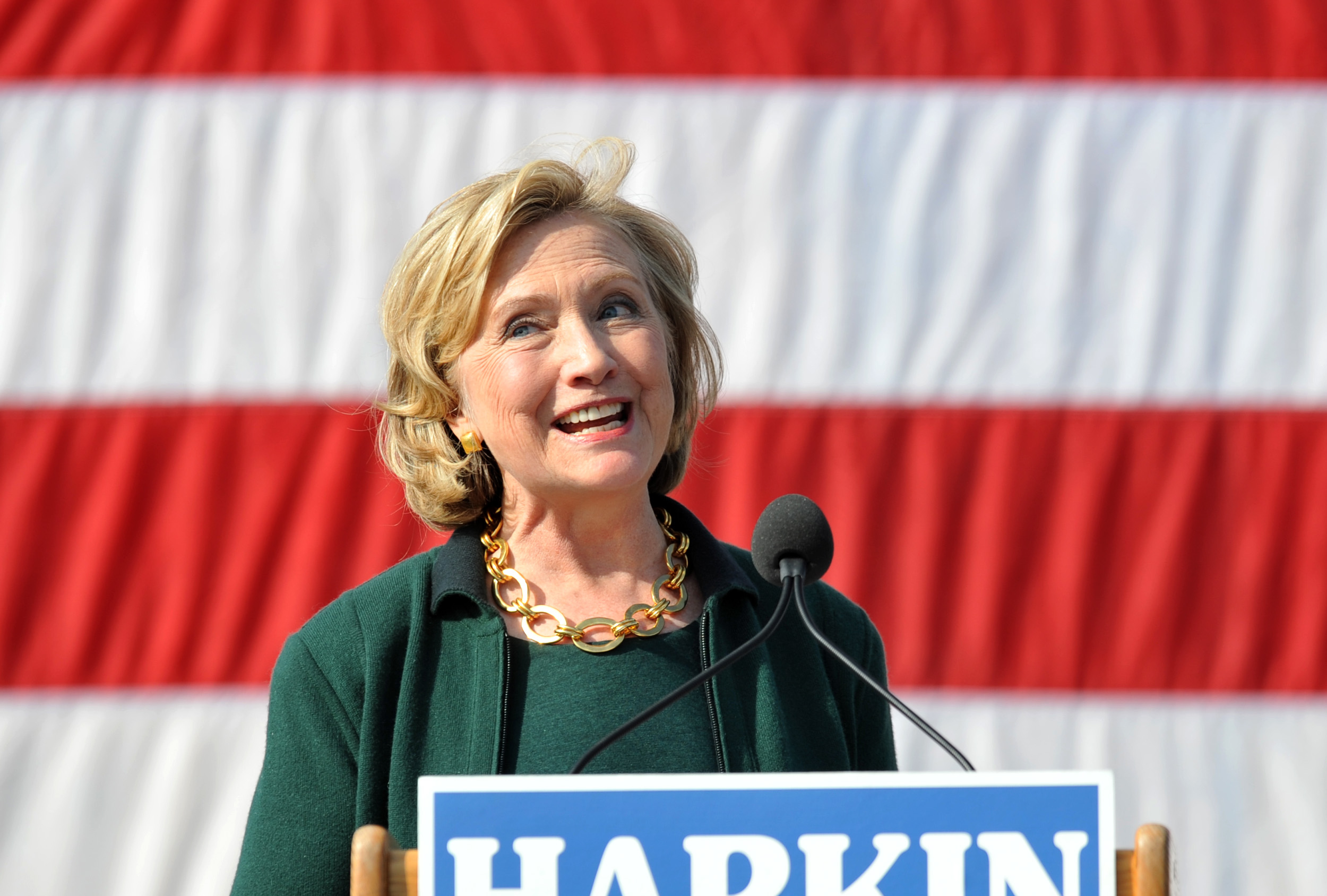
Hillary Clinton Attends Annual Tom Harkin Steak Fry In Iowa

Jay Newton-Small captures the atmosphere at Iowa Sen. Tom Harkin’s Steak Fry, “a Democratic fundraiser that has become known as a presidential launchpad.” Clinton still won’t admit that she wants the presidency:

“Are you running?” reporters repeatedly shout at Hillary. She demurs. She even pretends not to notice when, the event having finally started down the hill, a speaker starts asking the crowd: “Are you fired up? Are you ready to go? Are you ready for Hillary? ARE YOU READY FOR HILLARY?” he screams as the crowd roars.

“Are you ready, Hillary?” a reporter yells. She ignores all this and chats away with Harkin and his wife Ruth.

Ben Smith answers for Clinton – “she’s running”:

Today’s Clinton campaign, like the one back [in 2008], is a tractor trailer moving down the highway, one whose driver — Hillary — can exert some control over its direction and speed, but whose stopping distance is measured in miles, and who can barely control the thing at all once it’s rolling downhill. So the question isn’t what she’s done to run; it’s whether she’s made any effort to hit the brakes, or whether anything has fallen unexpectedly across her path.

Noam Scheiber spots a big chink in Clinton’s armor:

The problem is the general caution that defines her political style.

Of Bill Clinton it was often said that if you put him in a crowded room, he would gravitate toward his harshest critic, determined to win them over. Hillary strikes you as the oppositethe sort who huddles with friends and allies while eying the detractor warily from a distance. The Harkin steak fry speech, and the political strategy it foreshadowed, was basically the rhetorical equivalent of this tic. Hillary’s impulse was to hold close the ideas that have served her well, year in and year out, while steering clear of any possible dissent from establishment opinion. Sensibility-wise, it’s about as far as you can get from where Democrats are these days.

Lexington wonders how Hillary would “govern America at a time of alarming and seemingly insoluble gridlock”:

In his own speech, Bill Clinton tackled this directly. The country was “less racist, less sexist and less homophobic” than it had ever been. It was more diverse than ever before, and more interdependent with the rest of the world (he painted word-pictures of Iowa farmers digitally studying world commodity prices in real-time). Yet more than ever before, Americans did not want “to be around people that disagree with us.” For this reason, it was vital to elect more politicians who went to work without “ears plugged up” and “blinders on”.

Is Hillary Clinton this kind of politician? The question is a serious one, and it is one she will need to answer if and when she decides to run for president. She cannot expect voters to elect her simply because it is “her time”, or because she would be the first woman president (though such arguments were made by a worrying number of those at the steak fry). The idea of being president is not enough to make Mrs Clinton president, in short.

Ana Marie Cox was alarmed by rhetoric of Hillary supporters at the event:

“It’s interesting, but it’s not the main reason I support her,” one male “Students for Hillary” member told me about the idea of a first female president. His companion, a female freshman, was even more cautious: “It’d be nice to see more women in politics,” she said, “But if you push hard for it, it becomes an issue you didn’t ask for.”

Such dry reasoning was unsettlingly common with the student contingent at the steak fry. Unprompted, they offered analysis rather than real reasons for their support. “The Democrats can’t eat their own,” said one of them, serious. “We’ve got to coalesce around Hillary because there’s really no one else, and we can’t let the Republicans win.” It sends a shiver up your spine when a guy who probably isn’t even shaving regularly basically quotes Mark Penn.

(Photo: Former Secretary of State Hillary Rodham Clinton speaks to a large gathering at the 37th Harkin Steak Fry, September 14, 2014 in Indianola, Iowa. By Steve Pope/Getty Images)


The Soul Of John Updike

14852448109_9bf220b03a_k

In a review of Adam Begley’s Updike, William Deresiewicz finds that writer’s short story, “Pigeon Feathers,” offers telling insight into his religious beliefs. In the story, the character David is asked by his mother to kill the pigeons roosting in their barn, which gives him “the sensation of a creator.” How Deresiewicz describes what happens next:

It is when he’s burying these creatures that he has his epiphany. He has never seen a bird up close before. “Across the surface of the infinitely adjusted yet somehow effortless mechanics of the feathers played idle designs of color, no two alike, designs executed, it seemed, in a controlled rapture, with a joy that hung level in the air above and behind him.” Now he knows “that the God who had lavished such craft upon these worthless birds would not destroy His whole Creation by refusing to let 
David live forever.”

The story is a credo at once theological and artistic.

David finds God by emulating him. He creates. That he creates by killing
the story’s brazen moral scandalonly draws him nearer to his model, for He does the same, as Piet in Couples understands. The more important point lies in the way in which he kills: carefully, cleverly, with a patience both of seeing and of skill. It takes no wit to recognize a third, implied creator, intermediate between the other two. The boy creates the birds; the artist creates the boy; the deity creates them all. “Controlled rapture” is a precise description of the state in which the patterns of Updike’s own work, here and elsewhere, have been so evidently crafted. The joy hangs level 
everywhere around us.

This is the argument from design, and it is also an argument for design. Updike believed in art as imitation, a tracing of the wonders God has put in pigeons and in Davids. “Pigeon Feathers” tells us that people do not matter, not even to themselves, unless they have immortal souls. Elsewhere Updike makes a corollary statement about fiction. Without souls, he asks, “are mundane lives worth writing about?” Art becomes a form of affirmation. Updike didn’t want a better world, he only wanted this one, forever. He may not have thought that everything was holyhe wasn’t pious or sentimentalbut he thought that it was beautiful, to use the language of art, and he certainly thought, to use the language of Genesis, that it was good. And men and women (their sins 
included)they were very good.

Recent Dish on Updike’s faith here.

(Photo by Partha S. Sahana)

The Ideology Of ISIS

Kevin McDonald argues that its origins are not at all medieval, but rather modern, and indeed, even Western:

It needs to be said very clearly: contemporary jihadism is not a return to the past. It is a modern, anti-traditional ideology with a very significant debt to western political history and culture. When he made his speech in July at Mosul’s Great Mosque declaring the creation of an Islamic state with himself as its caliph, Abu Bakr al-Baghdadi quoted at length from the Indian/Pakistani thinker Abul A’la Maududi, the founder of the Jamaat-e-Islami party in 1941 and originator of the contemporary term Islamic state. Maududi’s Islamic state is profoundly shaped by western ideas and concepts. He takes a belief shared between Islam and other religious traditions, namely that God alone is the ultimate judge of a person, and transforms this – reframing God’s possession of judgment into possession of, and ultimately monopoly of, “sovereignty”. Maududi also draws upon understandings of the natural world governed by laws that are expressions of the power of God – ideas at the heart of the 17th-century scientific revolution.

Ella Lipin focuses on its allusions to Islamic eschatology and how ISIS uses the promise of an apocalyptic battle as a recruiting tool:

In July, ISIS released the first two issues of Dabiq, its digital magazine, revealingly named after a Syrian town believed to be the site of the future climactic battle, to be fought between Muslims and Romans, that will lead to Judgment Day.

The use of Dabiq draws from hadith, revered accounts of the Prophet Muhammad’s sayings or practices. The relevant passage states that the end of days won’t come until the battle at Dabiq. After the battle, the triumphant Muslims will go on to conquer the Western world (symbolized by Constantinople). ISIS reprinted this hadith in full in the first issue of its new publication. Herein lies ISIS’s propaganda strategy: employ Islamic apocalyptic tradition – with the West as the modern day Romans – to mobilize followers. Both the organization and its new recruits understand this script, made all the more relevant and compelling by the recent debate about U.S. airstrikes in Syria. …

This interpretation of events is not limited to Sunni extremists; a large number of Muslims believe these events may be imminent. A 2011-2012 Pew survey found that a high percentage of Muslims in the Middle East believe they would witness events leading to the Day of Judgment. In Iraq, where ISIS has recently expanded, 72 percent of respondents expect to experience the coming of the Mahdi, a messianic redeemer who will restore the political and religious purity of Islam. While the figures were lower in other Muslim countries—Tunisia (67 percent), Lebanon (56 percent), Morocco (51 percent), the Palestinian Territories (46 percent), Jordan (41 percent), and Egypt (40 percent)—the apocalyptic tradition clearly resonates deeply throughout the region.

Last week, Laurie A. Brand looked into how ISIS is trying to promote its ideology by rewriting the school curriculum in the areas it controls:

The term “Syrian Arab Republic” is to be removed completely and replaced with “the Islamic State,” and the Syrian national anthem is to be discarded or suppressed. There is to be no teaching of the concepts of national patriotism (wataniyyah) or Arab nationalism (qawmiyyah); rather, students are to be taught that they belong to Islam and its people, to strict monotheism and its adherents, and that the land of the Muslim is the land in which God’s path (shar’ Allah) governs. The words “homeland” (watan), “his homeland,” “my homeland,” or “Syria” are to be replaced wherever they are found with the phrases “the Islamic state,” “his Islamic state,” “land of the Muslims” or the “Sham (or other the Islamic State-governed) Province.” The teacher is instructed to replace any gaps in Arabic language and grammar instructional materials that may result from the suppression of these terms with examples that do not conflict with sharia or the Islamic State. In addition, all pictures that violate sharia are to be removed, as are any examples in mathematics that involve usury, interest, democracy or elections. Finally, in the science curriculum anything that is associated with Darwin’s theory or evolution is to be removed and all creation is to be attributed to God.

Meanwhile, Michael Koplow cautions against conflating the defeat of ISIS with the defeat of the ideas it espouses:

ISIS’s ideology is a revolutionary one seeking to overturn the status quo and to constantly expand, which makes it particularly susceptible to living on beyond the elimination of its primary advocate. Much like Voldemort’s life force after he attempts to kill Harry Potter as a baby, ISIS’s ideology will not die just because its host body is decimated. It will lurk around until another group seizes upon it and resurrects it, and much like ISIS seems to be even worse than al-Qaida, whatever replaces ISIS is likely to be more radical still. The problem with Obama’s speech yesterday was that it set an expectation that cannot be fulfilled. Yes, ISIS itself may be driven from the scene, but the overall problem is not one that is going to go away following airstrikes or even ground forces.

Andrew W.K. Teaches Us How To Pray

A reader of Andrew W.K.’s Village Voice advice column wrote in frustrated about being asked to pray for an older brother diagnosed with cancer, describing it as “kneeling on the ground and mumbling superstitious nonsense.” W.K. responds this way:

Prayer is a type of thought. It’s a lot like meditation — a type of very concentrated mental focus with passionate emotion directed towards a concept or situation, or the lack thereof. But there’s a special X-factor ingredient that makes “prayer” different than meditation or other types of thought. That X-factor is humility. This is the most seemingly contradictory aspect of prayer and what many people dislike about the feeling of praying. “Getting down on your knees” is not about lowering your power or being a weakling, it’s about showing respect for the size and grandeur of what we call existence — it’s about being humble in the presence of the vastness of life, space, and sensation, and acknowledging our extremely limited understanding of what it all really means.

Being humble is very hard for many people because it makes them feel unimportant and helpless. To embrace our own smallness is not to say we’re dumb or that we don’t matter, but to realize how amazing it is that we exist at all in the midst of so much more. To be fully alive, we must realize how much else there is besides ourselves. We must accept how much we don’t know — and how much we still have to learn — about ourselves and the whole world. Kneeling down and fully comprehending the incomprehensible is the physical act of displaying our respect for everything that isn’t “us.” …

The paradoxical nature of this concept is difficult, but it is the key to unlocking the door of spirituality in general, and it remains the single biggest reason many people don’t like the idea of prayer or of spiritual pursuits in general — they feel it’s taking away their own power and it requires a dismantling of the reliable day-to-day life of the material world. In fact, it’s only by taking away the illusion of our own power and replacing it with a greater power — the power that comes from realizing that we don’t have to know everything — that we truly realize our full potential. And this type of power doesn’t require constant and exhausting efforts to hold-up and maintain, nor does it require us to endlessly convince ourselves and everyone else that we’re powerful, that we know what we’re doing, and that we’re in control of everything.

Morgan Guyton, who works for a Christian campus ministry, asks himself hard questions after reading this agnostic approach to prayer:

There’s so much disdain among my fellow clergy folk for “spiritual but not religious” people. The stereotype we have in our heads is the clueless hippie who thinks that s/he can attain spiritual groundedness by shopping organic and doing yoga. Andrew W.K. makes it hard to write him off as a goofy hippie. I can’t speak for anybody else, but I know that in my own head, my rage against spiritual but not religious people is largely an expression of my deep anxiety about spending the rest of my ministry career on a ship that’s rapidly sinking. What if I’m actually obsolete because people can become a loving, humble, mature community without the grape-juice-soaked chunk of communion bread that I have to offer?

Now that I’m working in a secular university, I’m meeting so many students who seem more compassionate, humble, and disciplined than I am, but they don’t seem to have any inclination or need to be anything other than secular. A response that clergy like me often make to atheists is to say, “I don’t believe in the God you don’t believe in either.” And then we talk about how the silly god-caricatures of popular Christianity are not the same thing as the true God, who is the “source of being” and “a complete mystery.” But how is the mysterious God that sophisticated Christians believe in different than what Andrew W.K. calls “the size and grandeur of what we call existence.”

How much do I know that what I’m doing when I pray is more than what Andrew describes as “gaining strength by admitting weakness” or “turning [myself] over to [my] own bewilderment”?


Reductio Ad Nietzsche

Simon Smart lauds Nick Spencer’s Atheists: The Origins of the Species, remarking that “the most challenging aspect of this work is the way it illuminates the inherently naïve optimism contained in New Atheism’s rendition of the ‘God is dead’ trope”:

While there has been no shortage of non-believers who viewed the demise of the divine as ushering in an era of untrammelled human progress, no less a figure than Friedrich Nietzsche understood the great shadow that would be cast across Europe if, as he hoped, the rejection of Christianity came to fruition. Such a move would signal the ruin of a civilisation, and he wrote about “the long dense succession of demolition, destruction, downfall, upheaval that now stands ahead.”

Something of a dark prophet, Nietzsche envisioned troubled times ahead – a prediction that the 20th century’s atheist regimes fulfilled with alarming efficiency. Nietzsche’s importance, writes Spencer, lies in his understanding that metaphysics and morals are inseparable. Nietzsche was under no illusion that you could hold on to Christian ethics – which he saw as degenerate slave mentality – while jettisoning the Christian faith.

In reply, PZ Myers expresses his exasperation with all the Nietzsche-love from believers:

And then Spencer and Smart drag out one of my pet peeves: Nietzsche. Not Nietzsche the philosopher, of course, but Nietzsche the dolorous atheist. Nietzsche the regretful non-Christian. Nietzsche the sorrowful, reluctant thinker who praises Jesus while weeping sincerely, and simultaneously predicting cultural cataclysm because we’re losing our faith. It’s the only atheist message the devout want to hear — if you’re going to abandon religion, at least be sure to stroke the pastor’s ego on your way out the door.

These guys always make Nietzsche sound like a 19th century S.E. Cupp, which is an awfully nasty insult to deliver to a guy you’re praising. …

You know what? Fuck the Christian cartoon Nietzsche. He’s wrong, he’s annoying, and I feel no obligation to respect his views of a lovely essential Christian dogma. Also, as noted above, if atheism is a reaction to false authority…why the hell do you think citing a philosopher who has been dead for over a hundred years will make us roll over and surrender? Nietzsche ain’t the atheist pope, either. Christians can keep trying to shoehorn atheism into obligatory tropes that they’re subject to, but all it does is convince us that Christians don’t know what they’re talking about.

Previous Dish on Nietzsche and atheism here, here, here, and here.

Veiled Self-Acceptance

https://twitter.com/umamame/status/507385985076703232

Alice Robb flags some new research about the hijab and body image:

study published in the August edition of the British Journal of Psychology suggests that the hijab actually offers some protection against the body dissatisfaction that plagues many Western women.

A team of psychologists, led by Malaysian-born British psychologist Viren Swami at the UK’s University of Westminster, interviewed 587 Muslim women in London, 369 of whom regularly wore some sort of hijab. Their ages ranged from 18 to 70; the mean age was 27. The majority – about 79 percent – were unmarried, and they represented several ethnic groups – Bengali, Pakistani, Indian, and Arab. More than three-quarters held an undergraduate degree.

Swami and his team gave the women several tests to measure their attitudes toward their bodies – and the women who wore Western dress scored higher on every scale of body dissatisfaction. When subjects were asked to look at several sketches of women’s bodies and pick the one they would most like to have, the choices of the women who wore the hijab more closely resembled the bodies they actually possessed. On a measure of “drive for thinness” – determined by answers to questions about preoccupation with body weight, fear of becoming fat, and excessive concern with dieting – women who didn’t wear the hijab scored, on average, 3.58 out of 6 points, compared to 2.87 for women who cover up. Women who wore Western dress also registered a higher degree of “social physique anxiety,” or concern with how others perceived their physical appearance: 3.26, versus 2.92, on the 6-point scale.

Previous Dish on veiling and beauty standards here.

Going To War For God?

Nigel Biggar praises Karen Armstrong’s forthcoming book, Fields of Blood: Religion and the History of Violence, as “a magisterial debunking of the secularist tale” that claims “religion is essentially and uniquely generative of division and violence.” A run down of why she finds that tale too simple:

Armstrong’s corrective, complicating history includes a number of nicely water-muddying, stereotype-confounding details. For example, in the so-called Wars of Religion, Protestants and Catholics not infrequently fought on the same side against imperial forces: in its final phase, during the Thirty Years War, Catholic France came to the rescue of Protestant Sweden. Second, whereas that famous son of the Enlightenment, Thomas Jefferson, owned slaves, the inspiration for the abolitionist movement was originally and predominantly Christian. Third, the first genocide of the 20th century was committed by zealous secularists, the Young Turks, against (Christian) Armenians. Fourth, it was the Tamil Tigers, a non-religious, nationalist movement, which pioneered suicide bombing, and most suicide bombing in Lebanon during the 1980s was performed by secularists. Fifth, so deep-rooted were the habits of coexistence between Christians and Muslims in Bosnia that, during the 1990s, it took the Communist Slobodan Milošević three years of relentless nationalist propaganda to turn the former against the latter. Sixth, James Warren Jones, the instigator of the infamous Jonestown massacre in 1978, was not a religious zealot but a self-confessed atheist, who ridiculed conventional Christianity. Next, Ayatollah Khomeini’s critique of the regime of Shah Reza Pahlavi in the 1960s has much in common with Pope John XXIII’s contemporaneous critique of unfettered capitalism. And finally, what is striking about the 9/11 bombers is not how much they knew about Islam, but how little.

Ian Bell, however, points to questions that he believes Armstrong leaves unanswered:

What is it about humanity that allows it to receive and accept messages of love and compassion yet use faith in such precepts to justify mass murder? Freudian hokum invoking the trinity of id, ego and superego might once have been called upon. Armstrong prefers neuro-anatomy and a near-Marxist account of elites, class, oppression and exploitation.

“Each of us,” she writes, “has not one but three brains which co-exist uneasily.” We acquired this collection at various stages of evolution. The oldest is a reptilian remnant, utterly self-interested; the second, the limbic system, allows empathy; the youngest, acquired perhaps 20,000 years ago as the neocortex or “new brain”, grants us self-awareness. We can stand back, as Armstrong puts it, from our primitive instincts. We can also be imbued with faith and utterly murderous.

This is neat. It is also, for the sake of an argument, convenient. Armstrong understands religion in terms of the human search for – indeed, need for – meaning. Most of the major faiths make larger claims to do with a deity and absolute, eternal truth. If that is what is going on, surely the ugly, insistent claims of our buried “old brain” would be overwhelmed. It might be a mistake to claim, crudely, that religion causes war. But to put the question in the context of a fine and eloquent book: why has the impulse to faith failed to suppress our brutish taste for warfare?