Corporeal Appropriation

Cultural appropriation in fashion isn’t limited to the clothes themselves. Stacia L. Brown takes issue with a Vogue article on “the era of the big booty”:

The ways in which black women and their bodies are discussed in mainstream, predominantly white media matters. “Vogue” isn’t the only publication to frame conversation like this poorly. Just this month, The New York Times published a piece on “natural hair” titled, “Curls Get Their Groove Back.” It’s a multi-paragraph missive about the “new” trend of white women eschewing hair-straightening and “cultural bias” against white women with curly hair. One line is given to the discussion of black hair.

Back in April, Carimah Townes argued along similar lines:

In an article comically entitled “Rear Admirable,” Vanity Fair showcases social media sensation Jen Selter, who skyrocketed to fame after posting photos of her butt on Instagram. The pictures used in the spread include a backside shot of Selter in a black corset, and another of the model in 1940s-inspired, fishnet lingerie. The accompanying text describes Selter as a “member of a rapidly rising subset of Instagram stars: young women unfraid to share their deeply bronzed, sculpted figures.”

The takeaway message is that showing off curves in a public way is not only a new phenomenon, but looking darker, “or bronzed,” is the new way to be beautiful. It’s a breath of fresh air to see curves and darker skin tones applauded by a world-renowned publication, but disappointing that Vanity Fair used a white Jewish woman to convey a newly-accepted norm.

Give Millennials A Break

A new Pew study finds that the Internet hasn’t totally eroded the reading habits of Generation Y:

Millennials, like each generation that was young before them, tend to attract all kinds of ire from their elders for being superficial, self-obsessed, anti-intellectuals. But a study … from the Pew Research Center offers some vindication for the younger set. Millennials are reading more books than the over-30 crowd, Pew found in a survey of more than 6,000 Americans.

Some 88 percent of Americans younger than 30 said they read a book in the past year compared with 79 percent of those older than 30. At the same time, American readers’ relationship with public libraries is changing—with younger readers less likely to see public libraries as essential in their communities.

Meanwhile, Susan J. Matt, author of Homesickness: An American Historydefends the 22 percent of adults in their 20s and 30s who live with their parents. The idea that young adults should leave home, she argues, only took off in the 20th century:

By mid-century, experts were arguing that tightly bonded families were out of place in America. Sociologist W. Lloyd Warner explained that because the economy required individuals to move frequently, “families cannot be too closely attached to their kindred. . . or they will be held to one location, socially and economically maladapted.” Those who tried to maintain strong kin ties were criticized. In 1951, psychiatrist Edward Strecker, preoccupied with the Cold War and the need for a mobile fighting force, accused American mothers of keeping their “children enwombed psychologically,” failing to “untie the emotional apron string … which binds her children to her.” He dubbed these women the nation’s “gravest menace.”

Today, we continue to believe young adults should leave home. When they don’t, their living choices are chalked up to poor employment prospects. While economic realities surely play a part in their residential choices, the media give short shrift to other motives. The idea that families might be drawn together by feelings of affection is left out of the equation, as is the possibility that this generation wants to become something other than mobile individualists. Yet there’s considerable evidence that millennials hold values that center more on family and less on high powered careers. A recent poll found them far less concerned with financial success than the population at large. They also are closer to their parents, whom they fight with less, and talk with more than earlier generations.

Have We Outgrown Growing Up?

A.O. Scott sounds the death knell for adulthood in American culture, arguing that shows like Girls, Broad City, and “a flood of goofy, sweet, self-indulgent and obnoxious improv-based web videos” signal that “nobody knows how to be a grown-up anymore”:

It is now possible to conceive of adulthood as the state of being forever young. Childhood, once a condition of limited autonomy and deferred pleasure (“wait until you’re older”), is now a zone of perpetual freedom and delight. Grown people feel no compulsion to put away childish things: We can live with our parents, go to summer camp, play dodge ball, collect dolls and action figures and watch cartoons to our hearts’ content. These symptoms of arrested development will also be signs that we are freer, more honest and happier than the uptight fools who let go of such pastimes.

I do feel the loss of something here, but bemoaning the general immaturity of contemporary culture would be as obtuse as declaring it the coolest thing ever. A crisis of authority is not for the faint of heart. It can be scary and weird and ambiguous. But it can be a lot of fun, too. The best and most authentic cultural products of our time manage to be all of those things. They imagine a world where no one is in charge and no one necessarily knows what’s going on, where identities are in perpetual flux. Mothers and fathers act like teenagers; little children are wise beyond their years. Girls light out for the territory and boys cloister themselves in secret gardens. We have more stories, pictures and arguments than we know what to do with, and each one of them presses on our attention with a claim of uniqueness, a demand to be recognized as special. The world is our playground, without a dad or a mom in sight.

Adam Sternbergh appreciates the prompt to reconsider what maturity means today:

The best part of any essay about changing cultural notions of adulthood is that it encourages us, again, to revisit what adulthood means, exactly. To some, it’s men in suits and smoking and not being able to do what you want anymore, because propriety. For others, it’s a continuing suspicion of cultural pleasure that would make the Puritans proud. To my eye, watching Seth Rogen grapple with responsibility in Knocked Up is a much more honest engagement with the meaning of maturity than watching Woody Allen grapple with a 17 year-old Mariel Hemingway in Manhattan, a presumably more “grown-up” film.

Alissa Wilkinson also sees Scott’s point:

Growing into a full humanity requires cultivating virtues that temper one another. Some are associated with adulthood—courage, tenacity, autonomy. Others are more closely associated with childhood—curiosity, humility, generosity. So, yes: only engaging in “juvenile” culture could shape us in bad ways. … But only engaging in “grown up” culture can, too, as can reflexively defending sophisticated products and rejecting simpler ones.

As Scott points out, the kind of culture creative output that results from our cultural shift doesn’t merely mean we end up with “juvenile” culture and fart jokes and boy-men and girl-women. It also means we end up with a lot of “childish” culture. Or maybe “childlike” is a better term. We get things that test the edges of the accepted in playful ways. We have stories that find wonder everywhere. We experience pleasing blows to our self-importance. And sometimes, if we are paying attention, we are even returned to a time when things like faith, and hope, and love came easily.


Jack The Women-Killer

Katie Engelhart questions the lighthearted cultural obsession with Jack the Ripper:

In 1988, the centenary of the 1888 “Whitechapel Murders,” Rippermania was alive and kickingas evidenced by growing demand for Jack the Ripper walking tours. The most popular spot on the standard Ripper route was the Jack the Ripper pub (until 1976 it was called “The Ten Bells”) on Commercial Street, where one of Jack’s victims reportedly boozed up before her murder. The pub displayed Ripper memorabilia, hawked Ripper swag (like t-shirts depicting mutilated organs), and sold a blood red “Ripper Tipple” cocktail. “There’s nothing gory about it,” the pub’s landlady insisted. “It’s a great whodunit.”

But feminists had begun to rally against a thriving Ripper industry that, they argued, glamorized violence against women, fetishized the murder of prostitutes, and commercially exploited real-life murder victims. Some came together in Action Against the Ripper Centenary (AARC). “How can society call itself caring when it worships killers and forgets the women that were killed?” its founder charged. The group held demonstrations and staged a hundreds-strong march. Particular fury was directed at the Jack the Ripper pub. …

Twenty-five years later, interest in Jack endures. The Jack the Ripper pub is no longerit’s back to being “Ten Bells”but little else has changed. A London clothing shop, The New York Times reports, is channeling “the romance of Jack the Ripper.” Scotland Yard, London’s police headquarters, may publicly display evidence from the Ripper casereportedly, to help plug a £500 million budget shortfall.

Genes And IQ: An Update, Ctd

A reader quotes me:

“There’s not a huge debate about the heritability of IQ, but a huge amount of debate about how much intelligence can be tied to genes and how much to the environment.” You’ve been careful in the past not to let IQ stand as a proxy for intelligence, so I’m not sure why you absolutely conflate them here. Also, you have a false dichotomy here: genes and environment are not separate influences. Gene expression is mediated by the “environment”.

A well-known example of this is the desert locust, which has a solitary (grasshopper) and gregarious (locust) forms which were, at one time, thought to be different species. Which form develops depends on the social environment of the insect during its development (specifically, the gregarious form develops when its hind legs are often stimulated by other individuals due to crowding.) A particular pair of individuals, one solitary and one gregarious, may have exactly the same genome, but exhibit severe morphological differences upon full adulthood, and these differences are controlled entirely (or nearly entirely) by the genome.

And genomic expression is far more complicated than you make it sound.

There is rarely a straight gene-to-trait pathway of expression. A gene might regulate the expression of another gene, which turns off a separate gene and turns on two more, one of which slows down the expression of the first gene, another of which causes a side effect that … etc, etc. It’s a bewildering tangle of interactions that permeates the cell and well beyond. Do you think it’s possible to document the whole ecology of a rain forest: all of the interactions and feedback loops between plants, insects, animals, the air, the soil, bacteria, worms, sunlight, wind and weather, ocean currents, river sediment, etc, etc? Trying to find which genes affect intelligence is like trying to find particular Amazonian fish species that are responsible for global warming.

Another quotes the article I cited:

“A copy of each variant accounts for only 0.3 points on a standard IQ test (with a mean of 100 and standard deviation of 15).” With 126K points, the margin of error for something with a standard deviation of 15 and a 95% confidence interval (meaning that we’re 95% sure that this isn’t just chance) is about 2*15/355 = 0.085 IQ points, so at least the 0.3% looks to be statistically significant, although just barely, since the margin of error is more than 1/4 of the entire effect.  And the connection to IQ (as opposed to years of schooling) was based on a sample of 24,000, where the margin of error would be 2*15/155 = 0.2 IQ points, or nearly the entire effect.  So, I’m not sure whether these results are statistically significant – the algorithm for mapping the 126K data points of years of schooling through the 24K data points of IQ isn’t specified.

Worse, however, what they did is identify 6 variants that were associated with additional years of schooling.  If I told you that several of those variants were associated with Ashkenazy Jews, for example, I would have just found an expensive way of saying that Jews as a group spend more time in school than average.  Correlation really doesn’t equal causation.  My guess is that they found some genetic markers that are associated with some ethnic groups, and then “discovered” that those ethnic groups spend a little more time in school on average.

The author in the end says “We haven’t found nothing.”  But that’s most likely exactly what they found.

Another also scrutinizes the statistics:

I was rather surprised that you went there again:

What to make of this with respect to our cultural and political debate about genes and intelligence? For me, some relief that the area is so complex, and varied, and hard to decipher that we may have more time ahead before these things become more knowable, and thereby may avoid any of the worst social implications for longer than some of us feared.

As a scientist (albeit one completely unfamiliar with the field in question), a result that shows such a minuscule effect, well within the variance in the response of the system is equivalent to there being no effect at all. You should probably become more familiar with statistics but such a result essentially means that there is absolutely no correlation whatsoever between specific genetic markers and cognitive abilities. Such a small effect (an order of magnitude smaller than normal variance in IQ) is very likely the product of the random nature of the sample. Your statement seems to suggest that things are really complicated. They are not, at least when it comes to the conclusions of this study; there are no meaningful correlation between genetic variants and IQ.

Without knowing the literature at all, I am willing to bet that there are studies that find much larger correlations between socio-economic factors and IQ scores. Based on IQ scores of whites vs other groups, I am willing to say that such effects are perhaps an order of magnitude larger than the effects in this study.

Let it go (to quote from Frozen) ...
Everybody’s Working On The Weekend

8eff39f04

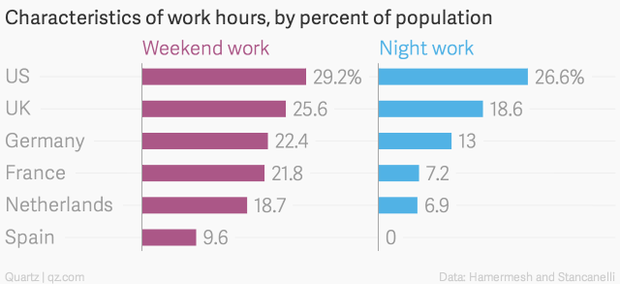
Looking at a new NBER study, Christopher Ingraham counts the ways Americans are overworked compared to our European peers. For one thing, we’re more likely to take that business call on a Saturday:

The U.S. has the highest incidence of people reporting any paid weekend work. 29 percent of Americans reported performing such work in the American Time Use Survey, more than three times the rate among Spanish workers. It’s important to note that this doesn’t necessarily mean that these workers are working 9 to 5 every weekend, only that they reported performing paid weekend work in a time use survey. This would include things like going into the office for a few hours to finish up a project.

The study showed that Americans are also more likely to work nights. Max Nisen notes the obvious origins of our weird work hours:

These strange work hours probably happen because Americans work so much and lack the enforced vacations and limitations on overtime that exist in some European countries. Nearly twice as many U.S. workers work 45+ hour weeks than in Germany, and more than twice as many do so than workers in France, the Netherlands, and Spain. As the work week grows longer, weekend and “strange” work becomes much more likely.This stands to reason: Someone moving from a comparatively standard week of 35 to 44 hours to a 55- to 64-hour week is almost twice as likely to let that work bleed into weekends and nights, according to the study. …

So what would happen to the U.S. if it adopted similar controls? According to the study, if the country adopted the French distribution of work hours, night and weekend work would drop substantially, but would still remain well above that of continental Europe.

Jordan Weissmann considers other explanations:

[T]he sheer time we spend working doesn’t explain why so many of us find ourselves staring into a glowing Outlook screen at 12:43 a.m. on a Wednesday. Even if Americans worked the same amount of time as the French, Dutch, or British, Hamermesh and Stancanelli find that we’d still be more likely to stay up late tooling around with Excel, reading memos, or doing whatever else it is that keeps us up at ungodly hours. It might be a cultural issue. It might be because we have fewer laws governing when people can and can’t be on the clock. Though it feels unlikely, there might even be a happy story here about enlightened American companies allowing their employees to use flexible schedules to accommodate their personal needs. Whatever the reasons, Americans  structure their workweeks differently than Europeans. We’re night owls and weekend MS Office warriors—which, in the eyes of the rest of the world, probably looks pretty nuts.

How Do You Solve A Problem Like ISIS?

A military approach alone won’t do the trick, Zack Beauchamp argues, emphasizing the extent to which Obama’s strategy depends on political factors largely outside his control:

Even assuming the Iraqi and Syrian rebel forces can be made strong enough to take on ISIS in purely military terms, there’s a list of everything that needs go right — politically — for Obama’s strategy to work out:

  1. The Iraqi government needs to stop repressing and systematically disenfranchising Sunnis. It also needs to accommodate their demands for positions of power in government in perpetuity, so ISIS doesn’t just pop back up after the US leaves.
  2. The US must avoid sending the signal that it’s coordinating with Iran, which would put it on the Shia side of a sectarian war.
  3. Syrian rebels armed and trained by the US don’t simply take their new weapons and defect to ISIS or Jabhat al-Nusra, the local al-Qaeda affiliate.
  4. US airstrikes and US allied military campaigns need to avoid killing large numbers of civilians, which could cause a pro-ISIS popular backlash.
  5. If the US actually does manage to demolish ISIS’s control on territory, it needs to ensure that neither Syrian President Bashar al-Assad nor al-Qaeda simply take over the land that ISIS has vacated.
  6. The United States has to do all of this without deploying ground troops or otherwise getting caught in a bloody, brutal quagmire.

For the outcome to end well, every single one of these events must go the right way. There’s a reason that one US General told the Washington Post that the new campaign in Syria is “harder than anything we’ve tried to do thus far in Iraq or Afghanistan.” Given how those wars ended up, that’s a pretty ominous comparison.

Deborah Avant also considers ISIS a fundamentally political challenge:

The US has done better at managing crises to roll back attacks in the Middle East. It has not been as successful translating these short-run gains into positive steps toward inclusive governance. Furthermore, US anointment in Iraq and Afghanistan has led to leaders with little legitimacy and little attention to US concerns. The last thing the US wants to do is to intervene in a way that pushes the various anti-government rebels in Iraq (and/or Syria) together with ISIS against perceived US puppets. Though less may not be enough, I agree with Joshua Rovner that less is more when it comes to US presence in the Middle East. A broad strategy involving many others is a good idea. Doing that under the mantle of an American coalition is not. A plan with the US in a supporting, background role has best chance for long run success.

Beyond that, however, what will the US and its allies do about the malaise upon which al-Baghdadi and others have been able to capitalize? … Messages about global citizenship, human security, and an inclusive global politics seemed to evince more hope in the 1990s – perhaps for good reason. The shreds of a hopeful message visible in parts of the Arab Spring have blown into hiding. The US talks more about how to combat extremism than about what might replace it.  Though some audiences in the US believe that America holds the keys to the future, many across the world do not.

#WhyIStayed, Ctd

The reactions to the Ray Rice story continue to roll in. CBS Sportscaster James Brown speaks out:

Amanda Marcotte rejects lines of commentary that suggest Ray Rice is a victim:

Because of this vast gulf in male and female experiences of domestic violence, unsurprisingly the impact also varies dramatically. On Tuesday, Catherine Cloutier of the Boston Globe published an examination of how much more seriously women’s lives are impacted by intimate partner violence. The CDC surveyed around 14,000 people to determine the impact of domestic violence on their lives. Men and women were somewhat similar in rates of having endured some kind of assault, at 27.5 percent for men and 29.7 percent for women.

But looking beyond counting individual touches, a different picture emerges. Twenty-four percent of female victims report feeling fearful, compared to 7 percent of men. One in five female victims suffer from PTSD symptoms, whereas only 1 in 20 male victims do. Only 3 percent of male victims suffer physical injury, but over 13 percent of female victims do. Twice as many female victims as male victims missed work because of domestic violence.

The disparity is likely the result of male abuse simply being way more violent and chronic than female abuse. Asking people if they’ve been hit once is relevant, of course, but in measuring the realities of domestic violence, the more important question is if you’re being hit frequently, being terrorized by violence on a regular basis, being stalked and controlled, or being threatened with your life if you try to leave.

Yes, no one should hit anyone else. But that statement is the beginning of the conversation about the problem of domestic violence, not the end of it.

And the Dish is channeling that conversation here. Josh Levin wants the NFL’s other abusers to held accountable:

The best analogy here is to the awful scourge of sexual assault on college campuses. In addition to going to local police, a student can have her complaint heard through a campus adjudication procedure, one that uses “the preponderance of evidence” as a standard of proof rather than a “beyond a reasonable doubt” standard. (As Emily Bazelon has explained, preponderance of the evidence means “reviewers must find only that it’s more likely than not that the sexual assault or harassment occurred.”) There are problems with these campus systems—the New York Times story on Hobart and William Smith Colleges offers a harrowing account of all that can go wrong—but at least they acknowledge the existence of something akin to institutional responsibility.

At least before TMZ released the Rice video, such a concept did not exist in the NFL. Teams have long operated on the assumption that they could say they’re “aware of the situation,” and then just pretend like nothing happened as soon as the news blew over. At some point, individual teams may decide that it makes sense for them to move to a preponderance-of-evidence standard—to decide that it’s in their best interest to cut a player if it’s more likely than not that he’s a domestic abuser. I don’t know if we’ve reached that point yet, but the Rice video has gotten us closer to that day. Seeing a sports star clock his fiancée in the face has changed something—for fans, for the media, and ultimately, I think, for the teams. If it doesn’t, then the NFL’s problem with domestic violence runs even deeper than we thought.

Alyssa Rosenberg finds wanting NFL Commissioner Goodell’s standard operating procedure:

When it becomes impossible to deny that bad news utterly, his task then becomes to respond in a way that has minimal impact on the NFL’s finances and on the week-by-week play on the field. As long as Goodell is willing to accept the public perception that he is dishonest or in denial, absorbing the damage on behalf of the league, I suppose it is a viable approach to protecting “the integrity of the NFL.” But no matter how much pain Goodell is willing to accept, this is a way of operating that leaves his league a little more battered with every incident. In life, unlike on the gridiron, sometimes it is better to take the hit and move expeditiously to heal from the damage.

Robert Silverman thinks the NFL needs more women:

If the league actually wants to solve the problem, instead of treating it as a particularly thorny public relations issue; if the league had a vested interest in trying to win back a semblance of trust from the 46 percent of their fan base that happens to be female and the unknown percentage of men who are equally repulsed? Here’s one solution: Hire more women and place them in positions of real power.

New Russia Sanctions: A Salvo In The Energy War?

The US imposed additional sanctions on Russia’s finance, energy, and defense sectors today over its involvement in the Ukraine crisis, on the heels of another round of sanctions from the EU:

The U.S. Treasury Department tightened on September 12 debt-financing restrictions for sanctioned banks from 90 days to 30 days. And it added Sberbank, Russia’s largest financial institution, to the list of state banks subject to the restriction.  It also prohibited the exporting of goods, services, and technology for Russian deepwater or offshore projects for five Russian firms: natural gas monopoly Gazprom Gazprom, its oil unit Gazprom Neft, Lukoil, Surgutneftgas, and Russia’s largest oil producer, Rosneft. Gazprom Neft and pipeline operator Transneft also have new debt restrictions of over 90 days’ maturity. … The European Union’s new sanctions include asset freezes on 24 senior officials and lawmakers, including nationalist firebrand Vladimir Zhirinosvky, bringing to 119 the number of people sanctioned by the bloc over the Ukraine conflict. The measures also include restrictions on financing for some state-controlled Russian companies such as Rosneft, Transneft, and Gazprom Neft.

Noting that the sanctions on Rosneft might freeze a $500 billion joint project with ExxonMobil to drill for oil in the arctic, Matthew Philips comments that “these latest energy sanctions could sever what are arguably the closest ties remaining between Russia and the West”:

In the two decades since the Cold War ended, Russian and American astronauts have worked together on the International Space Station, and the Russian military has helped the U.S. get equipment in and out of Afghanistan. But the strongest area of cooperation has come in the energy industry, where U.S. oil majors such as Exxon and Chevron(CVX) have entered into a number of joint ventures with Russia’s state-controlled energy giants Rosneft and Gazprom (GAZP:RM).

The Bloomberg View editors also tie the EU sanctions to the energy war:

Putin may have himself to blame for tipping the EU’s internal debate against him. By reducing natural gas deliveries to Poland and Slovakia this week, Russia made it clear that it still plans to escalate its effort to turn Ukraine into a failed state. Russia’s state gas company OAO Gazprom has cited maintenance work as the cause of the stoppages. That’s hard to believe. Poland and Slovakia happen to be the two countries that are reversing pipeline flows to pump natural gas from the EU into Ukraine, which Russia cut off from supply in June. The goal was to ensure that Poland doesn’t have enough gas to sell to Ukraine — which is exactly what happened. Slovakia has been warned.

Keith Johnson sees the Kremlin’s latest moves as an escalation in the gas war:

It’s not entirely clear whether the sudden drop in Russian gas exports to those countries is politically motivated or if there is a technical reason, such as maintenance on the Russian gas system or the pipelines themselves. Gazprom said that shipments to both countries remain unchanged. In any event, Polish officials said they have been assured by Russia that gas volumes will return to normal on Friday.

But Russian President Vladimir Putin made clear earlier this year that Moscow would aggressively go after countries that buy Russian gas and then turn around and ship it to Ukraine. That kind of energy trade, known as “reverse flow” because most of the gas pipelines pump fuel from east to west, has long incensed Gazprom and the Kremlin, which charge different countries different prices for gas and which rely on energy exports to maintain leverage over former client states in Central and Eastern Europe.

But Bershidsky calls sanctions on Russia a lose-lose proposition, particularly for Europe:

In this race to the bottom, Russia may prove the more resilient, if only because Putin’s authoritarian regime has a mandate from a majority of Russians to wage a new cold war. The food embargo and the price increases it caused in Russia did not drive down Putin’s approval ratings, and Russians have stoically accepted the ruble’s recent losses against the dollar. The currency depreciation can also help the government weather low raw materials prices by boosting the value of foreign-currency exports in ruble terms.

Europe, on the other hand, cannot take much more economic pain. A new slump could send some governments tumbling. In France, 62 percent of the population already wants President Francois Hollande to resign. The world is too interconnected economically, and the European recovery too fragile, to keep using trade disruptions as weapons. Even Ukraine is taking a hit from slumping metals prices: Steel and iron ore account for about a third of its exports.

This Is How Homophobia Ends

The relatively quiet, undemonstrative and yet decisive moment to allow self-identified gays to march in New York’s Saint Patrick’s Day parade is an almost text-book case of how homophobia can be undermined. There was mercifully no coercion – freedom of association is a critical principle for a free society. There was growing social pressure – from ordinary folk, organized gays, and, more critically, boycotts by New York politicians. No one is jumping up and down rubbing this quiet victory in. Yes, it took years of protest and anguish and anger to get here – and all the while, homophobia ran rampant. Cardinal Dolan has decided to remain the Grand Marshall of the parade, even with an explicitly gay group in its ranks – a remarkable turn-around from the past. The decision was a pragmatic one:

Dolan said Wednesday that the parade committee that operates the annual event “continues to have my confidence and support.” “Neither my predecessors as archbishop of New York nor I have ever determined who would or would not march in this parade … but have always appreciated the cooperation of parade organizers in keeping the parade close to its Catholic heritage,” he continued. Dolan concluded by praying “that the parade would continue to be a source of unity for all of us.”

Is that a sign that the Francis effect – downplaying the divisiveness of the issue in the Church – or just a sign that the society has evolved to a point where exclusion of gays seemed to counter “unity”?

My bet is that the threat of Guinness boycotting the parade was the final straw. The decision by the march’s organizers to include one gay group was unanimous. Bill Donohue is livid, of course. But even Donohue was reduced to merely arguing that a pro-life group be explicitly included in the parade alongside the gays – and when that didn’t transpire, he threw a tantrum and his organization – presumably him and his fax machine – will not be gracing the parade with its presence.

Too bad. He’s part of the New York Irish community and he belongs there as well. And what you see here, I suspect, is simply another reflection of greater informality in many religious groups and congregations, in favoring more inclusion without explicit rejections of orthodoxy. Michael Paulson has an interesting take on that development in American religion, especially with respect to gays and lesbians:

In the new results, 48 percent of congregations allow openly gay people in committed relationships to be members, up from 37 percent since the second study in 2006, and 27 percent of congregations allow them to serve as volunteer leaders, up from 18 percent.

Alas, Catholics are going backward – because inclusion was easier when gay couples couldn’t get married in a civil ceremony (creating a bizarre discrimination against those gays who have committed to one another for life). But the society moves on – as do congregations, as do public events.

Know change. And it may well come not with a bang, but a whimper.